


The handover deck ran to 60 slides and none of them explained why the session-trait logic in Sitecore Personalize only fires for logged-in visitors. Marketing has three brand launches queued this year, IT is still patching an older XP instance, and procurement has been asked to compare three vendors on rate card alone.
That's usually the moment a dedicated development team gets discussed, and usually for the wrong reason. Price per engineer is the least interesting part of the decision. What decides whether the arrangement works is who holds context when someone resigns, who approves AI-assisted code before it reaches production, and whether the platform is easier or harder to hand over after twelve months.
The pattern holds in both directions. Teams that compound capability share three traits: written governance, deliberate knowledge transfer, and metrics that measure delivery outcomes rather than attendance.
Table of Contents
- What a Dedicated Development Team Is
- Dedicated Team vs Staff Augmentation and Project Outsourcing
- Benefits and Tradeoffs for Enterprise DXP Programs
- Sitecore AI Portfolio Your Team Must Operate
- Building the Team Around Sitecore, AEM and SharePoint
- Contracting and Onboarding a Dedicated Team in Five Steps
- Governance, AI Guardrails and Knowledge Transfer
- Measuring Whether the Team Creates Lasting Value
- Confirm the Model Fits Before You Sign
What a Dedicated Development Team Is
Think about the difference between hiring a courier for one delivery and commissioning a studio for a returning series. A dedicated development team is the studio contract: a cross-functional unit (technical lead, engineers, QA, delivery manager) owned by an external provider, directed by your roadmap, and kept together on one product stream for months or years.
That continuity is the product. Context from the last release carries into the next one, priorities can shift at sprint boundaries without rebuilding the roster, and the people who know why a component was built a certain way are still there when it needs changing.
The model sits inside a large, maturing market. One estimate places global software-development outsourcing at $564.22 billion in 2025 and $618.38 billion in 2026, growing roughly 9.6% a year, and projects it to reach $977.04 billion by 2031 (YUSMP Group's outsourcing market estimate). That figure covers outsourcing broadly rather than dedicated teams specifically, but it shows external engineering capacity is a mainstream delivery channel, not an experiment.
Three questions decide fit. Does the work run longer than a quarter? Does it need several disciplines at once? Do you want the same people in every sprint? Three yeses point to a dedicated team. Anything less points to a different model.
Dedicated Team vs Staff Augmentation and Project Outsourcing
A manufacturer maintaining three Sitecore sites and a SharePoint intranet needs a release every sprint, seasonal campaign changes, and a steady stream of personalization work. Stitching that into fixed-scope projects means paying for rediscovery four times a year while each new project team learns the component library from scratch. A dedicated team is ahead by the second release and stays ahead.
Reverse the brief. A retailer needs one Azure integration specialist for six weeks to connect a payment provider before peak trading. A full pod is waste. Staff augmentation puts one engineer inside the existing team, under existing review, and ends when the contract ends.
| Model | Who Directs the Work | Best Fit | Typical Commitment | Knowledge Stays With |
|---|---|---|---|---|
| Dedicated development team | Provider runs the team to your priorities | Continuous roadmap on one product stream | Long-term, monthly or quarterly review | The team and its documentation |
| Staff augmentation | Your managers direct each engineer | Filling one specific skill gap | Flexible, per engineer | Your own staff, who lose it when the engineer leaves |
| Project outsourcing | Provider owns delivery to a fixed scope | Defined project with a clear end | Fixed scope or milestones | The provider, often handed back at project close |
The distinction is who keeps the decisions after the invoice: component choices, content-model rules, personalization logic, and the notes that say why an AI prompt or workflow was built that way. A dedicated team holds that context in the same people and their documentation. That cuts rediscovery, and it also concentrates dependency on one vendor unless handover is part of the engagement. Staff augmentation leaves the knowledge with your managers, then it leaves with the engineer. Project outsourcing often returns a pack at close, after the people who made the calls are gone.
Kogifi's dedicated teams also cover short-term projects and resource gaps through consultancy and staff augmentation. Compare both options for the same piece of work before you choose. The staff augmentation services overview sets out how individual engineers are scoped and managed.
Decision rule: choose by the length of the work, the number of disciplines it needs, and whether you have an internal leader who can direct a team day to day. No such leader, and a managed team or a fixed-scope project will usually beat a dedicated team, whatever the rate card says.
Benefits and Tradeoffs for Enterprise DXP Programs
A dedicated team can carry platform knowledge from one release to the next, but that continuity has value only when the team can coordinate and the client retains enough knowledge to govern the work.
On an enterprise DXP program, continuity can reduce repeated discovery around the component library, content model and integrations. A standing team can also bring architecture, front-end development, QA automation, DevOps and personalization skills under one arrangement. Its composition can change as priorities shift, while internal architects spend less time recruiting and more time reviewing technical decisions.
The tradeoffs are practical: coordination takes time, knowledge can concentrate with the provider, and reliance on a single vendor can grow unless the work is structured to limit it.
The coordination penalty is measurable
An IEEE Transactions on Software Engineering study of globally distributed software development found that distributed work items took approximately 2.5 times as long to complete as comparable colocated items. That finding makes coordination a delivery concern, not a minor inconvenience.
Use a stable, product-aligned pod for each platform stream. Keep repositories shared, document interface contracts, automate builds and deployments, and set a daily overlap window for design reviews, refinement and incident response. Reserve that shared time for decisions and handoffs; protect uninterrupted time for implementation.
Kogifi's engineering team is based in Poland, and its regionally aware teams work across Europe, North America and the Middle East, with language localization and compliance. For a distributed engagement, set working-hour overlap and handoff expectations in the contract so reviews and incident response do not wait unnecessarily.
Where the tradeoffs outweigh the benefits
The model becomes harder to justify when component ownership is unclear, no internal product owner can set priorities, or every change depends on one specialist. Each condition makes it harder to plan releases and increases the impact of a team change.
Agree on module ownership, decision rights and documentation expectations before delivery begins. A dedicated team does not remove dependency risk. The contract and operating model determine whether that risk is visible and manageable.
Sitecore AI Portfolio Your Team Must Operate
A campaign team can use AI to draft content, shape customer experiences and automate decisions. Each capability adds operational work: someone must set its rules, review its output and keep changes under control.
Sitecore Stream brings AI capabilities across Content Hub, Experience Platform, CDP, Personalize and Search. Sitecore describes these as brand-aware AI, copilots and agents, and agentic workflows (Sitecore documentation for Sitecore Stream). That breadth makes ownership a team responsibility, not a task to assign to one generalist.
In XM Cloud, AI assistance can help with copy tone, content length, SEO, AEO/GEO and translation. Personalize supports real-time personalization and A/B testing (Sitecore documentation on AI and personalization). For the team, the practical shift is from building targeting tools to setting review rules for what gets targeted and published.
Personalize's Code Assistant generates JavaScript from natural-language requirements for Conditions, Programmables and Session traits (Sitecore Personalize). Conditions filter audiences for experiences and experiments. Programmables support decision-model logic for offer selection. Session traits aggregate web-session events, calculate results at session end and store them in a guest profile.
Consider a request for a returning-visitor trait that counts three sessions in seven days. The personalization engineer should check the generated logic against known guest profiles in staging before attaching it to an experiment. Assign an owner, a pre-publication review and a test plan to each AI capability. Otherwise, generated logic can reach production without adequate review.
Building the Team Around Sitecore, AEM and SharePoint
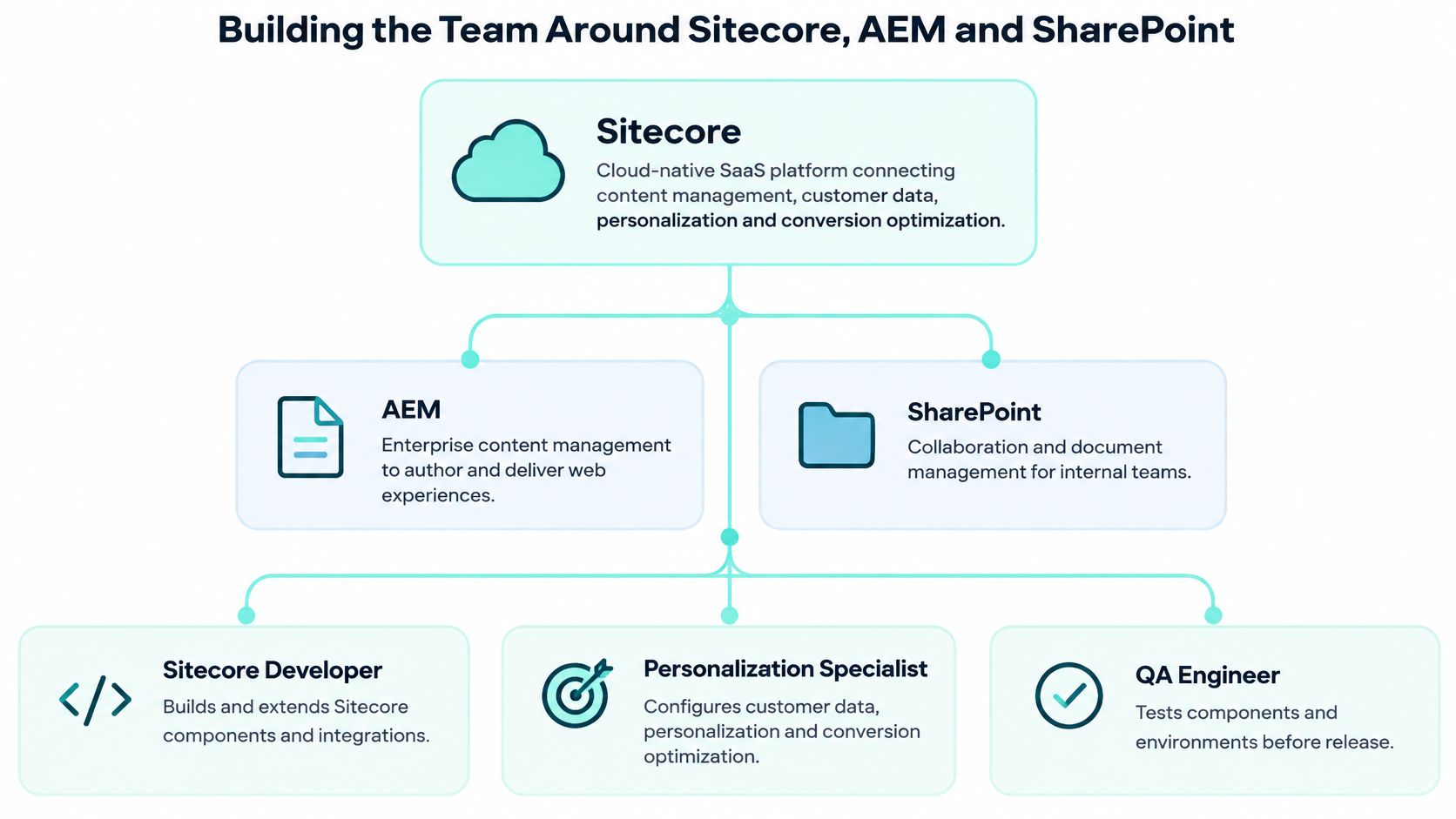
SitecoreAI is a cloud-native SaaS platform connecting content management, customer data, personalization and conversion optimization, and it ships with more than 20 pre-built AI-powered agents for creating, tagging, translating, personalizing and activating content (Sitecore platform tiers). Twenty agents without owners is a liability rather than a capability.
What a Sitecore team actually needs
A platform architect with Helix component library experience anchors the team. Around them sit a headless front-end developer working in Next.js on XM Cloud, a content modeler who owns taxonomy and multilingual structures, a personalization engineer for the trait and decision-model work, and a DevOps engineer for environment promotion across local, staging and production.
Serialization is the quiet dependency. Our engineers handle Sitecore content serialization as part of the implementation, so promoting items between environments doesn't default back to your team as an undocumented manual step. Ask any provider who owns that YAML and how merge conflicts on templates get resolved.
AEM and SharePoint are different staffing problems
AEM rewards integration depth over front-end volume. Cloud Service experience, dispatcher configuration and third-party integration work matter more than pixel output, so the team needs specialists who have migrated or run Managed Services estates rather than generalists. The Adobe Experience Manager implementation guide covers the phases that shape those roles.
SharePoint Online intranets pull in a different mix: SPFx developers, Power Platform makers, Microsoft 365 administrators and a content governance lead who owns bilingual publishing rules. On the E.ON Polska Sitecore programme, our delivery ran more than nine months and introduced a Helix-based architecture while upgrading the "my E-ON" portal, which is a fair marker of how many quarters a serious platform programme consumes before a new team is fully productive.
Three questions separate providers who know these platforms from those who list them. Which Sitecore products do they run in production today? How do they enforce component reuse across brands? How do they test personalization before it goes live?
Contracting and Onboarding a Dedicated Team in Five Steps
The sequence below is the one that survives contact with enterprise procurement. Skipping a step shifts cost into a dispute later.
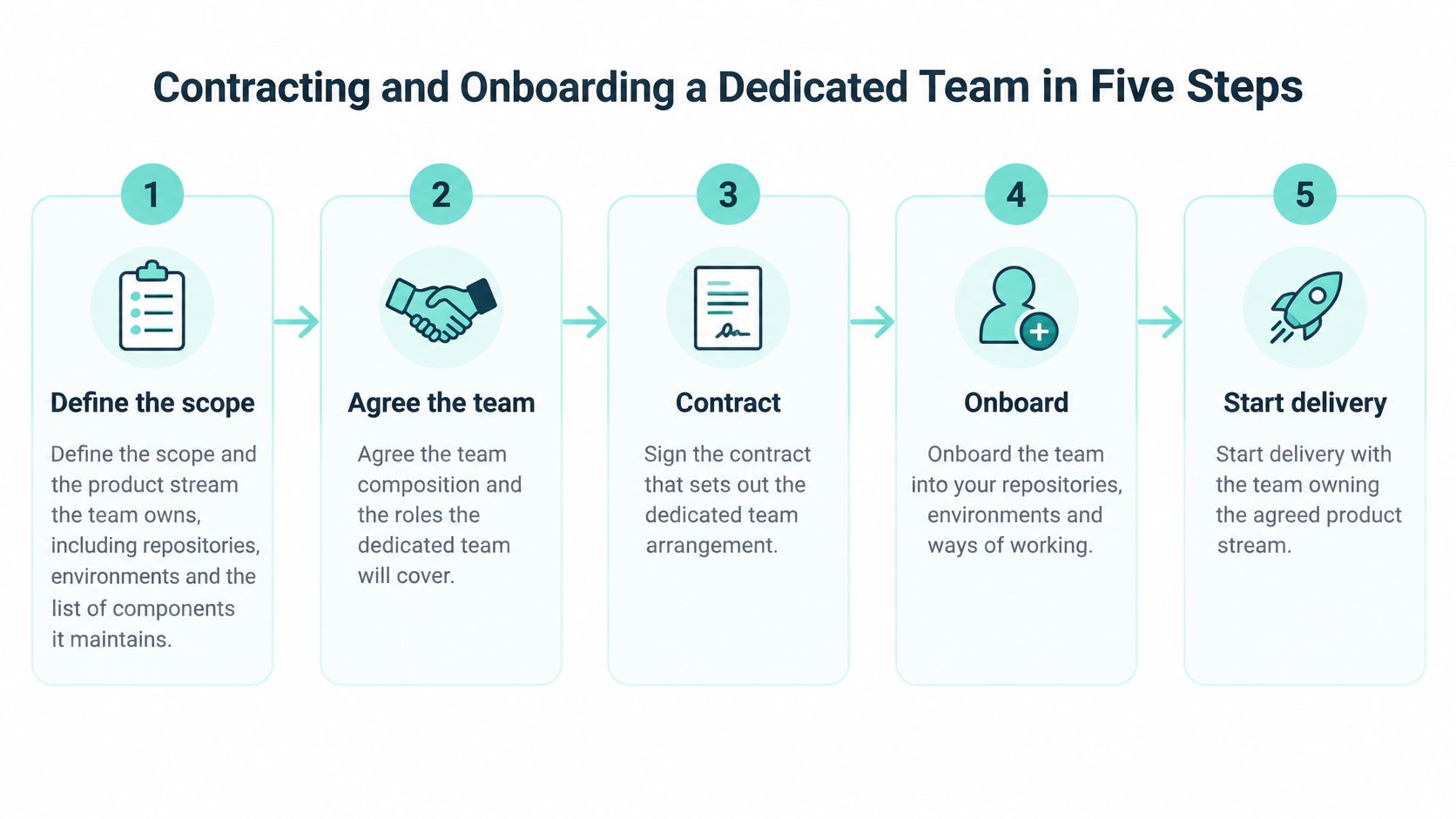
- Define the scope and the product stream. Name the repositories, environments and the list of components the team maintains. The reason is ownership, and the common slip is a scope that describes work types rather than assets, which leaves the repository question open until an audit or a migration forces it.
- Agree composition and rate model. Map every role to a named person, a seniority level and a replacement rule. Buyers slip here by signing headcount instead of names, then discovering mid-quarter that the architect was never guaranteed. If you're still shaping roles and salary benchmarks on your own side, LatoJobs' employer resource hub is a useful reference before you brief providers.
- Write the SLA properly. Response and resolution times by severity, uptime targets, monitoring duties and out-of-hours cover. Our certified DXP specialists are on standby 24/7 for proactive maintenance, security audits and troubleshooting, and the contract should set out exactly how that escalation path works. Undefined severity levels are the most common reason an SLA turns out to be unenforceable.
- Onboard in phases. Access and security review in week one, environment walkthrough and serialization workflow in weeks two and three, first supervised release in week four. Providers who wait for sprint one to start onboarding lose the most valuable month of the engagement.
- Set the review cadence. Weekly delivery review, monthly metrics review, quarterly capability review. The slip is treating onboarding as finished once velocity appears, which is precisely when documentation and handover habits stop being maintained.
For reference, Kogifi's own delivery runs in five stages: analytics, audit and optimization, workshops, web design and development, then hosting and 24/7 support with dedicated teams. It's a sequence worth mapping against your own programme before you sign anything.
Governance, AI Guardrails and Knowledge Transfer
AI adoption is now the norm and the confidence hasn't caught up. 84% of developers use or plan to use AI tools, up from 76% the previous year, yet only 17% of AI-agent users say the tools improved team collaboration, while 45% find debugging AI-generated code time-consuming and 61.7% cite ethical or security concerns about AI-generated code (Stack Overflow's 2025 developer survey). Productivity rose; trust didn't.
So the question in a Sitecore or SharePoint engagement isn't whether the team uses AI. It's who owns the consequences. Turn each one into a clause.
- Model approval: which tools are permitted, by name and version, and who signs off a new one.
- Prohibited data: what may never enter a prompt, including customer data from CDP, unpublished brand assets and personalization segments.
- Review requirement: mandatory peer review of AI-generated changes, no exceptions for "small" edits.
- Test thresholds: the automated coverage a change needs before merge, stated as a number.
- Provenance: how the team records that a component was AI-assisted and what it was validated against.
- Vulnerability scanning: which scanner runs on which pipeline stage and who triages findings.
- Escalation rights: your authority to halt a release over a governance breach, without a change-request negotiation.
What to ask: who holds admin access to hosting, who signs architecture decisions, and where the runbook lives. If the answer to all three is "the provider", you've bought a dependency, not a team.
Governance beyond AI follows the same logic. Root-cause analysis and emergency patches should be applied in both production and staging so the fix is never half-deployed, which is how our bugfixing and recovery work is scoped. Upgrades need phased cutovers and parallel environments so the contract covers how a release goes live and how it's reversed, not just the happy path. Our end-to-end delivery process describes how those stages connect.
As AI lowers the cost of writing code, governance becomes the differentiator. Headcount is easy to buy.
Measuring Whether the Team Creates Lasting Value
A team can ship frequently and still leave the platform harder to maintain. Track six outcome measures and two dependency-risk measures to see whether delivery improves without concentrating knowledge in a few people.
| Metric | What It Shows | How to Set the Target |
|---|---|---|
| Deployment frequency | How often changes reach production | Baseline first, then raise per product stream |
| Change lead time | Time from commit to production | Baseline first, then reduce through smaller changes |
| Time to restore service | How quickly incidents are recovered | Set by severity level in the SLA |
| Change-failure rate | Share of releases needing a fix or rollback | Baseline first, then lower through regression tests |
| Escaped defects | Defects found after release | Downward trend each quarter |
| Onboarding time | Days until a new member ships work | Track for each new member |
| Bus-factor risk | Components only one person understands | At least two people per component |
| Documentation coverage | Share of components with runbooks | Review quarterly against a set threshold |
The first four measures come from DORA's 2021 Accelerate State of DevOps report, which defines delivery performance through deployment frequency, change lead time, time to restore service and change-failure rate. It considers throughput alongside stability. Smaller changes are easier to diagnose and recover from, so measure performance by product stream rather than setting one target for every team.
A compact core pod can cover an enterprise CMS stream: a technical lead, platform engineer, front-end specialist, QA automation engineer and delivery lead. Add specialist capacity when the roadmap or platform needs it, rather than building a large, undifferentiated pool.
Reading a bad number
Baseline the four delivery measures per product stream before the team starts, then review them quarterly. High change lead time can point to backlog slicing, review capacity or CI/CD automation. High change-failure rates or slow restoration can point to gaps in regression coverage, observability, rollback capability or production ownership. Fix the constraint the metric identifies before adding people.
The knowledge silo problem
Velocity and utilization do not show whether the team is becoming difficult to replace. Track bus-factor risk and documentation coverage, and make sure architecture decisions and repository access are shared. A quarterly survey on onboarding and collaboration can surface friction that delivery metrics miss.
Use a framework for measuring ROI on DXP work to connect delivery measures to cost and risk.
The test: if the provider's team left tomorrow, could a new team pick up the platform within a defined period using only your artifacts? If answering requires a meeting, the knowledge transfer clause is not doing its job.
Confirm the Model Fits Before You Sign
A standing team makes sense when the work spans multiple quarters, needs several disciplines at once, and depends on the same people across sprints. Before signing, check that the agreement answers five practical questions:
- What does the team own? Name the scope, repositories, environments, and components.
- Who will do the work? Map roles to people, state seniority expectations, and define how replacements are handled.
- What support is covered? Set severity levels, response and resolution times, and out-of-hours coverage.
- How will delivery be judged? Agree on measurable metrics and baselines for each product stream before the first sprint.
- How will AI use and handover work? Specify approved tools, data restrictions, provenance requirements, and the artifacts the team must leave behind.
Kogifi's Outsourcing service provides dedicated Sitecore, Adobe Experience Manager, and SharePoint teams for development, support, and maintenance. It also covers custom feature development, integrations, 24/7 platform monitoring, and helpdesk support. Kogifi has completed 70+ DXP projects.
If a standing team feels premature, start with a focused assessment. The Sitecore Support Readiness Check Single package covers one Sitecore instance and up to three sites over one to two weeks. It costs from €6,500 / $7,000 / £5,500, credited to follow-on work.
Send a brief with your platform, versions, number of sites or brands, current team size, and top three problems to discuss whether the check fits.