


U.S. retail e-commerce sales reached $310.3 billion in the third quarter of 2025, accounting for 16.4% of total retail sales, according to the U.S. Census Bureau. At that scale, a digital commerce platform isn't just a website. It's an operating system for a material part of the business.
For an enterprise digital director, the challenge is connecting an engaging experience to accurate prices, reliable delivery, controlled AI decisions and profitable returns. SitecoreAI and its related products can support that experience, but the architecture must also establish who owns each decision, from a personalized recommendation to a refund.
Table of Contents
- Capabilities Every Digital Commerce Platform Needs
- Monolith, Headless and Composable Architectures Compared
- How One Order Moves Through the Stack
- Identity, Payments and Risk Controls at Checkout
- Setting Permission Boundaries for AI Shopping
- Selection Criteria Enterprise Teams Should Score
- Connecting Sitecore, AEM and Azure to Commerce
- Start Your Replatforming With One Pilot Journey
Capabilities Every Digital Commerce Platform Needs
A digital commerce platform is the software layer that lets a business sell online by managing its catalog, pricing, promotions, checkout, payments and fulfillment handoffs. Think of a shop's storefront, till and stock room working together, with connections to finance, delivery and customer service.
The scale extends well beyond retail websites: businesses across 46 economies recorded nearly $28 trillion in e-commerce sales during 2024, including domestic and cross-border business-to-business and business-to-consumer transactions, according to UN Trade and Development. That isn't a complete global total, but it establishes why commerce architecture deserves enterprise-level governance.
Core capabilities and what breaks without them
| Capability | What it handles | What breaks without it |
|---|---|---|
| Catalog and product data | SKUs, variants, attributes, images and localized content | Wrong sizes, prices or stock shown on product pages |
| Promotions and pricing | Discounts, bundles, tax and currency rules | Discounts stack incorrectly at checkout |
| Checkout | Address, delivery options and order review | Abandoned carts when preferred delivery or returns are missing |
| Payments | Authorization, capture and refunds across methods and markets | Declined orders and manual reconciliation |
| Personalization | Recommendations, content and offers based on behavior data | Every visitor sees the same offers |
| APIs and headless delivery | Connections between front end, commerce engine and third-party systems | Every storefront change needs a full-stack release |
These are capabilities, not necessarily separate products. A commerce engine might manage catalog, pricing and checkout, while Sitecore manages content, discovery and personalized experiences. Your enterprise resource planning system might remain responsible for financial records and stock accounting.
The important question is ownership. If both the product information management system and the content platform can change a product attribute, establish which publishes the authoritative value and how corrections propagate.
Read the table as a failure map
A weak capability rarely announces itself as an architecture problem. A shopper sees an unavailable size, an unexpected delivery charge or a promotion that disappears during checkout. Customer service then has to explain a disagreement between systems.
Localization makes ownership more demanding. Translating a product description doesn't establish the correct currency, tax treatment, regional assortment or delivery promise. Business teams need separate controls for each.
Start with a capability inventory:
- Running today: Name the system and accountable business owner.
- Handled manually: Record spreadsheet uploads, reconciliation work and service-team interventions.
- Missing: Identify requirements that no current system reliably supports.
Use that inventory to judge platform options. A polished demonstration doesn't close an operational gap unless the proposed architecture assigns it an owner.
Monolith, Headless and Composable Architectures Compared
A monolith resembles a single-storey shop where the window display, stock room and till share one building. Changes can be straightforward because everything is together, but major work may affect the entire premises.
Headless commerce separates the shop window from the back office. The front end calls the commerce engine through APIs. Composable commerce goes further: teams select replaceable services for capabilities such as search, content, promotions and payments.
Architecture patterns compared on the same criteria
| Criterion | Monolith | Headless | Composable |
|---|---|---|---|
| Deployment model | One codebase and one release cycle | Front end and commerce engine deploy separately | Independent services, often cloud-native |
| Front-end freedom | Tied to the platform's templates | Any framework through APIs | Any framework plus shared component libraries |
| Release speed | Full-stack release for most changes | Front end ships on its own | Individual services ship on their own |
| Personalization depth | Built-in, limited to the platform's data model | Through APIs to a CDP or personalization engine | Through composed services, most flexible and most integration work |
| Operating burden | Fewest integrations, higher upgrade risk | Moderate, needs API governance | Highest, needs DevOps and platform governance |
| Best fit | One market, standard storefront, small team | Multi-channel brand with a strong front-end team | Multi-brand, multi-market enterprise with platform engineering |
Treat these as typical patterns, not contractual promises. A poorly designed headless implementation can still require coordinated releases because teams have coupled their API contracts.
Read the deployment and release speed rows against your actual release calendar. If marketing needs to change landing-page layouts independently of checkout releases, separating the front end has practical value. If your team can barely maintain its existing integrations, distributing more services may create an operating problem.
Choose the burden you can manage
For a Sitecore estate, headless content delivery doesn't automatically mean the entire commerce architecture is composable. You can connect XM Cloud to a single commerce engine and selectively separate capabilities when there's a business reason.
PlatformDTC's guide to evaluating API-first commerce platforms offers useful context for assessing the commerce engine's API model. Our explanation of ecommerce microservices architecture helps frame the service-boundary decisions behind a more distributed implementation.
Practical rule: Don't buy architectural flexibility unless someone owns the integration testing, monitoring and incident response it requires.
Shortlist one pattern and name the constraint that rules out the others. That might be a small delivery team, a multi-brand estate or a release calendar that can't accommodate coordinated platform upgrades.
How One Order Moves Through the Stack
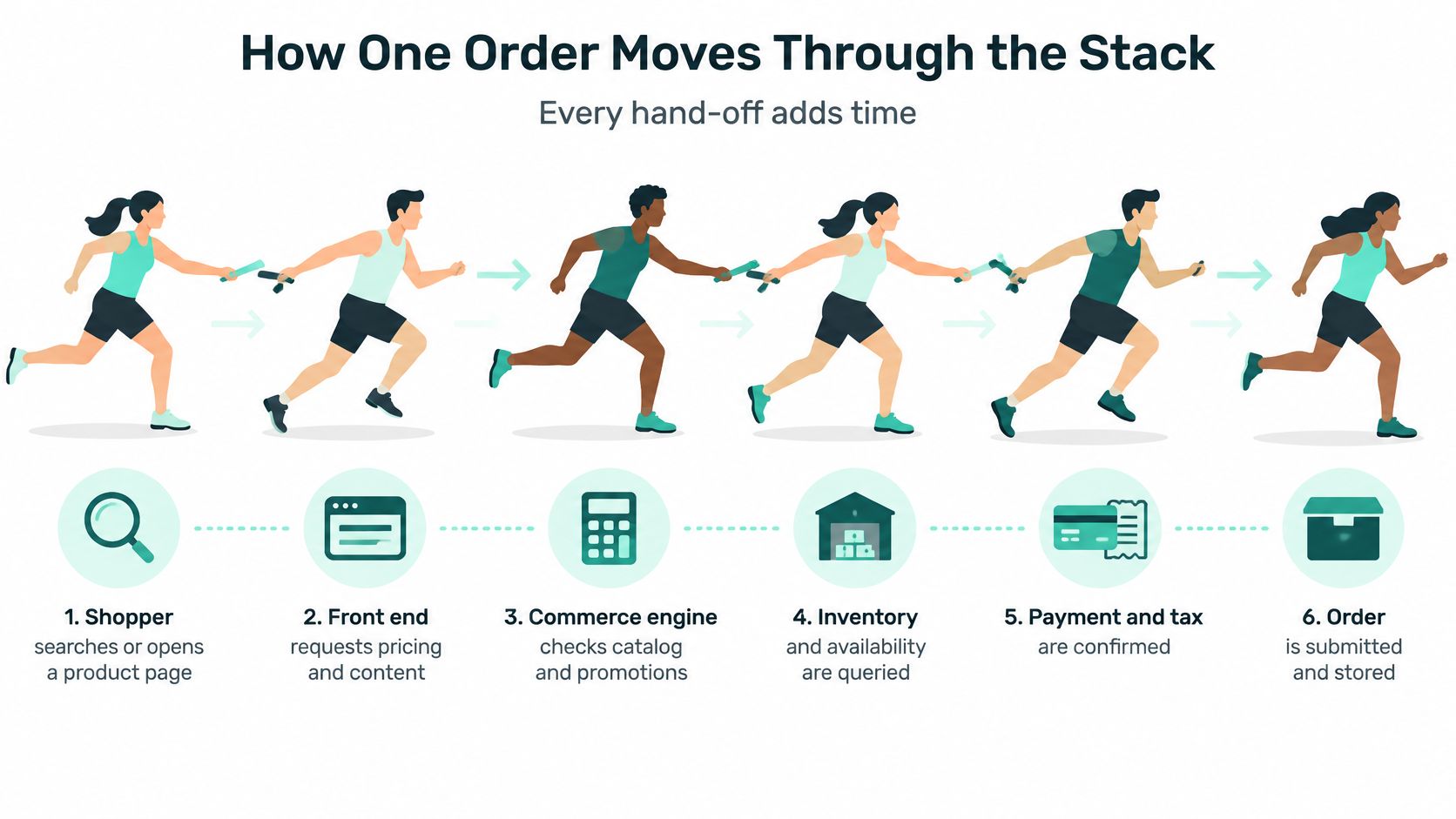
An online order resembles a relay race. Each system receives information, performs its work and passes the result onward. Every handoff adds time and creates a possible failure point.
The diagram illustrates the systems involved, although an implementation may query some of them in parallel.
Follow the shopper's order
- Discovery begins. A shopper searches for a replacement component or opens a category. The storefront queries the search index and catalog.
- The product page assembles. Content comes from the experience platform; current price, stock and applicable promotions come from their authoritative services.
- The basket changes. Adding an item triggers promotion evaluation and estimates for shipping and tax. The platform must distinguish estimates from confirmed charges.
- Checkout captures the commitment. The shopper provides an address, chooses delivery and reviews the order.
- Payment is authorized. The payment provider confirms whether the amount can be authorized. Authorization and capture aren't necessarily the same event.
- The order enters operations. Order management, ERP and fulfillment receive the order event, and the shopper receives confirmation.
Retries deserve special attention. If a payment response times out, the platform mustn't blindly create another charge or order. Use idempotency controls so repeating a request doesn't repeat its financial effect.
Measure the handoffs customers experience
Instrument real-user monitoring by device, geography, page template and traffic source. Pair Largest Contentful Paint, which concerns main-content rendering, with Interaction to Next Paint and Cumulative Layout Shift. A page can appear quickly but still respond slowly or move the purchase button.
Don't confuse performance evidence with identity guidance. The NIST Digital Identity Guidelines address identity assurance, not a benchmark for predicting sales improvements from page-speed changes.
For implementation planning, map your APIs for ecommerce to customer events such as product view, basket update and order submission. Add correlation identifiers so engineers can trace a failed journey across services.
Sketch your own order path and record each handoff's mobile response time. Prioritize slow journeys that prevent customers from buying, rather than optimizing a site-wide average that hides checkout failures.
Identity, Payments and Risk Controls at Checkout
Authentication should follow transaction risk, not one rigid login rule for every shopper. A routine purchase from a recognized device should face a different decision from an unfamiliar device attempting an unusual order.
The NIST Digital Identity Guidelines provide a standards-based foundation for selecting authentication assurance. Your commerce team must translate that foundation into proportionate checkout policies, rather than treating every risk signal as proof of fraud.
Risk signals and the checkout response for each
| Risk signal | Checkout response | Shopper friction |
|---|---|---|
| Routine repeat purchase on a known device | Streamlined sign-in or saved payment method | Low |
| New device or new shipping address | Step-up verification by one-time code or passkey | Medium |
| High-value order | Stronger verification before payment authorization | Medium |
| Unusual order velocity | Hold the order for review | High |
| Suspicious payment context | Decline or route to manual review | High |
These are starting policies, not universal rules. A customer sending a gift to a new address isn't necessarily fraudulent. Combine signals, inspect false positives and give legitimate customers a recovery route.
Put the decision where money moves
Centralize identity through a standards-based identity provider. Prefer phishing-resistant factors, such as passkeys or hardware security keys, where supported; a one-time code shouldn't be treated as equivalent protection.
Bind the authentication result to the relevant order and payment attempt. Otherwise, a customer may pass a check without the commerce system knowing which transaction that approval covered.
Keep customer identity separate from payment credentials, minimize sensitive data storage and retain auditable authentication events. For multinational brands, support federation where appropriate while applying regional privacy settings over a common security baseline.
Disputely's a merchant's guide to payment fraud is a useful companion when reviewing fraud scenarios with payment operations. Our guidance on best practices for IAM in DXPs addresses identity within the wider experience estate.
Stronger checks are useful when they change a risky decision. Repeating them indiscriminately adds effort without necessarily adding meaningful assurance.
List the signals your platform can observe, then assign each a response and an owner. Include the support process for a shopper who can't complete verification, so account protection doesn't become a dead end.
Setting Permission Boundaries for AI Shopping
Interest in AI shopping isn't the same as permission to spend. In the consumer survey described by CXM World, 58% were open to ordering through an AI assistant, but only 6% had done so; the reported control preferences appear below.
Shopper trust levels for AI ordering
| Permission wanted by shopper | Share of consumers |
|---|---|
| Open to ordering through an AI assistant | 58% |
| Had actually ordered through an AI assistant | 6% |
| Approval at every step | 34% |
| Suggestions only | 23% |
| No AI acting on their behalf | 21% |
These measures describe different attitudes and behaviors. They aren't a single set of mutually exclusive permission tiers.
For a Sitecore-led experience, separate the assistant's ability to generate content or recommend products from its authority to execute commerce actions. A helpful answer doesn't establish customer consent.
Define authority explicitly
- Recommendation: AI can explain products and suggest alternatives. The shopper chooses what enters the basket.
- Delegated purchasing: The agent can assemble a basket within customer-defined limits, such as an approved assortment, quantity, or spending cap. Substitutions require a defined policy.
- Payment authorization: Require an explicit, verified confirmation of the charge. Basket-building permission must not automatically become payment permission.
- Human handoff: Route complaints, exceptions, and sensitive decisions to a person, preserving the conversation and approval history.
Enforce these boundaries in service permissions, not merely in an assistant's prompt. Specify which catalog operations the agent can invoke, which customer fields it can read and where consent is stored.
Record the acting identity, requested action, approval state and outcome. Make reversible actions easy to undo, while clearly explaining when an order has passed the point of cancellation.
Before enabling an AI feature, inventory its available actions and assign each to a permission level. Personalization is a relevance decision; delegated purchasing is an authority decision. They require different controls.
Selection Criteria Enterprise Teams Should Score
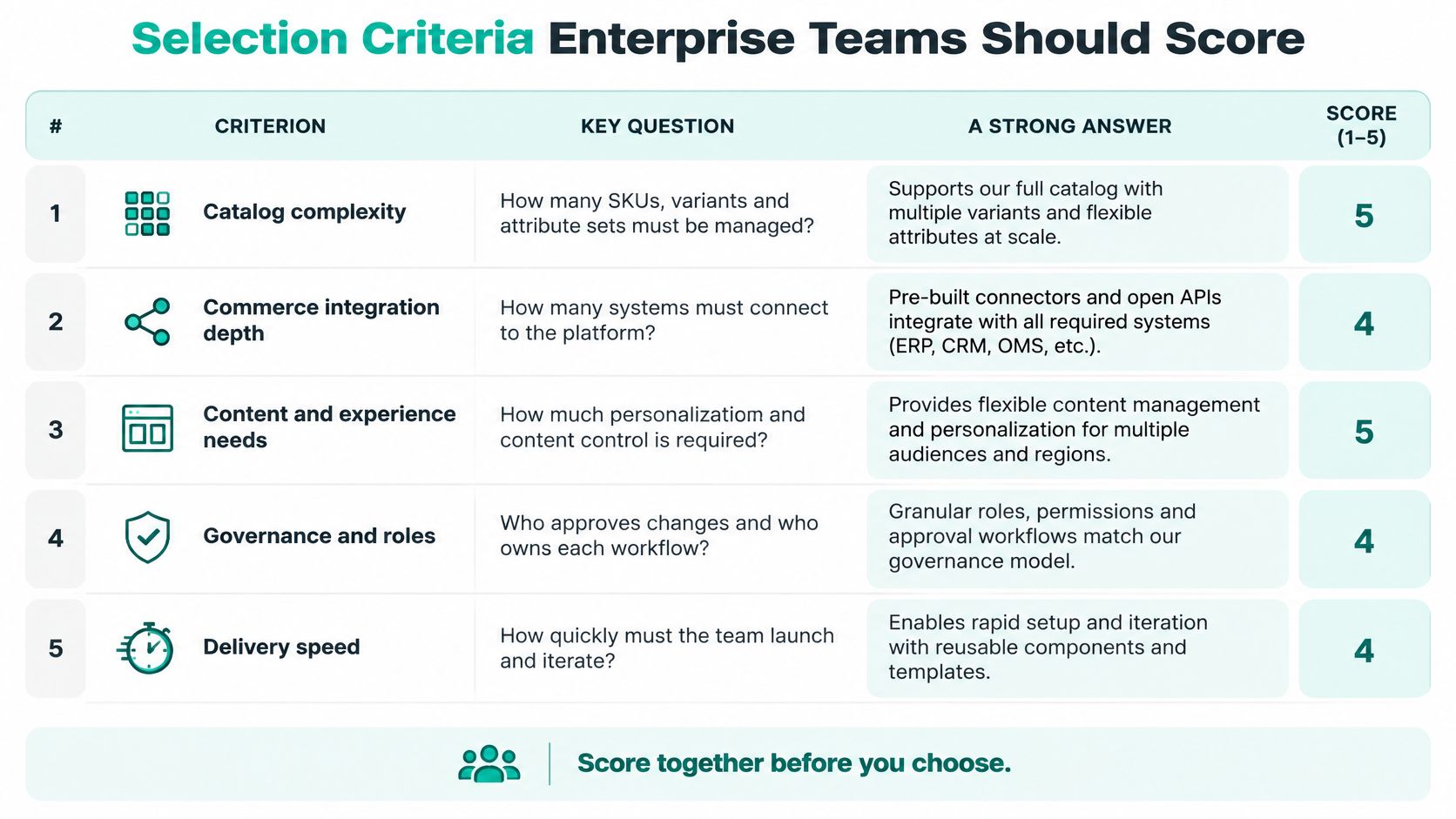
Bring digital, architecture, operations, finance and customer service into the same evaluation. A platform can satisfy a storefront demonstration while leaving the returns team with manual work.
Use the visual checklist to organize discussion, then require written evidence for the detailed criteria.
Ask questions that require demonstrable answers
- Catalog complexity: Can the platform represent your SKUs, variants and attribute sets without fragile custom code? Test your hardest product, not a demonstration catalog.
- Market coverage: Can currencies, tax rules, languages and brands share governed controls while retaining necessary local exceptions?
- Integration load: Which ERP, order management, PIM, CRM and identity connections are required? A strong answer names stable APIs and accountable owners.
- Team capacity: Who will operate front-end releases, API governance and DevOps? Include partner responsibilities and internal skills.
- Post-checkout operations: Demonstrate inventory visibility, delivery promises, exchanges and returns. In DHL's 2025 survey of 24,000 online shoppers across 24 markets, 81% said they abandon when their preferred delivery option is unavailable, and 79% when their preferred returns option is unavailable.
- Performance and resilience: Require real-user monitoring, defined hosting commitments and rollback rules linked to business outcomes.
- AI and personalization governance: Identify recommendation authority, approval requirements and consent records.
- Total cost: Compare license, hosting, integration, partner and operating costs over a proposed three-year planning horizon, not just launch expenditure.
- Partner evidence: Examine certifications, named delivery references and support coverage. We are a Sitecore Silver Partner, with experience across Sitecore, Adobe Experience Manager and Microsoft 365; apply the same evidence standard to us.
Score profitability as well as conversion
Measure contribution margin after returns, avoidable delivery failures and repeat purchase. Include reverse-logistics and service costs so a conversion increase doesn't conceal an unprofitable operating model.
Have the buying group use a proposed one-to-five score, with any score of two or lower treated as an unresolved blocker. These are evaluation rules you set, not industry benchmarks. Require the same written answers from every vendor before creating the shortlist.
Connecting Sitecore, AEM and Azure to Commerce
XM Cloud is the content foundation, not the complete transaction engine. Sitecore's documentation describes SitecoreAI across content, personalization and experience management, with automatic upgrades for XM Cloud customers and no replatforming required to access SitecoreAI.
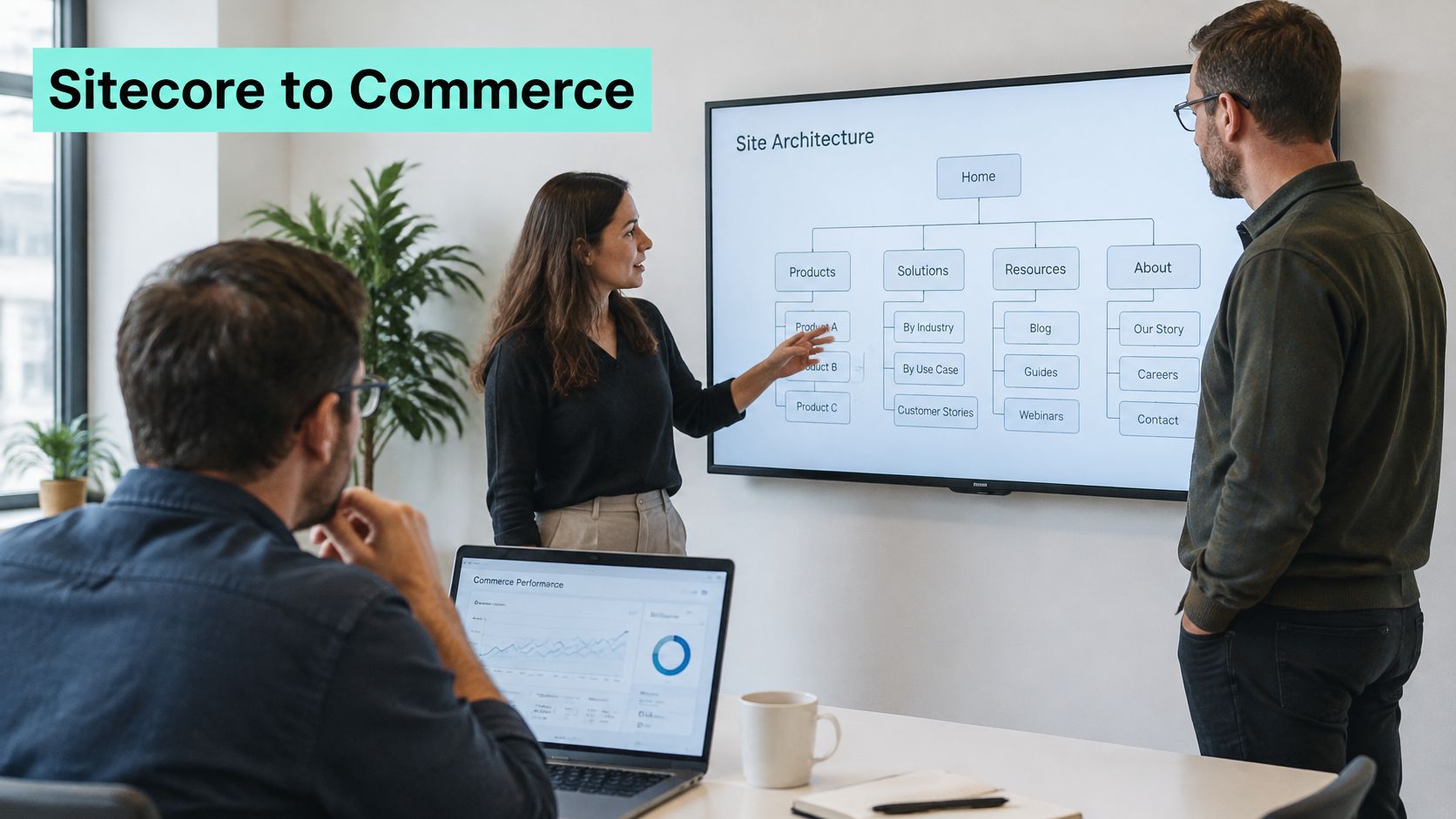
Use an architecture workshop to make the boundaries between experience services and transaction services explicit.
Build from authoritative content and commerce data
Start with a headless front end, such as Next.js, reading editorial content from XM Cloud and commercial values from the commerce engine. Then connect CDP and Personalize for behavioral context, Sitecore Search for discovery, and Content Hub for governed assets.
Sitecore's portfolio documentation describes AI-powered search relevance and OrderCloud developer resources. Confirm whether OrderCloud or another engine owns prices and orders; discovery indexes and recommendation services shouldn't become accidental systems of record.
Sitecore Stream supports ideation, on-brand drafting, campaign briefs and message personalization, and is built on Microsoft Azure OpenAI Service, according to the Stream documentation. Access includes embedded experiences and the Sitecore Cloud Portal's Campaigns, Brand Kits and Brand Assistant, while some capabilities require Stream Premium.
The accompanying video offers additional context for the experience-platform discussion.
Keep collaboration separate from transactions
Use Azure for integration workloads, deployment automation and identity connections where your architecture requires them. Don't assume every SaaS component runs inside your own Azure subscription.
For Adobe Experience Manager estates, establish product-data ownership before implementing Adobe Experience Manager integrations. Avoid making AEM and Sitecore competing editors of the same authoritative content.
SharePoint Online belongs alongside this stack for internal documents, partner files and operational knowledge. An implementation can use SPFx components and Power Platform automation, but permissions, external sharing and workflow boundaries need explicit validation.
A returns-policy approval process might live in SharePoint while the approved eligibility rules are implemented in commerce services. Don't make checkout depend on retrieving an employee document.
Close the design review by confirming license entitlements and naming the source of truth for content, assets, customer context, price, inventory and orders.
Start Your Replatforming With One Pilot Journey
A replatforming program should replace risk in manageable portions, not move every uncertainty into a single launch weekend. Choose a bounded customer journey that exposes meaningful integration work without putting the entire business at stake.
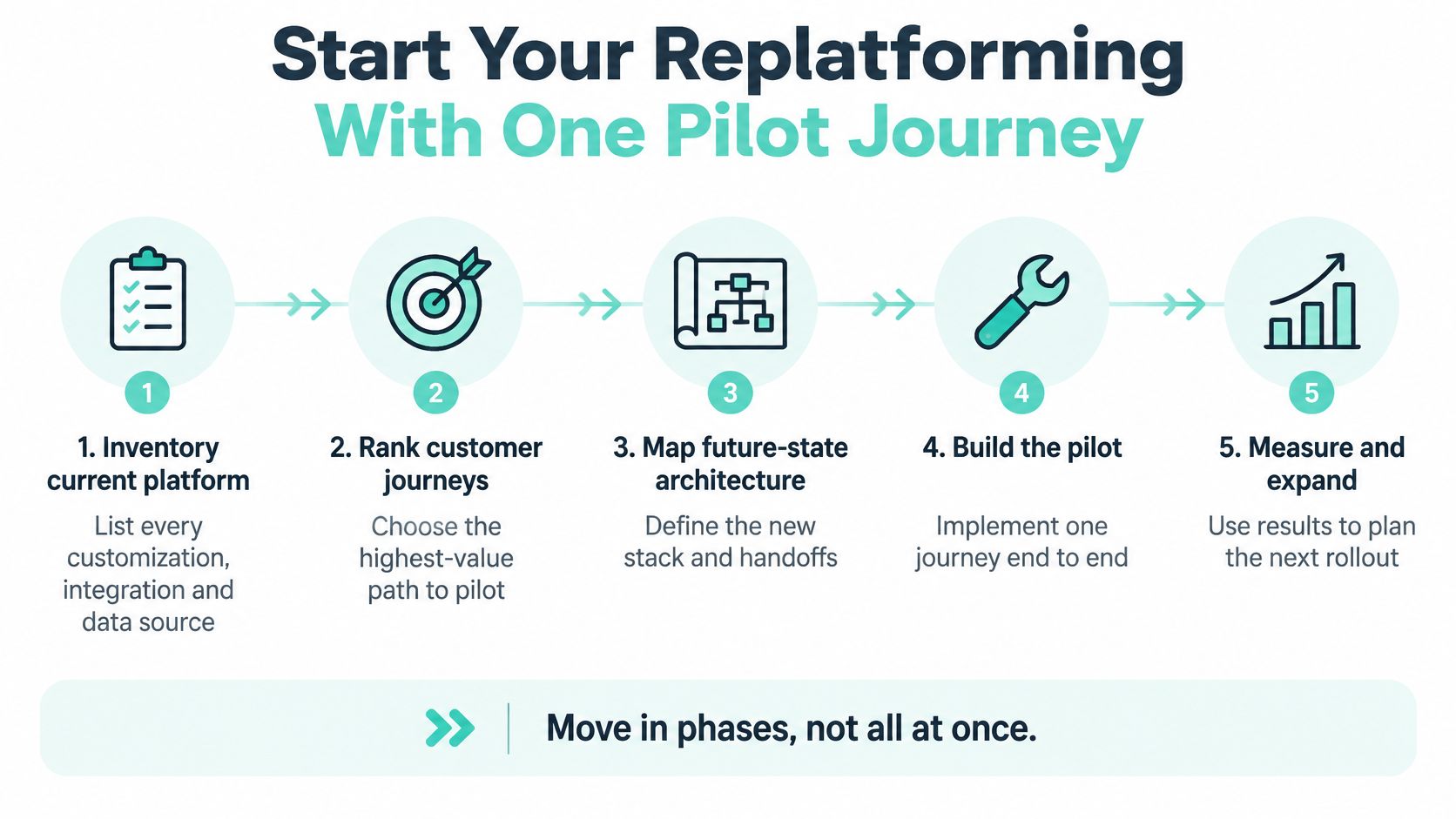
The roadmap illustrates phased delivery. The implementation plan also needs explicit payment, rollback and retirement gates.
Establish the migration gates
Inventory the current estate. List customizations, integrations and data sources, including scheduled jobs and manually maintained feeds. Mark which are still used and who can confirm their purpose. Don't reproduce obsolete behavior merely because it's present.
Rank journeys by revenue and risk. Select a contained pilot, such as a product category, brand or market. Prefer a journey with observable outcomes and representative dependencies, rather than an isolated page that proves little about commerce.
Build alongside the existing platform. Share governed content and product data through APIs. Establish routing rules so customers know which system owns their session and basket. For Sitecore migrations, validate authoring workflows as well as rendering.
Split live traffic deliberately. Route traffic by a controlled cohort, market or agreed percentage. Compare conversion and revenue per session while checking delivery errors and support contacts. Ensure analytics definitions match across the old and new experiences.
Move checkout and payments last. Complete identity, authorization, refund and fraud tests before moving financial responsibility. Test interrupted requests, repeated submissions and inconsistent downstream responses, not just successful purchases.
Set rollback thresholds before cutover. Name the decision-maker, monitoring signals and rollback procedure. Confirm how the team will reconcile orders accepted during an incident. Reverting a storefront doesn't automatically reverse a payment or warehouse instruction.
Retire deliberately. Decommission unused integrations, credentials and infrastructure after reconciliation. Review redirects individually: remove obsolete rules, but preserve redirects that still protect useful customer journeys and inbound links.
Use a relevant case without borrowing its target
We moved Regal Rexnord from on-premises Sitecore XP to headless Sitecore XM Cloud, using a Next.js hub-and-spoke model. The project reported go-live timelines reduced by 35 to 50 percent and publishing twice as fast.
Those results describe that implementation, not a guaranteed outcome for another estate. Compare your integration complexity, content readiness, brand model and approval process before setting a delivery target. A shared component library won't remove delays caused by unresolved ownership or unapproved translations.
A successful pilot proves that the organization can operate the new journey, not simply that developers can publish it.
Include content editors, service agents and fulfillment owners in acceptance testing. Ask them to correct a product, investigate a missing order and explain a return using the new tools. Their ability to complete those tasks is part of readiness.
Choose the pilot journey, name the single go-or-no-go business metric, and set a date for the first controlled traffic split. Keep security and operational acceptance as mandatory gates, even when the primary commercial metric looks healthy.
Kogifi designs, builds and maintains Sitecore-led commerce experiences, with expertise across AEM, Azure and Microsoft 365/SharePoint. Visit Kogifi to discuss a pilot journey, map its integration boundaries and define the evidence you'll need before expanding your replatforming.