


A cloud content management system is simply software that lets you create, manage, and publish your digital content over the internet. Instead of buying and maintaining servers in your own office, you access the system just like you'd stream a movie online. This frees up your team to collaborate from anywhere, at any time.
Defining the Modern Digital Library

Let's ditch the technical jargon for a second. Think of a traditional, on-premises content system like a physical library—a single building you have to visit to get information. All the books and records are stored on-site, demanding constant physical maintenance, security, and staff to keep things running.
A cloud content management system, on the other hand, is like a global digital library. Anyone with an internet connection can access it, liberating your teams from being tied to a specific location. Instead of sitting on your company's servers, your content hub is managed by a specialized provider like Microsoft Azure and delivered to you as a service.
This shift completely removes the headache of server maintenance, security patching, and hardware upgrades from your IT department's plate. It lets your organization pour its resources into what really matters: creating incredible digital experiences for your customers.
Cloud CMS vs On-Premises CMS At a Glance
To make the distinction crystal clear, it helps to see the two approaches side-by-side. The differences in architecture lead to very different outcomes in terms of cost, flexibility, and the resources you need to keep things running.
Ultimately, the cloud model offers a more agile and less burdensome path for most modern businesses, allowing them to focus on innovation instead of infrastructure management.
Core Characteristics of a Cloud CMS
The real power of a cloud CMS comes from a few key principles that set it apart from older systems. These platforms are built for the way businesses operate today—globally, collaboratively, and fast.
- Internet-Based Access: All your tools, content, and admin functions are right there in your web browser. No need for special on-site hardware or software installations.
- Subscription Model (SaaS): Most are offered as a Software-as-a-Service (SaaS) product, so you pay a recurring fee. This usually covers hosting, security, and automatic updates, turning a huge capital expense into a predictable operational cost.
- Third-Party Hosting: Your content and the CMS software itself live on servers owned and managed by a cloud giant like Microsoft Azure or AWS, ensuring professional management and high uptime.
This model has quickly become the standard. A huge driver of the CMS market's growth is the rapid enterprise adoption of cloud-native platforms.
By offloading infrastructure management, businesses can reallocate valuable IT resources toward innovation and strategic projects rather than routine maintenance. This shift enables greater business agility and faster time-to-market for new digital initiatives.
This architectural approach is the foundation for modern platforms like Sitecore XM Cloud, which is built on a composable, cloud-native architecture. It's a structure that enables both scalability and flexibility, setting the stage for more advanced capabilities. For a deeper look into this topic, you might be interested in our guide on the advantages of a cloud-based CMS. This approach is no longer just an option; it's a necessity for achieving enterprise agility and maintaining a competitive global reach.
The Power of a Modern Enterprise Cloud CMS

Let's be clear: a modern enterprise cloud content management system is so much more than a digital filing cabinet. It’s the engine driving the entire customer journey, turning static content into the kind of dynamic, personal experiences that build loyalty. This isn’t just a minor upgrade; it’s a fundamental architectural shift in how businesses connect with their audiences.
Instead of being locked into a monolithic, one-size-fits-all platform, today's best systems are built on a composable architecture. Think of it like building with high-end LEGO bricks. You’re not stuck with a pre-built model. Instead, you can pick and choose best-in-class tools for search, personalization, and e-commerce, then snap them together to create a custom Digital Experience Platform (DXP) that fits your business perfectly.
Embracing the Composable and Headless Future
Sitecore XM Cloud is a perfect example of this philosophy in action. It’s designed to be the central hub of a powerful DXP, integrating seamlessly with specialized tools. This lets you build a tech stack that is both incredibly powerful and refreshingly flexible.
This composable approach often goes hand-in-hand with a headless content delivery model. In a traditional CMS, your content (the "body") is tightly coupled with its presentation layer (the "head," like a website design). A headless CMS severs that connection. You create your content once, then deliver it anywhere and everywhere through an API.
A headless architecture future-proofs your content. What you create today can be pushed not just to your website and app, but to smart watches, in-store displays, or any other channel that pops up tomorrow.
This guarantees absolute message consistency across every single touchpoint, from a desktop browser all the way to an IoT device.
Intelligence and Security at the Core
Modern platforms are also incredibly smart. The integration of AI and analytics is a major reason for the market's rapid growth, as businesses look to automate workflows and deliver hyper-personalized experiences across all channels. At the same time, an intense focus on security and compliance is driving demand for these advanced cloud solutions. You can dig deeper into the market trends in content management systems to see the full picture.
This built-in intelligence gives you actionable insights that used to be nearly impossible to get. The leading systems now offer:
- AI-Powered Personalization: The Sitecore DXP leverages machine learning to analyze user behavior in real-time, serving up the most relevant content, offers, and product recommendations to each individual.
- Advanced Analytics: Clear, intuitive dashboards show you exactly how your content is performing, helping you understand what resonates and optimize your strategy on the fly.
- Predictive Insights: Sitecore can forecast user behavior, letting you proactively tweak campaigns for the biggest possible impact.
Of course, a true enterprise solution has to manage both external and internal content. While platforms like Sitecore master the external customer experience, tools like SharePoint excel at internal collaboration within the cloud. They provide a secure, centralized hub for document management and team workflows, ensuring all company knowledge is governed, protected, and accessible only to those who need it. This dual approach gives an enterprise total command over its entire content universe.
Finally, you can't have an enterprise platform without rock-solid security. Non-negotiable security and governance features are baked right into the architecture. With things like role-based access controls, detailed audit trails, and built-in compliance with global data privacy regulations, these systems deliver the peace of mind you need to operate in today's complex digital world.
Exploring Sitecore and SharePoint for Your Enterprise
When enterprises start looking at cloud content management, two names almost always come up, though for very different reasons: Sitecore and SharePoint. They aren't really direct competitors. Instead, they represent two powerful, yet distinct, philosophies for handling an organization's digital universe.
One is a master of engaging external customers, while the other acts as the secure backbone for everything that happens internally.
Think of it this way: Sitecore is the architect of your customer-facing world. It has grown far beyond a simple CMS into a composable Digital Experience Platform (DXP). This approach lets businesses hand-pick a "best-of-breed" tech stack instead of being locked into a monolithic system that might do a lot of things okay, but nothing exceptionally well. The end game is to build deeply personal customer journeys that actually drive sales and loyalty.
Sitecore: The Conductor of Customer Experience
At the heart of Sitecore’s cloud solution is Sitecore XM Cloud, a fully managed SaaS CMS. It handles the basics of creating and managing content, but its real magic is unlocked when you start plugging in other specialized tools from the Sitecore ecosystem. This is where that composable strategy really shines.
For instance, Sitecore Search goes way beyond simple keyword matching to deliver AI-driven, predictive results that help customers find what they need before they even finish typing. Then you have Sitecore Connect, which acts like the central nervous system for your entire tech stack. It uses a low-code/no-code interface to link hundreds of third-party apps—from your CRM to marketing automation platforms—making sure data flows smoothly everywhere.
The result is a unified platform where every piece works together perfectly:
- Content Hub: A single source of truth for all your digital assets, keeping your brand consistent.
- Personalization Engine: Uses real-time data to tailor content to individual users on the fly.
- Omnichannel Delivery: Pushes a consistent brand experience out to websites, mobile apps, kiosks, and whatever comes next.
This setup allows marketers to stop just publishing content and start orchestrating memorable, data-driven experiences at every single touchpoint.
SharePoint: The Engine of Internal Collaboration
While Sitecore is busy engaging customers, SharePoint is focused inward. As a key part of the Microsoft 365 ecosystem, it is the undisputed heavyweight champion of internal collaboration and Enterprise Content Management (ECM). It’s the digital headquarters where a company's operational knowledge lives and breathes.
SharePoint's primary strength is its incredible ability to manage the entire lifecycle of internal documents. It provides a secure, central hub where teams can create, store, share, and collaborate on everything from project plans and legal contracts to training manuals. Its deep integration with tools everyone already uses, like Microsoft Teams and Outlook, makes the whole workflow feel effortless for employees.
Where Sitecore is designed to persuade external audiences, SharePoint is designed to empower internal teams. It prioritizes governance, security, and process automation to make the business run more efficiently.
This internal focus is non-negotiable for any large company. SharePoint helps automate workflows, manage version control on sensitive files, and enforce strict compliance and security standards across all corporate data. For any business considering Microsoft's suite, understanding the benefits of SharePoint Online is a critical first step in building a modern digital workplace.
Two Platforms, One Unified Strategy
For most large enterprises, the choice between Sitecore and SharePoint isn't an "either/or" situation. A truly mature digital strategy often uses both, playing to each platform's unique strengths.
Picture a global manufacturing company. They use Sitecore to run their public websites, delivering personalized product information to potential buyers across different regions. At the same time, their internal teams rely on SharePoint as a central portal to collaborate on R&D documents, manage supply chain logistics, and access HR policies.
The two systems work in parallel, each optimizing a different, critical part of the business. By understanding their distinct but complementary roles, enterprises can achieve total control over their entire digital ecosystem.
Achieving True Scalability and Security in the Cloud
When businesses move their content operations to the cloud, they’re usually chasing two things: scalability and security. But these aren’t just tech buzzwords. They translate into real-world business advantages—the power to meet customer demand in a heartbeat and the peace of mind that comes with rock-solid protection.
Think of your old on-premise server like a brick-and-mortar shop. It has a fixed capacity. If a flash sale draws a massive crowd, the store gets swamped, the doors shut, and you lose business. A traditional server is no different. A sudden traffic spike from a marketing campaign can easily bring it crashing down, leading to costly downtime and frustrated customers.
Elastic Scaling: Your Secret Weapon
This is exactly where a cloud content management system shines, thanks to a feature called elastic scaling. Instead of being shackled to fixed hardware, a cloud platform automatically spins up more resources the second it detects a traffic surge. When things quiet down, it scales back. Simple as that.
This on-demand firepower means your website or app stays fast and responsive, no matter what you throw at it. For a platform like Sitecore running on Microsoft Azure, this isn’t some complicated manual process; it’s an automated, built-in part of the architecture.
- Handle Peak Demand: Seamlessly manage traffic from marketing campaigns, holiday rushes, or viral moments without a hint of slowdown.
- Cost Efficiency: You only pay for the extra horsepower you actually use, dodging the massive expense of buying and maintaining hardware for "just in case" scenarios.
- Global Reach: Resources can be spun up in data centers across the globe, ensuring a blazing-fast experience for users, whether they're in Boston or Berlin.
Fortifying Your Digital Assets with Cloud Security
Security is another area where cloud providers operate on a level most individual companies simply can't afford to match. Platforms hosted in environments like Microsoft Azure are wrapped in a multi-layered defense system that protects everything from the physical server racks to the application code.
It all starts with physical data center security, complete with biometric scanners and 24/7 surveillance. From there, it extends to a sophisticated digital defense network with automated threat detection, DDoS mitigation, and continuous vulnerability scanning. For a deeper look at this, our guide on cloud security for Sitecore DXP breaks it all down.
Cloud security isn't just about building a taller wall. It's about leveraging the collective intelligence of a global security operation that monitors millions of threats per second, an advantage that's nearly impossible to replicate in-house.
On top of that, these platforms are built to meet tough international compliance standards like GDPR, HIPAA, and SOC 2. This built-in compliance takes a huge regulatory weight off your shoulders, since the foundational infrastructure is already certified.
Maintaining Control with Data Sovereignty
A common worry about the cloud is data location, especially with the maze of regional privacy laws out there. A top-tier cloud content management system, however, puts you squarely in control of this.
When you set up an environment in Sitecore, for instance, you can choose the specific geographic region where your data is stored and processed. This concept, known as data sovereignty, is a game-changer for global companies. It guarantees that customer data from a user in Germany stays within EU data centers, keeping you in lockstep with GDPR. This control allows you to operate globally while respecting local rules.
This powerful mix of scalability and security is fueling explosive market growth. In fact, the cloud-based enterprise content management market is projected to hit USD 40.84 billion by 2025, largely because it helps organizations centralize content and nail down compliance. You can learn more about the growth drivers in the cloud ECM market to see the full picture.
Your Strategic Roadmap for a Cloud CMS Migration
Jumping into a cloud migration is a serious move—one that needs a clear strategy, not guesswork. A successful shift to a cloud content management system is about more than just moving data around. It’s about reinventing how your business operates, collaborates, and connects with customers. To get there, you need a practical roadmap to navigate the complexities with confidence.
The process kicks off long before you touch any technology. It starts with a deep audit of your current content and tech stack. This isn’t a simple inventory list; it’s a strategic look at what content should be moved as-is, what can be archived, and what’s ready to be rebuilt for the modern, composable world of a platform like Sitecore XM Cloud.
Getting this first phase right is crucial for defining the scope of the project and avoiding nasty budget surprises down the road. It gives you a true picture of your digital assets and infrastructure, setting a solid foundation for every decision that follows.
Defining Your Business Goals and Architecture
Once you have a clear view of your current setup, it's time to nail down your business goals. Are you trying to ramp up personalization, improve internal collaboration with a tool like SharePoint, or slash your time-to-market for new campaigns? Your answers will point you directly to the right architecture.
For example, if the goal is to deliver hyper-personalized experiences across every channel, a composable DXP built around Sitecore is a natural fit. But if you’re focused on streamlining internal document workflows, a SharePoint solution would be the priority.
The most effective migrations align technology choices directly with measurable business outcomes. The platform should be a tool to achieve a specific goal, not just a technology for technology's sake.
Defining these goals makes sure your investment pays off in real, tangible value and gives you clear metrics to track success. For companies that need an outside perspective, professional cloud migration services can be a huge help in aligning technology with these strategic objectives.
This flow shows the real-world benefits you can unlock with a smart cloud migration.
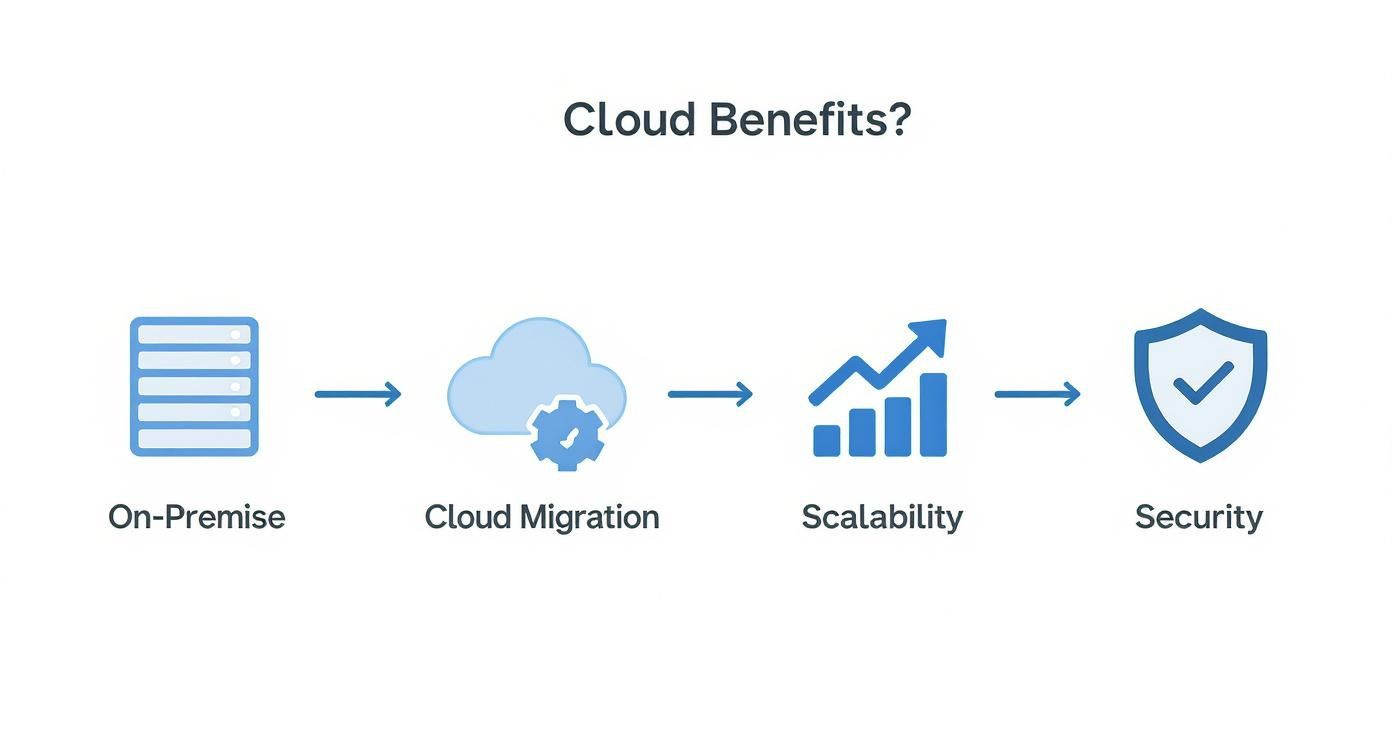
It’s all about moving from a rigid on-premise system to a flexible cloud environment, opening the door to better scalability and stronger security.
Managing the Human Element of Migration
Technology is only half the battle. The human side of the equation—your teams, stakeholders, and end-users—is just as important. A migration will inevitably shake up workflows and demand new skills, which makes change management a top priority.
Getting stakeholder buy-in from the very beginning is non-negotiable. This means clearly communicating the "why" behind the move, spelling out the benefits for each department, and being realistic about the timeline and potential bumps in the road.
Training isn't an afterthought, either; it’s a core part of the rollout. Your teams need to feel confident using the new system from day one. This goes beyond just technical how-to guides. It's about helping them understand how the new cloud content management system fits into their roles and helps achieve bigger business goals.
Adopting a Phased Rollout Strategy
A "big bang" migration, where you flip the switch on everything at once, is incredibly risky. A phased rollout is almost always the smarter, safer bet. It minimizes business disruption and gives your team the space to learn and adapt in manageable chunks.
This step-by-step approach has some major perks:
- Reduced Risk: By isolating the rollout to one brand, region, or department, you can contain any potential issues before they spread.
- Quick Wins: Launching a smaller piece of the project early on shows value fast, which helps keep momentum and stakeholders on your side.
- Iterative Learning: The lessons you learn from the first phases can be applied to the next ones, helping you fine-tune the process and get better results each time.
This methodical strategy turns a massive, intimidating project into a series of achievable milestones. To help you map it all out, our comprehensive website migration checklist offers a detailed framework to guide you every step of the way. By following a structured roadmap that covers technology, people, and process, you can make sure your move to the cloud is not just a technical success, but a strategic win for your entire organization.
Your Partner in Cloud CMS Excellence
Picking the right technology is just the start. The real win comes from executing that choice flawlessly, turning a powerful cloud content management system into measurable business value. A best-in-class CMS is only as good as the team that puts it to work, and that’s where Kogifi comes in. We bridge the gap between your digital vision and real-world results.
Our roots run deep in the enterprise space, with a sharp focus on the entire Sitecore product family. We know what it takes to build a modern, composable DXP—from laying the foundation with Sitecore XM Cloud to weaving in specialized tools like Sitecore Search and Sitecore Connect. Our goal is to make every piece of the puzzle fit together perfectly, delivering the personalized, data-driven experiences your customers expect.
Beyond Sitecore, we have a masterful grasp of SharePoint, understanding its pivotal role as the engine for internal collaboration and enterprise content management.
More Than an Implementer—Your End-to-End Partner
We don't just talk tech; we speak the language of business outcomes and ROI. Our entire process is built to ensure your technology investment directly fuels your most critical objectives. Whether you’re looking to boost customer engagement with Sitecore or streamline internal workflows with SharePoint, we tailor our approach to align the technology with your goals.
Our end-to-end services cover the entire journey:
- Strategic Consulting: We begin by digging into your business goals, helping you map out a technology strategy that delivers tangible results.
- Technical Audits: Our team conducts deep-dive analyses of your current systems to pinpoint opportunities for improvement and ensure a seamless migration.
- Custom Integrations: We wire your cloud CMS into your entire tech stack—from CRMs to analytics platforms—creating a single, unified digital ecosystem.
- Ongoing Managed Services: Our work isn’t done at launch. We provide 24/7 support and management to keep your platform secure, optimized, and performing at its peak.
A successful cloud CMS implementation isn't a one-and-done project. It's an ongoing partnership focused on continuous improvement and adaptation. The real aim is to create a living digital platform that evolves with your business and your customers.
This holistic view guarantees your platform isn't just technically sound but is also strategically aligned with your long-term growth.
Let's Build Your Digital Future
Navigating a cloud CMS migration or implementation is complex. It demands a partner with proven experience and deep platform knowledge. We're here to guide you on your path to cloud content mastery, turning ambitious strategies into high-performing digital realities.
Start a conversation with our experts today to see how Kogifi can help you build, optimize, and manage a cloud content management system that drives your business forward.
Frequently Asked Questions
When you're thinking about moving to a cloud content management system, it’s normal to have a few questions about how it will really work day-to-day. Getting your head around the details, especially for powerful platforms like Sitecore and SharePoint, is the key to making a smart decision that works for both your marketing team and your internal operations.
Is a Cloud CMS Secure for Enterprise Data?
Absolutely. In fact, a major platform like Sitecore XM Cloud, which runs on Microsoft Azure, usually offers security that's far beyond what most companies can manage on their own.
These platforms are backed by dedicated global security teams and automated threat detection. They also hold rigorous compliance certifications like GDPR and SOC 2, so you can be confident your enterprise data is constantly monitored and protected from new threats.
Can We Still Customize a Cloud CMS?
Yes, especially when you're working with a composable platform like Sitecore. A SaaS cloud content management system like XM Cloud is built to be customized using APIs and integrations.
You can still plug in your CRM, analytics platforms, and other essential business tools with solutions like Sitecore Connect. It’s the best of both worlds: you get the reliability of a fully managed service plus the freedom to build a unique Digital Experience Platform (DXP) that fits your business needs perfectly.
Does Sitecore Replace SharePoint in the Cloud?
No, they actually do very different jobs and work well together. Sitecore is all about managing and personalizing the external customer experience—your websites, apps, and other digital channels. SharePoint, on the other hand, is the workhorse for internal collaboration, document management, and team workflows.
A smart enterprise strategy often uses both platforms in parallel. Sitecore is for winning over customers, while SharePoint is for empowering your internal teams. Together, they manage an organization's entire content universe, inside and out.
At Kogifi, we specialize in implementing and managing powerful Sitecore and SharePoint solutions that drive real business results. Let's build your digital future together.