


For any CTO, getting your head around IaaS, PaaS, and SaaS in cloud computing isn't just an academic exercise—it’s the bedrock of your entire digital strategy. These models aren't just buzzwords; they represent distinct layers of cloud service, each striking a different balance between control, responsibility, and speed.
Picking the right model is make-or-break when you're architecting modern Digital Experience Platforms (DXP), particularly within the Sitecore and SharePoint ecosystems.
Decoding IaaS, PaaS, and SaaS
Let’s cut through the acronyms with a simple analogy: building a house. This makes these abstract cloud models feel more tangible and shows how each one shapes your team’s control and speed when rolling out powerful platforms like Sitecore or SharePoint.
IaaS (Infrastructure as a Service): Think of this as getting a plot of land with all the essential utilities—compute, storage, and networking—already hooked up. You have total freedom to build whatever you want, but you’re on the hook for everything from the foundation to the roof. This model gives you maximum control, which is often crucial for complex, custom Sitecore XP deployments.
PaaS (Platform as a Service): Here, you get a pre-built foundation and frame. The heavy lifting is done for you, so your team can focus on the fun part: customizing the rooms and interiors. PaaS is a huge development accelerator, making it a great fit for custom SharePoint solutions or building composable applications that plug into Sitecore’s ecosystem.
SaaS (Software as a Service): This is the equivalent of a fully furnished, move-in-ready home. You just bring your belongings (your data) and start living in it. The vendor handles all the maintenance, repairs, and updates. Sitecore’s composable products, especially the AI-powered XM Cloud, are perfect examples of this model, delivering speed and taking the operational weight off your shoulders.
The Strategic Importance of Each Model
Knowing which model to pick is a cornerstone of modern IT leadership. The proof is in the numbers. The massive shift away from on-premises data centers is undeniable, with global spending on IaaS alone projected to soar past $200 billion by 2026 as companies demand more flexible resources.
Each of these service models—IaaS, PaaS, and SaaS—provides a different blueprint for deploying and managing your applications. If you're looking to really nail down the fundamentals, an official certification resource like the AWS Certified Cloud Practitioner study guide can be a fantastic asset.
As you map out your digital future, whether it's a new SharePoint intranet or a global Sitecore implementation, this first decision sets the stage. It dictates your team’s responsibilities, your costs, and your overall agility for years to come.
The Cloud Responsibility Matrix: Who Manages What?
Understanding the split between IaaS, PaaS, and SaaS in cloud computing is the first step in planning your resources and managing risk. The model you choose draws a clear line in the sand: this is where the vendor’s responsibility ends, and yours begins. That decision directly shapes your team's day-to-day workload and your total operational costs.
Think of it this way: choosing a cloud model is less of a technical decision and more of a strategic one. It has to align with your team's skills and your company's goals. For instance, if you're migrating a legacy Sitecore XP instance to an IaaS environment, your team keeps the keys to the kingdom—control over the operating system, middleware, and application runtime. This is perfect for organizations with highly specific security rules or complex integrations that demand deep system access.
On the other hand, adopting a PaaS model, like Sitecore Managed Cloud, hands that entire infrastructure headache over to the vendor. Your developers are suddenly free from the grind of managing servers and patching systems. Instead, they can focus on what actually moves the needle for the business: building custom features, new integrations, and standout digital experiences. You can dive deeper into how this works in our article on managed cloud services.
A Visual Guide to Cloud Service Models
To really get a feel for how these responsibilities are divided, it helps to picture the cloud service models as a hierarchy. You start with the raw, foundational infrastructure and move up toward ready-to-use software.
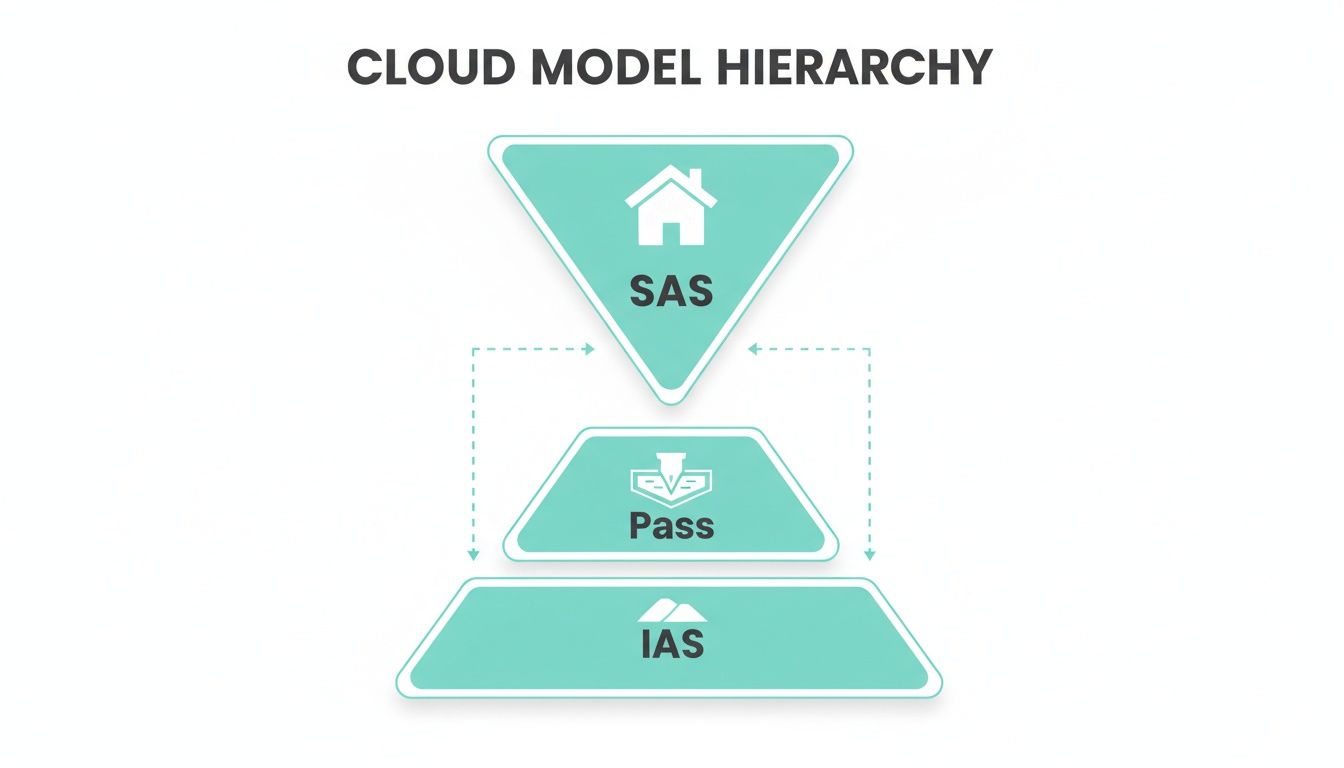
The image above nails the core concept: as you move up the stack from IaaS to SaaS, you're trading direct control for greater convenience, offloading more and more management tasks to your cloud provider.
Your Management Stack Across Models
Let's break down exactly what your team is responsible for versus what the vendor handles in each model. For a complete picture, we’ll even include a traditional on-premises setup. Getting this right is critical for avoiding surprise costs and making sure your team has the bandwidth for the model you choose.
Cloud Service Model Responsibility Matrix
The table below gives you a clear, side-by-side look at who manages each layer of the IT stack—from the physical network cables all the way up to the application your team uses every day.
As you can see, SaaS solutions like Sitecore XM Cloud or SharePoint Online take nearly all the infrastructure work off your plate. With these platforms, your team’s focus shifts completely. You’re no longer worrying about the servers; you’re configuring the application, managing content, and working with your user data.
By clearly defining who manages what, you empower your organization to make an informed decision. This matrix prevents the classic mistake of underestimating the internal resources required to support a cloud environment, ensuring a smoother transition and more predictable total cost of ownership.
IaaS: The Foundation for Bespoke Sitecore Solutions

When you absolutely need full architectural control over your digital experience platform, Infrastructure as a Service (IaaS) is your answer. For companies running highly customized Sitecore XP environments or intricate SharePoint farms, IaaS delivers the foundational building blocks—compute, storage, and networking—that give your IT team complete governance.
Think of a global brand with a complex, multi-site, multilingual Sitecore setup. It’s probably loaded with specific third-party integrations, connectors to legacy systems, and strict data residency rules. Forcing that kind of sophisticated ecosystem into a more rigid cloud model would almost certainly break something. This is where IaaS on Azure or AWS becomes the clear choice.
With IaaS, you can mirror your exact on-premises network configurations, apply fine-grained security policies down to the OS level, and manage operating system versions with precision. This is essential for ensuring compatibility with all your Sitecore modules and dependencies. It’s the closest you’ll get to running your own data center, but in the cloud.
Embracing Financial and Operational Agility
One of the biggest wins with IaaS is the financial shift it enables. You move away from massive, upfront Capital Expenditures (CapEx) and toward predictable, scalable Operational Expenditures (OpEx). Instead of buying and maintaining physical servers that lose value over time, you simply rent the capacity you need. This pay-as-you-go approach frees up capital that can be reinvested into innovation instead of just keeping the lights on.
This agility extends directly to performance. Imagine launching a huge marketing campaign or a seasonal sale that sends unpredictable traffic spikes to your Sitecore site. With on-premises hardware, you’d have to over-provision servers just to handle that peak load, meaning expensive equipment sits idle most of the year.
IaaS delivers elastic scalability on demand. Your team can automatically spin up additional virtual machines to handle a traffic surge and then scale back down when things return to normal. You only pay for what you actually use, a game-changer for maintaining performance and availability without blowing your budget.
Architectural Governance for Mission-Critical DXPs
For many organizations, the DXP is a mission-critical system tied to established operational and security protocols. IaaS empowers your IT team to maintain total architectural governance, ensuring your Sitecore or SharePoint environment aligns perfectly with these internal mandates. To learn more about this foundational model, you can explore a practical guide to What is Infrastructure as a Service (IaaS).
This level of control is crucial in a few key areas:
- Security Posture: Your security team can deploy their preferred endpoint protection, intrusion detection systems, and logging tools directly onto the virtual servers. This ensures your cloud environment meets the same tough standards as your on-premises data center.
- Disaster Recovery: IaaS providers like Azure and AWS have data centers all over the world, making it straightforward to build robust disaster recovery and business continuity plans for your Sitecore solution. You can replicate your entire infrastructure to another region for high availability.
- Legacy Integration: If your Sitecore instance needs to talk to an old on-premises ERP or a custom database, IaaS provides the networking flexibility to create secure, reliable connections that are often tricky to manage in more abstracted PaaS or SaaS models.
Today, managing this infrastructure with code has become the gold standard for efficiency. If you're looking to modernize your deployment pipelines, our article on IaC tools for multi-cloud environments is a great place to start. By codifying your server configurations, network rules, and deployment scripts, your team can build, replicate, and manage your Sitecore infrastructure with speed, consistency, and confidence.
Ultimately, IaaS strikes a vital balance. It takes the headache of managing physical hardware off your plate while providing the deep, granular control needed to run bespoke, high-stakes DXP and SharePoint solutions. This makes it an indispensable part of the IaaS, PaaS, SaaS in cloud computing spectrum for large enterprises.
PaaS: Your Development Team's Fast Lane for Custom SharePoint and DXPs
Platform as a Service (PaaS) strikes the perfect balance between the raw control of IaaS and the turn-key nature of SaaS. Think of it as leasing a fully equipped, professional workshop. All the heavy machinery—the servers, databases, and development tools—are already there, expertly maintained and ready to go. This frees up your team to do what they do best: focus on their craft and build amazing applications.
For modern development teams, especially those working with complex platforms like Sitecore or SharePoint, PaaS is a massive accelerator. It provides a managed environment that takes care of the underlying infrastructure, letting developers build, test, and deploy code much faster. In a world where speed to market can make or break you, this is a game-changing advantage.
Streamlining Sitecore and SharePoint Deployments
If your organization is building custom SharePoint solutions or extending a Sitecore DXP, PaaS environments like Microsoft Azure App Services are an excellent fit. These platforms offer a managed foundation that handles the operating system, middleware, and runtime. This lifts a huge operational weight off your IT team, who no longer have to spend their nights patching servers or worrying about system updates.
Instead, your developers can plug right into a rich ecosystem of services. A team building a new SharePoint-based intranet, for example, can immediately start creating custom web parts and workflows without first having to configure a single server or database connection. The platform is ready for them to start innovating from day one.
With a PaaS model, developers can finally stop managing infrastructure and start delivering real business value. Integrated CI/CD pipelines, automated scaling, and built-in security frameworks slash development cycles and dramatically reduce the risk of deployment errors.
This acceleration is a big reason why PaaS adoption is soaring. In fact, public PaaS and IaaS services are fueling explosive growth in the cloud market. PaaS revenue is projected to hit $209 billion globally in 2025, with a strong compound annual growth rate expected through 2034. It's a clear signal that enterprises trust this model. You can dig deeper into these cloud market share trends to see the full scope of this shift.
The Power of PaaS for Composable DXP Architectures
PaaS truly flexes its muscles when you're building modern, composable DXP architectures around Sitecore. A composable strategy involves knitting together a suite of best-of-breed tools, and a PaaS environment is the perfect workbench for developing the custom applications that tie them all together. For instance, your team could build a microservice on PaaS that integrates Sitecore Personalize with a third-party inventory system.
This approach offers several key benefits for a CTO:
- Faster Innovation: Developers can rapidly build and deploy new applications that improve the customer experience without having to touch the core DXP infrastructure.
- Reduced Operational Overhead: The PaaS provider handles all the underlying maintenance, freeing up your team's time and your company's budget.
- Effortless Scalability: PaaS applications can be set up to automatically scale with traffic, ensuring your custom solutions stay fast and responsive during peak demand without any manual hand-holding.
For SharePoint, a PaaS model makes it much simpler to create custom add-ins and integrations. Whether you're connecting a SharePoint portal to an external CRM or building a custom document management workflow, Azure App Services provides the tools and environment to get it done securely and efficiently.
Ultimately, adopting a PaaS strategy empowers your developers to innovate faster. It removes the operational headaches of server management and lets your team concentrate on building the custom features and integrations that push your business forward. For any leader trying to find the sweet spot between control and convenience, PaaS offers the best of both worlds in the IaaS, PaaS, SaaS in cloud computing landscape.
SaaS: The "Move-In Ready" Future for Enterprise DXPs like Sitecore XM Cloud

Software as a Service (SaaS) is no longer just for simple, single-purpose apps. Today, it’s the engine behind the most sophisticated enterprise Digital Experience Platforms (DXPs). Think of it as the “move-in ready” home in the world of IaaS, PaaS, SaaS in cloud computing. You simply subscribe to a fully managed application, and the vendor handles all the heavy lifting—infrastructure, maintenance, and all.
This shift is a game-changer. It frees your marketing and digital teams from the endless cycle of server management, security patches, and software updates. Instead, they can pour all their energy into what actually drives business growth: creating, personalizing, and delivering incredible customer experiences. Sitecore XM Cloud is the poster child for this evolution, proving how a true SaaS CMS can completely rewrite the rules.
With XM Cloud, the entire headache of infrastructure management simply vanishes for your team. The platform is delivered as a service, which means automatic updates, effortless global scalability, and peak performance are all baked in from day one. You get a modern, headless CMS that’s always up-to-date and ready to perform, no matter where your customers are.
The Power of a Composable SaaS Architecture
The real magic of modern SaaS, especially in the Sitecore ecosystem, is its composable architecture. This isn't about being locked into a rigid, all-in-one system. Quite the opposite. It’s about the freedom to assemble a "best-of-breed" DXP by hand-picking specialized SaaS tools and connecting them through APIs.
A composable DXP frees your organization from the monolithic constraints of the past. You gain unparalleled business agility by integrating powerful, dedicated tools for each specific function—personalization, customer data management, and commerce—without the burden of managing their underlying infrastructure.
This approach lets you build a digital ecosystem that’s a perfect match for your business needs. You're no longer stuck with a one-size-fits-all solution that doesn't quite fit anyone.
Unifying Experiences with Sitecore's SaaS Portfolio
Sitecore's product suite is a masterclass in composability. Each component is a powerful, standalone SaaS tool designed to integrate seamlessly, giving you a unified yet incredibly flexible platform.
Here’s a look at how the key pieces come together:
- Sitecore XM Cloud: This is the core of your content operations. A pure SaaS CMS built for speed and agility, it empowers marketers to create and manage content without breaking a sweat.
- Sitecore Personalize: An AI-driven SaaS tool that delivers one-to-one personalization in real-time. It connects to your front-end to tailor content, offers, and interactions for every single visitor, boosting engagement and driving conversions.
- Sitecore CDP (Customer Data Platform): This acts as your central nervous system for customer data. It gathers, unifies, and activates customer information from all touchpoints, creating a single, complete view of each person that then fuels the intelligence of Sitecore Personalize.
- Sitecore Search: A plug-and-play, AI-powered search solution. It delivers relevant, predictive search results right out of the box, helping customers find what they need instantly without complex configuration from your team.
Together, these SaaS products create a powerful, interconnected DXP. Your team can launch a new microsite on XM Cloud, use Sitecore CDP to understand visitor behavior, and then deploy a hyper-targeted campaign with Sitecore Personalize—all without filing a single server request or maintenance ticket. To better understand this strategic leap from a platform-based to a composable SaaS model, our article on choosing between Sitecore XP or Sitecore XM Cloud provides some valuable perspective.
Beyond Sitecore: The SharePoint SaaS Model
This SaaS revolution isn't just happening in the Sitecore world. Microsoft's SharePoint Online is another fantastic example of a powerful enterprise platform delivered entirely as a service. What once demanded dedicated server farms and specialized IT teams is now available with a simple Microsoft 365 subscription.
SharePoint Online gives organizations robust document management, team collaboration sites, and company intranets, all fully managed by Microsoft. This move frees up internal IT resources to focus on high-value work, like building custom solutions on the Power Platform that integrate with SharePoint, instead of just keeping the servers online.
Ultimately, the SaaS model for enterprise platforms like Sitecore XM Cloud and SharePoint Online offers a clear strategic advantage. It lowers TCO, slashes time-to-market, and—most importantly—empowers your business teams to innovate at the speed of customer expectations.
The CTO's Checklist: Picking Your Cloud Model
Alright, let's bring it all together. The final step is moving from theory to a practical decision on IaaS, PaaS, or SaaS in cloud computing. As a CTO, the right choice boils down to one thing: aligning your DXP goals with the service model that will actually get you there.
Think of this as a strategic checklist for your Sitecore or SharePoint journey. Each question is designed to cut through the noise and zero in on the model that fits your team's real-world operational needs.
1. How Much Control Do You Really Need?
The first and most important question is always about control. Are you the type of team that needs to get under the hood and tweak every part of the environment, or is a more standardized, ready-to-go platform a better fit?
- IaaS: This is your go-to if your Sitecore setup has very specific demands. Think deep OS-level access, custom network configurations, or specialized security tools that a PaaS environment just won't support.
- PaaS: The sweet spot for custom SharePoint development or extending Sitecore. You get all the application-level control you need without the headache of managing the underlying operating system and middleware.
- SaaS: If speed is the name of the game and the out-of-the-box functionality—like what you get with Sitecore XM Cloud—meets your business goals, this is your winner. Customization here shifts to API-first integrations rather than deep code changes.
2. What's Your Team's Technical Reality?
Be honest about your team's skills and, more importantly, their bandwidth. Do you have infrastructure gurus who live and breathe server management, or are your experts focused on building great applications?
A classic misstep is picking a model that stretches your team too thin. Opting for PaaS or SaaS frees up your best people to focus on building business-critical features, not getting bogged down in routine infrastructure maintenance.
For something like a complex SharePoint migration, a PaaS model is perfect. It lets your developers shine without forcing them to become server admins overnight.
3. What Is the True Total Cost of Ownership (TCO)?
Finally, you have to look beyond the monthly subscription or initial server costs. Your real TCO includes not just those direct expenses, but also the indirect costs of staffing, ongoing maintenance, and the business impact of potential downtime.
- IaaS: While the pay-as-you-go pricing seems attractive, the TCO can creep up. You need skilled staff to manage, secure, and patch everything, and their time isn't free.
- PaaS: This model helps lower TCO by offloading all the infrastructure management to the vendor. Your costs are primarily tied to application development and management.
- SaaS: This offers the most predictable TCO. A straightforward subscription fee typically bundles infrastructure, maintenance, and support into one clear cost. This is a huge advantage of platforms like Sitecore XM Cloud or SharePoint Online.
By walking through this checklist, you can confidently match your company’s unique needs to the right cloud service model. It’s the best way to ensure your investment in a platform like Sitecore or SharePoint delivers the maximum possible return.
Frequently Asked Questions
When it comes to IaaS, PaaS, and SaaS in cloud computing, plenty of questions come up, especially for enterprises running platforms like Sitecore and SharePoint. Let's tackle the most common ones with practical answers drawn from years of hands-on platform experience.
Our goal is to give you clear guidance that connects these cloud models to the real-world decisions you face with your DXP and collaboration tools.
Which Cloud Model Is Best for Migrating a Sitecore XP Instance?
The best path really depends on what you're trying to achieve strategically. If you want maximum control that feels just like your on-premise setup, IaaS is your most direct route. It gives you full command over the environment.
If you’d rather offload infrastructure headaches but keep deep customization power, a PaaS model like Sitecore Managed Cloud strikes a great balance. But if you’re making a strategic shift to a modern, composable architecture and want to minimize management overhead, migrating to the SaaS-based Sitecore XM Cloud is the ideal move.
Can We Mix IaaS, PaaS, and SaaS Models?
Absolutely. A hybrid or multi-cloud strategy isn't just possible—it's often the best approach for large companies. It lets you pick the right model for each specific job.
For instance, you could run a heavily customized Sitecore DXP on IaaS for that fine-grained control, use a PaaS environment to develop custom SharePoint add-ons, and subscribe to specialized SaaS tools like Sitecore Personalize or Sitecore CDP to add powerful new capabilities to your DXP.
This hybrid approach is at the heart of building a modern composable DXP. It allows you to maintain control where necessary (IaaS) while gaining agility and specialized functionality from dedicated SaaS solutions.
Does SaaS Limit Our Ability to Customize Our DXP?
Modern SaaS, especially in a composable DXP architecture, completely changes the game on customization. While you don't touch the core code of a platform like Sitecore XM Cloud, you gain incredible flexibility through its APIs.
Customization moves away from risky core platform changes and toward agile integrations. You can build custom front-ends (headless), create unique customer journeys with tools like Sitecore Personalize, and connect to countless other services. This gives you far more business agility than a traditional monolith ever could, letting you innovate around a stable, managed core.
Ready to build your digital future with the right cloud model? Kogifi brings together over a decade of DXP expertise with deep knowledge of Sitecore AI, the complete Sitecore composable portfolio, and SharePoint solutions. We help you choose and implement the IaaS, PaaS, or SaaS strategy that fits your business goals perfectly.