


Your team has the channels. Email is running. Paid media is active. The website has personalization rules. Customer service logs interactions. Stores or field teams capture offline intent. Yet the journey still feels broken because each system only sees its own fragment.
That's the enterprise reality behind most omnichannel discussions. The problem usually isn't channel count. It's the lack of a shared decisioning layer, a shared content model, and a shared customer view. When those pieces are missing, customers repeat themselves, teams duplicate work, and analytics tell partial truths.
Sitecore's composable stack is useful here because it treats omnichannel as an architecture problem, not just a campaign problem. That distinction matters when you're trying to connect web, app, commerce, service, and offline interactions into one operating model.
Table of Contents
- One customer record, not five
- Journey logic that spans channels
- AI personalization that can act in the moment
- Analytics that support operational decisions
- Commerce with shared state across devices
- Public sector service journeys
- Global brand governance without local bottlenecks
Why Your Customer Journey Feels Broken and How to Fix It
A customer browses on mobile during a commute, clicks a retargeting ad later, opens an email at work, and visits a store or speaks to support before buying. Your systems often record those as separate events managed by separate teams. The customer experiences one journey. The business runs five.
That disconnect is expensive because it creates friction in places teams don't always notice right away. Offers don't match previous activity. Content teams rebuild the same asset for multiple channels. Service agents ask questions marketing already answered. Commerce teams can't tell whether a cart abandonment journey should pause after an in-store purchase.
A study of 46,000 retail shoppers found that 73% of retail shoppers are omnichannel shoppers, and the average consumer now uses nearly six touchpoints in 2025, up from about two touchpoints 15 years ago according to Uniform Market's omnichannel shopping statistics. That changes the job of the platform. It can't just publish content and send campaigns. It has to preserve continuity.
What the break usually looks like
- Channel teams optimize locally: Email improves opens, paid improves clicks, web improves sessions. No one owns the full journey state.
- Customer data is fragmented: CRM, commerce, analytics, call center, and store data don't resolve to one usable profile.
- Content is channel-bound: The same campaign message gets recreated for web, app, email, and portal instead of assembled from reusable components.
- Decisioning is delayed: By the time one system learns what happened, another has already sent the wrong message.
Practical rule: If a customer changes channel and your business loses context, you don't have omnichannel. You have parallel marketing operations.
Fixing this starts with a shift in mindset. Don't ask how to add more touchpoints. Ask how to connect identity, content, offers, and journey state so each touchpoint can continue the same conversation.
For teams working through that operational gap, this perspective on integrated marketing for predictable growth is useful because it frames coordination as a discipline, not a campaign tactic. That's the right starting point before you choose technology.
Defining the Modern Omnichannel Marketing Platform
A modern omnichannel marketing platform is the conductor, not the instruments. Email, web, app, social, commerce, support, and offline interactions are the instruments. The platform's job is to keep them working from the same customer context, the same content logic, and the same business rules.
That's why omnichannel is different from multichannel. Multichannel means you operate in several places. Omnichannel means those places are connected enough that the customer can move between them without starting over. In practice, that requires persistent identity, reusable content, shared decisioning, and centralized visibility into the journey.

What belongs inside the platform
A real platform isn't just a campaign UI with integrations attached. It usually includes these operating parts:
| Capability | What it does in practice |
|---|---|
| Identity and profile | Resolves events and attributes into a usable customer record |
| Content services | Stores structured content that can be reused across surfaces |
| Decisioning | Determines next best message, content, or offer |
| Journey orchestration | Coordinates timing and transitions across channels |
| Analytics | Connects customer behavior to outcomes across the journey |
It is common for enterprise teams to confuse product categories. A CMS alone isn't an omnichannel platform. A CDP alone isn't either. A campaign tool alone definitely isn't. You need a connected set of capabilities with enough governance to support teams across regions, brands, and channels.
For a broader architectural view of where these capabilities sit, Kogifi's explanation of what a digital experience platform is is a useful reference point. In Sitecore terms, the platform becomes practical when XM Cloud, Content Hub, CDP, Personalize, Search, and commerce services are treated as one operating model instead of isolated purchases.
The strongest omnichannel platforms reduce handoffs. They don't create more dashboards for teams to manage independently.
The Four Pillars of a True Omnichannel Engine
Most enterprise failures in omnichannel don't come from bad intent. They come from missing one foundational capability and trying to compensate with process. That never holds for long. An effective omnichannel marketing platform needs a single customer data layer and journey orchestration that can join events across touchpoints in real time, while analytics, personalization, and journey management stay unified rather than siloed, as described in Wharton's overview of omnichannel marketing.
One customer record, not five
If web analytics identifies one visitor, CRM knows a lead, commerce knows a buyer, and support knows a case number, your teams can't make consistent decisions. Sitecore CDP addresses this by collecting behavior and profile signals into a shared data layer that other services can act on.
That matters in ordinary situations, not just advanced ones. A customer who redeemed an offer in store shouldn't keep receiving urgency emails for the same promotion. A visitor who already consumed product comparison content shouldn't see the same introductory journey again.
The point of the data layer isn't visibility alone. It's actionability.
Journey logic that spans channels
Once identity is usable, orchestration becomes the next constraint. Sitecore Personalize and related journey logic let teams respond to behavior across web, email, app, and other connected touchpoints rather than reacting inside one channel at a time.
Weak platforms demonstrate their limitations. They can trigger a message. They can't maintain journey state. Enterprise teams need more than “send if opened” or “notify if abandoned.” They need branching logic that reflects actual customer movement, including pauses, exclusions, and handoffs.
- Cross-channel continuity: A customer can start in one touchpoint and continue in another without duplicate prompts.
- Suppression logic: The platform can stop irrelevant messaging when conversion or service action occurs elsewhere.
- Operational visibility: Teams can inspect why a customer is in a journey, not just whether a message fired.
AI personalization that can act in the moment
AI in omnichannel is only useful when it changes the decision path while the session or journey is still active. Sitecore Personalize is valuable here because it can support real-time targeting, experimentation, and offer selection rather than static segmentation alone.
In practice, enterprise teams get the most value from AI when they constrain it with business rules. For example:
- Content relevance: Match modules, banners, or recommendations to behavior and intent.
- Audience refinement: Move beyond broad segments to behavioral patterns that evolve.
- Experience control: Keep legal, brand, and product constraints in place while AI chooses among approved options.
Analytics that support operational decisions
Analytics often arrives late in omnichannel programs. Teams launch integration work first, then realize reporting still follows organizational silos. Sitecore's analytics and connected reporting model matter because they support questions that channel reports can't answer well. Which journey branch creates better downstream outcomes. Which experience should suppress another. Which content component consistently advances intent across regions.
Architect's view: Analytics should answer “what should we change next,” not just “what happened last month.”
Building Your Composable Omnichannel Architecture
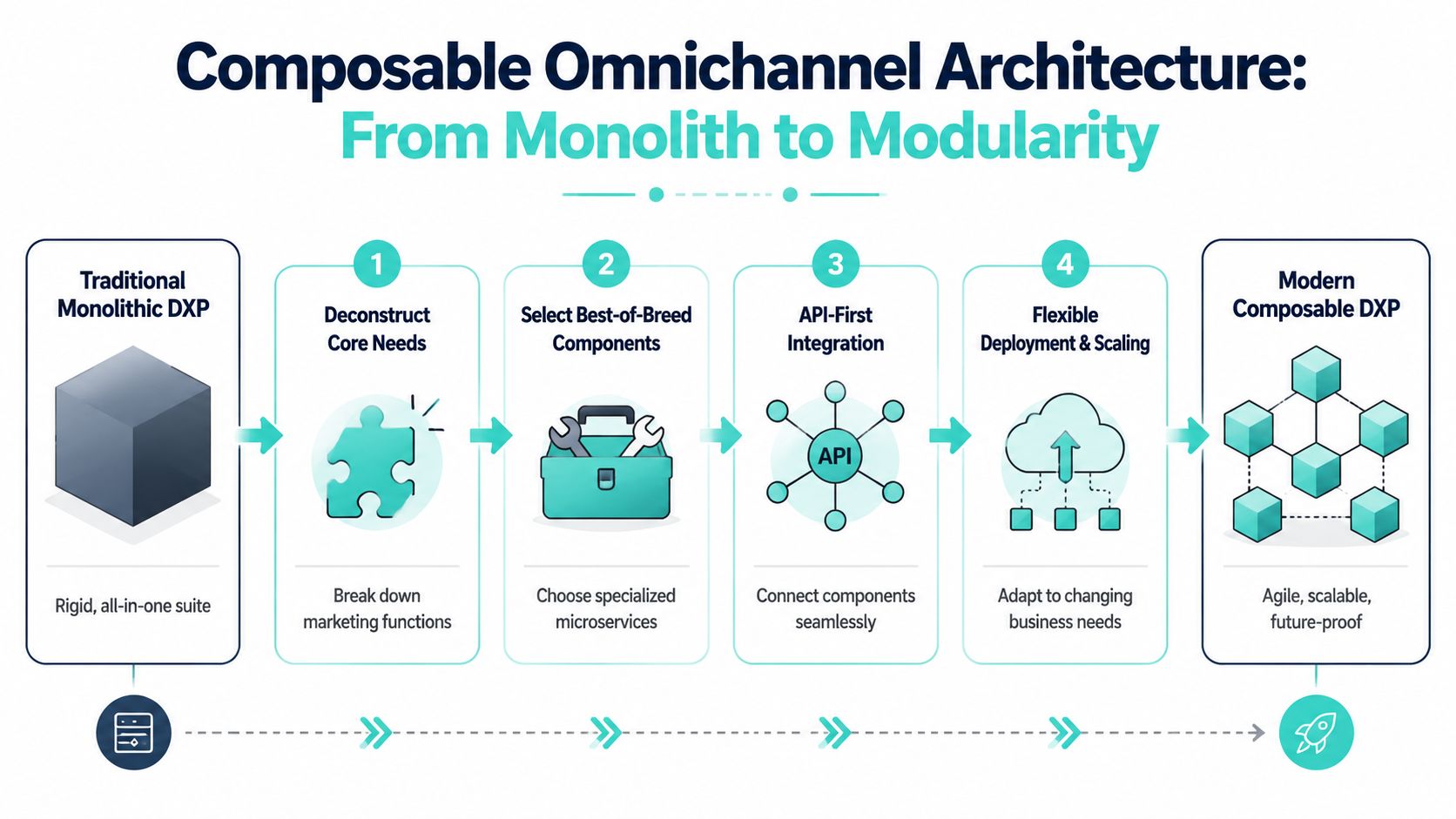
Composable architecture matters because enterprise omnichannel needs change faster than platform replacement cycles. New storefronts appear. Regional teams need different frontends. Service channels evolve. Governance rules tighten. A rigid suite turns every change into a dependency chain.
The more scalable pattern is a modular, API-first architecture with a centralized, channel-agnostic content repository and a unified customer data layer, with headless delivery supporting synchronized experiences across touchpoints, as outlined in WPVIP's write-up on omnichannel content management.
How the Sitecore stack fits together
Sitecore's composable DXP is effective when each product has a clear responsibility.
- XM Cloud: Manages presentation and experience composition for headless delivery.
- Content Hub: Centralizes content operations, taxonomy, asset management, and reuse.
- Sitecore CDP and Personalize: Unify customer understanding and decisioning.
- Search: Improves discoverability and relevance across digital properties.
- OrderCloud: Supports commerce logic, catalog, pricing, and order workflows through APIs.
That model gives enterprise teams room to modernize in phases. They can replace a frontend without rebuilding the content layer. They can change commerce experiences without rewriting customer data logic. They can add channels because the platform exposes services instead of forcing one presentation model.
For teams planning that transition path, Kogifi's article on future-proofing with composable DXP architecture aligns well with the implementation patterns enterprise programs usually need.
Where SharePoint belongs
SharePoint is often underestimated in omnichannel architecture because people only associate it with intranets. In practice, it can play a useful role on the internal side of the content supply chain.
SharePoint works well for internal knowledge, regulated documentation, review workflows, policy libraries, and collaboration spaces that support external experiences indirectly. Product, legal, support, and regional marketing teams often maintain source material there before approved content moves into Content Hub or XM Cloud delivery workflows.
A practical pattern looks like this:
| Internal need | Good fit |
|---|---|
| Knowledge bases and internal docs | SharePoint |
| Enterprise asset and content operations | Content Hub |
| Experience assembly and delivery | XM Cloud |
| Customer profile and decisioning | Sitecore CDP and Personalize |
If omnichannel reporting also depends on historical analysis outside the activation stack, teams usually need a serious data architecture behind the scenes. This overview of Zephony's guide to data warehousing is a useful companion because omnichannel platforms and warehouses solve different problems. One activates journeys. The other supports broader analytical persistence and governance.
What usually fails in implementation
The weak pattern is buying composable products and still operating them like a monolith.
Common failure points include:
- No shared content model: Teams expose APIs, but every channel still creates its own version of the same content.
- No identity strategy: Data flows exist, but profiles don't resolve cleanly enough for orchestration.
- No governance layer: Regions or business units create local exceptions until reuse collapses.
- No service boundaries: Every implementation change touches every system.
The fix isn't more meetings. It's clearer domain ownership.
An Enterprise Checklist for Platform Evaluation
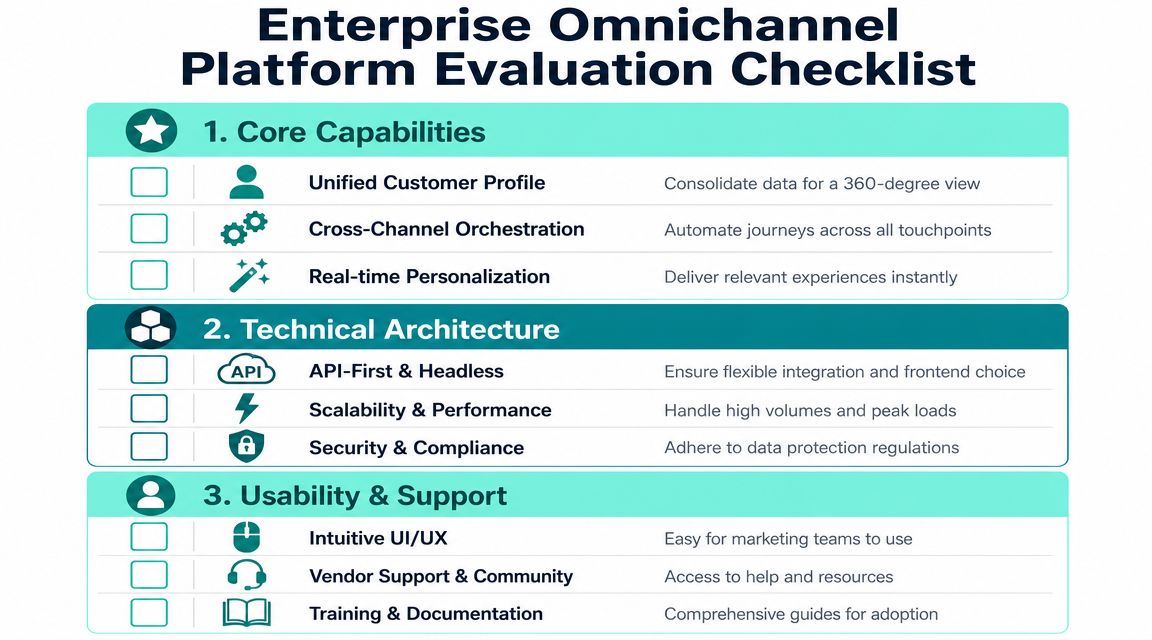
A platform demo looks convincing right up until procurement asks how the stack handles identity, regional governance, or a phased migration from legacy CMS and CRM tools. That is where weak evaluations fail. Enterprise teams need proof that the platform can run under real operational pressure, not just in a scripted sales flow.
For Sitecore, the evaluation should stay tied to the actual composable services you plan to use. XM Cloud, Content Hub, CDP, Personalize, and OrderCloud can solve a lot of the omnichannel problem, but only if the architecture, ownership model, and integration boundaries are clear from the start.
Questions that expose platform limits
Ask for working proof, not feature confirmation.
- Unified customer profile: Can Sitecore CDP resolve a usable profile across web, app, service, and offline signals, or are teams still stitching records together outside the platform?
- Cross-channel orchestration: Can Personalize and adjacent journey tooling react to behavior from another channel, suppress the wrong message, and continue the journey with the right context?
- Content reuse at scale: Can the same approved content object move from Content Hub into multiple delivery experiences without rework by each channel team?
- Headless delivery: Can delivery teams build in the frontend framework they prefer while marketers still retain page assembly, testing, and personalization controls in XM Cloud?
- Integration depth: Are the APIs complete enough to support real implementation patterns, including event ingestion, profile updates, commerce actions, and workflow triggers?
- Governance model: Can global teams control taxonomy, workflow, and shared components while regional teams localize experiences without fragmenting the operating model?
- Operational fit: How are releases, rollback, monitoring, permissions, and audit trails handled once the platform is live?
Teams comparing vendors at procurement stage usually need a stricter scoring model than a standard requirements matrix. A useful reference is this guide on how to evaluate DXP vendors for enterprise needs, especially if your shortlist includes both suite platforms and composable options.
What strong answers look like
Strong answers are specific, observable, and tied to real workflows.
Ask the vendor or implementation team to show one end-to-end scenario. A content team creates a product or service module once. It goes through approval and localization. XM Cloud delivers it to web and app experiences. CDP captures behavior against the same customer record. Personalize changes the next message or offer based on that behavior. That single walkthrough reveals whether the platform actually supports omnichannel execution or just presents connected screens.
I usually separate evaluation criteria by operating group because each group sees different failure points.
| Buying concern | What to verify |
|---|---|
| Marketing team | Authoring flow, experimentation controls, segmentation logic, localization support, approval process |
| Architecture team | API coverage, event model, identity design, composability, security boundaries, deployment model |
| Operations team | Monitoring, auditability, release management, rollback process, support ownership, vendor dependency |
One more trade-off matters. A highly composable stack gives enterprise teams more control over integration patterns and service boundaries, but it also raises the bar for architecture discipline. If the business wants speed with minimal internal platform ownership, that trade-off should be surfaced early instead of discovered halfway through implementation.
Real-World Omnichannel Use Cases
The easiest way to test whether an omnichannel marketing platform is real is to follow one customer or citizen journey and see whether the context survives channel changes. If it doesn't, the platform is still fragmented no matter how polished the interfaces look.

Commerce with shared state across devices
A customer adds products to a basket in a mobile app, reviews specifications later on desktop, and completes checkout after seeing a personalized offer. Behind the scenes, Sitecore OrderCloud manages commerce state through APIs, while XM Cloud presents the experience and Personalize adjusts content or offer logic based on current behavior.
The important part isn't that the cart persists. Many systems can do that. The useful capability is that promotions, recommendations, and suppression rules stay aligned with the same journey rather than being re-triggered independently by each touchpoint.
Public sector service journeys
Public sector and education organizations often have a harder omnichannel problem than retailers because the journey includes forms, service updates, appointments, and internal handoffs. A citizen might start a permit request online, receive status messages, return through a self-service portal, and then attend an in-person appointment.
A composable Sitecore setup supports this by separating concerns. XM Cloud handles front-end delivery and accessibility-focused experience design. Content Hub manages reusable service content. Customer and case events can feed orchestration logic so communications stay tied to service progress rather than generic campaign timing.
Video can help teams visualize these connected experiences in a simpler way:
Global brand governance without local bottlenecks
Global brands often struggle less with technology than with scale and governance. Headquarters wants brand consistency. Regional teams need language, product, legal, and campaign flexibility. Traditional CMS setups push that conflict into duplicated sites and manual governance.
Sitecore handles this well when teams use shared content models, centralized assets in Content Hub, and localized experience delivery in XM Cloud. Regions can adapt approved components instead of rebuilding them. AI-driven personalization can respond to local behavior patterns while still operating inside centrally defined rules.
Global omnichannel only works when governance is built into the platform. If governance lives in spreadsheets and approval emails, scale breaks first.
How to Measure Omnichannel Marketing ROI
Most omnichannel ROI discussions fail because they assume attribution should stay simple while the customer journey gets more complex. That's why enterprise teams often end up arguing over last-click reports that everyone knows are incomplete.
The harder question isn't whether omnichannel improves outcomes in a broad sense. It's whether the platform itself created incremental value, or whether better results merely happened alongside a large transformation effort. The American Marketing Association notes that a major challenge is proving the incremental ROI of an omnichannel platform because overlapping digital and physical touchpoints make uplift hard to isolate, even when teams track KPIs such as retention and AOV. The deeper gap is attribution governance, as discussed in AMA's overview of omnichannel marketing.
Why last-click keeps failing enterprise teams
Last-click reporting breaks for obvious reasons in omnichannel environments.
- Offline actions interfere with digital credit: Store visits, call center interactions, and field events change outcomes without fitting neatly into channel reports.
- Journeys overlap: Email, paid media, app engagement, and onsite behavior influence one another.
- Cross-device identity complicates causality: The same person appears as different sessions unless identity resolution is strong enough.
That doesn't mean measurement is impossible. It means the platform has to support a more disciplined model.
A practical measurement model
Start with measurement design, not dashboards.
- Define the business event clearly. Identify what counts as meaningful outcome for each journey. Purchase, application completion, repeat engagement, service completion, or another operational endpoint.
- Create exposure rules. Document which audiences entered the orchestrated experience, which did not, and what suppressions applied.
- Track journey-level outcomes. Don't just report email metrics or web conversions. Report progress across the full path.
- Use holdouts and controlled comparisons where possible. That's how teams get closer to incremental understanding rather than correlation.
- Separate platform ROI from campaign ROI. One measures infrastructure value. The other measures execution quality.
A unified Sitecore setup helps because identity, content exposure, decisioning, and interaction events are easier to align when they live in a connected operating model. That still doesn't eliminate governance work. Teams need clear definitions, test discipline, and reporting ownership. But it gives them the data foundation needed to ask better questions.
For teams formalizing that process, this guide on how to measure ROI is a practical next read.
If your customer journey is fragmented across content, commerce, data, and internal systems, the fix usually starts with architecture before it shows up in campaigns. Kogifi works on Sitecore, AI-driven personalization, composable DXP design, and SharePoint-connected enterprise workflows to help teams turn disconnected touchpoints into one operating model.