


Managed cloud services are essentially a strategic partnership. You hand over the keys to your cloud infrastructure, applications, and daily operations to a third-party provider who lives and breathes this stuff. This means your team is no longer bogged down with server maintenance or late-night security patching. Instead, an expert partner ensures your Sitecore or SharePoint digital experience platform (DXP) is running at peak performance, 24/7. It's a fundamental shift from shouldering in-house IT burdens to benefiting from expert oversight.
Unlocking DXP Potential with Managed Cloud Services
Think of your powerful Sitecore or SharePoint DXP as a high-performance vehicle. Your marketing and development teams are the skilled drivers, but they shouldn't have to be expert mechanics, too. Managed cloud services act as your dedicated pit crew, handling all the complex engine tuning—from server configurations and network security to performance optimization. This frees up your team to focus solely on winning the race for customer engagement.
This approach takes the immense technical weight of cloud infrastructure management off your shoulders. Instead of reacting to server outages or spending weeks applying security updates, your internal teams can get back to their core mission: creating exceptional customer experiences. For a better sense of the provider's role, it helps to understand what a Managed Service Provider is and how they operate.
The Focus on Sitecore and SharePoint Expertise
When you're running platforms like Sitecore, with its complex portfolio of XM Cloud, Content Hub, Sitecore CDP, and Personalize, generic cloud management just won't cut it. A specialized provider understands the unique architectural demands of these systems. They know precisely how to configure Azure environments for optimal Sitecore performance, manage database indexing efficiently, and ensure the entire ecosystem communicates without a hitch.
The same goes for a SharePoint environment, whether it's on-premises or in Microsoft 365. It requires expert oversight to keep collaboration flowing and security tight. Managed services ensure permissions are configured correctly, data is protected according to compliance standards, and the platform remains stable and accessible for your entire organization.
The core value of managed cloud services is transforming your DXP from a complex technical asset into a reliable business growth engine. It’s about ensuring the underlying technology is not just running, but running optimally to support your strategic goals.
This strategic partnership delivers more than just technical support; it offers peace of mind. By entrusting your infrastructure to specialists, you gain:
- Proactive Monitoring: Experts spot and resolve potential issues long before they can impact your users or business operations.
- Enhanced Security: Your DXP is fortified with enterprise-grade security protocols, managed by teams who live and breathe threat detection and prevention.
- Guaranteed Scalability: Your platform can effortlessly handle sudden traffic spikes from marketing campaigns or seasonal demand without breaking a sweat.
- Cost Optimization: You shift from unpredictable capital expenditures to a predictable operational cost model, paying only for the resources you actually need.
Ultimately, bringing on a managed cloud services partner allows you to maximize your investment in sophisticated platforms like Sitecore and SharePoint. If you're ready to dig deeper, our detailed guide offers more insights into a successful managed service strategy.
The Business Case for Managed Sitecore and SharePoint
Moving your DXP to a managed cloud isn't just an IT upgrade—it's a core business decision that directly fuels your marketing ROI, sharpens operational efficiency, and strengthens your bottom line. For organizations running sophisticated platforms like Sitecore or SharePoint, the conversation quickly moves beyond server uptime and into the realm of digital growth. It’s all about freeing up your teams to hit their goals without getting tangled up in technical constraints.
Picture this: your marketing team is launching a global campaign on your Sitecore DXP. Instead of nervously watching server load monitors, they're digging into campaign analytics and engaging with customers. That peace of mind comes from knowing an expert partner is in the background, ready to scale resources instantly to handle a massive traffic spike. The goal is to make the technology fade into the background, so your business strategy can shine.
It's a similar story for businesses that rely on SharePoint for daily collaboration and data management. The security of that information is everything. A managed services provider doesn't just set up security protocols; they live and breathe them, implementing and maintaining everything from advanced threat detection to identity access management. This breaks your internal IT staff out of the endless cycle of patching and monitoring, letting them focus on bigger projects that actually move the business forward.
From Capital Expenditure to Strategic Investment
One of the most powerful arguments for managed cloud services is the shift in how you handle the finances. Traditional on-premises setups demand massive Capital Expenditure (CapEx)—huge, upfront investments in hardware that starts depreciating the moment you plug it in and needs constant maintenance. It's a rigid, slow-to-adapt model that just doesn’t fit today’s pace.
Managed services flip the script to a predictable Operational Expenditure (OpEx) model. You pay a consistent fee for the services you actually use, making budgeting far simpler and more accurate. This pivot delivers some serious advantages:
- Cost Predictability: Say goodbye to surprise bills from hardware failures or emergency maintenance. Financial planning becomes much more stable.
- Reduced Total Cost of Ownership (TCO): When you add up the costs of hardware, software licenses, IT salaries, and even power consumption, a managed model often comes out ahead.
- Resource Optimization: You pay only for what you need. Scaling resources up or down on demand means you’re not wasting money on over-provisioned servers.
This financial agility is a huge reason the market is booming. The global cloud managed services market is projected to skyrocket to USD 482.93 billion by 2034, growing at a steady 13.4% compound annual growth rate (CAGR). This isn't just a trend; it's a fundamental shift away from old-school IT. As detailed in the full cloud managed services report, businesses are choosing agility and expertise over the burden of managing everything in-house.
Comparing Self-Managed vs Managed Cloud for Your DXP
Choosing how to host and manage your Sitecore or SharePoint instance is a critical decision. It’s not just about where your servers are located; it’s about who is responsible for keeping your entire digital experience running smoothly. The table below breaks down the key differences between going it alone and partnering with a managed cloud provider.
Ultimately, the choice comes down to strategy. A self-managed approach offers total control but demands significant investment in resources and expertise. A managed cloud model, on the other hand, lets you offload the heavy lifting so you can focus on what you do best: growing your business.
Maximizing Performance and Uptime
For any DXP, performance is money. Slow-loading pages or—even worse—unexpected downtime during a holiday sale or product launch can be catastrophic for your revenue and brand. Managed services for Sitecore and SharePoint are built from the ground up to prevent these disasters by focusing on proactive performance optimization.
A specialized managed services partner doesn't just keep the lights on; they fine-tune the entire environment—from database queries to caching strategies—specifically for your platform's unique architecture, ensuring peak performance when it matters most.
This expert oversight delivers real, tangible business results. By guaranteeing near-perfect uptime and lightning-fast scalability, managed services become a direct enabler of digital growth. Your marketing teams can launch ambitious campaigns with confidence, knowing the platform can handle it. Your sales teams can count on a stable, high-performing system to drive conversions. It’s about transforming your DXP from a potential headache into your most reliable asset for winning online.
Choosing the Right Cloud Model for Your DXP
Picking the right cloud model for your Digital Experience Platform (DXP) is a lot like deciding how you want your pizza. Are you making it from scratch, using a pre-made kit, or ordering delivery? Each choice—Infrastructure as a Service (IaaS), Platform as a Service (PaaS), and Software as a Service (SaaS)—comes with a different level of control and convenience.
This isn’t just a technical detail. For a powerhouse DXP like Sitecore Experience Platform (XP), your choice directly shapes your platform's flexibility, performance, and long-term potential. You have to match the model to your real-world technical needs.
IaaS: The Foundation for Custom Builds
Infrastructure as a Service (IaaS) is the “make it from scratch” pizza option. Your cloud provider gives you the kitchen essentials: the oven (servers), the fridge (storage), and the countertops (networking). You’re responsible for everything else—the dough (operating system), sauce (middleware), and all the toppings (your DXP application and data).
This model gives you ultimate control. Your team manages everything from the OS upward, which is often the go-to for complex DXP deployments.
- Total Architectural Control: You can fine-tune virtual machines, networking, and storage to meet Sitecore’s exact best practices, squeezing every last drop of performance out of features like xDB.
- Custom Security: Need to meet specific compliance or governance rules? IaaS lets you build bespoke security protocols from the ground up.
- Legacy Integration: It provides the raw flexibility required to connect your DXP to older, on-premise systems that aren’t built for the cloud.
Imagine you're setting up a sophisticated, multi-server Sitecore XP environment on Azure. With IaaS, you have the final say on load balancing, firewall rules, and database connections, letting you architect the setup for peak performance.
PaaS: The Balanced Approach for Sitecore and SharePoint
Platform as a Service (PaaS) is your "take-and-bake" pizza kit. The shop gives you the prepared crust and sauce (the platform, including the OS, runtime, and middleware). All you have to do is add your own cheese and toppings (your application and data) and pop it in the oven.
Microsoft Azure is a natural fit for Sitecore and SharePoint, offering excellent PaaS options like Azure App Service and Azure SQL Database. These services are practically tailor-made for hosting modern DXP and CMS solutions, dramatically cutting down your team's management workload.
With PaaS, your team is freed from the endless cycle of patching operating systems and managing server hardware. They can focus purely on optimizing the Sitecore or SharePoint application, which means faster development and better features for your users.
Deploying Sitecore on Azure PaaS means you push your application to a pre-configured web environment. Microsoft handles server health, security patches, and scaling, while your team gets to focus on what they do best: managing the Sitecore code and configuration. For many enterprise DXPs, this is the sweet spot.
SaaS: The Hands-Off Model for Modern DXPs
Software as a Service (SaaS) is the "pizza delivery" option. You just place an order, and a ready-to-eat pizza shows up at your door. The provider manages everything—the kitchen, the ingredients, the baking, and the delivery. You just enjoy the final product.
This is the model behind today's composable DXPs, like Sitecore XM Cloud. Sitecore manages the entire underlying infrastructure and the core CMS. Your team never has to think about servers or databases; their entire focus is on creating content and building incredible front-end experiences. If you want to see how this approach changes the game, our dedicated article offers more details on the advantages of a cloud based CMS.
Likewise, SharePoint Online (part of Microsoft 365) is a pure SaaS solution. Microsoft handles all the backend complexity, from security updates to server maintenance. Your organization gets to focus solely on collaboration and document management, always armed with the latest features and security without any of the operational headaches.
Your DXP Cloud Migration and Modernization Plan
Moving a powerful Digital Experience Platform (DXP) like Sitecore or SharePoint to the cloud is much more than a simple "lift and shift." It's a strategic modernization project, and like any major undertaking, it demands a rock-solid plan. A well-planned migration transforms your DXP from a legacy system into a flexible, scalable engine for future growth.
This whole process kicks off not with servers, but with strategy. Before you move a single piece of data, you need a complete audit of your current architecture. This audit maps out everything—custom code, third-party integrations, data structures, and content dependencies. It’s the blueprint you need to set clear, measurable business goals for the migration.
Laying the Groundwork for a Seamless Transition
Once your objectives are clear, the focus shifts to the technical side of things. This is where you'll pick the right cloud provider, like Azure for its native integration with Sitecore and SharePoint, and build out a detailed roadmap. For a smooth migration, it helps to understand the bigger picture of complex IT moves; looking into data center migration best practices can offer some really valuable insights.
This stage is where a managed cloud services partner truly proves their worth, helping you navigate the big decisions:
- Phased Migration Strategy: A risky "big bang" cutover is almost never the answer. Instead, a phased approach is the way to go. This means migrating components or user groups bit by bit, allowing for testing and validation at each step to keep business disruption to an absolute minimum.
- Data Migration Planning: The plan has to spell out exactly how you'll move terabytes of data with as little downtime as possible. This includes strategies for data cleansing, synchronization, and validation to make sure everything arrives in the new cloud environment intact.
- Security Framework Implementation: Security can't be an afterthought. From day one, the plan must bake in strong security protocols, including identity and access management (IAM), network security groups, and end-to-end data encryption.
The Modernization Mindset Beyond Migration
The real goal here isn't just to copy your current setup in a new location; it's to modernize it. This is your chance to refactor applications to be more cloud-native, say goodbye to outdated modules, and get the platform ready to take full advantage of cloud services.
A successful migration uses the move to the cloud as an opportunity to shed technical debt and re-architect for performance. It's about building the DXP you need for the next five years, not just moving the one you have today.
This forward-looking approach is why so many organizations are turning to managed services. The market for managed cloud services is growing fast. Revenue is projected to jump from just under $11 billion in 2021 to $26 billion by 2026. A staggering 73% of companies plan to lean more heavily on these partners, mostly because finding and keeping in-house cloud experts is so tough.
The diagram below shows how cloud models progress, from basic infrastructure all the way to fully managed software.
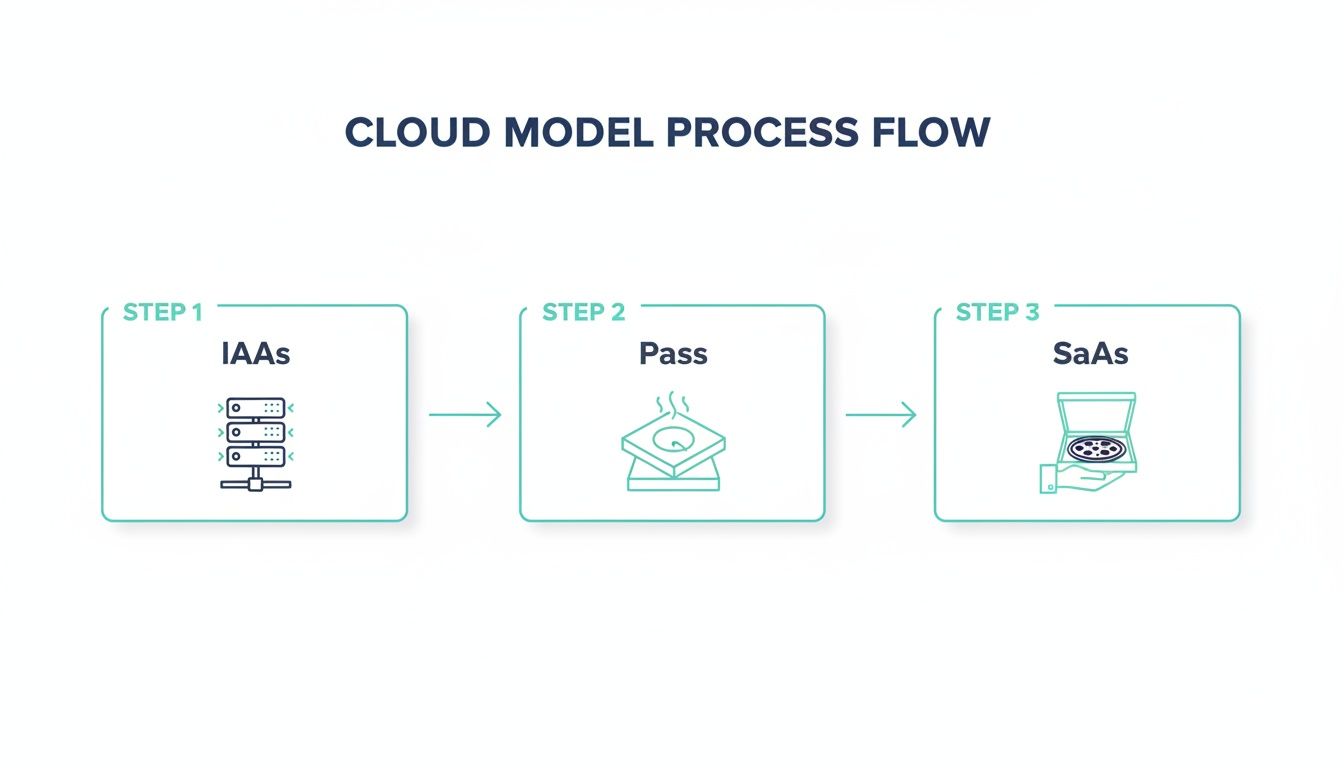
This flow shows how each model takes more of the operational load off your shoulders, freeing up your team to focus on work that actually drives the business forward.
A detailed plan, guided by expert partners, ensures your migration journey is smooth, secure, and strategically sound. To help you get started, we've put together a comprehensive digital platform migration checklist with 12 critical steps that walks you through the essential phases. This structured approach helps guarantee your DXP comes out the other side more powerful and resilient than ever.
Fortifying Your DXP with Managed Security and Compliance

For any enterprise DXP handling sensitive customer data, security isn't just a feature—it's the foundation of trust. But for most in-house teams, keeping up with a relentless stream of new threats is a monumental task. This is where managed cloud services become less of a convenience and more of a necessity. They offer a stronger, more resilient defense than most organizations could ever build on their own.
Think of it like upgrading from a simple lock on your front door to a full-fledged security command center. A specialized partner doesn’t just react to threats; they proactively build a defense system with multiple layers, all tailored to the unique architecture of platforms like Sitecore and SharePoint. This expert oversight turns security from a defensive chore into a real competitive advantage.
Building a Multi-Layered Security Strategy
Modern security is about much more than just a firewall. For a complex platform like Sitecore, which often integrates with other systems like Sitecore CDP and Content Hub, a comprehensive strategy is non-negotiable. A managed services partner puts a defense-in-depth model in place that shields every single layer of your DXP.
This proactive approach includes several critical components:
- 24/7 Threat Monitoring and Intrusion Detection: Expert teams use advanced tools to watch network traffic and system logs around the clock, spotting and neutralizing potential threats before they can do any harm.
- Robust Identity and Access Management (IAM): They strictly enforce the principle of least privilege, making sure users and applications only get access to the resources they absolutely need. This is crucial for protecting the Sitecore back-end and sensitive SharePoint document libraries.
- End-to-End Data Encryption: All data is encrypted using industry-standard protocols, whether it's sitting in a database or moving between services. This makes it completely unreadable to anyone without authorization.
- Regular Vulnerability Scanning and Patching: The provider systematically scans for weaknesses and applies security patches right away, closing off attack vectors before hackers can exploit them.
For businesses that rely on the full Sitecore ecosystem, this level of protection is essential. We dive deeper into building a secure foundation in our article on cloud security for Sitecore DXP.
Navigating the Complexities of Compliance
Staying compliant with regulations like GDPR, CCPA, and HIPAA is a tough, ongoing challenge. The rules are strict, they’re always changing, and the penalties for getting it wrong are severe. A managed services partner acts as your compliance co-pilot, making sure your platform's infrastructure meets these critical standards.
A specialized partner like Kogifi doesn't just provide secure infrastructure; they provide a compliant one. They understand the specific requirements for data residency, access controls, and audit logging that these regulations demand, and they build them directly into your managed environment.
Globally, public cloud spending is on track to hit $723.4 billion in 2025. A huge driver for this growth is the security boost companies see after moving to the cloud—a staggering 94% of companies report improvements. With 96% of businesses now using the public cloud and storing 60% of their data there, the role of managed services in securing these environments has never been more important. This expertise frees your team from the complex legal and technical burdens of compliance, letting them focus on what they do best.
How to Select the Right Sitecore Managed Services Partner
Choosing a partner for your managed cloud services is the single most important decision you'll make in this entire process. You’re not just finding a vendor to keep the servers running. You’re selecting a strategic partner who will become an extension of your own team, someone dedicated to getting the most out of your DXP investment.
A generic, one-size-fits-all provider just won't cut it. You need a team with proven, deep-in-the-weeds expertise in the specific platforms you depend on every day.
For any business running on Sitecore, this means looking far beyond basic cloud certifications. The right partner needs to have a profound understanding of the entire Sitecore ecosystem. They have to live and breathe the intricacies of its architecture, from the composable power of Sitecore XM Cloud to the data-driven capabilities of Sitecore CDP and Personalize.
Beyond the Generic Checklist
To find a true strategic partner, you have to ask questions that cut right through the surface-level sales pitches. Generic checklists are not enough. Your evaluation should be a deep dive into their practical, hands-on experience with platforms as complex as Sitecore and SharePoint.
Here are the critical areas to investigate:
- Comprehensive Sitecore Ecosystem Fluency: Does the partner have documented, successful projects involving not just Sitecore XM, but also Content Hub ONE, Sitecore CDP, and Personalize? Their ability to manage the full, integrated DXP is a clear sign of real expertise.
- Architectural Performance Tuning: Ask them to describe their process for optimizing a large-scale Sitecore installation. A top-tier partner will immediately start talking about database indexing strategies, the trade-offs between Solr and Azure Search, and advanced caching configurations specific to Sitecore.
- SharePoint Solutions Expertise: For SharePoint, their knowledge should extend way beyond basic administration. Ask about their experience with custom SharePoint Framework (SPFx) solutions, Power Platform integration, and managing complex security and compliance requirements for sensitive corporate data.
Verifying Deep Expertise and Support
Proven experience is all about tangible evidence. Don't just take their word for it; make them show you proof that they can handle the technical and operational demands of your DXP. This is where you separate the real contenders from the pretenders.
Selecting a partner is an investment in shared success. Look for a team that is as committed to your business outcomes—like conversion rates and customer engagement—as they are to server uptime.
Look for these non-negotiable qualifications:
- Certified Development Team: A roster of certified Sitecore and Microsoft developers shows a genuine commitment to the technology. It’s your assurance that they're following best practices.
- Robust 24/7 Support with Clear SLAs: Examine their Service Level Agreements closely. They should offer clear, financially-backed guarantees for response times and issue resolution, ensuring you have expert support exactly when you need it.
- A Portfolio of Large-Scale Deployments: Ask for case studies or references from clients with deployments similar in scale and complexity to your own. This is the ultimate proof of their ability to deliver results under pressure.
By using this rigorous framework, you can move beyond a simple vendor relationship. You will find a true partner who understands the immense potential of your DXP and has the deep expertise required to help you fully realize it.
Frequently Asked Questions
When you're diving into managed cloud services, a few questions always seem to pop up, especially when platforms like Sitecore and SharePoint are involved. Let's clear up some of the common points of confusion with straightforward answers.
Choosing between a one-time project and an ongoing partnership is a big decision, and it helps to know that the two serve very different—yet complementary—purposes.
What Is the Difference Between Managed Cloud and Cloud Consulting?
Think of cloud consulting as bringing in an architect to draw up the blueprints for your new digital headquarters. It's a project-based engagement where they map out the strategy, design the architecture, and hand you a detailed migration plan. Once the plan is delivered, their job is usually done.
On the other hand, managed cloud services is the long-term partnership that kicks in after the foundation is laid. This is the team that takes over the day-to-day responsibility for keeping your cloud environment running at peak performance. They handle management, security, and optimization long after the initial setup is complete.
Can Managed Services Help My Sitecore Instance Run Faster?
Absolutely. In fact, this is one of the biggest reasons businesses running Sitecore make the switch. A specialized partner does far more than just basic server upkeep; they deliver real, tangible performance boosts.
A team that truly knows Sitecore will proactively monitor your application, optimize sluggish database queries, and fine-tune caching strategies tailored to Sitecore's unique architecture. This constant attention leads directly to faster page loads, a more stable platform during traffic spikes, and a much better experience for your users.
How Do Managed Services Handle Security for SharePoint Online?
While Microsoft gives you a rock-solid security foundation with SharePoint Online, a managed services provider adds critical, advanced layers of security on top of that.
This isn't just about ticking boxes. It means configuring advanced threat protection, carefully managing user access rights based on the principle of least privilege, and actively monitoring for any suspicious activity. They also ensure your specific SharePoint setup is perfectly aligned with tough compliance standards like GDPR or HIPAA.
At Kogifi, we live and breathe the complexities of Sitecore and SharePoint. Our managed cloud services are designed by experts, for experts. Learn how our dedicated teams can optimize your DXP's performance, security, and scalability.