


A managed cloud service is essentially your dedicated technical crew, taking complete ownership of managing, securing, and fine-tuning your cloud infrastructure. This lets your internal teams get back to focusing on what they do best—driving business growth—instead of getting bogged down in server maintenance and late-night troubleshooting.
What a Managed Cloud Service Really Means
Let's ditch the jargon for a minute. Think of your Sitecore DXP as a world-class orchestra. You could hire every musician yourself, manage their schedules, tune each instrument, and fuss over the concert hall's acoustics. Or, you could hire an expert conductor to handle the entire ensemble, making sure every single note is played to perfection.
A managed cloud service is that conductor for your digital platforms. It's a true partnership where a specialized provider handles all the complex, behind-the-scenes work. This means they’re responsible for infrastructure management, 24/7 monitoring, security hardening, and constant performance tuning. The end result? Your team can focus on creating brilliant digital experiences, not wrestling with server configurations.
For powerful platforms like Sitecore and SharePoint, where uptime and speed have a direct line to your bottom line, this shift is a total game-changer. You’re no longer just managing infrastructure; you're managing outcomes. A managed cloud service with deep Sitecore and SharePoint expertise ensures that your investment in these powerful platforms delivers maximum ROI by optimizing performance, security, and scalability.
The Conductor for Your Digital Experience Platform
The real value here is specialized knowledge. A generic cloud provider gives you the stage and the lights, but a managed service provider with deep Sitecore expertise knows exactly how to make your DXP sing. They understand the subtle nuances of every platform, from Sitecore XP and XM to the latest composable solutions like Sitecore XM Cloud, OrderCloud, and Content Hub. If you want to dig deeper into the core concept, this guide on What Is Managed IT Services? is a great resource.
This expert-led approach covers critical areas that general IT support often misses:
- Platform-Specific Tuning: Optimizing Sitecore's xDB performance, configuring search with Solr or SearchStax, or tuning a SharePoint farm for heavy collaboration isn't a job for a generalist. It requires deep, application-level knowledge.
- Proactive Security: Instead of just reacting to threats, a managed partner hardens the environment specifically against vulnerabilities known to target Sitecore or SharePoint, implementing best practices for user roles and permissions.
- Cost Governance: They actively manage and "right-size" your resources, putting a stop to the uncontrolled cloud spend that can easily spiral out of control, ensuring your Sitecore or SharePoint TCO is optimized.
- 24/7 Expert Support: When something goes wrong, you get an engineer on the line who actually understands your Sitecore or SharePoint architecture, not just the servers it runs on.
Delivering on the promise of seamless, integrated digital experiences requires a rock-solid and perfectly tuned infrastructure. That’s precisely what a managed cloud service provider delivers. This foundation is non-negotiable for any organization looking to get the most out of its investment in a powerful cloud-based CMS like Sitecore.
Choosing Your Cloud Operating Model for Sitecore and SharePoint
Picking the right cloud strategy for your digital platform isn't just a technical detail—it's a core business decision. For heavy-hitting systems like Sitecore and SharePoint, your choice of operating model has a direct line to performance, security, and cost. More importantly, it determines where your team spends its most valuable asset: its time.
Generally, you're looking at three main paths: doing it all yourself with unmanaged infrastructure, partnering with an expert for a managed cloud service, or going all-in with a Software-as-a-Service (SaaS) solution. Each option draws a different line in the sand for who does what.
Unmanaged Cloud: The DIY Approach
Think of the unmanaged or Infrastructure-as-a-Service (IaaS) model as being handed the keys to a massive, state-of-the-art workshop. A provider like Azure or AWS gives you all the raw materials—servers, storage, networking—but you’re the one who has to build, secure, and maintain everything.
This path can work wonders if you have a seasoned, in-house DevOps team that thrives on cloud architecture and security protocols. For them, the total control is a huge advantage. But when you're running a beast as complex as Sitecore, it means your team is on the hook for absolutely everything:
- Architecting the environment from the ground up to support Sitecore’s unique distributed roles (Content Delivery, Content Management, Processing, etc.).
- Applying every security patch and hardening the infrastructure against constant threats.
- Configuring and fine-tuning complex puzzle pieces like Solr, Redis, and SQL databases for optimal Sitecore performance.
- Managing all backups, planning for disaster recovery, and being on-call for 24/7 monitoring.
For most organizations, this level of responsibility pulls skilled engineers away from innovation and into a constant cycle of just "keeping the lights on."
Managed Cloud Service: The Expert Partnership
A managed cloud service is less of a rental and more of a strategic partnership. You bring your application—your Sitecore DXP or SharePoint farm—and the provider builds and runs the perfect, high-performance environment for it. They take full ownership of the infrastructure, security, and day-to-day maintenance, freeing up your team to focus purely on what they do best: improving the application itself.
This is the sweet spot for companies that need the full power and customizability of a platform like Sitecore XP but want to offload the immense operational headache. A good managed service provider brings deep, platform-specific expertise to the table. They aren't just server admins; they're Sitecore and SharePoint specialists who get the unique demands of these systems.
This model is often the only sensible choice for complex setups, including a highly customized Sitecore DXP or a composable architecture integrating products like Sitecore OrderCloud or Content Hub. Many also find that automating infrastructure with code is essential here; you can learn more about the leading IaC tools for multi-cloud environments in our detailed guide.
A managed service transforms your cloud investment from a raw utility into a fully supported solution. It’s the difference between buying car parts and being handed the keys to a high-performance vehicle with a dedicated pit crew on standby.
Public Cloud SaaS: The All-in-One Solution
The third route is the pure SaaS or Platform-as-a-Service (PaaS) offering, like Sitecore XM Cloud or SharePoint Online. In this model, the vendor handles everything—the servers, the platform, and the application software. You just subscribe and get to work.
This approach offers the ultimate simplicity and the lowest operational footprint. Updates, security, and infrastructure are all managed for you behind the scenes. The trade-off? Control and customization. While you can certainly extend these platforms, you're ultimately playing inside the vendor’s sandbox.
For businesses whose needs fit neatly into the out-of-the-box solution, SaaS is a fantastic, hassle-free option. But for those with complex integrations or heavy customizations, the managed model often strikes a much better balance between power and practicality.
To really spell out the differences, let's look at who handles what in each model.
Cloud Service Model Responsibility Matrix for Sitecore and SharePoint
This table breaks down who is responsible for key operational tasks, making it easier to see the division of labor between your team and your provider in each scenario.
Ultimately, choosing the right model comes down to an honest look at your team's skills, your business goals, and your appetite for risk. When you align these factors, you ensure your Sitecore or SharePoint platform is built on a foundation that truly supports your digital ambitions, rather than getting in the way of them.
The Business Case for Managed Services
Moving to a managed cloud service isn't just an IT decision; it’s a strategic business move that turns technical perks into tangible results. For complex platforms like Sitecore and SharePoint, the line between expert management and business value is direct and easy to measure. This is all about converting technical performance into higher revenue, tighter security, and predictable financial planning.
The whole process often starts with a simple question: who should be in charge of your cloud environment? This decision tree helps visualize the main paths you can take, depending on who handles the day-to-day operational grind.
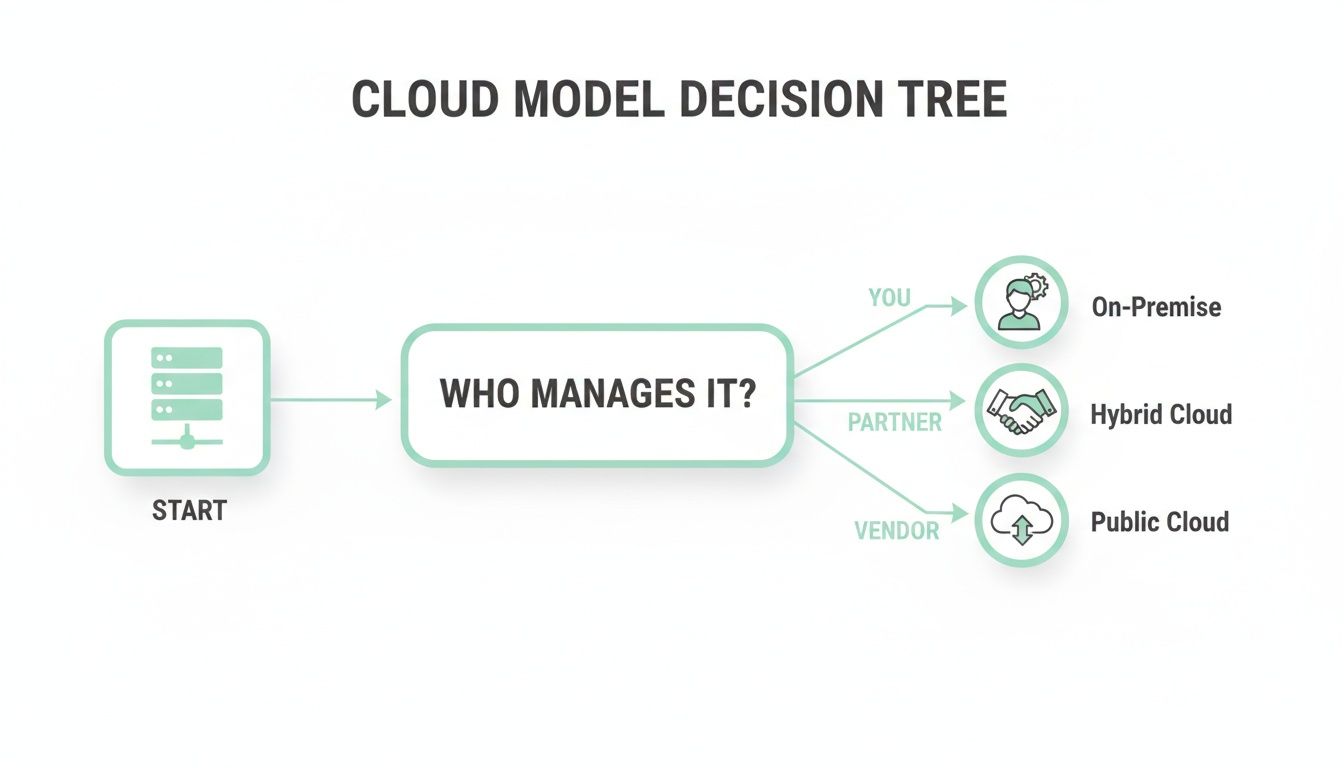
As the diagram shows, choosing a managed partner means you're intentionally handing over infrastructure control to gain specialized operational excellence. This choice has major implications for both your finances and your platform’s performance.
From Performance Tuning to Profit
For a Sitecore website, speed isn’t just a nice-to-have—it's essential. Proactive performance tuning from a managed service provider directly impacts your bottom line. Faster page load times and better Core Web Vitals lead to higher search engine rankings, lower bounce rates, and, ultimately, more conversions.
Think about an e-commerce site running on Sitecore Commerce or OrderCloud. A specialist provider knows exactly how to configure the Redis cache to serve up product pages instantly during a flash sale. That's the kind of expertise that prevents slowdowns, which are a notorious cause of abandoned carts and lost revenue.
A specialized partner understands how to optimize resources effectively, often leading to significant cost savings. By right-sizing infrastructure and eliminating waste, businesses can reinvest funds into innovation rather than just keeping the lights on.
The Financial Advantage of Predictability
One of the biggest headaches of cloud adoption is the unpredictable billing. A surprise invoice from Azure or AWS can completely derail budgets and create serious financial uncertainty. A managed cloud service flips this chaotic capital expenditure into a stable, predictable operational expense (OpEx).
Instead of reacting to fluctuating monthly bills, you invest in a consistent, budgeted service fee. This model gives you financial clarity and allows for more accurate forecasting, which is a significant win for any finance department.
This shift is a game-changer for long-term planning. It lets you build a reliable financial model around your digital platforms without constantly worrying about unexpected spikes in infrastructure costs. Building a solid business case depends on grasping these benefits, and this guide on unlocking cloud computing benefits for SMEs offers some great insights.
Mitigating Risk with Specialized Expertise
Beyond performance, a managed service is an investment in risk mitigation. The knowledge needed to secure a sprawling SharePoint environment with external user access or to properly configure Sitecore xDB is incredibly specialized. A generalist IT team, no matter how talented, often lacks the deep, platform-specific experience to head off threats before they become problems.
Consider where this focused expertise prevents expensive headaches:
- Sitecore Stability & Security: Knowing how to configure roles, permissions, and infrastructure to protect against common vulnerabilities, and how to optimize Solr indexing to keep search performance snappy as your content library grows.
- SharePoint Governance: Implementing the correct Data Loss Prevention (DLP) policies and information architecture to stop sensitive information from being shared inappropriately and keep the environment organized.
- Compliance: Ensuring the infrastructure meets industry-specific regulations like GDPR or HIPAA, which demands constant vigilance and very specific configurations for both Sitecore and SharePoint data.
This expertise prevents costly downtime, data breaches, and compliance failures. The investment in a managed service quickly pays for itself by helping you avoid the financial and reputational damage of a single major incident.
Ultimately, the business case is clear: you're not just outsourcing IT tasks. You're investing in reliability, security, and the specialized knowledge needed to make sure your platform is contributing directly to your business goals. For a deeper dive into the financial side, check out our article on how to measure ROI for digital projects.
Finding the Right Partner for Your Digital Experience Platform
Choosing a managed cloud provider is a lot more than a simple technical purchase; it’s the start of a critical partnership. When you’re talking about platforms as central to your business as Sitecore or SharePoint, the right partner feels like an extension of your team. The wrong one can become a constant headache.
Your vetting process has to go deeper than just promises of uptime. The real value of a managed cloud service is in its platform-specific expertise. When your digital experience platform is on the line, generic infrastructure support just won't cut it.
Asking Questions That Reveal True Expertise
A generic provider might guarantee 99.9% uptime, but a true Sitecore specialist can tell you exactly how they’ll achieve it. To tell the experts from the generalists, you need to ask pointed, application-aware questions that really test their depth of knowledge.
Move beyond the basics and dig into their understanding of your platform’s unique quirks. For instance, instead of asking about server monitoring, try these more revealing questions:
- For Sitecore: "What is your proactive strategy for tuning Sitecore xDB performance to prevent slowdowns during peak marketing campaigns? How do you handle a zero-downtime deployment for a production CD environment?"
- For SharePoint: "Can you describe your exact process for securing a SharePoint environment that requires external user access, including your approach to permissions and data loss prevention?"
- For Sitecore's Composable Stack: "How do you manage deployments and scaling for a composable DXP architecture using Sitecore XM Cloud, OrderCloud, and Content Hub? Describe your monitoring approach for this headless architecture."
The quality of their answers—the detail, the confidence, the specific examples—will tell you everything you need to know about their real-world experience.
Verifying Credentials and Certifications
Talk is cheap. Certifications are earned. A provider’s official credentials are a clear signal of their commitment and proven expertise. Don’t just take their word for it; ask for proof of their partner status and the certifications held by the engineers who will actually work on your account.
Look for key indicators that show a deep partnership with the technology vendors:
- Sitecore Certifications: Are their architects and developers certified on the latest versions of Sitecore platforms? A provider with multiple Sitecore MVPs (Most Valuable Professionals) demonstrates a world-class level of community-recognized expertise. You can often verify partners directly through the Sitecore Partner portal.
- Microsoft Partner Status: For SharePoint and Azure-hosted solutions, a high-level Microsoft Partner status (like Solutions Partner for Modern Work or Infrastructure) demonstrates a validated capability and a close working relationship with Microsoft.
These credentials aren't just badges; they represent a documented history of successful projects and a deep understanding of best practices.
Selecting a partner is like hiring a chief engineer for your most valuable digital asset. You wouldn't hire someone without checking their qualifications and past projects; the same rigor must apply to your managed service provider.
Dissecting the Service Level Agreement
The Service Level Agreement (SLA) is the foundation of your partnership, but not all SLAs are created equal. It’s crucial to look past the headline uptime percentage and understand what the agreement truly covers. The most important details are often buried in the fine print.
Pay close attention to these key areas:
- Response vs. Resolution Times: A fast "response" time is meaningless if the issue isn't fixed for hours or days. Look for clear, tiered resolution time guarantees based on how severe the incident is.
- Application-Level Support: Does the SLA only cover the infrastructure, or does it extend to the application layer? A great partner will guarantee support for issues within Sitecore or SharePoint itself, not just the server it runs on.
- Disaster Recovery (DR) Guarantees: Scrutinize the provider’s stated Recovery Time Objective (RTO) and Recovery Point Objective (RPO). These metrics define how quickly your service will be restored and how much data you might lose in a worst-case scenario.
A strong SLA, backed by proven expertise and verified credentials, is the bedrock of a successful partnership. It ensures your critical platforms are not just running, but are actively managed, secured, and optimized by a team that understands what you’re trying to achieve.
Your Blueprint for a Successful Cloud Journey
Moving to a managed cloud environment—and running your operations there—isn't a one-and-done event. It's a journey. A successful partnership starts with a careful, well-planned migration and continues with a dedication to making things better day in and day out. This blueprint lays out the critical phases for ensuring your investment in a managed cloud service for platforms like Sitecore or SharePoint pays off right away and for the long haul.

Phase One: The Migration Checklist
A smooth transition is everything. The goal here is simple: zero disruption to your business. The new environment should be more stable, more secure, and faster than what you had before. Rushing this step or failing to plan can create nagging issues that stick around for months.
Your provider should take the lead on a thorough process with several key checkpoints. This isn't just about moving files; it's about methodically transferring complex systems, like a sprawling Sitecore instance or a heavily customized SharePoint farm, without missing a beat.
A solid migration plan must include:
- A Comprehensive Audit: This is a deep dive into your current Sitecore or SharePoint setup. It's about finding all the dependencies, customizations, integrations, and potential roadblocks before anything gets moved.
- Defining Performance Benchmarks: You need to know where you're starting from. We're talking clear, measurable stats on your current environment's performance. This data is your baseline, the proof that the new managed service is actually delivering on its promise of better speed and reliability.
- User Acceptance Testing (UAT) Planning: A good UAT plan gets your key stakeholders involved to confirm everything works just as it should in the new environment. This ensures the final switch is a non-event for your end-users.
For a more granular look, our guide offers a digital platform migration checklist with 12 critical steps to help you get ready.
Phase Two: Ongoing Operational Success
Migration is just the starting line. The true value of a managed cloud service really shows up over time, through a partnership that's all about proactive support and continuous improvement. This is where you move from just keeping the lights on to strategic planning that drives your business forward.
An expert Sitecore and SharePoint partner understands that managing these platforms is a continuous process. This is where a partner with deep platform certifications and experience really earns their keep, transforming your cloud investment into a competitive advantage.
A successful long-term partnership isn't just about fixing problems when they arise. It’s about building a shared governance model that anticipates future needs, controls costs, and consistently extracts more value from your platform.
The key pieces of a successful long-term operational plan are:
- Establishing a Cadence for Strategic Reviews: Regular meetings to go over performance, security, and upcoming business goals ensure your cloud environment grows with you.
- Defining Clear Escalation Paths: Everyone on your team should know exactly who to call for different issues, whether it's a minor app question or a critical system-down emergency.
- Implementing Cost Governance: A good provider will proactively "right-size" your resources and give you transparent reports. The goal is to cut waste and make sure you only pay for what you actually need.
- Co-Planning for Platform Upgrades: Planning for future Sitecore or SharePoint upgrades together makes the whole process smoother, timely, and perfectly aligned with your tech roadmap.
By following this two-phase blueprint, you're not just completing a technical task. You're embarking on a strategic journey that will fuel your digital success for years to come.
Frequently Asked Questions
Got questions? We've got answers. Here are some of the most common things people ask us about managed cloud services for Sitecore and SharePoint, answered in plain English to help you see the full picture.
How Is a Managed Service Different from Standard Azure or AWS Support?
The biggest difference comes down to proactive ownership versus reactive support. When you use a public cloud like Azure or AWS, you get an incredible box of tools. But you’re the one who has to figure out how to build, secure, and run everything you create with them. Their support is there if a core service goes down, but they won’t be managing your specific application.
A managed cloud service flips that model on its head. We take proactive ownership of your entire setup. We don’t just hand you servers; we architect a solution designed specifically for your platform, whether that’s Sitecore or SharePoint. That means putting multi-layered security in place, constantly watching for performance issues, handling all the backups, and managing every patch.
Think of it this way: basic cloud support gives you the building blocks. A managed service provider is your expert architect and general contractor, designing and maintaining the entire house for you. We become a part of your team, bringing deep, application-level expertise that standard infrastructure support just can't offer.
Ultimately, this partnership lets your team get back to what they do best—creating amazing digital experiences—instead of getting bogged down in the complexities of cloud infrastructure. We handle the heavy lifting so you can focus on your business.
How Does a Managed Service Specifically Improve Sitecore Performance?
Getting peak performance out of a beast like Sitecore isn't about just throwing more server power at it. It takes a deep, almost obsessive understanding of how the platform works, from the CDN all the way down to the database queries. That's where we come in.
Our team lives and breathes Sitecore architecture. This specialized knowledge lets us pull levers and implement performance-tuning strategies that a general IT team might not even know exist. These aren't just one-time tweaks; they're ongoing optimizations that evolve as your platform grows.
Here’s a look at what that involves:
- Advanced Caching Strategies: We architect and fine-tune caching at every level—from the CDN and edge compute down to Sitecore's HTML cache and object caches, often using tools like Redis to ensure content is served instantly. This dramatically reduces the load on core servers.
- Optimized Indexing: We configure and constantly fine-tune search indexes, often with Solr or other best-in-class search providers, to deliver fast, accurate content queries. This is absolutely critical for sites with huge amounts of content or complex search needs.
- Database Fine-Tuning: Sitecore’s xDB and its marketing features can really hammer a database. We optimize your SQL databases to handle that load, preventing them from ever becoming a bottleneck, and ensure maintenance plans are running effectively.
We also monitor application-level metrics, not just server health. That means we spot things like slow database queries or inefficient API calls before they start affecting your users. This continuous, specialized focus is what keeps your Sitecore DXP running at its absolute best.
Can a Managed Cloud Service Really Help Us Control Costs?
Yes, absolutely. One of the biggest traps in the cloud is the surprise bill. Costs can easily spiral out of control from over-provisioned resources, forgotten dev environments, or just plain inefficient setups. A managed service provider brings financial discipline to your cloud spending.
We start with "right-sizing," making sure your infrastructure is a perfect match for what you actually use. You never pay for power you don't need. We're also constantly on the lookout for ways to optimize your spending, using cost-saving tools like Reserved Instances or Savings Plans on your behalf.
By working with us, you transform a jumpy, unpredictable capital expense into a stable, predictable monthly operational cost. We provide clear, detailed reports so you always know where your money is going. No more billing surprises—just a clear, manageable Total Cost of Ownership (TCO) for your entire cloud environment.
We Use SharePoint Heavily. What Value Does a Managed Service Add on Top of Microsoft 365?
That's a great question. While SharePoint Online inside Microsoft 365 is an amazing tool out of the box, a managed service unlocks its full potential by handling advanced customizations, beefing up security, and providing expert-level support that goes far beyond what Microsoft offers.
Many businesses need SharePoint to be more than just a place to store documents. They need it to be the central nervous system of their operations. This might mean complex integrations with an ERP or CRM, custom workflows to automate unique business processes, or specific governance policies to keep the information architecture clean. We design, build, and manage these custom solutions for you.
On the security side, we can configure advanced tools like Data Loss Prevention (DLP) to protect sensitive information, manage complex external sharing rules to keep collaboration secure, and ensure your setup meets specific industry compliance standards.
And maybe most importantly, when a critical business process hits a snag, you get immediate access to SharePoint experts. Instead of getting stuck in a generic support queue, you’re talking to specialists who understand your setup and can solve the problem fast. That saves your internal team countless hours and keeps your business moving.
Ready to unlock the full potential of your Sitecore or SharePoint platform without the operational overhead? Kogifi provides expert managed cloud services with 24/7 support, ensuring your digital experience platforms are secure, fast, and reliable. Contact us today to learn how we can build a high-performance environment for your business.