


Integrating a CMS and ecommerce platform isn't just a technical nice-to-have anymore—it’s the engine that powers a modern digital business. Think of it as your brand's master storyteller (the CMS) joining forces with its top salesperson (the ecommerce platform). The result? A single, powerful machine built to engage customers. This synergy turns bland product pages into rich, story-driven experiences that don't just sell, but also guide, educate, and build a loyal following.
The Power of Integrated Content and Commerce
Picture your website as a flagship retail store. Your Content Management System (CMS) is the brilliant architect behind the store's layout, the captivating product displays, and the expert staff who bring your brand’s story to life. Meanwhile, your ecommerce platform is the fast, secure checkout counter. When these two operate in separate silos, the customer experience feels disjointed—like being pulled from an immersive brand world into a cold, sterile transaction.
That gap creates friction and kills opportunities. An integrated CMS and ecommerce system closes it, weaving the two into a single, seamless journey. For an enterprise, this is more than a technical upgrade. It's a strategic pivot toward building deeper customer relationships and unlocking serious revenue.
Unifying the Customer Journey
The biggest win here is the ability to create a consistent and context-aware experience. Instead of treating content and commerce as two different worlds, you can blend them together. A blog post about hiking adventures can feature buyable links to the gear you're talking about, right there in the article. A how-to video can lead directly to a curated shopping list of everything the viewer needs.
This unified approach lets you:
- Bring Product Listings to Life: Product pages transform from boring grids into dynamic destinations, complete with videos, customer stories, and helpful guides.
- Guide and Educate Buyers: Use compelling content to help customers truly understand what they’re buying, building the trust and confidence needed to click "add to cart."
- Create a Cohesive Brand Voice: Your brand's personality should be felt at every touchpoint, from the homepage all the way to the final confirmation screen.
For an enterprise, the real power is in owning the entire customer lifecycle within one data-rich ecosystem. This is a core strength of advanced platforms like Sitecore, which are designed from the ground up to manage complex content and commerce operations on a global scale.
Why Integration Is a Strategic Imperative
In today's crowded market, a clunky digital experience is a major liability. A unified CMS and ecommerce platform gives you a clear advantage by centralizing both your data and your operations. To really get why this works, it helps to have a solid foundation in understanding Content Management Systems and what they're capable of.
Platforms like Sitecore shine here because they combine a world-class CMS with powerful commerce tools, creating a single source of truth for customer data and product information. If you want to dive deeper, our detailed guide on a CMS with ecommerce breaks down what to look for. Ultimately, this integration is the foundation for personalization, omnichannel strategies, and a far more profitable digital future.
Choosing Your Architectural Path
Deciding to bring your CMS and ecommerce platforms together is a great first step. But the real make-or-break decision comes next: picking the right architectural blueprint. This choice will define your brand's flexibility, how well you can scale, and whether you can create the kind of connected customer experiences people expect. It’s definitely not a one-size-fits-all situation—the best path is the one that lines up with your specific business goals and technical reality.
Think of it like setting up a sound system for your home. You could get an all-in-one box, or you could piece together high-end components. Each approach offers a different mix of convenience, power, and customization. Getting this right from the start saves you from costly rebuilds down the road and ensures your digital foundation is solid enough to support whatever comes next.
This is all about putting the customer at the center of your strategy, where your CMS and ecommerce platforms work together to serve their journey.
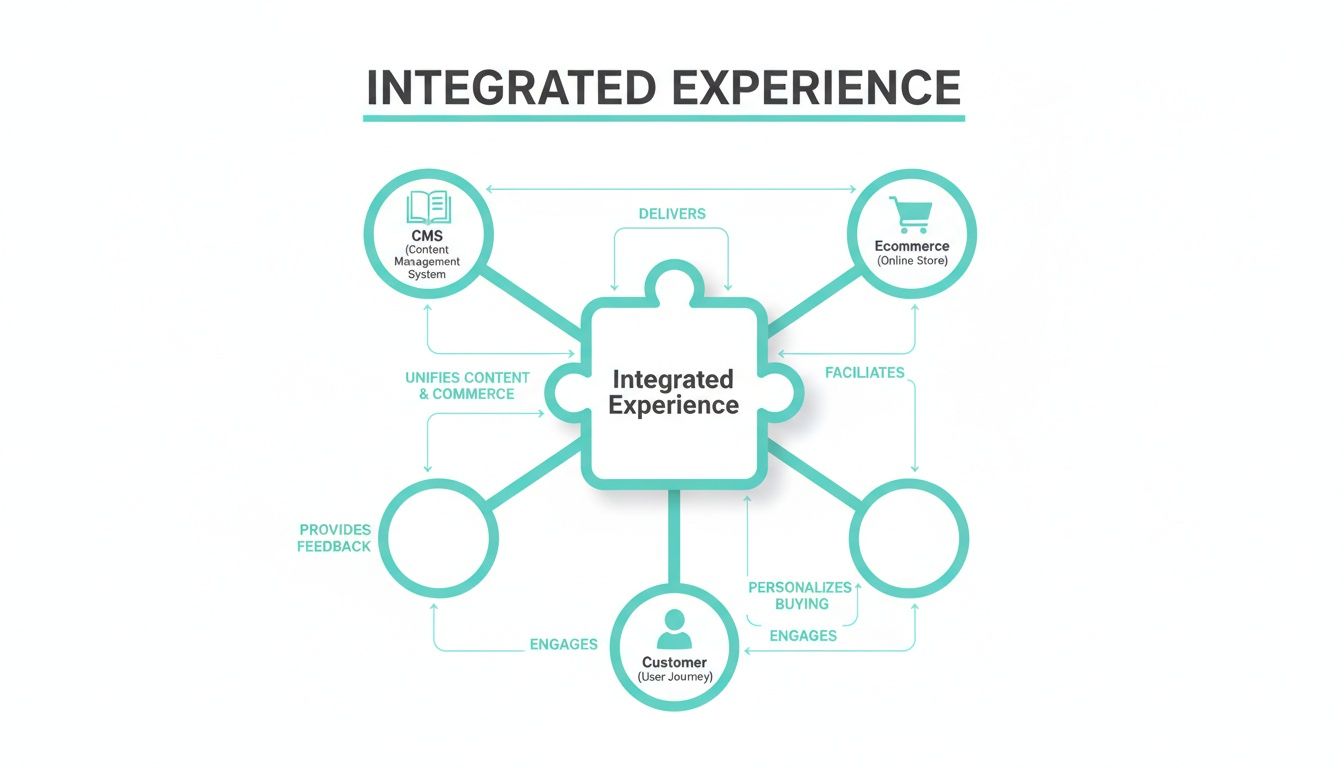
As the visual shows, a winning digital strategy isn't just about plugging technologies together. It's about using those connections to create a seamless experience for your customers, no matter how they interact with you.
The Traditional Monolith
The monolithic approach is the all-in-one appliance of the digital world. Think of an old-school home entertainment system where the TV, DVD player, and speakers are all fused into a single unit. It’s simple to set up and use because everything comes pre-packaged and is designed to work together right out of the box.
Many legacy platforms are built this way, with the CMS and ecommerce functions tightly woven together. This offers the convenience of dealing with a single vendor, but it often comes at the price of agility. Making customizations can get complicated, and an update to one part of the system might cause unexpected problems elsewhere, creating a rigid structure that struggles to keep up with change.
The Rise of Headless Architecture
Headless architecture flips the script by decoupling the front-end presentation layer (the "head") from the back-end content and commerce engine (the "body"). It's like buying high-end, separate audio components—a top-tier amplifier for power (your commerce engine) and premium speakers for clarity (your content delivery), all connected with specialized APIs.
This model gives you incredible flexibility. Your content and products can be pushed to any front-end you can imagine—a website, a mobile app, a smartwatch, or even an in-store kiosk—all without having to re-engineer the back-end. It frees up developers to use modern frameworks and innovate on the customer-facing experience without being held back. If you want to dive deeper, you can learn more about headless commerce and the strategic edge it provides.
This separation is the key to modern digital experiences. It lets brands deliver consistent, context-aware content and commerce functions across any channel a customer might use, breaking free from the limits of a single website.
The Composable Future with Sitecore
Composable architecture takes the headless concept even further. Instead of just separating the front and back ends, it breaks the back-end itself into a collection of independent, best-of-breed microservices. This is like building a custom tech stack from specialized components, where you pick and choose the best tool for each specific job.
Sitecore is a major player in this space, offering a portfolio of composable products that are designed to work together or integrate with other best-in-class solutions.
- Sitecore XM Cloud: A cloud-native, headless CMS that acts as your central content hub.
- Sitecore OrderCloud: A powerful, API-first headless commerce platform built for complex B2B and B2C needs.
- Sitecore Discover: An AI-powered tool for search and merchandising.
- Sitecore Personalize: An engine for creating real-time, individualized customer journeys.
This approach gives you the ultimate flexibility. A business could start with XM Cloud for content and plug in its existing commerce engine. Later on, it could swap in OrderCloud for more advanced commerce features without tearing down the whole system. This model, championed by platforms like Sitecore, allows enterprises to build a digital experience platform that is perfectly suited to their needs and can evolve as the market changes. Even a platform like SharePoint can fit into this picture, often serving as a secure content repository for B2B portals that integrate with other composable services.
Comparing CMS and Ecommerce Integration Architectures
To help you visualize the differences, here’s a quick breakdown of how these architectural models stack up against one another. Each has its place, and understanding their core characteristics is the first step in deciding which one is right for you.
Ultimately, the goal is to choose an architecture that not only solves today's problems but also gives you the freedom to adapt to tomorrow's opportunities. Whether you stick with a simple monolith or build a fully composable ecosystem, the right choice is the one that aligns with your long-term vision.
A Deep Dive Into Enterprise Platform Solutions
Alright, let's move from theory to practice. Choosing an enterprise platform is a make-or-break moment for any large-scale business, shaping not just your digital capabilities today but your agility for years to come. In this league, we're not talking about simple features anymore. We're talking about holistic Digital Experience Platforms (DXPs) that bring content, commerce, data, and personalization together into one cohesive powerhouse.
Two names pop up constantly in enterprise circles, each for very different reasons: Sitecore and SharePoint. Sitecore has cemented its place as a leader in composable DXPs for sophisticated marketing and commerce, while SharePoint owns a unique corner of the corporate world for collaboration and internal portals. Grasping what makes each tick is crucial for building a technology stack that's both robust and strategic.
This market has some serious momentum. The global CMS market was valued at around $28 billion in 2023, and forecasts are shooting as high as $123 billion by the late 2020s. This surge is fueled by cloud adoption and the rise of headless architectures. Right now, cloud-based deployments are the majority, with big enterprises accounting for roughly 67% of the total spend. You can dig deeper into these numbers in this comprehensive CMS market report.
Sitecore: The Architect of Composable Experiences
Sitecore has come a long way from its traditional CMS roots. Today, it’s a complete, composable DXP built for enterprises that need to deliver personalized, omnichannel experiences on a global scale. Forget the old all-in-one, monolithic systems; this is a suite of powerful, API-first tools you can assemble to create the perfect digital engine for your business.
At the core of this ecosystem are two flagship products that nail the modern approach to CMS and ecommerce:
- Sitecore XM Cloud: Think of this as the central hub for all your content. It's a cloud-native, headless CMS delivered as a SaaS (Software-as-a-Service) product, which means less time managing infrastructure and more time creating amazing customer journeys.
- Sitecore OrderCloud: This is a purely headless, API-first commerce platform designed to handle mind-bendingly complex scenarios. It’s a beast for B2B, B2C, and even B2X (business-to-anything) models, effortlessly supporting tricky pricing rules, multiple catalogs, and distributed fulfillment.
The real magic of Sitecore's portfolio is its composability. An enterprise can pair XM Cloud for content with OrderCloud for commerce, then sprinkle in Sitecore's AI-driven search (Discover) and personalization tools. This modularity means businesses can innovate without being stuck in a rigid, one-size-fits-all box.
This approach hits the nail on the head for large organizations. It gives them powerful, centralized control while offering the flexibility to pivot quickly to new channels and market demands. For a more detailed breakdown of how Sitecore stacks up against the competition, check out our AEM vs Sitecore DXP comparison.
How Sitecore Unifies Content and Commerce
Picture a global manufacturer that sells complex machinery to other businesses. Their customers need more than a simple "add to cart" button. They need detailed tech specs, training videos, and configuration tools before they even think about making a purchase.
With Sitecore, this company can craft a completely seamless experience:
- Content-Rich Engagement: The marketing team uses XM Cloud to create in-depth articles and guides about the machinery, all managed from one place.
- Contextual Commerce: These content pages are woven together with OrderCloud. A visitor reading about a specific machine part sees real-time pricing and availability pulled straight from the commerce engine.
- Personalized Journeys: Based on the visitor's industry and past behavior, Sitecore Personalize can tailor the content and product recommendations they see, steering them toward the best solutions.
- Omnichannel Delivery: Since both the CMS and commerce platforms are headless, this entire experience can be pushed out not just to the website but also to a partner portal, a mobile app for field techs, or even an in-person sales tool.
This is what a modern CMS and ecommerce strategy is all about—the line between content and commerce completely vanishes, creating a single, intelligent customer journey.
SharePoint: A Foundation for B2B and Partner Portals
While Sitecore dominates the public-facing DXP scene, SharePoint has carved out a critical niche within the enterprise ecosystem, especially for B2B and internal use. SharePoint’s real strength isn't as a high-volume, B2C retail platform. Instead, it’s a rock-solid, secure foundation for collaboration, document management, and workflow automation.
When you add commerce capabilities, SharePoint becomes a powerhouse for building secure B2B portals and partner extranets. Its deep integration with the Microsoft 365 suite (think Teams, Dynamics 365, and Power BI) lets organizations build a unified world where content, collaboration, and commerce all live together.
Imagine a supplier portal where partners can log in to access confidential product roadmaps, join collaborative planning sessions, and place inventory orders—all within the same secure interface. Here, the "content" is often highly controlled documentation, and the "commerce" is a specific, regulated transaction. In these scenarios, SharePoint's robust security and workflow tools are non-negotiable, making it the perfect choice for businesses that prioritize control and tight integration with their existing Microsoft stack. It’s a specialized yet powerful solution for very specific CMS and ecommerce needs.
Mastering Personalization and Omnichannel Strategy
An integrated CMS and ecommerce system is the foundation for personalization that actually works. It's what turns a static storefront into a dynamic, responsive environment that can anticipate what customers need and adapt in real time. This is where the magic of unifying content and commerce really comes alive, moving you beyond simple transactions to create genuinely memorable interactions.
The core idea is pretty simple: use all that unified customer data to create hyper-relevant experiences. When you combine behavioral data—like products they've viewed or carts they've abandoned—with their purchase history, you can start delivering real-time content recommendations and targeted offers that feel genuinely helpful, not creepy. To really get this right, you'll need to dig into some effective marketing personalization strategies.

Executing Personalization with Sitecore
Sitecore’s platform is practically built for executing sophisticated personalization at an enterprise scale. Its advanced personalization engine, a core part of its DXP, lets businesses move past basic segmentation and start delivering true one-to-one experiences.
Here’s a look at how it works in the real world:
- Unified Customer Profile: Sitecore pulls data from every single touchpoint—website visits, email clicks, purchase history from OrderCloud, and even in-store interactions—into one comprehensive customer profile.
- Real-Time Rule-Based Personalization: Marketers can set up rules to change content on the fly. For example, a returning visitor from the manufacturing industry might see a homepage banner with relevant case studies, while a brand-new visitor gets a general introductory offer.
- AI-Powered Recommendations: Using machine learning, Sitecore can automatically suggest products and content based on a user’s behavior and what similar customers have done, which is a great way to boost conversion and engagement.
The goal is to make every interaction feel like a continuation of the last, regardless of where it happens. This data-driven approach allows brands to build powerful, individualized journeys that guide customers from initial awareness to loyal advocacy.
This deep integration of content and commerce data is what separates a basic online store from a true digital experience leader. SharePoint can also play a role here, especially in B2B scenarios where personalization might mean showing contract-specific pricing or relevant technical documents inside a secure partner portal.
Building a Cohesive Omnichannel Strategy
A strong personalization engine is the heart of a great digital experience, but a true omnichannel strategy is the circulatory system that delivers it everywhere. Omnichannel isn't just about showing up on multiple channels; it’s about creating a single, unified shopping journey that flows seamlessly between them.
A powerful, integrated CMS and ecommerce platform like Sitecore acts as the central nervous system for this strategy. It makes sure your brand’s voice, product information, and customer data are consistent across every single touchpoint. This creates a fluid experience where a customer can:
- Discover a Product: See an ad on social media.
- Research and Configure: Hop on their laptop to read reviews, watch videos, and configure product options on your website.
- Finalize in Person: Use a mobile app to find a nearby store, where a sales associate can pull up their configured choices and complete the sale right there.
This kind of seamless flow is only possible when your content and commerce systems are deeply connected. The content from your CMS provides the rich, engaging experience, while the commerce engine handles all the transactional details with precision. For anyone looking to build this kind of connected ecosystem, our guide on creating an effective omnichannel customer experience offers a deeper strategic framework. By mastering both personalization and omnichannel delivery, businesses can build a durable competitive advantage.
Your Implementation and Migration Checklist
Jumping into a CMS and ecommerce integration is a serious commitment. Success hinges on a rock-solid plan, and the best way to get there is with a detailed checklist that turns a massive technical challenge into a series of clear, manageable steps.
This isn’t just about flipping a switch. The real work begins long before a single line of code is written. It starts with discovery and strategy—laying the groundwork to make sure your technical choices actually deliver on your business goals.
Phase 1: Discovery and Strategy
This first phase is all about setting your direction. It's tempting to rush this part, but that's a classic mistake that almost always leads to scope creep and busted budgets down the line. A thorough discovery process gets every stakeholder on the same page and keeps your project's goals both ambitious and achievable.
Here’s what you need to nail down first:
- Define Key Performance Indicators (KPIs): What does a win actually look like for you? Think beyond just revenue. You need to track metrics like conversion rate, average order value, customer lifetime value, and how users are engaging with your content.
- Map Customer Journeys: Take a hard look at how customers move through your site now, and then design the ideal path you want them to take. Pinpoint all the friction spots in the current experience that a new, integrated platform is meant to solve.
- Audit Existing Content and Data: Get your arms around everything you have—product data, customer info, marketing content, and every digital asset. This inventory is the backbone of your data migration plan.
- Define Technical Requirements: Document it all. What API integrations do you need? What are your security protocols, performance benchmarks, and scalability requirements? If you're implementing Sitecore, for example, you'd map out exactly how XM Cloud and OrderCloud need to talk to each other.
Phase 2: Platform Selection and Planning
Once your strategy is locked in, you can choose your technology with confidence. Your decision should be driven by your specific needs. Are you after the composable power of Sitecore for a B2C powerhouse, or the collaborative muscle of SharePoint for a B2B portal?
For enterprises with complex needs, specialized DXP solutions are often the only way to go. You can discover more insights about CMS statistics on diviflash.com.
An effective platform choice isn't about picking the most popular tool; it's about selecting the architecture that best supports your defined customer journeys and business KPIs for the long term.
After you’ve picked your platforms, the real planning kicks off. This means building a comprehensive project plan, assigning resources, and setting timelines that are actually realistic for each stage of the project.
Phase 3: Technical Execution and Migration
This is where the rubber meets the road—turning your strategy into a working, breathing reality. The technical execution phase demands an almost obsessive level of detail, especially when you're dealing with sensitive data and weaving together complex systems.
Your technical to-do list should cover:
- Environment Setup: Get your staging and production environments configured. For a solution like Sitecore XM Cloud, this means setting up your SaaS instances and wiring them into your development pipeline.
- API Integration: This is the handshake between your CMS and ecommerce platforms. It’s about making Sitecore OrderCloud and XM Cloud work together seamlessly, and also connecting them to your other critical systems like your ERP, PIM, and CRM.
- Data Migration: Time to execute the migration plan you built during the audit. This is often the trickiest part of the whole project and requires relentless testing to make sure no data gets lost or corrupted along the way.
- Testing and Quality Assurance: Run end-to-end tests, including user acceptance testing (UAT), to hunt down and squash any bugs before you go live. This isn't a step you can afford to skimp on.
Common Questions About CMS and Ecommerce
As you start exploring how to blend CMS and ecommerce, you'll find a lot of jargon and complex ideas floating around. Let's cut through the noise. Here are some of the most common questions we hear from enterprise leaders and technical teams, with straightforward answers to help you make the right call.
What Is the Main Difference Between a Headless CMS and a Composable DXP?
This is a great question because the terms are often used together, and it's easy to get them mixed up.
A headless CMS is a specific piece of technology. Its only job is to manage and store content, then deliver it anywhere via an API. By separating the content (the "body") from the presentation layer (the "head"), you can push the same product description or blog post to your website, mobile app, kiosk, or smartwatch without re-creating it.
A composable DXP (Digital Experience Platform) is the bigger picture—it's the overall strategy. Instead of buying one massive, do-it-all platform, you assemble a "dream team" of specialized, best-in-class tools. Your headless CMS is one of those tools, sitting alongside a separate commerce engine, a smart search tool, a personalization engine, and anything else you need. They all talk to each other through APIs.
Think of it this way: a headless CMS is a star player, like a world-class quarterback. A composable DXP is the entire championship-winning team, with the quarterback working alongside a top-tier running back, a solid offensive line, and a strategic coach. Each part is excellent on its own, but together, they're unstoppable.
How Does Sitecore's Portfolio Support Composable Ecommerce?
Sitecore has gone all-in on the composable future. Instead of forcing you into a rigid, one-size-fits-all suite, they offer a portfolio of powerful, API-first products that you can piece together to build the exact platform your business needs.
Here are the key players in their lineup:
- Sitecore XM Cloud: This is their cloud-native, headless CMS. It acts as the content brain for all your channels.
- Sitecore OrderCloud: A truly headless commerce platform built for complexity. It’s perfect for B2B, B2C, or marketplace models that have unique business rules.
- Sitecore Discover: An AI-driven tool focused on product discovery. It powers smarter search, merchandising, and recommendations to help customers find what they want, faster.
- Sitecore Personalize: This is the engine that drives real-time, one-on-one personalization, ensuring every customer interaction is relevant.
The beauty of this approach is its flexibility. You can start with just one component, like XM Cloud, and integrate it with your existing ecommerce platform. Or, you can combine all of Sitecore’s products with other best-of-breed tools to create a DXP that's perfectly tuned to your operations. That modularity is the core of a modern CMS and ecommerce strategy.
When Is SharePoint a Better Choice Than a Dedicated DXP?
While a dedicated DXP like Sitecore is the go-to for customer-facing, high-volume retail, SharePoint shines in a different arena. It's often the smarter choice for internal or B2B scenarios where the main goal is secure document management, not mass-market selling.
Think about building a portal for your suppliers or partners. They need a secure place to log in, access controlled documents, and maybe order specialized parts or products from a private catalog. This is where SharePoint excels.
SharePoint's core strengths are:
- Secure Collaboration: It’s built from the ground up to be a secure vault for sharing sensitive documents and collaborating with trusted partners.
- Workflow Automation: Its workflow engine is fantastic for streamlining the internal approvals and processes common in B2B transactions.
- Microsoft 365 Integration: It’s deeply woven into the Microsoft ecosystem, connecting seamlessly with tools like Teams and Dynamics 365 to create a single, unified environment for your operations.
So, if your project is more about secure collaboration with commerce as a secondary feature, SharePoint is a very logical and powerful solution. But if you're building a sophisticated B2C experience centered on personalization and driving high-volume sales, a purpose-built DXP will always be the better choice.
Ready to build a powerful, seamless digital experience that blends content and commerce? At Kogifi, we specialize in implementing enterprise-grade solutions using Sitecore and SharePoint. Let's build your digital future together.