


When you hear "Adobe," you might think of Photoshop or PDFs, but their impact on customer experience runs much, much deeper. Using Adobe for Customer Experience Management (CXM) means leveraging an entire ecosystem of integrated cloud products. It’s all about creating personalized, real-time interactions at every single touchpoint.
This isn't your standard CRM. Adobe’s platform goes beyond just collecting data; it activates it, turning disjointed moments into a continuous, meaningful conversation. The goal is to build genuine loyalty and give your business a serious competitive edge.
What Is Adobe Customer Experience Management
Ever tried to conduct an orchestra where every musician is playing from a different sheet of music? That’s what marketing can feel like without a unified platform. Adobe’s approach to Customer Experience Management (CXM) acts as the conductor, bringing harmony to your entire customer journey.
It’s more than just a place to store customer information. Where a traditional CRM stops, Adobe's ecosystem begins, focusing on putting that data to work across every channel. Tools like Adobe Experience Manager, Analytics, and Journey Optimizer work in concert to ensure that whether a customer is on your website, using a mobile app, or reading an email, the experience is consistent, personal, and relevant.
To dig deeper into the core ideas, you can explore our complete guide on what is customer experience management.
The Shift from Disconnected Interactions to Unified Journeys
Not long ago, customer interactions were completely siloed. A website visit, a support call, and a social media comment were treated as separate events, often handled by different teams using disconnected systems. Adobe’s CXM philosophy fixes this by creating a single, intelligent view of each customer.
Customer Experience Management is the discipline of analyzing, measuring, and improving every interaction a customer has with your brand. It transforms marketing from a series of isolated campaigns into a continuous, connected conversation that builds trust and drives growth.
This unified profile becomes the bedrock for delivering experiences that feel less like marketing and more like a natural dialogue. It allows your brand to anticipate needs, serve up relevant content, and guide customers along a path that feels both intuitive and valuable.
The Business Case for Adobe CXM
By 2026, a solid CXM strategy won't be a "nice-to-have"—it's an absolute must for survival and growth. As customer expectations keep climbing, the quality of the experience you deliver has become the main battlefield for winning and keeping customers.

This is where the financial impact becomes clear. A study found that businesses using such platforms achieved an average 597% three-year ROI, with annual benefits hitting $7.29 million. This isn't just about making things look good; it’s about driving real operational speed, including a 61% reduction in the time it takes to launch new websites.
Of course, modern CXM leans heavily on advanced tech. To get a better sense of how artificial intelligence is changing the game, check out this complete playbook on AI for customer experience. Ultimately, this approach doesn't just boost revenue—it cements customer loyalty in a marketplace that gets more crowded by the day.
Exploring the Adobe Experience Cloud Ecosystem
Thinking of Adobe Experience Cloud as just a box of tools is a common mistake. It’s better to imagine it as an orchestra. Each application is a finely tuned instrument, but the real magic happens when they play together to create one seamless customer journey.
The goal is to break down the walls between marketing, sales, and service teams. Adobe’s ecosystem gives every part of your business the same real-time customer data, allowing them to work in harmony. This turns disconnected interactions into a single, continuous conversation with your customer.
The Content Factory and The Audience Listener
At the heart of the ecosystem are two components that create a powerful feedback loop: one that builds content and another that listens to your audience.
Adobe Experience Manager (AEM) is your content factory. This is where your brand’s digital assets and experiences are born. Think of it as the workshop for crafting everything from website pages and mobile app designs to rich media, all managed and deployed at scale. AEM is all about ensuring brand consistency and quality across every channel.
Adobe Analytics is your audience listening post. It’s the tool that gathers and makes sense of customer behavior. Analytics tracks every click, scroll, and purchase, turning that raw data into clear insights about what your audience wants, where they get stuck, and what drives their decisions.
AEM creates the content, and Analytics measures how it performs, feeding intelligence back to AEM. This cycle of creating and learning is how you constantly refine and improve the customer experience.
The Journey Choreographer and Data Unifier
While AEM and Analytics cover the what and why, other products handle the when and how. This is where true personalization comes to life, all guided by a single, unified view of each customer.
The real breakthrough in modern customer experience isn't just collecting data; it's activating it. The Adobe Experience Cloud is designed to unify fragmented customer signals into a single, actionable profile that informs every interaction in real time, making personalization a scalable reality.
Adobe Experience Platform (AEP) acts as the central nervous system for the entire ecosystem. It pulls data from every source imaginable—AEM, Analytics, CRMs, point-of-sale systems—and stitches it together into a real-time customer profile. AEP creates that elusive "single source of truth" that makes genuine cross-channel personalization possible.
From there, Adobe Journey Optimizer (AJO) takes over as the journey choreographer. Using the rich, unified profiles from AEP, AJO designs, automates, and delivers personalized, omnichannel journeys. It figures out the best message, the right channel (email, push notification, web), and the perfect time to deliver it, ensuring every customer feels understood. You can learn more about Adobe Experience Cloud in our FAQ to see the key features.
Integrating Beyond The Adobe Stack
While Adobe’s native tools are powerful on their own, the ecosystem truly shines in a composable architecture. This is where our expertise in platforms like Sitecore AI and SharePoint becomes a game-changer. Our deep knowledge of the Sitecore product portfolio, particularly its AI-driven personalization tools, allows us to create powerful hybrid solutions. By connecting Sitecore's advanced decisioning capabilities to the rich data within AEP, we unlock a new layer of predictive intelligence.
This enables more sophisticated customer segmentation, automated content recommendations, and the ability to serve the 'next best experience' with unparalleled accuracy. Furthermore, we frequently integrate SharePoint for internal collaboration and document management. This allows us to build seamless workflows where internal knowledge and assets stored in SharePoint are easily surfaced on your public-facing AEM websites, creating a best-of-both-worlds solution that combines Adobe’s robust foundation with specialized intelligence.
Why AEM Is the Engine of Modern Customer Experiences
When you look inside the Adobe ecosystem, Adobe Experience Manager (AEM) is the powerhouse driving both content and digital assets. It’s not just another CMS; it's the foundation trusted by global enterprises and public institutions to manage their most important digital storefronts.
Think of it less like a simple website builder and more like a central command center for your entire brand. From this hub, you can create, manage, and deliver content across websites, mobile apps, and other digital touchpoints with incredible precision. This ensures every customer interaction feels consistent and on-brand, no matter where it happens.
Unifying Content and Commerce
One of AEM's biggest strengths is how it marries rich content with e-commerce. In an era where customers expect shoppable stories and interactive product catalogs, AEM is built to deliver. It gives brands the tools to create content-heavy product pages, guided selling experiences, and digital lookbooks that capture attention and drive sales.
This integration breaks down the old wall between your content platform and your e-commerce engine. Instead of a clunky handoff, customers get a smooth journey from inspiration to checkout, all within a single, cohesive experience. For effective customer experience management with Adobe, this unified approach is non-negotiable.
A Composable Architecture for Greater Flexibility
What really makes AEM stand out is its modern, composable architecture. Instead of being stuck with a rigid, one-size-fits-all system, AEM lets you build your digital experience platform (DXP) by connecting different best-of-breed tools. This is where Kogifi’s expertise with platforms like Sitecore AI and SharePoint becomes a huge advantage.
AEM's composable design means you aren’t locked into a single vendor’s toolkit. By integrating specialized solutions—like the Sitecore AI portfolio for smarter personalization or SharePoint for internal collaboration—you can build a DXP that’s perfectly suited to your business goals.
This flexibility delivers some major benefits:
- Future-Proofing: Easily add or swap out services as your business needs and technology change.
- Enhanced Capabilities: Integrate specialized tools like Sitecore AI to introduce sophisticated personalization, using customer data to predict intent and serve up the next best action.
- Improved Collaboration: Connect AEM to internal systems like SharePoint to streamline content workflows, letting teams collaborate on assets before they go live.
This structure gives you a rock-solid, secure, and high-performance foundation for your entire digital strategy. To get a better sense of what makes the platform so powerful, you can explore the secret of Adobe AEM's success in our detailed article.
Powering the Global Digital Stage
AEM’s widespread adoption speaks for itself. According to data from BuiltWith, Adobe Experience Manager is used by over 117,367 websites globally, with 40,318 live sites currently active. This impressive market share highlights its role as a reliable and scalable platform for organizations that can't afford to compromise on performance. You can discover more about AEM's market share on BuiltWith.com.
But getting the most out of such a powerful platform requires a partner with specialized knowledge. Kogifi’s deep expertise in AEM implementation, combined with our available 24/7 support, ensures your organization has a robust foundation to build on. We make sure your AEM instance is not only secure and high-performing but also perfectly integrated with your other key systems to deliver real value.
Unifying Your Data with the Adobe Experience Platform
If Adobe Experience Manager is the engine that drives your content, then Adobe Experience Platform (AEP) is the central nervous system powering your entire customer experience management adobe strategy. This is where the real magic of personalization comes to life. Think of AEP as the master data hub, built to pull in information from every single customer touchpoint imaginable.
Data streams in from website clicks, mobile app activity, in-store purchases, support calls, social media engagement—you name it. AEP gathers all this scattered information and stitches it together into a single, real-time customer profile. This isn't just a static record; it’s a living, breathing profile that learns and evolves with every new interaction.
The Power of a Unified Customer Profile
For Chief Technology Officers and IT leaders, the architectural payoff is huge. AEP demolishes the data silos that have frustrated enterprises for years, finally creating one source of truth for all customer data. This unified profile becomes the high-octane fuel for incredible cross-channel personalization and complex customer journey orchestration.
Instead of just guessing what a customer might want next, you can act on a complete, up-to-the-minute understanding of their behaviors and preferences. It unlocks a level of relevance that was simply out of reach at scale until now.
The core function of Adobe Experience Platform is to build a complete, real-time "golden record" for every customer. This unified profile allows brands to move beyond simple segmentation and deliver truly one-to-one personalization across every touchpoint, from the first ad they see to their most recent support ticket.
Making the shift from siloed data to a unified profile is a game-changer. It’s what allows you to apply modern User Experience Design principles, which are supercharged by this rich, centralized data.
Enabling a Composable DXP Architecture
AEP is also built for the modern, composable enterprise. Its open architecture supports flexible and powerful connections to other business-critical systems, which is a core specialty here at Kogifi. This means you’re not locked into a single ecosystem. Instead, you can build a best-of-breed digital experience platform (DXP) perfectly suited to your business.
Key integration patterns include:
- CRM Integration: We connect AEP with your CRM (like Salesforce or Microsoft Dynamics) to enrich customer profiles with sales and service history. This gives both marketing and sales teams a true 360-degree view.
- ERP Integration: Tying in your Enterprise Resource Planning system brings transactional and supply chain data into the mix, opening the door for personalized post-purchase experiences and inventory-aware marketing.
- SharePoint Solutions: For companies using SharePoint for internal collaboration or as an intranet, we create seamless integrations with AEP. This allows employee data or internal knowledge to inform personalized experiences on public-facing sites or secure portals.
The Strategic Advantage of Sitecore AI Integration
Our deep expertise in the Sitecore AI portfolio provides a unique strategic advantage when implementing AEP. While AEP excels at data unification, integrating Sitecore’s advanced AI capabilities introduces a powerful layer of predictive intelligence. By feeding the real-time, unified profiles from AEP directly into Sitecore’s machine learning models, we unlock transformational capabilities.
This powerful combination enables:
- Predictive Personalization: Utilize Sitecore AI to analyze AEP data and accurately predict a customer's next likely action, intent, or purchase.
- Automated Content and Audience Intelligence: Leverage Sitecore AI to automatically tag content and discover new audience segments, making it easier to serve the right assets to the right user without manual intervention.
- Advanced Decisioning: Implement sophisticated decisioning engines from the Sitecore ecosystem that determine the "next best experience" for each user in real-time, moving far beyond simple, rule-based personalization.
By bridging Adobe’s robust data foundation with Sitecore’s specialized AI muscle, we help organizations build a truly intelligent and adaptive CXM framework. To master the art of bringing different data sources together, check out our insights on customer data integration solutions. This composable approach ensures your technology stack is not only powerful today but also agile enough to adapt to whatever comes next.
A Proven Framework for Successful AEM Implementation
A powerful platform like Adobe Experience Manager is only as good as its implementation. A successful launch isn't just about the technical setup; it demands a clear roadmap that blends deep technical expertise with a sharp focus on real business outcomes.
This is where a specialized partner like Kogifi makes a difference. Our proven methodology guides organizations through every phase, from initial discovery and architectural design to agile development and post-launch optimization. We don't just build a solution that works on day one—we build one that drives long-term, measurable returns.
The Phases of a Successful Implementation
A solid AEM deployment isn't a single event; it's a carefully orchestrated process. Each phase builds on the last, ensuring the final product perfectly aligns with your business goals, user needs, and technical requirements.
Our approach combines best practices from the Adobe ecosystem with our deep expertise in composable architectures involving platforms like Sitecore and SharePoint. This results in a holistic strategy that turns raw data into actionable intelligence for truly superior customer experiences.
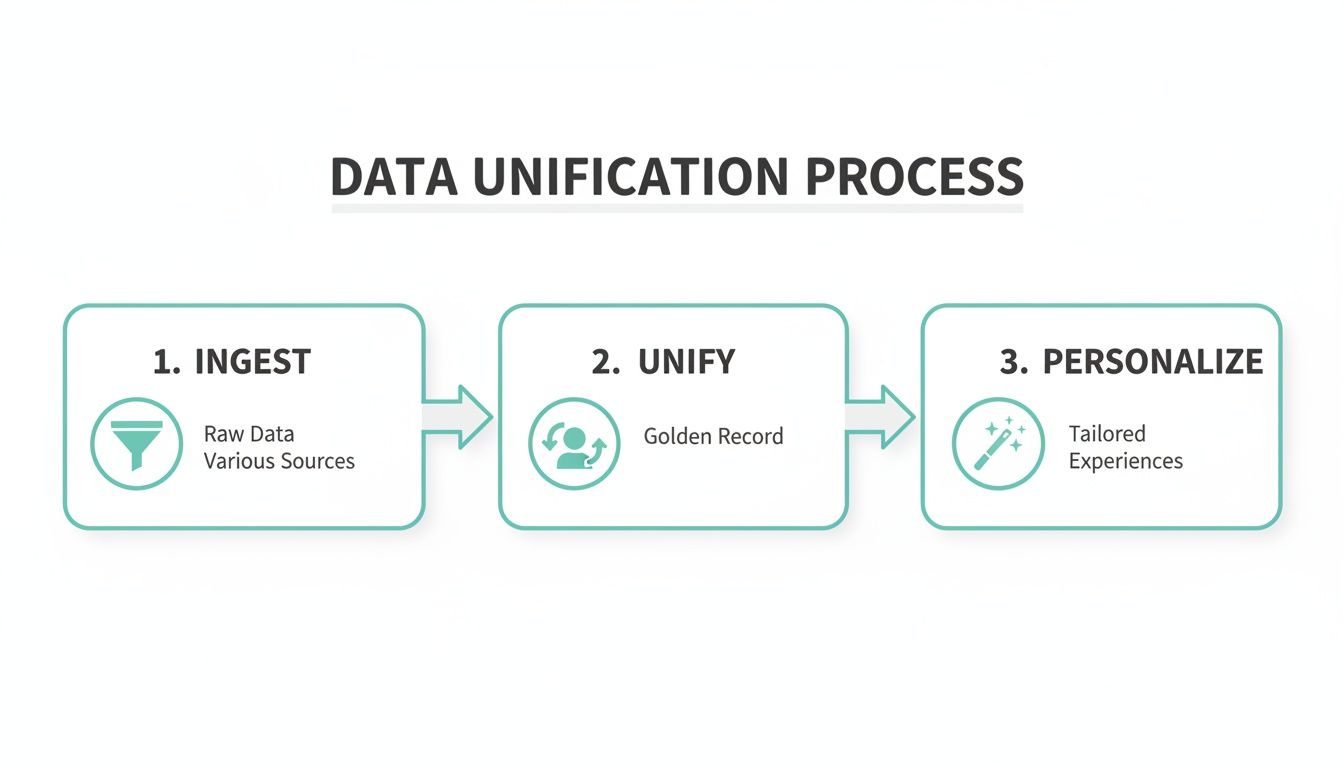
The process is straightforward: ingest disparate data, unify it into a single customer view, and then use that intelligence to deliver personalized interactions at scale.
Here’s how we structure the journey:
- Discovery and Strategy: We begin by deeply understanding your business objectives, target audience, and existing tech stack. We map out content workflows and identify crucial integration points, whether it’s connecting to SharePoint for internal collaboration or channeling data to Sitecore for AI-driven personalization.
- Architectural Design: Next, we design a scalable, composable architecture that leverages AEM's strengths while enabling seamless integrations. This is where we define how Sitecore's AI will ingest AEM data for predictive modeling or how SharePoint document libraries will flow into AEM Assets.
- Agile Development: We use an agile, sprint-based approach to build and test the platform iteratively. This method allows for continuous feedback, keeping the project aligned with your evolving business needs and delivering value much faster.
The Role of Governance and Team Enablement
Technology alone never guarantees success. A strong customer experience management adobe program depends on solid governance and a well-equipped team, and we make this a core part of our implementation framework.
AEM's strength is magnified when paired with a clear governance model. Defining roles, content workflows, and performance metrics ensures the platform is used effectively, preventing it from becoming a disorganized repository and instead turning it into a strategic business asset.
We help establish clear guidelines for everything from content creation and asset management to user permissions. Just as important, we provide comprehensive training and documentation to empower your teams, ensuring high user adoption and self-sufficiency. This enablement is absolutely crucial for maximizing your return on investment.
Even with its powerful features, AEM serves a specific, high-end niche. Adobe Experience Manager commands a 0.1% share of all CMS websites, part of the broader 0.7% Adobe Systems ecosystem. This footprint is concentrated among large-scale operations, where 61% of AEM Assets users have over 1,000 employees and 59% exceed $1B in revenue. You can find more on AEM's market position at W3Techs.
This data highlights why a specialized implementation partner who understands the complexities of enterprise-grade deployments is so important. With a proven framework, strong governance, and continuous team support, you can avoid the common pitfalls and ensure your AEM project delivers lasting value.
Frequently Asked Questions About Adobe CXM
Diving into Adobe’s ecosystem for customer experience management adobe often brings up some important questions. When you're weighing your options, you need straight answers on how it compares to other platforms, what an implementation really looks like, and whether it’s the right fit. Here’s a breakdown of the common inquiries we hear.
Adobe Experience Cloud vs a Traditional CRM
It's easy to get Adobe Experience Cloud and a traditional CRM confused, but they serve very different purposes. Think of a CRM as your system of record. It’s built to hold customer data and manage direct interactions, like sales calls or support tickets. It primarily looks backward at what a customer has already done.
Adobe Experience Cloud, on the other hand, is a system of engagement. It’s designed to take that data and use it in real-time to shape the entire customer journey across all your channels. While a CRM logs past events, Adobe’s CXM suite looks forward to anticipate what customers need next. At Kogifi, we specialize in connecting these two worlds, making sure your historical CRM data fuels every future customer interaction.
How Adobe CXM Compares to Sitecore DXP
Both Adobe and Sitecore are giants in the Digital Experience Platform (DXP) world, but they operate on different philosophies. Adobe Experience Cloud is a comprehensive, tightly integrated suite of best-in-class products. Its strength lies in the seamless way tools like AEM and Analytics work together right out of the box.
Sitecore has fully embraced a composable DXP strategy, centered around its powerful AI capabilities. This approach allows you to build a best-of-breed tech stack by picking and choosing specialized tools, such as the Sitecore Search and Sitecore Personalize products, which can be integrated into other platforms.
The choice isn't about which platform is "better," but which one fits your organization’s maturity and goals. Adobe offers an integrated powerhouse, while Sitecore provides unmatched flexibility with its AI-driven composable approach.
With certified expertise in both Adobe and the Sitecore product portfolio, Kogifi provides unbiased guidance to help you choose the right platform. We frequently implement hybrid solutions that combine the strengths of both. For instance, we can integrate Sitecore's AI-powered personalization engine with Adobe's robust data platform to create an intelligent system that neither could achieve on its own.
Is Adobe Experience Manager Only for Large Enterprises
While Adobe Experience Manager (AEM) is famous for powering massive global companies, its cloud-native version—AEM as a Cloud Service—has made it far more accessible for upper-mid-market businesses. The cloud model removes the headache of managing infrastructure and shifts costs to a predictable subscription.
That said, AEM is best for businesses with complex content needs, multiple brands, or a major focus on large-scale personalization. If your needs are simpler, like an internal company intranet or basic document storage, a different tool is probably a better fit.
For example, SharePoint is often a more practical and cost-effective choice for internal collaboration sites and document management. Our expertise at Kogifi extends to architecting and implementing robust SharePoint solutions, so we can provide an honest assessment and recommend the platform that truly matches your goals, preventing you from over-investing in technology you don’t need.
What Is a Typical AEM Implementation Timeline
An AEM implementation timeline depends entirely on the project's complexity. A standard website setup with basic features can usually be completed in about 4 to 6 months.
However, a large-scale, multi-site enterprise rollout with complicated integrations—such as connecting to a Sitecore AI engine for predictive personalization or a legacy SharePoint farm for content migration—can easily take 12 months or more.
At Kogifi, we follow an agile methodology to get you value faster. Our process focuses on launching a Minimum Viable Product (MVP) first, getting a working solution to market quickly. This way, you start seeing a return while we continue to add features and improvements in iterative sprints, guided by user feedback and your changing business needs.
Ready to unify your customer experience with a powerful, scalable platform? Kogifi has over a decade of experience implementing and supporting enterprise-grade DXP solutions. Contact us today to learn how our expertise in Adobe, Sitecore, and SharePoint can drive your digital success. Learn more at https://www.kogifi.com.