


Imagine you had a personal concierge who remembered every single thing you've ever talked about—every preference, every past purchase, every question—no matter if you spoke in person, called them up, or sent an email. That's the core idea behind a modern omnichannel customer experience. It’s a completely seamless journey where every channel works together, not as separate islands.
What an Omnichannel Customer Experience Truly Means
A true omnichannel experience is so much more than just showing up on multiple channels. It’s about creating one continuous conversation that flows effortlessly across every single touchpoint a customer has with your brand. This is the critical difference between a disconnected multichannel setup and a fully integrated omnichannel ecosystem.

From Disconnected Channels to Unified Conversations
In a typical multichannel world, a business has a website, a mobile app, and a physical store. The problem? These channels operate in silos. A customer might add an item to their cart on the app, only to find it empty when they log in on their desktop. The in-store associate has zero visibility into that customer’s online browsing history. Every interaction is a clean slate, forcing the customer to repeat themselves and creating a clunky, frustrating journey.
An omnichannel strategy, powered by a sophisticated Digital Experience Platform (DXP) like Sitecore, tears down those silos. It weaves separate touchpoints into one cohesive story.
An omnichannel experience accounts for each platform and device a customer will use to interact with the company and creates an equally efficient and positive experience across all platforms. The goal is to make the customer journey feel like one uninterrupted conversation.
Sitecore as the Central Nervous System
Think of a platform like Sitecore as the central nervous system for your entire customer experience. It connects every touchpoint—from a click on a website running on XM Cloud to an in-store purchase captured by a POS system—and feeds that data into a single, unified customer profile. This is where Sitecore's composable DXP architecture really shines.
It’s not just about technology; it’s about having a memory. When a DXP is at the core, the brand remembers:
- Past Purchases: A customer who bought hiking boots last month now sees relevant recommendations for waterproof gear.
- Recent Browsing: Someone who abandoned a shopping cart on their laptop gets a friendly reminder email, maybe with a small offer to nudge them back.
- Service Interactions: A support agent can see a customer's full history, so the customer never has to explain their problem from the beginning again.
This ability to build a persistent, intelligent customer profile is what separates a true omnichannel leader from a company that’s just present on multiple channels. It ensures every interaction is context-aware and deeply relevant.
For a deeper look at the foundational concepts, our guide on what omnichannel marketing is offers more context. And to see what this looks like in the real world, check out these inspiring omnichannel marketing examples. By connecting all the pieces of the puzzle, you deliver an experience that feels personal, predictive, and perfectly seamless.
The Three Pillars of an Effective Omnichannel Strategy
A powerful omnichannel strategy doesn't just happen because you bought new software. It’s built on a solid foundation, resting on three interconnected pillars that work together to create those seamless, intelligent customer journeys everyone is chasing.
If you ignore these fundamentals, even the most advanced tech stack will fall short of its promise.
The infographic below shows how a solid strategy branches out from these core components.
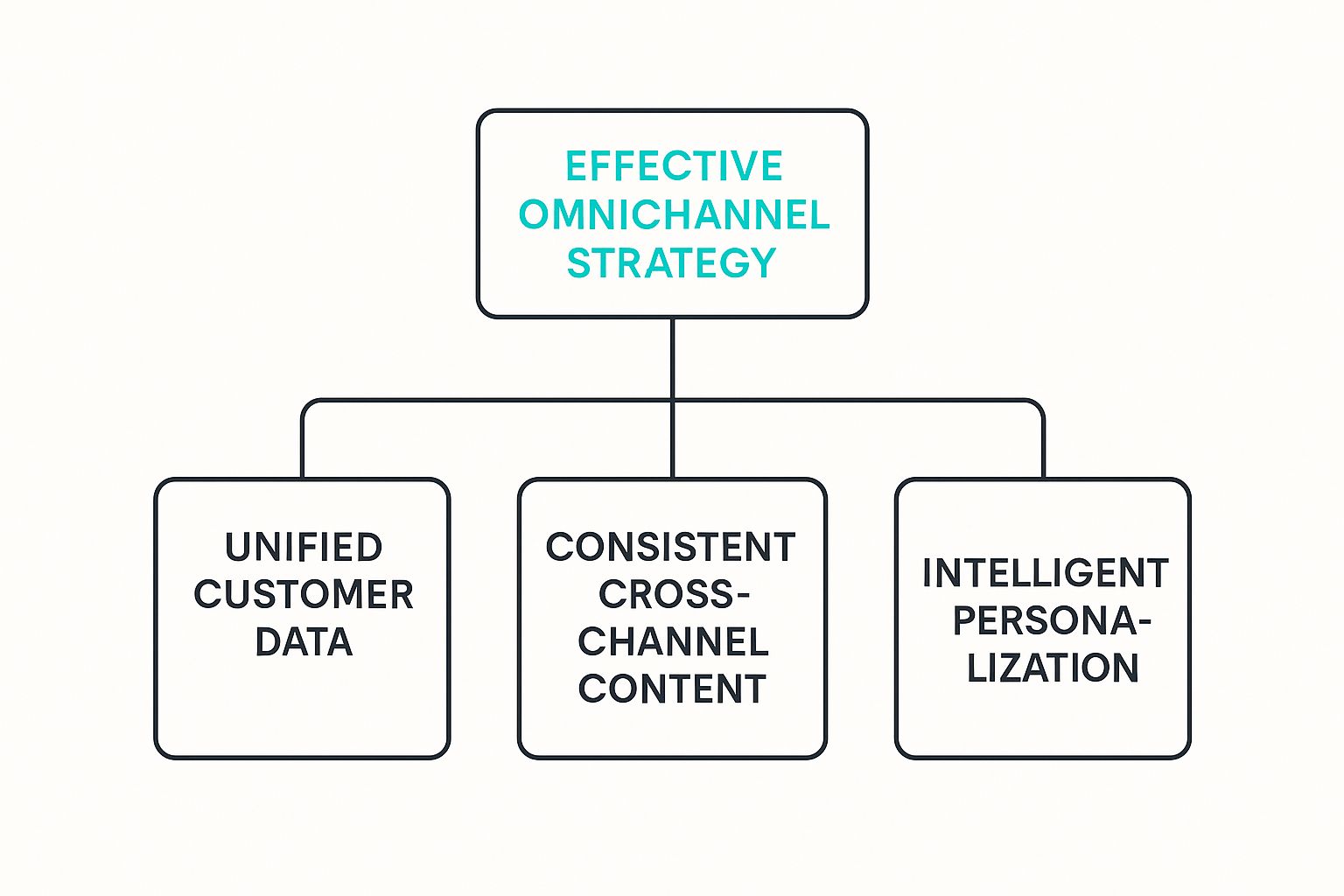
You can see how a unified data core is what makes both consistent content and smart personalization possible. All three are absolutely essential.
Unified Customer Data
The first and most critical pillar is unified customer data. Think about it: trying to have a meaningful conversation with someone who forgets everything you said five minutes ago is frustrating, right? That’s exactly what customers feel when their data is stuck in silos. An interaction on the website is completely forgotten by the mobile app, and an in-store purchase is a mystery to the customer service team.
This is where a Customer Data Platform (CDP) becomes the heart of your entire operation. A tool like Sitecore CDP is designed specifically to fix this mess. It acts as a central brain, pulling in data from every single touchpoint—online browsing, offline purchases, support tickets, social media comments—and stitching it all together into a single, persistent customer profile.
This complete, 360-degree view of the customer is the absolute bedrock of a genuine omnichannel experience. It transforms fragmented data points into actionable intelligence, allowing you to understand the entire customer journey, not just isolated moments.
By creating this "golden record" for each person, you lay the groundwork for everything else. If you want to dive deeper into the technical side of things, you can learn more about customer data integration solutions in our detailed guide.
Consistent Cross-Channel Content
Once you have a single view of your customer, the next pillar is making sure your brand speaks with one voice, everywhere. Consistent cross-channel content means your messaging, branding, and offers feel familiar and coherent, whether a customer finds you on your website, a partner site, or their social media feed.
Inconsistency kills trust. A promotion a customer saw on Instagram needs to be easy to find on the e-commerce site. Product details they viewed on a desktop have to match what’s on the mobile app. This demands a centralized content engine that can manage and distribute all your assets efficiently.
This is where platforms like Sitecore Content Hub and XM Cloud come in.
- Sitecore Content Hub: This acts as your single source of truth for all marketing content, from product images and descriptions to entire campaign assets. It’s all about maintaining brand consistency.
- Sitecore XM Cloud: As a composable, cloud-native CMS, it takes that consistent content and delivers it headlessly to any channel or device, guaranteeing a uniform experience no matter where the customer is.
When you use them together, these tools get rid of content silos. Marketing teams can create content once and push it everywhere, perfectly formatted for each specific channel.
Intelligent Personalization at Scale
The final pillar is where the magic happens. It brings the first two together, turning data and content into meaningful action through intelligent personalization at scale. With unified data (from Sitecore CDP) and consistent content (from XM Cloud and Content Hub), you can finally deliver experiences that are not just consistent, but deeply relevant to each individual.
This goes way beyond simple stuff like, "customers who bought X also bought Y." True personalization uses real-time behavioral data to anticipate what a customer needs and deliver the right content at just the right moment.
Sitecore Personalize is the engine that drives this pillar. It uses those rich, unified profiles from the CDP to:
- Trigger real-time experiences: If a customer abandons their cart, Personalize can automatically trigger a targeted email or show them a special offer on their next visit.
- Optimize journeys: It can A/B test different content variations and use machine learning to automatically serve the best-performing option for different audience segments.
- Deliver contextual interactions: It ensures the website "remembers" a customer’s last interaction on the app, creating a conversation that feels truly continuous.
Together, these three pillars—powered by Sitecore's integrated product suite—transform your omnichannel efforts from a bunch of separate channels into a single, smart, and cohesive customer journey.
Architecting Your Omnichannel Engine with Sitecore
Building a true omnichannel experience is more than just a philosophy—it requires a robust, interconnected architecture. This is where a composable Digital Experience Platform (DXP) like Sitecore really shines, giving you the blueprint to construct a powerful engine that delivers consistent, personalized interactions at every single turn.
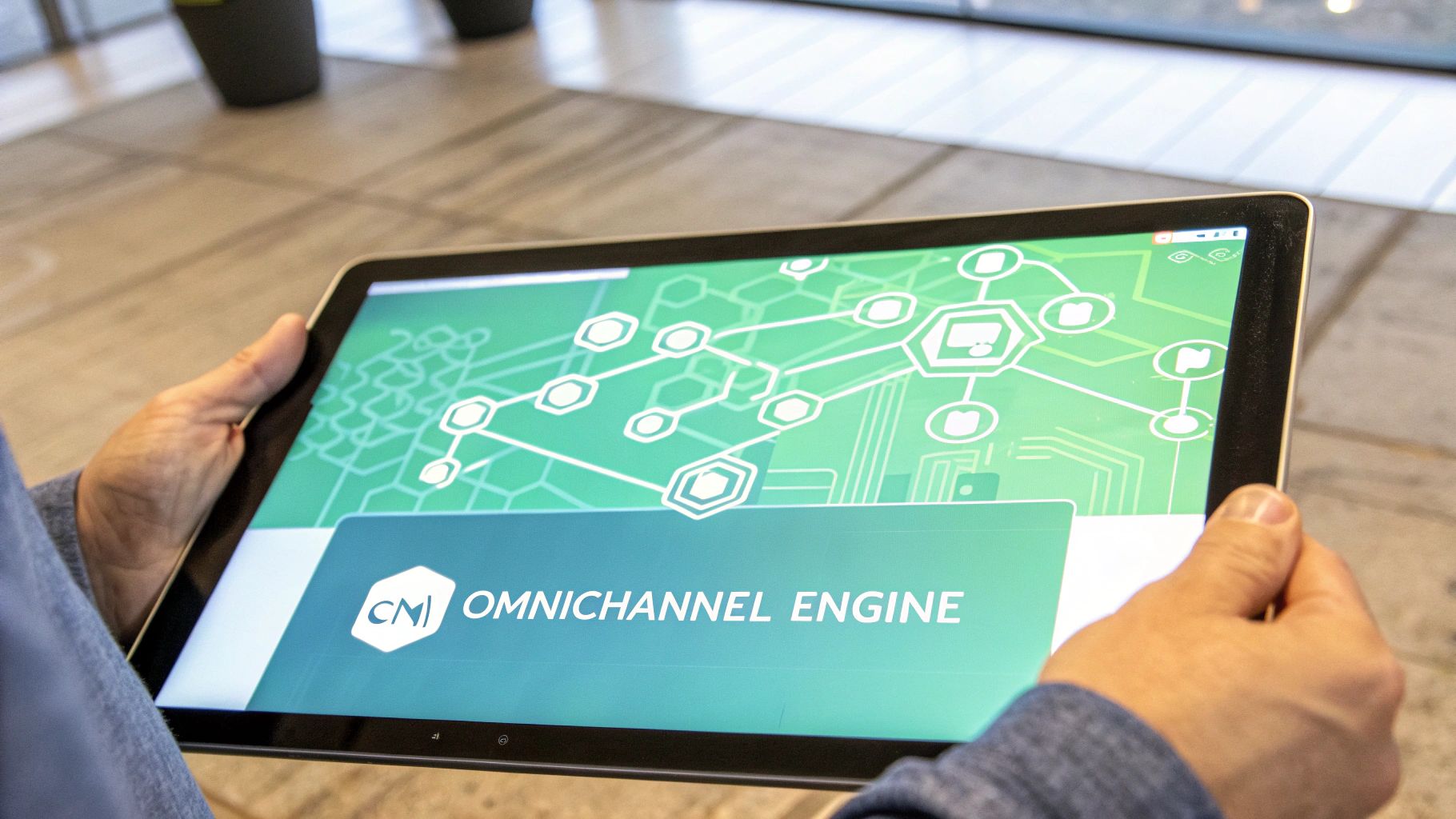
The goal isn't to build a monolithic fortress. Instead, think of it like assembling a high-performance engine, where finely tuned, specialized parts work in perfect harmony. Each component has a job, and data and content flow freely between them.
The Content Nucleus: Sitecore XM Cloud
It all starts with content. Your brand’s voice, messaging, and identity have to feel the same whether a customer is on your website, scrolling through your app, or tapping on an in-store kiosk. Sitecore XM Cloud acts as the central hub for this entire operation.
As a cloud-native, headless CMS, XM Cloud separates content creation from content delivery. Your marketing team can manage everything in one place, and that content can be pushed out to any channel or device through APIs. This headless approach is what prevents your brand from feeling disjointed across a sprawling digital ecosystem.
- For Websites and Web Apps: It delivers the rich, dynamic experiences customers expect on traditional browsers.
- For Mobile Applications: It feeds content directly into native iOS and Android apps, creating a fluid mobile journey.
- For IoT and Kiosks: It pushes information to emerging touchpoints like smart displays, interactive kiosks, or even voice assistants.
By centralizing content in XM Cloud, you get one source of truth. No more fragmented messaging.
The Data Powerhouse: Sitecore CDP
While XM Cloud handles the "what" (your content), Sitecore Customer Data Platform (CDP) is all about the "who" (your customer). You can't have an effective omnichannel experience without a deep, unified understanding of each individual, and Sitecore CDP is the tool that makes this happen.
Think of it as a central data repository that drinks in information from every possible touchpoint:
- Online Behavior: Tracking clicks, page views, and form submissions on your site.
- Transactional Data: Integrating purchase history from e-commerce platforms and point-of-sale systems.
- Offline Interactions: Capturing notes from in-store visits or calls with your customer service team.
Sitecore CDP stitches all this scattered information together into a single, persistent customer profile. This "golden record" gives you a 360-degree view of their journey, making every subsequent interaction smarter and more context-aware. You can explore how implementing a Sitecore platform lays the foundation for this powerful data integration.
The Activation Engine: Sitecore Personalize
Having unified content and unified data is a huge step. But the real magic happens when you activate that intelligence. Sitecore Personalize is the engine that takes the rich profiles built in Sitecore CDP and uses them to deliver real-time, one-to-one personalization.
It connects directly to the CDP, reads the customer's profile and current context, and executes tailored experiences on the fly. This goes way beyond just showing a customer's name on a homepage. It's about dynamically altering the entire journey.
Imagine a customer browsed a specific product category on your mobile app last night. When they visit your website today, Sitecore Personalize can instantly surface a hero banner featuring that exact category, showcase related accessories, and even present a limited-time offer to nudge them toward a purchase.
This is the kind of contextual personalization that transforms a standard digital interaction into a memorable, deeply relevant experience. It makes the customer feel seen and understood—the ultimate goal of any omnichannel strategy.
The synergy between these Sitecore products is what makes a sophisticated omnichannel architecture possible. Each platform addresses a critical requirement, and when combined, they create a seamless system for managing content, data, and personalization.
Here's a breakdown of how they work together:
Sitecore Product Synergy in an Omnichannel Architecture
This integrated approach ensures that every part of the customer journey—from initial discovery to post-purchase support—is connected, consistent, and intelligent. By leveraging the full Sitecore ecosystem, you can move beyond siloed channels and build a truly unified customer experience.
Measuring the Business Impact of a Unified Customer Journey
It’s one thing to talk about architecture, but it’s another to see the real-world results. This is where a true omnichannel customer experience strategy proves its worth. Investing in a powerful platform like Sitecore isn't just a technical upgrade; it's a direct investment in measurable business growth. Think of a unified journey as the engine that drives loyalty, efficiency, and ultimately, revenue.
The numbers don't lie. Companies that get omnichannel engagement right see a substantial 9.5% year-over-year increase in annual revenue, leaving businesses with weaker strategies far behind. On top of that, these strategies can drive an impressive 80% increase in store visits. And when those customers show up, they spend about 4% more.
This financial boost isn’t magic. It's the direct result of creating smart, seamless interactions that customers genuinely appreciate.
Quantifying Gains in Customer Loyalty and Lifetime Value
A connected journey, powered by tools like Sitecore CDP and Personalize, creates a powerful feedback loop. When a customer feels understood—whether they're on your app, browsing your website, or talking to a service agent—their trust in your brand grows. That emotional connection translates directly into a higher customer lifetime value (CLV).
By tracking interactions across every touchpoint, Sitecore gives you the data needed to actually calculate and improve CLV. You can finally pinpoint your most valuable customer segments, get a handle on their behaviors, and build targeted retention campaigns that keep them coming back for more.
A unified journey means every interaction adds value. Instead of starting from scratch each time, you're building on a relationship, which is the foundation of long-term loyalty and profitability.
To really dig into this, you need to map out every step of the customer's path. A comprehensive customer journey mapping guide is a great place to start.
Boosting Operational Efficiency Across Teams
The benefits aren’t just customer-facing. A well-designed omnichannel system delivers significant wins internally, too. When all your customer data lives in one place, like Sitecore CDP, you eliminate the frustrating silos that create friction between marketing, sales, and service departments.
Just look at the efficiency gains:
- Marketing Teams: Can build far more effective campaigns with a complete view of customer behavior. That means better conversion rates and less wasted ad spend.
- Sales Representatives: Walk into conversations armed with a rich history of every interaction, leading to more relevant pitches and shorter sales cycles.
- Service Agents: Resolve issues faster because the customer's entire story is right at their fingertips. This boosts first-contact resolution rates and keeps customers happy.
And it doesn’t stop there. Integrating a knowledge management system like SharePoint creates a single source of truth for your internal teams. This ensures every customer-facing employee has the same product information and support docs, guaranteeing a consistent and accurate brand message. This kind of internal alignment is a critical—and often overlooked—part of a winning omnichannel strategy.
For a deeper dive into the financial implications, you might be interested in our article on how to measure ROI effectively. In the end, a unified customer journey powered by Sitecore pays for itself through more revenue, stronger loyalty, and smoother operations.
Your Roadmap to Implementing an Omnichannel Strategy
Rolling out a true omnichannel strategy is much more than just plugging in new software; it requires a clear, step-by-step roadmap. This isn't just a tech upgrade—it's a fundamental shift that moves an organization from siloed, disconnected operations to a cohesive, customer-first model. With a structured approach, you can build a powerful engine for delivering a truly seamless customer experience omnichannel.

Think of this roadmap not as a sprint, but as a methodical journey. Each phase builds on the one before it, ensuring you create a stable and scalable foundation that will pay off for years to come.
Phase 1: Audit and Foundation Building
Before you can build anything new, you have to know what you’re working with. The first step is always to take a hard look at where you stand today. Kick things off with a comprehensive audit of all your existing customer touchpoints—from your website and mobile app to your in-store kiosks and customer support chats. The main goal here is to hunt down the data silos. Where is customer information getting trapped, unable to flow between systems?
Once you've mapped out your current landscape, the real work begins: building a rock-solid data foundation. This is precisely where a tool like Sitecore CDP becomes the cornerstone of your entire strategy. Your objective is to configure the CDP to pull in data from every single touchpoint you identified, creating that all-important single source of truth for every customer. Without this unified data layer, any attempt at personalization is just guesswork based on an incomplete picture.
Phase 2: Content Strategy and Internal Alignment
With your data foundation firmly in place, it's time to shift your focus to content. A great omnichannel experience is built on delivering consistent, relevant, and helpful messaging across every channel, every time. This requires a content-first strategy, which means you stop creating assets for individual channels in isolation and start thinking holistically.
This is the perfect job for Sitecore Content Hub. By centralizing all your marketing assets—from product photos and official descriptions to campaign slogans and videos—you guarantee brand consistency no matter where a customer interacts with you. Think of Content Hub as the single source of truth for your brand's voice and visuals.
At the same time, you need to get your internal teams ready for this shift. A brilliant external customer experience can fall flat if it’s supported by a disconnected internal one. Using SharePoint as a central knowledge hub is absolutely critical here.
Empowering your customer-facing teams with the right information at the right time is non-negotiable. SharePoint ensures your sales, service, and marketing teams are all reading from the same playbook, providing consistent answers and presenting a unified brand front.
Use SharePoint to house things like:
- Updated Product Information: All the latest details, specs, and availability.
- Marketing Campaign Briefs: To make sure everyone understands current promotions and messaging.
- Customer Service Scripts and FAQs: For providing accurate and consistent support that builds trust.
Phase 3: Activation and Measurement
Now it’s time for the fun part: activating all that data and content. This phase is all about launching your initial campaigns using Sitecore Personalize. Because it’s directly connected to your Sitecore CDP, Personalize can tap into those rich, unified customer profiles you’ve built to deliver interactions that are truly aware of the customer's context.
Don't try to boil the ocean. Start with a few manageable, high-impact use cases. For example, you could launch a campaign to reduce cart abandonment by triggering personalized offers via email or push notification. Or, you could create dynamic homepage content for returning visitors based on their previous browsing behavior. These initial campaigns act as powerful proofs of concept, showing everyone the real-world value of your new omnichannel engine.
Of course, execution is only half the battle; you also need to define what success looks like. Establish clear Key Performance Indicators (KPIs) right from the get-go.
Your KPIs should track:
- Customer Engagement: Look at metrics like conversion rates, average order value, and time on site.
- Customer Loyalty: Keep an eye on repeat purchase rates and Customer Lifetime Value (CLV).
- Operational Efficiency: Measure improvements in things like first-contact resolution for your support teams.
This phased roadmap—auditing your touchpoints, building a data foundation with Sitecore CDP, centralizing content with Content Hub, enabling your teams with SharePoint, and activating campaigns with Sitecore Personalize—provides a proven path forward. It turns the complex, often overwhelming goal of an omnichannel customer experience into a series of achievable, value-driven steps.
Common Questions About Sitecore and Omnichannel Experiences
Even with a clear plan, connecting the dots between your strategy and the technology can feel a bit fuzzy. It’s one thing to talk about an omnichannel customer experience; it’s another to see how a platform like Sitecore actually makes it happen.
Let's dig into a few common questions that come up when bridging that gap from theory to a real, working implementation.
What Is the Difference Between Multichannel and Omnichannel?
The big difference here is integration. It’s what separates a disjointed experience from a seamless one.
In a multichannel setup, you're active in different places—maybe you have a website, an app, and a physical store—but they all act like separate islands. What a customer does in the app is a complete mystery to your website.
An omnichannel experience, on the other hand, connects those islands. A platform like Sitecore weaves them into a single, continuous conversation with the customer.
Think about it this way: a customer could be browsing products on your mobile app during their commute, add a few items to their cart, and then pick up right where they left off on their desktop at home to complete the purchase. Sitecore CDP is the tech that makes that possible by connecting the dots between channels.
How Does Sitecore CDP Enable a True Omnichannel Experience?
Sitecore’s Customer Data Platform (CDP) is really the engine driving a modern omnichannel strategy. It acts as a central hub, pulling in customer data from every single touchpoint you have—online and offline—and stitching it all together into one unified customer profile.
This isn’t just a simple contact record. This "golden record" is incredibly rich, tracking everything from browsing history and past purchases to support tickets and even in-store visits.
By building this complete picture, Sitecore CDP feeds the intelligence directly to Sitecore Personalize. This is what allows your brand to deliver experiences that feel consistent and context-aware, no matter where your customer is interacting. They always feel like you know who they are.
How Does SharePoint Fit into a Sitecore Omnichannel Strategy?
If the Sitecore suite is focused on managing the external, customer-facing experience, then SharePoint is all about orchestrating the internal teams that make it all happen. Think of it as the central nervous system that empowers your employees to deliver on that omnichannel promise.
You can use SharePoint to manage all the critical internal information your teams need:
- Product Information: A single source of truth for specs, pricing, and stock levels.
- Marketing Assets: A centralized hub for campaign materials, brand guidelines, and approved creative.
- Training Documents: Consistent onboarding guides and procedures for anyone in a customer-facing role.
- Internal Procedures: Standardized workflows for sales and support teams so everyone is on the same page.
When you integrate SharePoint, you're making sure your sales, support, and marketing teams are all working from the same playbook. That kind of internal alignment is absolutely essential for delivering the consistent, high-quality service customers now expect.
At Kogifi, we specialize in architecting and implementing powerful digital experience platforms. Our expertise with Sitecore and SharePoint helps businesses build the seamless, integrated customer journeys that drive growth and loyalty. Discover how our solutions can transform your digital presence.