


Your team probably has content in Sitecore, SharePoint, shared drives, DAM folders, email threads, PDFs, product databases, and a few systems nobody wants to admit are still business-critical. Marketing can't tell which version is approved. Legal wants retention controls. IT wants fewer integrations, not more. Regional teams keep copying content because they don't trust central repositories. That isn't a storage problem. It's an operating model problem.
This is where enterprise content management consulting matters. Done properly, it doesn't produce a bigger document library. It gives the business a controlled way to create, govern, find, reuse, personalize, and retire content across digital channels and internal workflows. That shift matters because ECM is no longer a niche category. MarketsandMarkets projects the global ECM market at USD 59.53 billion in 2026 and USD 95.76 billion by 2031, with a 10.0% CAGR, while North America alone is projected to reach USD 21.93 billion in 2026. Buyers aren't funding ECM because they want cleaner folders. They're funding it because content now sits inside customer experience, compliance, search, workflow, and revenue operations.
Most enterprises still approach ECM backwards. They start with platform selection, then argue about migration, then discover taxonomy, governance, and ownership too late. That sequence burns budget and slows adoption. The smarter approach starts with content intelligence. Know what you have, who owns it, how it's used, what risk it creates, and where AI can help without weakening governance.
If you're weighing modernization, these enterprise content management benefits are useful context. But benefits only materialize when strategy, architecture, and adoption are designed together.
Table of Contents
- Introduction From Content Chaos to Content Intelligence
- The old warehouse model is dead
- What consultants actually do
- Strategy starts with content operations
- Sitecore should lead the customer-facing layer
- SharePoint should handle the internal collaboration layer
- Migration and governance decide whether the platform succeeds
- Discovery first, always
- Roadmap, build, and controlled rollout
- Optimization is part of the engagement, not an afterthought
Introduction From Content Chaos to Content Intelligence
A typical enterprise doesn't suffer from a lack of content. It suffers from too much unmanaged content in too many disconnected places. Brand teams create assets in one system, regional teams localize them in another, and internal stakeholders approve them through email, Teams, or spreadsheets. Then everyone acts surprised when the website, intranet, campaign landing pages, and sales enablement documents don't match.
That's why enterprise content management consulting should be treated as a business transformation discipline, not an IT workstream. You're not buying software to store files. You're designing how content moves through the company, how people trust it, and how digital experiences pull from it without creating chaos. In a modern DXP environment, the question isn't where content is saved. The question is whether the right content reaches the right audience through the right workflow with proper governance.
For Sitecore-heavy organizations, that distinction is even more important. Sitecore isn't just a CMS. In the right architecture, it's the customer-facing execution layer for content operations, personalization, search relevance, and omnichannel delivery. SharePoint then plays a different role. It becomes the internal collaboration and controlled document layer, not the system that should carry your external experience strategy.
Practical rule: If your content model can't support both governance and reuse, your personalization program will stall before your editors do.
Most companies don't need another repository. They need a clearer decision about which platform owns which content responsibility, and they need consultants who understand how that decision affects ROI, adoption, and long-term maintainability.
What Exactly Is Enterprise Content Management Consulting
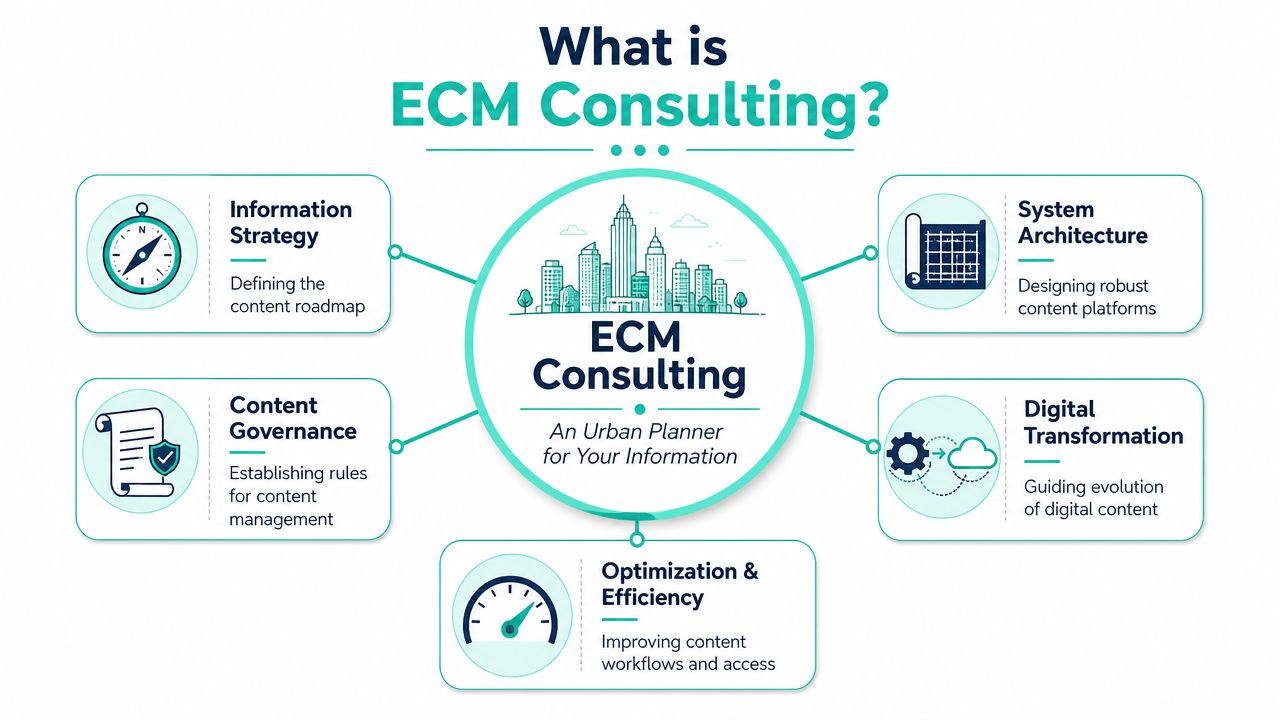
Enterprise content management consulting defines how content is structured, governed, integrated, and delivered across the business. It turns scattered repositories, inconsistent workflows, and platform overlap into a system the company can run at scale. In a modern DXP program, that work has a clear purpose. It helps the business publish faster, reuse content more effectively, reduce compliance risk, and support personalization without creating editorial chaos.
The old warehouse model is dead
Legacy ECM treated content like inventory. Store documents in one place, lock down permissions, add search, and call it done. That approach falls apart once content has to feed websites, portals, campaign journeys, knowledge experiences, and internal operations at the same time.
A broader ECM view is covered in these enterprise content management solutions, but the practical point is simpler. Modern consulting connects content operations to business execution. That includes content models, taxonomy, workflow design, API decisions, retention rules, localization, search configuration, and AI-assisted tagging, recommendations, and orchestration.
For enterprises investing in Sitecore, this is the line that matters. Sitecore should sit at the center of customer-facing content delivery and digital experience execution. SharePoint should support internal collaboration, controlled document management, and intranet use cases. If SharePoint is forced to carry external experience strategy, or Sitecore is treated like a document archive, cost goes up and value drops.
What consultants actually do
A serious ECM consulting engagement starts by identifying content domains, platform responsibilities, ownership gaps, and failure points in current workflows. The goal is not to catalog every file for the sake of documentation. The goal is to define a target operating model the business can maintain after launch.
That usually means examining where customer-facing content lives, where internal documents are created and approved, how metadata is applied, which systems need to integrate, and where governance breaks down. It also means deciding which content should be structured for reuse and automation, especially if the business wants AI features to produce useful results instead of amplifying bad inputs.
The output should be concrete:
- A content architecture that separates external experience content, internal collaboration content, records, and reusable assets
- A platform model that assigns Sitecore, SharePoint, DAM, search, and line-of-business systems clear roles
- A governance framework with named owners, approval paths, retention rules, and publishing controls
- An integration plan for CRM, PIM, translation, analytics, search, and AI services
- A migration strategy that cuts redundant, obsolete, and low-value content before it reaches the new platform
Enterprise content management consulting should give you a content operating model that supports growth, governance, and measurable ROI.
This is why ECM consulting matters more now than it did in the old repository era. In an AI-driven DXP ecosystem, weak content models produce weak search, weak personalization, and weak automation. Strong consulting fixes that at the source. It gives Sitecore the structured, governed content it needs to drive external experiences, while SharePoint stays focused on internal productivity and collaboration.
Core Consulting Services Unlocking Your Digital Potential
The most valuable ECM work doesn't start with migration scripts or UI templates. It starts with decisions about content operations. Who creates what. Where structured content lives. Which assets can be reused. What must be reviewed by legal. Which journeys need personalization. Which workflows deserve automation. If those decisions are weak, the implementation will be expensive and fragile no matter how polished the frontend looks.

Strategy starts with content operations
Strong enterprise content management consulting usually includes a mix of strategy, architecture, implementation planning, governance design, and operational change. The deliverables should be concrete. Not vague vision statements.
A serious engagement should define:
- Content domains: Separate customer-facing content, internal operational content, records, and reusable brand assets.
- Ownership model: Name business owners, technical owners, and approval authorities for each domain.
- Taxonomy and metadata: Create structures editors can maintain.
- Workflow design: Route content through review, translation, legal approval, publishing, and retirement steps.
- Measurement model: Tie outcomes to speed, quality, governance adherence, and reuse.
This is also where AI changes the conversation. Hyland's analysis of the future of enterprise content management notes that AI is shifting ECM toward intelligent content solutions using AI and machine learning for data extraction, analytics, personalization, and automated workflow support, while also raising governance questions tied to trust and misinformation risk. That means consultants now have to answer harder questions than "Can we automate this?" They need to answer "Should we automate this, where should human review stay in place, and how will we audit the result?"
Sitecore should lead the customer-facing layer
For external digital experience, a Sitecore-first architecture makes sense when the business needs personalization, composability, multilingual delivery, and a content model that supports multiple channels. Sitecore XM Cloud and the broader Sitecore portfolio fit organizations that want to stop rebuilding customer experiences around fragmented repositories and disconnected tools.
In practice, that means consultants should help teams do the following:
Model content for reuse
Build structured content types for pages, components, campaigns, offers, product stories, and knowledge content. Reuse beats duplication every time.Design composable integration patterns
Connect Sitecore to commerce, CRM, PIM, DAM, search, and analytics platforms through APIs. Customer experience breaks when editorial teams have to copy information manually.Apply AI deliberately
Use Sitecore AI capabilities and adjacent AI services where they improve authoring, tagging, search relevance, and content insight. Keep human oversight on regulated or high-risk content.Support omnichannel governance
A page isn't the unit of value anymore. Content fragments, variants, and reusable components are. Governance has to reflect that.
One practical option for this work is Kogifi's content governance framework, which outlines how governance can be embedded into content operations rather than layered on after launch.
If your Sitecore implementation still depends on page-by-page duplication, you don't have a modern content architecture. You have a maintenance problem.
SharePoint should handle the internal collaboration layer
SharePoint is still critical. It just needs the right job description. It should own internal collaboration patterns, controlled team sites, document libraries, intranet publishing, and process-driven internal content where Microsoft 365 is already the center of work.
That makes SharePoint valuable for:
- Departmental knowledge management
- Policy and procedure libraries
- Internal approvals and document workflows
- Collaboration around regulated internal documents
- Secure access for operational teams
It shouldn't be forced into becoming your full external DXP if your organization needs advanced customer-facing personalization, composable delivery, and complex digital marketing orchestration. That's not a criticism of SharePoint. It's architectural discipline.
Migration and governance decide whether the platform succeeds
Most troubled ECM programs fail in two places. First, during migration planning, when nobody wants to archive old content and every business unit insists that all legacy material is essential. Second, after go-live, when governance isn't staffed and editors fall back to old habits.
A capable consulting team should provide more than a migration checklist. It should define:
| Service Area | What good consulting looks like |
|---|---|
| Content audit | Maps repositories, duplicates, owners, and risk areas |
| Migration planning | Classifies content into migrate, archive, rewrite, or retire |
| Taxonomy design | Creates a maintainable enterprise vocabulary, not academic theory |
| Workflow automation | Aligns approvals and publishing with real business processes |
| Search strategy | Improves findability through structure, metadata, and relevance tuning |
| Governance model | Assigns decision rights for permissions, lifecycle, and quality |
| Adoption planning | Trains editors by role, not with generic platform demos |
The ECM Consulting Engagement Lifecycle Explained
A year after launch, the new platform is live, but teams still email documents for approval, search results are poor, and business units keep asking why the investment has not changed how content work gets done. That outcome usually starts much earlier, in a weak consulting process.
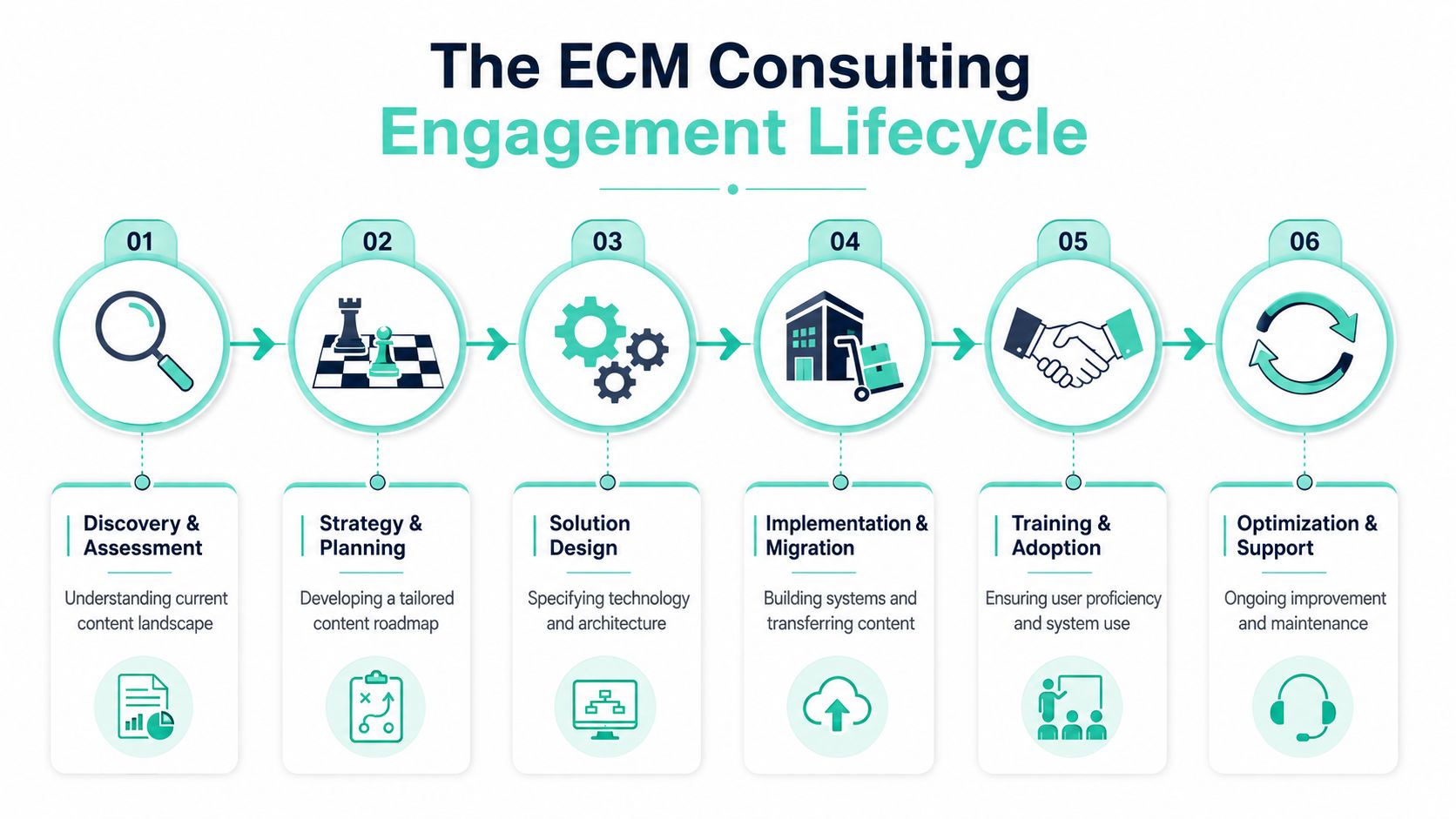
A serious ECM engagement follows a clear sequence. Each phase reduces risk, assigns ownership, and turns platform decisions into business outcomes. In a modern stack, that also means drawing a hard line between systems. Sitecore drives customer-facing content operations, personalization, and AI-assisted DXP use cases. SharePoint supports internal collaboration, controlled documents, and Microsoft 365 workflows. If those roles stay vague, the program drifts.
Discovery first, always
Assessment comes first because every later decision depends on it. The consulting team needs a working view of where content lives, who owns it, how it moves, which systems consume it, and where risk sits today. As noted earlier, strong ECM consulting starts with content inventory and repository mapping. Without that baseline, architecture turns into guesswork.
Consultants should inspect:
- Repositories and platforms: CMS, SharePoint, DAM, file shares, legacy intranets, email-driven stores
- Content types: web pages, documents, forms, media, records, product content, knowledge content
- Dependencies: integrations, approvals, localization flows, downstream publishing
- Risk areas: retention issues, permissions, unmanaged duplication, inaccessible content
This phase should force decisions, not collect opinions. Retire low-value content. Archive what has regulatory value but no operational value. Rewrite content that blocks reuse or personalization. Assign named owners. If nobody owns a content set, it will fail after migration too.
A short product walkthrough can help stakeholders understand what a structured platform journey looks like:
Roadmap, build, and controlled rollout
Once discovery is complete, the engagement moves into target-state design. During this phase, good consultants earn their fee. They define the operating model, platform boundaries, integration patterns, migration waves, and delivery order. If Sitecore will manage customer journeys, structured content, search experiences, and AI-driven personalization, say so now. If SharePoint will handle internal document collaboration and controlled team workflows, say that too.
Then the build starts. The work is not just template creation and connector setup. It includes content modeling, workflow configuration, permissions, metadata rules, search design, and integration with business systems that need content in the right format at the right time. Microsoft describes ECM in Microsoft 365 as a combination of document management, records controls, workflow, and compliance services across connected environments, which is the right way to frame this phase in enterprises already running SharePoint and Teams.
A controlled rollout usually includes:
- Pilot scope with a limited business domain
- Migration wave planning by content criticality
- Role-based training for editors, approvers, and admins
- Publishing guardrails before broad release
Launching every business unit at once is usually poor program management. Pilot first. Fix workflow friction, permission gaps, and search issues in a contained release. Then expand.
Optimization is part of the engagement, not an afterthought
Go-live is the handoff into operational improvement. Search relevance needs tuning. Metadata needs revision. New content types appear. AI-assisted processes need approval rules, monitoring, and editorial standards. Governance boards need a cadence and decision rights, or they become a mailbox nobody checks.
The right consulting partner stays involved in the operating model, not just the launch checklist. At Kogifi, that usually means reviewing:
- Editorial friction points
- Workflow bottlenecks
- Search quality
- Governance compliance
- Platform enhancements
- Backlog prioritization
That rhythm protects the investment. It also creates the ROI story executives care about: faster publishing, lower compliance risk, fewer manual handoffs, better reuse of content assets, and a platform stack that supports both internal collaboration and AI-driven digital experience delivery.
Choosing Your Platform and Expert Partner
Your team wants one platform to manage everything. Marketing wants personalized digital experiences. Operations wants controlled documents and approvals. IT wants fewer systems. Force all of that into one tool and you usually get a costly compromise.
Choose the platform around the job it needs to do.
For modern ECM, the primary decision is architectural. If your business is building AI-driven digital experiences across web, search, personalization, and multiple channels, Sitecore should sit at the center of the external content ecosystem. If your business needs internal collaboration, document control, and Microsoft 365-aligned working practices, SharePoint should support the internal layer. In enterprise programs, that split is often the right answer because it matches how content is created, governed, and delivered.
Licensing should not drive this decision. Operating model fit should.
Use this logic:
- Choose Sitecore when external experience delivery matters most. That includes structured content, multilingual publishing, personalization, composable DXP architecture, and AI-assisted content operations.
- Choose SharePoint when the priority is internal teamwork. That includes intranet publishing, document libraries, records controls, approval workflows, and collaboration inside Microsoft 365.
- Use both when the business needs a clean boundary between customer-facing experience management and internal collaboration. Sitecore handles experience orchestration. SharePoint handles employee content and document processes.
If you're comparing options, this guide to the best enterprise content management system gives a useful baseline before you narrow the stack.
The partner decision matters just as much as the platform decision. Procurement teams often score vendors on day rates and feature checklists. That is a mistake. A weak consulting partner will blur the line between DXP and document management, overbuild custom workflows, ignore content quality issues, and leave you with a platform that is expensive to run and hard to govern.
A strong partner does the opposite. They define where Sitecore ends and SharePoint begins. They map business goals to content architecture. They challenge bad migration assumptions early. They make AI governance practical instead of theoretical.
RFP Checklist for Selecting an ECM Consulting Partner
| Evaluation Criteria | What to Look For |
|---|---|
| Platform depth | Proven Sitecore architecture experience, plus real SharePoint delivery capability where internal collaboration matters |
| AI and content operations understanding | Ability to discuss metadata automation, search relevance, governance boundaries, and human review models without hype |
| Composable architecture skill | Practical API, integration, and cloud implementation experience across DXP ecosystems |
| Discovery methodology | Clear approach to repository mapping, content auditing, taxonomy review, and migration scoping |
| Governance approach | Defined model for permissions, lifecycle, ownership, decision rights, and editorial accountability |
| Migration discipline | Content triage process for archive, retire, rewrite, and migrate decisions |
| Change management | Role-based training, adoption planning, and post-launch operating model support |
| Support model | Ongoing optimization, SLA-based support options, backlog management, and roadmap refinement |
| Communication style | Direct recommendations, documented risks, and willingness to challenge bad assumptions |
| Commercial clarity | Transparent scope boundaries, assumptions, responsibilities, and escalation paths |
Ask hard questions before you sign anything.
Who owns taxonomy after launch? How will AI-generated metadata be reviewed and corrected? Which content is excluded from migration? What belongs in Sitecore, and what stays in SharePoint? Which integrations are required for phase one, and which should wait until the operating model is stable?
If a partner cannot answer those clearly, keep looking. A good ECM partner does more than implement software. They help you build a content system that supports revenue growth on the front end, control on the back end, and a measurable return on the investment.
Measuring ROI and Mitigating Common Project Risks
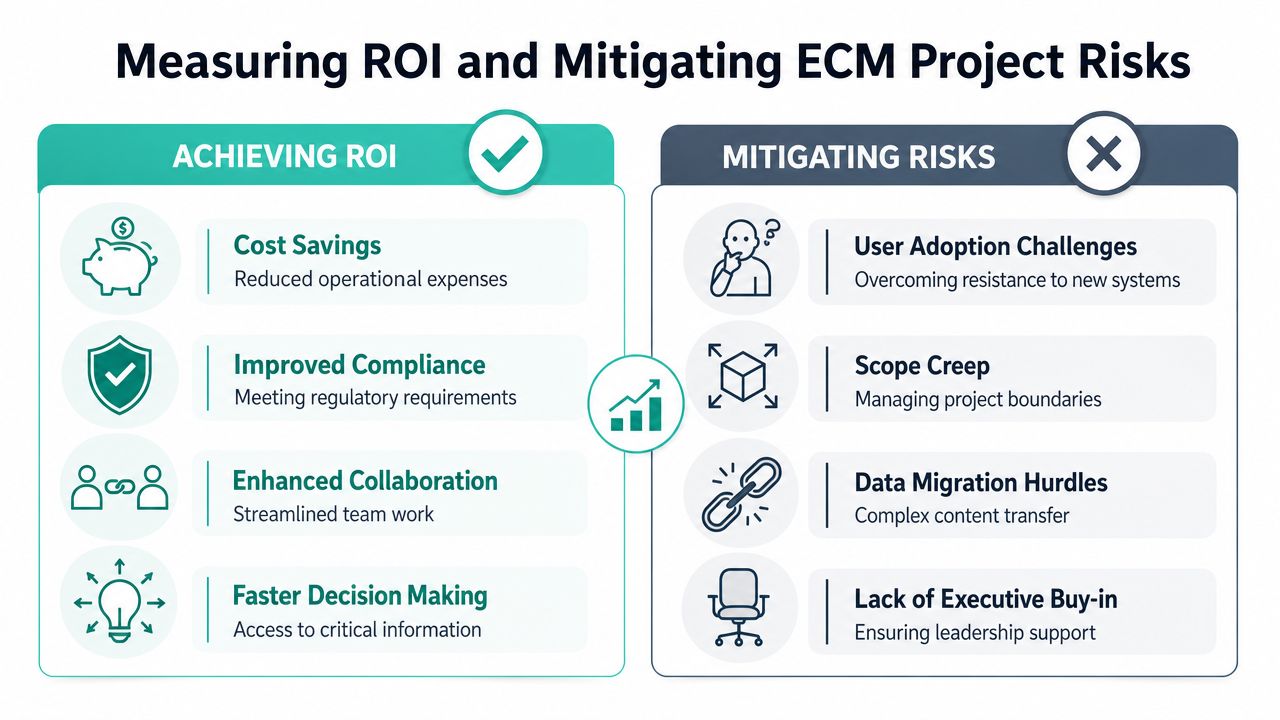
Many ECM projects don't fail because the software is weak. They fail because the operating model is. Teams launch a repository, migrate a lot of content, and then wonder why usage declines, search quality slips, and editors start storing files elsewhere. That's not a technology surprise. It's a governance failure.
The biggest ROI mistake is ignoring governance
A critical blind spot in many ECM projects is the absence of a realistic governance operating model. Without defined ownership for taxonomy, permissions, and lifecycle rules, platforms often slide into content sprawl and low adoption, undermining ROI, as discussed in this ECM governance perspective.
That risk shows up in familiar forms:
- Scope creep: every department wants exceptions, custom workflows, and legacy baggage preserved
- Low user adoption: editors stick with email, local drives, or Teams attachments
- Poor content quality: metadata is inconsistent, naming standards drift, and duplicate content returns
- Weak executive ownership: business leaders treat the platform as IT's problem after launch
Governance isn't paperwork. It's the mechanism that keeps content trustworthy after the project team leaves.
Mitigation is straightforward, but it requires discipline. Assign content owners. Define who approves taxonomy changes. Set lifecycle policies. Measure compliance with the operating model. Train by role. Review search quality regularly. None of that is glamorous. All of it affects ROI.
What to measure after go-live
Don't reduce ROI to license consolidation or storage savings. Those matter, but they miss the point. A modern ECM program should be measured through business performance and operational quality.
Use a scorecard like this:
| KPI Area | What to track qualitatively |
|---|---|
| Content velocity | How quickly teams move from draft to approved publishable content |
| Reuse | Whether teams are reusing approved assets and structured content instead of recreating them |
| Workflow efficiency | Where approvals stall, and whether manual handoffs are decreasing |
| Search effectiveness | Whether users can find the right content without workarounds |
| Governance adherence | Whether metadata, permissions, and lifecycle rules are being followed |
| Adoption | Whether editors and business teams use the platform as the default place to work |
| Experience quality | Whether customer-facing content stays consistent across channels |
The key is simple. If the platform makes publishing faster but governance weaker, that's not success. If governance is strict but authoring becomes painful, adoption will collapse. ROI comes from balance.
Conclusion Your Path to ECM Modernization in 2026
Enterprise content management consulting has changed. It isn't about centralizing files and calling the job done. It is about building a content operating model that supports digital experience, workflow automation, trustworthy governance, and AI-assisted scale without losing control.
For enterprises with serious customer-facing ambitions, Sitecore should be treated as more than a CMS. It's the strategic layer for structured content, personalization, omnichannel delivery, and modern composable architecture. That makes it the right foundation for organizations that want content to power experiences, not just sit in repositories. SharePoint still matters, but in a different role. It works best as the internal collaboration and document layer inside a broader ecosystem.
The strongest ECM outcomes come from three decisions made early and made clearly. Define platform responsibilities. Design governance before migration. Apply AI where it improves operations without weakening trust. Most failed programs get at least one of those wrong.
If you're planning ECM modernization in 2026, don't start with templates or migration estimates. Start with content inventory, business ownership, and architecture choices that reflect how your teams function. Then build the platform stack around that reality.
The payoff is practical. Faster publishing. Better reuse. Cleaner workflows. Stronger compliance. More reliable search. A digital estate that supports growth instead of slowing it down.
If you're evaluating Sitecore, SharePoint, or a combined DXP and collaboration architecture, Kogifi can help assess your current content environment, define a target operating model, and map a modernization path that aligns strategy, governance, and implementation.