

When you get down to it, the headless CMS comparison really boils down to one thing: platforms built from the ground up for omnichannel content versus those that have been adapted for it. API-first systems like Sitecore give developers maximum freedom and a solid foundation for the future. On the other hand, platforms like SharePoint leverage their existing ecosystems to push content out headlessly. The right choice depends on what you're trying to build—a best-of-breed composable DXP or a tightly integrated content service within a single, unified platform.
Why Enterprises Are Shifting to Headless Architectures
Enterprise digital strategy is making a decisive move away from old-school, monolithic systems. The destination? More agile, API-first architectures. This isn't just a technical refresh; it's a strategic pivot, driven by the need to deliver consistent, high-quality experiences across a constantly expanding universe of digital channels.
Leaders are increasingly prioritizing headless CMS solutions to make true omnichannel content delivery a reality. By decoupling the content repository (the "body") from the presentation layer (the "head"), businesses gain the flexibility to publish content to websites, mobile apps, IoT devices, and whatever comes next—all from a single source.
The Business Drivers Behind the Shift
The biggest motivation here is future-proofing the tech stack. A headless architecture ensures that as new devices and platforms hit the market, your content engine can adapt without needing a complete overhaul. This approach also gives developers the freedom to work with modern frontend frameworks like React or Next.js, which can dramatically speed up development.
This shift is a core part of building a composable DXP, where every component is a best-in-class solution connected through APIs. Sitecore’s portfolio, including products like XM Cloud and Content Hub, is a perfect example of this philosophy in action. It offers a purpose-built, cloud-native ecosystem designed for enterprise-level content operations and personalization.
In contrast, solutions like SharePoint have evolved to become powerful headless content sources within the Microsoft 365 ecosystem. While it wasn't originally designed as a headless CMS, its robust content services are accessible via the Microsoft Graph API. This makes it a fantastic choice for organizations already heavily invested in Microsoft's platform.
To truly get why enterprises are making this move, you have to understand the architectural changes powering it. Diving into microservices architecture best practices shows how this modular approach delivers far greater scalability and resilience.
Strategic Advantages of a Headless Approach
The upside of a headless CMS goes well beyond just technical flexibility. There are some serious strategic advantages at play:
- Improved Performance: Decoupling the frontend leads to optimized, lightweight experiences. Pages load faster, which has a direct and positive impact on user engagement and SEO.
- Enhanced Scalability: Cloud-native headless platforms are built to handle sudden traffic spikes and global demand much more effectively than their monolithic ancestors.
- Greater Consistency: A single source of truth for content ensures your brand messaging stays consistent across every single customer touchpoint.
This comparison will frame Sitecore's composable DXP and SharePoint's content services as two distinct—but equally powerful—options for enterprise headless content management. For a deeper look into the specific advantages, check out our guide on the benefits of headless CMS.
Comparing the Core Architectures of Sitecore and SharePoint
To really understand the headless capabilities of Sitecore and SharePoint, you first have to look under the hood. These two platforms were born from completely different philosophies, and those origins are still a huge factor in how they handle headless content today. Sitecore was built from the ground up as a pure digital experience platform, whereas SharePoint started as a document management system and gradually expanded into a broader content service.
This isn't just a bit of tech history; it shapes everything. It influences the developer experience, defines how the platform scales, and ultimately determines what kind of digital products you can realistically build. Getting a handle on these foundational differences is the first step to picking the right tool for your long-term goals.
Sitecore: A Purpose-Built Composable DXP
Sitecore’s architecture is all-in on a composable, API-first strategy that lives and breathes MACH principles (Microservices, API-first, Cloud-native SaaS, Headless). This isn't a single product that was adapted for headless; it’s a whole ecosystem of specialized, cloud-native services designed to slot together perfectly. The entire structure is built for agility and integrating best-of-breed tools.
The key pieces that make up its headless architecture are:
- Sitecore XM Cloud: This is the SaaS CMS sitting at the core of the ecosystem. It's where your team handles content authoring, modeling, and governance. Because it's fully cloud-native, it completely removes the burden of infrastructure management.
- Content Hub: This is your central command for Digital Asset Management (DAM) and Product Content Management (PCM). It acts as the single source of truth for all digital assets, which is non-negotiable for keeping your brand consistent everywhere.
- Experience Edge API: Think of this as the high-octane content delivery engine. When an editor hits publish in XM Cloud, the content is pushed to Experience Edge, a globally distributed GraphQL API. This decoupling is what makes content delivery incredibly fast and scalable, as it operates independently from the authoring environment.
At its core, Sitecore's architecture is designed for a clean separation of concerns. Content creation, asset management, and content delivery are all distinct but interconnected services. This composable model gives enterprises the freedom to build unique digital experiences without being locked into a monolithic stack.
This design gives your frontend developers total freedom. They can use any modern framework they want—like Next.js or React—to pull content from Experience Edge. All they need to interact with is a clean, predictable GraphQL endpoint, without ever having to touch the underlying CMS. To see how these capabilities can be put to work, you can learn more about our dedicated Sitecore implementation services.
SharePoint: Evolving into a Headless Content Source
SharePoint’s path to headless has been one of evolution, not revolution. Its architecture has its roots in enterprise collaboration and document management, making it a powerhouse for organizing internal content. Over time, its features have expanded to serve content headlessly, mostly by tapping into the power of the Microsoft Graph API.
Unlike Sitecore, SharePoint’s architecture isn’t inherently composable in the same mix-and-match sense. Its real strength comes from its deep, native integration within the Microsoft 365 ecosystem. It shines as a powerful content repository that can feed data into a huge range of applications, both for internal and external audiences.
For a headless SharePoint setup, the key architectural elements are:
- SharePoint Online: This is the content repository itself, where you store structured and unstructured content in lists, libraries, and pages. It’s the "body" of the headless model.
- Microsoft Graph API: This is the unified API gateway for accessing data across the entire Microsoft 365 world, including SharePoint. Developers use this single endpoint to query for content, files, and user data.
So, while SharePoint can absolutely serve content headlessly, its architecture is fundamentally woven into Azure Active Directory, the Power Platform, and other Microsoft services. It excels as a content source for applications built within that ecosystem—think custom intranets, knowledge bases, or internal mobile apps. The strategy here is less about composing a DXP with various third-party tools and more about getting the most value out of a unified Microsoft investment you already have.
A Feature-by-Feature Headless CMS Comparison
Let's move past the high-level architecture and get into what really matters: the features that shape your day-to-day operations. A true headless CMS comparison isn't about counting features on a checklist; it's about understanding how those features solve real business problems. The meaningful differences show up when you look at how each platform handles content modeling, personalization, and omnichannel delivery in a headless world.
For an enterprise, these aren't just technical specs. They're the gears that power customer engagement and make your teams more efficient. How a CMS handles these core functions defines its real value. Here’s a practical look at where Sitecore's composable DXP and SharePoint's content services really differ.
Advanced Content Modeling Capabilities
Strong content modeling is the foundation of any headless strategy. It's how you structure your content so it can be used logically across any channel you can dream up. This is an area where Sitecore’s maturity really shines.
In Sitecore, you structure content using templates that can inherit from each other, building a powerful and scalable information architecture. This lets you create complex, nested content types that map perfectly to sophisticated digital products. Imagine a global brand creating a base "Product" template with core fields; regional teams can then extend it with local attributes without starting from scratch.
SharePoint tackles content modeling through its system of Lists and Content Types. It's incredibly effective for document management and internal collaboration, but that structure is less flexible for the kind of channel-agnostic marketing content a headless approach demands. It’s built for structured data inside the Microsoft ecosystem and often needs more developer muscle to adapt for diverse, public-facing experiences.
The Nuances of Personalization Engines
When it comes to personalization, Sitecore's deep roots as a Digital Experience Platform (DXP) give it a massive head start. These capabilities are woven into the platform's DNA, designed from the ground up to track user interactions and serve up tailored content on the fly.
Sitecore's personalization engine lets marketers create rules and goals based on a visitor's behavior, device, location, and past interactions. This data is collected across every touchpoint, building a detailed user profile that powers dynamic content. In practice, two different users can land on the same page and see completely different content, each optimized for their specific journey.
SharePoint’s personalization is mostly driven by user profiles within the Microsoft 365 ecosystem, especially Azure Active Directory. It’s fantastic at delivering relevant content to authenticated users in an internal setting, like an intranet showing an employee documents from their department. While powerful for employee experience, it just doesn’t have the sophisticated anonymous user tracking and behavior-based rules engine that a DXP like Sitecore offers for winning over external customers.
The core difference is strategic. Sitecore's personalization is designed for marketing-led customer acquisition and engagement. SharePoint's personalization is engineered for productivity and collaboration within a known user base.
Developer Experience and API Maturity
In a headless world, the developer experience is everything. Both platforms bring robust APIs to the table, but they were built for different jobs and it shows. Sitecore's pivot to a composable DXP is clear in its polished, developer-first tooling.
- Sitecore's GraphQL API (Experience Edge): This is a purpose-built, high-performance API designed specifically for headless content delivery. It gives frontend developers strongly typed schemas, so they can predictably and efficiently query for the exact data they need and nothing more. Sitecore also provides official SDKs for modern JavaScript frameworks, which dramatically speeds up development.
- SharePoint's Microsoft Graph API: The Graph API is the unified gateway to the entire Microsoft 365 universe. It’s incredibly powerful and extensive, but it's a general-purpose API—not one fine-tuned for headless CMS content. To get SharePoint content, developers have to work with a much broader API surface, which can add complexity to the project.
Omnichannel Delivery Architecture
Finally, how does the content actually get to your user? Sitecore Experience Edge is a globally distributed delivery platform—essentially a Content Delivery Network (CDN) for GraphQL. When you publish content from Sitecore XM Cloud, it’s pushed to this edge network, guaranteeing low-latency access for users anywhere on the planet.
Getting content from SharePoint, by contrast, means making direct API calls to Microsoft Graph. While Microsoft’s infrastructure is robust and global, this model lacks the specialized edge caching and performance optimization layer that Experience Edge provides for public websites. For global brands where every millisecond of page load time impacts the bottom line, this is a critical distinction.
To bring these differences into sharper focus, let's lay them out in a comparison matrix.
Feature Matrix Sitecore vs SharePoint for Headless Operations
This table provides a side-by-side view of how Sitecore and SharePoint stack up on the features that are most critical for enterprise-level headless operations. The focus here is on the practical differences in architecture, personalization, developer tooling, and scalability that will directly impact your digital projects.
As the matrix shows, the choice isn't about which platform is "better," but which is built for the job you need to do. Sitecore is engineered for the specific demands of high-performance, personalized marketing at scale, while SharePoint's strengths lie in collaboration and internal content management.
Evaluating Ecosystems: Composable DXP vs. Unified Platform
Picking between Sitecore and SharePoint isn't just about technology—it’s about choosing an integration philosophy. This decision sets the foundation for how you'll build, manage, and grow your digital marketing stack. One path leads to a flexible, best-of-breed digital experience, while the other leans into the raw power of a deeply connected productivity suite.
This distinction is a big deal in any headless CMS comparison. Often, the ecosystem around the platform shapes your long-term success more than any single feature. Your choice will influence everything from developer workflows and marketing speed to your total cost of ownership.
Sitecore: The Hub of a Composable DXP
Sitecore’s strategy is all about composability. It's built to be the central hub of a best-of-breed Digital Experience Platform (DXP), connecting smoothly with other top-tier tools through its API-first design. This gives you the freedom to build a tech stack that fits your exact needs, without making compromises.
Instead of trying to do everything, Sitecore doubles down on what it does best: world-class content management, personalization, and delivery. It then provides the connectors to integrate specialized platforms for commerce, CRM, and advanced analytics. This approach frees you from vendor lock-in and lets you upgrade different parts of your stack independently.
A common Sitecore-centric setup might look like this:
- Content Core: Sitecore XM Cloud handles all content creation and modeling.
- Commerce Engine: A dedicated headless commerce platform manages products, pricing, and checkout.
- Customer Data: A CRM like Salesforce stores customer profiles and interaction histories.
- Analytics: A specialized analytics tool dives deep into user behavior.
Sitecore acts as the conductor of this digital orchestra. It pulls data from each system to personalize the content delivered through Experience Edge, creating a unified customer journey from a collection of best-in-class tools.
This composable model is a direct answer to the demand for more agile and adaptable digital platforms. If your goal is to build a highly customized digital presence that can scale, then exploring composable DXPs for scalable personalization is a logical next step.
SharePoint: A Unified Content and Productivity Platform
SharePoint’s power comes from its native integration within the massive Microsoft 365 ecosystem. It wasn't designed to be a hub for third-party tools. Instead, it’s the go-to content service for applications built on Microsoft technology, creating a seamless and powerful platform for both content and productivity.
The philosophy here is to make the most of the tools you already own. For businesses heavily invested in Microsoft 365, using SharePoint as a headless content source is a natural fit. The connections are ready to go and deeply embedded.
Key native integrations include:
- Microsoft Teams: Content from SharePoint libraries can pop up directly in Teams channels, making collaboration effortless.
- Power Platform: Power Apps and Power Automate can use SharePoint lists as a data source to build custom low-code apps and automate workflows.
- Azure Services: SharePoint content is secured by Azure Active Directory and can be indexed by Azure Cognitive Search for powerful, AI-driven search.
This creates a cohesive environment where content management, collaboration, and business automation are tightly connected. The growth of the headless market shows just how much demand there is for solutions that are both integrated and flexible. Once a niche tool for developers, the global headless CMS market is now a major player, estimated at roughly USD 3.26 billion in 2024 and projected to hit USD 26.66 billion by 2035. You can find more details about this market growth on marketresearchfuture.com.
In the end, it comes down to strategy. Sitecore gives you a flexible, composable DXP for crafting standout customer experiences with best-of-breed tools. SharePoint offers a powerful, unified platform that maximizes your investment in the Microsoft ecosystem for all your content needs, both internal and external.
Choosing the Right Platform for Your Business Goals
Translating a technical headless CMS comparison into a clear business decision always comes back to one thing: aligning the platform's capabilities with your strategic goals. The "best" choice is entirely dependent on your specific objectives, your current tech stack, and the kind of digital experiences you're trying to build. It’s about picking the right tool for the job.
This decision tree gives you a high-level view of the choice between a composable DXP and a unified platform, helping you map your main business goal to the right ecosystem.
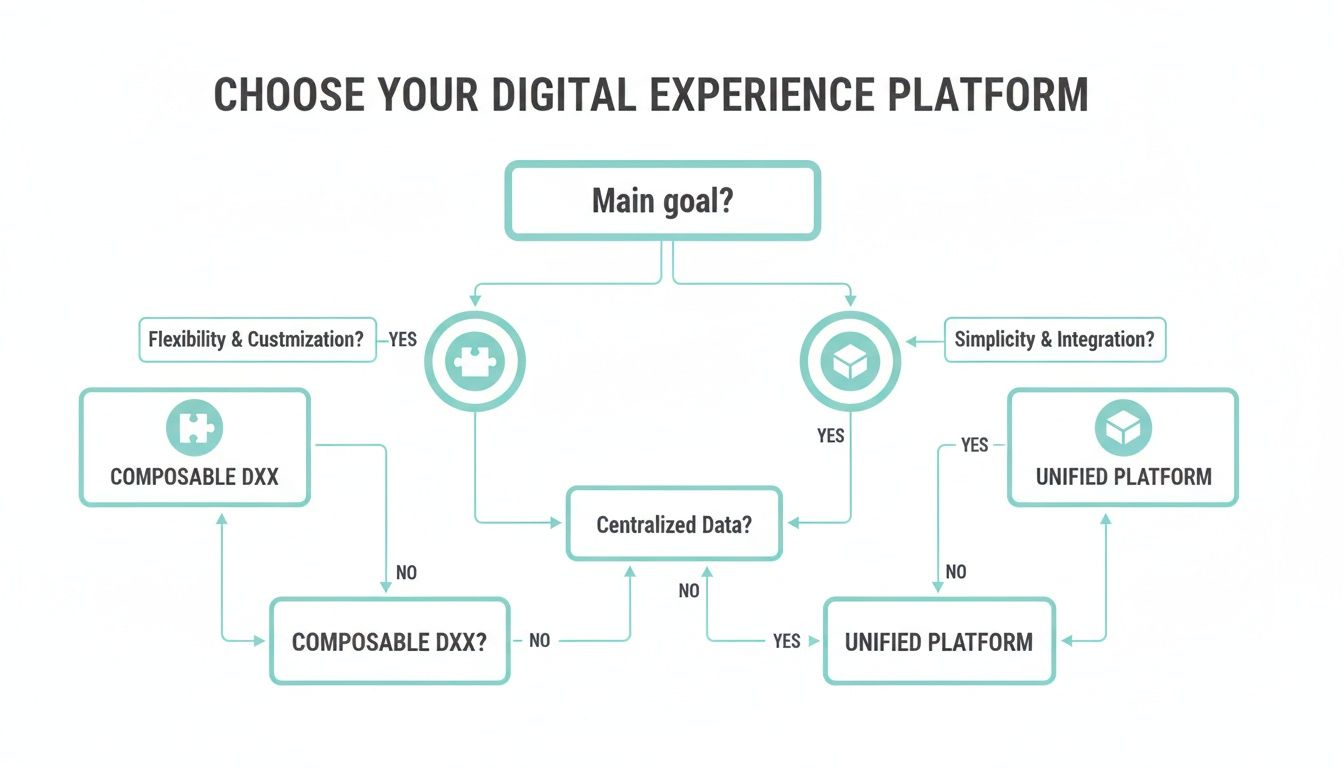
As the visual shows, organizations that prioritize a best-of-breed, highly customizable digital experience usually lean toward a composable DXP. On the other hand, those focused on internal productivity and getting the most out of their existing ecosystem often find more value in a unified platform.
When Sitecore Is the Definitive Choice
Sitecore's composable DXP is purpose-built for organizations where the digital customer experience is a primary driver of revenue and brand loyalty. Its architecture and entire feature set are engineered for sophisticated, large-scale marketing and content operations.
You should consider Sitecore the superior option in these scenarios:
- Global Omnichannel Marketing: For enterprises running complex campaigns across websites, mobile apps, and other digital touchpoints, Sitecore’s headless architecture delivers consistent, high-performance content around the world. Its Experience Edge API was specifically designed for this kind of scale.
- Advanced Personalization: If your strategy hinges on delivering deeply personalized content to both anonymous and known users based on their behavior, Sitecore’s integrated personalization engine is hard to beat. It lets marketers build complex rules and track user journeys in ways that simpler, profile-based systems can't match.
- Best-of-Breed Technology Stacks: Companies that are all-in on a composable strategy—integrating top-tier tools for commerce, CRM, and analytics—will find Sitecore's API-first design a natural fit. It’s built to be the central content hub in a flexible, future-ready ecosystem.
Sitecore excels when the goal is to win, serve, and retain external customers through exceptional digital experiences. Its entire portfolio is geared towards marketing-led growth and sophisticated content orchestration.
Where SharePoint Excels as a Headless Source
SharePoint’s strength is its deep, native integration within the Microsoft 365 ecosystem. It becomes the ideal headless content source when the primary goal is to boost internal productivity, improve collaboration, and leverage an existing Microsoft investment.
SharePoint is the clear winner for these use cases:
- Internal Applications and Intranets: For building modern, headless intranets, knowledge bases, or internal portals, SharePoint offers unmatched advantages. It connects seamlessly with user data from Azure Active Directory, making it incredibly easy to serve personalized content to employees.
- Document-Centric Headless Apps: When the core need is to serve documents, policies, or structured data from a secure, governed repository, SharePoint is the most efficient choice. Its robust document management capabilities are its foundational strength.
- Organizations Deeply Invested in the Microsoft Stack: If your organization relies heavily on Teams, Power Platform, and other Microsoft services, using SharePoint headlessly maximizes the value you’re already getting. The out-of-the-box integrations streamline development and cut down on complexity.
The move to headless is becoming mainstream. North America is leading the charge in CMS adoption, with many organizations seeing faster time-to-market and improved personalization after migrating. You can read more about headless adoption trends and their outcomes.
Ultimately, this decision comes down to your core business priorities—is it about external customer engagement or internal operational excellence?
Making the Move to Headless: Implementation and Migration

Transitioning to a headless architecture with Sitecore or SharePoint is a major strategic move—it’s much more than just flipping a switch. It’s a journey that demands thoughtful planning around content modeling, choosing the right frontend frameworks, and getting your teams ready to operate in a decoupled world. A huge piece of this puzzle is getting the budget right, and mastering accurate software development cost estimation is non-negotiable if you want to keep the project on track financially.
One of the biggest roadblocks teams run into is finding the right developer talent. The move toward headless and composable systems has created a surge in demand for people with advanced API and frontend engineering skills. The shortage of experienced headless-CMS developers is a real bottleneck to market growth.
This is exactly where having an expert partner makes all the difference.
De-Risking Your Transition with Deep Expertise
Migrating to a headless CMS means rewriting the rules for how your content is structured. Your content model is the absolute foundation of a successful project, as it dictates whether your content will be reusable and channel-agnostic from the get-go. An experienced partner can guide you through this critical process, helping you avoid the common trap of just recreating old, page-based content structures in a new, more flexible system.
With deep expertise in both Sitecore’s composable DXP and SharePoint’s content services, we help de-risk this complex transition by providing strategic guidance at every stage. We can help you pick the right frontend frameworks, design an architecture that can scale with you, and implement best practices for performance and security. For a more structured approach, our comprehensive website migration checklist lays out the key steps for a smooth move.
The right partner doesn’t just build what you ask for; they act as a strategic guide, ensuring your architecture is robust, your team is enabled, and your investment delivers maximum ROI.
Ultimately, a headless implementation isn't just a technical challenge—it’s a business transformation. Whether you're tapping into Sitecore's powerful DXP features or using SharePoint within your existing Microsoft ecosystem, our job is to make sure your project succeeds. We can manage the architecture design, oversee the implementation, and provide ongoing optimization, turning what could be a complex migration into a powerful strategic advantage.
Frequently Asked Questions
This section tackles some common questions that pop up when comparing headless CMS options, with practical answers focused on the real-world differences between Sitecore and SharePoint.
Is SharePoint Considered a True Headless CMS Like Sitecore?
No, their core design philosophies are miles apart. Sitecore XM Cloud is a purpose-built headless CMS inside a composable DXP, engineered from the ground up for omnichannel marketing. SharePoint, on the other hand, acts as a powerful headless content source.
It wasn't originally designed for this purpose but does an effective job of delivering content through the Microsoft Graph API. The biggest distinction is the ecosystem around them; Sitecore brings integrated tools for personalization and analytics, while SharePoint's main advantage is its deep connection to the Microsoft 365 suite for collaboration and internal productivity.
What Developer Skills Are Needed for a Sitecore Headless Project?
A Sitecore headless project really hinges on modern frontend developers. You'll need a team skilled in JavaScript frameworks like React, Next.js, or Vue.js to consume Sitecore’s APIs and build the user experience.
Backend developers still need their core Sitecore platform expertise for things like content modeling and system configuration. This decoupled approach lets you create specialized, agile frontend teams that can focus purely on the user-facing experience without getting bogged down in the CMS.
Can We Migrate Existing Content to Sitecore XM Cloud or SharePoint?
Absolutely. Content migration is a standard part of any headless project. For Sitecore, there are well-established strategies and tools for moving content out of legacy systems. For SharePoint, content can be brought over using Microsoft's own tools or various third-party solutions.
The success of any migration really comes down to a thorough content audit and building a new content model that’s actually designed for a headless, channel-agnostic world. Having an experienced partner is critical for planning and executing this transition without major headaches.
Ready to navigate your headless transition with confidence? Kogifi has deep expertise in both Sitecore and SharePoint, ensuring you select and implement the platform that aligns perfectly with your business goals. Get in touch with us to start building your future-proof digital experience.