

In the world of cloud software, multi-tenant architecture is a design where a single, shared instance of an application serves multiple customers, known as 'tenants'. While each tenant's data is kept completely separate and secure, they all operate on the same underlying infrastructure, database, and codebase. This model is the engine behind modern Software-as-a-Service (SaaS) platforms, particularly within the Sitecore ecosystem, because it delivers significant cost savings and operational efficiency.
The Core Concept of Multi-Tenant Architecture
Imagine a high-end apartment building. Every resident has their own secure, private unit with unique keys and furnishings. However, all residents share the building's core infrastructure—the foundation, elevators, and utilities. This is a perfect analogy for multi-tenancy. Instead of constructing a new, standalone house for each user (a single-tenant approach), one powerful, centrally managed application can serve many organizations at once.
Each tenant's data, configurations, and user permissions are strictly isolated, yet they all benefit from the shared resources, maintenance, and updates. This shared model is the cornerstone of platforms like Sitecore XM Cloud, enabling remarkable efficiency and scalability for enterprise digital experiences.
To help you quickly grasp the fundamental differences, here’s a high-level comparison of the two main architectural models. This table breaks down the key business considerations when choosing between a dedicated or a shared environment.
Single-Tenant vs Multi-Tenant At a Glance
Ultimately, the choice depends on your specific needs for control, cost, and scalability. While single-tenant offers maximum control, multi-tenant delivers efficiency and speed that's hard to beat for most modern digital experience platforms.
Efficiency and Scalability in Practice
This architectural style is at the heart of modern cloud computing. By allowing a single software instance to serve many tenants, businesses can dramatically lower operational expenses. This efficiency is fueling significant market growth; the global multi-tenant data center market, valued at USD 63.3 billion in 2025, is on track to hit a staggering USD 213.0 billion by 2035.
The main advantages of this shared model boil down to a few key points:
- Reduced Costs: Sharing infrastructure, maintenance, and licensing fees across hundreds or thousands of tenants drastically reduces the total cost of ownership for everyone.
- Simplified Maintenance: Updates, bug fixes, and security patches are applied to the central application once, and all tenants benefit instantly. This eliminates the complexity of managing individual upgrade projects.
- Effortless Scalability: Onboarding new tenants or websites can be done in minutes without provisioning new hardware or software, making it incredibly easy to support rapid business growth.
A well-designed multi-tenant system is foundational for any business leader evaluating their technology stack for growth. It provides a strategic advantage by optimizing resource use and centralizing management, which is critical for long-term success.
Before we dive deeper into specific multi-tenant patterns, it helps to have a good grasp of the foundational concepts of cloud computing architecture. This background really clarifies how shared resources can be managed securely and efficiently in a cloud environment.
How Different Multi-Tenancy Models Work
Not all multi-tenant systems are created equal. The architectural approach has significant implications, especially when implemented within sophisticated platforms like Sitecore or SharePoint. Selecting the right model is critical, as it directly impacts cost, security, performance, and customization potential.
The decision ultimately comes down to a trade-off: do you require complete, fortified isolation for each tenant, or is maximum efficiency through shared resources the priority? Let's break down the three primary architectural patterns.
This map shows the basic idea of multi-tenant architecture. Think of it as a single, powerful foundation that supports multiple, completely separate "apartments" or tenants.
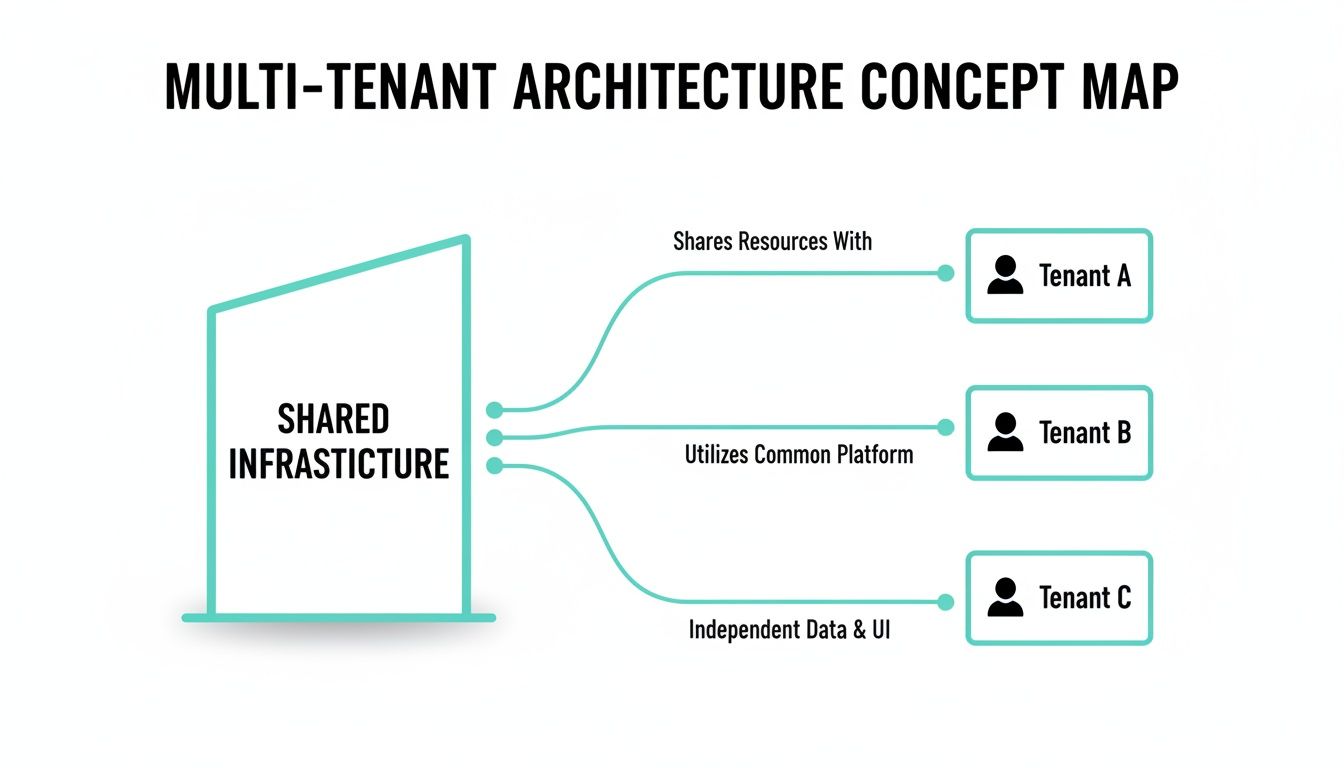
As you can see, every tenant gets their own private space but shares the underlying infrastructure, which is where the efficiency comes from.
Shared Database With a Shared Schema
This is the most common and cost-effective approach, representing the purest form of multi-tenancy. In this model, every tenant shares a single database and the exact same data structure, or schema.
Think of a large, shared spreadsheet where each row is tagged with a Tenant ID. This tag ensures that when a tenant queries the data, the application logic only returns the rows belonging to them, effectively creating a virtual private database.
This model is incredibly efficient and keeps infrastructure costs low, making it the standard for most SaaS DXP platforms, including Sitecore XM Cloud. The key advantage is rapid onboarding of new tenants and streamlined maintenance. However, it places a heavy reliance on the application's code to enforce strict data separation.
Shared Database With Separate Schemas
For those needing greater data isolation without the cost of separate databases, the schema-per-tenant model offers a balanced solution. Here, all tenants share the same database server, but each is given their own dedicated set of tables within it.
This is analogous to a shared warehouse where each company gets its own securely fenced-off area. The building is shared, but the inventory is kept separate.
This model is often seen in platforms like SharePoint Online. While the underlying infrastructure is shared, each SharePoint site collection functions as a logical container with its own security rules, creating a boundary that mirrors a separate schema. It provides a strong balance between security and resource efficiency.
Separate Databases for Each Tenant
For maximum security and data isolation, each tenant can be provisioned with their own completely separate database. This is the most secure, but also the most expensive, form of multi-tenancy.
This is like giving every tenant in an apartment building their own private, locked safe deposit box in a vault. There is zero chance of data commingling because the storage containers are physically distinct.
This model is ideal for tenants with stringent security or data residency requirements. For example, a global corporation using Sitecore XP might configure separate databases for each geographical region to comply with local data sovereignty laws like GDPR. The trade-off is significantly higher costs and management overhead, as each database must be maintained, backed up, and scaled independently.
Choosing the right model is a strategic decision. While a shared schema maximizes efficiency, a separate database offers unparalleled security. The best choice depends entirely on your specific business, security, and budgetary requirements.
Figuring out which of these models fits your needs is a huge part of building a successful strategy around a cloud-based CMS. Each one brings its own set of pros and cons that you have to weigh carefully.
The Business Case for Multi-Tenant Architecture
Technical concepts are great, but translating them into real business outcomes is where multi-tenant architecture truly shines. For marketing leaders and enterprise managers, this isn't just a technical shift—it's a strategic investment in efficiency and growth. It fundamentally changes how you allocate resources, scale your operations, and deliver digital experiences.
The most immediate and compelling benefit is a dramatic reduction in your total cost of ownership (TCO). By pooling resources like servers, databases, and software licenses across multiple tenants, the cost per tenant plummets. This shared model means you're not buying and maintaining dedicated infrastructure for every single brand, region, or department. It turns a significant capital expense into a predictable operational one.
Driving Financial Efficiency
The economic advantages go far beyond the initial setup. Centralized maintenance and updates are a complete game-changer. Instead of enduring costly, time-consuming upgrade projects for each site or application, a single update to the core platform benefits all tenants at the same time.
This ensures everyone instantly gets the latest features and critical security patches. It's a core principle of modern SaaS DXP platforms like Sitecore XM Cloud, where the vendor manages the underlying infrastructure. That frees up your internal teams to focus on creating value, not managing servers.
By sharing infrastructure, companies can significantly improve resource utilization and operational efficiency. The cost savings—often 40-50% lower than maintaining private data centers—empower businesses to scale during peak traffic without overprovisioning.
This model's financial impact has been a key driver in cloud adoption. The global multi-tenant data centers market is forecasted to expand from USD 68.5 billion in 2025 to USD 185.0 billion by 2035, underscoring its massive economic footprint. You can find more insights about this market growth on Fact.MR.
Unlocking Scalability and Agility
Effortless scalability is another huge business win. In a multi-tenant environment, adding a new website for a marketing campaign or a new regional portal is a matter of configuration, not construction. This agility allows businesses to respond to market opportunities with incredible speed.
The architecture is also designed to handle fluctuating demand. When a campaign goes viral and traffic spikes, the shared resource pool can absorb the load without manual intervention or performance hits. This elasticity means you're always prepared for success without paying for idle capacity during quieter periods. For a deeper dive into this topic, explore the key benefits of a CMS built on these modern principles.
Implementing Multi-Tenancy With Sitecore And SharePoint
Moving from theory to practice requires a platform designed with tenancy in mind. Two titans in the enterprise space, Sitecore and SharePoint, provide robust frameworks for multi-tenancy, but they approach it from different perspectives, tailored to distinct business needs.
For Sitecore, multi-tenancy is a foundational architectural principle. A single Sitecore instance can natively manage hundreds of distinct websites—from global brand portals and regional sites to campaign-specific microsites. This is a critical advantage for enterprises seeking to maintain brand consistency across their digital portfolio while empowering local marketing teams with autonomy.
Sitecore's Native Multi-Tenant Capabilities
Sitecore achieves multi-tenancy through its hierarchical content tree and intelligent site resolution logic. Each "tenant," or website, exists as a distinct branch within the content tree, complete with its own templates, content, media, and domain mapping.
Granular security permissions are then applied, ensuring that content editors for one brand cannot access or modify the assets of another. This creates a logical separation within a shared environment, striking a perfect balance between centralized governance and delegated management. You can see how this approach fits into bigger strategies for enterprise content management solutions.
The platform's evolution into Sitecore XM Cloud represents the ultimate realization of this philosophy. As a true multi-tenant SaaS DXP, XM Cloud abstracts away all infrastructure management, allowing Sitecore to handle maintenance, security, and updates. This frees businesses to focus entirely on crafting exceptional digital experiences.
The Sitecore dashboard serves as a unified command center, enabling administrators to manage multiple digital properties, users, and settings from a single, streamlined interface.
This centralized control is a key reason for the platform's success in the enterprise market.
The market has overwhelmingly embraced this efficient model. Sharing resources can slash operational costs by 50-70%, a significant advantage for complex Sitecore deployments requiring 24/7 support, monitoring, and compliance audits.
SharePoint's Approach To Tenancy
SharePoint, both on-premises and online, also offers powerful multi-tenancy capabilities, though they are primarily geared towards internal collaboration and departmental partitioning rather than public-facing websites. Within a SharePoint farm or tenant, administrators can provision distinct "site collections" that function as secure containers for different business units.
Each SharePoint site collection acts as a self-contained unit with its own security boundaries, features, and content databases. This creates a strong logical separation that is essential for maintaining data governance and compliance across a large organization.
To get a better feel for how different platforms handle multi-tenancy, digging into resources like SharePoint Online can offer a ton of insight into its architecture. While Sitecore excels at managing external, customer-facing brand ecosystems, SharePoint provides the tools to structure and secure a collaborative internal digital workplace for thousands of users.
Multi-Tenancy Feature Comparison Sitecore vs SharePoint
To help you visualize the differences, here's a quick high-level look at how Sitecore and SharePoint handle multi-tenancy in an enterprise context.
Ultimately, the choice between them often comes down to what you're trying to build. Sitecore shines for external, customer-facing digital ecosystems, while SharePoint is the go-to for organizing and securing the internal corporate world.
Navigating the Challenges of a Shared Environment
While the perks of multi-tenant architecture are compelling, jumping into a shared model isn't without its own set of hurdles. A smart implementation is all about anticipating these potential bumps in the road. Understanding them upfront helps you make a clear-eyed decision about whether a multi-tenant solution is truly the right fit for your needs.
Let's break down the real-world considerations around resource management, security, and customization, especially when you're working with enterprise platforms like Sitecore and SharePoint.
Taming the Noisy Neighbor Problem
One of the classic challenges in any shared environment is the "noisy neighbor" problem. This occurs when one tenant's high resource consumption—perhaps due to a viral marketing campaign or an inefficient query—negatively impacts the performance for other tenants on the same infrastructure.
Fortunately, modern platforms are engineered to mitigate this risk. Sitecore's cloud offerings, for instance, utilize sophisticated resource governance and auto-scaling capabilities. If one tenant experiences a traffic surge, the system automatically allocates more resources to that tenant without degrading performance for others. SharePoint Online employs similar mechanisms, using throttling and resource management policies to prevent any single site collection from monopolizing server resources.
Ensuring Robust Data Security and Isolation
In a multi-tenant world, security is non-negotiable. Even though tenants are sharing the same hardware, their data has to be kept completely separate and private. This isn't just a suggestion; it demands ironclad security measures at every single layer, from the application all the way down to the database.
Platform providers like Sitecore invest heavily in a multi-layered security strategy:
- Logical Data Isolation: At the database level, mechanisms like Tenant IDs are used to ensure that queries only return data belonging to the correct tenant.
- Strict Access Controls: Role-based access control (RBAC) is enforced rigorously to prevent a user from one tenant from viewing or modifying another tenant's content or configurations.
- Regular Audits: Platform providers conduct continuous security audits and vulnerability scanning to maintain compliance with global standards like GDPR and HIPAA.
A well-architected multi-tenant system treats each tenant as a fortress. The shared foundation is strong, but the walls between each tenant are impenetrable, maintained through constant vigilance and advanced security protocols.
For anyone managing a DXP, getting a handle on these security nuances is critical. You can dive deeper into protecting your digital assets by exploring best practices for cloud security for Sitecore DXP.
Navigating Customization Limits
Finally, there's the trade-off. One of the compromises you make for the efficiency of a shared environment is often around customization. In a standardized SaaS model like Sitecore XM Cloud, you can't just dive in and change the core application code. That’s intentional, as it’s what allows the provider to roll out seamless, automatic updates to every tenant at once.
But that absolutely doesn't mean you're stuck in a rigid box. These platforms are designed for composability, offering extensive configuration options and powerful APIs. This gives developers the freedom to build deep personalization, create custom front-end experiences, and integrate with any third-party system. The mindset shifts from modifying core code to leveraging APIs and configuration to tailor the experience.
Common Questions About Multi-Tenant Architecture
As you start to think about what a multi-tenant setup could mean for your business, a few practical questions always come up. Here, we’ll tackle the most common ones we hear from business leaders, with a focus on how they apply to platforms like Sitecore and SharePoint. Our goal is to give you clear, straight answers to help guide your decision.
Is Multi-Tenant Architecture Secure?
Yes, when implemented correctly by a reputable vendor, multi-tenant architecture is highly secure. The entire business model of enterprise SaaS providers like Sitecore hinges on their ability to guarantee data privacy and protection in a shared environment. They invest enormous resources into security engineering and compliance.
Security is achieved through multiple layers. The primary defense is logical data isolation, where the application and database are architected to ensure one tenant's data is completely invisible and inaccessible to another. This is reinforced by strict role-based access controls, continuous monitoring, and regular third-party security audits to meet stringent global compliance standards.
Think of it this way: with a platform like Sitecore XM Cloud, security isn’t just bolted on—it’s baked into the very foundation. The system is designed from day one to treat each tenant's data, content, and settings as if they were in their own private vault, even while sharing the underlying hardware.
Can I Customize My Application In A Multi-Tenant Environment?
Absolutely, though customization in a multi-tenant SaaS world is approached differently than in a traditional single-tenant model. The focus shifts from modifying the core platform code to leveraging its built-in configuration, extension points, and APIs. This is a more modern, sustainable, and scalable approach.
Platforms like Sitecore XM Cloud are built as composable DXPs. This means they are rich with APIs, webhooks, and headless capabilities. You can easily integrate third-party services, build custom front-end experiences using modern frameworks, and connect to other enterprise systems without touching the core application. This provides immense flexibility while ensuring that seamless, automatic platform updates don't break your customizations.
When Should I Choose A Single-Tenant Architecture Instead?
While multi-tenant is the preferred model for most modern businesses, a single-tenant architecture remains the right choice in specific scenarios.
Organizations with highly specialized or extreme regulatory compliance requirements—such as certain government, defense, or financial sector entities—may find that a dedicated, single-tenant environment is necessary to meet unique data handling and auditing controls.
The other primary reason is the need for deep, fundamental modification of the core software. If your business processes are so unique that they require altering the foundational code of the platform, a single-tenant model provides that level of control. However, for the vast majority of organizations, the strategic advantages of a modern multi-tenant model—scalability, lower TCO, and simplified maintenance—are far more compelling.
At Kogifi, we specialize in designing and implementing robust DXP solutions that are perfectly aligned with your business goals. Whether you're exploring the efficiencies of multi-tenancy with Sitecore or need to optimize your SharePoint environment, our team has the hands-on expertise to guide you. Discover how we can help you build a scalable and secure digital future.