


A global manufacturer can have twelve brand sites, three dealer portals, and a service app, yet still ask writers to retype the same warranty paragraph in every destination. The problem isn't a lack of content. It's the absence of an agreed canonical version, clear ownership, and a structure that lets one approved message travel safely across channels.
That is the practical territory of component content management systems, or CCMSs. They store content as named, reusable blocks with metadata, taxonomy, workflow, and version history instead of treating every page as an isolated document. The theory is straightforward. The platform reality is not. Sitecore XM Cloud, SitecoreAI, AEM, and SharePoint Online all support component-oriented work, but they expose it through very different models, authoring experiences, and governance requirements.
Table of Contents
- Start with an inventory, not a target template
- Model before transforming
- Integrate the DXP around ownership boundaries
Why Component Content Management Systems Matter Now
Channel proliferation has made page-by-page publishing difficult to control. The same product information may need to appear on a website, mobile application, kiosk, voice interface, in-product help panel, dealer portal, and printed document. Regulatory localization adds another constraint. Medical-device instructions, financial disclosures, warranty terms, and safety warnings need controlled variants, traceability, and review rather than casual copy-and-paste.
AI makes the structure problem more urgent. An assistant or retrieval pipeline needs a clearly labeled content unit with context, ownership, locale, validity, and product scope. Rendered HTML can be useful for presentation, but it doesn't reliably communicate whether a sentence is a warning, a warranty condition, an eligibility rule, or a regional exception.
A CCMS addresses that gap by separating content from presentation. A component might be a warranty clause, product attribute, troubleshooting procedure, call to action, or safety warning. Each unit can carry metadata and be assembled into different outputs while retaining a controlled source.
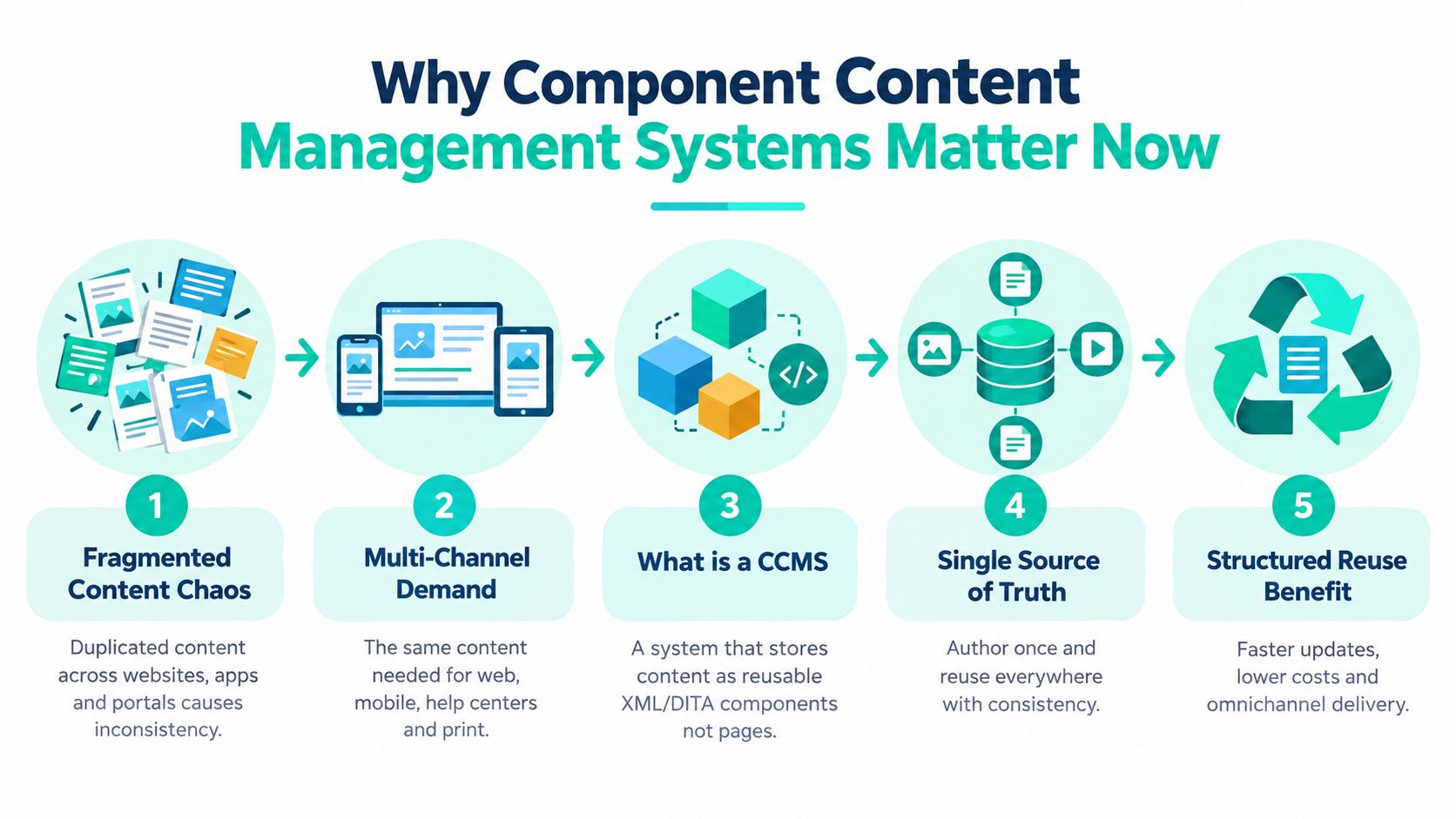
The operating model is more important than the label. A repository alone won't create consistency if teams keep creating near-duplicate components, bypassing workflow, or placing critical meaning inside unstructured rich text. A useful content supply chain model connects planning, authoring, approval, localization, delivery, measurement, and retirement.
Practical rule: Make the canonical component easy to find, safer to reuse, and more useful than creating a local copy.
The business case is also broader than technical documentation. Market estimates differ substantially by methodology, but all point toward sustained expansion. One 2025 estimate places the global CCMS market at USD 376.59 million in 2025, projecting USD 953.96 million by 2032 at a 14.20% CAGR. Another estimate values the category at USD 2.45 billion in 2024 and projects USD 5.67 billion by 2033, while a separate estimate reports USD 3.44 billion in 2022 and forecasts USD 6.52 billion by 2029. These figures are not interchangeable, but their differing methods still indicate growing enterprise demand for structured reuse and multichannel publishing, as summarized by independent CCMS market estimates.
How CCMS Thinking Evolved From Structured Authoring to AI-Ready Content
The modern CCMS didn't begin with headless CMSs. Component content management emerged in the 1990s, when organizations needed a granular way to manage large volumes of reusable information instead of editing whole documents repeatedly. Structured authoring and XML adoption gave teams a way to store, reuse, and repurpose content at component level across manuals, product documentation, and publishing workflows, a history documented in the overview of global component content management systems.
The underlying idea has stayed stable while delivery channels have multiplied. Technical writers moved from document files toward topics, reusable procedures, variables, and conditional content. Enterprise web teams then applied similar thinking to content fragments, structured fields, and API-delivered entries. Headless architecture changed how a system delivers information, but it didn't invent reuse. It decoupled presentation from content and made the delivery layer more flexible.
That distinction matters during platform modernization. An organization evaluating Sitecore XM Cloud or SitecoreAI may already possess structured authoring conventions, taxonomy, approval rules, and reusable content assets. Replacing those investments with a new visual page builder can create a cleaner interface while losing the semantic discipline that made the content valuable.
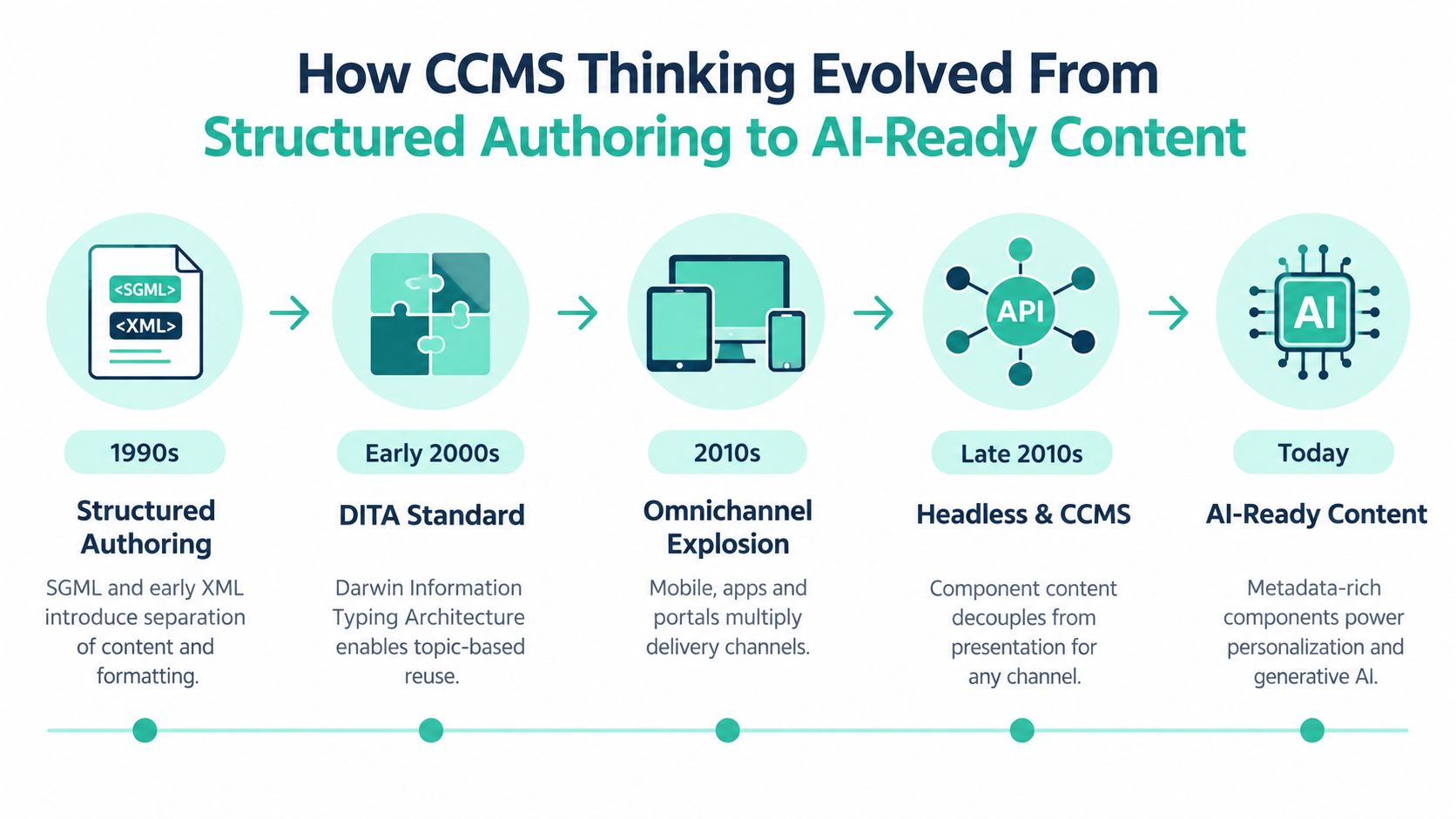
The important shift is semantic quality
AI-ready content requires more than breaking a page into smaller fields. Each component needs meaningful metadata, a stable schema, clear relationships, and governance that survives updates. A product warning should identify its product family, region, audience, regulatory scope, effective status, and source owner. Without those signals, retrieval may return a technically relevant sentence that lacks the conditions needed to use it safely.
The same principle applies to personalization and search. A recommendation engine can select a component more reliably when its fields describe the offer, audience, eligibility, and market. A generative assistant can ground an answer more responsibly when the retrieved block carries provenance and approval status.
Teams exploring this connection can use enterprise CMS capabilities for AI personalization as a useful conceptual reference. The practical conclusion is simple: headless delivery is an architectural choice, while structured content is an operational discipline. AI depends on the second, regardless of which platform provides the first.
The Core Architecture of a CCMS and How It Differs From a Page CMS
A CCMS exposes several layers that page-centric systems often hide inside templates. The repository stores components independently of pages. The taxonomy and metadata services classify them. Reference mechanisms allow a component to appear in multiple outputs. Workflow and version control govern changes, while a publishing engine transforms approved content into the formats and channels consumers need.
Consider a component called Battery Safety Warning. The author creates it once and tags it by locale, audience, regulatory scope, and product family. The same approved component can then be assembled into a product page, dealer PDF, mobile help screen, and regulatory filing. A page CMS can display the warning, but teams may need to re-enter or duplicate it in every relevant page template.
Independent architectural research describes CCMS platforms as typically including an XML editor, publishing engine, repository, check-in and check-out controls, and versioning workflows. It also identifies standards-based interfaces such as DOM and XQuery for accessing XML without shredding it into separate document formats, as explained in this academic analysis of component content management architecture.
| Layer | Page CMS | Component CMS |
|---|---|---|
| Content storage | Pages contain most authored content | Repository stores reusable components |
| Classification | Page types and folders dominate | Taxonomy, metadata, profiles, and relationships |
| Reuse | Often manual duplication or template reuse | References, inclusions, variants, and shared components |
| Governance | Page workflow | Component-level ownership, approval, versioning, and impact tracking |
| Delivery | Presentation is usually closely coupled | Publishing and APIs assemble content for multiple outputs |
The mapping to enterprise products requires care. AEM Content Fragments provide structured, reusable content that can be delivered beyond a single page. Sitecore XM Cloud Components support modular authoring inside a visual experience model, while the content tree, data templates, renderings, and placeholders determine how reuse works in practice. In SharePoint Online, content types, site columns, managed metadata, and reusable web parts provide component-like building blocks, although SharePoint's document and collaboration heritage shapes the operating model.
Teams also need a delivery and governance partner that understands the difference between modular content and merely splitting a page into smaller controls. A resource such as Osher Digital Brisbane AI can help frame AI and digital architecture questions, but the implementation still depends on sound schemas, ownership, and integration design.
For teams needing a concise primer on decoupled delivery, this headless CMS explanation provides useful context. Headless is valuable, but it isn't a substitute for a component model.
Comparing Traditional CMS, Headless CMS, and CCMS in Real Platforms
The three models answer different questions. A traditional CMS asks, “How should this page be edited and rendered?” A headless CMS asks, “How should this structured entry be delivered to applications?” A CCMS asks, “What is the smallest governed unit of meaning that can be reused across publications and channels?”
A traditional page model is productive for a straightforward site with limited reuse. Editors work within templates, preview the result, and publish a page. The weakness appears when the same message belongs in multiple pages, markets, or applications. A headless model separates presentation from content, but its entries may still represent large documents rather than reusable semantic blocks. A CCMS makes reuse, metadata, variants, and controlled assembly central to the model.
| Dimension | Traditional CMS | Headless CMS | CCMS | Sitecore XM Cloud | AEM | SharePoint Online |
|---|---|---|---|---|---|---|
| Primary unit | Page | Entry or content record | Reusable component | Item, rendering, component, or structured field | Content Fragment or component | Content type, list item, page property, or web part |
| Authoring | Template and page editor | Form-based structured editor | Structured authoring and assembly | Pages and Components with composable delivery | Components, fragments, and editable templates | Modern pages, lists, libraries, and web parts |
| Reuse | Usually template-led | Depends on references and modeling | Core capability | Shared items and component patterns | Fragments and component policies | Content types, site columns, managed metadata |
| Delivery | Page rendering | APIs and front ends | Publishing engine plus APIs | Omnichannel experience delivery | Sling and APIs | Microsoft 365 and SharePoint experiences |
| Governance burden | Page sprawl | Model and API governance | Component lifecycle and metadata | Helix, item, workflow, and environment governance | JCR, templates, dispatcher, and component governance | Tenant, site, permission, and information architecture governance |
Sitecore XM Cloud expresses component thinking through named renderings, placeholders, content-tree items, and visual authoring. Sitecore describes XM Cloud as a cloud-native, hybrid headless CMS with a composable architecture, centralized hosting, and subscription licensing. Its headless model decouples content from presentation, while Pages and Components support visual authoring, personalization, and analytics, as outlined in Sitecore XM Cloud platform details.
SitecoreAI extends that model beyond content entry. Sitecore positions it as a unified marketing platform, and its portfolio is described through Content, Assets, Studio, and Commerce. Content covers management and optimization, Assets supports AI tagging and reusable media operations, Studio supports agents, applications, and integrations, and Commerce connects the stack to transactional experiences, according to the Sitecore developer FAQ.
AEM has a stronger repository and component-system heritage, with Sling resource types, cq:Component nodes, editable templates, and Content Fragments. SharePoint Online takes a different path. It combines content types, site columns, managed metadata, libraries, lists, and web parts inside a cloud service delivered as part of Microsoft 365, as described by Microsoft's SharePoint Online documentation.
For teams refining the AI side of structured publishing, this guide to improving AI content publishing workflows is relevant because it focuses on the operational connection between content models, APIs, and automation.
Enterprise Implementation Patterns for Governance and Localization
A component library becomes difficult to maintain when everyone can create shared content but nobody owns its meaning. The operating model should separate responsibilities clearly. Content authors write and update approved content. Component librarians manage taxonomy, naming, reuse rules, and duplication control. Architects define schemas, dependencies, rendering contracts, and integration boundaries.
Use workflow states that reflect actual accountability rather than generic status labels:
- Draft: An author is shaping the component and its metadata.
- In review: A subject-matter expert, legal reviewer, or market owner is checking it.
- Approved: The designated owner has accepted the content for permitted use.
- Published: The component is available to its assigned channels and audiences.
- Archived: The component is withdrawn, replaced, or retained only for traceability.
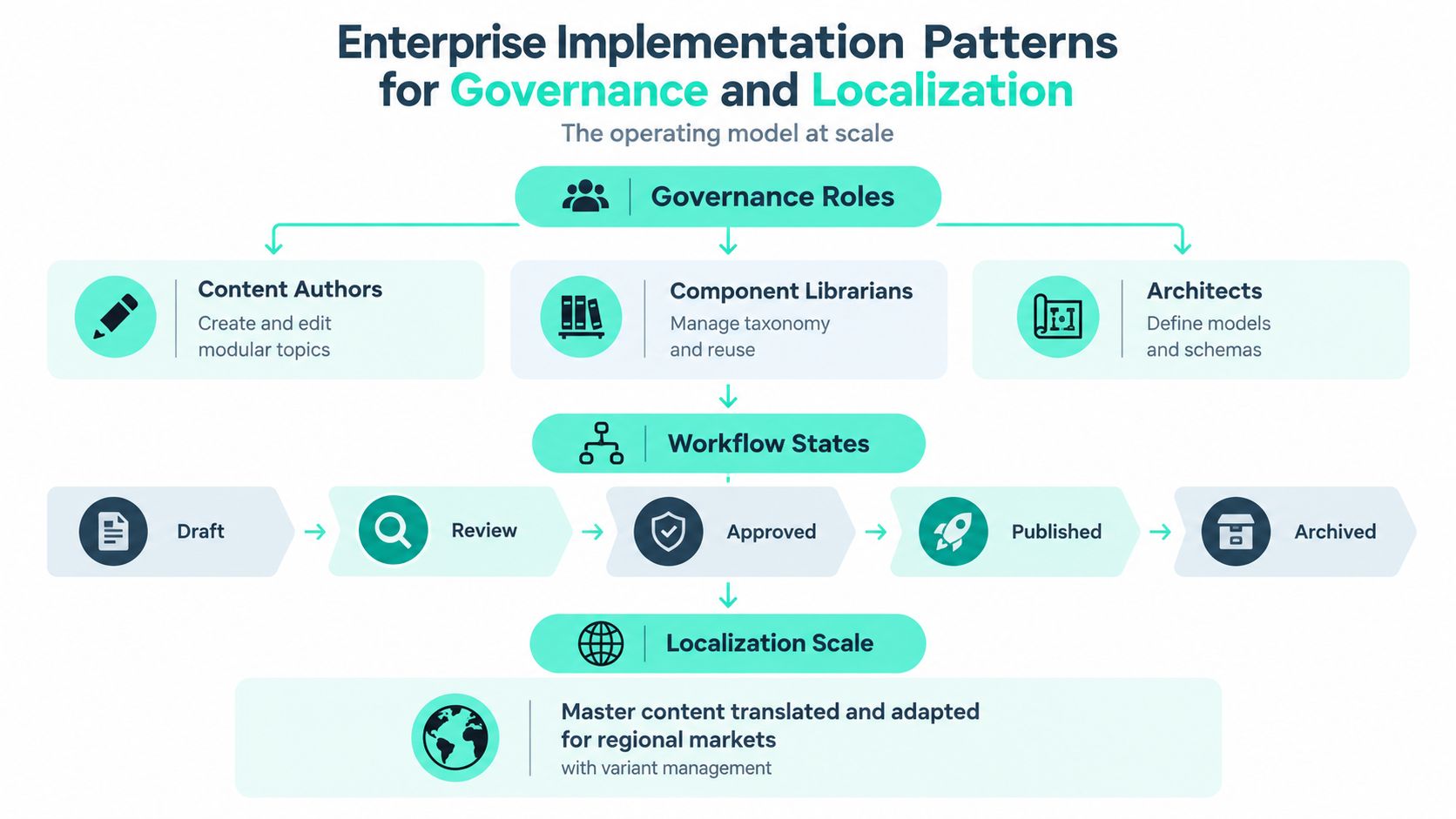
Localization belongs to the component model
Translation teams need to know whether a component is global, regionally adaptable, or legally constrained. Store locale, market, audience, product, and regulatory metadata alongside the source component. Translation memory and component-level status then help teams distinguish a changed sentence from an unchanged reusable block.
IDC and Adobe material describes granular taxonomy and component reuse as mechanisms that improve consistency and translation efficiency because one approved content block can serve multiple deliverables instead of being duplicated and translated repeatedly. The IDC technology spotlight on knowledge management provides the relevant background.
Sitecore implementations benefit from a disciplined Helix-style library. Keep foundation concerns such as shared rendering contracts and platform services separate from feature modules such as product specifications or alerts. Let the project layer assemble brand-specific behavior without creating dependencies that flow backward into reusable foundations.
Localization also needs fallback rules. Define what happens when a regional variant doesn't exist, when a translated component is stale, and when legal approval applies only to one market. Those decisions should be encoded in workflow and metadata, not left to an editor's memory.
For a broader operating model, teams can use this content governance framework to formalize ownership, lifecycle controls, and decision rights. API exposure comes after those controls. GraphQL fragments or REST payloads should return the component's identity, fields, relationships, locale, and status so front ends can hydrate content without losing context.
Migration, Integration, and Composable DXP Playbook
A migration fails when teams treat it as a file-transfer exercise. Copying pages from SharePoint, AEM, or an older Sitecore estate into a new repository preserves the old duplication and hides the modeling work that a CCMS requires.
Start with an inventory, not a target template
Classify legacy content into three groups:
- Component-worthy: Repeated, governed, structured, or channel-independent content such as product facts, warnings, policies, and reusable calls to action.
- Page-only: Narrative compositions that make sense only in a specific editorial context.
- Archive: Obsolete, redundant, unsupported, or legally retained material.
The inventory should record ownership, locale, references, approval history, and destination channels. It should also identify near duplicates. A clean migration deletes or consolidates those candidates before they become a new component library.
Model before transforming
Create the canonical content model with fields, taxonomy, relationships, validation, and rendering expectations. Map the model to existing assets rather than allowing each site team to invent its own variant. In Sitecore, this usually means aligning data templates, renderings, placeholders, serialization, and Helix boundaries. In AEM, rationalize components, consolidate overlapping editable templates, and decide which Content Fragments deserve independent lifecycle management.
SharePoint migration needs a different emphasis. Unify content types and site columns, rationalize managed metadata, and consolidate web parts before moving documents or pages. A folder copy may preserve files, but it won't create a coherent information architecture.
SitecoreAI Pathway is positioned as a way to automate content and schema conversion, with partner coverage of the 2025 announcement describing a marketed migration-time reduction of roughly two-thirds. Treat that as an acceleration mechanism, not a quality guarantee. Generated mappings still need human review for field semantics, taxonomy, locale handling, legal status, and components that should remain page-only. SitecoreAI's broader platform announcement also describes Agentic Studio, with 20+ out-of-the-box agents, plus Sitecore Studio layers for agents, applications, marketplace capabilities, and connections, as reported in coverage of SitecoreAI's composable platform direction.
Integrate the DXP around ownership boundaries
Connect the CCMS to the DAM for governed media, CRM for customer and account context, search for indexing and retrieval, analytics for measurement, and personalization services for decisioning. Keep each system authoritative for its own data. The CCMS shouldn't become a shadow CRM, and the DAM shouldn't become a second place to author product claims.
Stage migration by content type rather than by site. Parallel authoring can expose missing schemas and workflow gaps early, while incremental publishing lets teams validate APIs, caching, localization, and analytics before the entire estate moves.
Best Practices for Scalability, Performance, Accessibility, and AI Readiness
A component deployment scales when teams control both the content model and the delivery contract. Start with a practical checklist:
- Partition content deliberately: Separate brands, markets, products, and environments according to ownership and publishing boundaries.
- Define tenant isolation: Decide which users, indexes, assets, and workflows can cross organizational boundaries.
- Set CDN rules: Cache stable components aggressively, but define invalidation behavior for shared content and personalized variants.
- Track dependency impact: Know which pages, applications, documents, and markets reference a component before changing it.
- Measure component health: Monitor stale variants, unused components, duplicate models, failed translations, and publishing errors.
Sitecore XM Cloud Edge caching should follow component identity and invalidation rules rather than relying on broad page flushes. SXA variant reuse also needs a budget. Too many variants can turn a reusable component into a disguised collection of page-specific exceptions. In AEM, dispatcher rules should distinguish fragment delivery from page delivery and protect cacheability without serving stale regulated content. SharePoint Online's service behavior and throttling constraints should influence page composition, list design, API usage, and batch operations.
Accessibility belongs inside every component contract. For WCAG 2.2 AA work, the owner of a reusable block should define its alternative text behavior, heading-level rules, keyboard focus order, labels, error messaging, and color-contrast requirements. A central accessibility review won't compensate for a component that lets authors omit meaningful context or insert inaccessible markup.
AI readiness requires semantic fields, not just more content. Give components explicit metadata for audience, intent, product, locale, effective dates, regulatory scope, and source ownership. Expose embedding slots and retrieval-friendly text where appropriate, while keeping structured attributes separate from promotional prose. SitecoreAI's brand-aware direction makes clean schemas more valuable because automation can operate on known fields and governed relationships instead of guessing from rich text.
The hardest issue is governance over time. Recent industry coverage argues that metadata-rich structured content underpins accurate AI search, chat, and agentic delivery, while broader CMS reporting describes generative AI moving from pilots into widespread implementations in 2026, as discussed in CCMS guidance for AI-ready content operations. The practical bottleneck isn't creating more components. It's preserving trustworthy metadata, ownership, measurement, and lifecycle control.
Kogifi designs, builds, and supports component-based enterprise platforms across Sitecore XM Cloud, Adobe Experience Manager, and Microsoft 365/SharePoint, including headless architectures, Helix-based libraries, SPFx solutions, governance, migrations, and AI-enabled personalization. Visit Kogifi to discuss your content model, platform roadmap, or migration plan with a team that can turn CCMS principles into an operating enterprise solution.