


An estimated 94.8% of websites failed basic accessibility standards in 2025, according to Be Accessible's accessibility statistics. A polished launch clearly isn't the same as a well-run platform. Buying a Sitecore Stream implementation is closer to appointing an operating team than commissioning a chatbot: you gain content automation, but you also need owners for approvals, accessibility and ongoing cost.
That's the useful way to evaluate an enterprise web development agency. Judge its ability to operate a Sitecore AI portfolio and a SharePoint workplace after launch, not just its ability to deliver an attractive homepage.
Table of Contents
- Core services an enterprise web development agency should own
- Turn missing capabilities into a buying brief
- How to score an enterprise web development agency
- Demand security evidence from the lifecycle
- Make accessibility an acceptance rule
What an Enterprise Web Development Agency Delivers
In 2023, 78.1% of EU enterprises had a website, 43.3% used ERP software, 25.8% used CRM software and 15.3% used business-intelligence software, according to Eurostat's enterprise digitalisation report. Those figures describe adoption across EU enterprises, not necessarily a single connected installation. For a buyer, however, they illustrate why website procurement must account for the surrounding business systems.
An enterprise web development agency designs, implements and maintains the connected platforms through which customers, employees and partners interact with an organization. The deliverable isn't a collection of pages. It includes content structures, integration contracts, release processes and operational accountability.
Core services an enterprise web development agency should own
| Service line | What the agency owns | Proof the line is real |
|---|---|---|
| DXP implementation | Sitecore XM Cloud or XP, content model, personalization and search | Multi-brand publishing with governed components |
| Enterprise integrations | Identity, CRM, ERP, commerce and booking connections | One customer or employee journey across systems |
| Headless architecture | Next.js front end, APIs and a shared component library | A brand release that does not redeploy the whole platform |
| Support and SLA | 24/7 monitoring, incident response, hosting and recovery | Named response and recovery targets after go-live |
Read the table from the top down. DXP implementation establishes how teams create and deliver experiences. A governed content model distinguishes a reusable product description from a campaign-specific message, so editors don't have to rebuild content for every market.
Enterprise integrations connect that experience to actual business activity. A signed-in customer should be able to move from product information to a transaction without repeatedly entering information that another system already holds.
Headless architecture separates presentation from content delivery. Its value isn't the label; it's whether teams can change a brand experience without introducing unnecessary risk elsewhere.
Support and SLA establish who takes responsibility when production stops behaving as intended. Hosting alone doesn't answer who diagnoses a failed integration or coordinates recovery.
Turn missing capabilities into a buying brief
Mark every row your current platform can't deliver reliably. Add the affected journey, the business owner and a concrete failure example beside each mark.
Our platform implementation services cover the implementation side of that assessment. For broader thinking about where automation belongs in business workflows, the automation perspectives from Ryshe offer an additional reading resource, rather than a substitute for platform-specific evidence.
Practical rule: Buy responsibility for the missing capability, not merely a technology name on a proposal.
Your marked list gives procurement, marketing and IT a shared starting point. It also prevents an agency from answering an integration problem with a redesign.
Sitecore AI Across the Product Portfolio
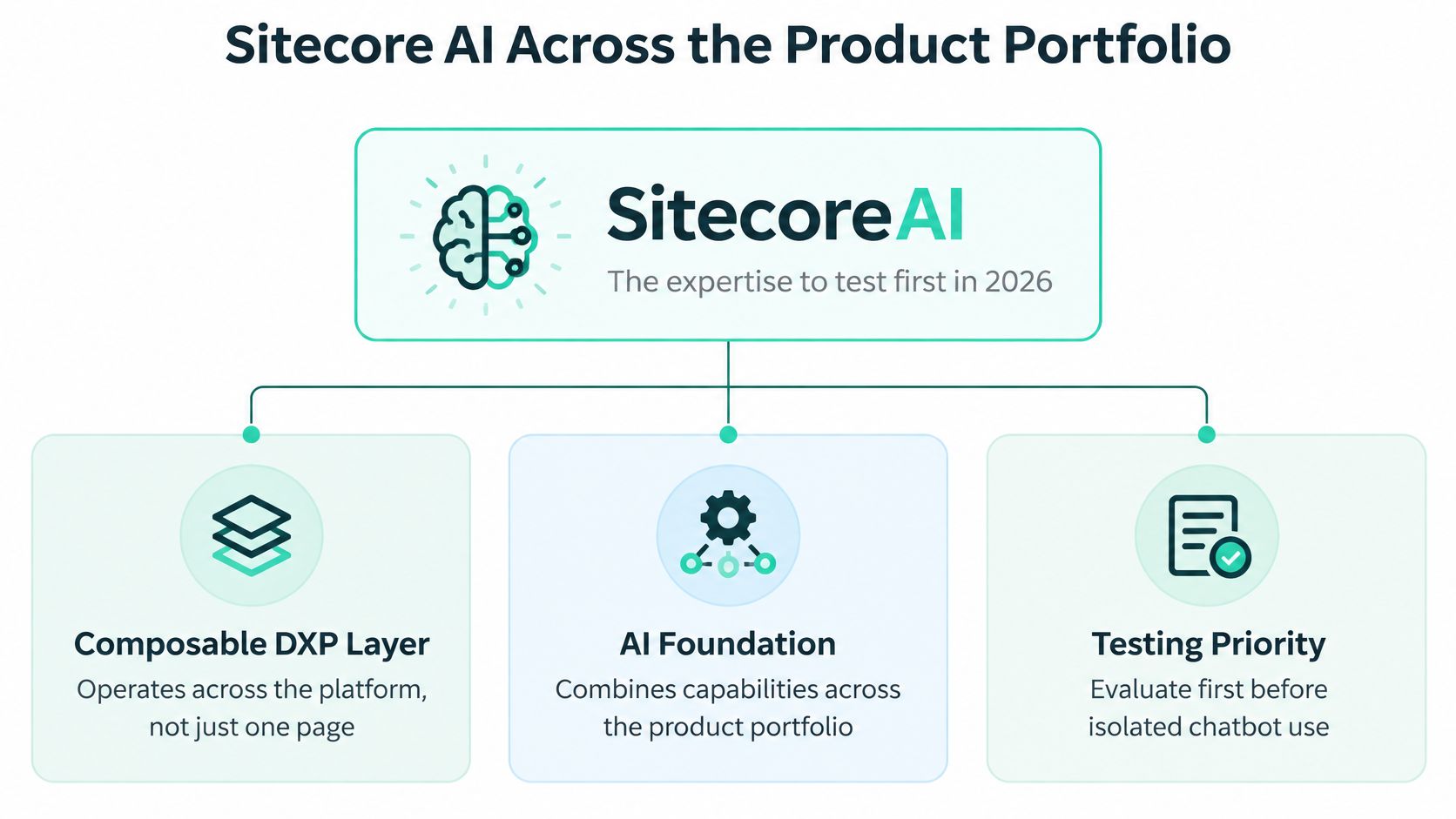
Sitecore AI expertise is the capability to test first when your estate depends on Sitecore. The important distinction is between adding an isolated assistant and governing AI across content, assets, customer data and experience delivery.
Sitecore describes SitecoreAI as the foundation of its composable DXP, combining brand-aware agents, copilots and intelligent workflows with AI-assisted search, recommendations and customer journeys. Evaluate that portfolio as an operating system for marketing work, not as a single page-authoring feature.
The portfolio view makes the implementation boundaries easier to understand.
Sitecore AI products and functions
| Product or feature | What it does | Where it matters |
|---|---|---|
| SitecoreAI | Composable DXP foundation with brand-aware agents, copilots and AI-assisted search | Platform layer for the whole estate |
| Stream | Ideation, content creation, campaign briefs and brand-grounded outputs | Spans CMS, digital asset management and customer data platform |
| Copilots | Brand, campaign, content, experience and optimization copilots | Assist each team inside governed workflows |
| Content extraction | Maps raw text, documents or images to template fields, optionally with a brand kit | Accelerates migration and content modeling |
| Media metadata | Suggests title, alt text, description and keywords for Media Library images | Feeds accessibility and search |
| Personalize | Automates actions after experiments | Turns test results into live experience changes |
| Visual search | Visual similarity, semantic search, reverse-image lookup and color-based discovery | Speeds asset reuse across brands |
Sitecore Stream's documentation describes an AI layer built on Microsoft Azure OpenAI Service, supporting content creation, campaign briefs, message personalization and orchestration. Teams can upload brand documents to ground outputs in their organization's identity and guidelines.
That grounding needs editorial ownership. Someone must decide which brand documents are authoritative, who updates them and what happens when regional guidance conflicts with global rules.
Sitecore's Experience Platform AI documentation explains template-based content extraction and suggested media metadata, including alternative text. An agency should demonstrate field mapping and review queues with your content, rather than assume every extracted value is publishable.
Match automation to decision risk
Sitecore's agentic workflow documentation describes chain-of-thought prompting, human-in-the-loop operation and fully agentic automation, alongside dedicated copilots. The procurement question is which mode belongs to each task.
A campaign draft can tolerate experimentation. A regulated claim, sensitive audience rule or public-facing personalized message needs a different approval boundary.
For a concrete personalization example, the FANUC website uses Sitecore Experience Database, or xDB, to collect customer-behavior data for personalized experiences. We provided consultancy, project delivery and support for its Sitecore Experience Platform website. That example concerns XP and xDB; it shouldn't be mistaken for evidence that every AI capability is available in every Sitecore configuration.
Our work spans UX, UI, web development, DXP, CMS, omnichannel delivery, deep traffic analysis, AI personalization and ongoing support. We also offer Experience Commerce, audit and optimization, Content Hub and Search, CDP and Personalize training, and an Airport Digital Experience Accelerator.
Use our AI-powered personalization guidance to frame the business use case. Then mark each portfolio function as production-ready for your intended use, human-approved, or outside scope.
How Headless Builds Integrations and SLAs Fit
Consider a manufacturer introducing a regional brand while retaining its existing customer accounts and commerce services. The agency must coordinate a new experience, established systems and production support, not merely select a front-end framework.
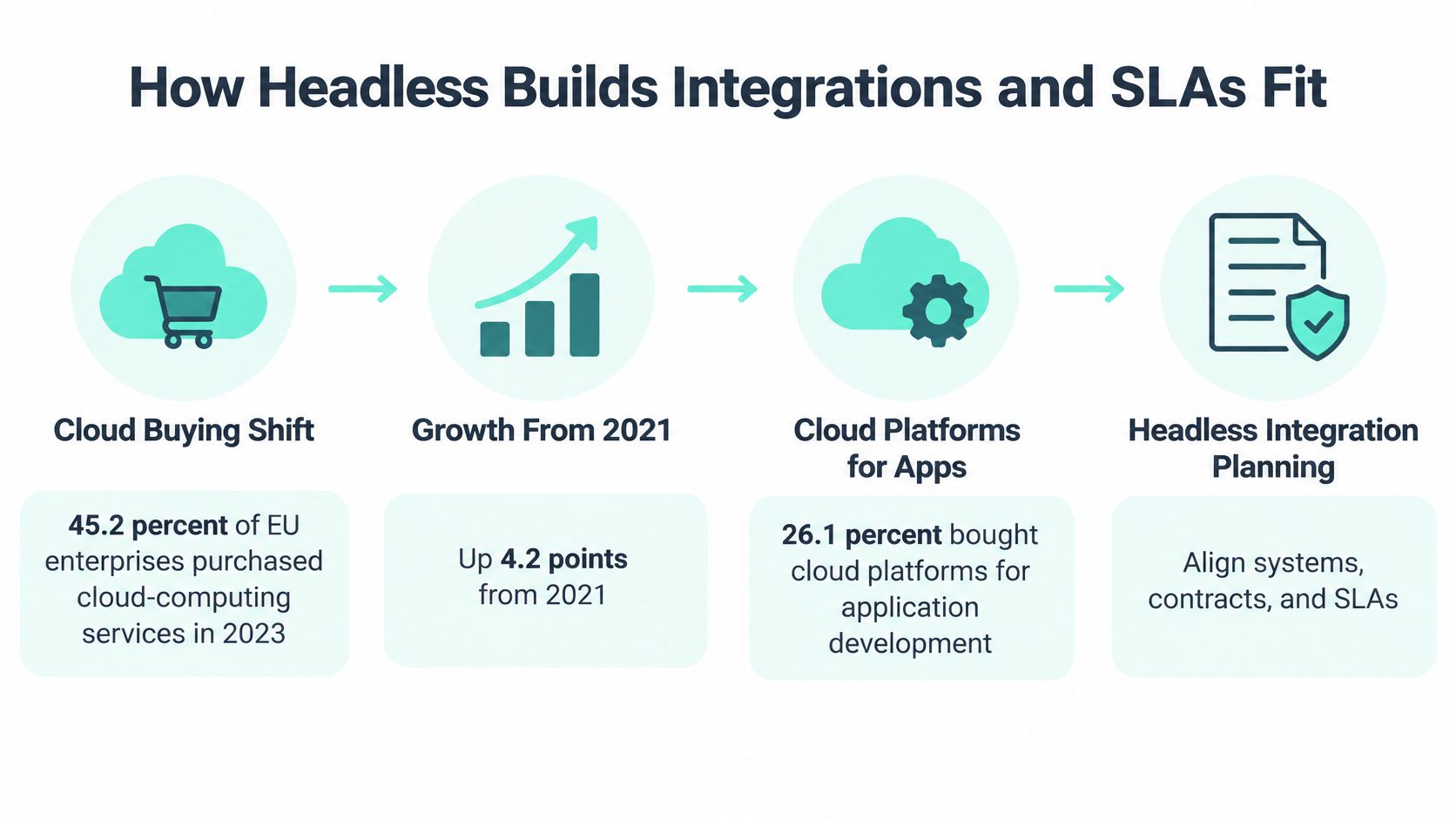
That buying environment is increasingly cloud-based. Eurostat reported that 45.2% of EU enterprises purchased cloud-computing services in 2023, up 4.2 percentage points from 2021, while 26.1% purchased cloud platforms for application development, testing or deployment.
The delivery sequence should connect cloud decisions to operational responsibilities.
Build around controlled independence
Think of the CMS as the kitchen, the Next.js website as the dining room and APIs as the kitchen pass carrying finished content. You can change the room without rebuilding the kitchen, provided the interface between them remains dependable.
For the manufacturer, that means a shared component library, explicit API contracts and separate deployment boundaries. A hub-and-spoke setup can give regional teams local flexibility while keeping shared functionality centrally maintained.
CI/CD pipelines should test those boundaries before release. Include component tests, integration checks, preview environments and a rollback route, rather than treating deployment automation as a way to publish faster regardless of risk.
The One Stop Shop platform illustrates a related delivery pattern: mobile-first delivery, high scalability, modern frontend stacks and cloud-native microservices. Those characteristics are architectural choices, not a requirement to turn every website function into a separate service.
Our API-first approach provides a useful basis for defining the contracts before teams build against them.
Integrate journeys and assign the run team
The customer's identity must survive the transition from the new brand site to commerce or account services. Likewise, a partner or employee portal needs an explicit permission model, not just a successful sign-in screen.
We build federated single sign-on and SharePoint integrations for partner and employee portals. The integration scope should also specify CRM, commerce or booking connections, data ownership and what users see when a downstream service fails.
- Monitor the journey: Track authentication and transaction failures, not only whether the homepage responds.
- Define incident ownership: Assign severity-based escalation and a named team responsible for coordination.
- Test recovery: Rehearse restoration and document dependencies that could prevent it.
- Control environments: Name owners for provisioning, shutdown and consumption alerts before launch.
Our Outsourcing service supplies dedicated Sitecore, Adobe Experience Manager and SharePoint teams for development, support and maintenance.
A successful deployment proves that a release reached production. A recovery exercise proves that the team can restore service when production fails.
Decide whether you're buying a build, integrations, a run contract or all three. Make that boundary explicit before comparing proposals.
SharePoint Solutions Beside the Public Website
We rebuilt the legacy intranet of RAC, Riyadh Airports Company, as a bilingual English and Arabic SharePoint Online root site. That's a different assignment from a public customer DXP: employees need current information, usable internal services and clear access permissions.
A workplace must support collaboration without becoming another place where staff search unsuccessfully for documents.
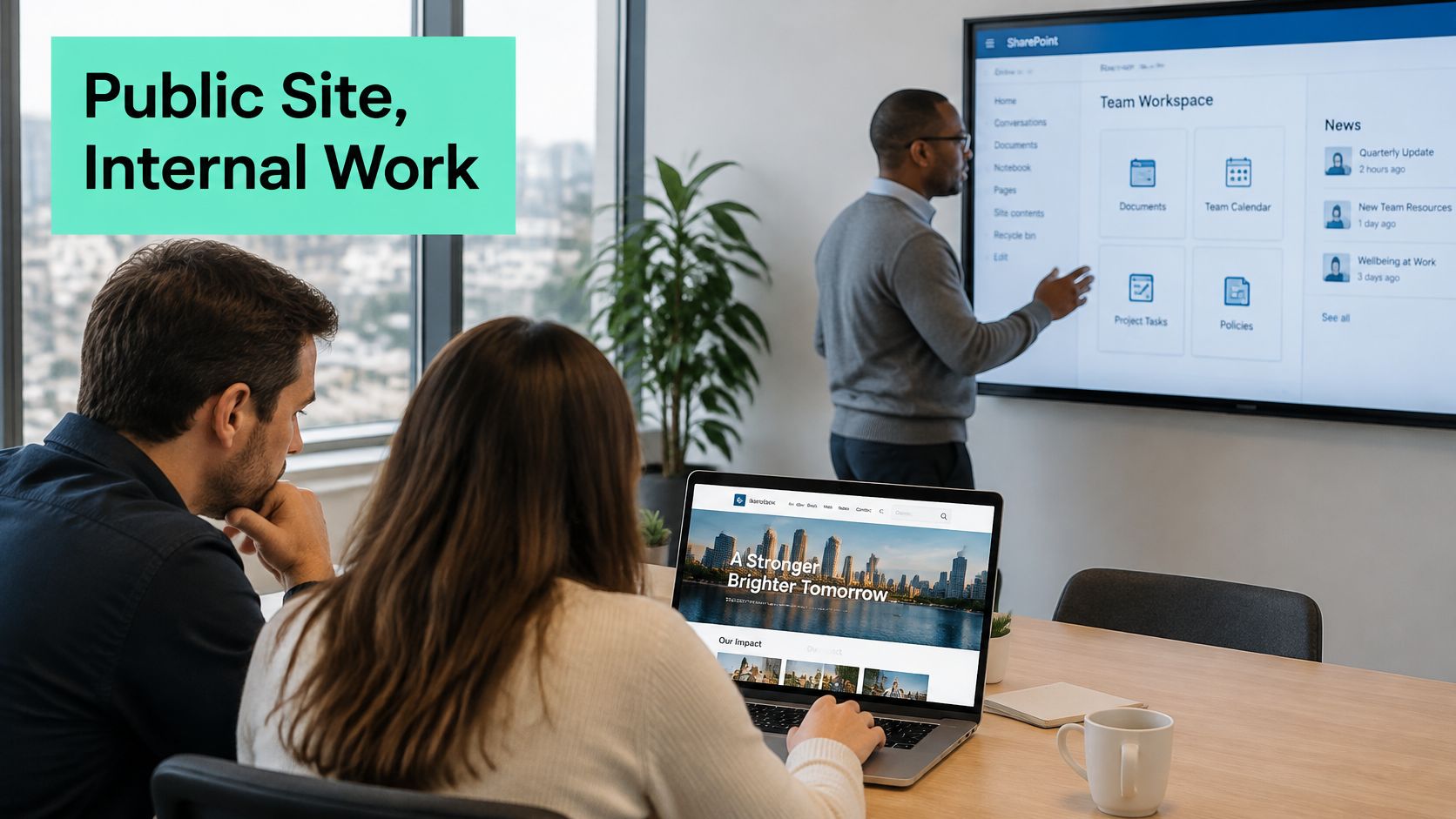
For airports, manufacturers and energy groups, bilingual delivery affects more than navigation labels. Policy ownership, search terms, document versions and approval messages need consistent treatment across languages and working patterns.
Say a shift supervisor needs the current operating policy and must submit an equipment request before handing over. The workplace should identify the approved policy, collect the right request details and route the approval without requiring the supervisor to find a colleague by email.
Design around employee tasks
Our SharePoint solutions combine SharePoint Online with SPFx components, Power Platform automations and Microsoft 365 integrations. The choice of component or automation should follow the task, rather than dictate it.
- Find a policy: Give documents owners, review status, useful metadata and a clear authoritative location.
- Complete a request: Use forms with understandable validation and visible submission status.
- Route an approval: Define the approver, delegation route and exception handling.
- Access shared services: Apply identity and permissions consistently for employees and permitted partners.
A public Sitecore platform and an internal SharePoint workplace can share organizational governance without sharing every content model. Customer campaigns and employee policies have different audiences, review cycles and confidentiality requirements.
The accompanying video offers another point of reference for the workplace discussion.
Stabilize what already exists
The engagement doesn't have to begin with a replacement. Our Bugfixing & Recovery service covers SharePoint, Sitecore and Adobe Experience Manager environments, including situations where instability needs attention before modernization.
Accessibility and security configuration belong in engineering checks for the workplace. Test keyboard use, form errors and language behavior alongside permission inheritance, external access and configuration changes.
If staff can't find a current policy or finish a request without emailing a colleague, include the intranet in the same procurement discussion as the website. Otherwise, you may modernize the customer experience while leaving employees to bridge the gaps manually.
Criteria That Separate a Capable Agency
A capable agency can show how it prevents defects, identifies residual problems and assigns remediation. A presentation full of platform logos doesn't establish any of those capabilities.
Use the scorecard to distinguish demonstrable delivery practices from assurances. Score each row pass or fail before the first sales conversation, marking unproven claims as unproven rather than assuming they pass.
How to score an enterprise web development agency
| Criterion | Pass evidence | Fail signal |
|---|---|---|
| Sitecore and SharePoint expertise | Production work across Sitecore AI, DXP and SharePoint, not a single CMS logo | Only a marketing homepage or a generic web portfolio |
| Platform partnerships | Sitecore Silver Partner plus formal Adobe and Microsoft relationships | No named partner tier or support path |
| Governance | Shared components, editor training and a publishing owner | Every brand keeps a private codebase |
| Scalability | Cloud scaling, shared libraries and hub-and-spoke rollouts | A new market requires a full rebuild |
| Security | SSDF controls, bill of materials, pipeline scanning and vulnerability response | Security is a one-off pen test after launch |
| Accessibility | WCAG 2.2 rules in the design system, CI checks and journey testing | A late automated scan with no remediation owner |
For another procurement perspective in a complex operational setting, Waymap's guidance to compare transit technology suppliers is useful supplementary reading. Keep your own evaluation tied to evidence from the actual platform and delivery team.
Demand security evidence from the lifecycle
NIST's Secure Software Development Framework organizes secure development around preparing the organization, protecting software, producing well-secured software and responding to vulnerabilities. Apply those practices within the delivery lifecycle, not as a final inspection.
Evidence should include a software bill of materials covering CMS modules and JavaScript dependencies, protected source code and deployment credentials, and controlled build pipelines. Examine peer review, dependency scanning, secret detection and infrastructure-as-code checks.
The response process matters as much as prevention. Require severity-based remediation targets, an escalation owner and records showing how fixes reach production. A penetration test is useful, but it doesn't replace these controls.
Make accessibility an acceptance rule
W3C's WCAG guidance describes WCAG 2.2's 13 guidelines across perceivable, operable and understandable principles, with testable criteria at Levels A, AA and AAA, including a 4.5:1 minimum contrast ratio for normal text.
Specify the intended conformance level and evaluate applicable exceptions correctly. Content also needs text alternatives for non-text information, while repeated navigation should remain in a consistent relative order unless the user initiates a change.
Reusable components should expose semantic names and keyboard states. Put those requirements into design tokens, authoring guidance and release checks so corrections can propagate across brands instead of being repeated manually.
Acceptance principle: Track accessibility by component, template and user journey. An automated scan alone can't establish conformance.
Manual testing should include keyboards and assistive technologies across relevant browsers. After launch, assign defects to owners and test changed content, localized forms and personalized states, not only the original page templates.
Questions to Ask Before You Appoint an Agency
Send these questions before requesting a detailed proposal. Require a concrete artifact with each answer, so procurement can distinguish a documented operating model from a confident sales response.
Questions that expose delivery boundaries
Which Sitecore products will you implement, and which AI actions require approval?
Request a product-and-workflow matrix covering content creation, publishing and personalization. It should identify who can approve an action, what gets logged and how a decision can be reversed.Can you demonstrate a headless reference with real integrations?
Look for an architecture diagram and a walkthrough of authentication, data exchange and failure handling. A redesigned homepage doesn't prove that the team can maintain a connected customer journey.What is the five-year operating picture?
Require an itemized model covering licenses, environments, CDN and search consumption, observability, CI/CD, integration maintenance, specialist staffing, content operations, incident response and exit costs.
Cloud economics deserve particular attention. Flexera's 2025 State of the Cloud report reported that the share of organizations with a FinOps team doing some or all optimization rose from 51% to 59%, while use of cost efficiency as a cloud-goal metric rose from 65% to 87%.
Your model should identify a FinOps owner, consumption assumptions and operating conditions that would trigger architectural review. Include a cost-per-market or cost-per-transaction measure where it fits the business.
Questions that expose operating responsibility
How will accessibility remain conformant after content changes?
Request a sample release report covering editor changes, added languages and personalization rules. It needs a remediation owner and an agreed way to measure outstanding defect age.Which SLA commitments cover response, recovery and overnight staffing?
Require a severity matrix, an escalation roster and disaster-recovery evidence. Distinguish acknowledging an incident from restoring a usable service, especially when another supplier owns a dependency.How will knowledge transfer reach both marketing and architecture teams?
Expect separate learning outcomes, working documentation and practical exercises. We delivered the E.ON Polska Sitecore implementation over more than nine months, including knowledge-transfer workshops for Digital Marketing and for technology and architecture teams.- Airport delivery: We work with Riyadh Airports Company on the Sitecore-based digital transformation of King Khalid International Airport's public website.
- Embedded capacity: We provide dedicated Sitecore teams and team extension for companies in the EU, UK and US.
- Portfolio scope: Our services include Experience Commerce, Content Hub and Search, CDP and Personalize training, and an Airport Digital Experience Accelerator, alongside UX, UI, DXP and AI personalization.
Record the answers beside your scorecard. Don't retain an agency on the shortlist if it can't make cost assumptions, approval boundaries and handover responsibilities specific.
Decide If Kogifi Fits Your Platform
Kogifi fits an enterprise estate where Sitecore is established or XM Cloud is under consideration, personalization and search have business value, and a SharePoint intranet or partner portal belongs in the same operating discussion.
We're a weaker fit for a simple brochure website with no integrations, no personalization and no ongoing support requirement. In that situation, enterprise architecture and specialist operating capacity may add complexity without a corresponding business benefit.
Match credentials to the work
Our credentials include Sitecore Silver Partner status and formal Adobe and Microsoft partnerships. Our delivery record includes more than 70 DXP projects, more than 12 years in operation and more than 50 specialists, with delivery across the USA, Europe and the Middle East.
We also received Sitecore Digital Impact Awards 2025 recognitions for Market Trailblazer and Intelligent Tech Stack. Treat those credentials as reasons to examine fit, not as replacements for a scoped technical discussion.
Send an evidence-based discovery packet
Send your marked service shortlist and completed agency scorecard. Include the journeys that fail today, the platforms involved and the internal owners who will participate in decisions.
Request discovery that defines Sitecore AI scope, human-approved actions, SharePoint scope, security controls and five-year run cost. Also identify what the internal team will operate after handover and what remains with the agency.
That packet gives you a consistent basis for comparing Kogifi with another shortlisted enterprise web development agency. The right choice is the team whose operating responsibilities match your estate, not the proposal with the most ambitious launch presentation.
Kogifi designs, builds and maintains Sitecore experiences and SharePoint workplaces, with AI personalization, integrations and ongoing platform support. Visit Kogifi with your service shortlist and scorecard to discuss a discovery scope covering approval governance, employee journeys and long-term operating cost.