


Content marketing ROI isn't just a fancy acronym; it's the answer to the big question: "Is our content actually making us money?" It measures the revenue you bring in from your content efforts against what you spent to create and share that content.
Simply put, it’s the metric that proves your investment is growing the business, taking you beyond vanity metrics like page views and social shares to show real, tangible financial impact.
Why Content marketing ROI Is More Than Just a Number
The real story of content marketing ROI isn't found in a single revenue figure. It’s about how your content builds business value over the long haul. It connects the dots, showing how every dollar you spend contributes to real outcomes like generating qualified leads, cementing your brand's authority, and fostering unbreakable customer loyalty.
To get this right, you have to look at the entire customer journey, not just the last click before a sale. Think about it: a prospect might read a blog post today, download a whitepaper six weeks from now, and finally convert after attending a webinar. Each touchpoint was a crucial step, and a basic ROI formula will almost always miss that bigger picture.
This is exactly why a sophisticated Digital Experience Platform (DXP) like Sitecore has become a must-have for modern marketing teams. A Sitecore DXP provides the backbone to connect every single interaction, giving you a crystal-clear view of how your content influences behavior from the first visit all the way to the final purchase.
Redefining 'Return' and 'Investment'
To make a compelling case for your content budget, you need to broaden your definitions of 'Return' and 'Investment' to match your strategic goals.
Investment is more than just creation cost. It’s the full picture: the cost of your tools, your distribution budget, team salaries, and all the time spent on planning and optimization. While tools like SharePoint can help manage asset creation, a true DXP like Sitecore tracks the entire content lifecycle, from ideation to personalized delivery.
Return is more than immediate sales. Revenue is king, of course, but your 'Return' also includes the value of qualified leads, a lower customer acquisition cost, and a higher customer lifetime value. For instance, a perfectly placed case study on your Sitecore-powered site might not trigger an instant sale, but it could be the exact piece of content that convinces a high-value prospect to finally talk to your sales team.
In essence, every piece of content is an asset that appreciates over time. An insightful article or helpful video doesn't just generate a one-time return; it builds brand equity and continues to attract and nurture leads long after it's published.
This wider perspective on content marketing ROI changes the conversation entirely, shifting content from a simple cost center to a strategic driver of growth. To truly squeeze every drop of value from your work, implementing effective content repurposing strategies can dramatically extend the lifespan and impact of your best assets. When you understand the full value story, you can walk into the boardroom with confidence, prove your impact, and secure the resources you need to win.
Tracking the Metrics That Actually Matter for ROI

Calculating an accurate content marketing ROI comes down to tracking the right numbers. It's way too easy to get mesmerized by vanity metrics—social media likes, page views, you name it. But those numbers rarely tell the whole story. Real business impact is found in the data that ties your content directly to the bottom line.
To get a clear picture, you have to separate your metrics into two camps. Think of it like a weather forecast versus the actual weather report: one predicts what might happen, and the other confirms what already did.
Leading Indicators: The Predictors of Success
Leading indicators are your forward-looking metrics. They're the early signals that tell you if your content is resonating with your audience, especially at the top and middle of the funnel.
While these KPIs don't scream "revenue" on their own, they are crucial predictors. Get these right, and the money will follow.
Key leading indicators include:
- Organic Traffic and Keyword Rankings: Are you showing up when people search for what you do? A steady climb here means your brand visibility is growing.
- Engagement Rate: This is where you look beyond simple views. Metrics like time on page, scroll depth, and comments show that people aren't just clicking—they're actually paying attention.
- Content Downloads and Form Submissions: When someone gives you their email for a whitepaper or webinar, that’s a huge sign of intent. It’s the moment an anonymous visitor becomes a tangible lead.
Lagging Indicators: The Proof of Performance
Lagging indicators are your bottom-line metrics. These are the results you take to the C-suite to prove your content investments are paying off in cold, hard cash. They directly tie your hard work to revenue and profit.
Lagging indicators are the ultimate proof of your content marketing ROI. They translate your content strategy into the language of business by focusing on financial impact and customer value.
Essential lagging indicators include:
- Sales Conversions from Content: The number of sales you can directly trace back to a specific piece of content, like a blog post that sent a user to a product page where they made a purchase.
- Customer Acquisition Cost (CAC): How much does it cost to win a new customer through your content? Proving a lower CAC compared to paid ads is a massive win.
- Customer Lifetime Value (CLV): Great content builds loyalty. Tracking the CLV of customers who engaged with your content shows its long-term impact on retention and revenue.
Connecting the Dots with Sitecore Analytics
The real magic isn't just tracking these metrics separately—it's connecting them. How do you prove that a blog post someone read six months ago (a leading indicator) influenced a major purchase today (a lagging indicator)? This is precisely the problem a powerful DXP like Sitecore is built to solve.
Sitecore provides a unified view that follows the entire customer journey. It stitches together every touchpoint, from the first anonymous visit to a blog post, to a newsletter signup, all the way to the final purchase. This 360-degree view allows you to attribute real business outcomes to individual pieces of content, giving you the solid data you need to justify your budget and fine-tune your strategy.
B2B content marketing strategies average a 3:1 ROI, generating $3 for every $1 invested, which easily outperforms most paid ad campaigns. By connecting leading and lagging indicators, you can build a powerful business case that shows not just what content is working, but exactly why.
For a deeper dive into the specific metrics that matter, check out our guide on essential content KPIs for enterprise CMS platforms.
Calculating Accurate ROI with Attribution Modeling
To get a real handle on your content marketing ROI, you have to stop giving all the credit to the last click. Think of a customer's journey like a soccer team scoring a goal. The striker who kicks the ball into the net gets the applause, but what about the midfielder who made the perfect pass or the defenders who started the play from the back? Giving 100% of the credit to that final touchpoint is like ignoring everyone else who made the goal happen.
This is exactly why attribution modeling is so important. It’s the framework you use to assign value to every blog post, webinar, or case study a customer engages with on their way to making a purchase. While simple models are a decent starting point, they rarely tell the whole story of how your content actually influences a buyer's decision.
From Basic Models to a Clearer Picture
Most marketers start with basic attribution models. They're simple to set up, but each one has serious blind spots that can make your content look less valuable than it really is.
- First-Touch Attribution: This model gives all the credit to the very first piece of content a person sees. It’s useful for figuring out what initially draws people in, but it completely ignores the rest of their journey.
- Last-Touch Attribution: The polar opposite, this model assigns 100% of the credit to the final interaction before a conversion. It's the most common and, frankly, the most misleading. It completely overlooks the hard work your earlier content did to nurture that lead.
These simple models don't just paint an incomplete picture; they can lead to bad decisions. You might end up cutting the budget for valuable middle-of-the-funnel content, like in-depth guides, just because they aren’t the "last click" that seals the deal.
Embracing Multi-Touch Attribution
If you want a true sense of your content marketing ROI, you need to think multi-touch. These more sophisticated models spread the credit across several touchpoints, giving you a much more balanced and realistic view of what’s driving results.
Multi-touch attribution is about seeing the entire field of play. It recognizes that a conversion is rarely the result of a single interaction but rather a series of influential moments created by your content strategy.
A few popular multi-touch models include:
- Linear Attribution: This model is the diplomat—it gives equal credit to every single touchpoint in the customer's journey. It’s fair, straightforward, and acknowledges that every interaction played a part.
- U-Shaped (Position-Based) Attribution: This model acts more like a talent scout, giving more weight to the first and last interactions (usually 40% each). The remaining 20% is then split among all the touchpoints in the middle. It values both the piece that sparked the initial interest and the one that drove the final conversion.
Imagine a customer first discovers you through a blog post, later joins a webinar, and finally requests a demo after seeing a case study. A last-touch model would give the case study all the glory. A U-shaped model, however, would rightly recognize the critical roles played by both the initial blog post and the final case study. To dig deeper into this, check out our guide on how to measure marketing ROI effectively.
How Sitecore Makes Accurate Attribution a Reality
This is where a powerful Digital Experience Platform (DXP) like Sitecore becomes a game-changer. Trying to manually track every click, download, and page view across a dozen channels is a recipe for a headache. Sitecore automates the entire process, capturing every interaction to build a complete picture of each user's journey.
Platforms like Sitecore connect the dots that are invisible with basic analytics. While a simpler system like SharePoint is great for storing content, Sitecore tracks how that content is actually used out in the wild. It follows the entire customer path and applies sophisticated attribution models for you, so you can see precisely which assets are influencing conversions.
This turns your ROI calculation from educated guesswork into a data-backed science. The global content marketing industry is expected to hit nearly $2 trillion by 2032, yet a recent report shows only 38% of marketers consistently track their ROI. By using a DXP to get your attribution right, you join an elite group that can confidently prove their content’s value and secure the budget you need to grow. To see where the industry is headed, take a look at the latest content marketing statistics and trends.
How Sitecore XM Cloud Boosts Your Content ROI
Calculating your content marketing ROI is a solid start, but the real goal is to make that number grow. That means moving beyond just tracking metrics and adopting a platform built to make your team more efficient and your content more effective. That’s where a platform like Sitecore XM Cloud comes in. As a cloud-native, headless CMS, it provides the tools you need to multiply your return by completely changing how you create, manage, and deliver content.
The magic of XM Cloud starts with its component-based architecture. Stop thinking of content in terms of static pages and start picturing a library of reusable Lego bricks. A headline, an image gallery, a customer testimonial, a call-to-action button—each one is an independent component. You create it once, and then you can assemble it in endless combinations across any channel you can imagine.
This completely flips the script on the old content production workflow. Instead of building every single page from the ground up, your teams can quickly snap together new experiences using pre-approved, on-brand components. The result? A massive acceleration in your time-to-market and a serious reduction in production costs, which directly improves the "Investment" side of your ROI equation.
Driving Radical Relevance with Personalization
But efficiency is only half the battle. The real power of Sitecore XM Cloud is unlocked when you use those components to deliver hyper-relevant, personalized experiences on the fly. Because the system is headless, it can serve those content blocks to any front-end—a website, a mobile app, a kiosk, or even an IoT device—and tailor the message to the individual user.
This is the shift from creating content for the masses to crafting experiences for individuals.
- Behavioral Targeting: XM Cloud can see what users are doing and serve content that matches their actions. If a visitor is binging your blog posts on enterprise security, the homepage banner can automatically feature a relevant cybersecurity whitepaper.
- Segment-Based Personalization: You can define audience segments based on firmographics, location, or data from your CRM. A B2B tech company could show case studies for the financial services industry to visitors from that sector, while simultaneously displaying manufacturing case studies to another.
- A/B and Multivariate Testing: With built-in testing, you can constantly fine-tune every component. Test different headlines, images, or CTAs to see what actually drives the highest engagement and conversion rates, making sure every piece of content pulls its weight.
By delivering the right message to the right person at the right time, you significantly increase engagement and conversion rates. This directly boosts the "Return" in your content marketing ROI calculation, proving the value of a personalized approach.
Ensuring Content Discoverability with Sitecore Search
You can create the most brilliant, personalized content in the world, but it’s all for nothing if people can't find it. A common ROI killer is when valuable assets get buried deep within a website, lost to the users who need them most. This is where a powerful search solution becomes an indispensable part of your content strategy.
This is where attribution models come in handy, helping you understand which touchpoints truly add value.
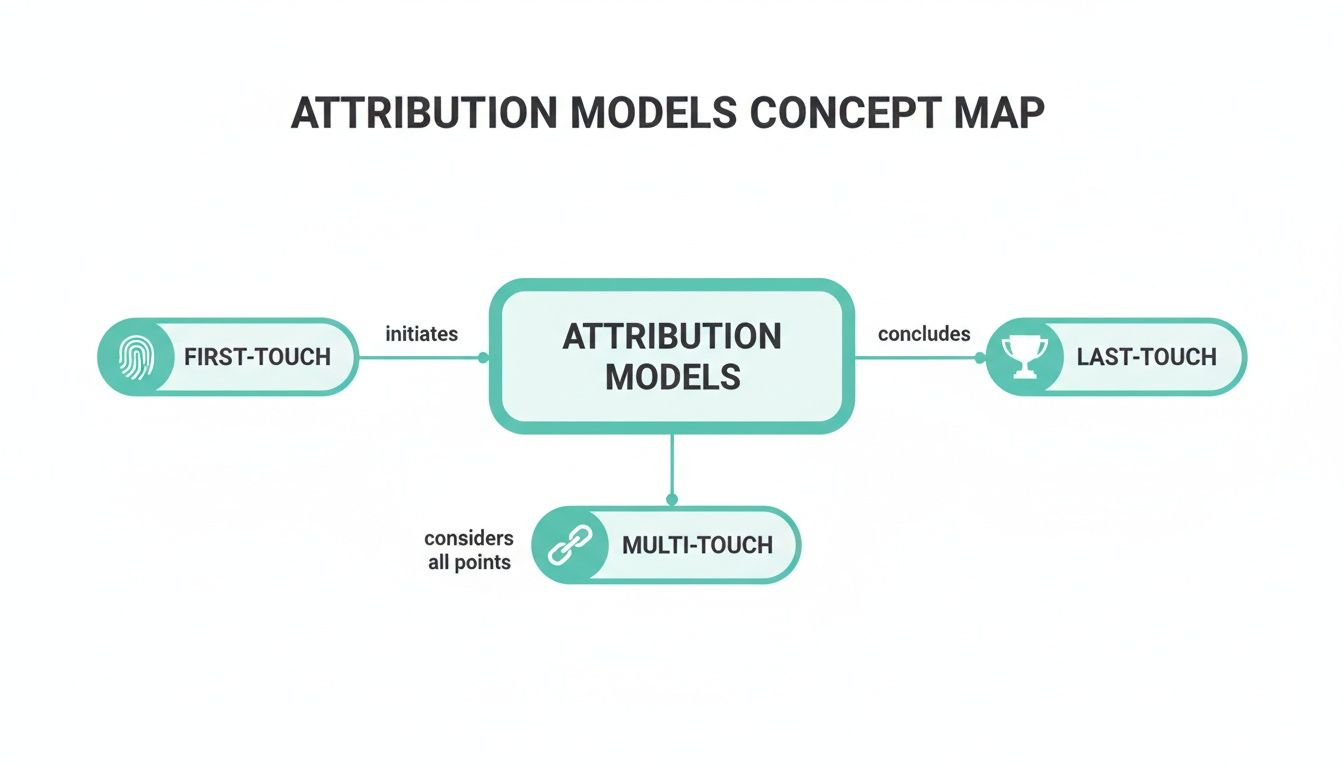
As you can see, relying on just one touchpoint often undervalues the content that nurtures a lead throughout their entire journey.
Sitecore Search, which integrates seamlessly with XM Cloud, tackles this problem head-on. It's an AI-powered search engine that does way more than basic keyword matching. It actually understands user intent and delivers predictive, relevant results that guide visitors to the content that’s most valuable for them. This makes sure your high-impact assets—case studies, product guides, and webinars—are always easy to find, directly connecting your content investment to the KPIs that grow your business.
Integrating with Your Broader Tech Stack
Finally, a platform like Sitecore XM Cloud doesn't live in a silo. Its API-first design means it plays nicely with the other critical systems you rely on, like your CRM, marketing automation platform, and even asset libraries like SharePoint. When SharePoint acts as your central hub for documents and media, Sitecore can pull those assets directly into its personalization engine, ensuring everything stays consistent and efficient across the board.
This connected ecosystem gives you a complete, 360-degree view of your customer, letting you trace the influence of your content across every single stage of their journey. By combining a component-based architecture, deep personalization, intelligent search, and seamless integrations, Sitecore XM Cloud gives you the power to not just measure your content marketing ROI, but to actively and systematically make it better.
Putting Theory into Practice: A DXP Transformation
All the theory in the world is great, but seeing a platform transformation drive real-world content marketing ROI is where the rubber really meets the road. Let’s walk through a common scenario: a mid-sized B2B tech company is struggling to prove the value of its content. Their assets are all over the place, their analytics are siloed, and they have no real way of knowing which pieces of content are actually helping to close big deals.
Their marketing team was cranking out fantastic stuff—deep-dive whitepapers, detailed case studies, and engaging blog posts. The problem? It was all managed through a jumble of disconnected systems. The blog lived on a basic CMS, while all the sales collateral was tucked away on a separate SharePoint site. This mess made it impossible to see the full customer journey, leaving them unable to show a clear financial return to the C-suite.
The Challenge of Disconnected Content
This company was hitting some serious roadblocks, all stemming from their disjointed tech stack. Their primary issues were holding them back from getting the most out of their content investment.
Here were the main pain points:
- No Central Hub: Content creation was a mess. Different teams were constantly reinventing the wheel because they couldn't easily find or reuse what already existed.
- No Way to Personalize: They knew they needed to talk to their finance, healthcare, and manufacturing clients differently, but their system just couldn't deliver targeted content to each group.
- Analytics Blind Spots: Sure, they could track page views and downloads. But connecting that first touchpoint to a lead's journey through the sales funnel? Not a chance.
At its core, the problem was a lack of a single source of truth. Without one unified view of both their content and their customers, calculating an accurate content marketing ROI was more of a guessing game than data science. They felt their content was valuable; they just couldn't prove it.
Implementing a DXP Solution
To tackle these challenges head-on, the company decided to implement a Digital Experience Platform built on Sitecore. This wasn't just about getting a shiny new CMS; it was a strategic move to bring their entire digital marketing world under one roof. The implementation zeroed in on three key areas to fix their old problems and boost their content marketing ROI.
First, they moved all their content operations into the DXP. This immediately stopped the redundant work and gave them a single, organized library for every marketing and sales asset. Next, they put Sitecore’s personalization engine to work, creating dynamic content experiences for each of their target industries. Now, a visitor from a healthcare company would automatically see case studies and product info that spoke directly to them.
Finally, they integrated the DXP with their CRM. This was the game-changer. It allowed them to track the entire buyer's journey, from the first time someone read a blog post to the moment a deal was signed. They could now pinpoint exactly how specific content assets were speeding up the sales pipeline and increasing deal sizes. Getting this right is even easier when you have a solid approach to automated content marketing.
The results were impossible to ignore. Within a year, the company saw a 30% surge in marketing-qualified leads and a 15% drop in customer acquisition costs. Best of all, they could finally walk into a boardroom and present a clear, positive content marketing ROI with complete confidence.
Integrating Video to Maximize Engagement and ROI

Of all the content formats out there, video is an absolute powerhouse for driving engagement and delivering a strong content marketing ROI. It’s dynamic, it’s easy to consume, and it grabs attention far more effectively than a wall of text. It's a non-negotiable part of any modern content strategy.
Short-form video, in particular, has become a massive ROI driver. The latest data shows it’s the top performer for 71% of video marketers, leaving images, blogs, and even podcasts in the dust. These bite-sized clips are perfect for sparking engagement—likes, shares, comments—which then fuels organic reach and pushes conversions. Discover more social media marketing ROI statistics.
But here’s the thing: creating great video is only half the battle. To really get a return on that investment, you need a smart system for managing and deploying these assets.
Centralizing Video Assets for Maximum Impact
A scattered collection of video files living on different drives and platforms is an efficiency killer. This is exactly why a centralized media library is so crucial. A robust Digital Asset Management (DAM) system, like the one built into Sitecore, becomes the single source of truth for all your video content.
Even a well-organized SharePoint solution can do the trick, keeping version control tight and access easy for your teams. The goal is to have one central hub where everyone—from marketing to sales—can find the latest, approved video assets, whether it’s a product demo or a customer story. For a deeper dive, you can learn more about video digital asset management solutions.
Think of your video library not as a storage folder, but as a strategic arsenal. When properly organized and tagged, each video becomes a reusable component ready to be deployed at the perfect moment in the customer journey.
Personalizing the Viewing Experience with Sitecore
Now, this is where a DXP like Sitecore takes your video strategy to the next level. It moves beyond just posting a video and hoping for the best, turning it into a personalized, ROI-driving machine. By tracking user behavior, Sitecore can intelligently serve up specific videos based on what an individual is interested in and how they're interacting with your site.
- Product Demos: Let’s say a user keeps browsing a specific product category. Sitecore can automatically show them a targeted video demo, answering their questions before they even have to ask.
- Customer Testimonials: For a visitor who seems close to making a purchase, a powerful testimonial video can provide the social proof they need to seal the deal.
- Tutorials and How-Tos: After a sale, personalized tutorial videos can create a fantastic onboarding experience, boosting customer satisfaction and building long-term loyalty.
By transforming a passive viewing into an active, relevant step in the buyer’s journey, Sitecore allows you to track exactly how your video assets are contributing to leads and sales. This gives you clear, defensible data that proves the immense value of video in your overall content marketing ROI.
Common Questions About Content Marketing ROI
Here are some of the most common questions marketers ask about calculating and improving their content marketing ROI. We’ve provided clear, practical answers to help you apply these strategies in your own organization.
How Long Does It Take to See a Positive Content Marketing ROI?
Content marketing is a marathon, not a sprint. You can typically expect to see meaningful results within 6 to 12 months.
Of course, you’ll see early signals like traffic growth and a few leads trickling in sooner. But generating a significant revenue impact takes time, depending on your industry, how tough the competition is, and how consistently you publish valuable content. The real magic happens as your content compounds over time, building authority and expanding its footprint in search engines.
What Is a Good Benchmark for Content Marketing ROI?
While it varies from one industry to the next, a widely cited benchmark for B2B content marketing is a 3:1 ratio—meaning you generate $3 in return for every $1 you spend.
But treat that as just a starting point. Your most important goal should be to set your own baseline and focus on beating it month after month. A platform like Sitecore helps you track this progress accurately, ensuring your ROI isn't just positive, but consistently growing. For more perspectives on content strategy, you can find a broader range of articles and discussions elsewhere. Explore more content marketing insights.
The ultimate goal isn't just to meet an industry benchmark, but to outperform your own previous results. Continuous optimization, informed by data from your DXP, is the key to unlocking exponential growth in your content marketing ROI.
How Can I Measure ROI Without a Platform Like Sitecore?
You can definitely measure a simplified version of content ROI using standard tools like Google Analytics paired with your CRM. This usually means manually tracking conversion goals and calculating the value of leads that came from specific blog posts or guides.
The catch? This method often leans on simplistic last-touch attribution, which can give you a pretty skewed picture of what’s really working. A DXP like Sitecore automates the data collection, enables sophisticated multi-touch attribution, and delivers a much clearer, more defensible picture of how your content drives revenue across the entire customer journey.
How Does a Headless CMS like Sitecore XM Cloud Affect ROI?
A headless CMS gives your content marketing ROI a direct boost by making you more efficient and more effective at the same time.
First, it lets you create content once and push it out to any channel—your website, mobile apps, social media, you name it. This slashes content creation costs. Second, its API-first design makes it far easier to deliver personalized experiences at scale, which drives up engagement and conversion rates. Both of these directly pump up the 'Return' side of your ROI calculation.
Ready to transform how you measure and maximize your content's financial impact? Kogifi provides the expertise and Sitecore solutions to connect every piece of content to your bottom line. Discover how our DXP services can elevate your ROI.