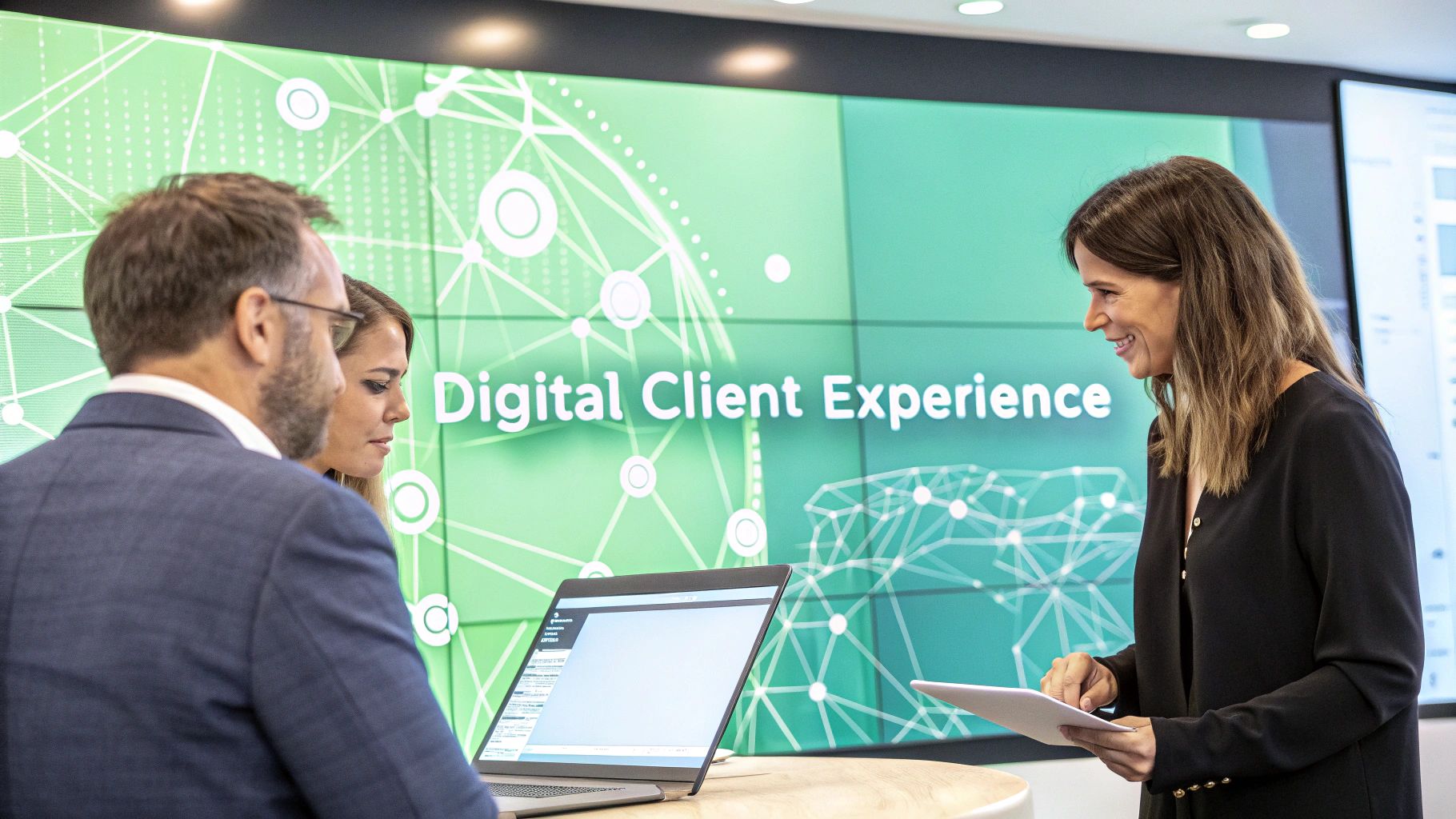



The digital client experience is the sum of every touchpoint a client has with your company online. It spans from their first visit to your website to their ongoing interactions with a secure client portal. This is no longer a background IT function—it is your digital headquarters and the core of your client relationships, where a single poor interaction can place an entire partnership at risk.
Why Your Digital Client Experience Is Everything
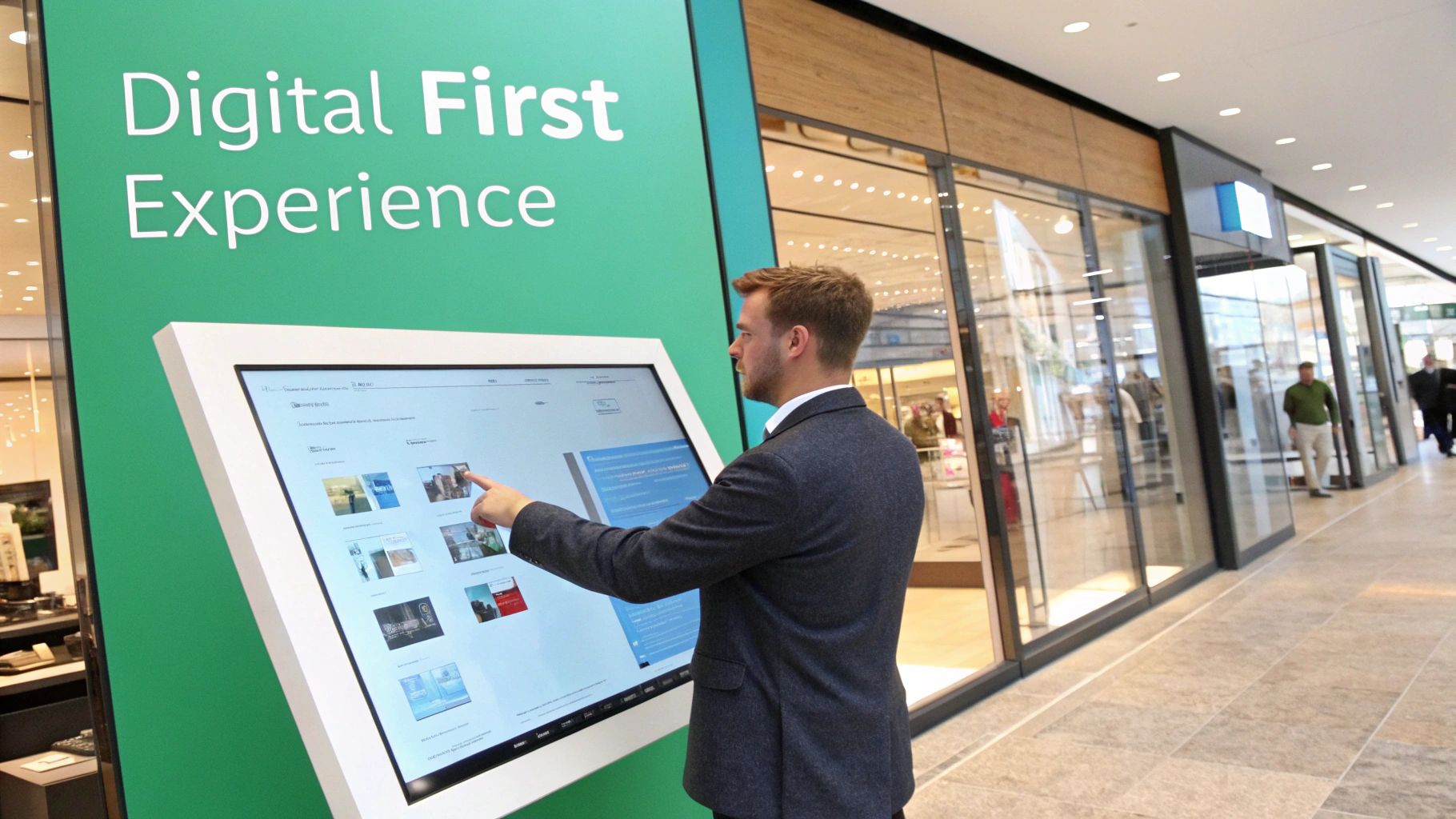
Consider a client's physical journey. You would welcome them into a polished office, offer a comfortable seat, and provide your undivided attention. Every detail is meticulously designed to build trust and confidence. Your digital presence must achieve the exact same outcome.
Each click on your website, every interaction with a client portal, or any experience on a mobile app reflects your brand’s promise. A clunky interface, a broken link, or the inability to find critical information sends a clear message: you don't value their time. This is where the stakes are incredibly high. A smooth digital client experience isn't a "nice-to-have"—it's a direct reflection of your company's operational excellence and commitment to your clients.
The Shift to Digital-First Engagement
The transition to digital-first engagement is a fundamental change in how business is conducted. Clients now demand immediate access to information and self-service capabilities. This client-driven evolution requires a sophisticated, strategic response grounded in powerful technology and human-centered design. We have moved beyond static websites and into an era of dynamic, personalized digital ecosystems. You can explore these core concepts in our guide on customer experience management.
A superior digital client experience is built on a simple premise: make it effortless for clients to achieve their goals. When every digital touchpoint is intuitive, responsive, and valuable, you're not just providing a service—you're building a partnership based on trust and competence.
The Foundation of a Winning Strategy
Delivering a superior digital client experience requires a robust technological foundation capable of managing complex client journeys. This is where platforms like Sitecore's composable Digital Experience Platform (DXP) provide the essential tools. Sitecore enables businesses to consolidate client data, personalize interactions at scale, and deliver a consistent brand experience across every touchpoint.
However, technology alone is not enough. To ensure your digital client experience is truly inclusive, it is crucial to adhere to website accessibility best practices. This commitment to both cutting-edge technology and universal accessibility is what truly sets the stage for meaningful, long-lasting client relationships.
The Four Pillars of an Unbeatable Digital Strategy
A powerful digital client experience doesn’t just happen—it's built on a foundation of four strategic pillars. Think of these as the essential supports that transform disjointed digital interactions into smooth, valuable client journeys. When you get them right, they form a blueprint that not only meets client expectations but consistently leaves them impressed.
Building this kind of strategy starts with a clear vision connecting every digital touchpoint to your bigger business goals. To get that foundation solid, it's worth reading this comprehensive guide to crafting an effective digital marketing strategy. This structure ensures your technology investments aren't just costs but direct drivers of growth and loyalty.
Seamless Omnichannel Journeys
Your clients don't think in terms of "channels"; they think in moments. They might start a support ticket on a mobile app during their commute, follow up on a web portal at their desk, and expect an email summary later. A seamless omnichannel journey makes this entire process feel like one continuous conversation.
This is much more than just showing up on multiple platforms. True omnichannel excellence is about the intelligent handover of data and context between those platforms. For a deeper look, our guide on omni-channel customer engagement offers some great insights. A platform like Sitecore's composable DXP is architected to unify these touchpoints, ensuring a client's history and intent travel with them and eliminating the frustration of starting over.
Intelligent Personalization
Generic, one-size-fits-all experiences are the fastest way to lose engagement. Intelligent personalization is the art of using data to deliver content and interactions that feel like they were created just for that client. This goes way beyond sticking their first name in an email; it's about anticipating what they need before they even ask.
For instance, using Sitecore CDP (Customer Data Platform), you can consolidate all client data—from website behavior to purchase history—into one unified profile. This rich profile then empowers Sitecore Personalize to make smart, real-time decisions, such as:
- Displaying relevant case studies on the homepage to a client from a specific industry.
- Proactively offering support articles based on the portal pages they've recently visited.
- Tailoring calls-to-action to align with their last interaction with your sales team.
Frictionless User Experience
The best digital experiences are often the ones you don’t even notice. A frictionless User Experience (UX) is all about creating intuitive, effortless paths for clients to get things done. If a client has to hunt for a critical document or gets lost in a confusing menu, trust in your brand’s competence starts to fade—fast.
This pillar is grounded in human-centric design, focusing on clear layouts, fast load times, and logical information architecture. In a platform like SharePoint, this means building client portals that are simple to navigate and make secure document sharing a breeze. For Sitecore, it’s about designing web experiences that guide users to answers with minimal clicks, making every interaction feel productive.
Proactive Data-Driven Engagement
Finally, a truly unbeatable strategy is proactive, not reactive. Instead of waiting for a client to report an issue, proactive data-driven engagement uses analytics to spot potential problems and opportunities before they happen. It’s about being a strategic partner, not just a service provider.
By analyzing user behavior data, you can identify where clients might be struggling in your portal and offer help before they even ask. This simple shift transforms your digital platform from a passive tool into an active, value-adding part of your client relationship.
To see how these pillars connect directly to business results, the table below breaks down each component and its tangible impact. It clarifies how these strategic concepts translate into real-world outcomes.
Four Pillars of Digital Client Experience and Their Business Impact
Ultimately, mastering these four pillars is what separates an average digital presence from an exceptional one that builds lasting client relationships.
The Sitecore DXP Engine: Powering Your Strategy
A powerful strategy needs an equally powerful engine to drive it. That’s where a composable Digital Experience Platform (DXP) like Sitecore comes in, acting as the central hub for your entire digital client experience. It's not a single monolithic product, but a collection of specialized, best-of-breed tools working in concert, each engineered for a specific job.
Understanding how these components interoperate is key to unlocking the strategic flexibility and power of the platform. Each element is designed to solve a distinct challenge in the client journey, from initial content creation to hyper-personalized delivery.
This diagram shows the core pillars that Sitecore's technology is built to support—things like customer journeys, personalization, and user experience.
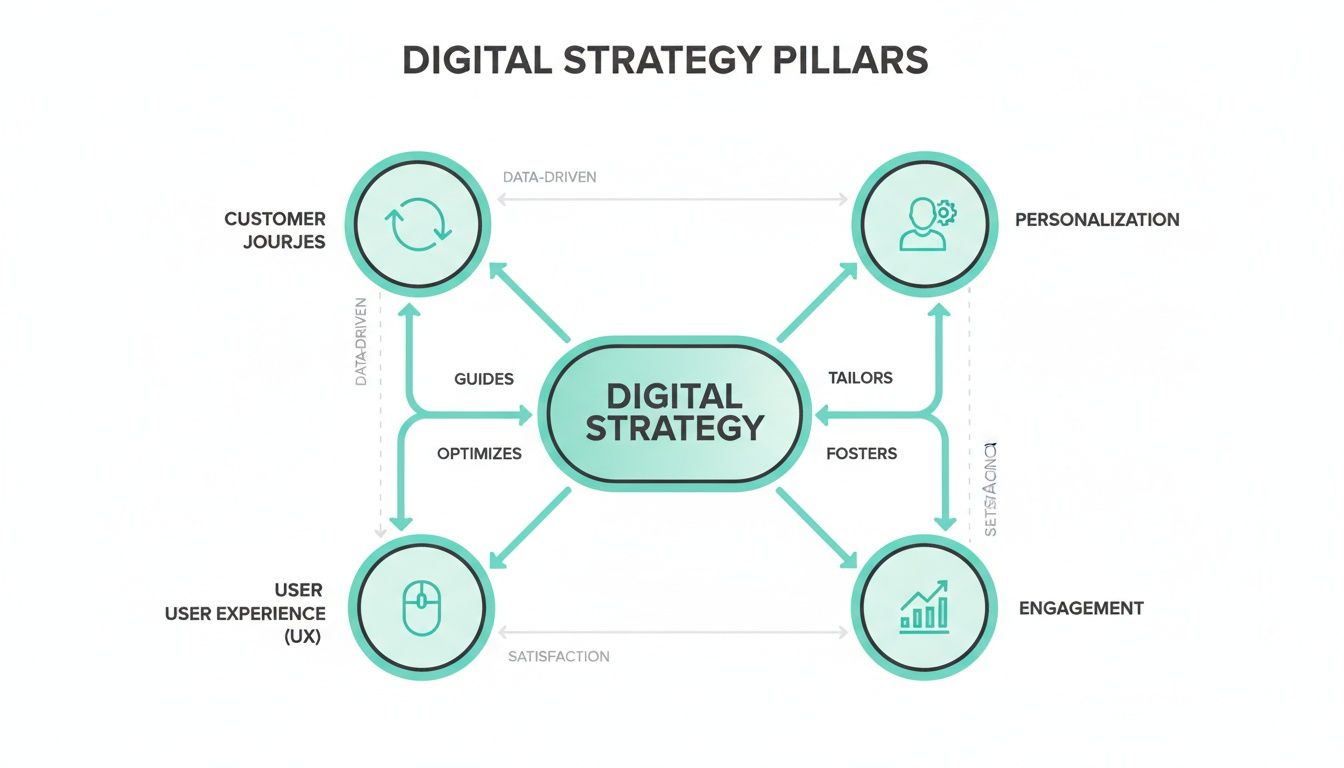
You can see how these distinct pillars are all interconnected. It’s a great visual reminder that an exceptional experience isn't about one thing, but about multiple, well-integrated components all working toward the same goal.
Sitecore XM Cloud: The Content Command Center
At the heart of the ecosystem is Sitecore XM Cloud. This is your content command center, built on a modern, headless architecture. This means content is decoupled from presentation, allowing you to create it once and deploy it anywhere—a traditional web portal, a mobile app, or even a digital kiosk.
This architectural agility is essential for creating seamless omnichannel journeys. It ensures brand consistency across all touchpoints and allows marketing and IT teams to work more independently, accelerating the entire content delivery lifecycle.
Sitecore CDP: The Central Nervous System
If XM Cloud is the command center, then Sitecore CDP (Customer Data Platform) is the central nervous system. Its sole purpose is to ingest, unify, and activate every piece of client data from every touchpoint, including web behavior, support interactions, purchase history, and offline data.
The result is a rich, 360-degree profile of each client, transforming fragmented interactions into a complete relational history. True personalization is impossible without this unified data; with it, you have the foundation for every intelligent action that follows.
A unified client profile is the bedrock of a modern digital client experience. It transforms data from a simple record-keeping tool into a strategic asset that fuels anticipation and relevance at every step of the journey.
Sitecore Personalize: The AI-Powered Decision-Maker
With a complete client picture from the CDP, Sitecore Personalize acts as the AI-powered decision-maker. This is where one-to-one interaction is executed. It leverages the unified data to deliver real-time personalization, conduct web-based experiments, and trigger specific experiences on the fly.
This component enables you to:
- Present a client from the financial sector with a homepage banner highlighting a relevant new service.
- Trigger a pop-up with a helpful guide for a client who has visited the same product page three times.
- Run A/B tests on your portal's navigation to determine which version optimizes task completion.
It is the intelligent engine that uses data from the nervous system (the CDP) to deliver a response that feels uniquely tailored and immediately valuable. By connecting these dots, you begin to shape a more complete digital customer experience and make every single interaction count.
The Supporting Cast: Sitecore Search and Content Hub
Two other components play vital roles. Sitecore Search leverages AI to deliver hyper-relevant search results, ensuring clients find what they need instantly by understanding user intent rather than just keywords.
Meanwhile, Sitecore Content Hub streamlines the entire content supply chain. It functions as a centralized Digital Asset Management (DAM) and content marketing platform, enabling teams to plan, create, and manage content efficiently. This operational backbone is what allows you to deliver high-quality, on-brand experiences at scale. Together, these tools form a cohesive engine built for strategic execution.
Unifying Your Ecosystem With SharePoint Integration
An exceptional external digital client experience is almost always powered by a well-orchestrated internal machine. While Sitecore excels at crafting and delivering personalized client-facing interactions, SharePoint is the powerhouse for internal operations, providing a secure backbone for collaboration and document management. Integrating them bridges the critical gap between internal workflows and external delivery.

This connection creates a unified system that streamlines processes for your teams and delivers a superior experience for your clients. Information flows seamlessly from internal creation to external publication, ensuring everything clients see is accurate, approved, and on-brand.
SharePoint as the Secure Content Vault
Think of SharePoint as your organization's secure content vault. It's the central hub where teams collaborate on documents, manage versions, and enforce strict access controls. This is where your most critical internal assets reside—from legal contracts and compliance documentation to marketing materials and technical specifications.
By establishing SharePoint as the single source of truth, you eliminate the risk of outdated or unapproved information reaching clients. Once an asset is finalized and approved within SharePoint, it is ready for governed distribution.
This controlled environment is the starting point for a trustworthy digital client experience. It ensures that the information fueling your external-facing platforms is governed by rigorous internal processes, building a foundation of accuracy and reliability.
This is where the integration with Sitecore becomes powerful. Approved assets from the SharePoint vault can be synchronized directly with Sitecore Content Hub. This secure pipeline moves finalized content and digital assets straight into your DXP’s central library, ready for marketers to utilize in campaigns and client portals.
Connecting Internal Workflows to External Experiences
The true value of this integration lies in connecting your internal world to your external one. Without a proper bridge, teams often resort to manual processes like downloading and re-uploading documents, which introduces human error and version control issues.
An automated connection between SharePoint and Sitecore solves this by establishing a governed content supply chain. Information moves from a secure, collaborative space to a dynamic, client-facing delivery platform without risky manual intervention. This locks in brand consistency and message accuracy across every digital touchpoint.
Building Secure Client Portals With SharePoint
Beyond content syndication, SharePoint provides robust features for building secure, dedicated client portals. These portals offer a private and personalized space for clients to interact with your business on sensitive matters.
Key features of a SharePoint client portal include:
- Secure Document Exchange: A safe environment for sharing confidential files like contracts, project plans, and financial statements, complete with audit trails.
- Project Tracking Dashboards: Custom views providing clients with real-time visibility into project milestones, tasks, and progress reports.
- Personalized Information Hubs: A central location for clients to access information relevant only to them, such as support tickets, invoices, and account details.
These portals build trust by creating a secure and transparent environment. When migrating existing systems or data into a new portal, a clear strategy is non-negotiable. Planning for a smooth transition is a key part of the process, which you can learn more about in our guide to SharePoint migration services.
By integrating these specialized SharePoint portals with the broader Sitecore experience, you can offer a truly comprehensive digital client experience. Clients receive the best of both worlds: the engaging, personalized content delivery of Sitecore and the secure, functional collaboration of SharePoint, all within one unified digital ecosystem.
Measuring What Matters and Avoiding Common Mistakes
Building a sophisticated digital client experience is a significant investment, but without the right measurements, you are operating blind. It is easy to focus on vanity metrics like page views, but a successful strategy is measured by KPIs that directly reflect business value and client sentiment. Focusing on the right metrics reveals what is working and where friction is damaging relationships.
This means digging deeper than surface-level data to concentrate on what truly drives growth. It’s about connecting every digital interaction to a tangible business outcome, and this is where platforms like Sitecore excel, with analytics built to track these meaningful KPIs and inform your next move.
Core Metrics That Define Success
To gain a true understanding of the health of your digital client experience, you need to look beyond the obvious. Here are three critical metrics that provide a complete picture, blending financial value with client sentiment and operational ease.
- Customer Lifetime Value (CLV): This is the ultimate report card for a successful relationship. Sitecore CDP is instrumental here, as it unifies client data from every touchpoint, allowing you to see precisely how personalized journeys and frictionless experiences lead to repeat business and increased value over time.
- Net Promoter Score (NPS): This metric distills client loyalty into one powerful question: "How likely are you to recommend us?" By integrating survey tools, you can correlate NPS feedback with specific digital interactions tracked in Sitecore to identify which actions create promoters versus detractors.
- Customer Effort Score (CES): This measures the ease with which a client could resolve their issue or complete a task. A low-effort experience is the gold standard of a great digital platform. You can analyze user session recordings and path analytics in Sitecore to identify and eliminate high-effort areas, such as a confusing portal navigation.
By focusing on CLV, NPS, and CES, you create a balanced scorecard for your digital client experience. You’re not just tracking clicks; you're measuring loyalty, satisfaction, and the long-term financial health of your client relationships.
Critical Mistakes to Avoid on Your Journey
Even with the best strategy, common traps can completely derail your digital experience efforts. Just knowing what they are is the first step to avoiding them and making sure your investment pays off. One of the biggest risks? Underestimating just how quickly a bad experience can destroy trust.
Client loyalty is incredibly fragile. Research shows that a significant percentage of customers will abandon a brand after just a few poor experiences, as detailed in these customer experience statistics for 2025. There is virtually no room for error.
This unforgiving reality makes it crucial to steer clear of these common missteps:
- Operating in Data Silos: When your CRM, analytics, and content management system don't talk to each other, you end up with a fractured, incomplete picture of your client. Tools like Sitecore CDP are specifically designed to knock down these walls, unifying data to fuel a cohesive strategy.
- Letting Technology Dictate Strategy: This is a classic mistake. Never pick a tool and then try to warp your strategy to fit its features. The best projects start by mapping out the ideal client journey and pinpointing friction points first. Then you configure tools like Sitecore Personalize to solve those specific problems.
- Failing to Invest in Continuous Optimization: Launch day is the starting line, not the finish line. The digital client experience isn't a "set it and forget it" project. You have to constantly use tools like Sitecore's A/B testing and analytics to test, learn, and refine every single part of the journey.
Your Digital Client Experience Questions Answered
Alright, let's move from the "what" and "why" to the "how." Transitioning from strategy to actually building something always brings up a few key questions. To help you connect the dots, this final section answers the most common things we hear about creating a winning digital client experience with Sitecore and SharePoint.
Think of these as straightforward, actionable answers to get you unstuck and moving forward.
What Is the First Step in Building a Digital Client Experience Strategy?
Before you even think about technology, the absolute first step is to map the entire client journey. You have to walk a mile in your clients' shoes to understand what their experience with you really feels like today.
Get granular. Pinpoint every single digital touchpoint they have with your company. This means everything from their first visit to your website, to how they find support documents, to tracking project updates in a portal.
To get this right, you need to combine hard data with human stories.
- Dig into your analytics. Where are people getting stuck or dropping off? Where are they spending way more time than they should have to?
- Send out client surveys. Ask for direct feedback on the tools they use. Are they happy? Frustrated? Indifferent?
- Actually talk to your clients. Set up interviews to understand the emotional side of their experience. What makes them feel valued, and what drives them crazy?
This process is all about uncovering the friction. Once you have a clear, data-backed picture of the pain points, then you can define your goals. Only after that should you start looking at tools like Sitecore’s DXP to solve those specific, well-understood problems. This "strategy-first" mindset ensures your tech investment actually solves problems instead of just adding more complexity.
How Do Sitecore and SharePoint Work Together in Practice?
The best way to think about this is like having two highly skilled specialists on the same team. Each has a distinct job, but together they create something seamless.
Sitecore is your "front-of-house" expert. It's the master of creating those public-facing, highly personalized digital experiences on your websites, apps, and marketing channels. It’s the engine that runs dynamic content, A/B testing, and personalized recommendations to keep clients engaged.
SharePoint, on the other hand, is your "back-of-house" specialist. Its superpowers are secure document management, complex internal workflows, and building rock-solid portals for controlled information sharing. It’s all about governance, version control, and compliance.
A classic integration has SharePoint acting as the single source of truth for critical documents. Those files are then securely surfaced to clients through a Sitecore-powered portal, giving you Sitecore's beautiful experience delivery with SharePoint's ironclad security.
For instance, a client logs into their portal, which looks great and is personalized by Sitecore. When they click to download a sensitive quarterly report, that file is pulled in real-time from a secure SharePoint library. This guarantees they always get the latest, officially approved version. It’s the perfect marriage of a world-class experience and bulletproof security.
What Is the Difference Between CX, UX, and Digital Client Experience?
These terms are often used interchangeably, but they represent three distinct and nested concepts. Understanding the difference helps focus your efforts effectively.
Imagine a large circle representing the entirety of your relationship with a client. That is Customer Experience (CX). It is the sum total of every interaction—online and offline—including sales calls, in-person meetings, billing, and all digital touchpoints. It is the big picture.
Now, zoom into a specific digital interaction within that circle, such as using your mobile app or navigating a client portal. The ease and effectiveness of using that single tool constitute the User Experience (UX). It is hyper-focused on the usability and intuitiveness of one specific digital asset.
The Digital Client Experience is the bridge connecting them. It is the sum of all digital interactions across all your platforms—your website, portals, apps, and chatbots working in harmony. It is about ensuring the journey between those digital touchpoints feels connected and effortless. A great portal UX is diminished if the digital journey to find and access it is a nightmare.
Here’s a simple way to break it down:
Ultimately, a superior digital client experience is born from perfecting the UX of individual touchpoints and orchestrating them intelligently to support your overarching CX strategy.
Ready to build an unbeatable digital client experience that drives growth and loyalty? The experts at Kogifi specialize in implementing and optimizing Sitecore and SharePoint solutions to create seamless, personalized client journeys. Contact us today to transform your digital presence.