


What Are Modern Digital Customer Experiences
The phrase “digital customer experience” gets thrown around a lot, but what does it actually mean? Think of it as the complete story of every online interaction someone has with your brand. It’s not just one click or one visit—it’s the entire journey, from the moment they find you on Google to the time they spend on your mobile app.
A truly great experience is personal, consistent, and intelligent at every single touchpoint. It’s the difference between a clunky, forgettable website and an interaction that feels genuinely helpful.

Let’s get practical. Imagine you had a personal concierge who knew what you needed before you even asked. That’s the goal of a modern digital customer experience (DCX). It's a cohesive, connected story a customer lives with your brand online.
This story begins the second a user types a query into a search engine and lands on your content. It continues as they navigate your site, maybe chat with a bot for help, and eventually complete a purchase. Every touchpoint—your website, app, social media—is a chapter in an ongoing conversation.
An exceptional DCX makes sure these conversations feel personal and smart, not robotic. The aim is to make every user feel seen and understood, turning them from a passive browser into an engaged customer.
The Shift from Static Pages to Dynamic Journeys
Not too long ago, a website was just a digital brochure—a fixed collection of pages that rarely changed. That model is now completely obsolete. Customers today expect a dynamic environment that adapts to them in real time, and that's where a Digital Experience Platform (DXP) comes into play.
Platforms like Sitecore are engineered to orchestrate these intricate customer journeys. Their composable architecture goes far beyond basic content management by integrating all the capabilities that define modern digital customer experiences:
- Content Management: Getting the right message to the right person at the perfect moment.
- Personalization: Customizing content and offers based on a user’s behavior and data.
- Analytics: Pulling insights from every interaction to continuously make the experience better.
- E-commerce Integration: Building a seamless bridge from product discovery to checkout.
This integrated approach ensures the experience feels connected from the first visit to post-purchase support, eliminating the jarring, fragmented feel of older systems.
A great digital customer experience isn't about having the flashiest website. It's about creating a seamless, intuitive, and personalized journey that makes the customer feel like you know them and are there to help them achieve their goals, every step of the way.
The Role of Internal Systems in External Excellence
While customer-facing platforms are what the user sees, the quality of their experience is a direct reflection of your internal efficiency. This is where tools like SharePoint play a crucial, behind-the-scenes role. Think of SharePoint as the central nervous system for your company’s internal content and collaboration.
When your marketing and support teams can instantly find accurate, on-brand information, the customer wins. For example, a support agent who pulls up the right troubleshooting guide from a SharePoint intranet in seconds can provide a fast, satisfying resolution.
A truly modern DCX strategy understands that a brilliant external experience is built on a solid foundation of internal precision. It’s the seamless flow of information between these systems that empowers brands to deliver the consistent, high-quality interactions that build real loyalty.
Why Investing in Customer Journeys Is a Business Imperative
In a crowded market, your most durable competitive advantage isn't price or features—it's the quality of your digital customer experiences. Treating the customer journey as a top priority isn't just a "nice-to-have" anymore; it's a fundamental requirement for staying in business and growing.
Ignoring your customer journey is like pouring water into a leaky bucket. You can spend a fortune on marketing to attract new customers, but if their digital experience is full of friction, they'll leave just as fast as they came. This dynamic makes your customer acquisition costs unsustainable and eats away at long-term profitability.
The Real Cost of a Poor Experience
It only takes one bad interaction to undo all the hard work your marketing team has done. Customers today have zero tolerance for clunky websites, irrelevant content, or a digital experience that feels disconnected. The cost of doing nothing isn't some abstract concept—it shows up in your revenue and churn rates, clear as day.
Poor online interactions are a major driver of customer churn. A negative digital experience can quickly turn a potential buyer into a detractor, destroying customer lifetime value and impacting your bottom line.
Fixing these issues starts with mastering effective customer journey mapping. It’s the only way to find and eliminate the friction points that are pushing your customers away.
Connecting DCX to Business Growth Metrics
A great digital customer experience directly fuels the metrics that matter most to leadership. When every digital touchpoint is optimized, the entire business reaps the rewards. A smooth, intelligent journey doesn't just feel better for the customer; it delivers tangible, measurable results.
Here’s how a strong DCX strategy hits your bottom line:
- Higher Customer Lifetime Value (CLV): Happy customers don't just buy once; they come back. A personalized, frictionless experience builds the kind of loyalty that turns a single transaction into a long-term relationship.
- Improved Conversion Rates: When you remove obstacles and anticipate what your users need, you make it easier for them to do what they came to do—whether that's making a purchase, filling out a form, or finding information. This directly lifts conversion rates.
- Reduced Churn: A proactive and supportive digital journey keeps customers engaged and satisfied. They're far less likely to jump ship to a competitor, which protects your recurring revenue and stabilizes your customer base.
An investment in the customer journey is an investment in your company's future. It's the most direct path to creating sustainable growth by building a loyal customer base that not only stays with you but also advocates for your brand.
The Strategic Role of a DXP
This is exactly where a powerful Digital Experience Platform (DXP) like Sitecore becomes essential. Sitecore is built from the ground up to manage and optimize the entire customer lifecycle. It gives you the tools to map out journeys, personalize content on the fly, and gather the data you need to constantly get better.
With Sitecore's integrated tools—like its Customer Data Platform (CDP) and personalization engine—you can stop guessing and start making data-driven decisions. It helps you finally plug the leaks in your "bucket" by creating experiences so compelling that customers have no reason to leave. Our guide provides an in-depth look at how to use a customer journey mapping template to get this process started.
Ultimately, investing in your customer journeys creates a powerful feedback loop. Better experiences lead to happier customers, who spend more, stay longer, and tell their friends about you. This transforms your digital presence from a simple website into a true engine for business growth.
The Four Pillars Of a Winning DCX Strategy
Crafting a digital customer experience that genuinely connects isn't about a single piece of technology or one clever marketing campaign. It’s about building a robust, interconnected system. Think of it like a high-performance engine, where four distinct but collaborative parts work in harmony to create power, speed, and reliability. These are the four pillars of a modern DCX strategy.
Without these foundational elements working together, even the most ambitious digital initiatives will sputter and fail. Each pillar plays a specific role, turning raw data into meaningful, personalized interactions that drive real business growth.
Getting this wrong isn't just a missed opportunity—it has direct financial consequences.
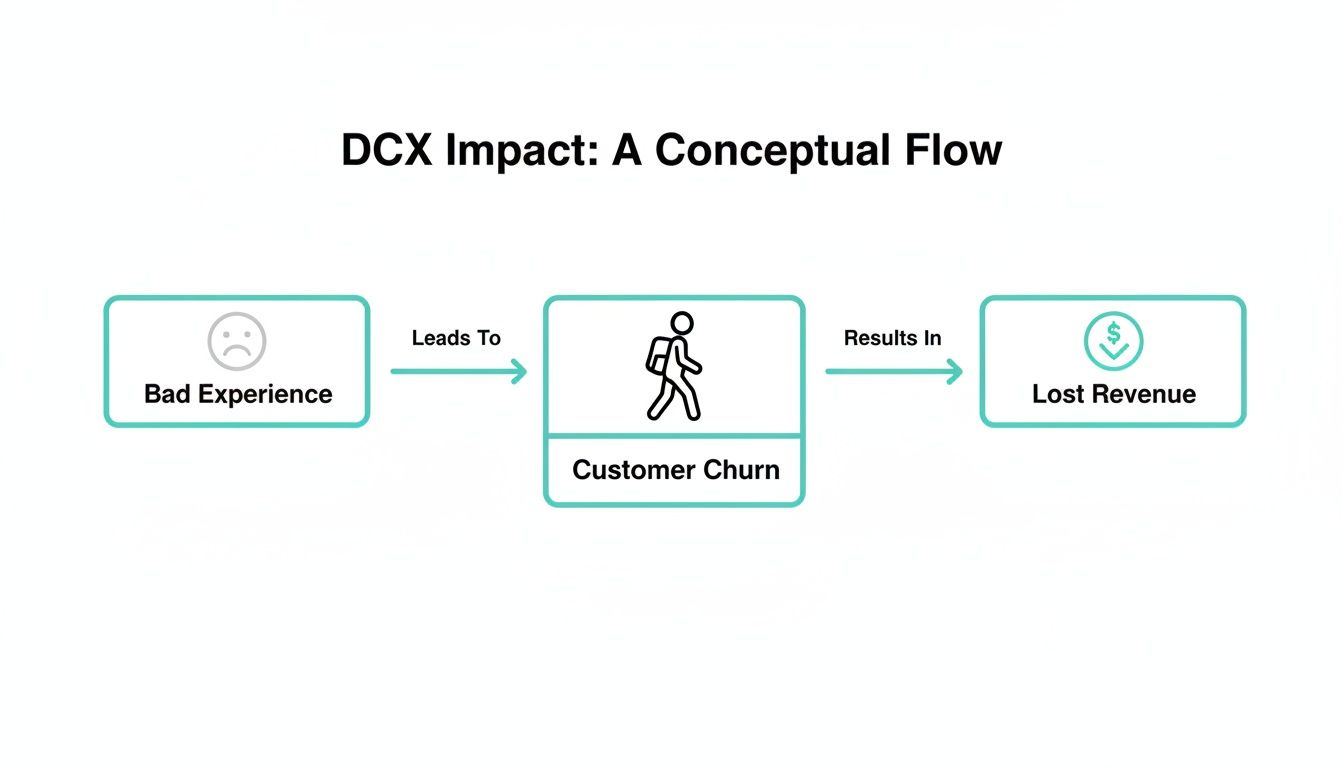
As you can see, a bad experience is the first domino to fall, kicking off a chain reaction that leads to customer churn and, ultimately, lost revenue.
Let’s break down the four essential pillars that prevent this from happening and create experiences that customers love.
A solid digital customer experience strategy is built on four core components. Each one supports the next, creating a holistic system that turns customer data into valuable, personalized interactions across every touchpoint. The table below outlines these essential pillars.
The Four Pillars of a Modern Digital Customer Experience Strategy
Together, these pillars provide the structure, intelligence, and consistency needed to build lasting customer relationships and drive sustainable growth.
Pillar 1: The Technology Core - DXP
At the heart of any modern DCX strategy is the Digital Experience Platform (DXP). This is much more than just a website content management system (CMS); it's the central command center that integrates every tool you need to manage the end-to-end customer journey. A true DXP, like the composable suite from Sitecore, acts as the powerful chassis of our engine analogy.
This technology core connects content delivery, e-commerce functionality, and customer data management into a single, cohesive environment. It provides the architectural foundation upon which all other pillars are built, ensuring stability and scalability. If you want a deeper look, you can learn more about what a digital experience platform is and how it functions as a central hub for all customer interactions.
Pillar 2: Unified Data And Analytics
The second pillar is the fuel for our engine—unified data. Customers leave digital footprints with every click, search, and purchase. The problem is, this data is often scattered across different systems like CRMs, analytics tools, and marketing automation platforms, creating a fragmented and incomplete picture.
A winning strategy breaks down these data silos. Technologies like Sitecore's Customer Data Platform (CDP) are designed to solve this exact problem. A CDP ingests data from every touchpoint, cleans it, and stitches it together to create a single, persistent, 360-degree profile for each individual customer.
This unified view is the absolute prerequisite for meaningful personalization. Without a single source of truth, any attempt at creating a relevant experience is just guesswork.
Pillar 3: AI-Driven Personalization
With a strong technology core and unified data, the third pillar—AI-driven personalization—can truly shine. This is where the engine’s intelligence comes from, using the fuel of data to adapt performance in real-time. Products like Sitecore Personalize use artificial intelligence and machine learning algorithms to analyze the unified customer profile and predict intent.
This allows you to move beyond basic segmentation (e.g., "show this banner to all returning visitors") to true one-to-one personalization. The system can automatically display product recommendations based on a user’s browsing history, adjust website content based on their industry, or trigger a timely offer when it detects they are about to abandon their cart.
Pillar 4: Omnichannel Cohesion
Finally, the fourth pillar ensures the experience is smooth and consistent, no matter where the customer is. Omnichannel cohesion means that the personalized journey seamlessly transitions across all channels—from your website and mobile app to email marketing and even in-store kiosks.
A customer might start researching a product on their laptop, add it to their cart on a smartphone, and later receive a follow-up email. A cohesive strategy ensures the context of their journey is never lost. The experience feels like one continuous conversation, not a series of disconnected interactions. This level of consistency is what builds trust and solidifies long-term loyalty, turning a one-time buyer into a brand advocate.
Orchestrating AI-Powered Journeys with Sitecore DXP
A great strategy points you in the right direction, but it's the right technology that actually gets you there. When it comes to creating truly exceptional digital customer experiences, a Digital Experience Platform (DXP) like Sitecore is the engine that brings your vision to life. It breaks free from the limits of a traditional CMS, offering a complete ecosystem built to manage complex, AI-driven customer journeys from the first click to the final conversion.
Sitecore isn’t just a tool for posting content on a website. It's a full suite of composable products designed to understand and connect with customers as individuals. It gives you the power to gather customer data, analyze it on the fly, and act on those insights in the blink of an eye. This is what turns a generic site visit into a meaningful, personal conversation.
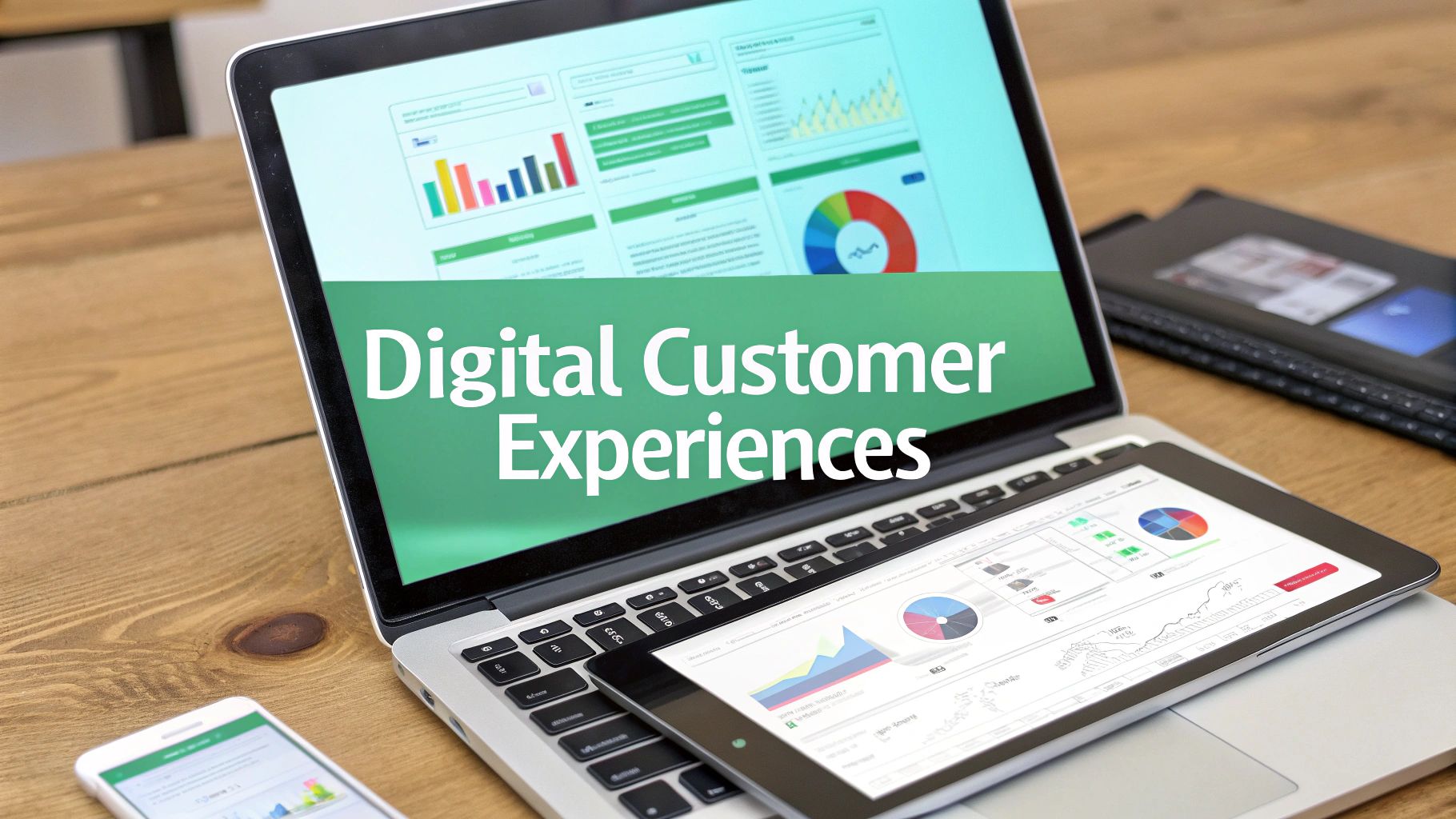
The platform makes it easy to visualize how customers interact with your brand, offering clear insights to fine-tune every step of their journey.

This kind of analytics dashboard is at the core of the Sitecore DXP, showing exactly how raw data becomes a deep understanding of customer behavior.
Unifying Customer Data with Sitecore CDP
Before you can personalize anything, you have to know who you’re talking to. That’s where Sitecore CDP (Customer Data Platform) comes in. Think of it as a central brain, pulling together customer data from every touchpoint—website clicks, mobile app activity, CRM notes, and even in-store purchases.
By stitching together these scattered pieces of information, Sitecore CDP builds a complete, 360-degree profile for every single user, including those who are still anonymous. With each new interaction, that profile gets richer and smarter, painting an ever-clearer picture of their needs and what they're looking for.
This unified view is the bedrock of modern digital customer experiences. Without it, personalization is just a series of disconnected guesses. Sitecore CDP gives you that single source of truth needed to make every interaction count.
Delivering One-to-One Experiences with Sitecore Personalize
Once you have that crystal-clear view of your customer, Sitecore Personalize is ready to put that intelligence to work. This AI-powered decisioning engine taps into the data from the CDP to deliver truly one-to-one experiences, no matter how large your audience. It can change content, suggest products, and show targeted offers in real time, all based on an individual’s unique profile and behavior.
Here’s how it works in the real world:
- Anonymous Visitor Arrival: A new user lands on your e-commerce site and starts browsing "men's running shoes." Sitecore CDP instantly starts building a profile.
- Profile Enrichment: They click on a specific brand and color. That detail is immediately added to their profile, signaling a strong interest.
- Real-Time Personalization: The next time they view a page, Sitecore Personalize swaps the generic homepage banner with a promotion for that exact brand of running shoes. It might even reorder the product categories to put running gear front and center.
This all happens in milliseconds, creating a seamless and incredibly relevant experience that shows the customer you get them. Our expertise in the Sitecore suite helps turn this powerful potential into a practical, revenue-driving reality. You can dive deeper into how AI enhances personalization in DXPs in our other articles.
The Human Element in an AI-Driven World
While AI and automation are powerful, the goal isn't to replace human connection—it's to make it better. Customers still value human interaction, and a successful strategy requires a balanced approach where technology empowers your team but doesn’t push your customers away. For a deeper look at the tech behind these journeys, you can find more information on leveraging AI and LLMs in digital experiences.
This is where platforms like SharePoint become crucial. It complements the customer-facing experience by making sure your internal teams are just as empowered. By creating a single source of truth for product details, brand assets, and support guides, SharePoint equips your human agents to provide fast, accurate, and consistent service. This internal efficiency directly improves the external customer experience, creating the perfect blend of smart automation and expert human support.
Powering Your DCX with a Strong SharePoint Foundation
A brilliant customer experience doesn't just happen on the front end. It’s built on a foundation of quiet, internal efficiency. This is where SharePoint plays a pivotal, often overlooked, role in shaping your digital customer experiences. It's so much more than an intranet—it’s the engine that helps your teams deliver consistent excellence.
When your internal processes are a mess, that chaos inevitably spills over and impacts your customers. SharePoint brings order by creating a central source of truth. It ensures everyone, from marketing to customer support, has instant access to the most accurate, up-to-date, and brand-compliant information. That internal precision has a direct and immediate impact on external satisfaction.
From Internal Chaos to External Cohesion
Imagine a customer service agent frantically searching for the right troubleshooting guide while an annoyed customer waits on the line. That moment of friction damages the customer's perception of your brand. A well-architected SharePoint solution prevents this by creating a single, searchable home for all critical assets and knowledge.
This internal alignment is the secret to a seamless omnichannel experience. When content is managed centrally, you can guarantee the information on your website matches what a support agent provides, which in turn aligns with your latest marketing campaign.
A great customer experience isn't an accident; it's the result of well-orchestrated internal processes. SharePoint provides the backbone for this orchestration, turning potential points of failure into moments of seamless service delivery.
How SharePoint Directly Improves Customer Journeys
Think of your SharePoint environment as the command center for all the assets that fuel your external platforms. It streamlines workflows and empowers your teams to operate with the speed and accuracy that customers feel at every touchpoint.
A properly configured solution helps in several key areas:
- Ensuring Brand Compliance: It acts as a central library for approved logos, messaging, and templates. This guarantees every piece of content that reaches a customer is perfectly consistent and on-brand.
- Streamlining Content Creation: With structured approval workflows, content moves from creation to publication faster and with fewer errors. Your teams become more agile and can respond to market changes in a snap.
- Empowering Support Teams: When agents can find the right answer in seconds using a powerful search function, resolution times plummet and customer satisfaction scores climb. This turns your support center into a true asset for building loyalty.
This structured approach is essential for any organization looking to scale its operations. You can explore more on how we implement high-performing SharePoint solutions that integrate seamlessly with your DXP.
Extending the Experience to Partners and B2B Ecosystems
SharePoint's capabilities aren't just for internal teams. It's an excellent platform for building secure, feature-rich partner portals. These portals extend a cohesive digital experience to your entire B2B ecosystem, giving vendors, distributors, or franchisees the resources they need to represent your brand effectively.
By giving partners self-service access to marketing materials, training documents, and sales enablement tools, you empower them to succeed. This creates a unified brand front, ensuring customers receive the same high-quality experience whether they're interacting directly with you or with one of your certified partners. That kind of reliable framework is a cornerstone of a mature digital strategy.
Here's the rewritten section, designed to sound completely human-written and match the provided expert tone and style.
Your DCX Implementation Roadmap with an Expert Partner
Turning your digital customer experiences from a collection of disconnected touchpoints into a single, cohesive journey doesn’t happen by accident. It takes a proven plan. An implementation roadmap cuts through the complexity, giving you a clear path from strategy to execution. As your partner, we'll guide you through four distinct stages built to deliver real, measurable results.
This isn't about just buying new software. It's a structured approach that ensures every investment in technology is tied directly to your business goals, creating an integrated system that actually drives growth and loyalty.
Stage 1: Discovery and Strategic Audit
Every great journey starts with a map of where you are right now. This first phase is all about a deep-dive audit of your entire digital ecosystem. We dig into your current tech stack, customer data sources, and internal workflows to pinpoint both the friction points and the hidden opportunities.
But this is far more than a technical review. We work alongside your teams to get a handle on your business objectives, define what success looks like (your KPIs), and map out the ideal customer journey. The result is a clear, data-backed understanding of your starting point and a strategic blueprint for where we need to go.
Stage 2: Platform Implementation and Integration
With a solid strategy in hand, it’s time to build the foundation. This stage is dedicated to the expert implementation and integration of core platforms like Sitecore DXP and SharePoint. Our deep expertise ensures these powerful systems aren't just installed—they're architected to work together seamlessly from day one.
This phase includes:
- Sitecore Implementation: We configure the DXP to manage content, commerce, and personalization from one unified hub.
- SharePoint Integration: We set up SharePoint as your central content repository and collaboration engine, empowering your internal teams to work more efficiently.
- Data Unification: We connect all your disparate data sources into a Customer Data Platform (CDP) to build that all-important 360-degree customer view.
Stage 3: AI Personalization and Optimization
Once the foundation is rock-solid, we bring in the intelligence layer. This is where the magic happens—we use the power of AI to turn all that unified data into meaningful, one-to-one personalization. We configure and deploy tools like Sitecore Personalize to analyze user behavior in real-time and deliver the right content, offers, and recommendations at the right moment.
Making the jump from static content to dynamic experiences is no longer optional. Digital channels are now the primary way customers interact. The recent 2025 State of Customer Experience report highlights that 73% of consumers now prefer digital channels over voice. This shows a huge gap between investing in technology and implementing it effectively—a gap our expertise is designed to close.
Stage 4: Continuous Evolution and Support
A world-class digital customer experience is never "finished." It's a living thing. The final stage of our roadmap is a commitment to continuous evolution, because customer expectations are always changing, and your platform has to adapt. We provide ongoing 24/7 support to ensure your entire digital ecosystem remains stable and performs at its peak.
This continuous cycle of monitoring, analyzing, and optimizing is what separates good digital experiences from great ones. It ensures your investment continues to deliver value long after the initial launch, keeping you ahead of the competition.
Following this phased approach, we provide a clear, manageable path to achieving DCX excellence, turning ambitious goals into tangible business outcomes.
Frequently Asked Questions
When you're digging into a modern digital experience strategy, a lot of questions come up. Here are some of the most common ones we hear from business leaders, with practical answers that cut through the noise.
What Is the First Step to Improving Our DCX?
Hold off on buying new tech. The most critical first step is to get an honest look at where you are right now.
A comprehensive customer journey audit is non-negotiable. Before you can build something better, you have to find all the friction points, dead ends, and moments of frustration that are hurting your current digital experiences. This audit gives you a data-driven map to guide your next moves and make sure you're investing your money wisely.
How Is a DXP Like Sitecore Different from a Traditional CMS?
Think of it this way: a traditional Content Management System (CMS) is a tool for managing your website's content. A Digital Experience Platform (DXP) like Sitecore is an entire ecosystem built to manage the whole customer journey, from start to finish.
A CMS manages content; a DXP orchestrates experiences. This is the fundamental difference.
A DXP like Sitecore goes way beyond a CMS by bringing everything under one roof, including:
- Personalization Engines: To serve up one-to-one content in real time.
- Advanced Analytics: To see exactly how users behave across every channel.
- Customer Data Platforms (CDP): To build that elusive 360-degree view of each customer.
- Omnichannel Delivery: To create a seamless journey whether a customer is on your website, a mobile app, or another touchpoint.
A DXP is the command center for all your digital customer experiences, not just a single website.
Can We Implement Personalization with Messy Customer Data?
This is probably the biggest roadblock we see, and the short answer is no—you have to fix the data problem first. Trying to personalize with messy, siloed data is a recipe for disaster. You'll end up with wrong assumptions, broken experiences, and frustrated customers.
The real solution starts with a Customer Data Platform (CDP), like Sitecore CDP. A CDP is built specifically to pull data from all your different systems, clean it up, unify it, and create a single, reliable profile for each customer. That clean data is the fuel your personalization engine needs to actually work.
What Is the Typical ROI on a DXP Implementation?
Instead of chasing a generic ROI number, the better question is how to measure the return on your specific DXP investment. The value from a well-executed DXP implementation, especially with a platform like Sitecore, shows up in tangible improvements to your core business metrics.
Success isn't about the tech itself; it's about the business outcomes. To measure your ROI, you should be tracking KPIs like these:
- Increased Conversion Rates: When the journey is more relevant and frictionless, more people complete their goals—whether that’s making a purchase or filling out a form.
- Higher Customer Lifetime Value (CLV): Personalized experiences build loyalty. Loyal customers come back more often and spend more over time.
- Improved Operational Efficiency: Integrating systems, like connecting Sitecore with SharePoint, smooths out internal workflows. This cuts down the time and money it takes for your teams to create and manage great experiences.
At Kogifi, we specialize in turning your digital presence into a powerful engine for growth. Our expertise in Sitecore and SharePoint allows us to build and support the world-class digital customer experiences that drive real results. https://www.kogifi.com