


Ecommerce product catalog management is the engine that drives your entire digital sales strategy. It’s the process of organizing, standardizing, and publishing all your product information across every single channel where you sell. Think of it less as a simple list of items and more as the central nervous system of your commerce operation, ensuring everything stays consistent and accurate.
What Is Ecommerce Product Catalog Management?
Imagine your product catalog is a massive, meticulously organized library. In a great library, every book (your product) has a specific spot on the shelf, a clear description, and is a breeze for visitors to find. Now, picture the opposite: a chaotic warehouse with no labels, where finding anything is a frustrating, time-consuming mess. That’s a poorly managed catalog, and it’s a surefire way to lose sales.
This isn't just about data entry; it's a core business function that has a direct, measurable impact on customer experience and, ultimately, your bottom line. Effective catalog management is mission-critical for scaling operations and delivering the personalized experiences modern customers expect.
To get a feel for how the sausage is made, from initial setup to expanding your offerings on a major platform, check out this practical guide on how to add products to your Amazon store.
The Four Pillars of Modern Catalog Management
At its core, solid ecommerce product catalog management is all about making sure every piece of product data is accurate, rich with detail, and presented consistently everywhere. This breaks down into four key activities.
Here’s a look at the fundamental pillars that hold up a high-performance ecommerce catalog:
This entire process is powered by a robust Product Information Management (PIM) system. The PIM serves as the single source of truth for all things product-related, eliminating the data silos that can quickly erode customer trust.
Platforms like Sitecore Content Hub are built to handle this complexity. To get a better handle on how this all fits together, take a look at our deeper dive into the role of a Product Information Management system in modern commerce.
The Anatomy of a High-Performance Product Catalog
A truly effective product catalog is far more than a digital list of items with prices and SKUs. It's a complex, interconnected system where every component works in harmony to drive conversions and create a seamless customer journey. This anatomy moves beyond basic data fields to reveal the powerful engine running underneath a modern commerce experience.
At its heart is a rich and flexible data model. This isn't just about what a product is, but what it does and who it’s for. In a platform like Sitecore, this means defining products not with flat attributes but with a structured hierarchy of information that can be connected to customer segments, campaigns, and content.
The Foundation of Findability Taxonomy and Attributes
The real power of ecommerce product catalog management lies in its taxonomy and attribute system. Think of taxonomy as the skeleton of your catalog—the logical categories and subcategories that organize everything (e.g., Electronics > Audio > Headphones). Attributes are the details that flesh out that skeleton—color, size, material, technical specifications.
A well-designed system, managed within a central hub like Sitecore Content Hub's PIM, powers faceted search and filtering. This lets a customer instantly narrow down thousands of products to the exact item they need, a make-or-break capability for a positive user experience.
The Power Trio PIM, CMS, and ERP
To get to that single source of truth, three systems must work in perfect sync. This symbiotic relationship is the cornerstone of any enterprise-grade solution.
- Product Information Management (PIM): This is your central command for all product data. Systems like Sitecore Content Hub are purpose-built to govern, enrich, and manage the complete product lifecycle.
- Content Management System (CMS): This is where product data meets storytelling. A composable CMS like Sitecore XM Cloud consumes the clean data from the PIM and presents it within engaging, personalized web experiences.
- Enterprise Resource Planning (ERP): This system handles the operational data—price, inventory, and logistics. It feeds crucial, real-time information into the PIM.
The goal of this integration is to create a seamless flow of information. Your ERP knows the stock level, your PIM knows the product features and marketing copy, and your CMS knows how to present it beautifully to the right customer at the right time.
This visual map breaks down the core process of gathering data from various sources, standardizing it in a central hub, and then pushing it out to every channel.
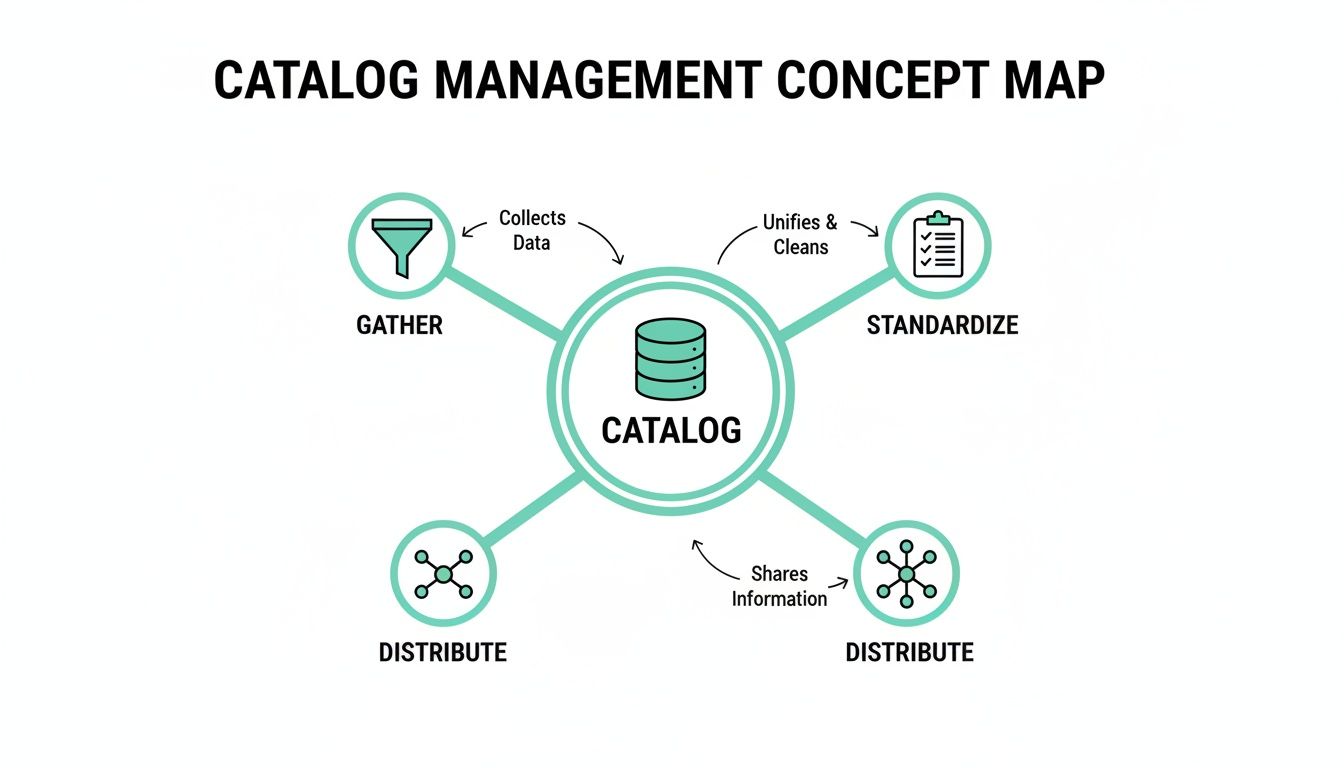
The map really drives home how a centralized catalog acts as the single point of control for maintaining data integrity. Of course, the quality of that data is everything; for more on that, check out this excellent guide on how to write effective product descriptions.
The Role of Digital Asset Management
Finally, no modern catalog is complete without high-quality media. Digital Asset Management (DAM) is not an optional add-on; it's essential.
Integrated DAM capabilities, like those within Sitecore Content Hub, ensure that every product is paired with high-resolution images, videos, and 360-degree views. This integration guarantees that the right visual asset is automatically linked to the right product, on the right channel, every time. You can learn more about Digital Asset Management best practices in our article.
Solving Common Catalog Management Pain Points
When your product catalog is a mess, everything slows down. It's the operational headache that stalls growth and sends customers running to your competitors. Most large companies are wrestling with the same nagging issues, but the good news is, these problems have clear, tech-driven solutions.
The most common culprit? Data inconsistency. Imagine a product is described one way on your website, another way in the mobile app, and has a completely different set of specs on a marketplace. This kind of chaos doesn't just confuse buyers; it erodes trust and torpedoes your SEO efforts. It's usually the result of siloed information trapped in disconnected spreadsheets or creaky legacy systems.
Then there's the nightmare of wrangling data from multiple suppliers. When every vendor sends information in their own unique format—with missing fields and inconsistent quality—your team is left to manually clean, standardize, and enrich every single product record. It's a soul-crushing, error-prone process that simply doesn't scale.
Automating Consistency with Sitecore Content Hub
This is exactly where a dedicated Product Information Management (PIM) system becomes non-negotiable. A platform like Sitecore Content Hub is built to attack these problems head-on by creating a single, centralized source of truth for every bit of product information.
It crushes data inconsistency by enforcing a standard data model and strict validation rules. When new product data comes in, the PIM acts as a gatekeeper, automatically checking for complete fields, correct formatting, and brand guideline compliance. This guarantees that any information pushed to downstream channels, like a website powered by Sitecore XM Cloud, is always accurate and consistent.
A core strength of Sitecore Content Hub’s PIM is its automated data validation. It stands guard, preventing incomplete or incorrect information from ever making it to your customer-facing storefront. This protects your brand's integrity and, most importantly, the customer experience.
Streamlining Supplier Collaboration with SharePoint
For many businesses, the chaos starts long before data ever hits the PIM. Suppliers bombard you with a messy mix of emails and file-sharing links containing specs, marketing copy, and media assets. This is where a tool like SharePoint can play a brilliant supporting role.
By setting up a SharePoint portal for supplier onboarding, you create a structured, collaborative front-end. It's all about establishing a clear governance framework right from the point of data collection.
Here’s how it works:
- Standardized Templates: You can require suppliers to fill out predefined forms or upload documents into a structured library. No more guessing games; you get all the information you need, right from the start.
- Workflow Automation: SharePoint workflows can automatically route new submissions to the right internal teams for review and approval before they're officially ingested into your Sitecore PIM.
- Version Control: You get a crystal-clear audit trail of every change and communication. Gone are the days of wondering which version of a document or image is the final one.
This one-two punch uses SharePoint to tame the wild, unstructured data at the source, allowing your Sitecore PIM to focus on what it does best: governing and enriching high-quality, finalized product information. Together, they create a bulletproof system for solving the most pressing ecommerce product catalog management challenges at an enterprise scale.
Best Practices for Catalog Governance and Optimization
Owning the right technology is just the starting point. Truly exceptional ecommerce product catalog management is built on a solid foundation of governance and a relentless drive for optimization. These practices are what turn your catalog from a static database into a dynamic, performance-driving asset that actively grows your revenue.
The first step? Establishing crystal-clear data ownership. Every attribute, description, and asset needs an assigned owner who is responsible for its accuracy and completeness. Without that accountability, data quality will inevitably degrade over time, leading to customer confusion and lost sales. A well-defined content governance framework is essential for maintaining order as your product offerings expand. You can explore a detailed guide on creating a robust content governance framework in our article.
Establishing Data Integrity and Standards
To keep things consistent, you need to create standardized attribute definitions and validation rules within your PIM. For instance, in a tool like Sitecore Content Hub, you can configure rules that prevent a product from going live if its main image is missing or a critical technical spec is incomplete.
This creates a system of checks and balances, guaranteeing data integrity before anything ever reaches the customer. It’s a methodical approach, but it’s critical for building and maintaining trust.
Optimizing for Search and Personalization
A well-governed catalog is also an SEO powerhouse. It's crucial to bake search engine optimization directly into your data enrichment process. This means crafting unique, keyword-rich product descriptions and titles and meticulously applying schema markup to help search engines understand your product data.
This process directly boosts your organic visibility, driving qualified traffic right to your product pages. Better yet, the structured data managed in Sitecore provides the perfect fuel for advanced personalization.
Using a tool like Sitecore Personalize, you can tailor catalog views for different user segments. Imagine showing bulk pricing to a B2B buyer while highlighting lifestyle benefits and customer reviews for a first-time retail shopper—all from the same core product record.
The impact of a well-executed strategy is substantial. Recent industry data highlights the continued effectiveness of modern catalog strategies, showing significant return on investment when catalogs are integrated into a multi-channel approach.
Building a Continuous Feedback Loop
Finally, the best catalogs are never really "finished." They evolve based on customer interactions and feedback. Integrating customer reviews and Q&A data directly into your PIM creates a powerful feedback loop that keeps your information relevant.
Here’s how to turn that customer input into actionable improvements:
- Identify Information Gaps: If multiple customers ask the same question about a product's features, it’s a clear sign your description needs an update.
- Refine Product Attributes: Analyze review sentiment to understand which features customers value most. Then, you can emphasize those attributes in your marketing copy.
- Improve Visual Merchandising: Use customer-submitted photos and feedback to guide your selection of hero images and product videos.
This approach transforms your catalog into a living, breathing asset that continuously adapts to meet customer needs, ensuring it remains a powerful engine for your commerce success.
Your Roadmap for a Sitecore-Powered Catalog Solution
Rolling out an enterprise-grade catalog solution isn’t just another software installation; it’s a strategic move. For any business serious about leading its market, the Sitecore ecosystem provides a powerful, composable foundation to get there. This roadmap lays out the key phases for building a world-class ecommerce product catalog management solution—taking you from messy spreadsheets and clunky legacy systems to a unified platform that actually drives performance.

The journey kicks off with a deep dive into discovery and data modeling. This first step is absolutely critical. It’s where you map out your current data landscape, pinpoint all the pain points, and define what the future should look like. This means tracking down all product data sources, standardizing your taxonomy, and designing a flexible attribute model that can handle your entire product line—both now and for whatever comes next.
Architecting Your Composable Solution
One of the biggest wins with the Sitecore DXP is its composable nature. Instead of getting locked into a rigid, one-size-fits-all suite, you can pick and choose the best-of-breed components that fit your business like a glove. This flexibility is central to the planning phase.
- For Content and Data Governance: The cornerstone of your solution is Sitecore Content Hub. Its top-tier Product Information Management (PIM) and Digital Asset Management (DAM) tools create the central source of truth for governing and enriching all your product information.
- For Complex Commerce: If your business deals with tricky B2B needs like negotiated pricing or complicated order workflows, Sitecore OrderCloud is your answer. It's an API-first commerce engine built for exactly this kind of flexibility.
Making these strategic choices ensures your tech stack is purpose-built to solve your specific commerce challenges, not someone else's.
The Role of SharePoint in Your Ecosystem
While Sitecore Content Hub is busy managing the structured, final-version product data, SharePoint steps in as the perfect sidekick for handling unstructured information and collaborative workflows. Think of it as the collaborative 'front door' to your PIM.
SharePoint can be set up to manage supplier data collection, internal review cycles for marketing copy, and even document management for compliance materials. This approach gets information cleaned up and organized before it ever touches the highly-governed PIM environment, which dramatically boosts data quality and team efficiency.
Migration and Integration Planning
Once the architecture is set, the focus shifts to the nuts and bolts of migration and integration. This phase is all about carefully planning how you’ll pull data from legacy systems or spreadsheets. A phased approach is usually the smartest way forward. Start with a small pilot group of products to test and fine-tune the process before you go all-in on a full-scale migration.
Key integration points usually involve hooking up your PIM to your ERP for real-time price and inventory updates. You'll also want to link it to your CMS (like Sitecore XM Cloud) to push all that rich product content out to your customer-facing channels.
Finally, a successful rollout hinges on user adoption and training. Your teams need to understand the new workflows and see the real benefits of having a centralized system. By following this strategic roadmap, you can build a robust, scalable, and highly effective catalog management solution that powers incredible customer experiences and drives sustainable growth for your business.
How to Measure Catalog Management Success
So, you’ve put in the work to get your ecommerce product catalog management in order. But how do you prove it was worth it? The answer isn't just about having clean data. Success is measured by connecting those efforts to tangible business outcomes—things like operational speed, a smoother customer journey, and of course, more revenue.
To make a convincing case, you need to track the right Key Performance Indicators (KPIs). This gives you a clear framework for showing the real return on investment from powerful platforms like Sitecore and SharePoint.
Essential Catalog Management KPIs
Let's break down the metrics into a few key areas. This helps you see exactly how your catalog strategy is impacting different parts of the business.
Here are the KPIs you absolutely should be monitoring:
Operational Efficiency
- Product Time-to-Market: How long does it take for a new product to go from the first data entry to being live on your site? A robust PIM should shrink this cycle dramatically. If it used to take weeks, now it should take days—or even hours.
- Data Error Rate: Keep an eye on the number of data-related problems found after launch, like incorrect prices or missing product details. The goal here is to get this number as close to zero as possible.
Customer Experience
- Conversion Rate: This is the big one. High-quality, complete, and accurate product information builds trust, and that trust directly translates into a higher percentage of visitors making a purchase.
- Return Rate (Due to Incorrect Information): Track how many returns are happening because of mismatched product descriptions, wrong specs, or misleading images. Every return you prevent by providing better information is a direct win.
A well-managed catalog directly fuels your bottom line. By linking accurate data to higher conversion rates and fewer returns, you create a powerful business case for continued investment in your PIM and data governance.
Tracking these numbers gives you a clear picture of what’s working. Below is a table that organizes the most important KPIs to help you get started.
Monitoring these KPIs isn't just a technical exercise; it's a strategic one. It allows you to tell a compelling story about how your behind-the-scenes work on product data is driving the entire business forward.
Got Questions? We've Got Answers
To wrap things up, let's tackle a few common questions that come up when discussing ecommerce product catalog management.
What Is the Difference Between PIM and Catalog Management?
It's easy to get these two mixed up, but the distinction is pretty simple. Think of your Product Information Management (PIM) system as the central, single source of truth for all your product data—a master library, if you will. It’s the technology that holds everything.
Catalog management, on the other hand, is the process of using that library. It’s the strategy behind how you organize, enrich, and publish that product information to create compelling customer experiences across your online sales channels. One is the tool; the other is the craft.
How Does Sitecore Improve Catalog Management?
Sitecore offers a powerful, composable DXP that gives you serious control over your catalog. Sitecore Content Hub provides a top-notch PIM and DAM to centralize and polish all your product data.
For more complex scenarios, especially in B2B, Sitecore OrderCloud brings an API-first commerce engine that can handle just about any catalog structure you throw at it. When you combine these tools with Sitecore's best-in-class content and personalization capabilities, you can deliver highly relevant product experiences that truly connect with customers.
Can SharePoint Replace a Dedicated PIM System?
While you could try to bend SharePoint to your will, it's not a true PIM. Its real strength lies in document management, team collaboration, and workflow automation.
Where we see enterprises use it effectively is as a collaborative "front door" to a real PIM. Teams can use SharePoint to manage unstructured supplier data, internal review processes, and marketing briefs. Once that data is clean and approved, it gets formally moved into a structured system like Sitecore Content Hub. It's a great supporting player, but it shouldn't be the star of your PIM strategy.
Ready to turn your product data into a strategic asset? At Kogifi, we specialize in implementing enterprise-grade DXP solutions that drive growth. Learn more about our Sitecore expertise at kogifi.com.