


A product information management system is a central platform built to collect, manage, and enrich every single piece of product data, creating one definitive source of truth. It's the solution to a massive business headache: data fragmentation. This is what happens when different departments hold conflicting or incomplete product info, leading to inconsistencies that ultimately create a poor customer experience.
What Is a Product Information Management System
Imagine trying to tell a consistent story about your products when every department has a different script. Your marketing team has one set of descriptions, the e-commerce team is using another, and crucial product specs are buried in a spreadsheet on an engineer's desktop. This is exactly the kind of chaos a Product Information Management (PIM) system is designed to fix.
Think of it as the ultimate digital command center for all your product data. It’s a centralized hub that gathers, organizes, and enriches every piece of information—from SKUs and technical specs pulled from your ERP to the marketing copy and high-res images scattered across various folders.
The Core Problem PIM Solves
The fundamental issue a PIM tackles is data fragmentation. When product information is scattered across dozens of systems, spreadsheets, and departments, it creates some very real problems:
- Inconsistency Across Channels: A customer might see one price on your website and a completely different one on Amazon or another partner marketplace.
- Manual Entry and Errors: Teams waste countless hours manually copying and pasting information into multiple places. This isn't just inefficient; it's a recipe for human error.
- Poor Customer Experiences: Nothing frustrates buyers faster than incomplete or inaccurate product details. This leads to higher return rates and damages the trust you've worked so hard to build.
- Slow Time-to-Market: Launching a new product turns into a logistical nightmare of chasing down scattered assets and coordinating conflicting information.
By creating a "single source of truth," a PIM ensures that every customer, on every channel, gets the exact same accurate and compelling information. One of the biggest wins here is its power to significantly improve data quality for everything related to your products.
PIM vs. Other Enterprise Systems
It’s easy to get a PIM confused with other common business platforms, but its role is incredibly specific. For instance, it's not a Content Management System (CMS), which is designed to manage webpage content and digital experiences. A PIM is exclusively dedicated to the product data that feeds into those experiences. If you want to dive deeper, you can explore our guide on what is a CMS platform and see how different its functions are.
A PIM system isn't just another database; it's a strategic asset. It transforms raw, scattered product data into a consistent, enriched, and reliable foundation for all your commerce and marketing activities.
Essentially, a PIM acts as the central hub that organizes and refines product details before they're pushed out to other systems like a Sitecore DXP, an ERP, or a DAM. This central control is what transforms business operations, locking in brand consistency and driving operational efficiency from a single, authoritative source.
How a Modern PIM System Actually Works
To really get what a product information management system does, you need to look under the hood. A PIM is much more than a database; it’s like a digital factory that takes raw, scattered data and turns it into polished, channel-ready product information. This whole process is designed to create a single, reliable source of truth for your entire business.
It all starts with data ingestion. Think of the PIM as a powerful magnet, pulling in product information from all over the place. It grabs SKUs from your ERP, technical specs from engineering databases, marketing copy from Word docs, and images from scattered folders. The first job is to bring all that chaos into one central spot.
This diagram shows the basic journey: product data goes from total disorganization to a single source of truth, all thanks to the PIM.
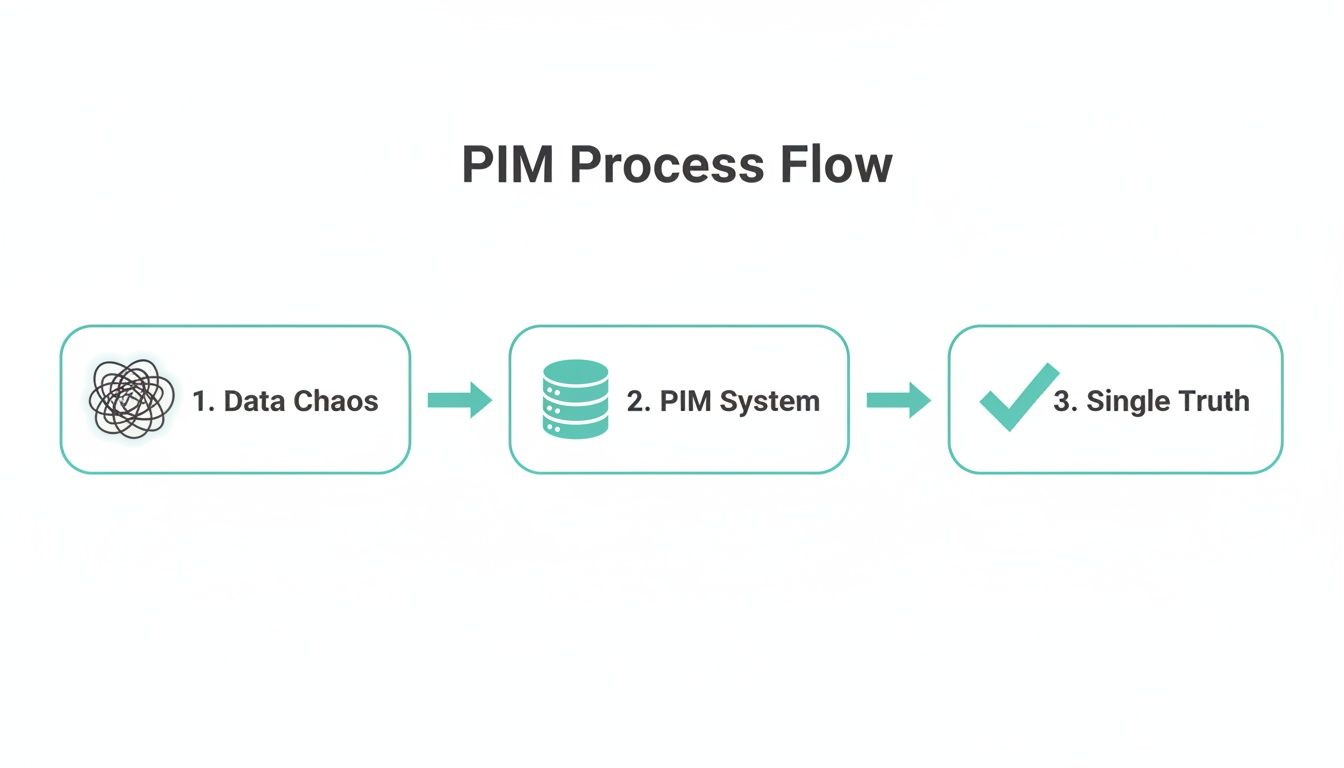
The PIM acts as the central engine, organizing all those separate pieces of information into one unified, trustworthy asset that everyone can rely on.
Building the Data Framework
Once all the data is in one place, the next step is data modeling. This is like creating the architectural blueprint for your products. A modern PIM, especially one built to work with platforms like Sitecore, lets you build a flexible, structured framework that actually makes sense for your business.
This goes way beyond creating simple fields for "name" and "price." A strong data model can handle real-world complexity:
- Complex Relationships: It defines how products relate to each other, like variations (size, color), bundles, or accessories.
- Hierarchies: It organizes products into logical categories and subcategories, which makes them much easier to find and manage.
- Attributes: It supports countless attributes, from technical details like voltage to marketing-focused ones like "key benefits."
Getting this structure right is crucial for delivering personalized experiences down the line. For instance, a well-defined model in your PIM ensures that Sitecore XM Cloud can pull the exact product attributes needed to power targeted recommendations for different customer groups.
Ensuring Data Integrity and Richness
With a solid framework in place, the focus shifts to data enrichment and governance. This is where raw data becomes compelling, customer-facing content. Enrichment is all about adding the details needed to inform buyers and drive sales.
A PIM doesn't just store data; it elevates it. The enrichment process turns a simple list of product specs into a rich, persuasive story that connects with customers on every channel.
Governance, on the other hand, sets the rules of the road. It ensures data is always top-notch by establishing validation rules, mandatory fields, and approval workflows. This stops incomplete or wrong information from ever getting out the door. For businesses using SharePoint for document collaboration, a PIM can pull in approved datasheets and manuals, guaranteeing only the latest, compliant versions are linked to products.
Distributing Perfected Product Data
The final step is syndication—pushing that perfected product data out to every single channel. The PIM acts as the central distribution hub, automatically formatting and delivering information tailored to the specific needs of each destination.
This could mean sending:
- A complete product catalog with rich media to a Sitecore-powered e-commerce site.
- A simplified data feed to a mobile app.
- A formatted export for a print catalog.
- Specific attribute sets to partner marketplaces or retail channels.
This automated syndication guarantees consistency everywhere. A price update made once in the PIM instantly populates across all connected channels, from your website to your internal sales tools. It eliminates tedious manual work and the risk of human error, transforming product data from a logistical headache into a strategic asset.
The Real-World Payoff of Centralizing Product Data
Bringing a Product Information Management (PIM) system into your business is much more than a simple IT project—it's a strategic move that delivers real, measurable returns. When you centralize your product data, you're not just organizing files; you're building a powerful engine for growth, efficiency, and customer happiness. It’s the difference between reactively managing data chaos and proactively leading your market.

The financial impact is hard to ignore. The global PIM market was valued at around USD 30.73 billion and is expected to explode to an estimated USD 249.53 billion by 2033. This incredible growth, running at a compound annual growth rate of roughly 26.2%, shows just how many businesses now see PIM as a fundamental part of staying competitive. You can explore more data on these market trends and what's driving them.
Get to Market in Record Time
One of the first things you'll notice with a PIM is how much faster you can launch new products. Without it, product launches are a frantic scramble to pull information from scattered spreadsheets, old emails, and siloed departmental databases. It’s a slow, error-filled process that holds back growth.
A PIM smooths out all that friction. By creating a single source of truth, all the necessary data—from technical specs and marketing copy to localized images—is organized and ready to go. This lets your teams launch products across multiple regions and languages all at once, not one after another. For a business running on Sitecore, this means a new product can be enriched in the PIM and instantly pushed to global websites powered by Sitecore XM Cloud, complete with tailored content for every market.
Slash Your Operational Costs
Bad product data costs real money. It’s a direct cause of higher product return rates when customers get something that doesn't match the online description. Those returns don't just hit your profit margins; they also chip away at your brand's reputation and your customers' trust.
Implementing a PIM is a direct investment in data quality. By enforcing data governance rules and automating validation, a PIM ensures that the information reaching customers is accurate, complete, and consistent, significantly reducing return rates and associated costs.
A PIM also automates countless manual jobs. Instead of your teams wasting hours copying and pasting data from one system to another, the PIM handles it automatically. This frees up your people to focus on strategic work instead of tedious data entry, making your marketing, e-commerce, and product teams far more productive.
Create Better Customer Experiences and Drive Conversions
Today’s customers expect rich, consistent, and relevant product stories. A PIM provides the high-quality data foundation needed to deliver those experiences. When you connect a PIM with a Digital Experience Platform (DXP) like Sitecore, it fuels personalization engines with accurate and detailed product attributes, letting you serve up tailored recommendations and content that actually resonate.
This teamwork leads to tangible results:
- Higher Conversion Rates: When shoppers have detailed specs, great images, and consistent information, they feel more confident hitting the "buy" button.
- Better Customer Loyalty: A seamless and trustworthy experience everywhere—from your website to a partner marketplace—builds relationships that last.
- Empowered Support Teams: When your customer service reps have access to a single source of truth, they can answer questions faster and more accurately, leaving customers happy.
Even organizations using SharePoint for document management can link it to a PIM. This ensures that customer-facing datasheets and manuals pulled from SharePoint are always the latest, approved versions. This unified approach turns product data from a simple necessity into a powerful tool for driving revenue and building a stronger brand.
Unlocking Superior Digital Experiences with Sitecore and PIM
Think of your product information management system as the high-octane fuel for your digital experiences. A Digital Experience Platform (DXP) like Sitecore is the engine, but it can’t perform without clean, rich, consistent data. When you pair them up, you get an powerhouse where content and commerce finally work together, moving you past basic product pages and into creating customer journeys that actually feel personal and memorable.
This isn't just about connecting two systems. It’s about giving your marketing team the ability to pull accurate, context-rich product data directly into personalized campaigns, dynamic content, and unique user experiences. That integration is what makes every click, scroll, and interaction more relevant.

Powering Personalization with Sitecore XM Cloud
For any modern digital marketing strategy, connecting a PIM with Sitecore XM Cloud is non-negotiable. As a composable DXP, XM Cloud is designed to run on structured, high-quality data to make its personalization and A/B testing features shine. A PIM is what delivers that data with total accuracy, ensuring the product attributes you use for targeting customers are always complete and up-to-date.
Let's make it real. Imagine a customer lands on your site and starts browsing for sustainable outdoor gear. With a PIM and Sitecore working together, you can immediately:
- Showcase relevant products by filtering for attributes like "recycled materials" or "ethical sourcing," which are managed in one place—the PIM.
- Display personalized content in Sitecore that highlights your brand’s commitment to sustainability.
- Fuel AI-powered recommendations with deeper data, suggesting other eco-friendly products instead of just the usual best-sellers.
This kind of detailed, in-the-moment personalization is only possible when your DXP has a direct line to a reliable source of product truth. That's exactly what a PIM provides.
Building Headless Commerce with Sitecore OrderCloud
If your business is moving toward a composable, headless architecture, pairing a PIM with Sitecore OrderCloud is a game-changer. OrderCloud is a MACH-compliant commerce platform built for complex B2B and B2X scenarios. It’s brilliant at handling all the transactional stuff, but it needs an external system—the PIM—to tell the rich product story.
In a headless setup, the PIM acts as the "catalog head," feeding perfectly curated product data through APIs to OrderCloud. This separation of duties creates an incredibly agile and scalable e-commerce solution. Your marketers and merchandisers can enrich product descriptions, add new images, or update specs in the PIM without ever needing to touch the backend commerce engine. This structure is a cornerstone of any successful omnichannel ecommerce strategy, keeping your product story consistent everywhere.
When PIM and OrderCloud are integrated, you get a master product record that feeds every single touchpoint. This guarantees absolute brand consistency, whether a customer is on your global e-commerce site or a specialized B2B buying portal.
Enhancing Asset Management with Sitecore Content Hub
Many companies want to unify more than just product data. This is where Sitecore Content Hub comes in, offering tools like a Digital Asset Management (DAM) system that syncs perfectly with a PIM. While the PIM is your source of truth for product attributes and specs, the DAM in Content Hub is the master for all your rich media—product photos, how-to videos, and 3D models.
By connecting the two, you establish a smooth workflow where SKUs in the PIM are automatically linked to their approved assets in the DAM. So, when a marketer goes to build a new landing page in Sitecore, they are always pulling the latest, on-brand product images and videos. You can learn more about streamlining your workflows with Sitecore Content Hub and see how it enhances a strong PIM strategy.
This complete ecosystem—spanning PIM, DAM, and DXP—breaks down data silos for good. It empowers your teams to create engaging, commerce-focused experiences faster and more accurately than ever before. It's not just about efficiency; it's about building a single source of truth that powers every part of your product's story.
Using SharePoint as a Stepping Stone to PIM
For a lot of companies, SharePoint is already the go-to place for documents and team collaboration. It's where datasheets live, marketing materials get drafted, and internal product specs are stored. Because your teams are already comfortable with it, SharePoint feels like a natural starting point when you begin thinking about a more organized product information strategy.
SharePoint is fantastic at managing unstructured content. Think of it as a highly organized digital filing cabinet for all the documents that support your products. Its power lies in version control, approval workflows, and keeping all those files in one central spot. But let's be clear: it was never built to be a true product information management system.
Where SharePoint Falls Short
Trying to make SharePoint do the job of a PIM will eventually create some serious headaches. It just doesn't have the structured data models needed to handle complex product relationships, attributes, and categories. This is the fundamental difference between a document library and a product-focused database.
Here’s where you’ll feel the pain:
- No Structured Data: SharePoint lists simply can't compete with the relational data models inside a PIM. It will buckle under the pressure of managing thousands of SKUs, each with hundreds of specific attributes.
- Lack of Syndication: There's no built-in way to automatically format and push structured product data to different channels like your e-commerce store, Amazon, or print catalogs.
- Limited Enrichment Tools: It's missing the specialized tools for bulk-editing product data, setting up validation rules, and running completeness checks to ensure your information is accurate and ready for customers.
- No Single Source of Truth for Commerce: While it can hold documents about a product, it can't serve as the definitive source for the actual data that powers online sales and personalized customer experiences.
The Path Forward: Augmenting SharePoint with a PIM
The smart move isn't to ditch SharePoint, but to supercharge it by integrating a dedicated PIM. This approach creates a powerful ecosystem where each platform does what it does best. The PIM becomes your central hub for structured product data, while SharePoint continues to manage all the related unstructured documents.
A PIM doesn't make SharePoint obsolete; it gives it a more focused and powerful role. The PIM manages the data, while SharePoint manages the documents that support that data, creating a complete and governed product record.
Imagine this: a product record in your PIM links directly to the latest, approved technical datasheet stored in a SharePoint library. When a new version of that datasheet gets approved in SharePoint, the link in the PIM automatically points to the right one. This integration ensures that when you push product information to a Sitecore-powered website, your customers always see the correct supporting documents.
This integrated strategy is becoming more critical as the demand for PIM software explodes. One analysis projects the PIM market to skyrocket from USD 3.67 billion to USD 20.66 billion by 2032, all driven by the need for better marketing processes and richer customer experiences. Discover more insights about these PIM market trends on fortunebusinessinsights.com. By pairing SharePoint with a PIM, you’re setting your business up to win in modern commerce.
How to Choose and Implement the Right PIM Solution
Picking and launching a product information management system is one of those make-or-break decisions. Get it right, and the platform becomes the central nervous system for your entire product story. Get it wrong, and you’ve just created more problems than you solved. The key is to start with a crystal-clear vision of what you need your business to achieve.
Your evaluation process needs to be laser-focused on a few core criteria. First, scalability is non-negotiable—your PIM has to grow with your product catalog and market ambitions. Even more important are its integration capabilities. A PIM that can’t talk to your other systems, especially a DXP like Sitecore, is a dead end. Product data has to flow effortlessly into your customer-facing experiences.
Key Evaluation Criteria
When you're comparing different PIM solutions, zero in on these critical aspects:
- Flexible Data Modeling: Can the system bend to your will? Your products have unique structures and complex relationships, and a rigid data model will force you to compromise on how you present them.
- Integration APIs: Don't just check a box that says "API." Dig into the quality and documentation. A powerful, well-documented API is your lifeline for connecting to platforms like Sitecore XM Cloud, OrderCloud, or even SharePoint for managing technical documents.
- User Experience (UX): Your teams will be living in this system day in and day out. If the interface isn't intuitive and easy to use, data enrichment becomes a chore nobody wants to do, and adoption will fail.
It's impossible to ignore the massive shift toward cloud-based PIM solutions. Today, cloud deployments command 63.5% of the PIM market and are growing at a blistering 18.2% annually. This isn't just a trend; it's a clear signal that businesses prefer the flexibility, automatic updates, and lower IT burden that SaaS platforms offer over clunky on-premise systems. You can dig into the numbers by reviewing research on PIM market share from technavio.com.
A High-Level Implementation Roadmap
Once you've picked your platform, you need a solid plan to get it up and running. While every project has its own quirks, a typical rollout follows a proven sequence of stages designed to keep disruption to a minimum and get you to value faster.
A successful PIM implementation is less about the technology and more about the process. It demands a deep understanding of your data, clearly defined governance, and a real commitment to training your teams.
Here’s a simplified checklist to guide your journey:
- Discovery and Data Audit: Start by taking a hard look at your existing product data. Figure out where it all lives, identify the quality issues (and there will be issues), and define exactly what a "golden record" looks like for your business.
- System Configuration: This is where you work with your implementation partner to shape the PIM to your reality. You’ll configure the data model, set up user roles, and design workflows that match how your business actually operates.
- Integration Development: Time to build the bridges. Connect the PIM to your most critical systems, like your ERP for pulling in basic data and your Sitecore DXP for pushing out rich, complete product stories.
- Data Migration: You can't just dump everything in at once. Carefully migrate your cleansed and standardized data into the new PIM, often in phased batches to manage the complexity.
- User Training and Rollout: Before you flip the switch, train your teams on the new system and processes. A phased rollout—maybe by product line or region—can make the transition much smoother for everyone involved.
For a more detailed blueprint on how to structure a project like this, check out our guide on creating a software implementation project plan. A strategic approach will help you sidestep the common pitfalls and ensure your PIM delivers the powerful results you're expecting.
Frequently Asked Questions About PIM Systems
To help wrap your head around product information management systems, we’ve pulled together answers to some of the questions we hear most often. This FAQ tackles the big queries, especially around integration with the Sitecore and Microsoft ecosystems, so you can make smarter decisions.
What Is the Main Difference Between PIM and DAM?
Think of it like this: a PIM is the brain for your structured product data. It's where you store and manage things like SKUs, technical specs, pricing, and all those carefully crafted marketing descriptions.
On the other hand, a Digital Asset Management (DAM) system, like the one inside Sitecore Content Hub, is the home for your digital assets. This is where your product images, videos, 3D models, and other rich media live. They’re designed to be teammates—the PIM handles the text-based info, while the DAM serves up the visuals that bring it to life.
Can We Use SharePoint as a PIM System?
While plenty of organizations lean on SharePoint for document management, it just isn't built to be a true PIM. SharePoint is fantastic for unstructured content like datasheets, PDFs, and internal manuals.
But it completely lacks the structured data models, syndication tools, and enrichment features that modern e‑commerce demands. The smart move is to integrate a dedicated PIM with SharePoint, letting each platform do what it does best. Your PIM manages the core product data, and SharePoint handles all the supporting documents.
How Does a PIM Integrate with Sitecore?
A PIM connects to the Sitecore ecosystem using robust APIs, creating a smooth, automated flow of product information. For example, it can push enriched, perfectly structured data directly into Sitecore XM Cloud to fuel personalization at a massive scale.
When you pair a PIM with Sitecore OrderCloud, it becomes the "catalog head" in a composable commerce setup. It supplies all the rich product stories and data needed for even the most complex B2B or B2C transactions. This synergy ensures Sitecore's powerful experience engine is always running on accurate, consistent, and compelling product data.
The real magic of a PIM in a Sitecore stack is its role as the "single source of truth." This is non-negotiable for creating consistent and personalized omnichannel experiences. Without it, Sitecore's personalization engine would be trying to work with fragmented, unreliable data—and that's a recipe for failure.
Is a PIM System Necessary for a Small Business?
It’s easy to think of PIM as an enterprise-only tool, but it’s becoming incredibly valuable for any business with ambitions to grow and maintain consistency.
If you’re selling across more than one channel—like your own website, Amazon, and social media—a PIM builds a scalable foundation right from the start. It heads off the data chaos that so often kills growth, making it a strategic investment rather than an expensive luxury.
Ready to centralize your product data and unlock superior digital experiences? The expert teams at Kogifi specialize in implementing PIM solutions that integrate seamlessly with platforms like Sitecore and SharePoint. Let's build your single source of truth together.