


A regional cloud incident rarely arrives alone. A retail brand may find its Sitecore delivery layer timing out while a SharePoint intranet becomes inaccessible after a conditional access change. The backup dashboard stays green, yet users face broken single sign-on, stale DNS, orphaned identities, expired certificates, and integrations that no longer know which environment is authoritative.
That gap between having backups and proving recovery is where managed disaster recovery earns its place. Enterprise platforms now combine SaaS, PaaS, and IaaS services, including content repositories, headless front ends, identity providers, CDNs, databases, APIs, workflow engines, and marketing automation. Each layer fails differently, and a recovery plan that covers storage alone won't restore a working customer or employee experience.

For teams assessing the fundamentals, the ARPHost disaster recovery guide offers useful background on planning disciplines and recovery terminology. The practical next step is connecting those principles to a managed cloud operating model, such as the approach described in this managed cloud service overview.
Table of Contents
Why Managed Disaster Recovery Matters for Enterprise Platforms
The failure pattern is familiar. A global retailer runs a composable Sitecore XM Cloud implementation with a Next.js front end, external search, customer identity, and region-specific integrations. A regional Azure disruption affects part of the delivery path during peak traffic. At the same time, a misconfigured conditional access policy blocks access to the SharePoint intranet used by store and corporate teams.
The incident quickly becomes more than an infrastructure problem. The web team can see content in the CMS, but the headless application can't retrieve it consistently. Some users authenticate against a policy that no longer matches the recovery environment. DNS still directs traffic toward an impaired endpoint, while downstream integrations continue sending requests to services that haven't failed over. The result is a recovery effort measured in hours, not because nobody planned for an outage, but because nobody validated the complete dependency chain.
The platform is the recovery boundary
Sitecore XM Cloud is a cloud-native, hybrid headless CMS and a managed self-service deployment platform. Its bundle includes Experience Manager, Pages, Headless Services, the Sitecore Next.js SDK, and Experience Edge, according to Sitecore's XM Cloud introduction. Recovering the content platform without validating the front end, edge delivery, identity, and integration behavior would leave the business with only part of its service.
The same principle applies to Sitecore XP. XP extends beyond CMS capabilities into customer data, analytics, AI, and marketing automation, and it is commonly delivered as a managed cloud solution where hosting forms part of the operational model, as described by MarTech's coverage of Sitecore's cloud architecture. A recovery design must therefore account for analytics and automation dependencies, not just the content database.
Practical rule: If the recovery test doesn't include authentication, routing, certificates, integrations, and a business-user journey, it proves backup availability, not service recovery.
Managed disaster recovery turns theoretical protection into a contract-backed operating capability. A provider supplies continuous monitoring, platform-specific tooling, escalation coverage, infrastructure automation, and runbooks that someone maintains after the original implementation team has moved on. The provider also has to produce evidence that the recovery procedure works under defined conditions.
That discipline matters as enterprise spending moves toward managed resilience. The DRaaS segment was valued at USD 7.1 billion in 2022 and is projected to reach USD 24.5 billion by 2030, at a 17.1% CAGR, while another estimate places the broader disaster recovery services market at USD 12.4 billion in 2023, growing to USD 28.6 billion by 2032 at a 9.8% CAGR, according to the business continuity market data. The market's size reflects a shift from ad hoc backup toward tested recovery orchestration across cloud and hybrid estates.
Setting RTO and RPO Targets That Drive Architecture
Recovery Time Objective, or RTO, defines the maximum acceptable delay between interruption and restoration. Recovery Point Objective, or RPO, defines the maximum acceptable age of data at the moment of recovery. These aren't reporting terms added after architecture is complete. They are the two constraints that determine replication, standby capacity, failover automation, and testing.
Microsoft's explanation of RTO and RPO in high availability and disaster recovery makes the relationship clear. A tighter RPO requires more frequent or lower-latency data movement. A tighter RTO requires pre-provisioned infrastructure, reliable orchestration, and validated cutover procedures.
Translate business tolerance into platform design
Consider a Sitecore XP deployment hosted on Azure or on premises. A target of a 4-hour RTO and 1-hour RPO points toward a warm standby model, database replication, tested application provisioning, and a controlled DNS or traffic cutover. The exact technology may vary, but the targets force the team to decide how much infrastructure stays ready and how much data can be recreated.
A composable XM Cloud estate may use managed content services, edge caching, and a separately deployed Next.js application. Its recovery design could prioritize edge continuity and rapid front-end redeployment, but the team still has to validate publishing behavior, personalization, identity, and integrations. A lower data-loss tolerance may require stronger controls around content changes and external systems than the CMS vendor's platform boundary suggests.
Avoid treating real-time replication as automatically superior. The distinction between real-time and batch processing helps business and technical stakeholders understand why a tighter RPO changes data movement, cost, and operational complexity. A batch-oriented workload may tolerate delayed synchronization, while transactional content or customer-state data may not.
| Platform Type | RTO Target | RPO Target | Architecture Pattern | Relative Cost |
|---|---|---|---|---|
| Sitecore XP with warm standby | 4 hours | 1 hour | Replicated database, prebuilt secondary environment, automated runbooks | Medium to high |
| XM Cloud with managed delivery and edge controls | Business-defined | Business-defined | SaaS dependency mapping, front-end redeployment, CDN and identity validation | Variable |
| SharePoint Online intranet | Business-defined | Business-defined | Microsoft 365 controls, identity recovery, workflow and integration validation | Variable |
| Hybrid DXP with critical transactions | Aggressive | Aggressive | Multi-region application pattern, frequent replication, automated traffic control | High |
The business case should compare the revenue and operational impact of an outage with the cost of the selected recovery pattern. Compliance requirements also influence the minimum acceptable controls. A provider agreement should state the target, the measurement point, the conditions under which it applies, and exclusions for dependencies outside the provider's control.
Documenting Microsoft SQL Server protection is part of that design rather than a separate backup task. Teams working through MSSQL Server backup planning should connect backup frequency and restore validation directly to the agreed RPO, not to a default schedule chosen for convenience.
Core Components of a Managed Disaster Recovery Service
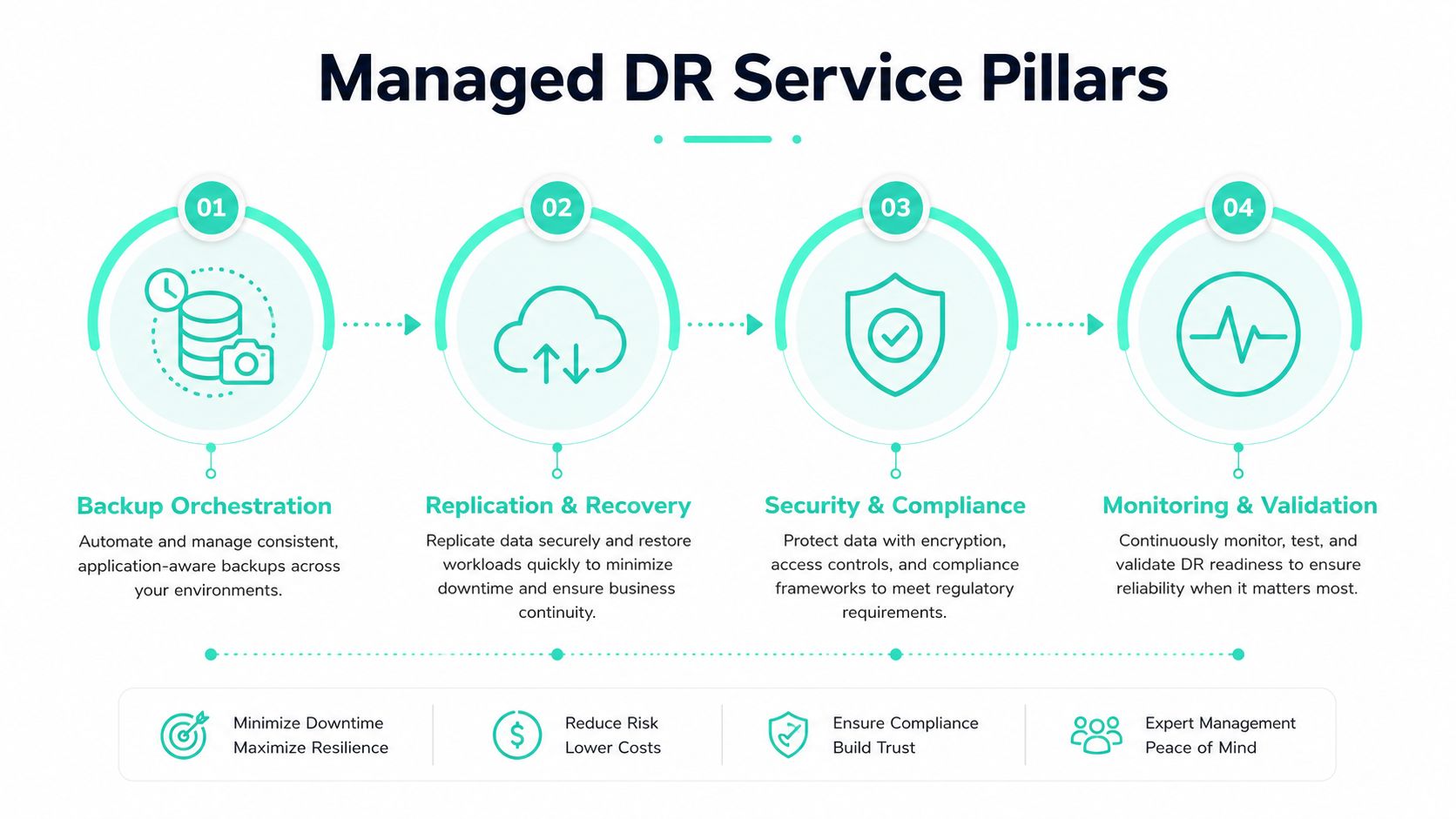
A managed DR service proves whether recovery works beyond a written plan. Its operating model rests on four pillars: backup orchestration preserves usable recovery points, replication and failover make them available, runbooks coordinate people and systems, and drills expose failures under controlled conditions.
Backup orchestration
A useful backup service is policy-driven and application-aware. It maps Sitecore content stores, AEM repositories, SharePoint data, configuration artifacts, and integration settings to recovery tiers. Immutable storage and cross-region copies limit the chance that an attacker or operator can change every available recovery point.
Successful snapshots do not prove that restoration will work. Permissions, indexes, linked assets, and application configuration can remain unusable after a backup completes. Restore logs, integrity checks, and business-owner validation provide evidence that the recovered state supports the intended application journey.
Teams working through MSSQL Server backup planning should tie backup frequency and restore validation to the agreed RPO, rather than selecting a convenient default schedule.
Replication and automated failover
Infrastructure as code can recreate or maintain secondary Azure resources, including App Service plans, Azure SQL capacity, networking, and Front Door routing. The meaningful test is whether the provider has executed that code in a controlled drill and produced an environment that serves a real request path.
Failover also has to cover the composable services around the CMS. Test front-end deployment, API endpoints, search, personalization, payment or booking services, certificates, identity federation, and routing behavior. A database can recover while the customer journey still fails.
Runbooks and recovery drills
Runbooks should define activation, access control, DNS changes, certificate rotation, integration checks, smoke tests, communications, and failback. Each procedure needs owners, prerequisites, decision points, timestamps, and remediation history. A static PDF becomes unreliable after a release, identity-policy change, or vendor update.
The evidence package should include approved RTO and RPO targets, activation and cutover timestamps, DNS and network records, restore or replication logs, IAM and MFA validation, application screenshots, business signoff, and tracked remediation. The disaster recovery testing checklist for IT teams presents this evidence-oriented approach in practical terms.
A formal plan is only the starting point. The cited dataset reports that 73% of organizations had a formal DR plan, compared with 61% in 2020, and that 67% tested their plans in 2023, compared with 52% in 2021, according to business continuity statistics from ZipDo. Repeated failover drills show whether identities, DNS, integrations, and application behavior remain intact under load. They also create a record of what failed and what the provider corrected.
Managed Disaster Recovery Versus In-House DR Teams
The decision isn't just whether internal engineers are capable of recovery. Most experienced platform teams can recover some part of a Sitecore, AEM, or SharePoint estate. The question is whether they can maintain recovery readiness while also delivering releases, handling incidents, managing identity policy, and supporting business users.
| Factor | Managed DR Service | In-House DR Team |
|---|---|---|
| Staffing | Shared specialist coverage and defined escalation | Internal availability depends on schedules and competing work |
| Tooling | Provider-managed orchestration, monitoring, and evidence collection | Organization funds and maintains its own tooling |
| Platform expertise | Can include Sitecore, AEM, SharePoint, Azure, identity, and integration skills | Depth depends on hiring and retention |
| Testing | Formal cadence can be written into the service agreement | Drills may be deferred when delivery work takes priority |
| Documentation | Runbooks and evidence packages are maintained as service outputs | Documentation quality varies by ownership and discipline |
| Control | Less direct operational control, with shared-responsibility boundaries | Greater control, with full responsibility for outcomes |
| Cost profile | Predictable service cost, plus provider scope and dependency charges | Direct staffing and tooling costs, plus hidden training and coverage costs |
Where internal teams work well
An in-house model can fit organizations with strong platform ownership, mature automation, and enough operational capacity to test without disrupting production. It also offers immediate context about business priorities and internal dependencies. The risk appears when only one or two people understand the recovery path or when the team treats an annual tabletop exercise as equivalent to a live technical drill.
Internal ownership doesn't remove the need for evidence. Teams still need timestamped tests, recovery logs, business signoff, and tracked remediation. They also need to rehearse identity and integration failures, because those dependencies often sit outside the CMS team's normal responsibility.
Where managed services add leverage
A managed provider brings repeatable processes and specialist coverage, but the buyer gives up some direct control and must define the shared-responsibility boundary precisely. The contract should identify who owns SaaS configuration, identity policy, DNS, certificates, third-party APIs, content validation, communications, and failback.
Cost comparisons should include more than the monthly service fee. Internal teams carry the cost of continuous monitoring, recovery tooling, training on platform-specific behavior, staff coverage, and the opportunity cost of pulling architects into drills. Managed DR isn't automatically cheaper. It is often easier to justify when the business needs predictable accountability and audit-ready proof.
The wrong comparison is “provider versus our backup scripts.” The right comparison is “repeatable recovery capability versus the full cost of maintaining it ourselves.”
Recovery Design for Sitecore and SharePoint Stacks
A recovery plan can restore servers and still leave the business offline. Sitecore XM Cloud, Sitecore XP, SharePoint Online, and Microsoft 365 use different control planes and recovery boundaries, while users depend on shared identity, routing, search, workflows, and integrations. Design recovery around that service map rather than around individual products.
Sitecore recovery boundaries
XM Cloud reduces infrastructure ownership, not recovery ownership. The inventory must cover headless applications, deployment pipelines, environment variables, identity connections, search, analytics, personalization, and external APIs. The runbook should specify how the front end is rebuilt or redirected, then how editors and visitors are validated.
Sitecore XP needs a clear application and data topology. An Azure design may use a primary application tier, replicated SQL data, separate content and delivery roles, and a warm secondary region. Failover must preserve content consistency and verify marketing automation, analytics collection, session behavior, and search. A healthy application tier is insufficient if publishing or personalization still fails.
SharePoint and identity
SharePoint Online recovery is more than restoring a site collection. Microsoft documents administration for SharePoint Server and SharePoint in Microsoft 365, while Microsoft's Power Platform documentation covers Power Apps, Power Automate, and related tools. These services often support intranet forms, approvals, notifications, and operational workflows.
The runbook should test Entra ID or Azure AD federation, group membership, conditional access, MFA, SharePoint permissions, Power Automate connections, service accounts, and downstream data sources. An intranet that loads while an approval flow cannot authenticate is not a recovered business service.
Build the dependency map
A practical recovery sequence looks like this:
- Establish access control: Confirm identity federation, privileged access, MFA, groups, and service principals.
- Restore data state: Validate content, databases, repositories, versions, permissions, and relevant indexes.
- Activate applications: Deploy or start Sitecore, AEM, Next.js, SharePoint, and integration components.
- Redirect traffic: Validate DNS, CDN, load balancing, certificates, and routing policy.
- Prove business journeys: Test publishing, search, login, personalization, forms, approvals, and key integrations.
- Record and remediate: Capture timestamps, screenshots, logs, owner signoff, and defects for the next drill.
Deleted content and permissions need their own operating path. Define ownership and escalation through a deleted item recovery process, then include it in resilience tests wherever it affects continuity. The strongest design is one that proves the full journey, including identities, DNS, and integrations, under conditions that resemble production load.
The Operational Proof Gap in Disaster Recovery Testing
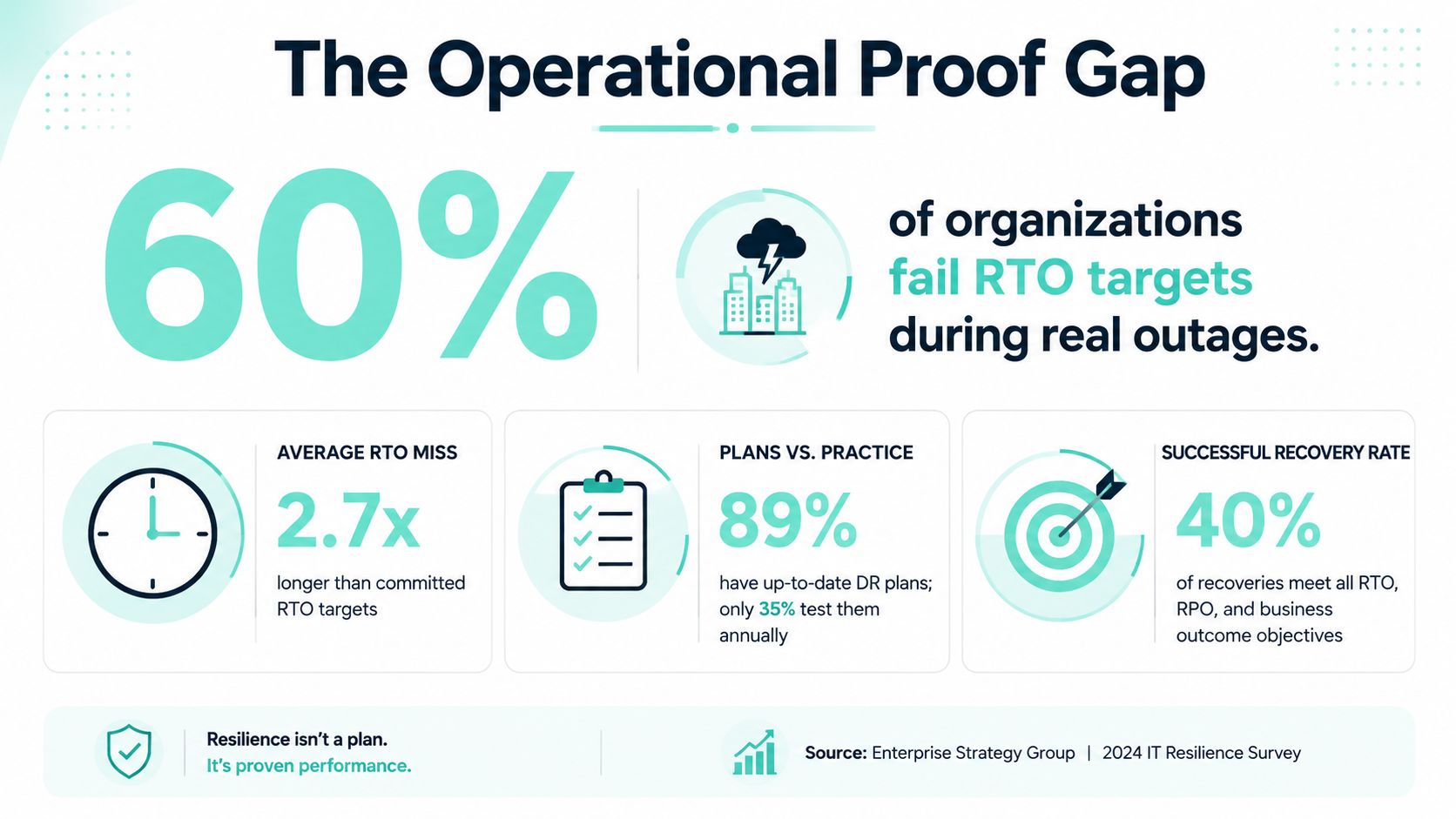
A DR plan can pass an approval review and still fail during an outage. The break usually occurs at a dependency boundary: DNS sends users to the wrong service, a certificate has expired, an identity claim no longer matches, a load-balancer rule was never exercised, or a third-party API rejects requests from the recovery environment.
The available data points to a persistent validation gap. The BCDR trends report for MSPs and IT teams reports that only 15% of businesses conduct daily backup tests, around 20% test weekly, and 23% test monthly. The same industry coverage reports that 71% of organizations don't perform failover testing and 62% don't conduct regular backup restoration exercises. These figures describe test activity, not proof that a composable Sitecore, AEM, or SharePoint service can recover under real load.
What proof looks like
Operational proof has three properties. It is repeatable, so the same test can run after platform or integration changes. It is measurable, with timestamps showing whether the agreed RTO and RPO were achieved. It is complete, with evidence covering applications, identities, integrations, and business journeys rather than a single restore screen.
A credible drill starts with an approved scenario and ends with business-owner signoff. Record activation time, final replication state, traffic cutover, authentication, application availability, data validation, and the decision to fail back or return service. The evidence package should follow the controls described in the organization's disaster recovery procedures, not sit separately from them.
Test under realistic conditions
Tabletop exercises help teams rehearse communications and decisions, but they will not expose a broken certificate or missing API secret. A technical drill should use representative traffic and realistic dependencies while limiting production risk. For an enterprise Sitecore stack, test page publishing, personalized content, search, authentication, and analytics or marketing automation behavior. For SharePoint, include permissions, approvals, Power Automate connections, and downstream data access.
Recovery evidence also needs remediation tracking. A failed test provides useful information when the team records the defect, assigns an owner, defines the correction, and reruns the affected scenario. A passing test without retained logs, timestamps, and business validation is difficult to defend to an auditor or executive.
Organizations often cite benchmark RTOs and RPO performance from business continuity research, as noted earlier. Those benchmarks matter only when the enterprise measures its own environment under conditions resembling an incident. A four-hour target means little if DNS, identity federation, certificates, or integrations are excluded from the clock.
The financial case is just as direct. Ransomware recovery costs averaged USD 4.45 million per incident in 2023, according to the previously cited business continuity data. Managed DR closes the operational proof gap by scheduling technical drills, preserving evidence, coordinating dependency owners, and turning defects into rerun scenarios.
The practical definition of resilience is simple: the organization can demonstrate that people, platforms, data, identity, and integrations recover together.
How to Select a Managed Disaster Recovery Provider
Start with a live technical review, not a feature sheet. Ask the provider to map the recovery boundary for your Sitecore XM Cloud, Sitecore XP, AEM, or SharePoint estate, then identify every dependency outside that boundary. The goal is to expose whether the team can prove recovery with identity, DNS, certificates, integrations, and business journeys operating together.
Examine the agreement
A useful SLA should define:
- RTO and RPO measurement: State the start and end points, evidence required, and conditions for measurement.
- Service exclusions: List SaaS dependencies, customer-managed identity, third-party APIs, DNS, certificates, and business validation responsibilities.
- Remedies: Specify service credits or other financial consequences when an agreed target is missed.
- Testing obligations: Document drill frequency, scenario types, participant responsibilities, and the evidence package.
- Shared responsibility: Assign an owner to every recovery task, including failback and post-incident review.
Ask how the service performs under production-like load, during identity failure, and when an external integration is unavailable. A best-case recovery promise does not establish operational readiness.
Validate platform depth
Look for engineers who understand Sitecore XM Cloud's managed boundaries, Sitecore XP's application and data tiers, AEM repositories and deployment patterns, and SharePoint Online with SPFx and Power Platform workflows. Request sanitized runbooks, sample recovery reports, incident post-mortems, and evidence of executed failover. Design documents alone cannot show whether recovery works.
Compliance reporting should provide audit-ready recovery logs, access validation, remediation history, and alignment with controls relevant to your industry. SOC 2 or ISO 27001 alignment can support governance, but certification does not prove that your specific platform recovers under real conditions.
Reject providers that bundle DR into general hosting without dedicated orchestration, cannot demonstrate controlled failover during evaluation, hide dependency exclusions, or provide no transparent post-mortem after incidents. Kogifi provides platform stabilization, dependency mapping, runbook authoring, controlled failover drills, and recovery services for Sitecore, AEM, and SharePoint environments. Visit Kogifi to discuss a recovery assessment based on your architecture, business journeys, and evidence requirements.