


A lot of enterprise teams are already living the same pattern. The global brand team approves a campaign. Regional teams wait for templates. Local editors copy content into separate systems. Legal requests one disclaimer change, but that update has to move site by site. Someone discovers one market is still using an old component, another is publishing from a different workflow, and a third has analytics no one can compare with the rest.
That is not a web governance problem in isolation. It is an operating model problem.
Multiple site management matters when your digital footprint stops behaving like a collection of websites and starts behaving like a portfolio. At that point, every delay in publishing, every mismatch in brand presentation, and every disconnected integration has a business cost. For global brands, public sector organizations, higher education groups, and distributed commerce teams, a key question is not whether to centralize. The core question is how to centralize without crushing local relevance.
Sitecore’s composable DXP, especially when paired with Sitecore AI, gives digital teams a practical way to do that. SharePoint also has a clear role, particularly for intranets, collaboration portals, and document-heavy internal estates. The strongest approach is rarely “one platform for everything.” It is an intentional platform strategy that gives each digital estate the operating model it needs.
The Growing Complexity of a Global Digital Footprint
A global launch looks simple on the roadmap. One campaign. One deadline. One brand story. In practice, the work splits fast across country sites, product sites, campaign pages, partner portals, and internal knowledge hubs, each with its own templates, integrations, approval paths, and publishing rules.

That complexity creates costs long before anyone starts a platform migration. Regional teams wait for component changes because shared patterns were never standardized. Legal updates stall because disclaimers live in separate systems. Analytics teams cannot compare performance cleanly because tracking, taxonomy, and domain structures differ by market. Security and IT inherit the worst of it through duplicated access models, inconsistent patching, and integrations no one fully owns.
For enterprise teams, this is a digital transformation problem tied to operating scale. The question is how to run a growing portfolio of sites without multiplying content effort, governance overhead, and technical risk every time a new market, language, or business unit comes online.
Sitecore’s composable DXP addresses that problem well because it separates shared foundations from local execution. Teams can standardize components, workflows, identity, analytics, and delivery patterns while still giving regional owners room to adapt content and experiences. Sitecore AI adds another layer of operational control. It can help teams accelerate content production, identify reuse opportunities, support localization workflows, and improve search and discovery across large estates where manual coordination breaks down.
SharePoint solves a different part of the estate. It is often the better fit for intranets, policy libraries, departmental portals, and document-centric collaboration where Microsoft 365 governance matters more than public-facing experience orchestration. For many global organizations, the practical answer is not one platform stretched across every use case. It is a clear division of roles between Sitecore for experience-led multisite delivery and SharePoint for enterprise content and collaboration.
The business impact is measurable in day-to-day operations:
- Stronger brand consistency: Shared components and content models reduce local drift.
- Faster rollout cycles: Teams launch new regions, campaigns, and language variants from an existing foundation.
- Lower operational risk: Access, integrations, and publishing controls are managed with fewer exceptions.
- Better content efficiency: Sitecore AI helps teams create, adapt, and govern content across many properties without repeating the same work.
Well-run multisite programs do not just reduce admin effort. They give global brands a cleaner way to scale digital experiences, while keeping local teams effective and central teams in control.
What Is Multiple Site Management Really
A global brand rarely struggles because it has too many websites. It struggles because each site starts behaving like a separate product, with its own content model, release cycle, integrations, permissions, and reporting logic. Costs rise. Governance gets harder. Teams spend more time reconciling differences than improving customer experience.
Multiple site management is the operating model that prevents that drift. It gives the business one way to manage many sites without forcing every market, brand, or business unit into the same experience.
For enterprise teams, that usually means a shared foundation across technology, content, and governance. In practice, the foundation includes:
- Shared code and components: page templates, navigation patterns, forms, search experiences, and integration logic are created once and reused where they fit.
- Shared infrastructure and delivery controls: hosting patterns, CI/CD, environment strategy, observability, security controls, and access management are handled consistently.
- Shared content and asset structures: taxonomies, media, reusable content blocks, and structured data models are governed centrally.
- Defined room for local execution: regional teams can adapt language, offers, legal content, and campaign activity without breaking standards.
That last point matters most. Good multisite management does not aim for uniformity. It aims for controlled variation.
In Sitecore, this model becomes much more practical because the platform can separate shared services from local execution. Teams can use shared component libraries, common content models, centralized analytics patterns, and AI-assisted content operations, while still tailoring experiences by market or brand. Sitecore AI is especially useful here. It helps teams identify reusable content, accelerate localization workflows, generate draft variations within approved structures, and keep large estates from turning into a copy-and-paste operation.
SharePoint plays a different role. It is often the better system for document-heavy portals, internal knowledge hubs, and policy-driven collaboration spaces where Microsoft 365 governance is the priority. Many enterprises get better results by treating multisite management as a portfolio decision. Sitecore handles experience-led public properties. SharePoint handles intranet and collaboration use cases. That split is usually more sustainable than forcing one platform to cover both jobs.
The model fails when ownership is unclear. I see three patterns cause the most trouble:
Every market runs independently
Local teams choose their own tools, workflows, and integrations. The result is duplicated spend, uneven security, and inconsistent customer journeys.The central team controls everything
Global standards turn into global bottlenecks. Local teams wait for simple changes or start creating workarounds outside the platform.One platform, no operating rules
Teams share a CMS, but no one defines which components are reusable, who owns taxonomy, how releases are approved, or when local variation is allowed.
A simple rule works well here: centralize what is expensive to duplicate, and localize what needs market judgment.
For Sitecore programs, that often means central ownership of templates, design systems, integrations, identity, search patterns, analytics frameworks, and AI services. Local teams then manage campaigns, translations, regulated market content, and merchandising decisions inside those boundaries. If your estate also needs tenant separation by brand or business unit, this guide to multi-tenant architecture in Sitecore is a useful companion.
Multiple site management is a business discipline more than a CMS feature. The goal is to run a distributed digital estate with fewer exceptions, faster rollout paths, and tighter control over quality, cost, and risk.
Exploring Key Multiple Site Architectures
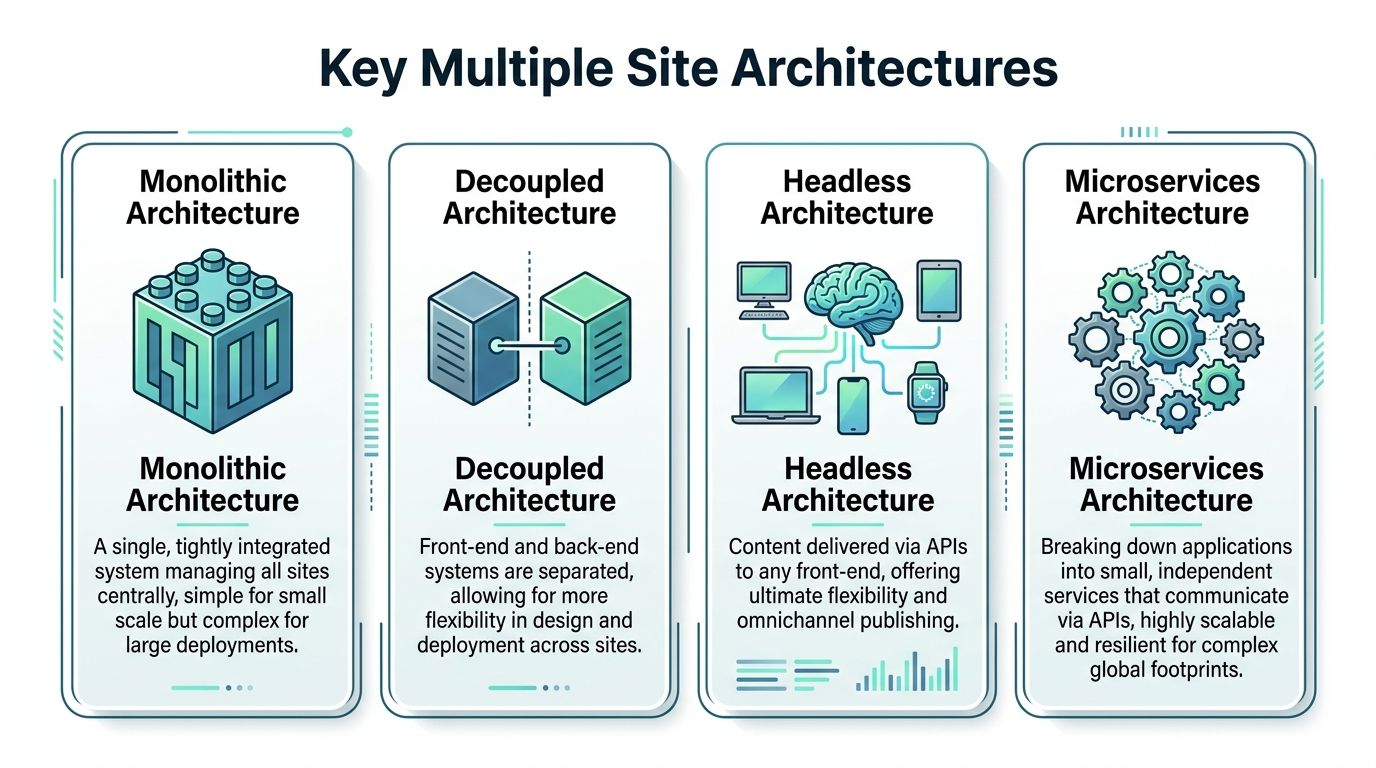
Architecture decisions determine whether multiple site management feels efficient or permanently brittle. In practice, most organizations move through three broad models over time. They may not label them this way internally, but the pattern is consistent: centralized monolith first, hybrid second, composable third.
Traditional monolith
This is the classic enterprise setup. One platform instance manages many sites in a tightly integrated model. In Sitecore terms, that often means a single implementation where multiple sites share templates, rendering logic, security patterns, and deployment pipelines. For some organizations, this still works well.
The monolith is attractive because governance is direct. Shared presentation, shared authoring, and shared deployment are simple to understand. If your estate is relatively uniform, a centralized instance can keep operations disciplined.
The trade-off is coupling. Release cycles become more sensitive. A change for one site can affect others. Integrations stack up inside one large implementation. Teams can manage this for a while, but the effort grows as brands, channels, and regions diverge.
Hybrid model
Many mature enterprises operate in this model today. The CMS or DXP remains central, but shared services move into clearer platform layers. You might have a central content repository, a shared DAM, a PIM, shared identity, shared search, and frontends with some degree of independence.
This model aligns well with modern multisite operations because a single content repository can serve varied frontends through APIs, which cuts deployment complexity. In multisite DXP environments, engineering teams have been observed dedicating 30-50% less capacity to integration maintenance than teams working with point-to-point legacy setups, and those environments can support release cadences of multiple deploys per day (Liferay on digital agility for websites).
For Sitecore, the hybrid model often becomes the bridge to composable. Teams preserve shared content and governance while reducing frontend dependency. That is where architectural discipline starts paying off.
Composable future
The composable model treats the digital estate as interoperable services rather than one large application. Sitecore XM Cloud is the clearest example in this conversation. Content, search, assets, personalization, analytics, and orchestration can be connected through APIs and event-driven patterns, while frontends stay flexible.
This model fits organizations that need to support many brands, markets, languages, and channels without turning every release into a coordination event. It also fits AI better. Sitecore AI capabilities are easier to operationalize when content is structured, events are flowing cleanly, and orchestration does not depend on brittle point-to-point customizations.
The composable model is not automatically simpler. It is simpler to scale when designed well. It is more complex to design poorly.
Comparison of Multiple Site Management Architectures
| Architecture | Core Concept | Best For | Sitecore Example |
|---|---|---|---|
| Traditional monolith | One tightly integrated platform manages all sites centrally | Smaller or more uniform site portfolios with strict central governance | Sitecore XP or a centralized Sitecore implementation managing many sites from one core setup |
| Hybrid | Central platform with shared services and partially decoupled frontends | Enterprises balancing governance with market-level flexibility | Sitecore with shared content, DAM, PIM, and API-driven delivery across multiple site experiences |
| Composable | API-first services connected through orchestration and events | Global brands needing agility, omnichannel delivery, and AI-ready architecture | Sitecore XM Cloud with modular services and headless delivery patterns |
How to choose the right model
The wrong architectural discussion starts with product preference. The right one starts with operating constraints.
Use these questions instead:
- How many teams publish independently?
- How often do sites diverge by market or brand?
- How much shared content should remain centrally governed?
- How often do you need to release frontend changes?
- Do AI use cases need shared behavioral context across many sites?
A useful adjacent concept here is multi-tenant architecture in enterprise platforms. It helps clarify when shared infrastructure is an asset and when it becomes an unwanted dependency.
Architect’s view: Monoliths are efficient when variation is low. Composable architecture earns its keep when variation is high and speed matters across many teams.
The best roadmap is usually evolutionary. Standardize first. Decouple second. Compose where flexibility and AI-driven orchestration create real operational advantage.
Solving the Six Core Challenges of Multisite Operations
A global brand launches the same campaign across 18 country sites. By day three, one market has the wrong legal disclaimer, another has an outdated product image, two sites missed the publish window, and the personalization rules only work on the flagship site. That is what multisite operations look like when architecture and operating model drift apart.

The six recurring problems are usually content reuse, localization, governance, performance, personalization, and security. They rarely fail in isolation. One weak decision in the content model shows up later as translation cost, approval delays, inconsistent experiences, and broken AI outputs.
Content reuse
Duplication is still the fastest way to make a multisite estate expensive.
Teams copy hero banners, product copy, FAQs, campaign blocks, and regulated text into separate site trees because the model was built for pages, not for reuse. The first few launches feel efficient. The fifth global update exposes the flaw. Editors have to find every local copy, compare variants, and hope nothing is missed.
In Sitecore, reuse works best when content is structured for assembly rather than locked inside a page. Shared content items, reusable components, taxonomy, DAM assets, and clear ownership rules reduce rework and make AI-generated variations safer to govern. Sitecore AI performs better when it can work with structured source content instead of scraping meaning from inconsistent page-level copy.
Localization
Localization is an operating model question, not just a translation task.
Markets need room to adapt for language, regulation, product availability, channel preferences, and accessibility requirements. Central teams need consistency in brand, messaging, and compliance. Problems start when those decisions are handled manually in email threads or spreadsheets instead of in workflows and content rules.
A good Sitecore implementation separates what must stay global from what can vary locally. Shared fields, local override fields, approval workflows, and market-specific versions create that line clearly. For firms comparing platforms before they define that model, this guide on how to choose a CMS system for multisite governance and localization is a useful checkpoint.
Governance
Governance breaks down when responsibilities are implied instead of defined.
Global marketing wants consistency. Regional teams want speed. Legal wants control. IT wants fewer exceptions. If permissions, workflows, template ownership, and publishing rights are unclear, the estate swings between two bad outcomes. Either every change needs central approval, or local teams bypass standards to hit deadlines.
Sitecore handles this well when governance is built into the platform configuration. Global teams should control templates, shared components, taxonomy, design system rules, and AI guardrails. Regional teams should control market content, local campaigns, and approved variations inside those boundaries. SharePoint often supports the adjacent enterprise process well here, especially for internal documentation, policy management, and collaboration around approvals. Sitecore should remain the system that governs customer-facing experience delivery.
Performance
Performance problems across multisite estates are usually inconsistent, not universal.
One site is fast because the implementation stayed close to the standard. Another slows down because local teams added unreviewed scripts, oversized media, duplicate tags, or custom frontend logic. The user sees one brand. The platform team sees ten different technical standards hiding under it.
That trade-off matters. Local flexibility can improve speed to market, but too much variation raises support cost and weakens Core Web Vitals across the estate. Sitecore’s composable delivery patterns help by centralizing shared services and reducing ad hoc implementation choices. Sitecore AI also depends on reliable event capture and page performance. If the frontend is fragmented, behavioral signals become less trustworthy and personalization quality drops with them.
Personalization
Personalization is where multisite ambition usually outruns operational readiness.
Enterprises often prove the concept on one flagship site, then struggle to extend it across regions, brands, and languages. The problem is rarely the model itself. The problem is fragmented content, inconsistent tracking, and unclear rules about when local teams can override centrally defined experiences.
Sitecore AI is valuable here because it can use shared content structures, common behavioral signals, and centralized decisioning across a distributed estate. That lowers the effort required to scale experimentation and personalization beyond a single site. It also gives global brands a better path to composable DXP operations, where content, decisioning, analytics, and delivery stay connected without forcing every market into the same experience.
In practice, three conditions matter:
- Structured content that can be reused and adapted across sites
- Unified event data across brands, regions, and channels
- Defined local override rules for regulatory, cultural, and commercial exceptions
Without those foundations, AI speeds up inconsistency. With them, AI helps global teams scale relevance without multiplying manual setup work in every market.
A short walkthrough can help make the operational model more concrete:
Security
Security issues in multisite operations usually come from exceptions that became permanent.
A regional integration remains unpatched because one market still depends on it. Permission groups multiply over time. Shared admin access survives longer than it should. Backup and recovery standards vary across environments. None of those decisions look dramatic on their own. Together, they create audit risk and slow incident response.
Centralized standards reduce that exposure. In Sitecore environments, the practical goal is simple: fewer one-off configurations, fewer privileged users, fewer unsupported integrations, and clearer separation between global administration and local publishing. SharePoint can support enterprise controls for internal collaboration and document governance, but public multisite delivery still needs its own security model, release discipline, and permission boundaries.
Key takeaway: Strong multisite operations come from standardizing content structure, workflow, permissions, and data collection across the estate, then allowing controlled local variation where the business case is clear.
These six challenges form one system. Poor reuse creates localization overhead. Weak governance creates security gaps. Performance inconsistency weakens data quality. Fragmented data limits what Sitecore AI can do across the portfolio. The organizations that handle multisite operations well design for those dependencies early, then enforce them consistently.
Choosing Your Platform and Planning Migration
A global brand is running 40 country sites, three product families, a partner portal, and an intranet. Marketing wants faster launches. Regional teams want more control. IT wants fewer integrations to support. If one platform is asked to solve all of that equally well, the result is usually a weaker operating model, higher cost, and slower delivery.

When Sitecore should lead
Sitecore should lead when the estate exists to drive customer experience, not just publish pages. That includes global brand sites, regional campaign sites, product ecosystems, commerce-connected experiences, partner journeys, and multilingual public sites with different audience rules by market.
The platform earns its place when several needs show up at the same time:
- Coordinated multisite delivery across brands and regions
- Composable architecture with API-first integration
- Reusable structured content
- AI-driven personalization across a large estate
- Connections to DAM, PIM, CRM, search, and analytics platforms
- Local publishing freedom within a controlled global model
Sitecore AI changes the business case here. It can assist with content creation, improve segmentation, support experimentation, and help teams scale personalization without multiplying manual work. But that only works when content models, taxonomy, and data flows are designed properly. If every site has different structures and naming rules, AI output becomes less reliable and harder to govern.
When SharePoint should lead
SharePoint should lead when the primary job is internal communication and document-centric collaboration. Intranets, policy libraries, employee service hubs, knowledge bases, and departmental sites usually fit that model well.
Its strengths are clear. It aligns with Microsoft 365, handles enterprise permissions well, supports document workflows, and meets internal users where they already work. For customer-facing multisite delivery, though, it is usually a compromise. It does not give enterprises the same level of experience orchestration, composable delivery, or AI-driven personalization that Sitecore provides for public digital channels.
Where the split makes sense
Many enterprises need both platforms, with clean boundaries between them.
Sitecore runs the external digital estate. SharePoint supports internal knowledge, collaboration, and operational content. That split works because each platform is assigned to the job it handles best, instead of forcing one product into two very different roles.
If your team is still evaluating the fit, this guide on how to choose a CMS for enterprise digital experience requirements is a useful starting point. The decision should come from operating model, integration demands, content structure, and AI goals, not from procurement history or internal familiarity.
Plan migration as an operating model change
Migration is rarely a publishing exercise. It is usually a correction of years of platform drift.
Teams get into trouble when they move content first and ask architectural questions later. I have seen estates migrate hundreds of pages into a new platform, only to discover that templates are inconsistent, market workflows conflict, analytics naming is unusable, and AI features cannot be applied cleanly across sites. The technology was modern. The operating model was still fragmented.
A practical migration sequence looks like this:
Audit the estate
Identify duplicate content, outdated site patterns, unsupported custom code, broken integrations, and areas where content cannot be reused.Group sites by pattern
Classify sites by type, such as brand, country, campaign, service, portal, or product. Each pattern should map to a target architecture, template set, and publishing model.Design the shared core
Define reusable components, content models, taxonomy, analytics rules, integration standards, and the data structure Sitecore AI will depend on.Migrate in waves
Start with a representative set of sites. That exposes edge cases early and gives global teams a repeatable migration method before the larger rollout.Remove exceptions where possible
Every local workaround kept during migration adds cost to testing, support, training, and future upgrades.
What usually goes wrong
The common failure pattern is predictable. Teams preserve weak workflows because changing them creates internal friction. Regions negotiate custom requirements site by site. Old content is copied over with no clear retention standard. Analytics and AI readiness are postponed until after launch, which means the new estate goes live without the structure needed to improve it.
A better approach is phased consolidation. Sitecore supports the customer-facing estate and the AI roadmap. SharePoint supports internal collaboration and document-heavy use cases. Kogifi is often brought in at this stage for audits, migration planning, implementation, upgrades, and managed support. The value is not the partner name. The value is disciplined reduction of platform sprawl, with clear decisions about what should be shared, what should stay local, and what should be retired.
Establishing Your Governance and Operations Model
A multisite platform without a governance model becomes a shared mess. The technology may be modern, but the operating behavior stays fragmented. Good governance is what lets global teams move faster without creating approval chaos.
Define roles by accountability
Start with responsibilities, not job titles.
A practical multisite model usually includes:
- Global platform owners: Control architecture, shared components, templates, integrations, AI policy, and release standards.
- Brand or regional owners: Manage market-specific experience rules, local campaign planning, and localized publishing.
- Editors and contributors: Create and adapt content within defined templates and workflows.
- Reviewers: Legal, compliance, accessibility, or product stakeholders who approve only where their input is required.
This model works because it separates platform stewardship from editorial execution. The same principle is central to a workable content governance framework for enterprise teams.
Standardize workflows without making them rigid
The right workflow is consistent, but not identical for every site type. A regulated public-sector service page does not need the same path as a campaign landing page. A product update does not need the same review chain as a board-policy announcement.
Use standard workflow families instead of one universal flow. For example:
- Global reusable content workflow
- Regional adaptation workflow
- Fast campaign workflow
- Regulated content workflow
That gives teams a common language without slowing every publish action to the pace of the most complex use case.
Build operations around events, not handoffs
Multisite DXPs work best when systems communicate through events rather than manual coordination. Fragmented MarTech stacks create operational drag, and point-to-point integrations can inflate costs by 25-40%. In consolidated DXP environments, event-driven architectures help reduce campaign launch times from weeks to days and enable 50-70% automation of workflows such as content migration (ioDigital on why DXP initiatives fail).
In practice, that means:
- Publishing can trigger downstream actions automatically
- Content state changes can update connected systems
- Approval events can be auditable
- AI-driven processes can operate on trusted signals rather than ad hoc exports
Make CI CD multisite-aware
Deployment is where many governance models subtly break. Teams centralize authoring but still release like every site is a one-off application.
A better model includes:
- Shared pipelines for common services
- Site-specific deployment controls where needed
- Automated validation for templates, components, and dependencies
- Rollback planning that reflects portfolio impact, not just one site
Operational advice: If a release process cannot tell you which sites a change might affect, your governance is incomplete.
The strongest governance models are not heavy. They are explicit. Teams know what is shared, what is local, who approves what, and how changes move safely from idea to production.
Measuring Success with the Right KPIs and ROI
Many multisite programs fail their own business case because they track the wrong metrics. They report activity. They do not report normalized performance.
Why raw comparisons mislead
A large global commerce site and a smaller regional information site should not be compared through raw maintenance effort alone. Their traffic, complexity, publishing cadence, and integration load are different. The same logic appears in operational benchmarking outside digital. In multi-site operations, normalizing KPIs is essential, and maintenance cost as a percentage of Estimated Replacement Value (ERV) is useful because it lets operators compare unlike facilities more fairly instead of relying on misleading raw figures (Limble on KPI normalization across multi-site operations).
The lesson for digital leaders is not to copy the facility metric directly. It is to copy the discipline behind it.
KPIs that matter in multiple site management
A useful scorecard usually includes a mix of delivery, reuse, governance, and commercial measures.
| KPI area | What to look for |
|---|---|
| Launch efficiency | Time required to stand up a new site, microsite, or region |
| Reuse maturity | Share of content, components, and assets reused versus recreated |
| Governance health | Workflow adherence, permission hygiene, and exception volume |
| Operational efficiency | Effort spent maintaining integrations and duplicated site logic |
| AI readiness | Availability of structured content and unified behavioral signals for Sitecore AI use cases |
| Business impact | Contribution of improved speed, consistency, and personalization to pipeline, service quality, or conversion outcomes |
Normalize before you report
Do not compare all sites as if they perform the same job.
Normalize by factors such as:
- Site type: Brand site, regional site, campaign site, portal, support site
- Market complexity: Language, compliance burden, product variation
- Publishing intensity: High-frequency editorial sites versus stable reference sites
- Integration density: Number of connected systems and content dependencies
Leaders need to distinguish healthy variation from operational waste. A multilingual service portal with layered approval and accessibility requirements should not be judged by the same publishing speed benchmark as a short-lived campaign microsite.
A broader enterprise framework for how to measure ROI in digital platforms helps connect these operational metrics to commercial outcomes.
Practical test: If your KPI dashboard makes a simple site look inefficient and a complex site look healthy without explaining why, the metrics are not normalized well enough.
The goal is not to prove that every site performs identically. The goal is to prove that the platform model is improving speed, control, and reuse across very different digital properties.
Your Enterprise Playbook for Multisite Mastery
The organizations that handle multiple site management well do not treat it as a CMS rollout. They treat it as a platform operating model.
A workable playbook is simple to state and harder to execute well:
- Audit the estate: Identify duplication, unsupported exceptions, and weak integrations.
- Choose architecture by operating need: Use monolithic control where variation is low. Use composable patterns where speed, divergence, and AI matter.
- Separate global standards from local execution: Shared templates, taxonomies, and AI guardrails. Local control where market relevance requires it.
- Pick platforms for the right jobs: Sitecore for outward-facing composable experiences and AI-driven personalization. SharePoint for internal collaboration and document-centric estates.
- Migrate in patterns, not in chaos: Group sites by type and move in waves.
- Govern with clarity: Explicit roles, explicit workflows, explicit release ownership.
- Measure normalized performance: Compare like with like and tie platform gains to business outcomes.
Multiple site management becomes manageable when digital leaders stop asking, “How do we run all these sites?” and start asking, “What operating model lets this portfolio scale without losing control?”
If your team is evaluating Sitecore AI, SharePoint, or a broader multisite architecture, Kogifi can help assess the current estate, define the right platform split, and plan a practical migration path for global, multilingual, and multi-brand environments.