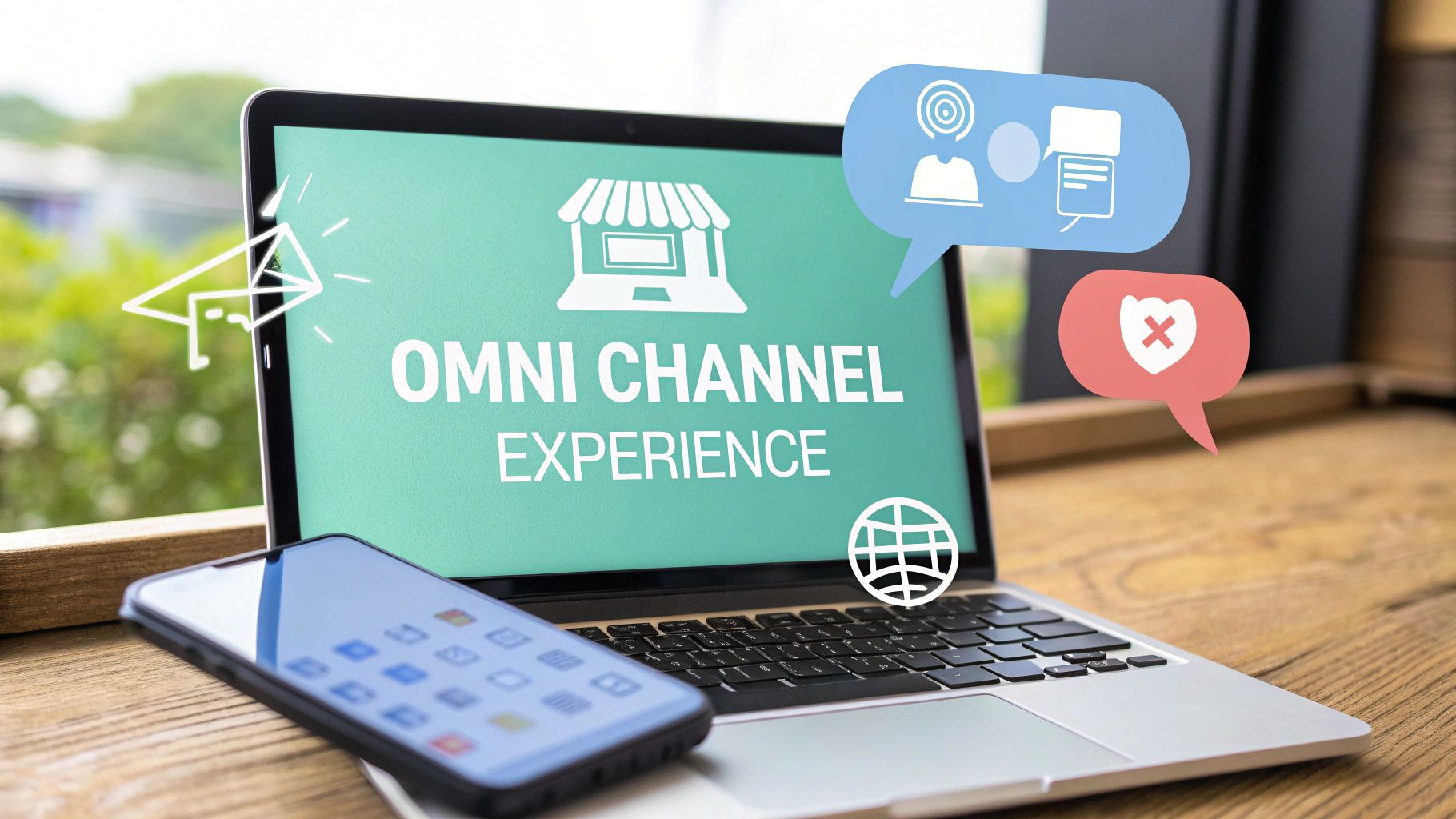



Think about a conversation you've had with a friend. It might start with a text, switch to a phone call, and then wrap up in person. Through it all, you never have to repeat yourself or lose track of what you were talking about. That seamless, connected flow is the heart of a modern omni channel customer experience. It's a holistic approach that puts the customer, not the channel, at the center of every single interaction.
Moving Beyond Multichannel to True Omnichannel Experiences
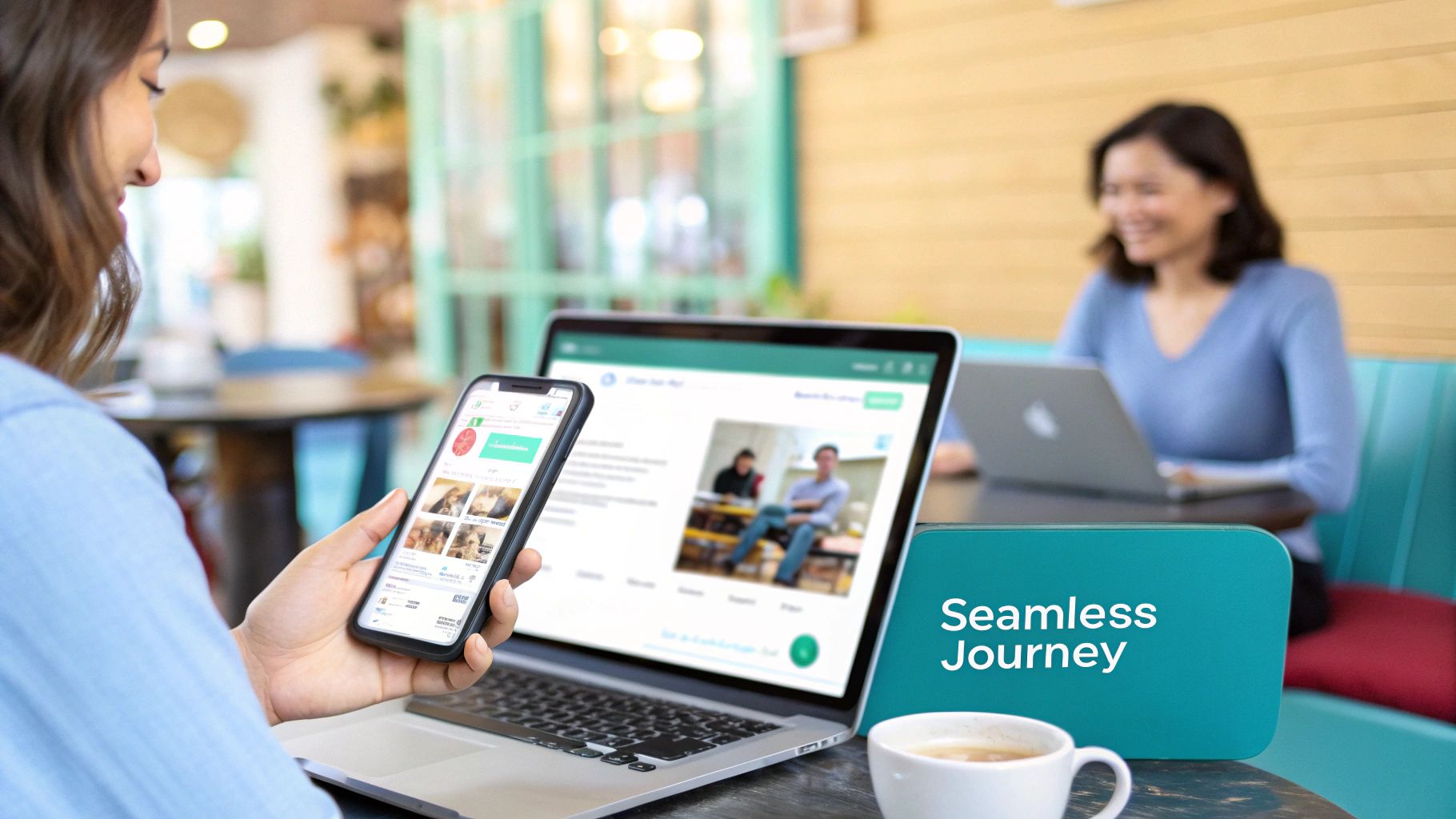
For a long time, the goal for businesses was to be "multichannel." This meant showing up everywhere—on a website, a mobile app, social media, you name it. While that was a good first step, it often created a disjointed and frustrating journey for the customer. Each channel was its own little island, completely unaware of what was happening on the others.
This disconnect is where the friction happens. A customer might research a product on their laptop, add it to their cart on the mobile app, and then head to a physical store to see it in person. In a multichannel world, those are three separate, broken events. The store associate has no clue about the online research, and the mobile cart might as well not exist.
An omni channel customer experience tears down those walls. It weaves every touchpoint—online, mobile, in-store, and beyond—into one continuous conversation, all driven by unified data.
The Shift to a Customer-Centric Model
Today’s customers don’t think in channels; they just see one brand. They expect their experience to flow smoothly from one device to the next without missing a beat. This shift in expectation has turned a true omnichannel strategy from a nice-to-have into a core business necessity.
The data makes this crystal clear. A major survey found that 73% of shoppers use multiple channels on their path to purchase. More importantly, brands with strong omnichannel strategies retain 89% of their customers, a stark contrast to the 33% retained by those with weak engagement.
The difference between these approaches is crucial for building real customer loyalty. To truly grasp this strategic shift, it's worth exploring the differences between omnichannel vs. multichannel in more detail. It’s all about moving from a channel-focused setup to a truly customer-centric one.
An omnichannel approach isn't about being on every channel. It's about being unified on every channel. The goal is to make the transition between them so seamless that the customer feels like they're having one continuous conversation with your brand.
The Technology That Makes It Possible
At the heart of this integrated experience are Digital Experience Platforms (DXPs) powered by intelligent AI. Platforms like the Sitecore Engagement Cloud act as the central nervous system for this new model.
- Sitecore CDP (Customer Data Platform): This is the brain of the operation. It gathers data from every interaction—website clicks, app usage, in-store purchases, support calls—and pulls it all together to create a single, 360-degree view of the customer.
- Sitecore Personalize: This is the AI engine that puts that unified profile to work. It delivers relevant, personalized experiences in real-time, ensuring the conversation stays consistent and valuable across every single touchpoint.
By connecting these systems, businesses create a fluid world where a customer’s journey on their tablet is instantly recognized on their desktop. Every interaction becomes smarter and more personal than the last.
The Pillars of a Winning Omnichannel Strategy

A truly great omni-channel customer experience isn't something you stumble into. It’s carefully constructed on three foundational pillars that work together to create a single, cohesive customer journey. Get these right, and the technology falls into place. Get them wrong, and even the best tools won't deliver the seamless interactions modern customers demand.
The whole structure rests on a simple but powerful idea: every touchpoint should feel like part of the same conversation. This isn't just about appearances; it requires a deep commitment to breaking down silos and building a truly unified operational model.
The Unified Customer Profile
The first and most critical pillar is the Unified Customer Profile. Think of it as a living, breathing digital file for every single customer. It gathers every interaction they have with your brand—from browsing your website and using your mobile app to chatting with a service agent or making a purchase in-store.
Platforms like Sitecore CDP are built specifically to create this single source of truth. By pulling in data from every channel, Sitecore builds a rich, 360-degree view that updates in real time. This profile is the engine that powers genuine personalization, letting you understand not just who your customer is, but what they need at any given moment.
For example, a customer who browsed winter coats on your website last week can be greeted with a relevant offer the next time they open your mobile app. That kind of contextual awareness is only possible when all your data flows into one central hub.
A Consistent Brand Experience
The second pillar is all about delivering a Consistent Brand Experience. Your brand's voice, visuals, promotions, and values must be the same everywhere. A customer should never feel like they're dealing with a different company when they move from your social media page to your physical store.
This goes way beyond logos and color palettes. It extends to the offers they see and the language your team uses. If a product is on sale online, that promotion should be recognized and honored in-store without any friction or confusion.
This is where a tool like SharePoint becomes invaluable internally. By acting as a central library for marketing assets, brand guidelines, and campaign details, it ensures every team—from digital marketers to in-store staff—is working from the same playbook. That internal alignment is what makes a unified external brand identity possible.
The goal is to make your brand presence so consistent that the channel becomes irrelevant. The customer isn't having a "mobile experience" or an "in-store experience"; they are simply having your brand's experience.
Seamless Channel Integration
The final pillar is Seamless Channel Integration. This is the technical glue that connects every touchpoint, allowing a customer's journey to flow effortlessly between channels without hitting a dead end.
Think about this common scenario: a customer adds a few items to their shopping cart on their work computer during a lunch break. Later that evening, they open their tablet and find those same items waiting in the cart, ready to go. That continuity is the hallmark of a well-integrated omnichannel strategy.
This pillar is all about demolishing the technical silos that keep your channels isolated. A powerful Digital Experience Platform (DXP) like Sitecore provides the API-first architecture needed to connect all your different systems. It makes sure that data and context are passed smoothly between your e-commerce platform, CRM, and even your physical point-of-sale systems.
Understanding how to connect these touchpoints is fundamental. For a deeper dive, explore A comprehensive guide to omnichannel ecommerce strategy to see how integration powers sales.
Ultimately, these three pillars support each other to create a superior experience. When you get them right in an e-commerce setting, they drive serious business results, as we cover in our analysis of e-commerce omnichannel success.
How Sitecore AI Powers a Unified Customer Journey
Building a truly omnichannel customer experience is more than just a good idea—it requires a powerful tech foundation that can weave every customer touchpoint into one intelligent system. This is where a top-tier Digital Experience Platform (DXP) becomes the central nervous system for your entire operation. Sitecore is a major player in this space, offering a suite of AI-powered tools designed to turn disconnected interactions into one fluid, personalized journey.
It all starts with a solid content foundation. Sitecore XM Cloud, a cloud-native and composable CMS, makes sure your brand’s voice is consistent and easy to push out to any channel. Whether it's a webpage, a mobile app, or a digital sign in a store, XM Cloud provides the content backbone for a unified brand presence.
But content alone is just half the story. The real magic begins when that content is powered by a deep, genuine understanding of the customer.
Sitecore CDP: The Central Brain of Customer Data
To give customers a unified experience, you first need a unified view of the customer. This is exactly what Sitecore CDP (Customer Data Platform) is built for. Think of it as the central brain of your omnichannel strategy, constantly pulling in and making sense of data from every possible touchpoint.
- Website Interactions: Clicks, page views, time spent on a page, and items added to a cart.
- Mobile App Usage: In-app behaviors, feature engagement, and location data.
- In-Store Purchases: Transaction details from your point-of-sale (POS) systems.
- Customer Service Calls: Notes and outcomes pulled from your CRM.
- Social Media Engagement: Likes, shares, and comments on your brand’s profiles.
Sitecore CDP doesn't just hoard this data; it connects the dots. It can identify anonymous visitors, link their online browsing to an in-store purchase, and build a rich, 360-degree profile for every single person. This breaks down the data silos that so often hamstring marketing efforts, creating a single source of truth that’s always up-to-date.
Orchestrating Experiences with Sitecore Personalize
Once you have that unified customer profile in Sitecore CDP, it's time to put that intelligence to work. This is where Sitecore Personalize steps in. As the platform's AI-powered orchestration engine, it uses the rich data from the CDP to deliver hyper-relevant experiences across all your channels, right when it counts.
Put simply: if Sitecore CDP knows who the customer is and what they’ve done, Sitecore Personalize decides what they should see next. This opens the door to sophisticated personalization that goes way beyond just dropping a first name into an email.
A customer browses for a specific pair of running shoes on their phone during their lunch break but doesn't buy them. Later that evening, they visit your website on their laptop. Sitecore Personalize can instantly greet them with a banner featuring those exact shoes, maybe even with a limited-time free shipping offer to nudge them toward a purchase. That’s the power of a connected, AI-driven omnichannel customer experience.
AI is supercharging these capabilities. A stunning 95% of interactions are projected to be AI-powered by 2025, which is critical since 89% of businesses now compete primarily on customer experience. The global omnichannel market is expected to reach $11.8 billion by 2025, fueled by unified customer views that drive 20-30% revenue increases and 10-15% lifts in year-over-year retention. For brands, this means integrating platforms like Sitecore AI for real-time personalization, a priority for the 79.3% of B2C marketers planning more martech investments. For more about Sitecore’s vision, you can explore their resources at Sitecore.
Aligning Internal Teams with SharePoint Solutions
A flawless external customer experience is impossible without a well-aligned internal team. If your marketing, sales, and service departments are all working in their own bubbles, that disconnect will eventually trickle down to the customer. This is where integrating a tool like SharePoint becomes a critical piece of the puzzle.
SharePoint acts as a central hub for all your internal resources, making sure everyone is working from the same playbook.
- Centralized Asset Library: Marketing can store approved brand assets, campaign materials, and promotional calendars, keeping messaging consistent everywhere.
- Shared Customer Insights: Sales teams can access key insights from Sitecore CDP, helping them understand a customer's recent online behavior before a call.
- Unified Knowledge Base: Customer service agents can pull from a shared repository of product info and FAQs to provide consistent and accurate support.
By connecting an internal collaboration platform like SharePoint with the customer-facing intelligence of the Sitecore stack, you create a truly cohesive ecosystem. This internal alignment ensures the promise of a seamless omnichannel experience is delivered consistently by every part of your organization. For businesses planning this journey, understanding the nuances of AI integration is key, and you might be interested in our AI personalization in DXP implementation guide for 2025.
Your Roadmap for Implementing an Omnichannel Vision
Moving to a true omnichannel experience isn't an overwhelming leap of faith; it's a manageable journey. By breaking the process into clear, actionable steps, marketing and IT leaders can confidently guide their organizations toward a more unified, customer-first future. This roadmap cuts through the complexity, showing you how to get from siloed channels to a seamlessly integrated ecosystem.
This flow shows how the process works in practice—from gathering raw customer data to using AI to process it, all culminating in a deeply personalized experience.
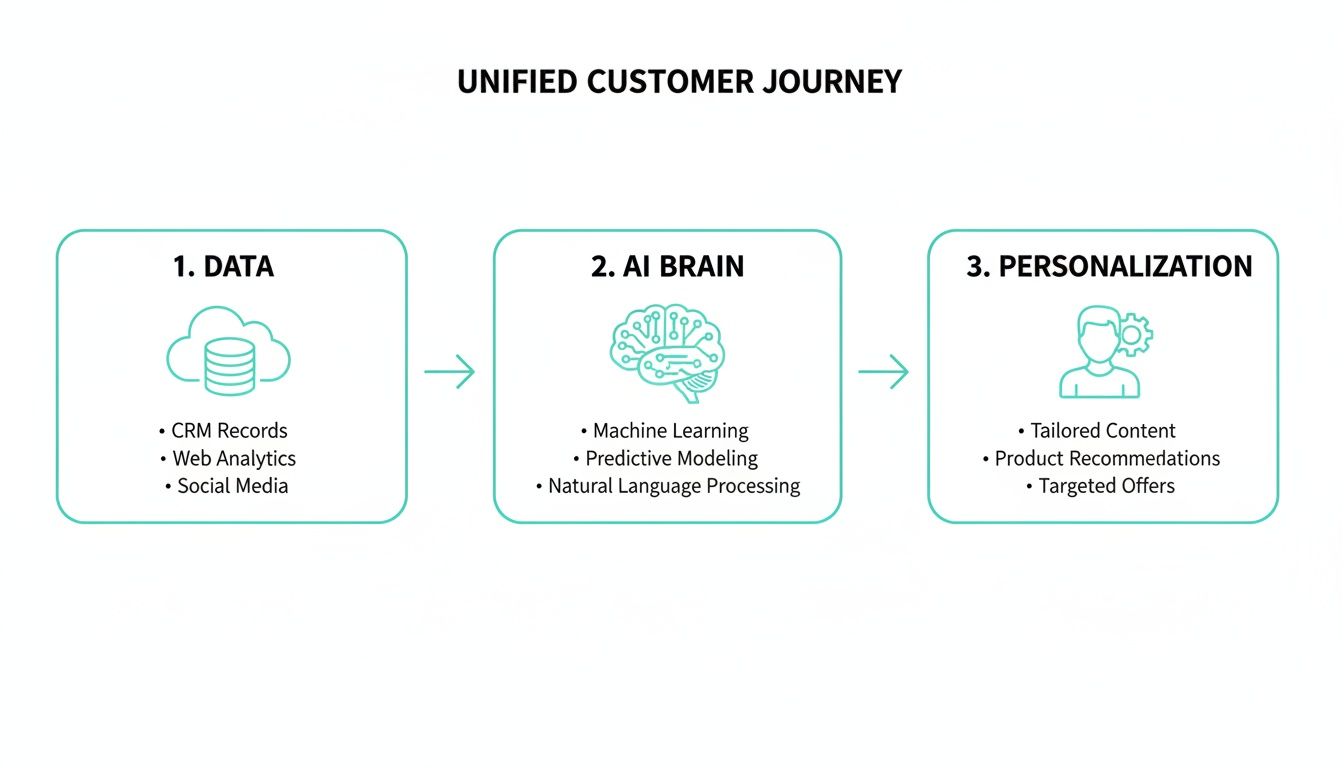
As you can see, a winning strategy hinges on using the right technology to turn disconnected data points into cohesive, context-aware interactions.
Step 1: Audit Your Current Channels
First things first: you need to get a clear picture of where you stand today. This means a thorough audit of every single customer-facing channel—from your website and mobile app to your physical stores and customer service lines. The goal is to map out how data currently flows, identify where information gets stuck in silos, and pinpoint the exact friction points that derail the customer journey.
During this stage, ask the tough questions. Where are customers dropping off? At what point do they have to repeat themselves? This audit gives you the baseline you need to measure success later on and helps prioritize which silos to tear down first. Think of it as the foundational diagnostic that shapes every decision to come.
Step 2: Design Your Tech Stack
With your current state mapped out, it’s time to design the ideal technology stack to bring your vision to life. A modern omnichannel strategy demands flexibility, which is why a composable architecture is so vital. Instead of getting locked into a rigid, all-in-one system, a composable Digital Experience Platform (DXP) lets you pick and choose best-in-class tools for the job.
Sitecore’s composable DXP is built for this exact model, offering incredible flexibility. You can start with a solid foundation like Sitecore XM Cloud for content management and then plug in other powerful components as your needs grow. This approach helps you avoid vendor lock-in and ensures your tech can adapt to new customer behaviors and channels down the road.
A composable architecture is like building with LEGOs instead of being handed a pre-built model. You have the freedom to choose the exact pieces you need—a CDP here, a personalization engine there—to construct a solution that perfectly fits your unique business requirements.
Step 3: Integrate Data for a Single Customer View
This is where the magic really happens. In this step, you connect your chosen systems to build that all-important single customer view. This is the most critical technical phase of the entire process. Sitecore CDP becomes the heart of your operation, acting as the central hub that pulls in, cleans up, and unifies data from every touchpoint you identified in your audit.
The integration process involves connecting everything:
- Your website and mobile analytics
- Your e-commerce platform and point-of-sale (POS) systems
- Your Customer Relationship Management (CRM) software
- Your customer service and support tools
By feeding all this information into Sitecore CDP, you transform a messy collection of fragmented data points into a rich, living profile for every single customer. This unified view is the fuel that powers true, real-time personalization and finally makes a consistent omnichannel experience possible.
Step 4: Create Pilot Journeys
Don't try to boil the ocean. Instead, start with small, high-impact pilot programs. Pick a few common customer journeys that are currently clunky or disconnected and focus on making them seamless. This lets you test your new tech stack and processes in a controlled environment, gather feedback, and—most importantly—demonstrate value quickly.
A classic example is a "buy online, return in-store" (BORIS) workflow. Pulling this off successfully requires flawless integration between your e-commerce platform and your physical store systems, all orchestrated through that central customer profile. Nailing a pilot like this gives you a powerful proof of concept to get broader buy-in from across the organization.
Step 5: Empower and Train Your Teams
At the end of the day, technology is only as good as the people using it. The final step is to empower your teams with the training they need to succeed in this new customer-centric world. For this, SharePoint solutions can be a game-changer for creating a centralized knowledge base.
This internal hub can host training materials on the new Sitecore tools, updated brand guidelines, and shared customer insights. By building a culture of collaboration and providing a single source of truth internally, you ensure that every employee—from marketing to the front lines—is ready to deliver the flawless, unified experience your customers now expect.
Measuring the Success of Your Omnichannel Investment
Putting a true omnichannel customer experience into play is a serious investment. To prove its worth to stakeholders, you need to look past surface-level numbers like website traffic or app downloads. The real story is told by holistic key performance indicators (KPIs) that track the entire, unified customer journey.
Your goal is to show exactly how a seamless, integrated experience boosts both customer loyalty and your bottom line. This means shifting your focus from metrics that live in a silo to ones that follow the customer, telling a complete story of their journey.
Core Metrics for Omnichannel Success
To build a powerful business case, you need to zero in on KPIs that capture the full value of a connected experience. These are the numbers that show how your strategy is performing from the first touchpoint to the last.
Key indicators include:
- Customer Lifetime Value (LTV): This is the ultimate report card. A strong omnichannel strategy builds deeper relationships, which means more repeat purchases and a higher LTV. Tracking this shows the long-term financial payoff of your efforts.
- Customer Retention Rate: Happy, satisfied customers don't leave. By creating a frictionless journey across every channel, you naturally reduce churn. A rising retention rate is a clear signal that your unified experience is building real loyalty.
- Journey-Based Conversion Rates: Stop measuring conversions on a single channel. Instead, analyze the conversion rates for journeys that cross multiple touchpoints. How many people who started on your mobile app finished the purchase on their desktop? That's the data that proves your integration is working.
Tracking Cross-Channel Behavior
You see the true power of an omnichannel setup when you analyze how customers flow between channels. Being able to track a single person as they move from their phone to their laptop to your physical store is a core function of a system like Sitecore CDP, and it unlocks priceless insights.
For instance, you can measure the percentage of customers who use "buy online, pick up in-store." Another fantastic metric is tracking how many users add an item to their cart on the mobile app and complete the purchase later on a desktop. These specific cross-channel conversion points give you undeniable proof that your channels are working together, not competing.
The most powerful omnichannel data points are those that follow the customer, not the channel. When you can clearly show that 25% of in-store sales were influenced by a prior mobile interaction, you are demonstrating tangible, interconnected value.
Optimizing for Efficiency and ROI
Beyond the customer-facing wins, a great omnichannel strategy makes your business run smarter. A crucial KPI here is the cost to serve a customer across different journey paths. Analyzing this helps you spot the most efficient and profitable routes your customers take.
For example, you might discover that customers who start with your chatbot before talking to a live agent have a lower cost to serve and a higher satisfaction rate. By optimizing for these pathways, you improve both the customer experience and your operational margins. Understanding how to link these metrics to real financial outcomes is key. You can dive deeper into these strategies in our complete guide on how to measure ROI, which gives you a clear framework for proving the powerful return on your omnichannel initiatives.
Navigating Common Implementation Challenges
Embarking on an omni channel customer experience journey is a powerful move, but let's be honest—it comes with its own set of predictable hurdles. Knowing what's coming is half the battle. Most businesses run into the same three roadblocks: fragmented data, organizational silos, and the technical debt from legacy systems.
The trick is to address these head-on with a smart strategy and the right technology from the start. If you solve these core problems early, you can build your implementation on a solid foundation that’s ready to scale and adapt.
Unifying Fragmented Data
The single biggest barrier to a seamless experience is fragmented data. When customer information is scattered across different systems—your CRM, e-commerce platform, marketing automation tools—it's impossible to get a single, coherent view of who your customer is. This almost always leads to disconnected and frustrating interactions.
The solution is a robust Customer Data Platform (CDP). Think of Sitecore CDP as the central nervous system for your customer data. It ingests information from every touchpoint and stitches it together into one unified profile. This single source of truth becomes the foundation for all your personalization and orchestration, taking the guesswork out of the equation and ensuring every interaction is informed by the customer's complete history.
Breaking Down Organizational Silos
Technology alone can't fix everything; your company’s structure plays a massive role. When marketing, sales, and customer service teams operate in isolation, they often have competing goals and fragmented views of the customer journey. That internal disconnect inevitably bleeds into a disjointed external experience for your customers.
The answer is to build cross-functional teams with shared goals and KPIs. This is where a tool like SharePoint becomes critical for getting everyone aligned internally. By creating a central hub for shared customer insights, campaign materials, and performance dashboards, SharePoint ensures everyone is working from the same playbook, fostering a truly customer-centric culture.
When it comes to the technical side of integration, especially around payments and transactions, getting expert advice is a smart move. Tapping into insights from payments experts can help you ensure that even the most complex parts of the customer journey are smooth and secure.
The stakes are high. Research shows that while 70% of customers prefer brands with multi-channel service, a staggering 56% get frustrated from repeating information because of company silos. On the flip side, brands with strong omnichannel strategies retain 89% of their customers, a stark contrast to the 33% retained by those with weak, disconnected ones. You can find out more about how omnichannel strategies impact customer retention.
Frequently Asked Questions About Omnichannel
Building a true omnichannel experience always brings up a few questions. Let's tackle some of the most common ones, focusing on what it takes to implement it and how technology, like the tools in Sitecore’s portfolio, makes it all happen.
What Is the Main Difference Between Multichannel and Omnichannel?
Think of it this way: multichannel is like having separate conversations in different rooms. You might have a website, a mobile app, and a social media presence, but they don't talk to each other. A customer’s actions on your website are a mystery to your mobile app, creating a choppy experience where they have to start over at every turn.
Omnichannel brings all those conversations into a single, seamless dialogue. It connects every touchpoint, so a customer can browse a product on their laptop, add it to their cart via the mobile app, and get a pickup notification on their smartwatch without ever feeling a disconnect. The magic isn't just being on many channels; it's the unified data and context that ties them all together.
How Does Sitecore AI Specifically Improve the Customer Journey?
Sitecore AI takes the customer journey from a fixed, one-size-fits-all map to a living, breathing conversation. It taps into the unified data gathered by Sitecore CDP to understand what an individual customer is doing and what they want, right in that moment.
With that intelligence, Sitecore Personalize steps in to:
- Predict the next move: It anticipates what a customer is likely to do next and proactively serves up the perfect piece of content or a timely offer to guide them along.
- Shape experiences in real-time: Based on a customer's immediate actions, it can instantly change the content on a webpage, send out a personalized email, or trigger a push notification to their phone.
- Learn and adapt on the fly: The AI is always learning from every interaction, making each subsequent experience even more relevant and effective than the one before it.
What Is the Best First Step for a Company to Take?
The best place to start is with a thorough channel and data audit. It’s tempting to jump straight into new technology, but you first need a clear picture of where you stand today. Map out every single customer touchpoint, from your website to your in-store kiosks. Identify where your data is trapped in silos and pinpoint the biggest points of friction in your current customer journey.
This foundational analysis gives you a roadmap. It tells you which integrations and fixes will deliver the biggest wins right away, ensuring that when you do invest in a platform like Sitecore, your efforts are targeted and effective from day one.
At Kogifi, we specialize in designing and implementing these sophisticated omnichannel strategies. Let us help you build a connected customer experience that drives results.