

Omnichannel marketing is the orchestration of customer touchpoints across all channels to create a single, unified, and continuous customer experience, powered by centralized data. Today's average consumer uses almost six touchpoints when purchasing a product, and companies with strong omnichannel customer engagement strategies retain 89% of customers on average versus 33% for companies with weak omnichannel engagement.
You're probably dealing with the same pattern most enterprise teams face. Marketing wants personalization. Commerce wants conversion. Customer service wants context. IT wants a stack that won't collapse under another round of integrations. Meanwhile, the customer just wants the promotion they saw on email to match the offer in the app, the website, and the store.
That gap is where the omnichannel marketing definition usually becomes useless. Most definitions stop at “consistent experience across channels.” That's directionally right, but it leaves out the hard part: the architecture, governance, and delivery model required to make that experience real at enterprise scale.
For a CTO, omnichannel is not a campaign model. It's an operating model. For a marketing leader, it's not just message consistency. It's the ability to continue the same conversation when a buyer moves from paid media to the website, from the website to a sales conversation, or from a mobile app to a service desk.
The practical definition has to include both sides. Customer journey design and technical execution. That means unified customer data, API-first integration, identity resolution, content operations, decisioning logic, and a platform layer that can serve the same context across digital and physical touchpoints.
Sitecore is relevant here because it sits at the intersection of content, data, personalization, and orchestration. SharePoint matters too, often for a less visible but equally important reason: it helps enterprise teams govern internal content, documentation, approvals, and operational knowledge so that the experience presented externally stays coherent.
Table of Contents
- Introduction Why Disconnected Experiences Cost You Customers
- One customer conversation, not many channel campaigns
- Omnichannel versus multichannel in practice
- Why the enterprise case is stronger than the marketing case alone
- Where the value actually comes from
- Composable DXP is the practical foundation
- How Sitecore AI turns data into decisions
- Integration is where most omnichannel programs succeed or fail
- Why SharePoint still matters in an omnichannel stack
- Why channel metrics break down
- KPIs that fit omnichannel reality
- Attribution has to match the actual journey
Introduction Why Disconnected Experiences Cost You Customers
A customer sees a promotion in email during the morning commute. By lunch, they open the mobile app and can't find the same offer. In the evening, they visit a physical location and staff can't see either interaction. Nothing about that journey feels connected, even though every team involved believes they're “doing digital.”
That's the practical reason the omnichannel marketing definition matters. It's not a terminology debate. It's the difference between a customer feeling recognized and a customer doing integration work on your behalf.
The pressure has grown because customer behavior has changed faster than most enterprise stacks. Today's average consumer uses almost six touchpoints when purchasing a product, up from only a couple of digital touchpoints fifteen years earlier, according to Keyshot's omnichannel statistics roundup. The same source notes that companies with strong omnichannel customer engagement strategies retain 89% of their customers on average, compared with 33% for companies with weak omnichannel engagement.
Those numbers explain why disconnected experiences have become expensive. Every silo introduces friction. Every mismatch between channels weakens trust. Every missing handoff forces the customer to repeat context your systems should already know.
Disconnected channels don't just create bad UX. They create operational drag, duplicate work, and blind spots in decision-making.
In enterprise environments, this problem rarely starts with bad intent. It starts with separate systems, separate KPIs, separate content workflows, and separate teams. The website sits in one platform, campaign logic in another, service history in a third, and internal documentation somewhere no frontline team can reliably access.
Three patterns show up repeatedly:
- Campaign inconsistency: Marketing launches offers that don't propagate cleanly across web, app, contact center, and in-person channels.
- Fragmented identity: The same customer exists as multiple records across CRM, commerce, analytics, and support systems.
- Content drift: Teams publish variations of the same message because no governed source of truth exists.
A useful omnichannel strategy fixes those issues by design. It aligns customer journey logic with the technical systems that deliver it. That's the lens that matters for an enterprise CTO. Not “how many channels do we use,” but “can our stack preserve context, identity, and intent as the customer moves between them?”
The Core Omnichannel Definition Beyond the Buzzword
The most accurate omnichannel marketing definition is simple to state and difficult to execute. It's the orchestration of customer lifecycle touchpoints across digital and physical channels to deliver a unified, data-integrated experience.
That word orchestration matters. Omnichannel doesn't mean “present in many places.” It means the channels behave like parts of one system.
One customer conversation, not many channel campaigns
The easiest way to explain omnichannel is to compare it with a conversation. In multichannel marketing, each channel speaks separately. Email says one thing, the website says another, in-store staff sees something else, and support has no shared context. In omnichannel marketing, every interaction picks up where the previous one left off.
That distinction is why omnichannel is customer-centric while multichannel is usually channel-centric. As Wharton's explanation of omnichannel marketing puts it, multichannel marketing operates channels independently, while omnichannel ensures fluid hand-offs. The same source cites benchmark data indicating 91% higher customer retention and 15% YoY revenue growth via omnichannel strategies.
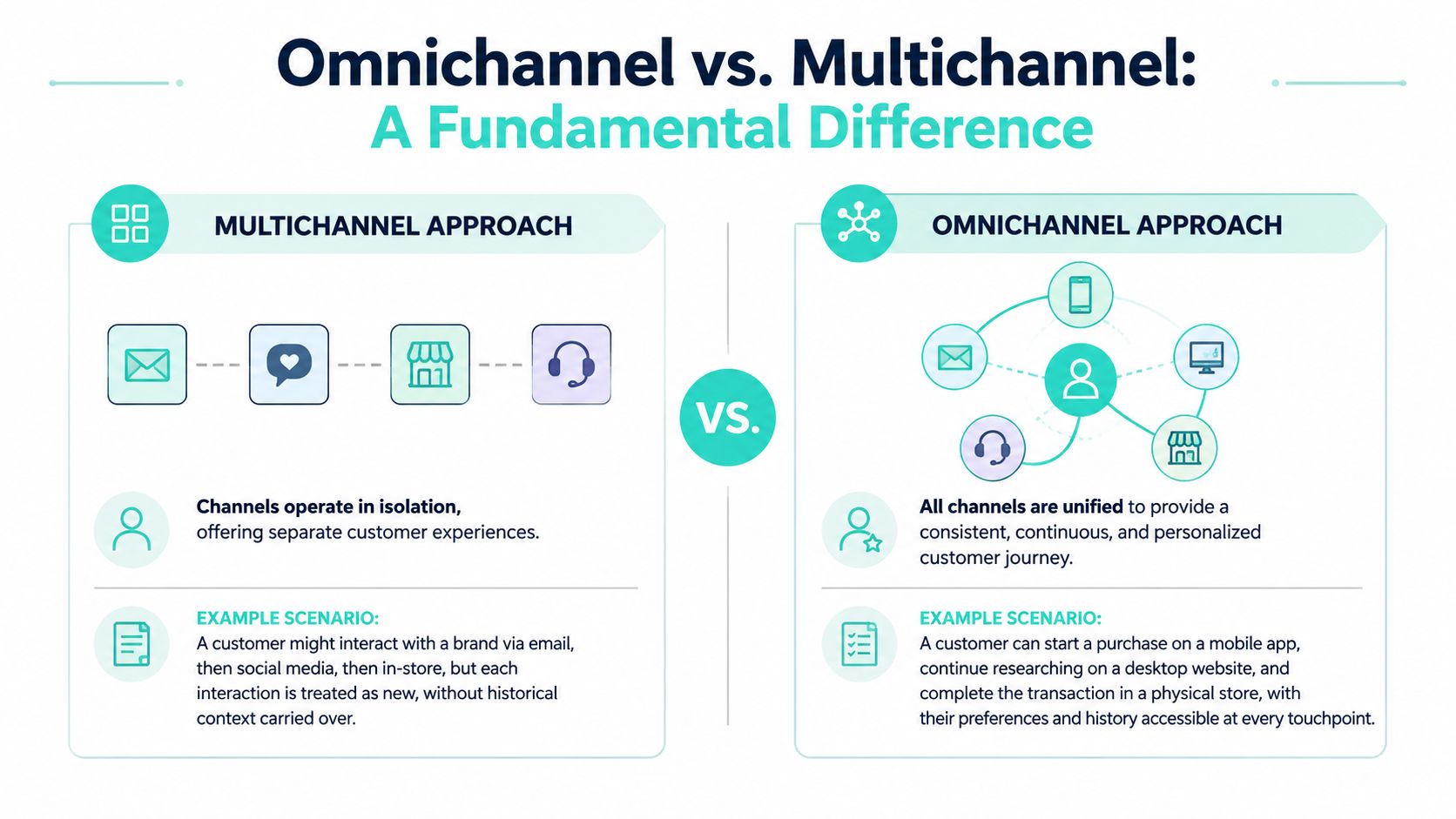
A practical definition should include four conditions:
- Shared identity: the business can recognize the same person across channels.
- Shared context: recent behavior and preferences are available when the next interaction happens.
- Shared decisioning: personalization and next-best-action logic use the same underlying data.
- Shared content operations: teams don't manage each touchpoint as a disconnected publishing universe.
If one of those is missing, what you have is usually coordinated multichannel, not true omnichannel.
Omnichannel versus multichannel in practice
The distinction becomes clearer when you map operating characteristics.
| Attribute | Multichannel Marketing | Omnichannel Marketing |
|---|---|---|
| Organizing principle | Channel performance | Customer journey continuity |
| Data model | Separate records and reports | Unified customer context |
| Personalization | Rules vary by channel | Decisions persist across channels |
| Handoff quality | Often manual or inconsistent | Designed to be continuous |
| Content management | Recreated per touchpoint | Governed and reusable |
| Customer experience | Fragmented but broad | Consistent and connected |
One useful reference for teams comparing the two models is Kogifi's guide to omni-channel vs multi-channel, especially when internal stakeholders still treat channel expansion as the main objective.
Practical rule: If a customer has to reintroduce themselves, re-find an offer, or restart a task after changing channels, you don't have omnichannel.
This is also where Sitecore's perspective tends to be more useful than abstract marketing definitions. A DXP is not there just to publish pages. It exists to combine content, customer data, rules, and delivery logic so the experience can remain coherent when journeys become non-linear.
That matters because enterprise journeys are almost never linear. A prospect might see paid media, visit a product page, download documentation, talk to sales, revisit through email, and complete a transaction through a different channel entirely. Omnichannel marketing treats that as one evolving interaction, not five unrelated events.
Strategic Benefits for the Modern Enterprise
For enterprise teams, omnichannel pays off when it reduces friction across the entire customer lifecycle, not just when it improves campaign output. The strategic value shows up in retention, lifetime value, operational clarity, and the ability to make decisions from one customer view instead of six partial ones.

Why the enterprise case is stronger than the marketing case alone
A marketing-only view of omnichannel usually focuses on message consistency. That's part of it, but it's too narrow for large organizations. The bigger value is that omnichannel forces a business to align systems, teams, and operating assumptions around the customer instead of around internal ownership boundaries.
That changes how work gets done:
- Marketing teams stop building campaigns in isolation from service and commerce data.
- IT teams stop treating experience delivery as separate from data and integration strategy.
- Operations teams get fewer exceptions caused by mismatched information across channels.
This is why the strongest omnichannel programs usually look disciplined rather than flashy. They don't chase every new touchpoint. They remove failure points from the journey and make each handoff cleaner.
For a grounded outside perspective, Million Dollar Sellers' omnichannel insights are worth reviewing because they emphasize execution discipline over channel sprawl.
Where the value actually comes from
The business case tends to come from a few repeatable improvements rather than one dramatic leap.
First, unified context improves continuity. A customer who starts on mobile and later speaks with a service rep shouldn't encounter a blank slate. When context travels with the customer, the business wastes less effort and the customer experiences less friction.
Second, content and experience operations become more efficient. Teams can reuse approved components, offers, and decision logic instead of rebuilding them per channel. That reduces internal inconsistency and lowers the cost of maintaining digital estates that have grown organically over time.
Third, omnichannel improves planning quality. Leaders can see the journey as a connected system instead of optimizing isolated dashboards. That changes budget conversations because the question becomes “what moved the customer forward?” rather than “which channel took the final click?”
A useful way to make this concrete internally is to map current journeys against working examples. Kogifi's article on examples of omnichannel is a good framework for that kind of workshop because it helps teams evaluate continuity, not just channel presence.
The strongest enterprise omnichannel programs are usually boring in the right ways. Data is cleaner. Workflows are clearer. Fewer teams argue about which system owns the truth.
That's the strategic point. Omnichannel isn't valuable because it sounds modern. It's valuable because it makes a fragmented organization behave coherently from the customer's point of view.
The Technology Backbone An Omnichannel DXP Architecture
Most omnichannel programs fail in the layer between strategy and delivery. Leadership agrees on the experience vision, but the stack can't support identity, content, and decisioning across all the required touchpoints. That's why the omnichannel marketing definition has to include architecture.
Achieving true omnichannel maturity requires investment in composable DXP architectures and API-first integrations capable of delivering personalized experiences at scale, especially for global brands that need continuous support and SLA-based maintenance, as discussed in McKinsey's omnichannel explainer.

Composable DXP is the practical foundation
A composable DXP gives enterprise teams the flexibility to separate concerns without separating the experience. That matters because omnichannel rarely fits inside one monolithic system anymore.
In practice, the architecture often needs to coordinate:
- Content management for structured and reusable content
- Customer data for profile unification and segmentation
- Personalization and decisioning for next-best experience logic
- Commerce and transaction systems for inventory, pricing, and order state
- Analytics and attribution for journey visibility
- Internal knowledge systems for policy, support, and operational content
Sitecore fits this model well because its product portfolio supports content orchestration, headless delivery, personalization, and AI-assisted experience management without forcing every function into one rigid application boundary.
A composable approach also gives CTOs a more realistic migration path. You don't have to replace every legacy system at once. You can build a controlled integration layer, expose business capabilities through APIs, and move high-value journeys first.
One practical overview of this delivery model is Kogifi's omnichannel technology page, which frames omnichannel as a coordination problem across content, data, and service layers rather than just a front-end design exercise.
How Sitecore AI turns data into decisions
Sitecore AI becomes useful when it is attached to a disciplined data model and a governed content model. Without those, AI just generates more inconsistency faster.
In an omnichannel architecture, Sitecore AI can support work in three areas:
Content operations
Marketing teams can accelerate variant creation, summarize source content, and adapt messaging for different stages of the journey. The key is governance. AI-generated outputs still need approved taxonomies, content types, and editorial controls.Personalization
Experience decisions improve when behavior from multiple channels feeds a unified profile. The point isn't to personalize everything. It's to choose where context materially improves the journey.Decision support
AI is most effective when it helps teams identify the next useful action. That might be surfacing a relevant knowledge article, changing a content block, or prioritizing a follow-up sequence based on recent engagement patterns.
What doesn't work is bolting AI onto fragmented systems and expecting omnichannel behavior to emerge on its own. It won't. AI can improve orchestration, but it can't substitute for orchestration.
If the profile is fragmented, the content model is inconsistent, and APIs are unreliable, AI will amplify those weaknesses.
Later in the stack, the delivery mechanism matters as much as the model. Headless Sitecore implementations let teams expose content and personalization decisions consistently across web, app, portal, and campaign surfaces without recreating business logic each time.
A short product overview is useful here:
Integration is where most omnichannel programs succeed or fail
The hard engineering work is rarely on the homepage. It's in the connectors, identity logic, and operational flows behind it.
Sitecore xConnect has historically been important in Sitecore-centered estates because it supports collection and synchronization of interaction and customer data across systems. In practical terms, teams use capabilities like that to connect CRM, commerce, support, and behavioral data into a usable customer context rather than leaving each system to report on its own island.
The integration design usually has to solve for these realities:
- Legacy systems remain in place: ERP, CRM, PIM, and service platforms aren't going away because marketing wants a cleaner journey.
- Data changes at different speeds: product data, customer preferences, service events, and campaign interactions don't all update on the same cadence.
- Not all channels deserve equal depth: some journeys need real-time orchestration, others only require periodic synchronization.
That's why API-first design matters. It creates a cleaner contract between systems. The DXP doesn't need to own every record. It needs reliable access to the right context at the right time.
Why SharePoint still matters in an omnichannel stack
SharePoint isn't usually the public face of an omnichannel strategy, but it often supports the internal discipline that makes one possible.
Enterprise teams use SharePoint for policy libraries, campaign documentation, regulated content workflows, knowledge bases, service scripts, and internal approvals. That becomes significant when customer-facing consistency depends on internal teams using the same approved information.
A few examples:
- Service teams need current policy language before responding across contact channels.
- Regional teams need access to approved content modules and documentation.
- Compliance teams need reviewable workflows for regulated communications.
- Marketing and product teams need a controlled repository for supporting assets, not another folder maze.
SharePoint complements Sitecore rather than competing with it. Sitecore handles external experience delivery and personalization. SharePoint often handles internal collaboration, governance, and document-centric workflows that keep those experiences accurate.
Used together, they create something closer to a complete enterprise model. Customer-facing experience on one side. Internal knowledge and process control on the other.
Measuring Success With Omnichannel KPIs and Attribution
A lot of omnichannel reporting still reflects a single-channel mindset. Teams track email opens, paid clicks, site sessions, app events, and store activity in separate dashboards, then try to explain customer behavior after the fact. That doesn't work well when the journey itself is cross-channel.
Why channel metrics break down
The problem isn't that channel metrics are useless. It's that they become misleading when used as the main definition of success.
A customer might discover a product through social, compare options on the website, engage with email, speak to support, and purchase through a store or sales-assisted path. If the business gives most of the credit to the last digital click, it will underinvest in the touchpoints that moved the decision forward.
That's why omnichannel measurement has to start with journey logic rather than channel ownership.

KPIs that fit omnichannel reality
The most useful omnichannel KPIs usually share one trait. They connect customer progress to business outcomes across channels.
A practical KPI set often includes:
- Cross-channel conversion paths: Which combinations of touchpoints lead to progression or purchase.
- Retention by cohort: Whether customers exposed to connected journeys stay longer than those who experience fragmented ones.
- Lifetime value by journey type: Whether personalized, continuous journeys produce stronger downstream value.
- Blended acquisition and engagement efficiency: What it costs to create progress across the full journey, not just inside one channel.
This is also where DXP analytics become more useful than isolated campaign dashboards. Sitecore-centered reporting can tie content exposure, behavior, and personalization decisions together in a way that supports journey-level optimization rather than local channel optimization.
For teams building their reporting model, Kogifi's guide to measuring digital marketing effectiveness is a useful planning reference because it pushes measurement toward business outcomes instead of vanity metrics.
Attribution has to match the actual journey
Omnichannel attribution modeling distributes conversion credit across touchpoints instead of relying on last-click logic. According to Marketing Evolution's overview of omnichannel, offline channels contribute up to 28% to online sales. The same source notes that implementing omnichannel personalization within a DXP drives a 5-15% revenue increase and results in 40% higher lifetime value for customers.
That has two immediate implications.
First, offline and service interactions belong in the measurement model. If you exclude them, your attribution system will bias budget toward whichever digital platform happened to capture the final event.
Second, personalization should be measured by incremental business effect, not by how clever the rules look in a demo. A personalized journey only matters if it changes conversion quality, retention, or lifetime value.
A disciplined attribution model usually moves through stages:
| Stage | What the team measures | Limitation |
|---|---|---|
| Last click | Final touchpoint before conversion | Ignores journey influence |
| Position-based | Early, middle, and late journey weight | Better, but still simplified |
| Data-driven | Credit based on observed contribution patterns | Requires cleaner data and governance |
Better attribution usually starts with better event design, not with a fancier dashboard.
That's the reporting shift enterprise teams need. Stop asking which channel “won.” Start asking which connected sequence produced value, where friction appeared, and which touchpoints deserve more support because they influence outcomes beyond the final click.
Common Omnichannel Implementation Pitfalls to Avoid
Enterprise teams don't usually fail because they misunderstood the definition. They fail because they underestimate the organizational and technical consequences of trying to deliver it.
The most common failure patterns
The first failure pattern is buying platform capability without agreeing on journey ownership. Marketing acquires personalization tools, commerce upgrades storefronts, service modernizes case management, and nobody decides who owns the customer state between systems.
The second is weak data governance. Teams talk about a single customer view while maintaining multiple IDs, inconsistent taxonomies, and no durable agreement on what counts as a usable profile. That leads to personalization errors, reporting disputes, and low confidence in automation.
A third pattern is excluding offline and service channels from scope. Omnichannel then becomes “digital channel coordination,” which sounds good in a roadmap but breaks down when customers call, visit, or escalate issues.
A fourth is trying to launch everything at once. Large programs often collapse under their own ambition. Too many markets, too many touchpoints, too many integrations, and not enough attention on one high-value journey that can prove the model.
A practical planning aid for stakeholder alignment is Full Circle Agency KAM Scorecard, especially when teams need a structured way to discuss account coordination and ownership maturity across functions.
What works better
The organizations that make progress usually do a few things differently.
- Start with one critical journey: Choose a journey with visible commercial or service impact. Prove continuity there before expanding.
- Define a system-of-record strategy: Decide which platform owns profile data, product data, content, service history, and consent logic.
- Create governance early: Taxonomy, identity rules, content models, and API contracts should be agreed before broad rollout.
- Include service and offline touchpoints: If the customer experiences those channels, the architecture and reporting model have to account for them.
- Phase change management: Teams need training, new workflows, and decision rights, not just new software.
A phased rollout isn't slower. It's usually the fastest route to a stable omnichannel model because it keeps complexity under control.
One more trade-off is worth stating plainly. Over-customization is often the hidden cost center in omnichannel programs. If every market, brand, or business unit insists on unique logic for content, identity, and workflow, the architecture becomes expensive to maintain and difficult to govern. Standardize where you can. Customize where it changes outcomes.
That's the balance mature teams learn to hold. Omnichannel should feel personalized for the customer, not endlessly bespoke for the organization.
Conclusion Your Path to Omnichannel Maturity with Kogifi
An effective omnichannel marketing definition must do more than describe a consistent and fluid customer experience. It has to account for the systems, integrations, governance, and operating decisions that make that experience possible.
For enterprise organizations, that means thinking beyond campaign orchestration. Omnichannel is a business capability built on unified customer context, composable architecture, governed content, and measurement that reflects actual customer behavior. Sitecore AI plays a central role because it connects content, personalization, and experience delivery in a way that can scale across complex estates. SharePoint remains important because internal consistency often determines whether external consistency is even possible.
The practical test is straightforward. Can your organization recognize the same customer across touchpoints, carry context from one interaction to the next, deliver relevant content through a governed stack, and measure outcomes at the journey level rather than the channel level? If the answer is no, the work isn't mainly definitional. It's architectural and operational.
That's also why omnichannel maturity should be treated as a progression, not a switch you flip. Most enterprises need to rationalize systems, clarify ownership, improve data discipline, modernize content operations, and focus on one or two high-value journeys before scaling broader orchestration.
Used well, Sitecore gives teams the tools to build that progression with more control. SharePoint gives them a way to support the internal process layer that keeps complex organizations aligned. And one option for implementing that model is Kogifi, which works with DXP, CMS, Sitecore AI, and SharePoint environments for platform implementations, updates, audits, and ongoing support.
The important part is choosing an approach that respects reality. Legacy systems won't disappear overnight. Organizational silos won't vanish because a new platform launches. But with the right architecture and governance, those constraints stop dictating the customer experience.
If your team is trying to define omnichannel in a way that survives enterprise implementation, Kogifi can help assess your current stack, map the highest-value journeys, and shape a Sitecore AI and SharePoint architecture that supports connected experiences without adding unnecessary complexity.