


You're likely dealing with a familiar problem. Content production is active, campaigns are running, search traffic is moving, and dashboards look busy. Then the budget review arrives and the question changes from “what did we publish?” to “what business value did it create?”
That's where most content programs get exposed. Enterprise teams rarely fail because they lack content. They fail because they can't connect content activity across CMS, CRM, analytics, personalization, and sales systems in a way that a CFO or CMO will accept.
In a DXP environment, roi on content marketing isn't a soft metric. It's a measurement discipline. The companies that get this right stop reporting likes, pageviews, and isolated conversions as if they were the outcome. They report contribution to pipeline, influenced revenue, content reuse efficiency, lower production waste, and stronger conversion paths across channels. That's the standard now, especially for organizations running Sitecore, SharePoint, and other enterprise platforms where one asset may influence many journeys over time.
Table of Contents
- Why Proving Content Marketing ROI Is More Critical Than Ever
- Return means more than booked revenue
- The enterprise lens changes the calculation
- Start with the core formula
- What belongs in investment
- What belongs in return
- A practical workflow for campaign calculation
- Why simple attribution breaks in enterprise buying journeys
- How common attribution models differ
- Why multi-touch works better in a DXP stack
- Where Sitecore AI changes the economics
- Using Sitecore CDP and Personalize to prove value
- Where SharePoint fits in the ROI picture
- Bring lifetime value into the conversation
- Measure durable content value
- Use incrementality to isolate contribution
Why Proving Content Marketing ROI Is More Critical Than Ever
Leadership teams aren't skeptical about content because they dislike it. They're skeptical because too many reporting packs still translate business investment into marketing activity, not business impact. If your reporting stops at engagement, you've made content harder to defend than it should be.
That's a costly mistake because B2B content marketing generates an average ROI of 3:1, meaning $3 in revenue for every $1 invested, with potential returns reaching 748% when paired with effective SEO strategies, according to Genesys Growth's content marketing ROI statistics. The opportunity is real. The problem is proving that opportunity inside a complex enterprise stack.
For enterprise teams, the issue usually isn't whether content works. It's whether the organization can trace value across multiple touchpoints, business units, and systems. A whitepaper may start in Sitecore, trigger an email journey, influence a sales conversation, and support a later renewal. If your stack can't connect those moments, the board sees cost without context.
That's why disciplined measurement matters more than volume. The right conversation isn't “did the blog perform?” It's “did this content reduce acquisition friction, create qualified demand, support conversion, or lower delivery cost?”
Practical rule: If a metric can't help a leader decide whether to invest more, change direction, or cut spend, it's context, not proof.
Teams in consumer goods have wrestled with the same pressure. Reddog Consulting on CPG growth offers a useful reminder that ROI measurement becomes a growth tool once marketing ties activity to commercial outcomes rather than channel vanity.
A strong enterprise reporting model also has to connect web behavior, campaign data, and downstream commercial signals. That's the gap most organizations need to close. Kogifi's perspective on measuring digital marketing effectiveness is useful here because it pushes measurement toward operational and revenue value rather than isolated platform metrics.
Defining Content ROI in a DXP and Enterprise Context
In smaller marketing environments, ROI often gets reduced to a simple equation of content cost versus immediate revenue. In enterprise DXP programs, that definition is too narrow. Content doesn't just generate leads. It supports sales cycles, feeds personalization, reduces duplication, and creates reusable assets that serve many channels at once.

Return means more than booked revenue
When enterprise teams talk about roi on content marketing, they should separate return into three layers.
- Direct commercial return means influenced opportunities, qualified pipeline, closed revenue, and assisted conversions.
- Operational return means lower production waste, faster publishing, structured reuse, fewer duplicated assets, and less manual reporting effort.
- Strategic return means stronger search visibility, better audience intelligence, higher trust, and richer first-party data that improves later campaigns.
This matters because a modern Sitecore build isn't just a website. It's a delivery and decision layer. Content stored in structured form can power web pages, landing pages, campaign variants, support journeys, and personalized modules without requiring separate production for each touchpoint.
The most undervalued return in enterprise content is often reuse. If one governed asset serves five touchpoints, the return isn't only in conversion. It's also in avoided cost.
A platform decision changes the economics. Teams using structured components, shared taxonomies, and clear governance often gain value in places finance doesn't initially see. That includes fewer rework cycles, cleaner approval workflows, and faster adaptation for region, language, or channel.
For leaders evaluating platform design, what a DXP is and how it works in practice becomes central to the ROI discussion. Once content is treated as a reusable business asset instead of a one-off page output, the measurement model improves.
The enterprise lens changes the calculation
A DXP and enterprise CMS environment forces a more mature question: what exactly was the investment trying to produce?
A single content initiative may have several outcomes at once:
| ROI dimension | What to measure qualitatively |
|---|---|
| Revenue impact | Leads, influenced deals, renewal support, conversion assistance |
| Cost efficiency | Reuse, workflow speed, governance, reduced content duplication |
| Strategic value | Search authority, audience insight, personalization readiness |
That's why mature teams don't ask for one universal ROI number and stop there. They build a hierarchy.
First, they calculate straightforward financial return where attribution is reasonably clear. Then they add operating gains from workflow, reuse, and platform efficiency. Finally, they report strategic impact as a directional business asset that strengthens future acquisition and retention.
The mistake is forcing every piece of content into a last-click sales framework. A thought leadership article may never be the final conversion event, but it can start a buying journey, support brand preference, and improve the performance of every later touchpoint.
A DXP also changes accountability. Marketing owns content planning, but IT owns parts of integration, data quality, and platform delivery. Sales owns qualification and progression. If one group reports in isolation, content ROI becomes fragmented by design.
The Essential Formulas and Metrics for Calculating ROI
Most debates about roi on content marketing become confusing because teams jump into attribution before they've established clean financial logic. Start with the basic formula. Then pressure-test the inputs.

Start with the core formula
The core calculation is straightforward:
ROI = (Return - Investment) / Investment × 100
The challenge isn't the formula. It's deciding what counts in the numerator and denominator in an enterprise program.
If you undercount investment, the result looks artificially strong. If you overcount return by giving content full credit for every influenced deal, the result loses credibility. Strong operators stay conservative enough that finance will trust the number.
What belongs in investment
A proper content investment total should include more than writing costs.
Use a full-cost view that includes:
- Strategy and planning such as editorial planning, campaign design, audience research, and stakeholder time.
- Production including writing, design, video, localization, compliance review, and content operations.
- Platform and tooling such as CMS, DXP modules, analytics tools, workflow tools, SEO tools, and DAM usage where relevant.
- Distribution including paid amplification, email deployment, syndication, and campaign setup.
- Measurement and optimization such as reporting, testing, tagging, dashboard maintenance, and analyst support.
Enterprise teams often get sloppy in this area. Shared tools and shared people create allocation challenges. That doesn't mean you ignore them. It means you define a reasonable allocation rule and apply it consistently.
What belongs in return
Return should also be categorized instead of dumped into one bucket.
A practical view is:
- Attributed revenue from content-originated or content-influenced opportunities.
- Lead value when revenue hasn't matured yet, using agreed commercial assumptions from sales and finance.
- Cost savings from reuse, reduced production effort, or improved workflow efficiency.
- Traffic value proxies only when they're clearly defined and leadership accepts them as directional rather than final proof.
If your business uses customer economics heavily, it also helps to model post-conversion value. A useful primer on how to calculate customer lifetime value can support more realistic return estimates, especially when educational content improves retention or expansion rather than only acquisition.
For practical KPI selection, Kogifi's guide to metrics for content marketing is a good reference point because it helps teams separate useful business indicators from reporting noise.
A practical workflow for campaign calculation
A clean way to operationalize the formula is to calculate ROI at the campaign or asset-group level first, then roll upward.
Use a sequence like this:
- Define the content unit. Pick a campaign, topic cluster, resource center, or gated asset group.
- Set the time window. Content compounds, but finance still needs a reporting period.
- Capture all direct costs attached to that unit.
- Trace conversion events from form fills, demo requests, or qualified journey milestones.
- Reconcile with CRM outcomes so the commercial team validates lead quality and deal association.
- Add efficiency gains only if your methodology is documented and repeatable.
A gated whitepaper example is simple enough to start with. Calculate the production, design, and promotion cost. Track form submissions and follow those contacts into CRM stages. Apply your organization's agreed value model for qualified leads or closed business. Then subtract total campaign investment and divide by investment.
That doesn't produce perfect truth. It produces defensible truth, which is what enterprise stakeholders need.
The video below is a useful companion if your team needs a quick visual refresher on the mechanics of ROI thinking before building its own model.
Working advice: Don't wait for perfect attribution before calculating ROI. Start with the cleanest measurable slice, document assumptions, and improve the model over time.
Navigating Attribution Models to Accurately Assign Value
Attribution is where many enterprise content programs lose confidence. The journey is rarely linear, and the more complex the buying process becomes, the less useful simplistic credit assignment looks.
Why simple attribution breaks in enterprise buying journeys
A buyer may first encounter a brand through an article, return through organic search, register for a webinar, read product content, click an email, and only later request a demo. If your reporting gives full credit to one touchpoint, you're not measuring influence. You're measuring whichever system happened to record the final event.
That gap becomes harder to manage in organizations with separate teams for web, campaign automation, CRM, sales enablement, and customer success. Each system sees part of the story. None owns the full journey unless the architecture was designed for that purpose.

How common attribution models differ
Different models answer different business questions. None is universally correct.
| Model | What it does well | Where it falls short |
|---|---|---|
| First-touch | Shows which content starts journeys | Undervalues mid and late journey influence |
| Last-touch | Simple to report and explain | Overcredits the final interaction |
| Linear | Recognizes all recorded touchpoints | Treats all touches as equally important |
| Time-decay | Gives more weight to later-stage influence | Can still understate discovery content |
| U-shaped | Highlights creation and conversion moments | Compresses the middle of the journey |
The right choice depends on your sales cycle, buying committee size, and data quality. For long B2B journeys, first-touch and last-touch are usually too blunt. They can still be useful as directional views, but they shouldn't be the only story a leadership team sees.
Why multi-touch works better in a DXP stack
A composable DXP stack creates the conditions for better attribution because it can unify identifiers, content interactions, and downstream business actions. In practice, that means connecting website behavior, form interactions, CRM updates, campaign data, and personalization events into a shared reporting model.
Over 65% of CMOs report being unable to quantitatively demonstrate the impact of their marketing spend, often due to siloed data and a lack of integrated analytics across platforms, according to Infinity Marketing's analysis of content ROI barriers.
A well-implemented multi-touch framework inside a Sitecore-led environment doesn't just assign more accurate credit. It also reveals patterns that improve execution. Teams can see which content introduces high-quality visitors, which assets consistently appear before conversion, and where prospects stall.
Attribution should do two jobs. It should defend budget, and it should tell the team what to change next.
In practice, many organizations should run more than one view at once. Keep a simple executive summary model for broad reporting, then maintain a richer operational model for optimization. Finance often wants consistency. Marketing needs diagnosis. Those aren't the same requirement.
Leveraging Sitecore AI to Amplify and Prove ROI
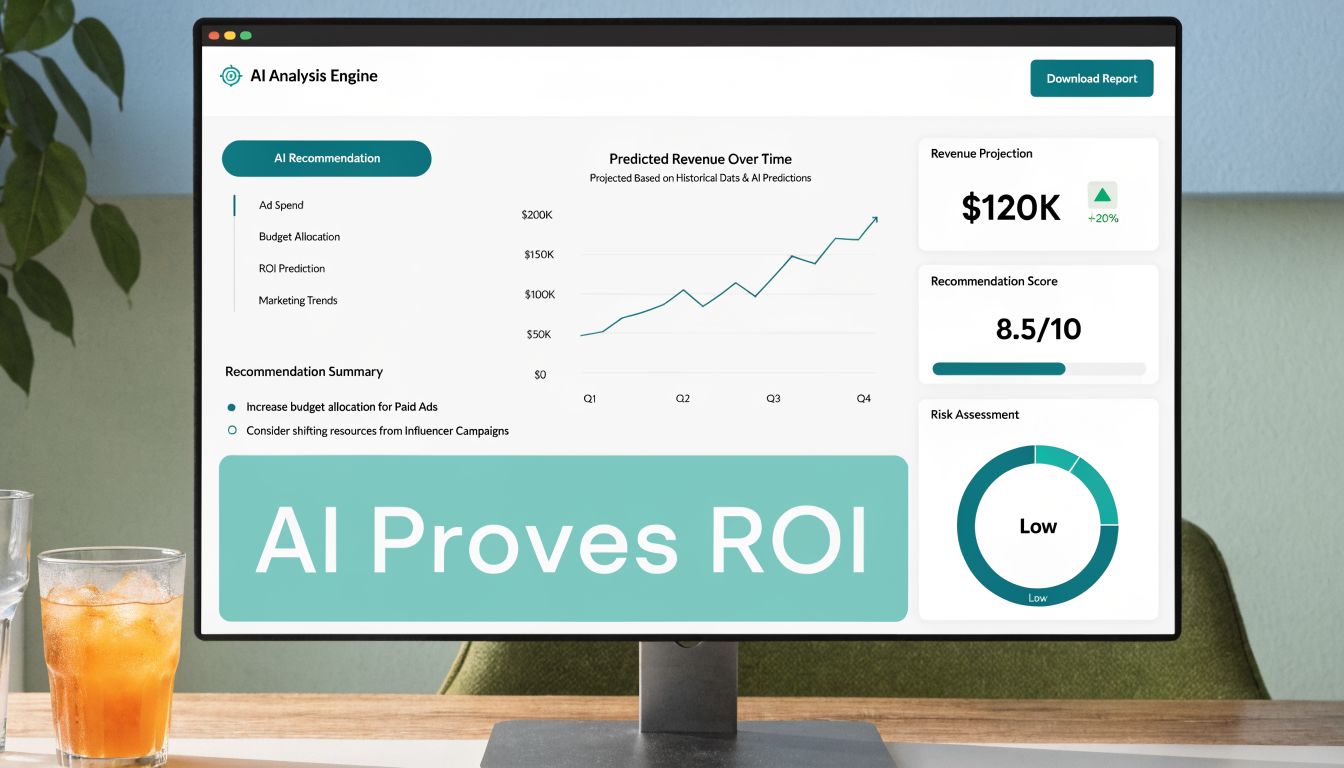
Most discussions about AI and content stay at the productivity layer. They focus on drafting faster or generating more variants. That's useful, but it misses the bigger enterprise question. Its true value appears when AI improves both performance and proof.
Where Sitecore AI changes the economics
Sitecore AI matters because it can sit closer to the delivery layer than standalone writing tools. In an enterprise environment, that means content generation, testing, audience adaptation, and experience optimization can happen inside a governed ecosystem rather than through disconnected workflows.
That has direct implications for roi on content marketing:
- Faster variant production supports more experimentation without multiplying manual effort.
- Personalized delivery increases the chance that the right message reaches the right segment.
- Integrated data capture gives teams stronger evidence of what content influenced progression.
- Workflow consistency reduces the cost of moving from idea to live experience.
The business case for this approach is strong. Marketers leveraging AI in content marketing and SEO report significant ROI boosts, with 68% of businesses seeing higher returns and an average 70% increase in ROI for AI users, according to Semrush's content marketing statistics.
That doesn't mean AI should flood the stack with more content. In practice, poor governance turns AI into a volume machine that creates duplication, inconsistent messaging, and weak performance. Sitecore's advantage in enterprise scenarios is that teams can connect AI-assisted creation to content models, approval workflows, personalization logic, and measurable business events.
Using Sitecore CDP and Personalize to prove value
Sitecore CDP and Sitecore Personalize become especially important once the organization moves beyond campaign reporting.
A mature setup can support several ROI-critical capabilities:
- Audience unification so anonymous and known behaviors can be stitched into a more complete customer view.
- Experimentation at experience level where teams compare content variants in a controlled way.
- Journey-based personalization that adapts modules, offers, and messaging based on behavior rather than broad assumptions.
- Outcome-linked reporting that connects on-site actions to downstream commercial milestones.
Many simpler CMS stacks hit a ceiling at this point. They can publish content, but they can't help teams explain which experience variation moved the metric that leadership cares about.
A practical pattern is to treat personalization like an investment portfolio. Don't personalize everything. Prioritize high-friction moments such as high-intent landing pages, solution pages, gated resource journeys, or renewal-support content. Then measure whether the personalized journey improves lead quality, progression, or conversion support relative to a control experience.
The same applies to search-focused content. If your team is using AI to scale optimization, connect those efforts to actual business outcomes, not just rank changes. Kogifi's article on how to boost organic traffic is useful in that respect because traffic only matters when it enters a measurable conversion path.
Good AI governance starts with one question: what decision will this model help us make better?
One practical option for teams that need structured ROI planning around DXP programs is Kogifi's ROI calculator approach for platform investment analysis. Used carefully, that kind of tool can help align marketing, IT, and finance around common assumptions before implementation or optimization work begins.
Where SharePoint fits in the ROI picture
SharePoint usually doesn't get enough credit in content ROI conversations because people frame it only as an intranet or document platform. In enterprise architectures, it can play a different role.
When integrated properly, SharePoint can act as a governed content source for internal knowledge, regulated documentation, campaign inputs, and reusable business content that later feeds digital experiences. That lowers friction in creation and governance. It also reduces the hidden cost of content chaos, especially in global organizations where teams repeatedly recreate approved material because they can't find or trust what already exists.
Used alongside Sitecore, SharePoint is often most valuable when it supports structured source content, workflow clarity, and internal collaboration while Sitecore handles high-performance experience delivery. That split can lower the investment side of ROI by reducing duplication and shortening publishing cycles without weakening governance.
The trade-off is clear. If SharePoint becomes the front-end experience layer for public content journeys it wasn't designed to optimize, performance and measurement usually suffer. If it remains a managed source and collaboration layer inside a wider DXP strategy, it can improve ROI materially.
Advanced ROI Measurement Beyond Direct Revenue
Direct-response metrics matter, but executive teams eventually ask harder questions. Does content improve customer quality over time? Does it strengthen brand preference? Does it create outcomes that paid media alone wouldn't have produced? That's where advanced measurement starts.
Bring lifetime value into the conversation
Not all content is acquisition content. Some assets support onboarding, adoption, retention, and expansion. In subscription, service, or complex B2B environments, those effects can be commercially significant even when they don't appear in a campaign report.
A useful way to think about this is to segment content by business role. Some content creates awareness. Some accelerates deal confidence. Some reduces post-sale friction. If your ROI model only values the first purchase or first lead event, you'll understate the contribution of educational, operational, and support-oriented content.
That's particularly relevant for enterprise portals, support hubs, partner ecosystems, and authenticated experiences managed through DXP and ECM environments.
Measure durable content value
Leadership also needs to understand that not all return appears in the reporting window where content was created.
Evergreen solution pages, knowledge resources, glossary content, and conversion-support assets can keep contributing long after the initial campaign has ended. Mature teams handle this by evaluating content in cohorts. They compare newer assets with older ones, check whether certain formats continue to assist conversion, and identify which assets still earn meaningful interaction after publication.
Use a review model like this:
- Durability asks whether an asset keeps attracting qualified attention over time.
- Assist value checks whether the asset repeatedly appears before conversion events.
- Reuse value tracks whether content supports multiple channels or business teams.
- Strategic relevance tests whether the asset still aligns with current audience and commercial priorities.
A content asset doesn't stop creating value because the campaign code expired. Reporting often stops sooner than the asset does.
Use incrementality to isolate contribution
At some point, attribution alone won't satisfy a skeptical stakeholder. They'll want to know whether content caused an outcome or merely appeared somewhere in the path.
That's where incrementality testing becomes useful. In plain terms, you compare outcomes between audiences, markets, journeys, or time periods where content exposure differs in a controlled way. The objective isn't perfect academic certainty. It's stronger evidence that a content intervention changed behavior beyond what would have happened anyway.
In enterprise environments, this usually works best when teams test:
- Content versus no-content support in a defined journey
- Personalized versus non-personalized experience paths
- Updated versus non-updated evergreen assets
- Different content mixes across segments or regions
This requires discipline in tagging, audience definition, and reporting consistency. It also requires patience. Advanced ROI models are only as good as the data governance underneath them.
How to Build a Compelling Business Case for Stakeholders
Good measurement still fails if the organization can't understand it. The final challenge isn't analytical. It's communicative.
Many leadership teams receive either too much marketing detail or too little commercial context. That's one reason over 65% of CMOs report being unable to quantitatively demonstrate the impact of their marketing spend, often due to siloed data and a lack of integrated analytics across platforms. In practice, the business case collapses when data remains fragmented or when reporting is built for channel managers instead of decision makers.
Build one dashboard for decision makers
A stakeholder-ready dashboard shouldn't try to prove everything at once. It should answer a short set of decision questions.
A useful executive dashboard usually includes:
- Investment view showing what the organization spent on content operations, campaigns, and supporting tools
- Performance view showing qualified engagement and progression indicators
- Commercial view showing influenced pipeline, lead quality trends, or revenue-linked outcomes
- Efficiency view showing reuse, workflow gains, or operational savings where documented
- Decision view showing where to scale, fix, pause, or reallocate
Keep the language close to business outcomes. “Resource center engagement increased” is weaker than “the resource center is repeatedly present in journeys that reach sales qualification.” The second statement tells leaders why they should care.
Tell the story leadership actually needs
A persuasive business case has three parts.
First, establish the commercial objective. This could be demand generation, market expansion, sales enablement, retention support, or operational efficiency. Second, show the evidence chain from content action to business outcome. Third, explain what the organization should do next and what confidence level the team has in the recommendation.
That last part matters. Enterprise leaders don't need marketing certainty theater. They need informed judgment. If attribution is partial, say so. If a result is directional, label it correctly. Credibility grows when the methodology is transparent.
A simple presentation structure works well:
- What we invested
- What content changed in audience behavior
- What commercial or operational effect followed
- What we learned about high-value formats, topics, or journeys
- What should be funded, optimized, or stopped next
The strongest ROI narrative is rarely “everything worked.” It's “we know which parts worked, which parts didn't, and what to do next.”
For Sitecore and SharePoint environments, the integration story is paramount. When analytics, CRM, and content systems align, marketing can stop asking leadership to trust intuition. It can present evidence.
If your team needs a clearer model for proving roi on content marketing across Sitecore, SharePoint, and enterprise reporting workflows, Kogifi can help map the data flow, attribution logic, and platform design needed to connect content activity to business value.