


A familiar pattern shows up in enterprise teams every quarter. Marketing launches a strong campaign, creative signs off, media starts driving traffic, and the website greets every visitor with the same hero, the same message, and the same calls to action.
Then the reporting comes in. Traffic looks acceptable, but engagement is weak. Buyers from different industries see the same proof points. Returning visitors get no recognition. Existing customers land on pages written for prospects. Internal teams start debating copy when the actual problem is relevance.
That’s why personalized web content stops being a marketing add-on and becomes a delivery capability. In practice, personalization means the platform can change content, offers, search results, journeys, and next actions based on who the visitor is, what they’ve done, and what they’re trying to accomplish right now. For enterprise organizations, that requires more than token first-name insertion. It requires data, modular content, decisioning, and governance across channels.
The strongest implementations sit at the intersection of architecture and operations. Sitecore’s composable stack is built for that. SharePoint matters too, especially when the same principles need to improve the employee experience behind the firewall. The hard part isn’t understanding that personalization matters. The hard part is building something that scales, stays compliant, and proves business value.
Why Generic Content Fails and Personalization Wins
Generic content fails because it forces every visitor into the same journey. A first-time buyer, a returning customer, a partner, and an existing account holder all see identical messaging, even though their needs are different.
That usually creates subtle friction before it creates obvious failure. The page still works. The forms still submit. The campaign still gets clicks. But the experience asks each user to do too much interpretation on their own.
Personalization fixes that by reducing the distance between intent and content. A visitor exploring product capabilities should see educational proof and next steps. A known customer should see enablement content, support paths, or expansion offers. A user arriving from a campaign about a specific industry should land in language that matches that industry from the first screen.
The business impact isn’t theoretical. Personalized web content delivers an average 19% uplift in sales, and personalized CTAs are 202% more effective than generic versions, according to Instapage’s personalization statistics.
Generic pages make users work. Personalized pages remove decisions the platform should make for them.
A useful way to separate shallow customization from actual personalization is this:
| Approach | What it looks like | Why it usually underperforms |
|---|---|---|
| Basic customization | First name in an email, one regional banner, static audience pages | It doesn’t react to behavior or changing intent |
| Behavior-driven personalization | Dynamic content blocks, adaptive CTAs, product or content recommendations, audience-aware journeys | It aligns the experience with current needs |
For teams trying to move beyond broad audience assumptions, content personalization in practice starts with a simple rule. Don’t personalize everything. Personalize the moments where relevance changes outcomes: homepage modules, campaign landing pages, search, recommendations, and high-intent conversion paths.
That’s why one-size-fits-all content keeps underperforming. It isn’t that the content is bad. It’s that the platform treats context as optional when users treat it as expected.
The Tangible Business Impact of Personalization
Budget holders rarely ask whether personalization sounds promising. They ask whether it changes business results enough to justify platform work, content operations, and governance overhead.
The answer is yes, but only when personalization is attached to a clear commercial job. In enterprise programs, that usually means improving conversion quality, increasing account relevance, reducing wasted traffic, and making digital journeys easier to complete.
Where value shows up
In e-commerce, the clearest gain often comes from recommendations and adaptive merchandising. Product discovery improves when the platform stops showing the same order of products to every visitor. In lead generation, the gain usually comes from matching proof points, forms, and offers to industry, account maturity, or previous engagement.
In service-heavy industries, the pattern is different. A financial services team might tailor content around product eligibility, regional messaging, or user lifecycle stage. A manufacturing brand might surface sector-specific case material to procurement users while giving technical users specification content and integration guidance.
The point isn’t to make the website feel clever. The point is to reduce mismatch.
Loyalty, retention, and spend efficiency
Personalization also affects what happens after the first conversion. Relevant post-conversion content can guide onboarding, encourage repeat use, and lower the chance that users stall after the initial interaction.
That matters because poor relevance creates silent churn. Users don’t always complain. They stop engaging, stop returning, or move to channels that are more expensive for the business to serve.
A practical business case usually includes these outcomes:
- Higher-value conversions: Better-matched content tends to improve lead quality because users self-select into journeys built for their needs.
- Lower content waste: Teams stop forcing paid traffic into broad landing pages that try to say everything to everyone.
- Stronger customer continuity: Known users can be served different messages than net-new visitors, which is critical for account growth and retention.
- Better use of campaign spend: Paid media performs better when the destination experience continues the same promise made in the ad or email.
Practical rule: If a team can’t name the business metric a personalization use case should influence, it isn’t ready to build that use case.
That’s also why ROI discussions should be grounded in operating models, not slogans. Personalization requires content design, audience rules, data inputs, QA, analytics, and decision ownership. Those costs are real. So is the upside when teams stop publishing undifferentiated experiences.
Many organizations already understand this in principle. The more useful question is where to begin. In most programs, the strongest starting points are pages and journeys with obvious intent signals and measurable outcomes. There, the link between relevance and commercial impact is easiest to prove. For teams framing that discussion internally, content marketing ROI is a useful companion concept because it pushes the conversation toward measurable contribution instead of content volume.
Architecting Your Personalization Foundation
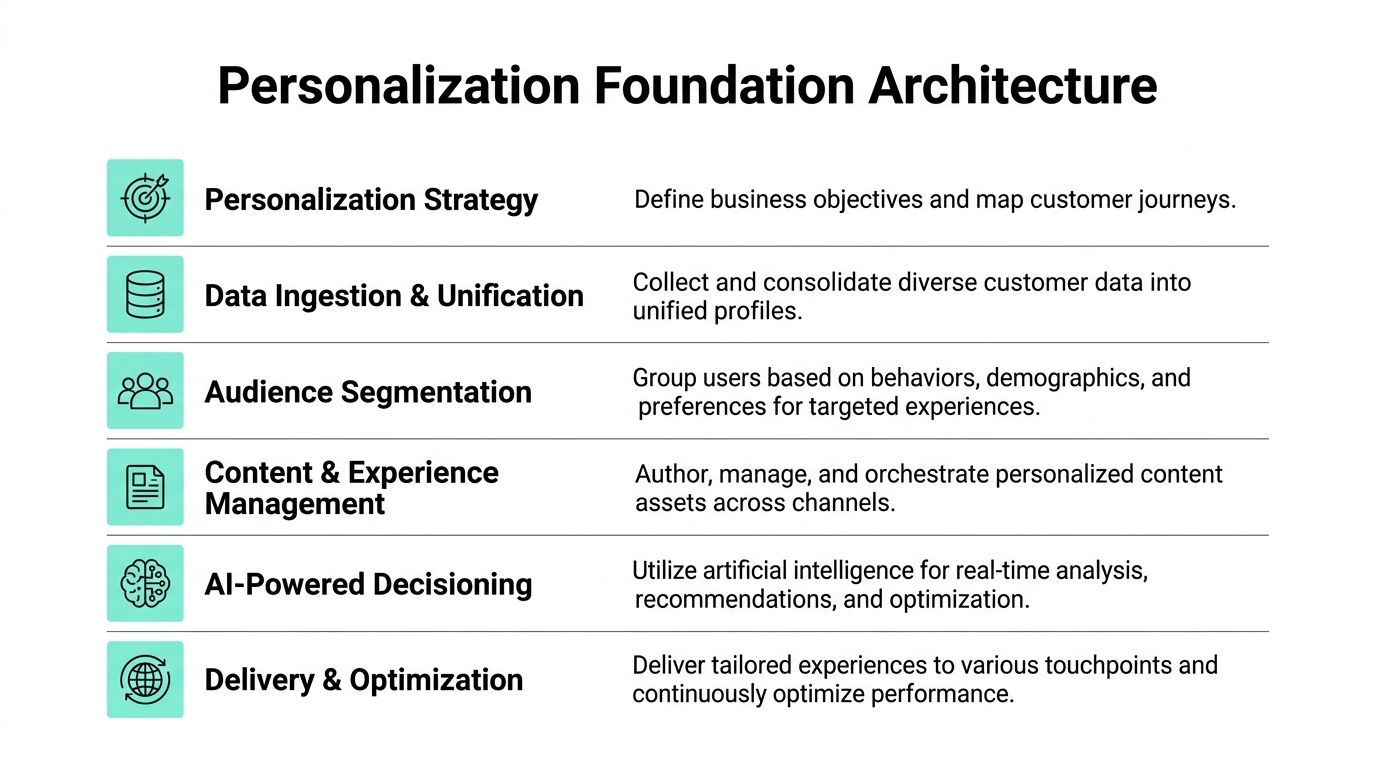
Personalization fails most often for architectural reasons, not creative reasons. Teams buy a capable platform, define a few audience segments, and then discover that the content model is too rigid, the data is fragmented, or the decisioning layer can’t operate in real time.
A workable foundation has six layers. Strategy at the top. Delivery and optimization at the bottom. Everything in between has to support fast decisions without creating operational chaos.
Start with data contracts, not audience fantasies
Most enterprise teams begin by brainstorming segments. That’s understandable, but backward. The first job is defining which signals the platform can trust, where those signals originate, and how quickly they become available for decisioning.
A DXP can only personalize from the data it receives and the content it can assemble. If CRM data arrives late, if consent status is inconsistent, or if session events aren’t structured properly, the personalization engine ends up making weak decisions with false confidence.
A strong foundation includes:
- Event collection: Page views, search queries, clicks, form events, cart actions, and content interactions
- Identity logic: Anonymous session stitching, known user recognition, and profile unification
- Consent handling: What can be stored, activated, and retained
- Content metadata: Tags for audience, funnel stage, region, language, product line, or topic
- Decision interfaces: APIs or native platform services that can select the right experience at render time
For teams evaluating architecture patterns, a practical reference point is a data management platform approach, because it forces decisions about collection, unification, activation, and governance before the personalization use cases expand.
Why composable architecture usually wins
Monolithic platforms can support personalization, but they often become restrictive when multiple teams, markets, and channels need to move independently. Composable architecture changes that by separating concerns. The CMS manages structured content. The CDP or profile layer handles identity and audience data. The decisioning layer evaluates context. Delivery channels render the outcome.
That separation matters when a brand needs to personalize across web, app, email, service portals, and regional sites without binding every use case to one front-end release cycle.
A simple comparison helps:
| Layer | Monolithic tendency | Composable tendency |
|---|---|---|
| Content | Tightly coupled templates | Modular content blocks and reusable models |
| Data | Platform-bound profiles | Shared profile and event services |
| Decisioning | Rules embedded in the web layer | Centralized decision APIs or native orchestration |
| Channels | Website-first | Omnichannel delivery |
The operational advantage is speed with control. Teams can refine one layer without rebuilding the others.
Real-time processing is where personalization becomes useful
Static segmentation can still help, but enterprise-grade personalization needs live context. Modern DXPs can process more than 10,000 events per second with sub-100ms latency, enabling immediate content adaptations that can drive up to 35% higher conversion rates and reduce cart abandonment by 20-30%, based on the benchmarks summarized by Contentstack on composable DXP personalization.
That kind of speed changes what’s possible. A user who adds a product to cart can immediately see accessory recommendations. A visitor who searches a support topic repeatedly can be routed toward service content instead of demand-generation messaging. A known account visitor can be shifted from awareness content to migration or expansion material during the same session.
Fast personalization isn’t just about latency. It’s about shortening the gap between user behavior and business response.
Teams that are assembling this capability from several services should also pay attention to orchestration discipline. Framework references like AI Build Stack are useful because they help teams think through where models, data pipelines, APIs, and application logic belong, instead of forcing every AI decision into the CMS itself.
The architecture that works best is rarely the one with the most tools. It’s the one where data arrives cleanly, content is modular, and the decision layer can act without waiting for a batch process or a manual publish cycle.
Driving Engagement with the Sitecore AI Ecosystem
A global enterprise visitor lands on a product page from paid search, refines results with an internal search query, then returns a week later through a sales email. If Sitecore CDP, Personalize, Search, and SharePoint are operating as separate systems, that visitor gets three disconnected experiences. If they are connected properly, the second visit reflects prior intent, the search experience adapts to likely needs, and the content team can still govern what appears across regions and business units.
That is where the Sitecore AI ecosystem earns its keep in enterprise delivery. Sitecore CDP collects behavioral and profile signals. Sitecore Personalize applies decision logic across channels. Sitecore Search improves discovery based on intent and context. SharePoint continues to play an important role for many organizations because approved documents, internal knowledge, and controlled business content often still live there. The architecture has to account for both systems instead of pretending one platform owns the whole content estate.
can help teams evaluate likely journey patterns, content gaps, and failure points before exposing a new personalization model to live traffic. For organizations building a broader operating model around enterprise personalization, our guide to personalization strategies across Sitecore and connected content systems covers the governance and delivery considerations in more detail.
The trade-off is straightforward. More decisioning can improve relevance, but it also increases dependency on clean data, disciplined taxonomy, and cross-platform orchestration. The Sitecore AI ecosystem works best when teams treat personalization as an operating capability, not a feature switch.