


The project discovery process is a structured investigation that happens before anyone writes a single line of code. Think of it as the blueprinting stage for your digital project, where we align your business goals with what's technically possible. It’s all about making sure that what you plan to build is precisely what your business needs and what your users will actually value.
Why Your Project's Success Hinges on Discovery
Imagine commissioning a skyscraper without an architectural plan. The idea might be ambitious, but the execution would be chaotic, expensive, and ultimately doomed. Launching a complex digital experience platform (DXP) on Sitecore or a collaboration hub on SharePoint without a proper discovery phase is the exact same thing—it’s a recipe for budget overruns, missed deadlines, and a final product that doesn't even solve the right problems.
The project discovery process is the strategic foundation that separates successful digital projects from costly failures. It's the journey of getting every stakeholder, from the C-suite to the IT department, rallied around a single, unified vision. This is where ambiguous business ideas get translated into a concrete, actionable, and technically sound plan, specifically for enterprise platforms like Sitecore.
From Vague Ideas to a Concrete Blueprint
Discovery transforms fuzzy concepts into a detailed roadmap. It’s not just some preliminary chore; it’s the most critical value-creation phase of the entire project. This initial investment of time and resources acts as a powerful risk-mitigation strategy.
Here are the key goals of a discovery phase:
- Defining Clear Goals: We move beyond generic statements like "improve user experience" to specific, measurable targets for your Sitecore DXP.
- Uncovering Hidden Risks: This could mean identifying potential technical debt in an existing Sitecore XP environment or mapping out complex integration points for a new Sitecore OrderCloud implementation.
- Aligning All Stakeholders: Discovery ensures that marketing, sales, IT, and leadership are all on the same page about the project’s scope, priorities, and what success looks like.
- Validating Technical Feasibility: We confirm that the proposed solution can actually be built within your technology stack, preventing expensive surprises down the road.
A thorough discovery phase doesn't slow a project down; it ensures the project moves in the right direction from day one. It’s about building the right thing before you focus on building the thing right.
As business operations get more complex, the need for structured approaches like this becomes even more critical. It’s a trend reflected in the rapid expansion of the project management software market, which is projected to grow from $7.24 billion in 2023 to $12.02 billion by 2030. This growth shows a global recognition of the value that systematic processes bring to the table. To fully appreciate the impact of a solid project discovery process, it's also helpful to understand what product discovery entails.
Ultimately, this phase provides the clarity needed to create a powerful digital transformation strategy that drives real business results.
The Four Phases of a Successful Discovery Journey
A solid project discovery process isn't just a single meeting or a quick checklist. It's a structured journey that methodically transforms a rough business idea into a concrete, ready-to-build project plan. This is especially true for complex digital experience platform (DXP) and content management system (CMS) projects on platforms like Sitecore or SharePoint.
Think of it as moving through four distinct, yet interconnected, phases.
This visual flow shows how a simple idea evolves into a detailed blueprint, ultimately leading to project success through a structured process.

This illustrates that success isn't an accident. It’s the result of a deliberate approach where each stage builds a stronger foundation for the next.
Phase 1: Stakeholder Alignment
The journey kicks off by getting every key player in the same room, all rallied around a shared vision. This phase is less about tech and more about people and purpose. Through a series of structured workshops and interviews, we make sure that business leaders, marketing teams, IT departments, and subject matter experts are all pulling in the same direction.
Without this alignment, projects are often plagued by conflicting priorities and goals that shift mid-stream. For a Sitecore XM Cloud migration, this means getting marketing and IT to agree on personalization goals versus the technical architecture. For a SharePoint intranet overhaul, it means ensuring HR, legal, and operations have a unified view of what they need for document management and collaboration.
Phase 2: Deep Dive Audits and Research
Once the vision is clear, it’s time to map the current landscape. This is where the real investigation happens, both on the technical and user-centric fronts. We don’t just look at what you want to build; we analyze what you have today to fully grasp the opportunities and limitations.
Key activities in this phase typically include:
- Technical Stack Audit: We get under the hood of your existing systems, integrations, and infrastructure. For a Sitecore project, this means analyzing your current version (like Sitecore XP), identifying technical debt, and assessing how ready your organization is for a move to a composable architecture with XM Cloud.
- Content and SEO Audit: We take a hard look at your content ecosystem, information architecture, and search engine performance. The findings here will directly inform the new content strategy within Sitecore.
- User Research: Through user interviews, surveys, and analytics reviews, we build a crystal-clear picture of user behaviors, pain points, and needs. This work is the bedrock for creating effective user personas and journey maps. To get a better handle on this, check out our guide and customer journey mapping template over on our blog.
This deep dive is like a pre-flight check for an airplane. Skipping it means you’re flying blind, unaware of potential issues with the engine (your tech stack) or the flight path (your user needs).
Phase 3: Strategic Requirements Definition
Now we translate everything we've learned into a detailed plan. This is where high-level business goals and research findings become granular functional and non-functional specifications. Vague objectives like "improve personalization" are sharpened into specific requirements, such as "Implement Sitecore Personalize to serve dynamic content to users based on their browsing history and CRM data."
This is meticulous work. For a Sitecore project, it involves detailing component specifications, content authoring workflows, and integration points with other systems like Sitecore CDP or an ERP. For a SharePoint solution, it means defining precise document library structures, permission levels, and workflow automation rules. The final output is a clear set of instructions for the development team.
To provide a clearer picture, here’s a breakdown of how the discovery phases connect to tangible outputs.
Key Discovery Phases and Their Primary Deliverables
This table shows how each phase produces a critical deliverable that informs the next, ensuring nothing gets lost in translation from idea to execution.
Phase 4: MVP Scoping and Prioritization
With all requirements defined, the final step is to decide what to build first. It's tempting to want everything at once, but that's rarely the smart move. The goal here is to define a Minimum Viable Product (MVP)—the smallest, most focused version of the product that can be released to deliver immediate business value and start gathering real user feedback.
Using proven prioritization frameworks like MoSCoW (Must-have, Should-have, Could-have, Won't-have), we work with stakeholders to rank features based on their impact versus the effort required. This ensures the initial launch is both powerful and realistic, providing a strong foundation for future iterations. It's how a comprehensive wish list gets transformed into a value-driven project roadmap.
Turning Discovery Insights into Actionable Deliverables
A project discovery phase isn't just about gathering notes and ideas. Its real value comes from turning those abstract insights into tangible, actionable deliverables. These documents become the project's single source of truth, bridging the gap between a big-picture business vision and the nitty-gritty of technical execution.
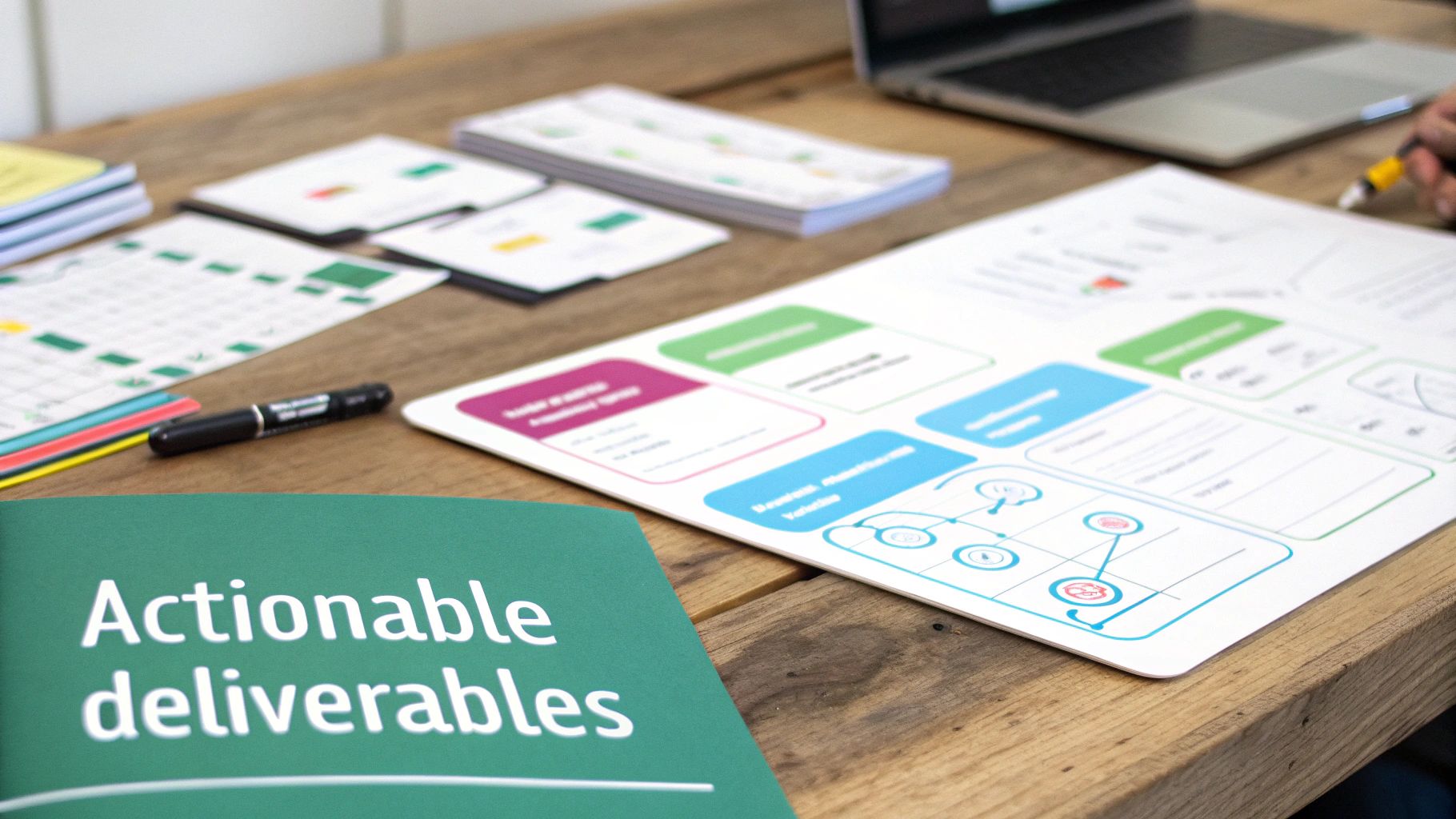
Without these concrete plans, teams end up working on assumptions. That's a recipe for rework, delays, and misalignment. For a complex project like a Sitecore DXP implementation, these deliverables are what keep developers, marketers, and stakeholders all building toward the same goal.
Core Deliverables That Drive Clarity
Every discovery phase should produce a set of key documents. While the exact list might change depending on the project, a few are non-negotiable for success, especially in the Sitecore and SharePoint ecosystems. These artifacts provide the clarity needed to build a comprehensive software implementation project plan.
- Business Requirements Document (BRD): This is the foundational text. It lays out the what and why of the project in plain language, capturing business goals, stakeholder needs, and the metrics that will define success.
- User Personas and Journey Maps: These documents give a face to your target audience. Personas create fictional characters that represent key user groups, while journey maps visualize how they interact with your platform, highlighting pain points and opportunities.
- Technical Architecture Diagram: Think of this as the visual blueprint for your entire tech stack. For a Sitecore project, it maps out how Sitecore XM Cloud will connect with tools like Sitecore Search, Content Hub ONE, and any third-party APIs. It's crucial for building a scalable and robust solution.
- Prioritized Product Backlog: This is simply an ordered list of all the features, user stories, and tasks needed for the project. Using a framework like MoSCoW to prioritize it gives the development team a clear, step-by-step guide for each sprint.
These documents aren't just created out of thin air. They're the direct result of the stakeholder interviews, user research, and technical audits you just completed.
The Sitecore Content Model: A Critical Artifact
For any CMS project, the Content Model is vital. But for a headless or composable platform like Sitecore XM Cloud, it's arguably the most important deliverable of all. It’s the architectural plan for your content. It defines every content type, its fields, how different types relate to each other, and the rules that govern them.
A well-designed content model is the backbone of a great authoring experience and a personalized user journey. It ensures content is structured, reusable, and ready for omnichannel delivery from day one.
For example, your content model might define a "Product" with specific fields like ProductName (text), SKU (text), Price (number), and ProductImage (media). It would also define how that "Product" relates to a "Category." Getting this right from the start prevents content chaos down the line and empowers marketers to use Sitecore’s full personalization power without needing a developer for every little change.
From SharePoint Workflows to Functional Specs
When the project involves a SharePoint solution, the discovery deliverables often zero in on workflows and information architecture. Here, a Functional Requirements Document (FRD) becomes a key artifact, as it goes a level deeper than the BRD.
An FRD translates broad business needs into specific system behaviors. For instance, a BRD might state, "The system must streamline document approvals." The FRD would then detail the exact steps:
- A user uploads a document to the "Drafts" library.
- The system automatically starts an approval workflow, notifying the manager via email.
- The manager can approve or reject the document directly from that notification.
This level of detail is crucial for removing ambiguity. It gives developers the precise instructions they need to correctly configure SharePoint lists, libraries, permissions, and Power Automate flows, ensuring the final product perfectly matches how the organization actually works.
Our Blueprint for Sitecore and SharePoint Discovery
Theory is one thing, but execution is everything. A generic project discovery process just won't cut it for complex, enterprise-grade ecosystems like Sitecore and SharePoint. At Kogifi, our approach is a battle-tested blueprint, refined over years of hands-on DXP and CMS implementations. It’s specifically designed to navigate the unique challenges and opportunities these powerful platforms present.
Whether we’re handling a multifaceted Sitecore XP to XM Cloud migration, a new Sitecore OrderCloud implementation for a composable commerce strategy, or a complete SharePoint intranet overhaul, our discovery process is built for the tech. We move beyond standard questionnaires, using specialized workshops, proprietary audit checklists, and deep-dive technical interviews to uncover the requirements that truly matter.
Tailoring Discovery for the Sitecore Ecosystem
The Sitecore product family is vast and deeply interconnected. A successful discovery has to account for how every component—from personalization engines to content operations—works together. Our approach is built to deconstruct this complexity and map out a clear path forward.
Our Sitecore-specific discovery involves:
- Composable Readiness Workshops: Before any move to XM Cloud, we have to assess an organization's maturity for a composable DXP. This means evaluating content models, integration capabilities, and the marketing team's operational readiness.
- Personalization and CDP Deep Dives: For projects using Sitecore Personalize or Sitecore CDP, our workshops zero in on identifying high-value user segments and mapping crucial data points. We pinpoint the exact customer data needed to fuel effective personalization from day one.
- Content Hub and DAM Audits: We meticulously analyze existing digital asset management (DAM) workflows to design a seamless integration with Sitecore Content Hub, guaranteeing a single source of truth for all marketing assets.
This focused detail delivers real results. For a global CPG client, our project discovery process for Sitecore CDP identified key data points that increased personalization campaign effectiveness by 35% within the first quarter. We didn't just plan a tech rollout; we mapped a strategy for business impact.
Mapping Workflows for SharePoint Success
With SharePoint, the discovery shifts heavily toward internal workflows, information architecture, and user adoption. A great SharePoint intranet or document management system isn't just about features; it’s about becoming an essential part of how an organization runs. Our blueprint for these projects focuses squarely on business processes.
The goal of a SharePoint discovery is to make the platform invisible. It should integrate so seamlessly into daily tasks that employees don't think about 'using SharePoint'—they just think about getting their work done more efficiently.
This means our SharePoint discovery process includes meticulous workflow mapping sessions. We sit down with users from different departments to understand their day-to-day tasks, step-by-step. By diagramming content lifecycles, approval chains, and collaboration patterns, we can design a system that mirrors and improves how teams actually work.
For a prominent legal firm, our SharePoint intranet discovery meticulously mapped user workflows for case file management. This deep analysis led to a redesigned document retrieval system that resulted in a 50% increase in efficiency, saving lawyers valuable time.
Our detailed blueprint also applies to other comprehensive business solutions, where initial phases are critical for successful implementation and understanding Microsoft Dynamics 365. The principles of deep technical auditing and stakeholder alignment are universal.
Ultimately, a specialized discovery process ensures the powerful capabilities of platforms like Sitecore and SharePoint aren't just implemented—they are fully activated to solve specific business problems. For more insights on this topic, explore our complete guide to enterprise content management solutions.
Avoiding Common Pitfalls in Your Discovery Process
A great discovery process is as much about dodging bullets as it is about following a checklist. Even the most well-intentioned teams can stumble into common traps that weaken a project’s foundation before a single line of code is ever written. Steering clear of these pitfalls is the only way to ensure your Sitecore or SharePoint implementation starts on solid ground.
Gaining Only Partial Stakeholder Buy-In
One of the quickest ways to derail a project is by failing to get everyone on board from the start. When key decision-makers from marketing, sales, IT, or legal aren't actively involved, their needs get overlooked. This inevitably leads to clashing priorities and last-minute change requests that throw the entire development cycle into chaos.
Imagine building a new SharePoint intranet but forgetting to loop in the compliance team. You could end up designing a beautiful user experience that accidentally violates data retention policies, forcing an expensive and time-consuming redesign down the road.
A RACI (Responsible, Accountable, Consulted, Informed) matrix is your best defense here. This simple chart clarifies who needs to be in the room and what their role is, making sure every critical voice is heard before you lock in the project scope.
Starting with Ambiguous Business Goals
Another classic mistake is kicking off discovery with vague, feel-good objectives. Goals like “improve personalization” or “make the intranet more collaborative” sound great in a meeting, but they give the technical team nothing concrete to build toward. Without specific targets, success is left up to interpretation, and it becomes impossible to measure.
This is where you need to get SMART (Specific, Measurable, Achievable, Relevant, Time-bound). It’s all about turning fuzzy ambitions into real, actionable targets.
- Vague Goal: We want a better user experience on our Sitecore site.
- SMART Goal: We will reduce the bounce rate on our product pages by 15% and increase the average session duration by 30 seconds within six months of launching the redesigned Sitecore DXP.
This level of clarity cuts through the noise. It gives your entire team a shared definition of success and a clear finish line to work towards, ensuring every decision is tied to a tangible business outcome.
Underestimating Existing Technical Debt
It’s easy to get excited about the shiny new features of a platform like Sitecore XM Cloud and completely overlook the messy reality of your current technical environment. Legacy systems, undocumented customizations, and clunky integrations all add up to significant technical debt. Ignoring it is like trying to build a skyscraper on a shaky foundation.
A thorough technical audit isn’t optional—it’s essential. It means digging into your current Sitecore or SharePoint instance to uncover potential roadblocks before they become project-killers. This isn't unique to software development. In the legal tech world, for example, the cost breakdown for eDiscovery has changed dramatically. Back in 2012, document review accounted for 73% of the spend. By 2024, that number fell to 64%, and it's projected to hit just 52% by 2029 as AI review tools take over.
This shift shows that a clear understanding of your current state—whether it's legal processes or your own IT infrastructure—is crucial for smart future planning. You can find more details on these eDiscovery spending trends and their drivers on JD Supra.
Allowing Scope Creep into Discovery Itself
Finally, one of the most ironic pitfalls is letting scope creep infect the discovery phase itself. Discovery exists to define the scope, not become a bottomless pit of exploration for every "what-if" scenario. When stakeholders keep tossing new ideas into the ring without a clear cutoff, the discovery phase drags on, burning through the budget and delaying the actual start of the project.
The solution is simple: timebox it. Set a firm timeline with defined milestones and deliverables. Establish a hard deadline for gathering and prioritizing all requirements. This keeps the process focused, efficient, and productive, setting the stage for the real work to begin.
Your Project Discovery Process Questions Answered
Even after you’ve got a handle on the phases and deliverables, a few practical questions always pop up before a team dives into discovery. This is where the theory meets reality. Let's tackle some of the most common questions we hear, especially when it comes to complex Sitecore and SharePoint projects.
How Long Does a Typical Discovery Phase Take?
There's no magic number here—the timeline for discovery scales directly with the project's complexity. A straightforward SharePoint intranet refresh or a small-scale Sitecore feature might only need a focused discovery of one to two weeks.
For a bigger undertaking, like a brand-new Sitecore DXP implementation or a complete overhaul of a SharePoint document management system, you’re likely looking at three to six weeks. But for a massive digital transformation that ties together multiple systems—think integrating Sitecore XM Cloud, Sitecore CDP, and a third-party CRM—the discovery could easily stretch to eight weeks or more.
The goal of discovery isn't speed; it's clarity. Pouring the right amount of time in at the start is a strategic move. It saves you an exponential amount of time, money, and headaches down the road by preventing rework and ensuring you're building on solid ground.
This upfront investment pays off by creating a clear, risk-managed roadmap that actually speeds up the entire project lifecycle later on.
Is Discovery Different from Project Planning?
Yes, they're distinct stages, but they flow directly into one another. You can't really have one without the other. Think of it as a two-step process to get your project off the ground successfully.
- Discovery is about the "What" and the "Why." This is the investigation. The entire point is to dig into the problem, get to know the users, confirm what’s technically possible, and lock down the business goals. The result is a deep understanding and a detailed list of requirements.
- Project Planning is about the "How" and the "When." This phase takes everything from discovery—like the Business Requirements Document and prioritized backlog—and turns it into an actionable plan. This is where you build schedules, assign resources, set budgets, and map out development sprints.
Simply put, discovery figures out where you're going; planning draws the map to get there.
Who Needs to Be Involved in Discovery?
Getting the right people in the room is non-negotiable for a successful discovery. You need a mix of perspectives to make sure the final solution is strategically sound, technically viable, and actually solves problems for the people who will use it every day.
The best discovery teams are a blend of people from both the client's side and the implementation partner's side.
From the Client Side:
- Executive Sponsors: The leaders who hold the budget and can champion the project, making the final calls on scope and priorities.
- Business Stakeholders: Department heads from marketing, sales, or operations who own the business outcomes the project is supposed to deliver.
- Subject Matter Experts (SMEs): The people on the front lines. They know the day-to-day workflows, the real pain points, and the practical needs better than anyone else.
From the Implementation Partner:
- Project Manager: The facilitator who keeps the process moving, ensures everyone is on the same page, and manages communication.
- Business Analyst: The person who gathers all the requirements and translates business needs into clear technical specifications.
- Solutions Architect: The technical expert who assesses the current systems and designs the architecture for the new solution.
- UX/UI Designer: The advocate for the end-user, responsible for conducting research and mapping out user journeys.
This mix ensures that every angle—from high-level business strategy down to the nitty-gritty of daily use—is covered.
Can We Skip Discovery to Save Time and Money?
We hear this a lot, and it's easily the most dangerous question you can ask. It seems like a shortcut, a quick way to cut costs and jump right into building something. But skipping discovery is a classic false economy that almost always ends in disaster. It is one of the single most expensive mistakes a company can make.
Trying to build a solution without a proper discovery phase is like setting sail without a map or a compass. You’re inviting massive risks:
- Endless Rework: Without clear requirements, developers are left to guess. This leads to building the wrong thing, tearing it down, and starting over—again and again.
- Scope Creep: The project’s boundaries are fuzzy from the start, making it easy for new requests to constantly push the timeline and bloat the budget.
- Missed Requirements: You overlook critical user needs or technical roadblocks, and the final product fails to solve the actual problem it was meant to.
- Zero ROI: The solution doesn't deliver the expected business value because it was never truly aligned with clear objectives from day one.
Think of discovery as the best insurance policy you can buy for your project. It's a calculated investment that minimizes risk, guarantees alignment, and dramatically increases the odds of delivering a successful Sitecore or SharePoint solution on time and on budget.
Ready to build your next digital experience on a solid foundation? Kogifi specializes in a meticulous project discovery process designed for enterprise-level DXP and CMS implementations. Let our experts help you define a clear path to success. Contact us today to start your discovery journey.