


The budget is approved, the platform choice is settled, and the delivery board is full of apparently sensible work: configure XM Cloud, build the component library, migrate content, connect search, launch the sites. Then the programme starts slipping. Marketing approvals aren't available when developers need them, identity and analytics contracts remain undefined, legal review appears at the release gate, and every brand interprets “shared component” differently.
That pattern is rarely a coding failure. It's a project management decomposition failure. The visible deliverables were broken down, but the connective work between them wasn't given an owner, estimate, or acceptance condition. Enterprise Sitecore and SharePoint programmes become controllable when the work breakdown structure includes the platform, the products, and the horizontal responsibilities that make delivery possible.
Table of Contents
Why Enterprise DXP Projects Fail at the Breakdown Stage
A multi-brand organisation may approve a Sitecore programme with a hub-and-spoke model. The hub owns shared templates, components, search, analytics, and release practices. Each spoke represents a brand, region, or business unit with its own content, approval chain, language requirements, and integrations.
At first, the work breakdown structure looks complete. The team has workstreams for discovery, design, development, content migration, testing, and launch. The problem emerges when those streams meet. A shared component needs a brand decision, a legal decision, an accessibility review, content modelling, front-end implementation, authoring guidance, and regression testing across every consuming site. A search implementation needs more than an index. It needs source mapping, relevance decisions, update behaviour, ownership, and operational review.
The programme manager sees a delayed page template. The delivery team sees unresolved governance and integration work that never entered the baseline.

The monolith hidden inside the backlog
A traditional agile backlog can make this worse. Teams create an epic called “XM Cloud implementation” and add stories as discoveries occur. That approach supports iterative delivery, but it doesn't automatically provide scope completeness. Backlog items tend to follow the visible product surface, while security reviews, stakeholder alignment, content ownership, release governance, and integration testing remain scattered across meetings and informal notes.
I've seen teams estimate a component accurately and still miss the work required to make that component usable across brands. The component wasn't late because its code took longer than expected. It was late because the approval model, content rules, translations, analytics events, and visual regression coverage had no place in the decomposition.
A useful diagnostic is to compare every deliverable with its dependencies and control activities. Ask who supplies the data, who approves the experience, who tests the result, who maintains it after launch, and what happens when a source system changes. Actionable strategies to prevent failure can help teams strengthen this wider risk discipline, but the WBS must still make those responsibilities visible.
A structure that protects delivery
The practical response is to decompose the programme along two dimensions. The first follows deliverables, such as content architecture, front-end experience, search, personalisation, and migration. The second captures cross-cutting work, such as governance, integration assurance, accessibility, localisation, security, and operational readiness.
That structure gives leaders a clearer answer to the question behind every status report: what is preventing this deliverable from being accepted? Teams looking at broader delivery failure patterns can also use Kogifi's analysis of project failure as a prompt for reviewing ownership, dependencies, and decision latency.
Core Rules for Structuring Work Packages
Project management decomposition works when each package represents a controllable piece of scope, not merely a smaller sentence in a backlog. The concept has a long delivery history. The U.S. Navy introduced PERT in 1957 for the Polaris missile programme, and the U.S. Department of Defense and NASA published a PERT/COST guide in June 1962 describing the WBS approach. The DoD issued MIL-STD-881 in 1968, and PMI later documented the technique for non-defense organisations in 1987, showing how a defence planning method became mainstream over roughly 30 years. These milestones are documented in the history of the Work Breakdown Structure.
PMI defines decomposition as breaking scope and deliverables into smaller components until the project work is defined in sufficient detail for execution, monitoring, and control. Its practice standard for work breakdown structures describes the WBS as a hierarchical, product-oriented family tree. In delivery terms, the lowest useful level is the work package where cost and duration can be estimated, assigned, monitored, and accepted.
Start with outcomes, then test the boundaries
Begin with the programme outcome, not with the tool's navigation or technology stack. “Launch a governed multi-brand experience on SitecoreAI” is an outcome. “Create rendering host” is a technical element underneath a site foundation deliverable.
Use these tests while moving down the hierarchy:
- One accountable owner: A package should have one person responsible for completion, even when several specialists contribute.
- Complete parent coverage: Child packages should cover the parent's agreed scope under the 100% rule. If “launch” includes cutover rehearsal, communications, and rollback preparation, those items must appear.
- A clear acceptance condition: The team should know what evidence proves completion. “Search configured” is weak. “Search returns approved content from the defined sources, with agreed relevance checks completed” is actionable.
- A manageable reporting horizon: Stop when one owner can manage the package inside one reporting cycle. Breaking it down further can add coordination cost without improving control.
The stopping rule matters more than a preferred task size. A package that's too broad hides risk. A package that's too granular forces a delivery lead to manage administrative movement instead of outcomes. Teams working from Jira can use the Refact founder guide to Jira epics to keep hierarchy aligned with planning and product ownership, but an epic isn't automatically a proper work package.
Avoid the two expensive extremes
Under-decomposition creates false confidence. A migration item may include content assessment, transformation, validation, redirects, author training, and cutover rehearsal without naming any of them. Testing, data cleansing, training, and rehearsal then arrive as “additional” work even though the organisation always needed them.
Over-decomposition creates a different problem. Teams split a simple configuration into many technical actions, add non-scope improvements, and spend budget against work that never belonged in the approved baseline. The WBS becomes busy while decision-makers lose sight of the product outcome.
Review the draft with team leads before baselining it. Confirm that each package has an owner, a dependency view, an acceptance condition, and a realistic estimate. The definition of done for Scrum delivery can help teams distinguish completed activity from an increment that is ready for use.
Decomposing Sitecore AI and XM Cloud Implementations
An enterprise Sitecore programme can appear well defined until teams price the connections between content, data, search, personalisation, and release operations. The WBS should reflect both the customer experience and the composable services behind it. Sitecore describes its SaaS-enabled digital experience platform as including Sitecore CDP, Sitecore Personalize, and Sitecore Search, supporting customer insights, segmentation, and predictive search across content sources. Its documentation also defines Search usage metrics such as “Bursting Allowance,” “Documents/Product SKU,” and “Document Updates.” Search therefore needs packages for consumption, scaling behaviour, and monitoring, not only build activities. See the Sitecore documentation for platform and product definitions.
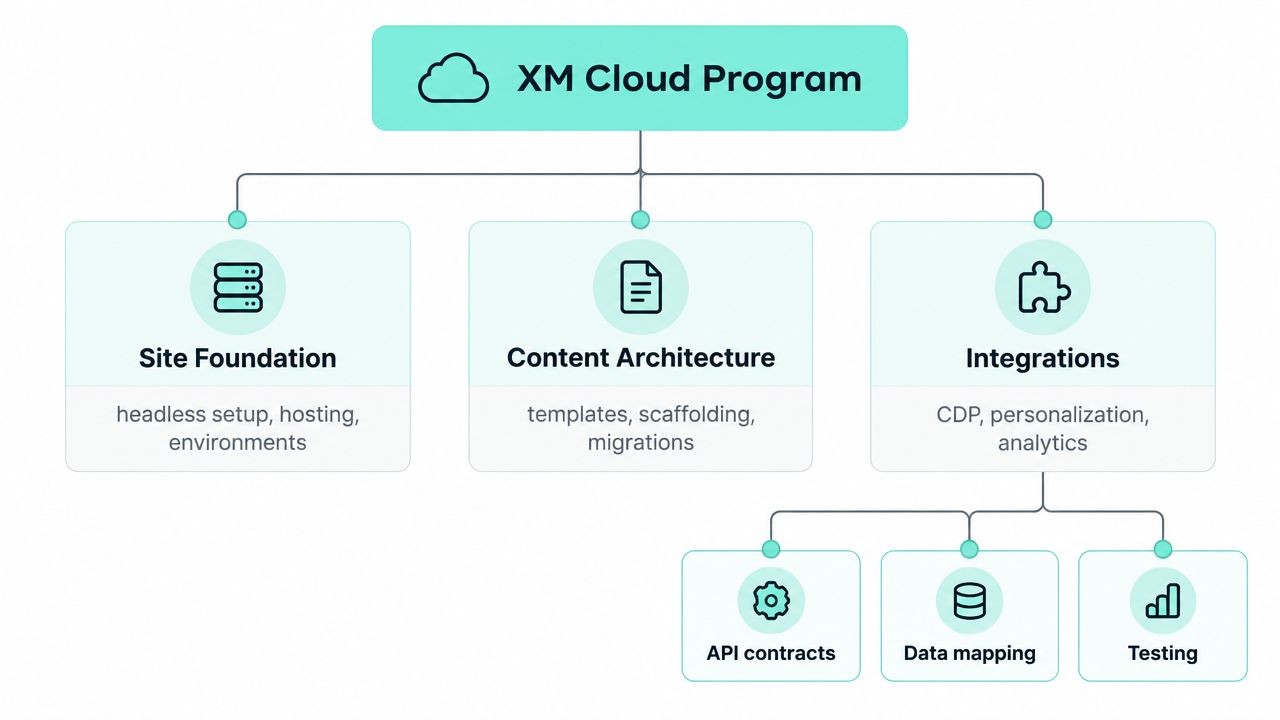
Start with the programme outcome, then create product-oriented parent packages:
- Site foundation: tenant and environment decisions, headless setup, deployment paths, security boundaries, observability, and release controls.
- Content architecture: information architecture, templates, fields, taxonomy, authoring roles, component scaffolding, migration rules, and editorial validation.
- Experience delivery: Next.js routes, Helix-based component libraries, design-system alignment, responsive behaviour, accessibility, analytics events, and browser assurance.
- Search and data products: source onboarding, API contracts, indexing rules, relevance decisions, update handling, monitoring, and Search consumption governance.
- Personalisation and insight: CDP data mapping, identity assumptions, audience definitions, Personalize decision logic, consent treatment, test scenarios, and reporting.
- Launch and operations: content freeze, migration rehearsal, cutover, rollback, support procedures, training, and post-launch optimisation.
Map epics to demonstrable platform outcomes
An epic such as “personalised product discovery” needs features with distinct evidence. One feature can establish CDP identity and data mapping. Another can define segments, while a third implements Personalize decisioning. Stories beneath those features should cover configuration, content dependencies, consent behaviour, test data, analytics, and operational ownership. These dependencies often consume more delivery time than the configuration itself.
The same discipline applies to a headless build. “Build Next.js front end” is a container, not a reliable estimate. Break it into route patterns, rendering behaviour, component variants, authoring controls, API integration, performance assurance, accessibility checks, and release validation. For implementation detail, see our guide to implementing a headless site with JSS in XM Cloud. Keep reusable Helix components separate from brand-specific presentation so the hub-and-spoke model remains visible in the WBS.
Include the SaaS operating model
SitecoreAI is presented as an AI-centred, composable SaaS platform that unifies content, data, personalisation, search, and operations. The announcement also describes Agentic Studio with 20+ out-of-the-box agents, creating an AI workflow layer rather than limiting the platform to conversational features or content generation. Plan packages for use-case selection, permissions, review controls, prompt or workflow governance, human approval, and operational monitoring. “Enable AI” is too broad to estimate or govern. These details appear in the SitecoreAI overview.
A 2026 industry overview says SitecoreAI consolidates XM Cloud, Content Hub, Search, Personalize, CDP, and Stream in one platform. Another analysis says SitecoreAI Pathway is marketed as reducing migration time by roughly two-thirds through automated content and schema conversion. Treat that positioning as a planning input, not a delivery promise. Retain packages for source assessment, exception handling, validation, and editorial sign-off. The consolidation and migration positioning are described in this SitecoreAI analysis.
Structuring SharePoint Online and Intranet Deliverables
SharePoint Online decomposition starts with employee workflows rather than customer journeys. An intranet may need news, policies, departmental spaces, search, events, service requests, approvals, and Teams or Viva integration. Each capability crosses content, permissions, information architecture, user experience, and Microsoft 365 administration.
Microsoft describes the SharePoint Framework, or SPFx, as a page and web part model for client-side SharePoint development that also supports extending Microsoft Teams and Microsoft Viva. Its SPFx overview makes the distinction important for estimation. A web part package covers client-side UI, configuration, data retrieval, responsive behaviour, and testing. A Power Platform workflow adds trigger conditions, connectors, security, error handling, ownership, and support procedures.
Compare the work by platform
| Platform | Primary Component Focus | Integration Work Packages | Governance Tasks |
|---|---|---|---|
| SitecoreAI or XM Cloud | Headless routes, Helix components, content models, search, personalisation | CDP, Personalize, Search, analytics, identity, external APIs | Brand rules, editorial roles, release controls, consent, localisation |
| SharePoint Online | SPFx web parts, pages, libraries, Viva surfaces, employee workflows | Microsoft Graph, Teams, Viva, Power Platform, identity, line-of-business data | Permissions, retention, ownership, approval flows, information architecture |
An SPFx work package should state whether the component reads SharePoint lists, Microsoft Graph, a Power Platform endpoint, or an external service. “Build employee directory” doesn't tell a developer whether profile data is authoritative, how access is filtered, or what happens when records are incomplete. Those decisions belong in decomposition before estimation.
Make inclusion part of the component
Bilingual intranets need localisation at the component level. Define language behaviour, fallback content, translated metadata, navigation rules, and editorial responsibility alongside each relevant component. Don't create a final “translate intranet” task and assume it covers every page, label, notification, and workflow message.
Accessibility follows the same principle. WCAG-aware design should influence component states, keyboard interaction, labels, focus treatment, contrast decisions, and content authoring guidance from the beginning. SharePoint's employee audience also makes permissions a functional requirement. A page can be technically complete and still fail if the intended audience can't discover or use it.
A marketing DXP usually optimises for customer journeys, brand expression, and campaign publishing. SharePoint decomposition must give equal weight to information findability, secure collaboration, employee roles, and the Microsoft 365 operating environment.
Capturing Hidden Governance and Cross-Cutting Work
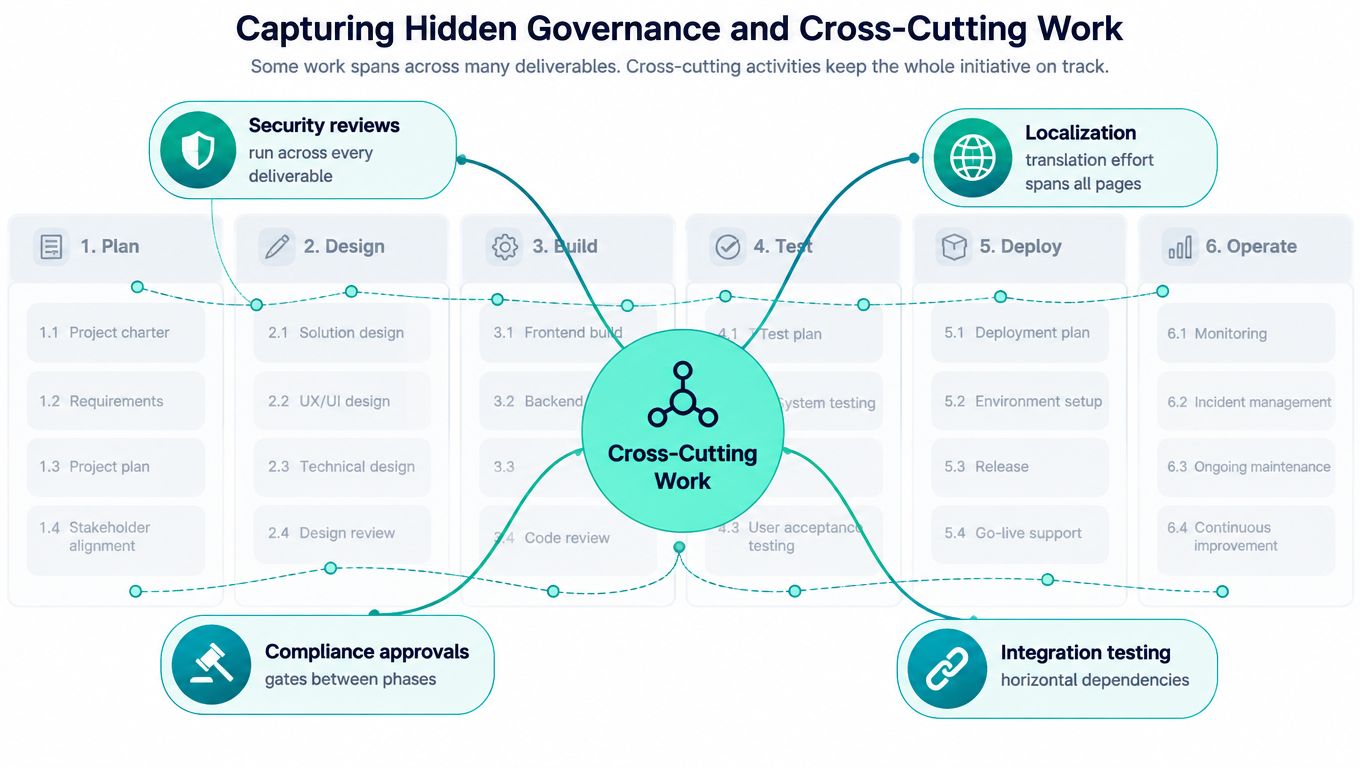
The most damaging WBS omission is work that doesn't belong neatly to one visible deliverable. A team can assign owners to page templates, search indexes, migration batches, and SPFx components while leaving security, legal review, stakeholder communication, QA, localisation, and integration assurance floating between workstreams.
Those activities aren't overhead in the dismissive sense. They change whether the deliverables can be released.
Give horizontal work a visible home
There are two workable modelling patterns. Create a dedicated parent node for cross-cutting work, or distribute the effort across deliverables with an explicit cross-reference and accountable owner. The first pattern gives leadership a clear governance budget. The second keeps effort close to the item being delivered. Large programmes often need both.
A cross-cutting parent node might contain:
- Security and compliance: threat review, permissions validation, consent decisions, data handling, and approval gates.
- Quality assurance: test strategy, shared test data, regression coverage, accessibility validation, integration testing, and defect triage.
- Localisation: translation workflow, terminology decisions, language fallback, regional content ownership, and release coordination.
- Stakeholder communication: workshops, decision records, demonstrations, training, escalation paths, and change management.
- Platform operations: deployment standards, monitoring, incident ownership, service transition, documentation, and support readiness.
The content governance framework guidance is useful when teams need to turn editorial responsibility into named roles and repeatable controls. The key is to link governance activities to release evidence. A compliance review isn't complete because a meeting occurred. It's complete when the required decision, record, and remediation status exist.
Model integration as a relationship
Visible deliverables describe things the team can point at. Integration work describes relationships between those things. A search index depends on source data quality, schema mapping, update behaviour, relevance decisions, and monitoring. Personalisation depends on identity, consent, audience data, content variants, decision logic, and analytics. SharePoint workflows depend on permissions, triggers, connector behaviour, exception handling, and business ownership.
Practical rule: If a deliverable can fail because another team, system, or approval chain hasn't acted, model that dependency as work.
This approach protects the delivery margin because it prevents late discoveries from being labelled as rework. It also improves handover. The operations team can see who owns a connector, who reviews access, who updates taxonomy, and who responds when a source system changes.
Translating the Breakdown into Estimation and Governance
The lowest useful work package is where estimation becomes credible. Assign cost and duration to that package, record its assumptions, identify dependencies, and define the evidence required for acceptance. Roll those estimates upward to features, workstreams, and the programme, rather than estimating a large Sitecore or SharePoint epic as a single block.
A delivery lead should challenge every package with four questions:
- Who owns the result? One accountable lead must be visible, even where implementation is shared.
- What must be true before work starts? Capture data availability, design decisions, API contracts, environments, permissions, and approvals.
- What proves completion? Include test evidence, stakeholder acceptance, documentation, and operational readiness where relevant.
- What remains uncertain? Put discovery, spikes, migration exceptions, and unresolved policy decisions into the baseline as explicit work.
PMI warns that poor decomposition can produce repeated replanning, unclear assignments, scope creep, budget overruns, missed deadlines, and unusable deliverables. Its guidance on applying WBS across the project lifecycle also supports reviewing the breakdown with team leads and including administrative, approval, and uncertain-scope items before the baseline is finalised.
Govern the baseline as a living control
A WBS shouldn't be frozen before the people doing the work have tested it. Run a review with solution architects, content leads, QA, security, legal, localisation, operations, and business owners. Ask each participant to identify missing work, hidden dependencies, and acceptance evidence.
AI-driven migration can accelerate the route from source assessment to execution, but it doesn't remove accountability. SitecoreAI Pathway's marketed migration reduction, described as roughly two-thirds, may compress content and schema conversion effort, yet teams still need packages for source quality, exceptions, validation, redirects, author review, and cutover. Automation changes the shape of the work. It doesn't make governance disappear.
For enterprise DXP programmes, decomposition is a commercial control as much as a planning technique. It protects the baseline, makes trade-offs visible, and gives marketing and IT a shared view of what “ready to launch” means.
Kogifi helps enterprise teams decompose and deliver Sitecore XM Cloud, SitecoreAI, and SharePoint Online programmes with explicit ownership, dependencies, governance, and integration work packages. Visit Kogifi to discuss a practical delivery structure for your next DXP migration, composable build, or intranet programme.