


A citizen starts with a simple task, maybe renewing a permit, checking housing support, or finding the right benefits form. Instead, they hit a portal with broken links, different logins, duplicate forms, and a call center queue that sends them back to the website. That is where public sector digital transformation starts, with a service failure that wastes time on both sides of the counter.
Government teams are under pressure to fix that experience while modernizing platforms that were never designed for today's service model. The work is less about a shiny front end and more about reducing friction across identity, content, case handling, and data sharing. That requires a clear digital transformation strategy and a platform plan that can survive procurement cycles, security review, and inherited technical debt.
The technology choice matters because public services are judged by outcomes, not roadmaps. A composable DXP such as Sitecore can separate content, personalization, and delivery so teams can improve one layer without breaking the rest, while Microsoft collaboration tools can reduce the internal bottlenecks that slow service updates and interdepartmental approvals. For a practical framing of that strategy side, Kogifi's own overview of digital transformation strategy is a useful companion to the platform decisions that follow. For a broader civic lens, the smart city perspective in Beyond Surplus's smart city IT guide shows how government service design, infrastructure, and resident experience increasingly move together.
The goal is straightforward. Fewer dead ends for residents, less rework for staff, and a digital foundation that can support better service delivery without forcing agencies to rebuild everything at once.
Table of Contents
- What Public Sector Digital Transformation Really Means
- Why the business case keeps growing
- What usually blocks progress
- Sitecore XM Cloud for citizen journeys
- Sitecore XP for controlled complexity
- SharePoint Online for internal modernization
What Public Sector Digital Transformation Really Means
A resident does not think in terms of back-end systems. They know they submitted the same information twice, waited too long for a response, and still do not know which department owns the case. That gap between public need and service reality is where public sector digital transformation starts.
At its simplest, the phrase means replacing fragmented, manual, and department-centered service delivery with connected digital services that are easier to find, faster to use, and safer to operate. In practice, that includes citizen portals, digital identity, shared data layers, self-service workflows, and internal collaboration tools that help staff work from the same information. It is not just going digital. It is redesigning how government works from intake to resolution. For a practical definition and delivery lens, see Kogifi's digital transformation strategy guide.
The urgency comes from where the market has been headed. As noted earlier in Statista, spending on digital transformation has reached a very large scale, and that matters to government because cloud-native platforms are now the default infrastructure for modern service delivery. Public agencies cannot treat modernization as a side project anymore.
That same pressure shows up in citizen expectations. People compare government portals with banking apps, retail checkouts, and digital onboarding flows that feel immediate and guided. If an agency still asks citizens to print, scan, mail, and repeat data entry, it is not only inefficient, it is visibly out of step with the rest of digital life.
A useful way to frame the shift is as a service redesign problem with technology as the enabler. The tools matter, but the outcome is what counts, fewer handoffs, cleaner data, better accessibility, and a service journey that makes sense to the person using it. Sitecore helps on the external experience side, especially when agencies need a composable DXP that can support content, personalization, and multilingual service delivery without locking every change into one release cycle. SharePoint helps on the internal side, where staff need shared documents, controlled collaboration, and a clearer path through approvals and case work.
The operational trade-offs are real. A portal can look modern and still fail if the back office remains fragmented. A collaboration suite can improve staff productivity and still leave citizens repeating the same facts across departments. Strong programs connect both layers, citizen-facing journeys and internal workflows, so the service improves in ways residents can feel and staff can sustain.
Practical rule: if the citizen still needs to understand your org chart to complete a task, the transformation has not reached the service layer yet.
A good reference point is Beyond Surplus's smart city IT guide for how civic technology choices connect to service delivery, operations, and the broader public experience.
Core Drivers and Toughest Barriers
A resident starts an online permit request, uploads documents on a phone, then gets forced back into a paper trail or a call center. That gap is why public sector digital transformation keeps getting attention. Citizens expect government services to work with the same clarity they get from consumer platforms, and agencies are under pressure to deliver that experience without adding friction.
Efficiency is the other driver. Agencies have to do more with legacy budgets, smaller teams, and rising demand, so they need platforms that cut duplicated work and keep staff on higher-value tasks. Digital transformation is also about internal productivity, faster access to knowledge, and fewer manual steps between intake and resolution. Sitecore helps on the citizen-facing side when a department needs a composable DXP for content, personalization, and multilingual delivery. SharePoint helps on the internal side, where teams need shared documents, controlled collaboration, and a clearer path through approvals and case work.
Why the business case keeps growing
The challenge is that delivery has not kept pace with ambition. Only 35% of companies worldwide reported succeeding in their digital transformation goals in 2021, up from 30% in 2020, according to Mooncamp's statistics roundup. That gap matters even more in government, where procurement complexity, technical debt, and interoperability requirements slow change and make programs more fragile.
Public agencies also carry a heavier trust burden. A service has to be fast, secure, auditable, privacy-aware, and explainable. That creates a hard balance, because the same program has to satisfy residents, compliance teams, procurement officers, and operational staff at once. Understanding the common reasons for the failure of a project is the first step to avoiding them, especially in public sector work where weak governance and unclear ownership can stall delivery before users ever see a benefit.
Government modernization fails most often when teams treat it like a software install. It is an operating-model change, with software as one part of the answer.
What usually blocks progress
Legacy systems are the obvious blocker, but siloed decision-making can do just as much damage. One team wants a new portal, another owns identity, another owns records, and another owns security review. Without shared governance, each group optimizes for its own risk profile, and the citizen gets the weakest version of the journey.
For practical disposal and end-of-life hardware planning, mastering public sector ITAD and recycling is relevant because modernization often includes responsible decommissioning, not only launching new systems. That detail is easy to miss in a roadmap, yet it matters when agencies are clearing infrastructure, managing compliance, and retiring aging estates.
The smartest way to read these barriers is as a chain. Procurement delays slow architecture decisions, architecture choices lock in legacy coupling, and coupling makes governance more cautious. The program then drifts from transformation into maintenance.
A clean strategy has to break that chain early. The work needs a migration model that lets the agency move in controlled phases and prove value without betting the whole program on one release.
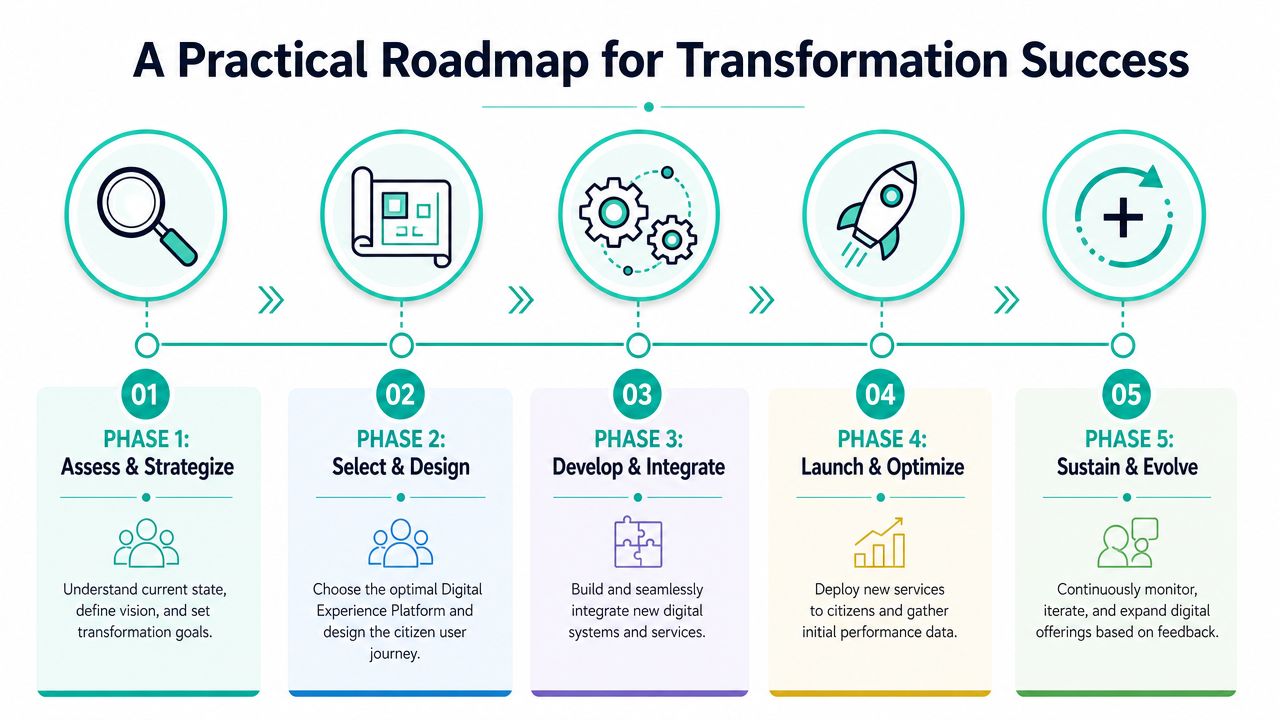
A Practical Roadmap for Transformation Success
A workable roadmap starts with the current estate, not the future vision. The first question is what systems exist, how they connect, and which ones carry the most operational risk. A government team that skips that inventory usually ends up funding the loudest problem instead of the most important one.
Strategy and governance
Strategy has to translate into service outcomes. That means defining which journeys matter most, what “good” looks like for citizens and staff, and which service lines should move first. If the program can't name the user problem, the roadmap is too abstract.
Governance then decides how the work will survive the organization. Cross-department steering, clear product ownership, and funding tied to service outcomes matter more than one-off project approvals. McKinsey's public-sector guidance also stresses coordination of IT investments, better use of data, and redesign around the end user, which lines up with a shared-platform model rather than isolated departmental builds, as shown in its public-sector digitization guidance.
Practical rule: if no single owner can say yes or no to a change, the program will drift into committee-based delay.
Architecture and migration
A robust modernization program should run in phases. First inventory all systems and dependencies, then prioritize each application by risk and value, and only then choose among replacement, replatforming, or retirement, according to Elastic's public sector modernization guidance. That sequencing reduces delivery risk because legacy estates often have hidden coupling, and hidden coupling is what turns a migration into an outage.
The practicalities of platform choice come into play. Citizen-facing journeys often need a composable DXP, while internal collaboration and records-heavy work may fit Microsoft 365 and SharePoint better. The right answer is usually not one tool for everything, it's a clean division of responsibilities across the service stack.
Accessibility and security
Security and accessibility can't be bolted on late. They need to shape design, content models, permissions, and publishing workflows from day one. If authors can publish inaccessible pages or if access control is inconsistent across systems, the transformation moves old risk into a new interface.
The goal is controlled modernization, not heroic replacement. Agencies that phase the work, standardize the architecture, and define ownership early tend to preserve continuity while still improving the experience people feel.
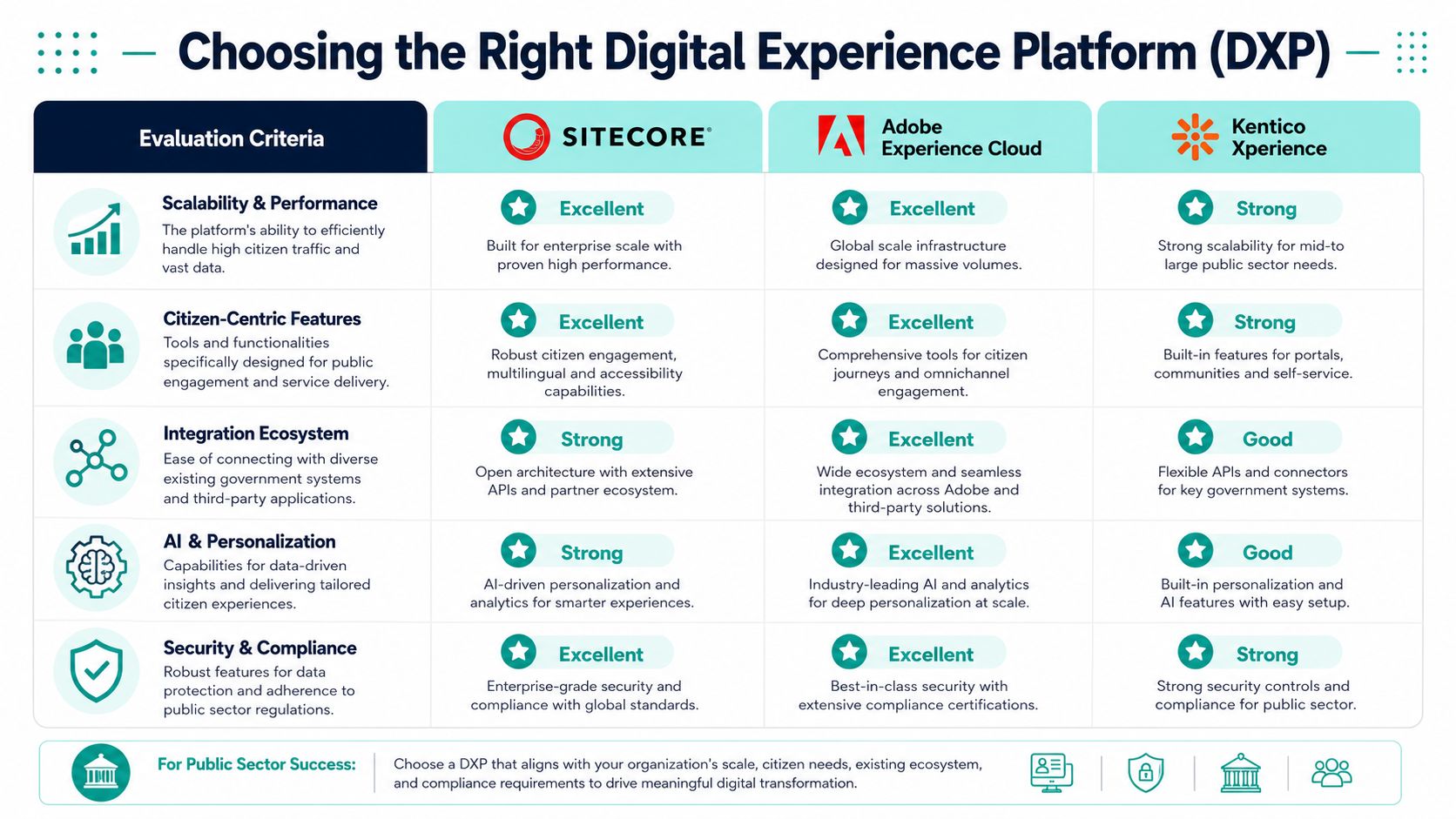
Choosing the Right Digital Experience Platform
Public sector teams usually don't need more features, they need fewer compromises. The key question is which platform fits the service model, the data environment, and the pace at which the agency can operate. For many government programs, Sitecore and SharePoint solve different parts of the same problem.
Sitecore XM Cloud for citizen journeys
Sitecore XM Cloud fits agencies that need a cloud-native, composable experience layer with room for personalization, faster release cycles, and cleaner operational boundaries. It works well when the public-facing portal has to serve many services, many audiences, and frequent content updates without dragging the whole stack into a monolith.
Sitecore XP for controlled complexity
Sitecore XP still makes sense where deep marketing-style orchestration, mature content operations, or existing investments in that ecosystem matter. It's useful when the agency needs strong experience management and is prepared to support a more established deployment model.
SharePoint Online for internal modernization
SharePoint Online is the practical answer for intranets, employee knowledge, policy distribution, and internal service portals. It pairs well with Microsoft 365, Power Platform, and workflow automation, which is why it's often the faster route to unify communication and reduce internal fragmentation.
The platform comparison below is useful because it keeps the decision grounded in public sector needs instead of vendor slogans.
| Feature | Sitecore XM Cloud | Sitecore XP | SharePoint Online |
|---|---|---|---|
| Deployment model | Cloud-native SaaS | Traditional or managed platform | Cloud SaaS |
| Personalization | Strong, composable delivery | Strong, mature orchestration | Limited for external citizen journeys |
| Governance | Good for standardized, multi-site control | Good in established operating models | Strong for Microsoft-centered collaboration |
| Public-facing portals | Excellent fit | Good fit | Limited fit |
| Internal intranet and knowledge management | Not the primary use case | Not the primary use case | Excellent fit |
KPMG's 2024 UK public-sector research reports that organizations plan to prioritize moving applications to the cloud (82%) and boosting cybersecurity (81%) over the coming year, which aligns closely with this platform split and with KPMG's public-sector maturity report. Cloud migration and security are the operational center of gravity, not side benefits.
For teams evaluating their broader option set, Kogifi's platform comparison guidance is useful because it frames the trade-offs in implementation terms, not just feature lists. The best platform is the one the agency can govern, secure, and sustain.
Leveraging Sitecore AI for Citizen-Centric Services
AI becomes valuable in government when it reduces search friction, improves relevance, and helps content teams keep up with complexity. That's where Sitecore's AI capabilities fit well, because the platform is not just a publishing layer, it can also support smarter discovery and more disciplined content operations.

Personalization that reduces wasted effort
The strongest use case is not flashy segmentation, it's helping people get to the right service faster. If a resident lands on a government site and the content adapts to their intent, location, or known journey stage, the agency can cut through the noise without forcing more forms and clicks.
That matters because public services are often overloaded with generic pages that answer too many questions at once. Personalization gives the site a chance to narrow the path, especially when citizens are looking for one thing, eligibility, next steps, or contact details.
Practical rule: use personalization to remove unnecessary choices, not to decorate the homepage.
Search and content operations
AI-powered search is just as important. Government sites tend to grow large fast, and conventional navigation breaks down when users don't know the departmental language. Semantic search can better handle natural-language queries and steer people toward the right page, form, or service hub.
Content teams also need help behind the scenes. Automated tagging, suggested metadata, and content-quality assistance reduce the burden on authors who are trying to keep service pages current while also meeting accessibility and governance standards. Sitecore AI thus functions as a practical productivity layer, not a novelty feature.
For teams thinking about implementation patterns, real-time personalization guidance is relevant because government use cases depend on controlled relevance, not uncontrolled experimentation. The same logic applies to service guidance, where trust matters as much as speed.
A short video example helps show how digital connectivity and service delivery come together in public-sector environments.
Sitecore AI should be judged by whether it lowers effort for residents and staff. If it improves search precision, keeps content fresher, and helps authors publish cleaner pages, it's doing real work. If it only produces more noise, it's just adding another layer of complexity.
Real-World Use Cases and Measuring Success
The cleanest use cases in government are the ones that remove repetition. A unified citizen portal with single sign-on lets people move between services without reintroducing themselves at every step, and a multilingual service finder helps diverse communities reach the right pathway without dead ends. Internal teams need the same kind of simplification, which is why a SharePoint-based knowledge base often makes more sense for employee-facing content than a scattered document library.

The once-only model
McKinsey identifies the “once only” principle as a key transformation mechanism, where governments prefill forms so users only enter information once, and that requires an integrated data management regime across the public sector, as described in its digital public services guidance. That's one of the clearest examples of public sector digital transformation turning back-end integration into a visible citizen benefit.
It also shows why content and platform design can't be separated from data architecture. If systems can't share data safely, the citizen pays the price in repeated entry and avoidable effort.
Measuring whether it worked
Success needs operational proof, not vanity metrics. The most useful measures are the ones tied directly to service delivery, such as fewer handoffs, less manual rework, smoother self-service, and faster completion of common tasks. Internal adoption matters too, because if staff keep bypassing the new process, the transformation has only reached the surface.
A government team can also use AI and workflow tools to support discovery and procurement activity. For example, AI for Government Contracts is relevant for teams trying to identify opportunities and reduce the time spent searching fragmented sources.
A strong measurement set usually includes:
- Service completion quality: whether citizens finish the journey without dropping out or being redirected.
- Operational burden: whether staff spend less time on repetitive queries and manual data handling.
- Content freshness: whether service pages stay accurate after policy or process changes.
- Trust and usability: whether people can find, understand, and use the service without outside help.
The point is simple. If the portal looks modern but the support desk still carries the same load, the transformation hasn't yet reached the business process. If the portal, data layer, and internal tools all move together, the result is visible in both the user journey and the operating model.
Partnering for a Successful Transformation
Public sector modernization succeeds when strategy, platform choice, and delivery discipline line up. Sitecore is the right fit for citizen-facing experience, SharePoint is a strong fit for internal collaboration and knowledge, and neither one delivers value without governance, migration planning, and steady execution. The agencies that move fastest usually do the least guessing.
Kogifi works in that middle layer where architecture decisions become live services. The practical value is in implementation, migration, support, and platform operations across Sitecore and Microsoft 365/SharePoint, especially when the goal is to reduce risk while improving service quality. For government teams, that combination matters more than any single feature list.
If your program is still stuck between legacy constraints and a long list of modernization ideas, now's the time to turn the plan into a phased delivery model and pick the platform mix that fits the service you need to run.
A CTA for Kogifi.