


You're probably in the middle of a familiar argument. Finance wants to know why the DXP line item keeps growing. Marketing wants faster launches, personalization, and less waiting on IT. Security wants supported software, not another exception memo. And your platform team is stuck answering the same question in every steering meeting: should we buy outright, or should we subscribe?
For enterprise DXPs, that question isn't about preference. It decides how quickly your teams can ship, how much technical debt you tolerate, and how exposed you are when your platform falls behind the business. In Sitecore and SharePoint estates, the licensing model shapes architecture, support boundaries, upgrade cycles, integration velocity, and governance overhead just as much as it shapes budget.
If you need a practical definition of the broader platform category, this overview of a digital experience platform is a useful baseline. The important point is simpler. In subscription vs perpetual decisions, most enterprises still focus too narrowly on upfront cost. That's the wrong frame. The core decision is whether you want to fund continuous capability, or own a version that starts aging on day one.
Table of Contents
- Use perpetual sparingly and only for low-change capabilities
- Use subscription where business change is constant, but control it hard
- Make the decision at capability level
The High Stakes of DXP Licensing Decisions
A DXP licensing choice looks harmless when it sits inside a procurement spreadsheet. One column shows a larger upfront payment. The other shows a recurring annual fee. That framing hides the actual impact. In practice, you're deciding how your organization will consume innovation, manage supportability, and absorb change over the next several years.
For a CIO, the tradeoff isn't just CapEx versus OpEx. It's control versus agility, but even that oversimplifies it. A perpetual license gives you ownership of a defined software version. A subscription gives you access to a service that keeps evolving. In customer-facing platforms, especially those tied to personalization, search, analytics, and workflow automation, evolution usually matters more than ownership.
That's why the subscription vs perpetual debate becomes sharper in Sitecore and SharePoint environments. Your customer journey doesn't stand still. Your intranet requirements don't stand still. Identity systems, compliance controls, AI features, frontend frameworks, and integration patterns change constantly. If the platform model slows your ability to adapt, the software may still be licensed, but it stops being strategically useful.
Practical rule: If the platform directly supports customer acquisition, content operations, employee productivity, or regulatory workflows, licensing is a risk decision before it's a finance decision.
Leadership teams often underestimate the compounding effect of delay. A postponed upgrade becomes a missed feature. A missed feature becomes another customization. Another customization becomes a more complex future migration. That's how a seemingly prudent perpetual purchase turns into an expensive operating constraint.
The strongest licensing decisions align with business rhythm. Stable back-office capabilities can justify a different treatment from digital channels that need constant iteration. Treating every system the same is where enterprises make avoidable mistakes.
Perpetual vs Subscription Models in the DXP Context
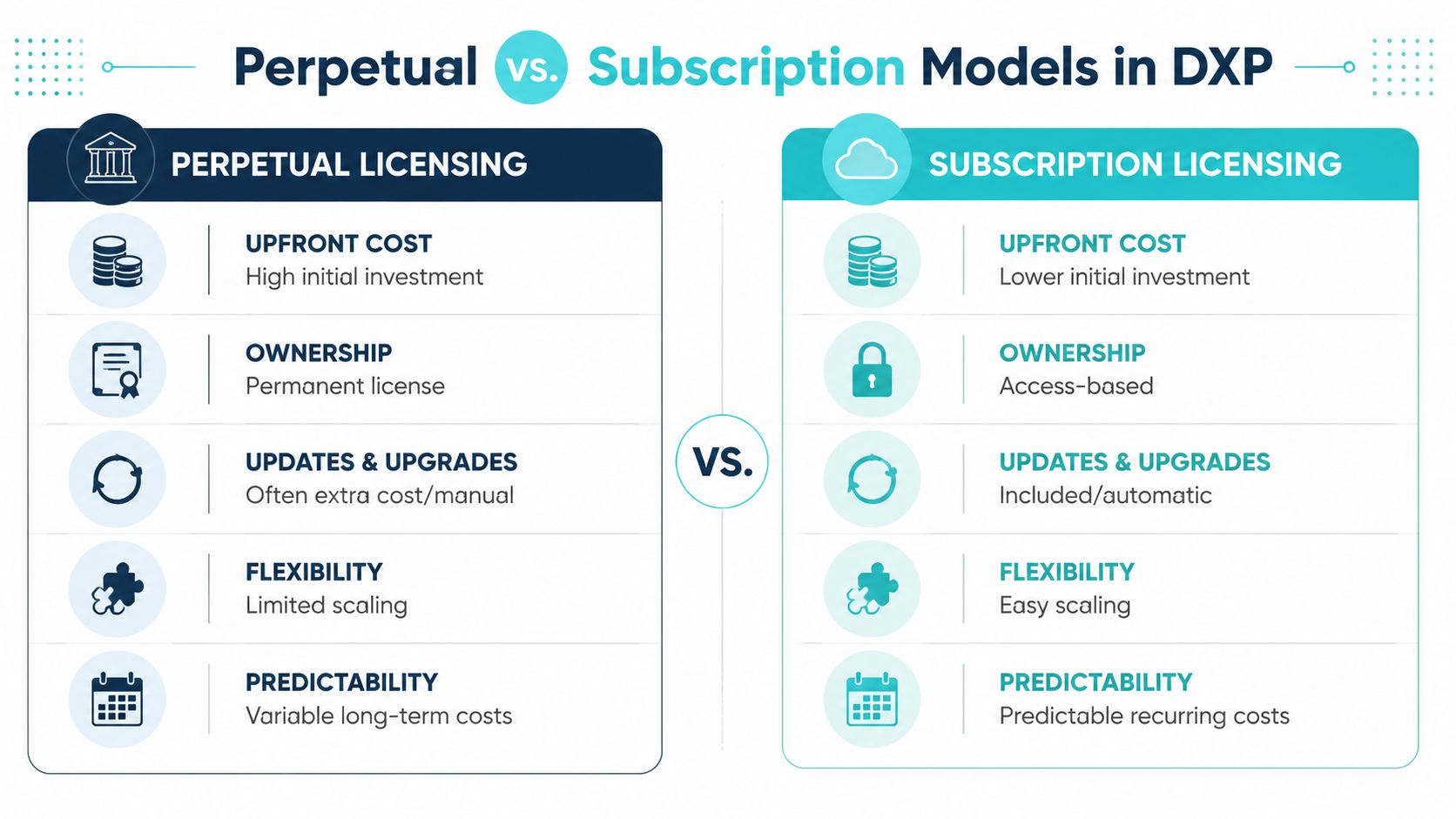
The cleanest way to evaluate subscription vs perpetual is to start with structure. Perpetual licensing buys the right to use a specific software version indefinitely. Subscription licensing buys ongoing access, usually bundled with support, updates, and cloud-delivered improvements.
A side by side view
| Licensing area | Perpetual | Subscription |
|---|---|---|
| Payment model | One-time purchase, usually followed by separate maintenance or upgrade costs | Recurring fee, typically annual or monthly |
| Rights | Ongoing use of the purchased version | Ongoing access while the agreement remains active |
| Product updates | Often manual, planned, and separately governed | Usually included and delivered continuously |
| Support | Frequently tied to an added maintenance agreement | Commonly bundled into the commercial model |
| Infrastructure fit | Often associated with self-managed hosting and tighter version control | Strong fit for SaaS and cloud-native delivery |
| Scaling | Slower to expand across changing business demand | Easier to adjust across teams, regions, and use cases |
The market has already made a directional decision. Over 70% of SaaS companies generate the majority of their revenue from recurring subscriptions, reflecting the value of predictable MRR and better cash flow forecasting in software businesses, as outlined in this analysis of subscription and perpetual licensing trends.
What this means in a DXP estate
In a DXP program, the model changes behavior. Perpetual licensing encourages version preservation. Teams become cautious about upgrades because each one affects infrastructure, integrations, custom code, and test effort. That caution is understandable, but it often becomes drift.
Subscription changes the commercial relationship. The vendor isn't just delivering software once. The vendor is expected to keep improving the service. That matters in platforms like Sitecore XM Cloud, where delivery speed, managed services, and ongoing feature releases are part of the value proposition.
Perpetual licensing still has a place. If you run a highly stable workload with a long validation cycle and tightly controlled change management, ownership can fit. But most customer-facing DXP capabilities don't behave like that. Content operations, campaign activation, personalization logic, AI enrichment, workflow automation, and front-end integration all benefit from constant improvement.
A perpetual license gives you permanence. A subscription gives you momentum. In digital experience programs, momentum usually wins.
The mistake I see most often is using a legacy purchasing mindset for a platform that the business expects to function like a modern service.
Analyzing Financial Impact TCO and ROI
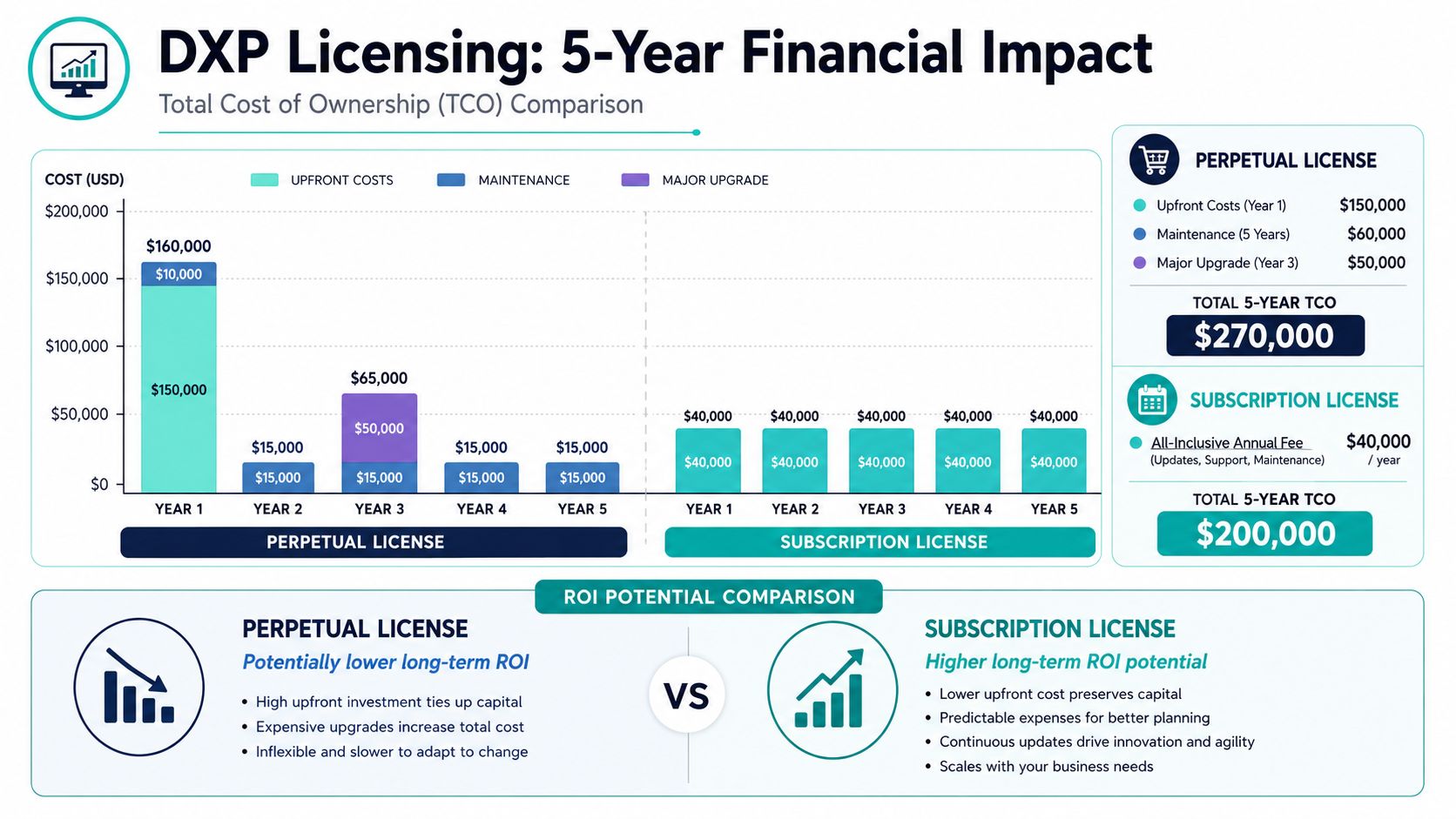
The finance discussion gets distorted because procurement teams often compare invoice shapes instead of actual operating cost. A perpetual deal looks cheaper when you focus on year one. That's not how enterprise platforms should be evaluated.
Why the one time purchase story breaks down
The long-term cost myth around perpetual licensing persists because many business cases omit the expensive parts. They count the license. They undercount the consequences of staying current.
Customers on perpetual models often absorb major version upgrades, hardware hosting, and customization work, while SaaS subscribers avoid hosting expense and receive frequent automatic updates as part of the service, as described in this breakdown of Microsoft perpetual versus subscription licensing economics.
That cost pattern matters in DXP estates because upgrades aren't isolated technology events. They pull in regression testing, integration remediation, deployment planning, security review, content freeze windows, and sometimes external specialist support. If your Sitecore XP implementation includes custom pipelines, third-party connectors, Solr tuning, identity extensions, or bespoke workflow logic, every upgrade has a real labor cost whether finance sees it or not.
Here's a practical way to evaluate TCO:
- Platform costs: License, maintenance, subscription fees, cloud consumption, and vendor support.
- Change costs: Upgrade projects, remediation of customizations, QA effort, and release management.
- People costs: Internal admin effort, specialist contractors, platform engineers, and managed service needs.
- Delay costs: Slower feature rollout, postponed integrations, and backlog growth when the platform resists change.
This is why a simple purchase-versus-rent argument fails. A DXP is not a static asset like office furniture. It's an operating platform that touches customer journeys and internal teams every day.
For readers building a business case, a DXP ROI calculator is a more useful starting point than a procurement spreadsheet because it forces you to look beyond license price alone.
A short explainer on the finance tradeoff helps frame the discussion with stakeholders:
How subscription improves the business case
Subscription doesn't automatically mean lower cost. It means clearer cost alignment. You can map spend directly to active usage, support entitlement, and delivered platform capability. That's easier to budget, easier to govern, and easier to explain to a board that wants predictable operating models.
For ROI, that matters because value delivery doesn't wait for the next upgrade cycle. Teams can adopt new features as they arrive, especially in SaaS-first products. When the platform vendor handles more of the maintenance burden, your internal team can focus on personalization, integration, content quality, search relevance, and journey orchestration instead of plumbing.
If your DXP is strategic, predictability beats the illusion of a bargain.
Technical and Operational Consequences for Teams
The licensing model shows up in the backlog long before it shows up in a board deck. IT teams feel it in patch cycles, release windows, and support tickets. Marketing teams feel it when a capability exists on the roadmap but isn't available in the current estate because the platform version is behind.
What IT inherits under perpetual licensing
Perpetual environments give infrastructure and platform teams more direct responsibility. That can be appropriate in some architectures. It also means they inherit the burden of staying supported.
In a traditional Sitecore XP deployment, that usually means planned upgrades, compatibility checks across modules, testing of custom renderings and integrations, search index validation, and operational coordination with hosting and security teams. In older SharePoint-style thinking, it often meant administrators carrying a large support obligation for environment health, add-ons, and custom solutions.
The operational consequence is straightforward:
- Upgrade projects become episodic and heavy: Teams delay them because they're disruptive.
- Security work becomes local work: Internal teams must track and apply the right remediations.
- Customizations age badly: What solved a problem two years ago often blocks modernization now.
- Release velocity drops: More time goes to platform care than business-facing change.
That's one reason enterprise teams increasingly prefer cloud delivery models. This comparison of PaaS and SaaS approaches is useful because the hosting model and the license model often reinforce each other. A perpetual license often drifts toward more self-management. A SaaS subscription usually shifts operational responsibility back toward the vendor.
What marketing gains from subscription platforms
Marketing doesn't care about licensing language. Marketing cares about how long it takes to launch a page, test a journey, or roll out a new capability across regions. Subscription platforms, especially SaaS products like Sitecore XM Cloud, support that pace better because new capabilities arrive without the same upgrade drag.
The benefit isn't abstract. Automatic updates, managed security, and a stronger vendor-managed service boundary give digital teams more room to work on what users notice. Editors care about better authoring. Campaign teams care about integrations and activation. Personalization teams care about fresher data and AI-assisted decisions.
When the platform team spends less time preserving the stack, the business gets more time to improve the experience.
That doesn't mean subscription removes effort. It changes effort. Teams still need governance, release discipline, integration design, and architecture standards. But the work shifts from technical preservation to business enablement, which is where a DXP team should be spending its time.
Licensing Strategies for Sitecore and SharePoint
The generic subscription vs perpetual debate becomes less useful. Sitecore and SharePoint sit in different vendor ecosystems, and the right answer depends on how those ecosystems deliver value.
Why Sitecore AI fits a subscription model
For Sitecore, the center of gravity has moved toward cloud-native, composable, subscription-led delivery. That's not just a commercial decision. It's an architectural one.
Sitecore AI depends on continuously available data, identity reconciliation, business semantics, and activation pipelines. Its Customer 360 architecture follows a five-stage process of raw data ingestion, identity resolution, semantic business logic modeling, curated view creation, and AI-powered activation, enabling a unified golden record for personalization, as explained in this overview of Sitecore Customer 360 architecture.
That architecture doesn't sit comfortably inside a static ownership mindset. It benefits from a delivery model where data services, AI capabilities, orchestration layers, and platform services keep evolving together. In practice, that makes Sitecore XM Cloud and the broader composable portfolio a much stronger fit for subscription than for legacy perpetual thinking.
A few implications matter for CIOs:
- Customer data value depends on freshness: If identity and activation services lag, personalization quality falls.
- AI capability is cumulative: The platform improves when the vendor can deliver ongoing service enhancements.
- Composable stacks reward managed evolution: Frontend, CMS, search, and data services need cleaner coordination than monolithic estates.
If you're evaluating the platform direction itself, the Sitecore platform portfolio gives the clearest picture of how the product family is structured today.
Why SharePoint makes sense inside Microsoft 365
SharePoint is different. Its real value doesn't come from buying document management in isolation. It comes from operating inside Microsoft 365, where SharePoint Online works with Teams, Power Automate, Power Apps, OneDrive, Entra-connected identity, and the broader governance model of the tenant.
That's why a perpetual framing is usually the wrong mental model for modern SharePoint. The benefit comes from the service ecosystem, not from locking a static platform version in place. Intranet search, employee communications, approvals, document workflows, forms, and collaboration patterns all improve when they're tied to the subscription suite that people already use.
For enterprise governance, this only works if procurement and platform ownership are disciplined. Subscription flexibility without policy becomes sprawl. Enterprises should pair platform decisions with a clear operating model for approvals, ownership, lifecycle, and entitlements. This guide to establishing strong corporate governance is relevant because digital platforms fail as often from weak decision rights as from weak technology.
Sitecore should be licensed in line with innovation cadence. SharePoint should be licensed in line with ecosystem value.
Those are not the same thing, but both point toward subscription-first thinking for most modern enterprise scenarios.
A Modern Decision Framework for Your DXP Investment
A CIO signs a low annual subscription because it looks flexible. Eighteen months later, the estate includes duplicate environments, overlapping add-ons, unclear ownership, and a renewal bill nobody can explain. Another CIO buys perpetual rights to avoid recurring cost, then funds a major catch-up program three years later because the platform can no longer support the security, integration, and experience requirements of the business.
Both teams made the same mistake. They treated licensing as a purchasing decision instead of an operating model decision.
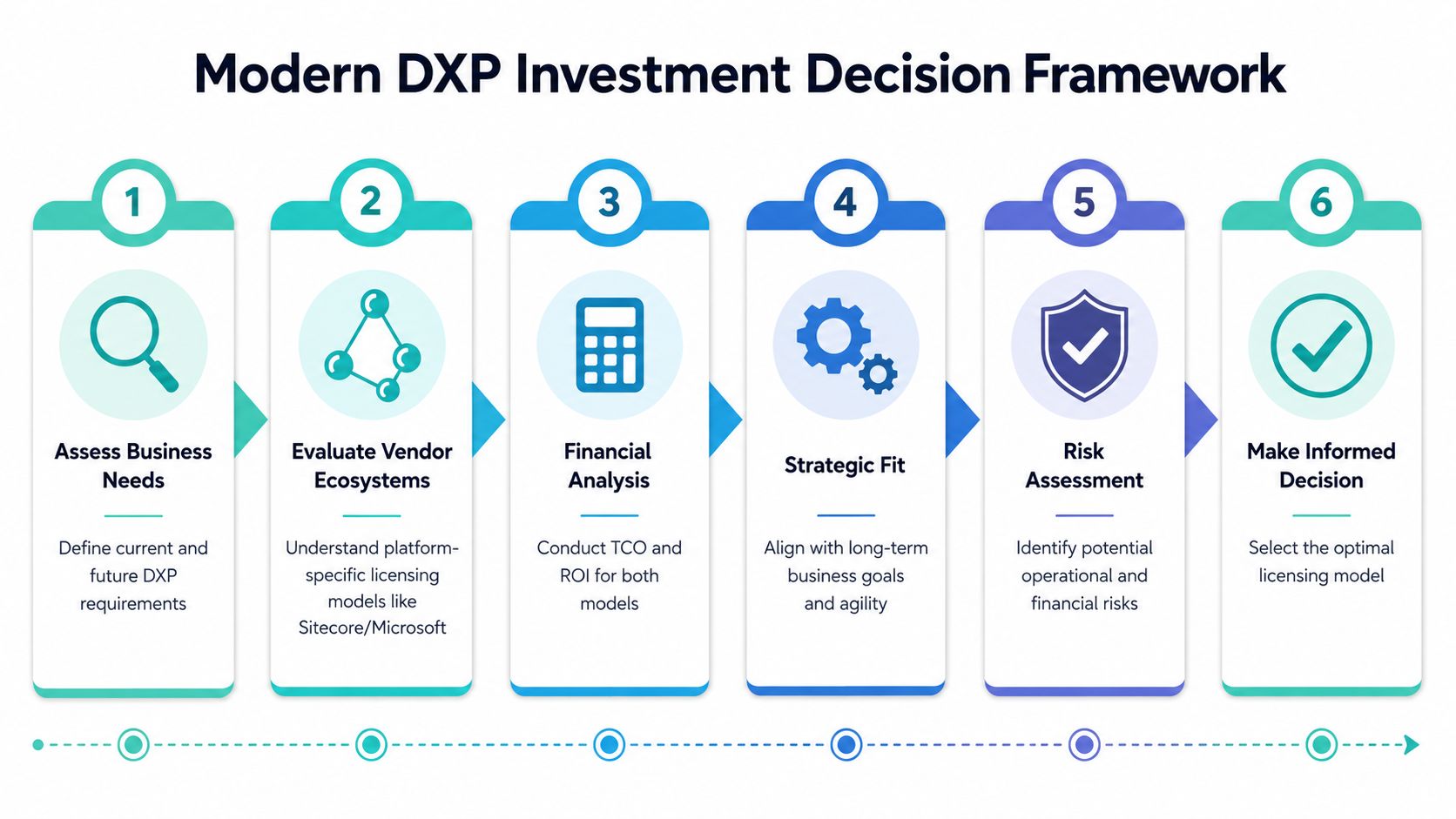
The right framework for enterprise DXP investment is hybrid by design and strict in governance. Use perpetual only where change is slow, business exposure is low, and your team can support the platform without creating upgrade debt. Use subscription where business value depends on release cadence, cloud services, integration change, and vendor innovation. Then put controls around both.
Use perpetual sparingly and only for low-change capabilities
Perpetual licensing still has a place. It fits tightly bounded workloads with stable requirements, long validation cycles, and limited pressure to adopt new platform services.
That rarely describes the parts of the estate that shape customer experience.
For Sitecore, perpetual logic breaks down quickly once the platform is tied to personalization, search, experimentation, content operations, or composable services. Those capabilities change with the business. If your digital roadmap depends on faster launches, better data use, or new channel support, a static licensing posture creates a cost that never appears on the original quote. You save on annual fees and pay later in delayed delivery, complex upgrades, and architectural rework.
That is the cost of stagnation. It is operational, not just financial.
Use subscription where business change is constant, but control it hard
Subscription should be the default for capabilities that need regular enhancement and vendor-led improvement. That includes most modern Sitecore cloud and composable scenarios, and it includes SharePoint Online as part of Microsoft 365.
The trap is license sprawl. Teams add environments, storage, premium workflow usage, app connectors, and adjacent services faster than governance catches up. The commercial model stays flexible. The estate becomes messy.
SharePoint is the clearest example. The platform works best when it is treated as part of the Microsoft 365 service stack, not as a standalone product line. That improves collaboration and reduces custom build effort, but it also means cost control depends on tenant governance. If nobody owns provisioning rules, retention boundaries, site lifecycle, and entitlement reviews, the subscription model expands unchecked beyond the value it delivers.
Make the decision at capability level
Do not choose one licensing model for the whole estate because procurement wants simplicity. Choose per capability.
A practical framework looks like this:
- Rate the business change frequency. Monthly change points to subscription. Multi-year stability can justify perpetual.
- Measure platform dependency. If the capability depends on vendor roadmap items, cloud services, or rapid security response, choose subscription.
- Calculate support ownership. If your team will struggle to patch, upgrade, host, and recover the platform well, do not buy perpetual just to reduce annual fees.
- Audit governance maturity. If you cannot track entitlements, environments, usage, and renewals cleanly, fix that before expanding subscriptions.
- Assess exit cost. Include migration effort, retraining, integration rebuilds, and contract friction, not just license price.
- Match the model to the risk. Customer-facing and revenue-affecting capabilities need agility. Back-office utilities with low change can tolerate slower cycles.
Sitecore and SharePoint usually diverge. Sitecore decisions should follow innovation demand and delivery speed. SharePoint decisions should follow tenant governance, service adoption, and control of Microsoft 365 sprawl.
Good licensing strategy follows operating reality. If the platform must change fast, fund it that way. If it must stay controlled, staff and govern it that way.
Actionable Next Steps for Platform Procurement
A weak licensing decision usually starts with a strong commercial conversation and a weak operating conversation. Procurement pushes for discount, finance pushes for predictability, and the architecture team gets asked for a sign-off after the commercial terms are already set. That sequence creates expensive mistakes in both directions. You overbuy subscription capacity you cannot govern, or you buy perpetual rights for a platform your teams will not keep current.
Fix the sequence. Put architecture, security, operations, and procurement in the same review before legal redlines start.
Questions for vendors
Use these questions in every DXP licensing review and insist on written answers:
- Support boundaries: What is included in standard support or maintenance, what response times apply, and what work is billable?
- Upgrade path: For perpetual licensing, what is required to stay on a supported version, including infrastructure changes, module compatibility, and partner effort?
- Feature access: Which capabilities are restricted to subscription, SaaS, or higher tiers, and which roadmap items will never reach the perpetual product line?
- Environment rights: How are dev, test, UAT, DR, and regional failover environments licensed?
- Usage triggers: What causes cost to rise over time, such as traffic, users, storage, API calls, environments, or add-on services?
- Exit terms: If you reduce scope, change architecture, or leave the platform, what happens to data export, configuration portability, and integration continuity?
For Sitecore, ask for a clear map of how XM Cloud, Content Hub, Search, CDP, Personalize, and AI-related services are licensed together or separately. Many CIOs underestimate cross-product licensing and end up with a composable roadmap that looks elegant in architecture diagrams and fragmented in the budget.
For SharePoint and Microsoft 365, press on storage growth, premium feature dependencies, Power Platform consumption, retention requirements, and the boundary between included capability and paid extension. License sprawl rarely starts in the core tenant. It starts in adjacent services that business teams adopt faster than central IT can govern them.
Questions for your internal team
Internal alignment matters more than vendor positioning. Ask these questions before you choose a model:
- Who owns entitlement control? Name the team responsible for license assignment, renewal tracking, environment visibility, and usage review.
- Who owns upgrade execution? If you choose perpetual, identify the budget, skills, and partner capacity required to patch and upgrade on time.
- What is the expected rate of change? A customer-facing Sitecore estate with frequent experimentation needs a different commercial model than a stable intranet or records workload in SharePoint.
- Where is operational risk highest? Customer data, identity integration, search, analytics, and workflow usually carry more downside than the license line item suggests.
- What happens in year two? Revalidate staffing, support, cloud hosting, technical debt, and governance effort, not just first-year contract value.
Be blunt in this discussion. If your team cannot control Microsoft 365 service growth, a subscription model will drift into waste. If your team cannot reliably patch and upgrade Sitecore, perpetual licensing will turn into a stagnant estate with rising security and recovery risk.
A procurement checklist should end with explicit approval across six areas: architecture fit, security obligations, support model, operating ownership, entitlement governance, and roadmap alignment. If one owner is missing, the contract is ahead of the delivery reality.
If you're weighing subscription vs perpetual for Sitecore, SharePoint, or a broader DXP estate, Kogifi can help you assess the commercial model against architecture, supportability, governance, and long-term TCO before you commit to the wrong platform contract.