


According to Gartner's 2024 marketing survey, only 14% of organizations have successfully achieved a true 360-degree customer view (LatentView). That figure changes how this topic should be discussed. A Customer 360 view isn't a standard feature you switch on in a DXP. It's a difficult enterprise capability that very few teams have built effectively.
In a Sitecore-centric environment, that distinction matters. Teams often buy modern tooling, wire up a few data sources, and assume they now have a usable customer profile for personalization. They don't. What they usually have is a partial data aggregate, a few stitched identifiers, and inconsistent activation across channels. A real Customer 360 view only starts creating value when identity, governance, activation, and authoring workflows all operate from the same trusted profile.
Table of Contents
What Is a Customer 360 View and Why Is It Elusive
A Customer 360 view is a governed customer profile that brings together identity, behavior, transactions, service history, consent status, and channel context so teams can act on the same record. In a Sitecore program, that profile has to do more than look tidy in a reporting layer. It has to support audience building, personalization, service context, analytics, and orchestration across a composable stack.
Very few enterprises get to that standard. As noted earlier, the gap is not data collection. The gap is agreeing on who the customer is, which events belong to that customer, and which system is allowed to define the current truth.
That gap shows up quickly in enterprise delivery. Marketing may identify a person by email. Commerce may key off an account ID. Service may work from a case record tied to a household or contract. Sitecore can only personalize well if those identifiers resolve into a usable profile with timing, consent, and business rules applied consistently. Without that, teams still have data, but they do not have a reliable 360.
It's a capability built across the stack
Customer 360 is an operating model supported by technology. It depends on ingestion pipelines, identity resolution, profile design, governance, and activation. Many programs stall after integration because the records arrive but remain duplicated, stale, or politically disputed across departments.
Identity resolution is usually the point of failure. Matching a website visitor, a mobile app user, a support contact, and a billing account sounds straightforward until names vary, households share devices, regions follow different privacy rules, and source systems disagree on the primary key. Rules-based matching helps, but large organizations usually need AI-assisted identity resolution to improve match confidence at scale and surface probable duplicates for review instead of forcing hard merges too early.
That issue becomes even more visible in service and trust workflows. Teams responsible for fraud, escalation handling, or support triage often need a real-time customer view for social ops because fragmented interaction trails slow decisions and increase the chance of acting on incomplete context.
Practical rule: If marketing, service, and commerce cannot trace the same person across systems and explain why the record was matched, the 360 is not production-ready.
Why Sitecore teams often misjudge readiness
Sitecore is often blamed for problems that start upstream. A composable Sitecore ecosystem can activate a unified profile well, but it does not master customer identity by itself. The same applies to CRM and CDP platforms. They each play a role, but none should be mistaken for the whole solution. A clear CDP vs CRM comparison helps clarify why campaign activation and relationship management are different from identity-centered unification.
The platform choice also affects who the 360 is for. Sitecore is the right place to use unified customer data for external experience delivery, personalization, journey orchestration, and content decisions. SharePoint serves a different purpose. It can expose internal-facing customer context to sales, service, or operations teams, but it is not the system that should resolve identities or own mastered profiles. Teams get into trouble when they treat SharePoint as the 360 repository rather than the internal consumption layer.
The pattern that works is more disciplined. Define a canonical profile. Set match rules and confidence thresholds. Add stewardship for exceptions and merge disputes. Track consent and regional policy at the profile level. Then push only the fields each channel needs into Sitecore and internal tools. That is how a Customer 360 becomes usable, trusted, and governable in an enterprise environment.
Defining Business Value and Measuring C360 Success
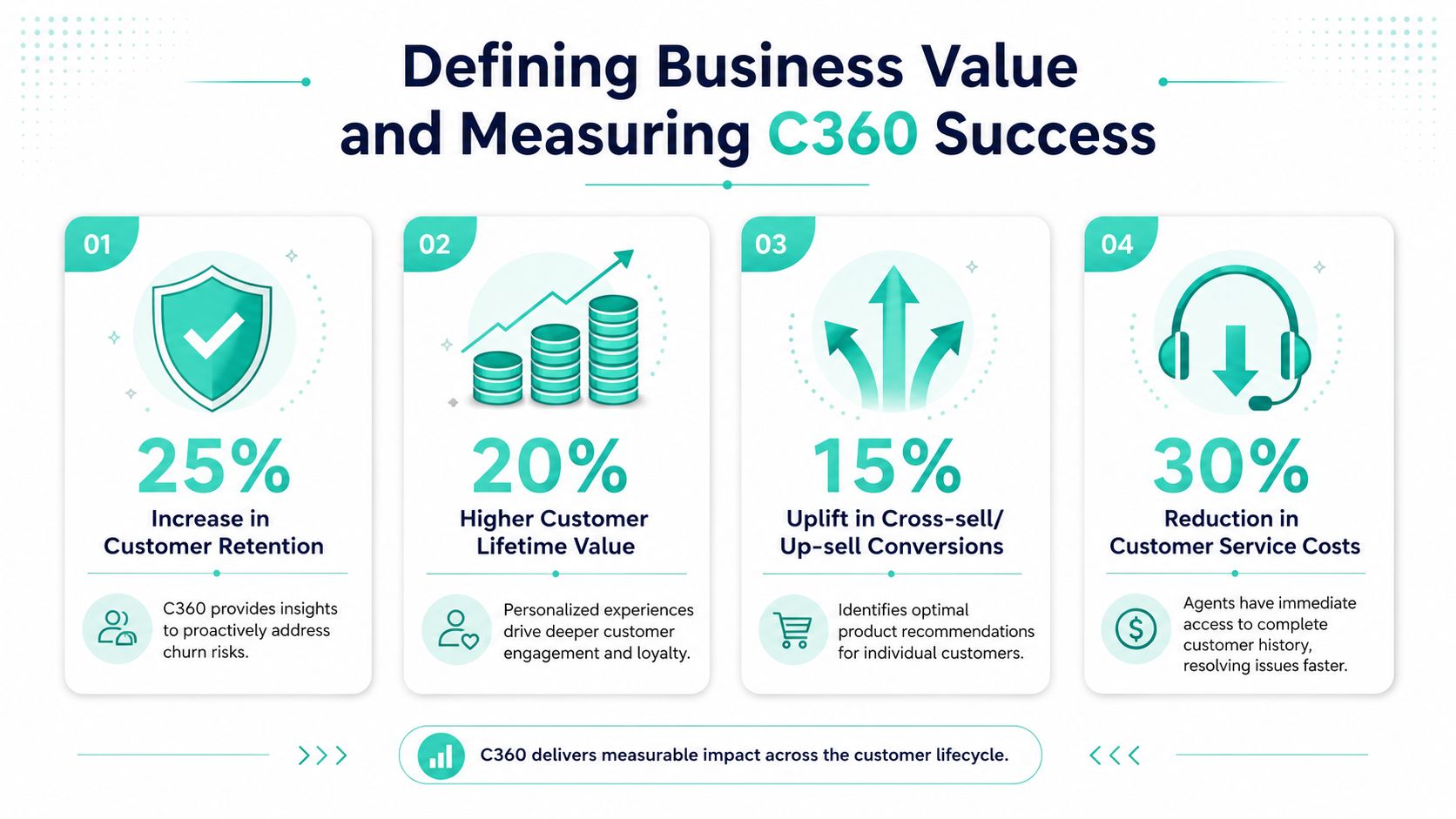
The business case for a Customer 360 view becomes credible when it's tied to outcomes leaders already own. Retention, satisfaction, service efficiency, and expansion revenue all depend on whether teams can act on a complete and current customer profile. If they can't, each function optimizes in isolation.
According to Tamr, Customer 360 views can reduce customer churn by up to 25% and increase customer satisfaction scores by 20% when organizations use unified data to deliver hyper-personalized, real-time experiences (Tamr). Those are board-level outcomes, not vanity metrics.
Value shows up in operating decisions
A mature Customer 360 view improves decisions at the moment of action. Service agents can see recent digital behavior before a call starts. Marketing can suppress irrelevant outreach after a complaint or billing issue. Content teams can tailor the next experience based on known preferences rather than channel guesses.
In practice, the most useful metrics usually fall into four categories:
- Retention quality: A unified profile helps teams spot risk earlier because support history, product usage, and campaign engagement aren't split across systems.
- Satisfaction improvement: Customers notice when context carries across channels. They also notice when it doesn't.
- Expansion opportunity: Cross-sell and upsell work better when recommendations reflect full relationship history rather than a single transaction stream.
- Service efficiency: Agents resolve issues faster when they don't spend the first part of every interaction reconstructing the customer story.
A Customer 360 program should be measured by decision quality and response timing, not by the number of integrations completed.
Don't measure the platform. Measure the use case
One of the most common mistakes is trying to prove value at the platform layer. Executives don't fund “better unification” for its own sake. They fund lower churn, stronger experience consistency, cleaner segmentation, and fewer service handoffs.
That's why the first scorecard should tie each activation scenario to a business metric. For example:
| Business objective | C360-enabled signal | Team using it |
|---|---|---|
| Reduce churn | Health change across service, web, and transaction data | Customer success |
| Improve satisfaction | Context-aware case handling and follow-up | Support and service |
| Grow account value | Unified product, behavior, and journey history | Sales and marketing |
A sound measurement model also distinguishes between leading and lagging indicators. Trusted identity match rates, profile completeness, and activation coverage are leading indicators. Churn and satisfaction are lagging outcomes.
For teams that need a stronger ROI framework before launch, this guide on how to measure ROI is a practical reference. It helps move the conversation from platform enthusiasm to accountable outcomes. That's where Customer 360 programs survive budget scrutiny.
Architecting a Unified Customer Data Foundation
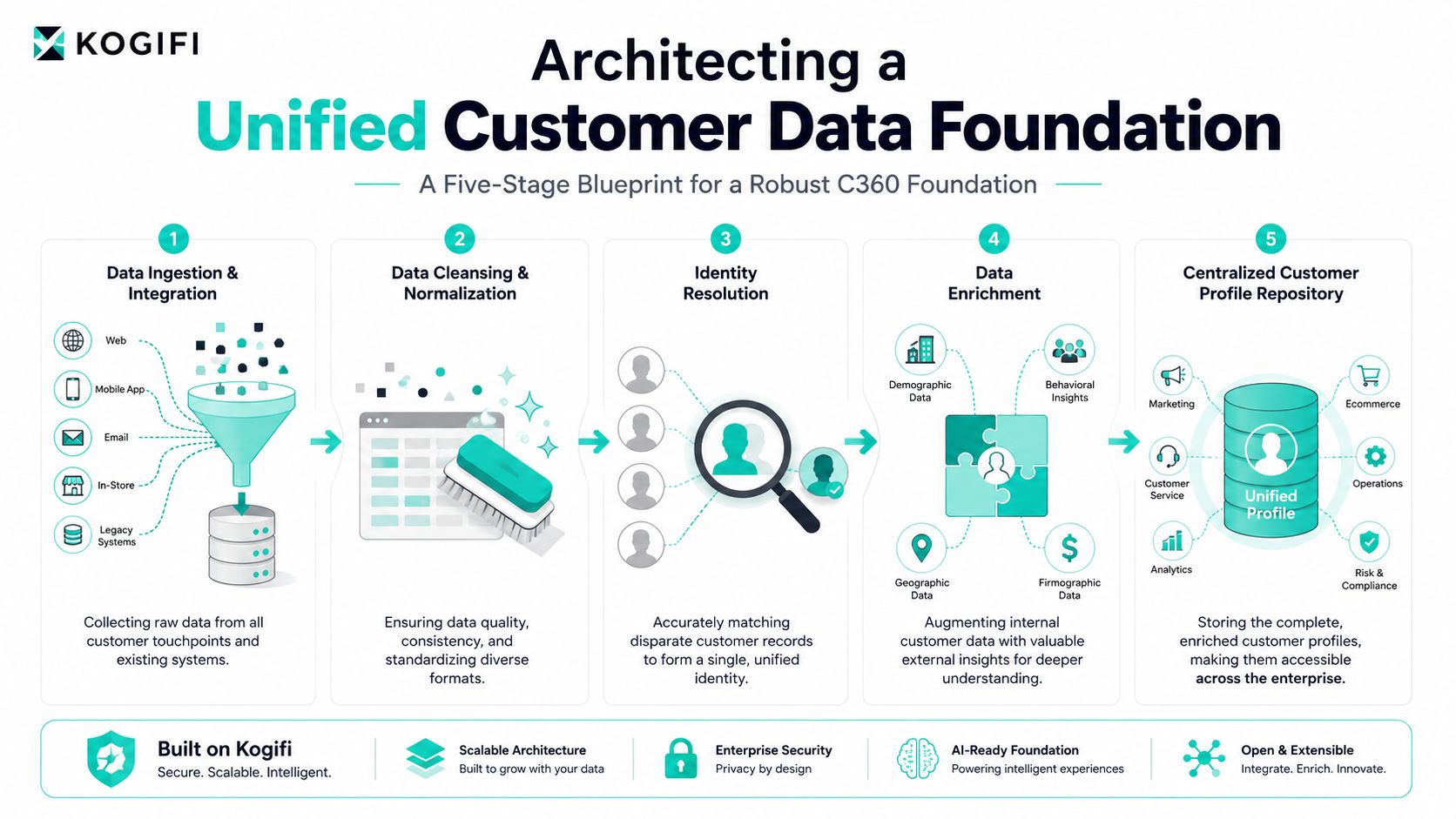
The architecture has to be designed for trust first, activation second. If teams reverse that order, they usually end up with attractive dashboards and unreliable profiles. In enterprise estates with Sitecore, commerce, service platforms, and legacy systems, the foundation has to absorb structured and unstructured data, normalize it, reconcile identity, and expose governed outputs to downstream applications.
Dremio describes the architecture as a five-stage process spanning raw data ingestion, identity resolution, semantic business logic modeling, curated view creation, and AI-powered activation. It also notes that delivery typically depends on separate roles for data integration, architecture, and customer identity processing (Dremio).
The five stages that matter
Most enterprise teams benefit from treating the architecture as a disciplined pipeline rather than a broad transformation slogan.
Raw ingestion
Pull customer-relevant data from CRM, marketing automation, transaction systems, support tools, web analytics, and external feeds. The point here is coverage, not perfection.Identity resolution
Resolve whether records and events belong to the same customer. This includes anonymous interactions, known logins, duplicate accounts, and conflicting identifiers.Semantic modeling
Translate source-system fields into business meaning. “Customer status,” “active account,” or “household value” need consistent logic across domains.Curated view creation
Publish governed profile outputs that downstream teams can trust. Here, the golden record becomes operational.AI-powered activation
Push the profile into systems that personalize content, prioritize service, support segmentation, and drive next-best action.
Why identity resolution breaks most initiatives
This is the part high-level guides usually skip. Teams often assume that once data lands in one place, they now have a Customer 360 view. They don't. They have co-located data.
Senzing highlights a more serious failure pattern. 68% of enterprises with customer 360 initiatives fail to achieve ROI because their data remains siloed at the identity level, leading to duplicate records and bad segmentation (Senzing). That's the line between “all our data is available” and “our profile is reliable enough to activate.”
If your segmentation depends on duplicate people appearing as separate profiles, every personalization layer above it gets worse, not better.
This is also where program governance matters. Identity rules can't live only in integration scripts or campaign logic. They need stewardship, exception handling, and auditability. In regulated environments, teams also have to align profile creation with consent, retention, and access policies.
A practical architecture checklist usually includes:
- Data contracts: Define source ownership, refresh behavior, and field semantics.
- Matching strategy: Combine deterministic rules with AI-driven entity resolution where customer relationships are messy.
- Profile governance: Establish who approves model changes, survivorship rules, and downstream usage.
- Activation boundaries: Decide which fields are safe and useful for Sitecore, support tools, and reporting.
- Compliance controls: Build access and traceability into the design rather than adding them later.
For teams still deciding system roles in the stack, this comparison on how to decide between CDP and CRM is helpful because it surfaces a common misconception. Neither tool replaces identity-centered mastery. They consume it.
Integrating C360 with Your Sitecore Experience Cloud
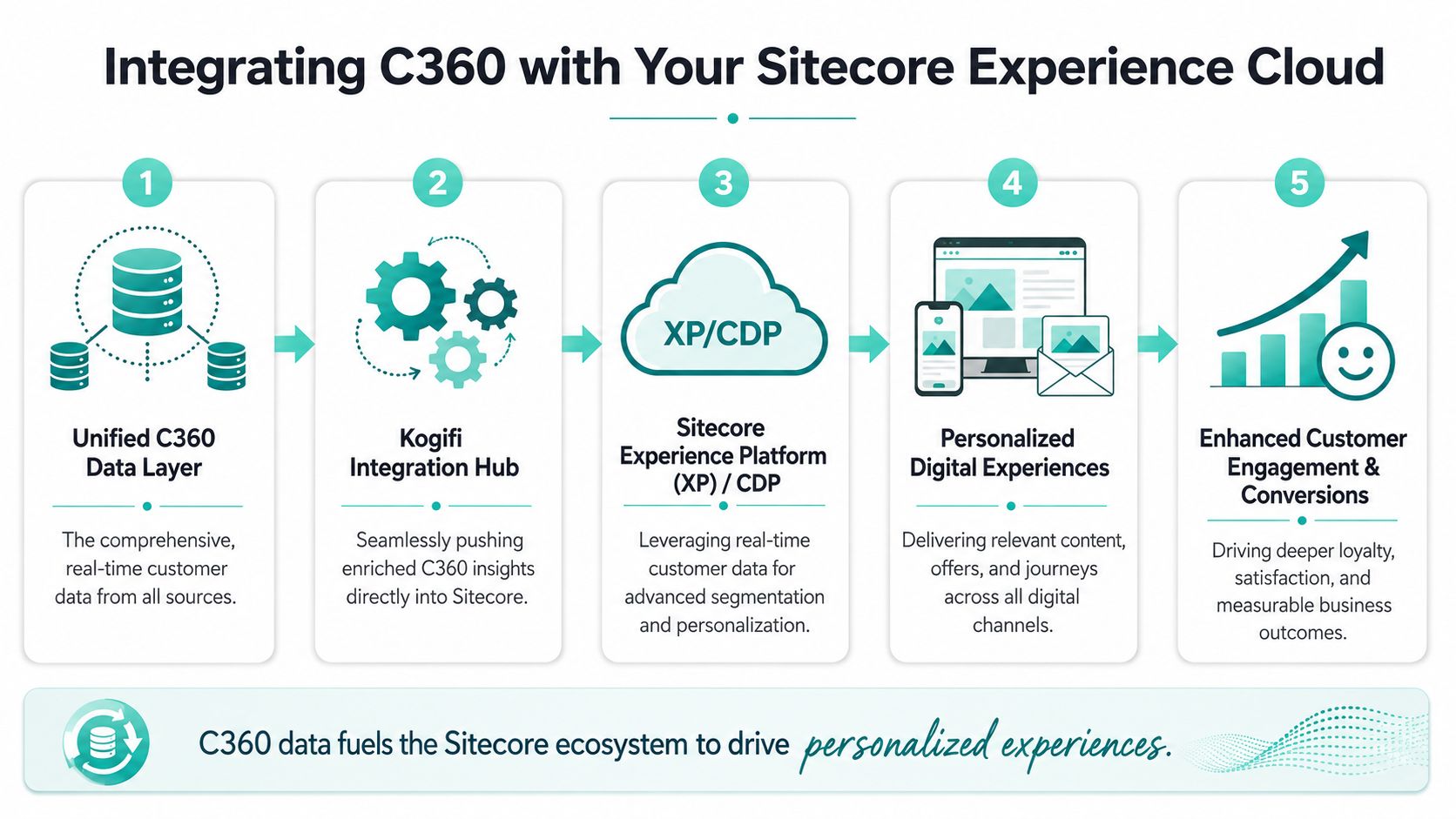
A Customer 360 view only becomes valuable in a Sitecore program when it changes what Sitecore can decide, present, or automate. That means the integration pattern matters as much as the profile model. If the data arrives too late, without confidence scores, or without governance around key attributes, Sitecore can't do much with it beyond broad segmentation.
The right pattern is a clear flow from mastered profile to activation layer to experience delivery.
How the data should flow into Sitecore
In composable Sitecore environments, the best implementations keep profile mastery outside the presentation layer and feed Sitecore only what it needs for orchestration and decisioning. Sitecore CDP and personalization capabilities are strong when they operate on trusted audience and behavioral inputs. They're much less effective when asked to compensate for broken identity.
A common enterprise flow looks like this:
| Sitecore Product | Role in C360 Activation |
|---|---|
| Sitecore CDP | Consumes unified profile data for segmentation and audience logic |
| Sitecore Personalize | Uses profile and behavior signals for decisioning across journeys |
| Sitecore XM Cloud | Delivers the content experience informed by trusted customer context |
| Sitecore Search | Improves relevance when customer intent and profile data are available |
| Sitecore Stream | Assists teams with AI-driven orchestration tied to brand and experience context |
The implementation details matter. Anonymous and authenticated behavior should map into a common identity strategy. Segment definitions should use governed attributes, not ad hoc content fields. Event pipelines should support recency-sensitive use cases like service recovery, onboarding, and account expansion.
For teams modernizing omnichannel execution, this guide to omni-channel customer experience is relevant because it frames the operational side of delivering continuity across channels. Sitecore can orchestrate that continuity, but only if the profile underneath it is coherent.
Where Sitecore AI becomes useful
Sitecore's AI portfolio grows especially interesting. Sitecore Stream introduces over 250 new features, including brand-aware AI that aligns AI-driven actions with brand identity over time (CMSWire). That matters in real programs because AI output isn't just a productivity feature. It needs to stay on-brand, channel-appropriate, and context-aware.
A related pattern is emerging in XM Cloud authoring workflows. A private GPT model trained on a brand's tone, voice, and knowledge base can be deployed via Azure OpenAI Service in Sitecore XM Cloud, enabling authors to use a “Review with AI” action that returns brand-aligned review comments on serialized page content, including fields, blocks, and localization details (Altudo). That's more than a content helper. It's a way to connect governed brand intelligence with operational content review.
Here's a useful product demonstration:
There's also a broader market signal around Sitecore's cloud direction. Sitecore has reported 100% growth in XM Cloud, its AI-powered cloud CMS that combines AI, personalization, and more unified workflows for marketers (CMS Critic). The practical point isn't the growth figure by itself. It's that enterprise teams are increasingly moving toward cloud-native Sitecore patterns where Customer 360 data can be activated more consistently across authoring, personalization, and orchestration.
The strongest Sitecore implementations don't treat AI as a separate layer. They feed AI with governed profile data, brand rules, and channel context so the system can make useful decisions without drifting.
What doesn't work is overloading Sitecore to become the master customer repository. Sitecore should consume trusted customer intelligence and act on it. It shouldn't carry the full burden of identity mastering, cross-system reconciliation, or enterprise data governance.
Extending the 360 View to Your Internal Audience with SharePoint
The same design principles behind a Customer 360 view apply internally, but the use case changes. Instead of building a complete external customer profile, organizations often need an operationally useful internal view of employees, partners, or distributed teams. In practice, that means pulling together identity, role, location, collaboration context, knowledge access, and workflow signals so the intranet becomes useful rather than decorative.
What an internal 360 view actually supports
A SharePoint-based internal 360 view works best when it solves concrete employee problems. Teams need personalized landing experiences, role-relevant resources, surfaced expertise, and easier access to tasks or policies that normally live in separate systems.
In Microsoft 365 estates, a practical internal profile often draws on:
- Directory and role data: Department, geography, permissions, reporting line, and business unit.
- Collaboration context: Microsoft Teams, document activity, and community participation.
- Knowledge relevance: News, policy content, forms, FAQs, and training mapped to role or location.
- Workflow signals: Approvals, requests, onboarding steps, and recurring internal tasks.
That's where SharePoint Online, SPFx, and Power Platform fit well. SharePoint can present a personalized intranet layer, Power Automate can orchestrate process steps, and Power Apps can expose internal services without requiring employees to jump between disconnected systems.
Internal 360 initiatives succeed when the intranet stops being a publishing destination and starts acting like a role-aware work surface.
Where SharePoint fits and where it does not
SharePoint is excellent for internal knowledge delivery, workflow access, collaboration surfaces, and governed document experiences. It is not an enterprise customer identity resolution engine, and it shouldn't be treated like one. That distinction matters when organizations try to mirror external Customer 360 ambitions inside Microsoft 365.
A sensible split looks like this:
| Need | Better fit |
|---|---|
| External identity mastering | Dedicated customer data and identity architecture |
| Internal knowledge and workflow experience | SharePoint Online and Microsoft 365 |
| Employee task automation | Power Platform |
| Personalized intranet delivery | SharePoint with SPFx components |
For organizations with fragmented intranet estates, the first step is usually rationalization rather than personalization. If content is duplicated across site collections, permissions are inconsistent, and ownership is vague, the employee profile won't rescue the experience. Structure comes first.
This is one reason SharePoint migration services often become foundational in broader digital workplace programs. Moving content without redesigning governance relocates the clutter. A useful internal 360 view depends on cleaner information architecture, role-sensitive content, and a predictable model for surfacing the right resources at the right time.
A Practical Roadmap for Implementing Your C360 Initiative
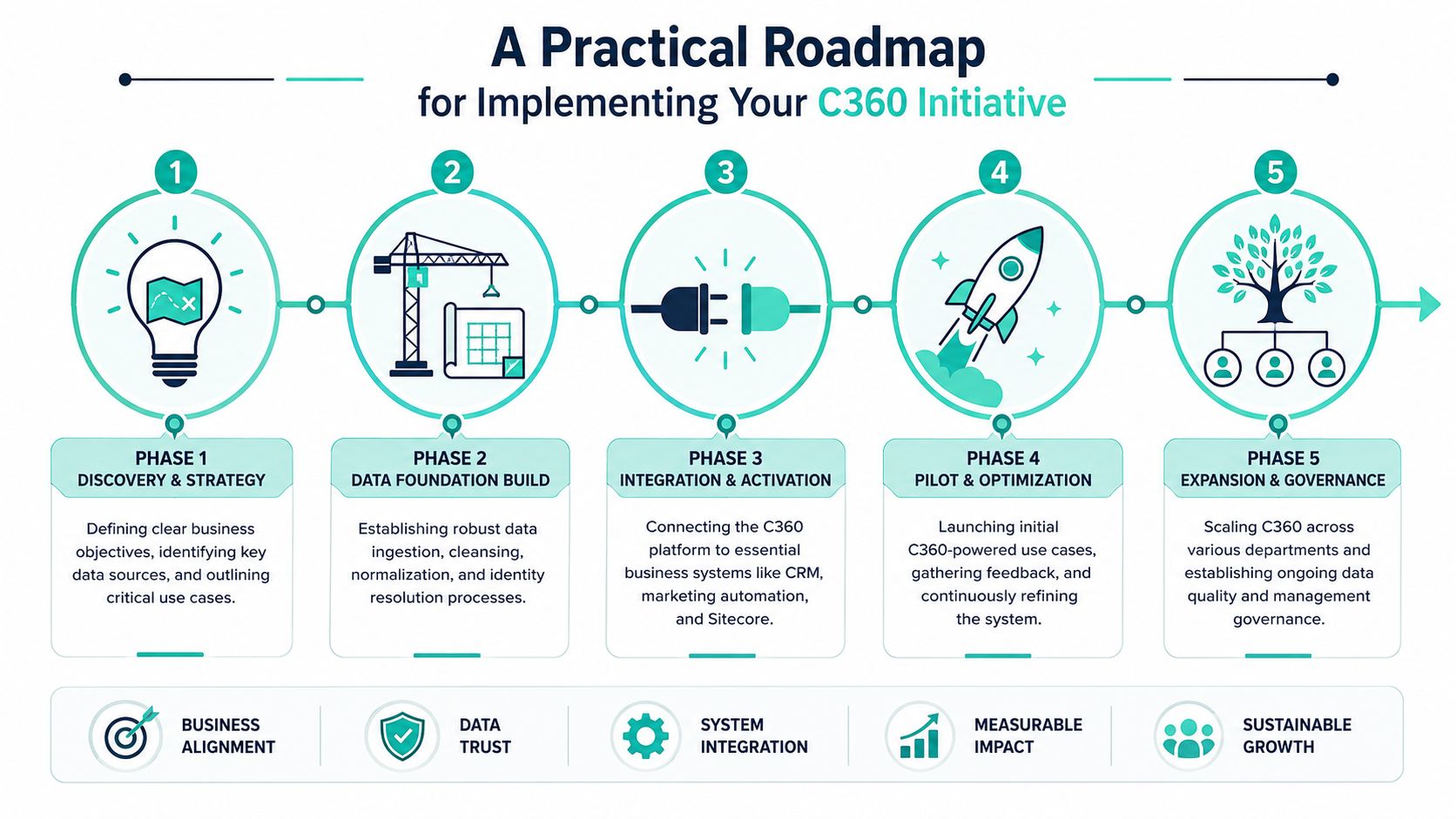
Most Customer 360 programs fail because they try to boil the ocean. The better pattern is phased delivery with one or two high-value activation scenarios, a constrained identity scope, and clear ownership from both business and technical leads. That keeps the architecture grounded in outcomes instead of becoming a long-running integration program with no operational adoption.
Phase by phase execution
Phase 1: Discovery and strategy
Start with business questions, not source systems. Define the use cases that justify the investment, such as retention intervention, service context, or experience personalization. Then map the minimum data required for those outcomes.
Phase 2: Foundation build
Stand up ingestion pipelines, profile models, matching logic, stewardship rules, and consent-aware governance. Keep the first version narrow enough that teams can test the profile against real records.
Phase 3: Integration and activation
Connect the curated profile to downstream systems that can immediately use it. In Sitecore environments, that often means audience logic, personalization inputs, and content relevance signals.
Phase 4: Pilot and optimization
Launch with a contained population, then inspect match quality, profile trust, and operational usability. Teams should review false matches, weak joins, and missing signals before scaling.
Phase 5: Expansion and governance
Only expand once profile quality, ownership, and activation discipline are stable. Add more business units, sources, and journeys without breaking the profile model.
The mistakes that slow programs down
The biggest implementation problem usually isn't tooling. It's mis-sequencing. Teams often push for personalization before identity confidence is acceptable, or they load every possible source into the foundation before they've proven one meaningful use case.
A second issue is authentication friction. Deloitte and Okta's 2024 discussion found that 42% of customers abandon journeys due to inconsistent login experiences across channels, which breaks profile continuity and weakens personalization (YouTube discussion). If customers hit different authentication patterns across web, app, support, and account areas, the Customer 360 view becomes incomplete before any AI model or segmentation rule gets a chance to help.
A practical implementation checklist should include:
- Identity before orchestration: Don't scale personalization on top of uncertain profile joins.
- Authentication continuity: Align login, session, and account recognition across channels.
- Governance from day one: Define owners for data quality, survivorship, and profile usage.
- Use-case discipline: Launch with scenarios that create operational feedback quickly.
- Business validation: Ask service, marketing, and sales teams whether the profile is usable.
Teams don't lose momentum because Customer 360 is too ambitious. They lose momentum because the first release doesn't solve a real operational problem.
The roadmap should feel deliberately narrow at first. That's a strength, not a limitation. A smaller trusted profile used in production beats a broad theoretical model that nobody activates.
From Data Fragmentation to Customer Centricity
Customer centricity doesn't come from buying more experience technology. It comes from deciding that customer truth needs architecture, governance, and operational ownership. That's why the Customer 360 view remains hard to achieve. It sits between data engineering, identity, content, service, and digital experience. Most organizations have all of those functions. Fewer align them around one profile strategy.
For Sitecore estates, the practical lesson is clear. Sitecore is where much of the customer experience gets delivered, orchestrated, and improved. But Sitecore works best when it receives governed customer intelligence rather than trying to create enterprise truth on its own. The strongest programs let a trusted profile drive segmentation, personalization, AI-assisted authoring, and journey decisions without turning the DXP into the master data layer.
SharePoint has a parallel role on the internal side. It can surface role-aware information, streamline workflows, and create a more coherent employee experience, but only when the underlying information model is clean and governed. The same principle applies externally and internally. Unified views depend on disciplined identity and data ownership.
If you need a concise reminder of why this matters, Intelligent Contacts offers useful insights on unified systems that reinforce the operational cost of staying siloed. Fragmented systems don't just slow reporting. They degrade experience quality at every touchpoint.
The path forward isn't glamorous. It's architectural. Build the profile properly, govern it tightly, and activate it where it changes customer outcomes. That's how a Customer 360 view stops being a slide in a strategy deck and starts becoming an advantage.
If your team is evaluating how to build a Customer 360 view across Sitecore, XM Cloud, CDP, personalization, and Microsoft 365, Kogifi can help you assess readiness, define the right architecture, and turn fragmented platforms into a governed experience ecosystem.