


The web content lifecycle is the guiding strategy for every piece of digital content your business creates, from its first spark of an idea all the way to its eventual retirement. Don't think of it as just another technical checklist. It’s your blueprint for creating, delivering, and fine-tuning content to drive real, measurable growth and maximize your return on investment.
The Modern Blueprint for Digital Content
Imagine your content is a premium product. It doesn't just magically appear on the shelf; it goes through a careful process of research, design, manufacturing, distribution, and performance tracking. The web content lifecycle mirrors this journey, giving you a structured way to make sure every digital asset—from a blog post to a product page—hits its business goal.
Without a clear lifecycle, content efforts can quickly turn into chaos. Teams create assets with no clear purpose, valuable content gets lost or becomes outdated, and you miss countless opportunities for personalization and improvement. The result? Wasted resources and a disjointed customer experience.
From Linear Steps to a Dynamic Cycle
In the past, this was often seen as a straight line: create, publish, and forget. But the modern web content lifecycle is a continuous loop, fueled by data and real-time insights. Each stage informs the next, creating a powerful system of constant improvement.
Here’s a quick look at the core stages in this ongoing process.
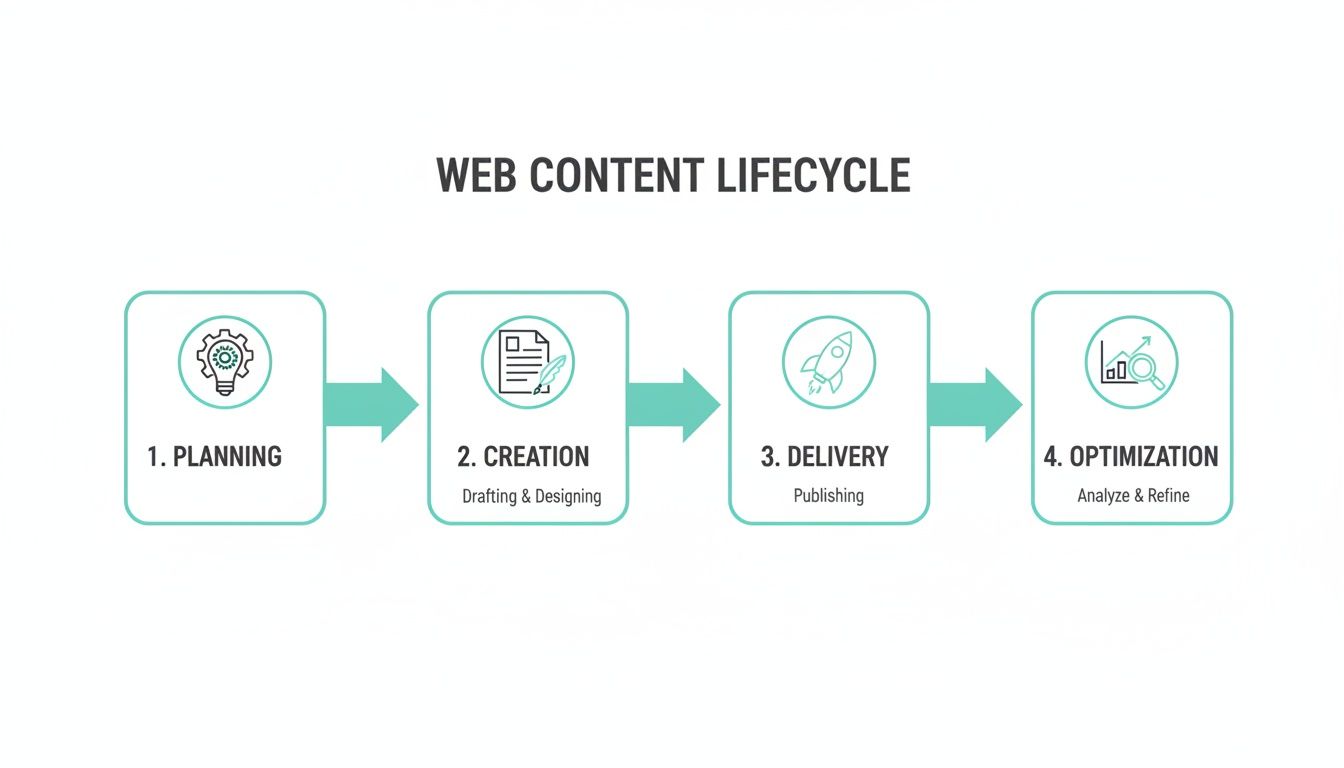
This flow shows how smart planning leads to creation, which then moves into intelligent delivery. Finally, data-driven optimization circles back to refine your future plans. It's a feedback loop that never stops.
In this model, every piece of content has a job to do, and its performance is tracked every step of the way. Platforms like Sitecore are engineered to manage this entire journey, turning what could be a manual slog into an intelligent, automated engine for growth. Sitecore's composable DXP allows businesses to integrate best-in-class tools at each stage, from AI-powered planning with Sitecore Discover to personalized delivery with XM Cloud and Sitecore Personalize.
To give you a clearer picture, this table breaks down what happens at each stage of the lifecycle.
The Core Stages of the Web Content Lifecycle
As you can see, the lifecycle provides a complete framework for turning ideas into assets that perform.
Why Mastering the Lifecycle Matters
For any large business, getting a handle on the web content lifecycle is non-negotiable. It keeps your brand message consistent across every channel, makes your teams more efficient, and—most importantly—delivers the kind of top-tier digital experiences that turn visitors into loyal customers. It provides the governance you need for large-scale operations while giving you the agility to react to market shifts.
A well-managed content lifecycle ensures that your digital assets are not just published, but are actively working to achieve business goals. It turns your content library from a cost center into a powerful revenue-generating asset.
Throughout this guide, we'll dive deep into each stage of this modern lifecycle. We'll explore how platforms like Sitecore and essential tools like SharePoint provide the foundation for building, managing, and scaling a world-class content operation. You'll learn how to move beyond just producing content and start orchestrating digital experiences that deliver tangible results.
Fueling Your Strategy with AI-Driven Planning
Great content doesn't start with a guess anymore—it starts with data. The initial planning stage of the web content lifecycle has evolved from old-school brainstorming sessions to a sharp, analytical process. This is where you lay the groundwork for success, making sure every single asset is built to meet both your audience's needs and your business goals.
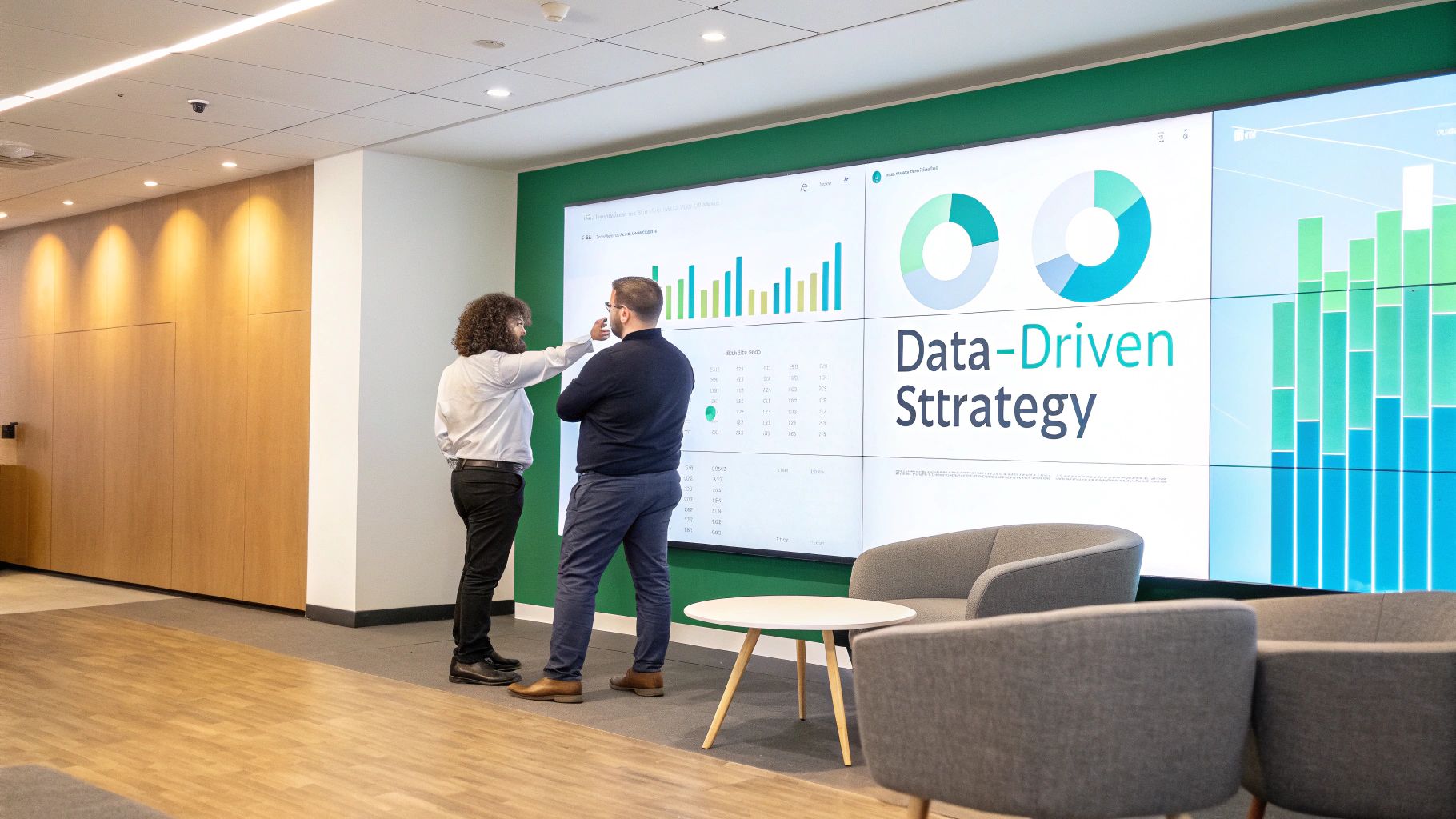
The trick is to move from broad assumptions to specific, actionable insights. Instead of targeting a vague group like "millennial shoppers," a data-first approach lets you pinpoint behavioral segments like "price-sensitive researchers who abandon carts on mobile" or "high-value loyalists who jump on new product announcements." Trying to find these patterns manually just isn't possible at scale.
This is exactly where AI becomes your most valuable partner. Platforms like Sitecore use machine learning to sift through massive datasets, uncovering hidden patterns in market trends, competitor moves, and real-time user behavior. Suddenly, planning goes from a reactive chore to a predictive discipline.
Identifying High-Value Segments with Sitecore AI
Sitecore's suite of AI-powered tools is built to power this initial phase with smart automation. Think of tools like Sitecore Discover and Sitecore Personalize as your analytical engine, digging through data to show you who your most valuable audiences are and what they really want.
These systems go way beyond basic demographics. They focus on the behavioral data that actually drives decisions. The insights they generate help you build a content strategy that hits the mark because it's based on solid evidence, not just a hunch. For instance, Sitecore Discover can spot emerging search trends within your product catalog, giving you a clear signal on what topics your next blog series should tackle.
Key planning activities powered by Sitecore AI include:
- Audience Segmentation: AI automatically groups users based on their on-site actions, purchase history, and engagement, creating laser-focused segments for your campaigns.
- Predictive Search Insights: The platform analyzes search queries to predict what users are looking for and identify content gaps, helping you create assets that answer customer questions before they even have to ask.
- Customer Journey Mapping: By tracking user paths across your digital properties, Sitecore helps you see common friction points and opportunities, allowing you to map content directly to each stage of their journey.
When you're bringing AI into your content strategy, choosing the right tools is everything. For a better handle on making those calls, check out this guide on how to compare AI models. It'll help you figure out which technologies are the best fit for your specific business needs.
Collaborative Planning with SharePoint
While Sitecore delivers the data-driven insights, enterprise teams still need a solid system for collaboration and documentation. This is where a tool like SharePoint becomes an indispensable partner.
SharePoint acts as the central hub for all your planning documents and discussions. It offers a secure, version-controlled space where teams can work together on key documents before anything gets pushed into the DXP for creation. This integration ensures those valuable strategic insights are properly documented and easy for everyone to find. You can learn more about how AI is supercharging platforms like this in our guide on AI personalization in DXP implementation.
The synergy between Sitecore's AI-driven analytics and SharePoint's collaborative framework creates a powerful, end-to-end planning process. Insights from Sitecore inform the strategy, and SharePoint provides the structured environment to document, refine, and approve it.
This powerful combination ensures the web content lifecycle starts on solid ground. Every piece of content is conceived with a clear purpose, a defined audience, and measurable goals, setting the stage for strong performance before a single word is even written.
Creating Content in a Composable DXP
With your AI-driven plan locked in, the web content lifecycle shifts from strategy to the hands-on work of execution. This is the creation phase, where ideas finally take shape as tangible assets. In a composable Digital Experience Platform (DXP), this process is fundamentally different—it’s less about building static, one-off pages and more about assembling a library of intelligent, reusable content components.
The whole point is efficiency and scale. You create a piece of content once and then deploy it everywhere, keeping your brand story consistent across every single touchpoint. To pull this off, you need a powerful central hub to manage all your assets and keep workflows in check.
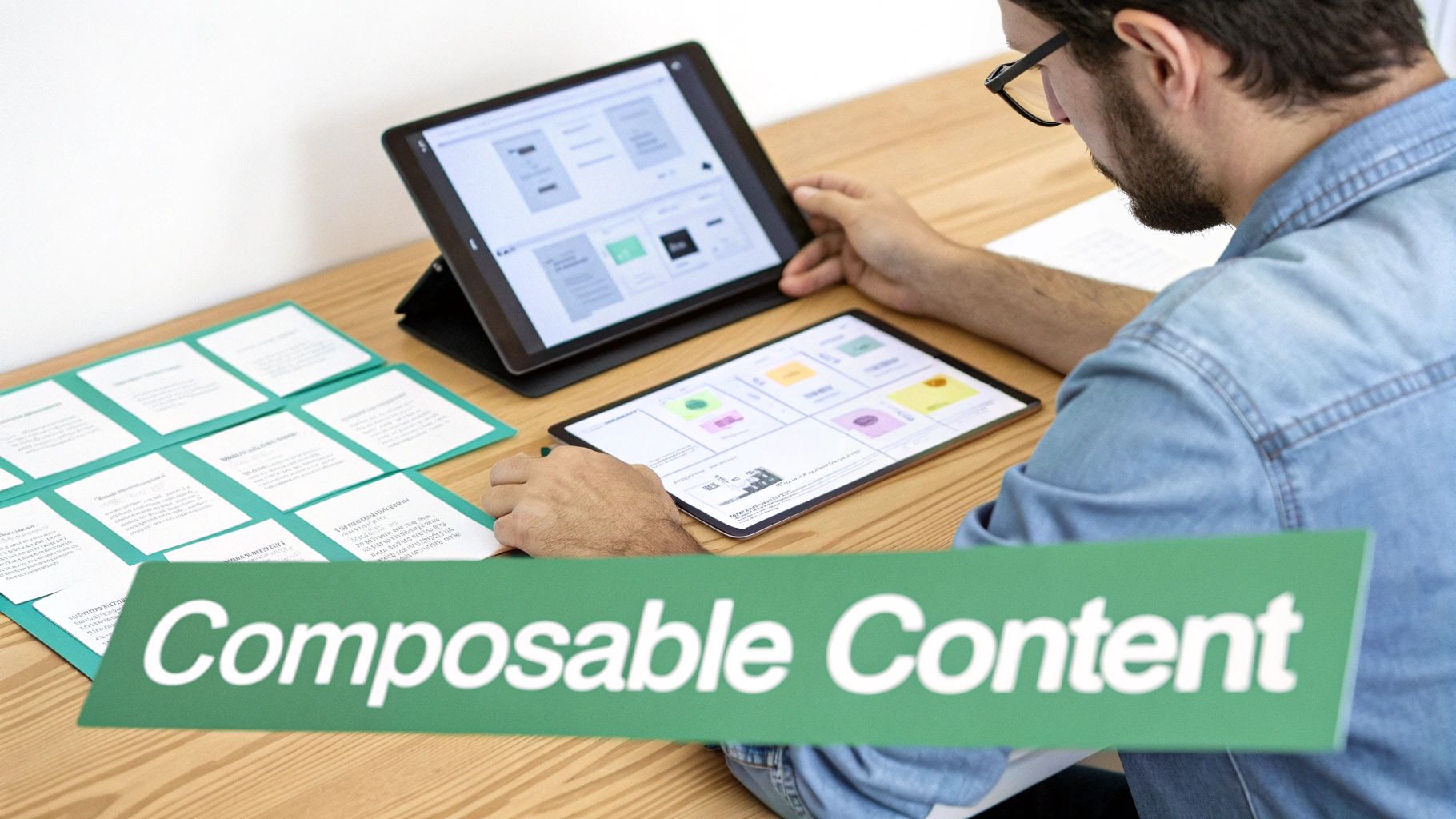
This image gets to the heart of modular content—designing and creating individual components that can be mixed and matched into countless different experiences.
The Central Role of Sitecore Content Hub
Sitecore Content Hub sits right at the center of this modern creation process. It acts as a single, unified platform for planning, creating, collaborating on, and managing content. In short, it becomes your organization's single source of truth for every digital asset you own.
But Content Hub is far more than just a place to store files; it orchestrates the entire creation workflow from start to finish. It gives teams a place to manage everything from initial briefs and drafts all the way through to complex review and approval cycles.
Think of Sitecore Content Hub as a manufacturing plant for your content. Raw materials (ideas, data) come in, and they move through an automated assembly line (workflows) to produce finished goods (content components) ready for distribution via any channel.
This centralized system gets rid of the chaos of scattered files and confusing email chains. A key part of the modern web content lifecycle involves effective Content Creation strategies that cover everything from ideation to production and optimization. Inside Content Hub, every asset has a clear owner, status, and history, which gives you complete visibility and control over the entire production pipeline.
Building Atomic Content with XM Cloud
While Content Hub manages the assets, Sitecore XM Cloud is where they're actually structured for delivery. As a headless, cloud-native CMS, XM Cloud is brilliant at creating atomic content—small, modular blocks of content that aren't tied to any specific presentation layer.
These content "atoms" can be just about anything:
- A product description
- A customer testimonial
- A promotional banner
- An author bio
Because these components are decoupled from the front-end design, they can be delivered seamlessly to a website, a mobile app, a kiosk, or any digital channel that comes along in the future. This is a core benefit of a composable approach, a concept you can dive into deeper in our article on future-proofing with composable DXP architecture. This flexibility is critical for building a future-proof content strategy.
Integrating SharePoint for Enterprise Governance
For many large organizations, SharePoint is still the go-to tool for initial drafting and internal collaboration, especially for documents that need to pass through strict compliance or legal reviews. The modern workflow often kicks off here, where teams can securely work together on foundational documents.
Once those initial drafts get the green light within SharePoint's secure environment, they are moved into Sitecore Content Hub to be transformed into structured content components. This integrated approach plays to the strengths of both platforms: SharePoint for its rock-solid document management and internal security, and Sitecore for its advanced content operations and omnichannel delivery. This two-step process ensures rigorous governance without creating bottlenecks, helping you get content to market faster while still maintaining full control.
Delivering Personalized Experiences at Scale
Hitting the “publish” button isn’t the finish line—it’s the starting gun. This is the moment your carefully planned content meets the real world. Success in the delivery stage comes down to one thing: getting the right message to the right person at the right time. This is precisely where generic, one-size-fits-all content falls flat and intelligent, personalized delivery wins.

The real magic happens when content dynamically adapts to each visitor, creating a unique journey that feels personally curated. Moving beyond simple publishing to orchestrate individual experiences at a massive scale is the hallmark of a mature content delivery strategy.
Harnessing AI for Real-Time Personalization
At the heart of modern content delivery is an AI engine that understands user behavior in real time. This is the domain of Sitecore Personalize, a powerful tool designed to turn anonymous visitors into known customers by delivering uniquely tailored experiences. It goes far beyond basic segmentation, using machine learning to analyze every click, search, and interaction.
This lets you create hyper-relevant digital journeys based on:
- Behavioral Triggers: Showing a special offer to a user who has viewed a specific product three times.
- Contextual Data: Modifying homepage content based on a visitor's geographic location or the device they are using.
- Predictive Insights: Identifying users at risk of abandoning their cart and proactively presenting them with a helpful chatbot or a targeted promotion.
This approach shifts the work from manual content assignment to automated, intelligent decision-making. It empowers teams to build and deploy sophisticated personalization strategies without needing constant developer intervention.
True Omnichannel Distribution with Sitecore XM Cloud
Personalization is most effective when it’s consistent across every channel. The composable architecture of Sitecore XM Cloud makes this a reality. Because content is created as modular, channel-agnostic components, it can be seamlessly delivered to any endpoint—from your primary website to a native mobile app, an email campaign, or even an in-store digital display.
This headless approach ensures a unified customer experience. A user who browses products on your website can receive a personalized follow-up email featuring those exact items, creating a cohesive journey that builds trust and drives conversions. You can learn more about this strategy in our guide on the personalization of content.
For enterprise environments, SharePoint often serves as a secure distribution point for internal-facing content. While Sitecore manages the public, personalized experience, SharePoint can simultaneously deliver regulated documents, training materials, or internal communications to employee portals, ensuring the right information reaches the right internal audiences securely.
The Critical Role of Performance in Delivery
Ultimately, even the most personalized content is useless if the user experience is slow and frustrating. Website performance is fundamentally inseparable from the content lifecycle. A poor user experience can lead to high bounce rates and damage brand perception. Core Web Vitals are now a critical factor in search rankings, making performance optimization a non-negotiable part of the delivery stage.
A slow website is a broken website. In the delivery stage, every millisecond counts. High-performance architecture isn’t a technical luxury; it’s a foundational requirement for engagement, SEO, and revenue.
Sitecore's cloud-native architecture, combined with its integrated Content Delivery Network (CDN), is engineered for speed. By caching content at the edge—closer to the end-user—it dramatically reduces latency and ensures lightning-fast load times, no matter where your visitor is located. This relentless focus on performance ensures your brilliant, personalized content is actually seen and experienced, turning casual visitors into loyal customers.
Optimizing Performance with Advanced Analytics
Once your content goes live, the web content lifecycle enters its most important feedback loop: the optimization stage. This is where you pivot from creating and publishing to monitoring, measuring, and refining. It’s all about answering one crucial question: "Is our content actually working?" The answers you find will fuel a cycle of continuous improvement.
In this phase, the name of the game is moving past surface-level vanity metrics like page views. Real performance is measured by tracking genuine engagement, conversion rates, and the actual return on investment (ROI). This is where having a unified platform like Sitecore gives you an incredible advantage, offering a 360-degree view of how your content truly impacts the bottom line.
Gaining a 360-Degree View with Sitecore Analytics
Sitecore’s built-in analytics are designed to give you deep insights right where your content lives. This approach completely sidesteps the data silos that so often trip up enterprise marketing teams. Instead of trying to stitch together reports from a dozen different tools, you get one cohesive picture of content effectiveness.
With Sitecore, you can track the performance indicators that actually matter:
- Engagement Value: Assign scores to critical user actions—like downloading a whitepaper or requesting a demo—to see which content drives the most valuable interactions.
- Path Analysis: See the exact journeys users take through your site. This helps you spot high-performing content paths and identify precisely where visitors are dropping off.
- Conversion Tracking: Directly link conversions to specific content, campaigns, and personalization rules to understand what’s really driving results.
This gives you actionable data, not just a spreadsheet full of raw numbers. You can see exactly how a blog post influenced a high-value conversion or how a personalized banner on the homepage contributed to a sale.
Implementing Continuous Refinement with A/B Testing
Data is only useful if you act on it. Sitecore's platform makes it easy to run A/B and multivariate tests, letting you continuously sharpen your messaging and user experience based on real user behavior.
Let's say your team is debating between two different headlines for a key landing page. Instead of getting stuck in a debate, you can run an A/B test directly in Sitecore. The platform automatically shows each version to different audience segments and declares a winner based on which one gets a higher conversion rate.
Optimization isn't a one-time task; it's an ongoing discipline. By systematically testing and refining content based on hard data, you transform your digital presence from a static brochure into a dynamic, performance-driven engine.
This testing capability goes far beyond headlines. You can test calls-to-action, images, page layouts, and even entire personalization strategies. Every test provides valuable data that feeds right back into the planning stage, closing the loop on the web content lifecycle and creating a powerful engine for improvement.
The Strategic Value of Integrated Analytics
You really can’t overstate the importance of a solid analytics framework. As explored in web analytics trends on Piwik.pro, the push for data privacy and first-party data collection is making integrated analytics more critical than ever. Enterprise teams are increasingly seeking to consolidate their tech stacks around unified platforms like Sitecore that combine analytics, personalization, and content management into a single, cohesive ecosystem.
For enterprise teams using SharePoint for internal portals, analytics is just as vital. Tracking metrics like document downloads, search query success rates, and page engagement helps organizations understand how employees find and use critical information. This allows for the continuous optimization of internal knowledge bases, ensuring both customer-facing and internal content lifecycles are driven by data.
Managing Content Archiving and Governance
Sooner or later, every piece of content reaches the end of its useful life. The final phase of the web content lifecycle isn't just about hitting "publish" and walking away; it’s about strategically managing what happens next. This is where you make smart, data-driven decisions to keep your digital presence clean, effective, and valuable.
Without a solid plan, your content library can quickly become a digital junkyard—bloated with outdated articles, irrelevant pages, and underperforming assets. This doesn't just create a messy user experience; it can actively harm your SEO performance. A structured governance policy is your best defense against content chaos.
Establishing Governance with Sitecore and SharePoint
Effective governance isn’t a simple matter of deleting old pages. It's a strategic framework for deciding whether to update, archive, repurpose, or simply retire an asset. This is where a powerful DXP like Sitecore and a collaboration hub like SharePoint work together beautifully.
Sitecore’s job is to bring the data. Its analytics can automatically flag content when performance drops—think plummeting traffic, high bounce rates, or dried-up conversions. You can even set up workflows that trigger a review once an asset hits a certain age or dips below a key performance threshold.
Meanwhile, SharePoint acts as the command center for governance. When Sitecore flags a piece of content, a review task can be automatically created in SharePoint. This creates a clear audit trail and pulls in the right stakeholders—from subject matter experts to legal teams—to weigh in. This tag-team approach blends automated data analysis with essential human oversight. For a deeper dive, our guide to building a content governance framework has you covered.
Strategic Actions for Aging Content
Once content is flagged for review, you have a few choices. The goal isn't just to clean house but to squeeze every last drop of value from your initial investment.
- Update and Relaunch: If a piece of content is still topically relevant but factually out of sync, a refresh can bring it back to life. This is a go-to move for high-performing blog posts that just need updated statistics or fresh examples.
- Repurpose: That comprehensive whitepaper could be a goldmine. Break it down into a blog series, an infographic, or a dozen social media posts. Sitecore’s composable architecture makes this a breeze, allowing you to deconstruct assets and reuse individual components across new channels.
- Archive: Some content might have historical or compliance value but is no longer relevant to the public. Archiving removes it from the live site but keeps it accessible internally in a secure SharePoint repository.
To make these decisions easier, a clear decision-making framework is essential. The table below outlines a simple model for determining the right course of action based on content performance and relevance.
Content Governance Actions
By systematically evaluating each piece of aging content, you ensure your digital ecosystem remains healthy and continues to deliver results long after the initial publish date.
Strategic archiving and repurposing are the keys to long-term content ROI. It ensures that the effort invested in creating an asset continues to deliver value long after its initial publication date, completing the web content lifecycle.
Frequently Asked Questions
Even with a solid strategy in place, the day-to-day work of managing a web content lifecycle can throw up some tricky questions. Here are some straightforward answers to the issues we see most often from marketing and IT leaders working with platforms like Sitecore.
How Does a Composable DXP Change the Web Content Lifecycle?
A composable DXP, like the one offered by Sitecore, revolutionizes the content lifecycle by detaching content from any single channel. Instead of a rigid, linear process locked into one website, you can select best-of-breed tools for each stage. For example, you can leverage Sitecore Content Hub for planning and collaboration, then use XM Cloud for headless delivery to any endpoint.
This composable model means you create content once as a modular, channel-agnostic component and then distribute it everywhere—from your primary website to a mobile app or a digital kiosk. The result is a dramatic acceleration in time-to-market and a highly adaptable tech stack that is ready for future channels.
What Is the Role of AI Throughout the Content Lifecycle?
AI acts as an intelligent layer that enhances every stage of the web content lifecycle within the Sitecore ecosystem.
- Planning: Sitecore AI analyzes vast datasets to uncover audience insights and predict emerging content trends, ensuring your strategy is data-driven from the start.
- Creation: AI-powered tools can assist in generating copy variations, optimizing content for SEO in real-time, and suggesting relevant assets from Content Hub.
- Delivery: This is where AI excels, with Sitecore Personalize delivering real-time, 1:1 personalization that dynamically adapts the user experience.
- Optimization: AI algorithms can identify complex performance patterns and conversion opportunities in your Sitecore Analytics data that a human analyst might miss.
Ultimately, integrating AI transforms the content lifecycle from a reactive, manual process into a proactive, automated system engineered to maximize engagement and ROI.
The real job of AI in the web content lifecycle is to replace guesswork with data-driven confidence. It gives your teams the power to make smarter, faster decisions that lead directly to a better customer experience and stronger business results.
How Do We Justify Investing in a Premium DXP?
Justifying the investment in a premium DXP like Sitecore hinges on demonstrating a clear and measurable return on investment. The business case is typically built on three core pillars. First, operational efficiency: streamlined workflows and content reuse within Sitecore Content Hub significantly reduce production time and operational costs.
Second is an enhanced customer experience: the AI-driven personalization capabilities of Sitecore Personalize translate directly into higher engagement, improved conversion rates, and increased customer loyalty. Finally, a composable DXP provides business agility, enabling you to adapt to market changes much faster than competitors using legacy monolithic systems. By tracking metrics like conversion lift, reduced content production time, and increased customer lifetime value, a DXP proves itself to be a revenue driver, not just a cost center. Integrating a solution like SharePoint for internal governance further strengthens this case by ensuring secure and efficient internal processes.
Ready to get your organization's web content lifecycle running like a well-oiled machine with a world-class DXP? The experts at Kogifi specialize in implementing and optimizing Sitecore and SharePoint solutions to drive measurable growth. Explore our DXP implementation services and start building a more effective digital presence today.