


A lot of enterprise teams arrive at the same point before they ask what is content governance. The website has grown faster than the operating model behind it. Regional teams publish pages in different tones. Product teams upload assets with inconsistent metadata. Legal reviews happen in email threads no one can trace later. SharePoint libraries turn into document graveyards, while the public DXP keeps serving outdated pages that still rank, still get traffic, and still create risk.
The problem usually isn't a lack of effort. It's a lack of control that scales.
In practice, governance is what stops a digital estate from fragmenting as more teams, channels, languages, and systems get added. It gives content clear ownership, defined review paths, publishing standards, and retirement rules. It also gives platform teams a way to enforce those rules in the CMS instead of relying on memory and goodwill. If your team is already trying to improve workflow speed, metadata quality, or compliance discipline, governance is closely tied to the broader content supply chain that moves content from idea to maintenance.
That matters even more in platforms like Sitecore AI and SharePoint, where the technology is powerful enough to either create order or amplify chaos. The difference comes down to architecture, permissions, workflow design, and how deliberately you use automation. Good governance doesn't slow enterprise teams down. It removes avoidable decisions, makes approvals predictable, and keeps content trustworthy at scale.
Table of Contents
- Introduction From Content Chaos to Composable Control
- Governance turns content strategy into daily control
- What governance covers in daily operations
- Strategic intent comes first
- Roles and responsibilities need real ownership
- Policies and standards make quality repeatable
- Technology turns governance into enforcement
- Where AI helps and where it needs guardrails
- How to apply this inside the Sitecore stack
- The operating model that keeps AI useful
Introduction From Content Chaos to Composable Control
A common pattern appears when an enterprise expands into multiple markets. The central brand team still thinks it owns the message, but local teams now control campaign pages, product updates, translations, PDFs, and microsites. The DXP keeps growing, yet nobody can answer basic operational questions with confidence. Who approved this page. Which version is current. Why does this document exist in three places. Why is accessibility checked on some content but not on all of it.
That's when content governance stops sounding theoretical and starts looking like an operational requirement.
The shift matters because enterprise content is no longer a simple publishing exercise. It sits inside a web of workflows, legal obligations, accessibility expectations, brand controls, and platform integrations. Content has to move across websites, apps, portals, intranets, commerce journeys, and support environments without losing consistency. In composable architectures, that challenge gets harder because content isn't confined to one monolithic CMS. It's distributed across services, repositories, and APIs.
Good governance isn't a layer of bureaucracy added after the platform launch. It's the operating model that makes the platform sustainable.
For teams using Sitecore AI, Sitecore Content Hub, XM Cloud, or SharePoint, governance has to be designed into the structure of the platform. That means role-based permissions, workflow rules, taxonomy discipline, approval logic, and lifecycle controls. It also means deciding where AI should assist and where a person must still review, approve, or override.
If your current environment feels fast in isolated moments but unreliable over time, that's usually a governance gap. Teams can still publish, but they can't publish with predictable quality, auditability, and scale. A mature governance model solves that by making control visible, repeatable, and embedded in the tools people already use.
Defining Content Governance Beyond the Buzzwords
What is content governance? In enterprise environments, it is the operating model for content. It sets the rules, roles, standards, and workflows that control how content is created, reviewed, approved, published, maintained, and retired across its lifecycle.
That distinction matters because governance is often reduced to a style guide, a permissions spreadsheet, or a final legal check. In practice, it decides whether content can scale across brands, regions, teams, and platforms without creating compliance issues, duplicated effort, or inconsistent customer experiences. For Sitecore AI and SharePoint programs, governance is the difference between a platform that supports growth and one that slowly turns into a cleanup project.

Governance turns content strategy into daily control
Content operations break down in predictable ways. A product team updates copy in SharePoint, marketing publishes a different version in Sitecore, legal approves one asset but not the derivative versions, and AI tools start generating net-new content against outdated guidance. Every team is working hard. The business still gets inconsistency, rework, and avoidable risk.
Governance prevents that by making decisions explicit and enforceable.
In practical terms, governance defines five things:
- What content can be created. Content types, templates, approved use cases, and channel rules.
- Who is accountable. Clear ownership before publication and after it.
- How review happens. Editorial, legal, compliance, accessibility, and brand checks based on risk.
- What standards apply. Metadata, taxonomy, tone, structure, retention, and accessibility requirements.
- When content changes state. Draft, review, approval, publication, expiration, archive, or removal.
That is why a useful content governance framework for enterprise teams reads less like theory and more like an operating manual.
What governance covers in daily operations
A practical model answers the same operational questions every time content is created or changed.
| Governance area | What it answers |
|---|---|
| Ownership | Who owns this content after publication |
| Creation | Who can draft or edit it |
| Approval | Which teams must review it before release |
| Standards | What quality, accessibility, and brand rules apply |
| Lifecycle | When it must be reviewed, updated, archived, or removed |
| Auditability | How the organization proves what changed and who approved it |
The business value is straightforward. Clear ownership reduces orphaned content. Defined approvals reduce review bottlenecks and legal exposure. Consistent standards improve search, reuse, and AI output quality. Lifecycle rules lower the cost of carrying outdated content across multiple channels.
Practical rule: If a team can publish content but cannot name the owner, approval path, and next review date, governance is missing.
In Sitecore and SharePoint, these decisions need to exist inside the platform, not in a slide deck. Templates should enforce structure. Metadata should support findability and AI classification. Permissions should match business roles. Workflow states should reflect actual approval paths. Retention and version history should support audit requirements.
That is also where trade-offs become real. More control can slow low-risk publishing if every asset follows the same approval route. Too little control creates expensive exceptions later, especially once content is reused across web, intranet, email, portals, and AI-assisted experiences. The right model applies stricter governance where risk is high and lighter governance where teams need speed.
For enterprise clients, I usually define content governance in one sentence: it is the set of business decisions and platform controls that keeps content accurate, compliant, reusable, and scalable. If that control is built into Sitecore AI and SharePoint from the start, teams publish faster with fewer exceptions, lower risk, and a much better return on their content investment.
The Pillars of an Effective Governance Framework
Most governance programs fail for one of two reasons. They stay too abstract, or they become a document no one uses. An effective framework works because it connects business intent to platform controls and daily team behavior.
Research shows that 36% of enterprises have implemented formal content governance frameworks to manage brand safety and compliance, and that shift reflects a move away from ad hoc content decisions toward more mature operations, according to 2026 content governance statistics. In practice, that maturity shows up in standardized tone, structure, metadata, and accessibility requirements that make content more dependable.
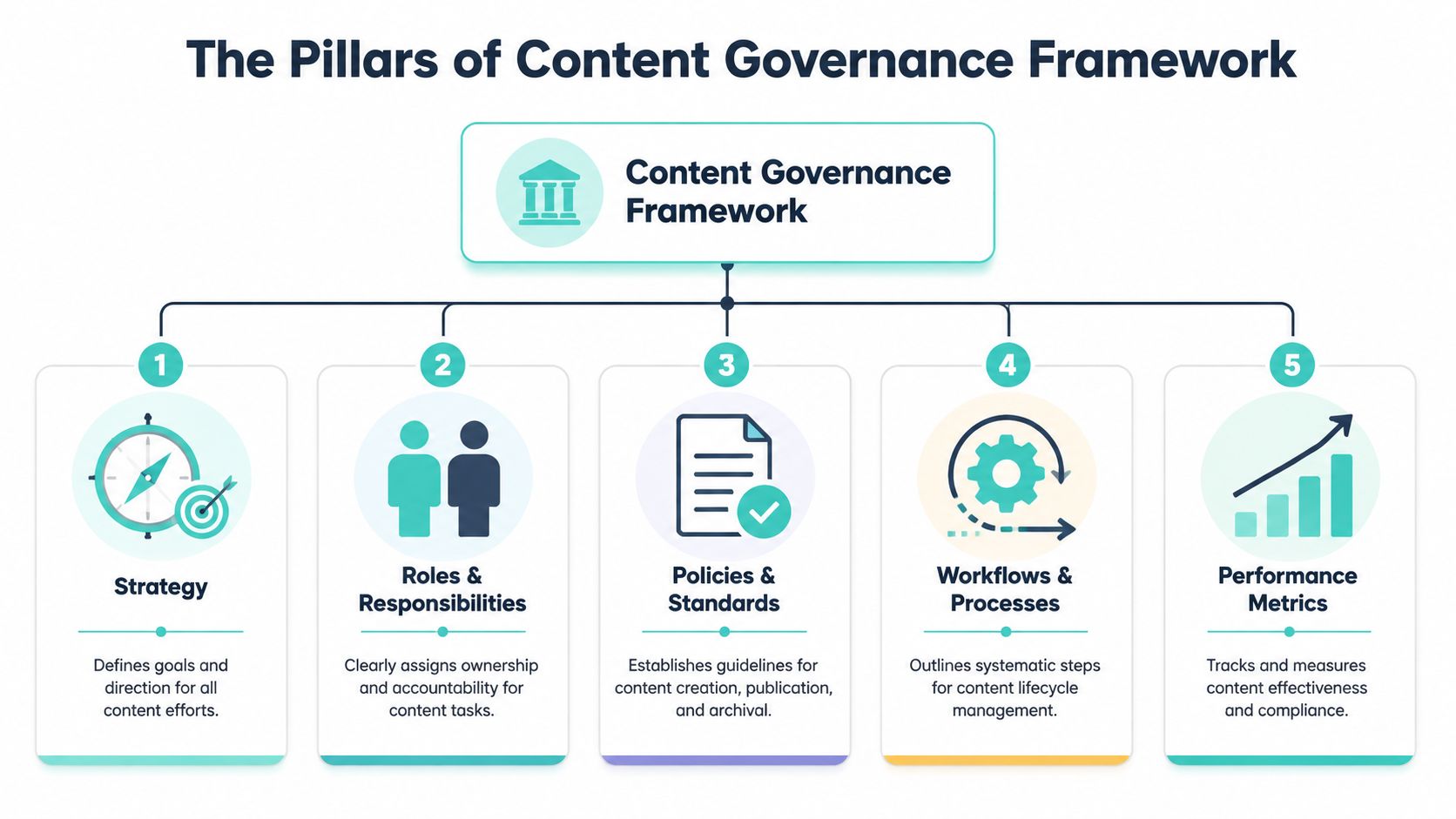
A strong framework doesn't need to be huge. It needs to be enforceable. For many organizations, a workable starting point is a small governance core that later expands into local variations and channel-specific rules. A more detailed example of that operating model appears in this guide to a content governance framework.
Strategic intent comes first
Governance breaks down when teams treat it as a cleanup task instead of a business system. The first pillar is strategic intent. You need to know what the governance model is protecting and enabling.
That usually includes priorities like:
- Brand integrity: Keep messaging, terminology, and presentation consistent across markets and channels.
- Regulatory control: Make sure legal, privacy, and accessibility obligations are built into publishing.
- Operational efficiency: Reduce duplicated effort, unnecessary approvals, and content rework.
- Scalability: Support more teams, more markets, and more channels without losing control.
If those goals aren't explicit, workflows become arbitrary. One team adds approvals because they feel safer. Another removes them because they want speed. Both create friction because neither is working from the same business mandate.
Roles and responsibilities need real ownership
This pillar looks simple on paper and causes some of the biggest delivery problems in practice.
A governance model needs named responsibility, not shared assumptions. “Marketing owns content” is too vague. Governance works when ownership exists at the level of content domain, channel, and lifecycle stage.
A practical enterprise setup often includes:
- Content owners who stay accountable for accuracy and business outcomes after publication.
- Editors or stewards who protect standards, metadata quality, and structural consistency.
- Approvers from legal, compliance, product, or brand where risk requires review.
- Platform administrators who configure permissions, workflow states, and audit rules.
- Local market leads who adapt content within approved boundaries.
The fastest way to create governance friction is to give five people approval rights and none of them ownership after launch.
Role design should also reflect risk. A campaign landing page, a public policy notice, and an intranet announcement shouldn't all use the same approval model.
Policies and standards make quality repeatable
Policies answer what must happen. Standards answer what good looks like.
In mature environments, these rules cover voice and tone, content structure, taxonomy, metadata, accessibility, localization, legal review needs, retention periods, and archival triggers. The mistake is trying to write every possible rule up front. Teams don't need a governance encyclopedia. They need standards that are clear enough to act on and narrow enough to enforce.
A simple way to structure this pillar is by content type.
| Content type | Governance focus |
|---|---|
| Public web pages | Brand, SEO fields, accessibility, approval path |
| Product content | Accuracy, versioning, localization, retirement dates |
| Knowledge content | Ownership, review cadence, duplication control |
| Intranet documents | Permissions, retention, discoverability |
| Campaign assets | Usage rights, expiry, channel consistency |
That approach works well in Sitecore because templates and components can mirror the standards. It also works in SharePoint because content types, libraries, and metadata columns can reflect the same rules.
Technology turns governance into enforcement
At this point, many enterprise programs become real.
Governance can't depend on everyone remembering the process. The platform has to enforce as much as possible. That means permissions, workflow states, mandatory fields, validation rules, audit history, scheduled review triggers, and reporting. In modern stacks, it also includes AI-assisted checks that support metadata quality, compliance scanning, and lifecycle management.
A governance framework becomes much more durable when technology does three things well:
- Restricts what shouldn't happen
- Guides what should happen
- Records what did happen
That enforcement layer is what makes the framework operational rather than aspirational. It's also where Sitecore and SharePoint differ in useful ways. Sitecore typically carries the public experience and personalization burden. SharePoint often carries collaboration, document governance, and internal knowledge responsibilities. The framework has to align both rather than let each platform drift into its own local logic.
Why Governance is Non-Negotiable for Enterprise DXPs
An enterprise team launches a new product page in Sitecore, updates pricing in a shared PDF stored in SharePoint, and publishes campaign assets to three regions. By the end of the week, the website shows one message, the sales team shares another, and two markets are still using expired content. The platform did exactly what it was configured to do. The problem was governance.
Enterprise DXPs scale publishing fast. They also scale mistakes fast. As more teams, channels, integrations, and AI-assisted workflows enter the stack, weak governance turns into a business problem. Revenue teams lose time fixing avoidable errors. Compliance teams spend more effort on checks that should have been built into the process. Content operations costs rise because nobody trusts what is current, approved, or reusable.
In Sitecore and SharePoint estates, I usually frame governance as an operating control, not a documentation exercise. It protects brand consistency, reduces legal and regulatory exposure, and keeps content production efficient as volume grows. Without it, the architecture may be composable, but the operating model is fragmented.

What this looks like in Sitecore and SharePoint
Sitecore carries governance differently from SharePoint because the business risk is different. In Sitecore, the focus is usually customer-facing experience content, structured authoring, personalization inputs, and publishing control. Governance starts in the content model and continues through workflow, permissions, approval paths, and publishing restrictions. If those controls are set up well, editors work faster inside defined boundaries and teams spend less time correcting avoidable issues after launch.
That has direct commercial value. Approved page structures reduce rework. Controlled components protect brand consistency across markets. Traceable workflows make regulated reviews easier to audit. In larger Sitecore programs, that discipline also improves the quality of AI inputs, because poor metadata and inconsistent structure weaken downstream automation.
SharePoint serves a different governance need. It manages internal documents, policy libraries, records, operational knowledge, and collaboration spaces where content spreads quickly if nobody owns the rules. Strong governance in SharePoint depends on content types, managed metadata, retention settings, approval flows, and permission boundaries that reflect how the business works.
A practical split usually looks like this:
- Sitecore governs customer-facing content, reusable components, and publishing controls
- SharePoint governs internal documents, policies, records, and collaborative knowledge
- Shared taxonomy, ownership, and lifecycle rules keep both platforms aligned
That alignment matters more once AI and content operations tooling enter the picture. Teams using Sitecore Content Hub workflow automation patterns often see the benefit quickly. Better governance means assets are easier to classify, approve, reuse, and retire across both public and internal channels.
What breaks when governance is missing
The first failure is usually not technical. It is operational confusion.
Editors do not know which content item is authoritative. Regional teams copy assets locally because the shared version feels risky to touch. Approval requests go to whoever answered last time. AI-generated variants appear faster than the review process can handle them. None of this looks dramatic in isolation, but at enterprise scale it creates real cost.
Content sprawl is the most visible symptom. Duplicate pages, stale documents, conflicting assets, and unmanaged media libraries make every update slower. Search quality drops. Reuse falls. Teams create new content because finding the approved version takes too long.
The second failure is control drift across a composable estate. A DXP may connect CMS, DAM, search, intranet, CRM, and AI services cleanly at the integration layer while governance rules remain inconsistent between systems. That is where enterprise programs start losing ROI. Content can move across channels, but ownership, retention, approvals, and metadata standards do not move with it.
The third failure is risk exposure. In Sitecore, an editor may publish content that bypasses the intended review path. In SharePoint, a policy document may remain accessible after it should have been retired or replaced. In both cases, the issue is rarely a missing feature. It is a missing governance decision that was never translated into platform configuration.
Good governance gives enterprise teams a controlled way to scale. It lets central teams define the guardrails, local teams work efficiently within them, and architects configure Sitecore and SharePoint so policy becomes part of day-to-day operations rather than a manual checkpoint.
Implementing AI-Powered Governance with Sitecore AI
A common pattern appears a few months after an enterprise switches on AI features in its DXP. Editors use AI to draft copy variations. Content Hub starts suggesting metadata. SharePoint libraries grow faster because classification is easier to postpone than to fix. Output volume goes up, but confidence drops because nobody can answer three basic questions consistently: who approved this, which model influenced it, and what happens if it is wrong.
That is the implementation challenge. AI increases throughput, but governance has to keep quality, compliance, and reuse intact. In Sitecore and SharePoint estates, the practical goal is to place AI inside controlled workflows so teams get faster production without increasing legal risk, brand drift, or content debt. Earlier guidance on content governance and AI has made the same point. Automation helps most when paired with human review, transparent rules, and clear accountability.

Where AI helps and where it needs guardrails
In practice, AI adds the most value in repetitive governance tasks that slow teams down but still follow clear rules.
Inside a Sitecore ecosystem, that usually includes metadata suggestions, content classification, accessibility checks, stale-content detection, and brand language review. In SharePoint, the same pattern applies to document tagging, retention prompts, policy-library hygiene, and identifying duplicate or outdated files. These use cases improve findability and reduce manual effort, which is where governance starts producing measurable ROI.
The trade-off is accuracy.
AI can suggest a convincing summary that misses the central point of a page. It can apply the wrong taxonomy term because the content model is weak. It can recommend language that fits the brand style guide while introducing factual or regulatory problems. That is why AI should sit in a recommendation layer for many use cases, not in an auto-publish path.
Architect's advice: Treat AI as a governed contributor with defined permissions, review rules, and audit visibility.
That decision affects platform design immediately. It changes how you set up workflows, who can approve AI-assisted content, which actions are logged, and where exceptions are handled.
How to apply this inside the Sitecore stack
Sitecore gives governance teams a good base because the platform already supports structured content, role-based permissions, workflow states, and shared assets. The implementation question is where AI belongs in that model.
A practical pattern looks like this:
| Sitecore capability | Governance use |
|---|---|
| Content templates | Require structure, mandatory fields, and approved schema before AI suggestions are accepted |
| Workflow states | Hold AI-assisted content in review until a named editor or approver signs off |
| Content Hub | Control taxonomy, asset rights, lifecycle status, and enrichment rules |
| XM Cloud | Keep channel delivery consistent by reusing governed components and approved content models |
| Personalize | Limit experimentation to approved segments, offers, and messaging boundaries |
The same principle extends to SharePoint. If AI helps classify a policy document, the retention label, owner, review date, and access rules still need to come from an agreed model. If AI summarizes a knowledge article, that summary should be stored as managed metadata or a draft field, not treated as approved truth by default.
I usually advise clients to start with low-risk, high-volume use cases first. Metadata enrichment is a good example. It improves search and reuse quickly, and errors are easier to catch than they are in customer-facing claims or regulated content. Accessibility prompts and stale-content alerts are also strong early candidates because they improve quality control without handing editorial judgment to the model.
Teams that want cleaner day-to-day execution should connect governance decisions to workflow design. Our guide to streamlining workflows with Sitecore Content Hub shows how approval paths, asset controls, and taxonomy management work together in practice.
A short product walkthrough helps make that more concrete:
The operating model that keeps AI useful
The difference between useful AI and expensive governance debt usually comes down to a handful of implementation decisions.
Define approved use cases first
Start with narrow tasks such as metadata suggestions, classification, accessibility checks, translation review, or stale-content detection. Broad generation creates volume before standards are ready.Separate recommendation from publication
AI can draft or enrich. Named people should approve customer-facing pages, policy content, regulated material, and anything with legal or reputational exposure.Record AI activity in the workflow
Editors and auditors should be able to see whether AI created, summarized, tagged, or modified content. Hidden automation makes root-cause analysis much harder.Set exception handling rules
Conflicts will happen. A regional team may reject a centrally approved taxonomy term. Legal may block a phrase the brand checker passed. The workflow needs a clear route for those exceptions.Review model performance regularly
Taxonomy drift, weak tagging patterns, false accessibility warnings, and biased language do not fix themselves. Governance owners need a review cycle and a feedback path into prompt design, model configuration, or content structure.
Sitecore AI and SharePoint governance often succeed or fail at this critical juncture. The platform features are usually there. The gap is translating policy into templates, permissions, review stages, retention settings, and audit trails that hold up under enterprise scale.
Kogifi helps clients do that translation. The work is usually less about adding new features and more about configuring Sitecore AI, Content Hub, and SharePoint so AI supports faster delivery without weakening control. That is what turns governance from a policy document into an operating model that scales.
Building Your Governance Team and Measuring Success
Governance fails when it's treated as a content team side task. It needs an operating group with authority, clear responsibilities, and a way to measure whether the model is working.
Who should own governance
The most effective setup is usually a governance council with a small core and targeted contributors. It shouldn't be a large committee that reviews everything. It should be a decision-making group that defines standards, approves changes to the model, resolves exceptions, and monitors performance.
A practical team often includes:
- A business owner: Usually a senior digital, marketing, or communications lead who can align governance with business priorities.
- A platform owner: The person responsible for Sitecore, SharePoint, or the broader DXP architecture.
- Content leads: Editors or strategists who understand publishing patterns and quality issues.
- Risk stakeholders: Legal, compliance, privacy, or accessibility specialists where needed.
- Domain representatives: Product, service, regional, or departmental owners for key content areas.
That council shouldn't own every page. It owns the model. Day-to-day accountability stays with content owners and stewards inside each domain.
Governance gets traction when one person owns the rulebook, one person owns the platform behavior, and named domain owners stay responsible after publication.
A simple responsibility split helps:
| Role | Main accountability |
|---|---|
| Governance lead | Rules, standards, change control |
| Platform admin | Permissions, workflows, enforcement |
| Content owner | Accuracy, relevance, review completion |
| Content steward | Quality checks, metadata, consistency |
| Subject matter expert | Factual validation and business accuracy |
What to measure once governance goes live
You don't need a huge dashboard at the start. You need a small set of indicators that reveal whether governance is reducing friction and risk.
Useful measures often include:
- Time to publish: How long content takes from draft to approved release.
- Review completion rate: Whether scheduled reviews happen.
- Metadata completeness: Whether required fields are being populated properly.
- Accessibility issue volume: How often content fails agreed checks before publication.
- Outdated content backlog: How much published content is past review date.
- Reuse rate: Whether teams are reusing governed content components and assets instead of recreating them.
The exact benchmark will vary by organization, so the first task is usually to establish a baseline. Then the governance team can track movement over time and identify where the process is too loose or too heavy.
That's also why governance metrics shouldn't live only in platform administration reports. They should connect to business outcomes. If time to publish improves but quality complaints rise, the model is under-controlled. If compliance is strong but simple campaigns take too long, the model may be over-engineered.
For teams building measurement into their content operations, these metrics for content marketing help frame the difference between activity reporting and useful performance signals.
Conclusion Your Roadmap to Mature Content Operations
The simplest answer to what is content governance is this. It's the operating discipline that keeps enterprise content accurate, consistent, compliant, and scalable across its full lifecycle.
In smaller environments, teams can often compensate for weak governance with effort and familiarity. Enterprise DXPs don't allow that for long. Once content spans multiple regions, systems, approval paths, and digital products, the organization needs structure that lives inside the platform, not just in policy documents. That's why governance belongs in templates, workflows, metadata models, permissions, review schedules, and audit trails.
Sitecore and SharePoint both play important roles here. Sitecore gives organizations the control surface for structured digital experiences, personalization, and scalable omnichannel delivery. SharePoint gives them a governed environment for internal publishing, documents, knowledge, and operational collaboration. When the governance model is aligned across both, teams publish faster with less ambiguity and less avoidable risk.
AI raises the stakes and the opportunity. Used well, it can support metadata quality, accessibility checks, lifecycle monitoring, and content consistency at a scale manual review can't match. Used poorly, it creates new forms of governance debt. The answer isn't to avoid AI. It's to govern it deliberately.
Strong governance improves ROI because it reduces waste, lowers compliance risk, protects trust, and helps teams reuse content and workflows instead of rebuilding them. It also makes the DXP investment more durable. The platform stops being a publishing tool and becomes a controlled content operation.
If your organization is trying to bring order to Sitecore, SharePoint, or a broader DXP estate, Kogifi can help assess the current model, define governance rules that match business risk, and translate those rules into workable platform configuration and daily publishing processes.