


You're staring at the same problem many digital teams face right now. Marketing wants faster launches, IT wants fewer risky releases, and the current CMS keeps turning every change into a coordination exercise. That's the pressure point where MACH architecture stops sounding like a buzzword and starts looking like a practical way out.
Table of Contents
- Introduction From Monoliths to Modernity
- Microservices and API-first working together
- Cloud-native and headless in practice
Introduction From Monoliths to Modernity
A monolithic CMS usually shows its limits in the same places every time, release windows get longer, simple changes ripple across unrelated parts of the stack, and teams spend more time negotiating dependencies than shipping value. That's why enterprise leaders start looking for a model that lets one capability change without forcing the whole platform back through deployment.
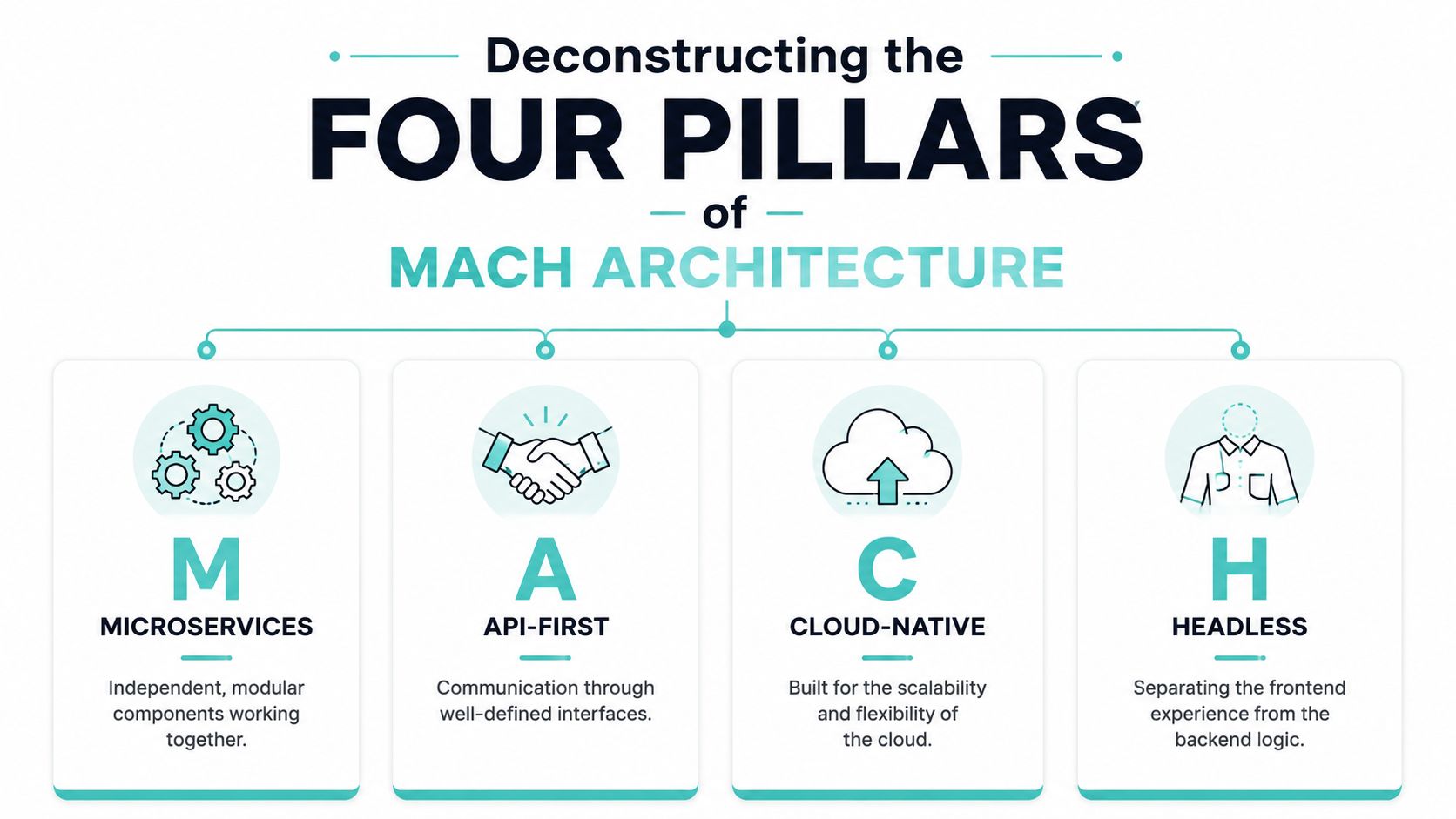
MACH means Microservices-based, API-first, Cloud-native, and Headless architecture, and the core technical effect is independent deployability. Business functions are split into replaceable services exposed through APIs, so teams can update one capability without redeploying the whole stack, which is exactly the kind of operating model that modern DXP programs need (Sitecore MACH overview).
If you're mapping a modernization path, the first question isn't whether MACH sounds modern. It's whether your current platform is blocking content reuse, slowing releases, or forcing every channel into the same rigid template. For organizations doing legacy planning, the practical comparison often starts with legacy system modernization strategies, not with a platform vendor pitch.
Practical rule: if one low-risk content change still needs multiple teams and a synchronized release train, the architecture is already costing you speed.
Deconstructing the Four Pillars of MACH Architecture
Microservices and API-first working together
Think of microservices as a set of LEGO blocks. Each block has a clear job, and the value comes from combining them without rebuilding the entire structure every time a business need changes. That's the opposite of a monolith, where one large application owns too many responsibilities at once.
The API-first part is the universal translator. It gives each service a defined way to communicate, which means content, commerce, search, identity, and personalization can all interact without hard-wiring the front end to one backend shape. If you want the implementation view, an API-first approach is what keeps those services reusable instead of isolated.
Architecture insight: APIs are not a nice integration extra, they're the contract that lets teams work independently without breaking one another's releases.
Cloud-native and headless in practice
Cloud-native means the platform is built for the cloud environment it runs in, not merely hosted there. This approach delivers business advantages like elasticity, operational resilience, and less internal burden around infrastructure management. That's why SaaS-based DXP platforms matter so much in enterprise programs, the vendor absorbs a large part of the platform maintenance model.
Headless separates the backend logic from the presentation layer. In practice, the same content and business rules can feed a website, a mobile app, a kiosk, or another channel without rebuilding the underlying content model for each surface. That decoupling is what makes omnichannel delivery manageable instead of chaotic.
The historical lineage matters too. MACH's conceptual roots go back to the Mach microkernel project, which treated core services like memory management and inter-process communication as a small kernel concern, while moving other services outside the kernel boundary (Mach kernel history)). That separation of concerns is the same design instinct behind modern composable DXP thinking.
For teams building capability maps, a resource for Cloud Engineer roles can help align cloud ownership, deployment responsibility, and support boundaries before the first migration sprint starts.
The Business Case for Adopting MACH
MACH gets approval when it solves a business problem, not when it wins an architecture debate. The clearest value comes from the ability to move one part of the experience without waiting on the entire estate, which reduces friction for product teams and lets leaders prioritize the channels that matter most.
Primark provides a concrete example. After adopting a MACH-based solution, it reported a 23% global increase in website traffic, reaching 140 million visits across 17 markets (Dynamic Yield MACH article). That doesn't prove every implementation will produce the same result, but it does show why independent services, scalable infrastructure, and reusable content logic matter at international scale.
Monolithic vs. MACH Architecture At a Glance
| Attribute | Monolithic Architecture | MACH Architecture |
|---|---|---|
| Release model | Changes are tightly coupled and often travel together | Services can be deployed independently |
| Scalability | Scale tends to happen at the application level | Services scale separately based on need |
| Change risk | One update can affect unrelated functions | Updates stay localized to the capability being changed |
| Channel support | Front end and back end are tightly bound | The same back end can feed multiple channels |
| Operational fit | Simpler to start, harder to evolve | Better for composable enterprise operating models |
If you're building the internal case, tie the architecture to outcomes your finance and operations stakeholders already understand. Measuring digital investment impact is usually more persuasive than abstract platform language because it frames the discussion around delivery risk, release velocity, and long-term flexibility.
A monolith can still be rational when the business is stable and the channel mix is narrow. MACH becomes compelling when the platform has to support different markets, different teams, and different release rhythms without collapsing under its own coordination overhead.
How Sitecore XM Cloud Embodies MACH Principles

Sitecore's current cloud direction centers on XM Cloud as a SaaS-based DXP, built on a cloud-native architecture that removes the need for customers to manage traditional infrastructure while still supporting composable delivery patterns and modern headless implementations (Sitecore cloud direction). That matters because enterprise teams don't just need a CMS, they need a delivery model that reduces operational drag.
Why XM Cloud fits a MACH program
XM Cloud aligns naturally with the MACH model because it favors decoupled delivery, reusable content, and API-driven integration. That makes it easier to connect content operations with personalization, search, commerce, and analytics without forcing every change through a single release cycle.
This is also where Sitecore's broader product direction becomes relevant. When content is modeled for reuse and governance is built into the publishing workflow, teams can operate with more discipline across brands and channels. Kogifi's headless Sitecore implementation path with JSS in XM Cloud sits in that same architectural lane.
What enterprise teams should look for
Sitecore AI programs work best when the platform architecture supports structured content and clear rules. In practice, that means reusable content objects, governed publishing, and integrations that can be extended without turning every new capability into a one-off build.
Implementation takeaway: a MACH-aligned Sitecore stack works when content, personalization, and delivery are designed as separate concerns that still share a common operating model.
That same logic applies to Sitecore's current cloud portfolio beyond XM Cloud. If the team is trying to modernize experience delivery without recreating legacy coupling in a new stack, composability is the difference between a prettier monolith and a flexible platform.
Planning Your Enterprise Migration to MACH
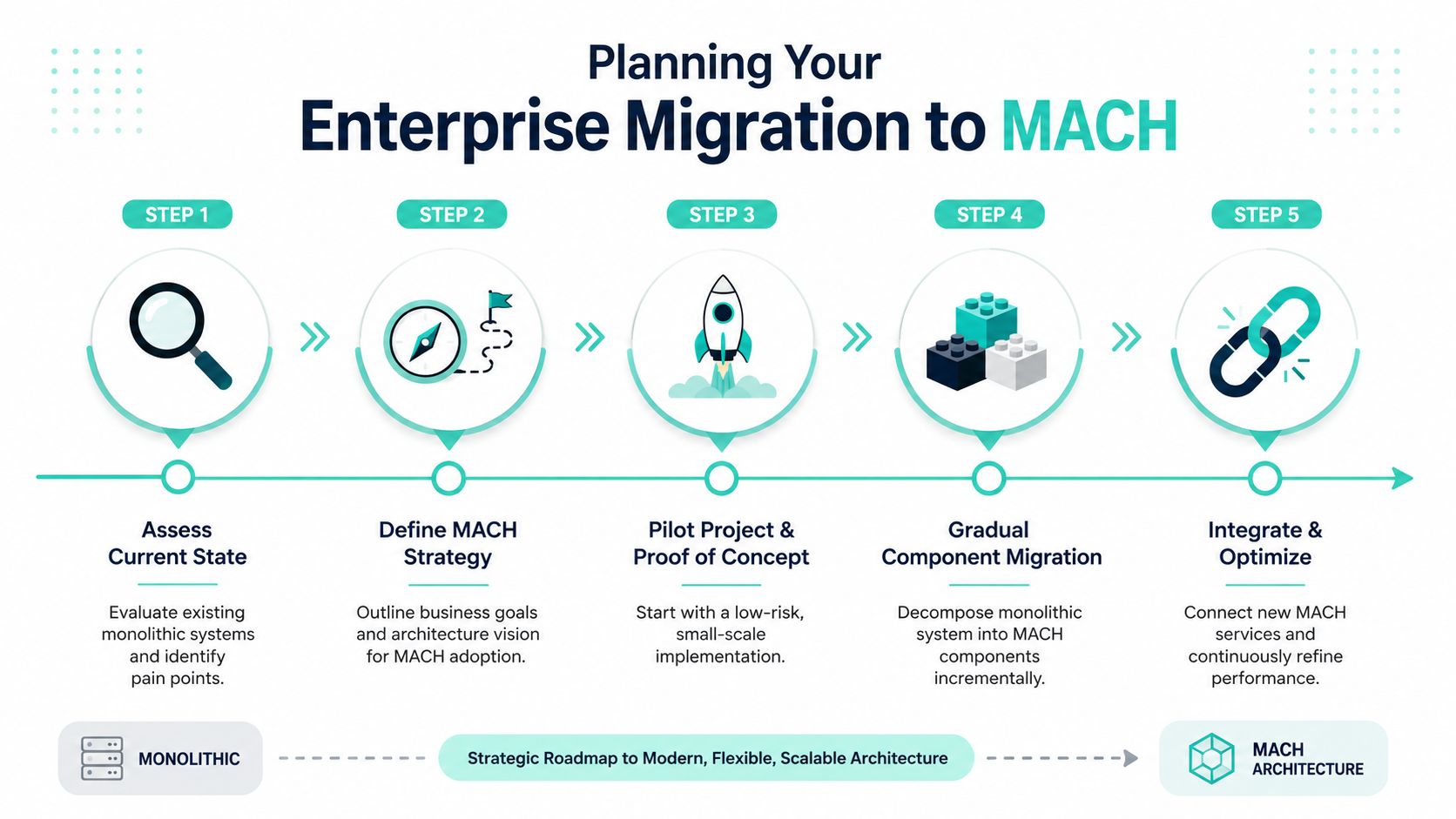
The safest MACH migration starts with scope, not ambition. First, map the current platform and identify where release bottlenecks, duplicated content, and integration pain show up most often. Then separate the must-fix constraints from the nice-to-have improvements, because not every part of the stack deserves the same migration pace.
A practical migration sequence
- Assess current state. Identify the systems that create the most friction for releases, content updates, or integrations.
- Define MACH strategy. Decide which channels, markets, and teams need independent change cycles.
- Run a pilot. Start with one bounded experience where the business risk is manageable.
- Migrate gradually. Break out services in a way that doesn't disrupt the whole operating model.
- Integrate and optimize. Tighten governance, observability, and lifecycle management after the first wave goes live.
That roadmap is easier to execute when the organization has clear ownership boundaries. For customer-facing platforms, that usually means aligning content, engineering, and operations around shared standards. For internal experience layers, the same approach can extend into the employee portal stack.
Don't forget the SharePoint side
For enterprise intranets, SharePoint Online and Microsoft 365 already provide a useful composable base through SPFx and the Power Platform (Microsoft 365 ecosystem for intranets). That makes SharePoint a strong fit when the goal is to modernize internal communication, automate workflows, and connect employee experiences to the broader digital experience architecture.
The migration question is not “Should everything move at once?” It's “Which experience layer will prove the model fastest without overwhelming the team?” That answer is usually where the roadmap becomes real.
Potential Risks and When to Reconsider MACH
MACH isn't the right answer for every organization, and pretending otherwise hurts credibility. The biggest mistake is adopting it in a sector that doesn't reward independent lifecycles fast enough to justify the added integration, operations, and governance work.
That warning matters most in low-channel-variance, validation-heavy, or vendor-constrained environments (when not to adopt MACH). In those cases, the overhead of additional services and API governance can outweigh the benefit of composability, especially if the operating model isn't ready for more autonomy.
The trade-offs that show up first
- Operational complexity. More services mean more monitoring, more release discipline, and clearer ownership.
- Governance overhead. APIs need versioning rules, content models need standards, and teams need shared lifecycle policies.
- Team maturity. Without strong DevOps habits, a MACH stack can become fragmented fast.
- Vendor coordination. Multi-product ecosystems only work when integration contracts are treated seriously.
A simpler architecture can be the smarter move when the business doesn't need parallel release cycles or broad channel reuse. The right decision isn't always the most modular one, it's the one the organization can operate well.
Balanced view: MACH improves flexibility, but flexibility only pays off when teams are ready to govern it.
Conclusion Building a Future-Ready Digital Platform
What is MACH architecture at enterprise level? It's a way to stop treating the digital experience stack as one rigid system and start treating it as a set of replaceable capabilities. That shift matters because it changes how fast teams can release, how easily content can move across channels, and how well the platform can adapt when business priorities change.
Sitecore XM Cloud makes that future tangible for enterprises that want a cloud-native, composable DXP without carrying the full burden of traditional infrastructure. SharePoint Online extends the same thinking inside the organization, where employee portals, workflow automation, and structured collaboration need the same kind of operational clarity.
The right modernization program doesn't begin with a technology label. It begins with a clear view of the release pain, content governance gaps, and integration dependencies that are slowing the business down. From there, MACH becomes a roadmap, not a slogan.
If your team is planning a Sitecore or SharePoint modernization path, talk to Kogifi about the architecture choices, migration steps, and governance model that fit your environment.