


Multichannel marketing is a straightforward concept: you use multiple channels to talk to your customers. The key word here is multiple. Each channel acts as its own separate path to reach people.
Think of it like casting a wide net. You might run an ad in a print magazine, launch a separate campaign on Facebook, and send out a promotional email. Each of these efforts operates independently, but the goal is to get your brand in front of as many people as possible, wherever they happen to be. The brand and its products are squarely at the center of this strategy.
Defining Your Multichannel Foundation

At its heart, multichannel marketing is company-centric. The main goal is to maximize the number of touchpoints your business has, engaging with the broadest possible audience. Whether it's email, social media, a brick-and-mortar store, or a mobile app, each channel runs its own race, often managed by different teams.
This separation has its perks. It allows for highly specialized optimization on a per-channel basis. For instance, your PPC team can fine-tune a Google Ads campaign for conversions, while your social media team focuses on building brand awareness on Instagram with a completely different set of tactics. The objective is simple: make your product available wherever customers might be looking.
Multichannel vs. Omnichannel: The Core Difference
It's easy to get multichannel and omnichannel marketing mixed up. While they both involve using more than one channel, their philosophies are worlds apart. Multichannel marketing treats each channel as a silo. Omnichannel, on the other hand, weaves them all together to create one seamless, continuous customer experience.
If you're interested in a deeper dive, our guide comparing omnichannel vs multichannel marketing breaks it all down.
Multichannel is about offering multiple paths to the brand. Omnichannel is about creating a single, unified experience with the brand, regardless of the path a customer takes. The shift from one to the other is a strategic evolution toward true customer-centricity.
To really nail down the distinction, it helps to see the core attributes side-by-side.
Multichannel vs Omnichannel at a Glance
This table breaks down the fundamental differences between the two approaches, from the strategic focus to the technology required to pull it off.
As you can see, the jump from multichannel to omnichannel is a significant one, moving from a brand-focused broadcast to a customer-centric conversation.
The Strategic Value of a Multichannel Start
While omnichannel is often seen as the more advanced goal, there's tremendous value in starting with a solid multichannel strategy. It’s a practical first step. It lets your organization build a presence on key platforms, gather channel-specific performance data, and really get to know your audience's behavior in different environments.
This foundational knowledge is absolutely essential before you even think about the complex integration an omnichannel experience demands. For enterprises just starting this journey, a well-executed multichannel plan helps refine your messaging and pinpoint which channels are your top performers.
To learn more about building a winning approach from the ground up, this guide on a modern multichannel marketing strategy is a fantastic resource. A strong multichannel footing sets the stage for future growth, paving the way for a gradual but deliberate shift toward a more connected customer engagement model, often powered by platforms like Sitecore.
Why a Multichannel Approach Drives Real Results
Let's move past the textbook definition and get into why a multichannel strategy is more than just a buzzword—it's a core requirement for any business that wants to grow today. The thinking behind it is simple but powerful: the more places your customers can find you, the better you'll perform. Being where your customers are isn't just about their convenience; it's a strategic must-have for you.
When you connect with people across different touchpoints, you're not just repeating your message; you're creating more chances for them to take action. This isn't just a hunch. The data consistently shows that campaigns running on three or more channels can blow single-channel efforts out of the water. In fact, industry reports have found that purchase rates can jump by 200-300% when campaigns are coordinated across at least three channels.
From Reach to Revenue Generation
The real magic of a multichannel approach is its ability to build momentum. A potential customer might first see your ad on social media, later search for your brand on Google, and finally make a purchase after receiving a targeted email offer. Each channel plays its part, but together they create a powerful, cumulative effect that guides the customer down the path to purchase. This increased visibility doesn't just get your name out there; it directly fuels revenue growth.
To see this in action, check out these inspiring top multi-channel marketing campaign examples. They do a great job of showing how brands are effectively engaging audiences across different platforms to get incredible results.
A multichannel strategy multiplies your chances of being seen at the right moment. Each channel acts as a doorway into your brand, and by opening more doors, you naturally invite more people in, which is a key step to improving your content marketing ROI.
This approach also lets your marketing team collect incredibly valuable data from each platform. You start to learn what messages click on LinkedIn versus what works on Instagram, or which offers perform best in an email campaign versus a paid search ad. These insights are gold for fine-tuning your strategy and making sure your budget is spent where it will have the most impact. Without this kind of diversified presence, you're almost certainly missing out on huge segments of your audience.
The Technology Backbone: Sitecore and SharePoint
Trying to manage a sophisticated multichannel marketing strategy without the right tech is like trying to conduct an orchestra without a conductor—it's just chaos. This is where a powerful Digital Experience Platform (DXP) like Sitecore becomes absolutely essential. Sitecore gives you that unified platform you need to orchestrate, manage, and measure customer experiences across every single touchpoint, from your website and mobile app to email and social media.
Sitecore's product suite is built specifically for this challenge:
- Sitecore Experience Platform (XP) lets you track every customer interaction and deliver personalized content on any channel they choose.
- Sitecore Content Hub™ keeps your brand message consistent by centralizing all your content and digital assets in one place.
- Sitecore Personalize helps you deliver real-time, data-driven personalization to make every interaction feel relevant, no matter where it happens.
Working hand-in-hand with a DXP is a robust internal solution like SharePoint. Think of it as the engine room that keeps everything running smoothly behind the scenes. It streamlines internal collaboration and content management, ensuring that only approved, on-brand assets get fed into your Sitecore-powered marketing machine. This integration prevents the content mess that can so easily derail multichannel efforts.
By combining the external-facing power of Sitecore with the internal discipline of SharePoint, large organizations can effectively manage complexity, boost their returns, and turn a wide presence into real, tangible business results.
Navigating Your Core Marketing Channels
A winning multichannel strategy isn't about shouting from every rooftop; it’s about having the right conversations in the right places. Every channel in today’s marketing mix has its own rhythm, its own audience, and its own unspoken rules. Getting a feel for these differences is the first real step toward building a program that actually connects with people.
Think of each channel as a different social setting. A paid search ad is like directly answering a question someone just asked you—it’s timely and solves an immediate need. A social media post is more like joining a lively public conversation; you have to be interesting and relevant to the group to get noticed. Email, on the other hand, is a personal, one-on-one chat with someone who's already invited you to talk.
The Essential Channel Mix for Enterprises
While the list of places you could be is nearly endless, a handful of channels consistently form the bedrock of successful marketing. These are the platforms where your audience is already spending their time and where your message can truly land. From our experience rolling out complex Digital Experience Platforms (DXPs), we can tell you that mastering this core set is non-negotiable before you even think about expanding.
Your primary channels will almost always include:
- Email Marketing: Still the king of direct communication. Email is your go-to for nurturing leads, sending personalized offers, and keeping existing customers close. Its high ROI and deep personalization options make it a must-have.
- Social Media: Platforms like LinkedIn, Instagram, and Facebook are where you build your brand’s personality, engage with your community, and drive traffic through both organic posts and paid ads.
- Paid Search (PPC): Tools like Google Ads let you capture high-intent customers at the very moment they’re searching for what you sell. It’s a powerful way to drive conversions now.
- Mobile Apps & SMS: If you have a dedicated app, push notifications and SMS are a direct, immediate line to your most loyal users. It's perfect for flash sales, important alerts, and exclusive content.
- Website & Blog: This is your digital home base. Your website is the final destination for campaigns running on other channels and the engine for organic growth through smart content and SEO.
Why Channel Proliferation Demands a Strategy
The customer journey is no longer a straight line; it's a web of touchpoints scattered across dozens of platforms. This has completely changed how marketing teams plan and budget. Marketers now juggle an average of 10 customer engagement channels when planning campaigns, and the top-performing teams are personalizing experiences across about six of them to get results.
This explosion of channels matters because it reshapes everything from budgets to how we measure success. Over 80% of marketers still count on email, while social media, mobile web, apps, and paid search consistently round out the top five. You can dig into more of these insights in these marketing statistics from Salesforce.com.
The takeaway is clear: you can’t just copy and paste. A compelling email newsletter will fall flat as a social media ad. This simple truth is foundational when we plan DXP implementations on platforms like Sitecore, because it dictates how every piece of content needs to be structured, tagged for personalization, and tracked.
Without a central strategy, managing all these separate conversations descends into chaos. This is where a tool like Sitecore Content Hub proves its worth. It lets your team create content components once, then intelligently adapts and deploys them across your channels. You get brand consistency without sacrificing the unique feel of each platform.
For example, a single product announcement can be spun into a detailed blog post, a short-form video for social, and a punchy email alert—all from one central hub. This is how you avoid the content anarchy that sinks so many multichannel efforts. To take it a step further, a platform like SharePoint can serve as the internal content repository, streamlining approvals before assets are pushed into Sitecore for public distribution. This creates a clean, end-to-end content lifecycle that powers a truly sophisticated marketing machine.
Executing Multichannel Marketing with Sitecore and SharePoint
Moving from strategy to execution in multichannel marketing demands a powerful, centralized technology stack. For any large business, trying to manage separate channels without a core system is a recipe for brand inconsistency and wasted effort. This is where integrating the Sitecore suite with SharePoint offers a real operational advantage, turning theory into high-performance reality.
At the heart of it all is the Sitecore Experience Platform (XP). Think of it as the central nervous system for your entire multichannel operation. It doesn't just manage your website; it connects customer data and content delivery across every touchpoint, from email to mobile apps and beyond.
Centralizing Content with Sitecore Content Hub
One of the biggest headaches in multichannel marketing is content fragmentation. Different teams create assets for their own channels, which often leads to off-brand messaging and duplicated work. Sitecore Content Hub solves this problem directly by creating a single source of truth for all marketing assets.
Instead of your team making ten different versions of a promotional graphic, they create it once in Content Hub. From there, it can be automatically adapted and pushed out to your website, social media scheduler, and email marketing platform. This "create once, deploy everywhere" model is key to maintaining brand integrity and staying efficient at scale. It guarantees a customer sees the same message whether they're on their laptop or their phone.
By decoupling content from its presentation, Sitecore Content Hub transforms your marketing assets into intelligent, reusable components. This shift is crucial for executing a sophisticated multichannel strategy that feels cohesive to the customer, not cobbled together.
This centralized approach doesn't just ensure consistency—it also speeds up campaign launches. Marketers can quickly grab approved, on-brand assets without digging through confusing folder structures or waiting on manual approvals, which directly shortens their time-to-market.
Delivering Targeted Experiences Across Channels
Once your content is centralized, the next step is delivering it with precision. This is where Sitecore Personalize and the Sitecore Customer Data Platform (CDP) work together. The CDP gathers customer data from every channel—website visits, email clicks, in-app behavior, even offline interactions—into a single, unified profile.
This rich, 360-degree view of the customer is then put into action by Sitecore Personalize. It uses that data to deliver targeted messages and experiences across every channel in real time.
Here’s a practical example:
- A user browses a specific product category on your website but doesn't buy. The Sitecore CDP logs this interest.
- The next day, that same user gets an email featuring products from that exact category.
- Later, when they open your mobile app, the homepage banner is personalized to show a special offer related to their browsing history.
This level of coordinated personalization across different channels is what elevates a basic multichannel approach. It makes every interaction relevant and nudges the customer closer to conversion, no matter which channel they’re using. The concept map below visualizes some of the core channels where these interactions happen.
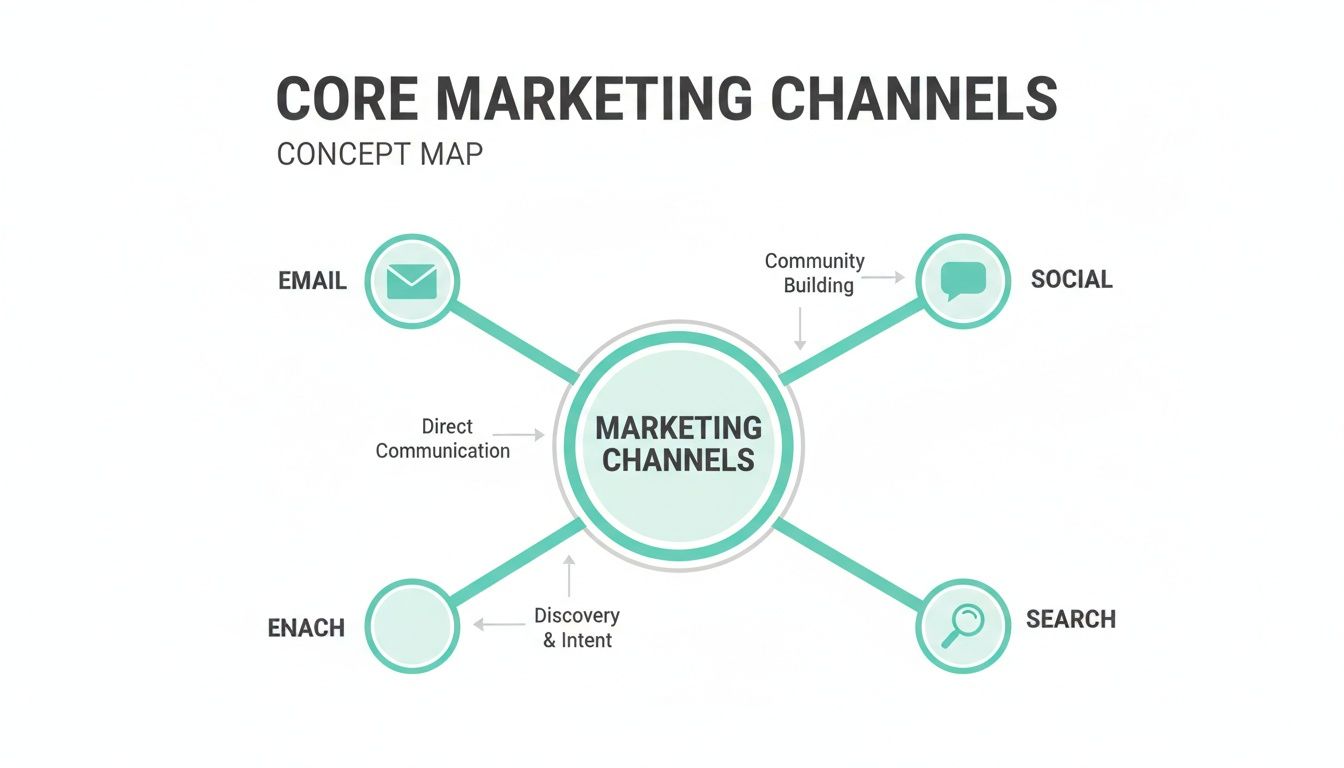
This illustrates how distinct channels like email, social, and search branch out from a central strategy, each needing a tailored yet consistent approach.
The Role of SharePoint as an Internal Engine
While Sitecore manages the external, customer-facing execution, SharePoint plays a vital internal role as a collaboration and content governance engine. Before an asset ever gets to Sitecore Content Hub, it often goes through a whole internal lifecycle of creation, review, and approval.
SharePoint provides the structured workflows and document management needed for this process. Marketing teams can collaborate on campaign briefs, draft copy, and manage legal reviews in a secure, centralized space. Once an asset is finalized and approved in SharePoint, it can be pushed seamlessly into Sitecore Content Hub, ready for public distribution.
This integration creates a complete, end-to-end content pipeline:
- Idea & Creation: Teams collaborate within SharePoint.
- Review & Approval: Workflows ensure compliance and brand alignment.
- Centralization & Distribution: Approved assets are published to Sitecore Content Hub.
- Personalization & Delivery: Sitecore XP and Personalize deploy the content across all marketing channels.
This structured process prevents unapproved or outdated content from ever reaching the customer, which solves a major pain point in large-scale multichannel operations. The combination of SharePoint's internal discipline with Sitecore's external delivery power creates a robust framework for executing what is multichannel marketing at an enterprise level. To dig deeper into this topic, you can learn more about the power of automated content marketing in our detailed guide.
Tackling the Inevitable Hurdles of Multichannel Marketing
Even with the best tech stack, rolling out a multichannel strategy comes with its own set of operational headaches. Enterprises quickly learn that just showing up on multiple channels isn't the whole story. Real success means wrestling with consistency, untangling data, and proving what’s actually working. Drawing from our years implementing large-scale Sitecore solutions, we’ve seen the same problems crop up time and again—and we’ve found the technology-driven fixes that work.
Let’s break down three of the biggest challenges: keeping your brand consistent across a sprawling channel mix, unifying customer data trapped in different systems, and accurately measuring ROI when the customer journey is all over the map.
Keeping Your Brand and Messaging Consistent
One of the first cracks that appears in any multichannel effort is brand inconsistency. Your social media team, email marketers, and content creators are all working hard, but if they're not singing from the same song sheet, the customer gets a disjointed, confusing story. This erodes trust and dilutes the impact of your message.
The fix is centralized content governance. Sitecore Content Hub becomes the single source of truth for every marketing asset—from brand logos and product shots to approved messaging and campaign copy.
- Content Workflows: It sets up clear review and approval processes, making sure only on-brand, compliant content ever sees the light of day.
- Digital Asset Management (DAM): Teams pull from one central library, so you can finally stop worrying about outdated logos or incorrect product images being used.
- Content as a Service (CaaS): Assets are created as reusable chunks that can be pushed to any channel, from your website to a mobile app, guaranteeing the core message stays the same everywhere.
This approach stops brand fragmentation in its tracks and ensures a cohesive customer experience, no matter where they interact with you.
Unifying Siloed Customer Data
Another major roadblock is siloed customer data. Your email platform knows who clicks, your e-commerce site knows who buys, and your social channels know who engages. But if these systems don't talk to each other, you're left with a fragmented picture. You can't see the full customer journey, and true personalization remains out of reach.
This is a classic data integration problem, and it's exactly what a Customer Data Platform (CDP) was designed to solve. Sitecore CDP is built to pull in data from all those separate channels and stitch it together into a single, complete customer profile.
By creating a persistent, 360-degree view of each customer, Sitecore CDP turns fragmented data points into actionable intelligence. It tracks every interaction—online and offline—to build a rich history of behaviors and preferences.
This unified profile is the engine that drives personalization. It allows Sitecore Personalize to serve up relevant content and offers across every channel, based on a customer’s entire history, not just their last click. If you're curious about the nuts and bolts of bringing these data sources together, our article on customer data integration solutions dives deeper into the technical side.
Measuring Cross-Channel ROI Accurately
Finally, the million-dollar question: how do you prove what's working? When a customer sees a social media ad, clicks an email link, and then visits your site directly to make a purchase, which channel gets the credit? Without a clear attribution model, you're just guessing where to put your budget, and you’ll struggle to prove the value of your marketing spend.
The integrated analytics inside Sitecore Experience Platform (XP) bring much-needed clarity. Because Sitecore XP tracks the entire customer journey across the channels it manages, it connects the dots between different touchpoints and the final conversion. It moves way beyond simplistic last-click attribution, giving you a holistic view of performance. By analyzing the complete path to purchase, you can see which channels are most effective at different stages of the funnel and allocate your resources with confidence. This data-driven approach turns ROI measurement from a guessing game into a genuine strategic advantage.
Your Enterprise Multichannel Strategy Checklist

Moving from theory to a real, working multichannel program requires a solid game plan. This checklist is your roadmap, designed to help enterprise teams launch a new strategy or fine-tune an existing one. We'll pay special attention to getting the most out of platforms like Sitecore and SharePoint to lock in your success.
Think of it as building from the ground up. Each step is designed to create a strong foundation, ensuring your program is not just effective but also scalable and easy to measure.
Foundational Strategy And Goal Setting
First things first: you need to know where you're going and what success looks like before you create a single piece of content. Without clear goals, you’re just guessing, and you won’t be able to measure the return on your multichannel marketing investment.
- Define Channel-Specific Objectives: Don't fall into the one-size-fits-all trap. Your goal for email (maybe lead nurturing) should be totally different from your goal for social media (say, building brand awareness). Get specific and document the primary job of each channel.
- Map Customer Touchpoints: Walk in your customer's shoes. Identify every key interaction point they have with your brand, from a social ad to a support email. This simple mapping exercise will quickly reveal gaps in the journey and new opportunities to connect.
- Establish Key Performance Indicators (KPIs): This is where you get real about results. Assign concrete metrics to every channel goal. If your website's purpose is to generate leads, you need to be tracking form submission rates. This gives every channel a clear performance benchmark.
Technology And Content Governance
With your strategy mapped out, it's time to get your tech and content workflows in order. This is where a DXP like Sitecore becomes the linchpin, acting as the central hub that connects all your efforts and keeps the brand message straight.
A successful multichannel strategy is built on a foundation of centralized technology and rigorous content governance. Platforms like Sitecore Content Hub and SharePoint are not just tools; they are the operational backbone that prevents brand fragmentation and ensures consistency at scale.
- Select a Centralized DXP: A platform like Sitecore Experience Platform (XP) is your command center. It's essential for bringing all your customer data together and delivering personalized content across every channel.
- Implement a Content Hub: Use a tool like Sitecore Content Hub to create a single source of truth for all your marketing assets. Adopting a "create once, deploy everywhere" model is the only way to maintain brand consistency without going crazy.
- Integrate Internal Workflows: Your DXP needs to talk to your internal collaboration platforms, like SharePoint. This connection ensures that content goes through the proper review and approval cycles before it ever sees the light of day, creating a seamless and compliant process.
- Plan for Continuous Optimization: A multichannel strategy is never "done." You need to schedule regular check-ins to review channel performance data. See what's working, what's not, and make adjustments. This constant cycle of testing and refining is the secret to long-term success.
Ready to put this into practice? This checklist breaks down the process into manageable phases, helping your team stay aligned from initial strategy to final launch and beyond.
Multichannel Strategy Implementation Checklist
By following these steps, you build a multichannel program that’s not just powerful on day one, but also adaptable enough to evolve with your customers and your business goals.
Got Questions? We've Got Answers
When you start digging into multichannel marketing, especially for a large organization, a few key questions always seem to pop up. Let's tackle the ones we hear most often.
How Is Multichannel Different From Cross-Channel Marketing?
It's easy to mix these two up, but the difference is pretty simple. Think of multichannel marketing as having several separate conversations. You might engage customers on email, social media, and your website, but each channel operates on its own, like separate storefronts that don't talk to each other.
Cross-channel marketing is the next step up. Here, the channels start sharing information to create a more connected experience. For instance, a customer might get an email that directly references something they just looked at on your website. It's more joined-up, but not quite the completely seamless journey you'd find in an omnichannel setup.
What Is the First Step to Building a Multichannel Strategy?
Before you even think about which platforms to use, you have to start with your customer. The absolute first step is getting a deep, clear understanding of who they are.
Where do they spend their time online? What do they use each channel for? Answering these questions with real data is non-negotiable. This insight ensures you put your resources where they'll actually make a difference, instead of wasting time and money on channels your audience simply doesn't use.
How Does Sitecore Specifically Improve Multichannel ROI?
Sitecore delivers a better return on investment by bringing three critical elements under one roof: content, personalization, and analytics. It immediately boosts efficiency by letting you create content components once and reuse them across different channels, which is a huge time and cost saver.
But the real magic is in its personalization engine. Sitecore allows you to deliver highly relevant experiences that drive up conversion rates. And because all the data is integrated, you get crystal-clear attribution, showing you exactly which channels are performing best and giving you the hard numbers to justify your marketing spend.
Ready to build a powerful, results-driven multichannel strategy? Kogifi has over a decade of experience implementing enterprise-level Sitecore and SharePoint solutions that turn channel presence into measurable growth. Contact us today to learn how we can help.