


Automated marketing isn't just about sending emails anymore; it's become a complete business philosophy built around smart, real-time interactions with customers. Looking ahead to 2026, the question is no longer if you automate. The real differentiator is how intelligently you do it, moving from basic triggers to predictive, truly personal experiences powered by a robust platform like Sitecore.
Why Your 2026 Strategy Needs Intelligent Automation
In a market where customers don't just want personalization but expect it, a simple, rule-based automation strategy just won't cut it. The game has changed. We've moved beyond basic "if-this-then-that" rules to predictive models that figure out what customers need before they even ask. This is where a powerful, intelligent platform like Sitecore AI becomes so essential.
This shift is clear in the market data. The global marketing automation market hit $47.02 billion in 2025 and is on track to reach a staggering $81.01 billion by 2030. That 11.5% annual growth isn't just a number; it’s a signal that automation is now a survival tool in any digital-first market.
Moving Beyond Basic Triggers
Too many companies are still stuck in the first gear of automation. They’re using it for simple, repetitive tasks like welcome emails or abandoned cart reminders. While that's a good start, it’s only scratching the surface of what’s possible. An intelligent strategy uses AI to graduate from these simple rules and orchestrate dynamic, omnichannel experiences.
For example, Sitecore AI does more than just see a user left something in their cart. It digs into their entire behavioral history, compares it with similar user profiles, and predicts the next best action. That action could be anything from:
- A personalized email with a time-sensitive offer.
- A targeted ad on social media featuring a product that complements what was in their cart.
- A customized hero banner that greets them on their next visit to your site.
This is the kind of sophistication that sets market leaders apart. It's about building a system that learns, adapts, and optimizes itself on the fly. If you're looking to implement these advanced techniques, getting a firm grasp of marketing automation best practices is the perfect place to start.
For CTOs and marketing leaders, the message is clear: failing to adopt a sophisticated, AI-driven strategy is a direct threat to market relevance. It’s the difference between speaking to your audience and having a genuine conversation with each individual customer.
The Role of an Integrated Ecosystem
Pulling this off requires more than just a single tool. It demands an integrated ecosystem where your Digital Experience Platform (DXP) and content repositories work together seamlessly. This is exactly why our expertise is centered on combining Sitecore’s powerful AI and personalization with the rock-solid content management and collaboration features of SharePoint.
When you use SharePoint as your internal content engine, your marketing teams get a steady stream of approved, well-governed content. This content then feeds the Sitecore platform, which applies its intelligence to deliver the right message to the right person, at the right time, on the right channel. This synergy creates a scalable and efficient framework for executing a modern automated marketing strategy that actually works.
Building Your Data and Technology Foundation
An automated marketing strategy is only as powerful as the data and tech that fuel it. Let’s get practical: your tech stack blueprint starts with unifying all that scattered customer data into a single, coherent profile. This is where a Digital Experience Platform (DXP) like Sitecore becomes the central nervous system for your entire ecosystem.
Real automation needs high-quality, accessible data to work. I've seen it time and again—when information is siloed in your CRM, ERP, and e-commerce platforms, you can't get a holistic customer view. The first move is to design a data architecture that breaks down those walls, enabling the real-time segmentation and personalization that Sitecore AI needs to do its job.
The process involves integrating these enterprise systems directly with the Sitecore Experience Platform (XP) and its related portfolio. You’re aiming for a seamless, two-way data flow that makes customer information not just collected, but truly actionable.
Architecting for Sitecore AI
To get the most from Sitecore AI, your data architecture has to be designed with its specific needs in mind. This means moving beyond static lists and basic demographic segments. Sitecore’s AI engines, including Sitecore Personalize and Sitecore CDP (Customer Data Platform), need a constant stream of behavioral data to build rich, dynamic user profiles.
This involves configuring Sitecore XP to meticulously track key interactions:
- Goals: Define what success looks like—a completed purchase, a form submission, or a whitepaper download.
- Events: Track the smaller steps that lead to goals, like watching a video, adding an item to a cart, or clicking a specific CTA.
- Outcomes: Assign business value to these interactions. This helps the AI understand not just what users do, but what their actions are worth to the business.
This detailed tracking is what feeds the machine learning models, allowing them to spot patterns, predict future behavior, and automatically serve hyper-personalized content. A well-designed system doesn't just react; it anticipates user needs. If you’re trying to create a seamless flow of information between different systems, it's worth exploring expert guidance on customer data integration solutions to make sure your foundation is solid.
The following flowchart shows how an automated strategy matures from basic rules to AI-driven prediction.
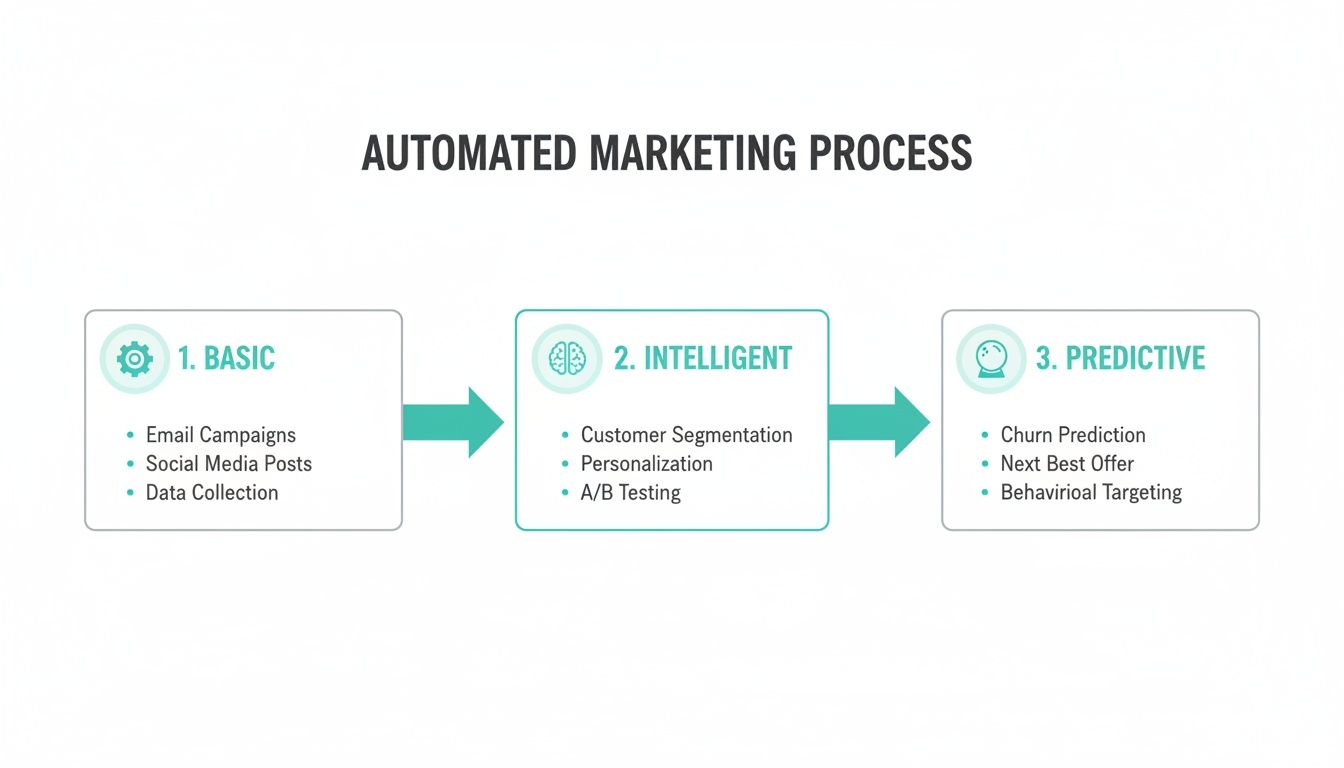
This visual shows the journey: from simple, task-based automation to an intelligent, predictive system that powers a modern marketing strategy.
Integrating SharePoint for Content Velocity
While Sitecore manages the customer-facing experience, SharePoint plays a critical, complementary role. Integrating SharePoint as an internal content hub provides the fuel for your automation engine. It establishes a governed, collaborative space where your marketing teams can create, approve, and manage content efficiently.
By connecting SharePoint to Sitecore, you solve a common bottleneck in enterprise marketing: content velocity. This integration ensures a steady supply of approved, on-brand assets is ready to be personalized and deployed by Sitecore AI, making your strategy more scalable and agile.
This setup creates a powerful synergy. SharePoint streamlines internal workflows and content governance, while Sitecore focuses on intelligent delivery and personalization. For instance, a new product datasheet approved in a SharePoint workflow can be automatically synchronized to Sitecore, ready for the AI to surface it to relevant customer segments on the website or in email campaigns.
An integrated approach ensures your automated marketing strategy is supported by both world-class technology and efficient operational processes. A deep understanding of the marketing automation tools comparison highlights why this kind of bespoke, integrated stack often outperforms all-in-one solutions.
3. Designing Your Strategy with Sitecore and SharePoint
With a solid data foundation in place, it’s time to move from architecture to action. This is where you’ll start designing an automated marketing strategy that gets the most out of your Sitecore stack. The process always begins by mapping customer journeys to pinpoint the moments that matter most—those key touchpoints ripe for automation.
This isn’t just a theoretical exercise; it’s a deep dive into how customers actually interact with your brand. Using tools like Sitecore Experience Manager (XM), we can visualize the entire customer lifecycle, from their first flicker of awareness all the way to post-purchase loyalty. The goal here is to identify friction points and opportunities where a timely, personalized interaction can make all the difference.

Configuring Sitecore for Intelligent Tracking
Once you've mapped the journey, the next step is translating those touchpoints into trackable actions within Sitecore Experience Platform (XP). This is absolutely crucial for feeding the AI engines the behavioral data they need to start learning. It’s not just about tracking page views; it’s about understanding intent.
We get this done by configuring three core elements in Sitecore XP:
- Goals: These represent significant business conversions. A goal could be anything from a user submitting a "Contact Us" form to completing a high-value purchase. Each goal gets assigned a specific value to quantify its importance.
- Events: These are the smaller, incremental actions a user takes on the path to a goal. Think of things like watching a product demo video, adding an item to a wishlist, or using a cost-calculator tool on your site.
- Outcomes: These define the ultimate business results of a user's journey. For instance, an outcome could be "Lead Captured" or "Upsell Opportunity." This layer of data helps the system connect user interactions to real business impact.
By meticulously setting up these tracking components, you create a rich data stream that fuels Sitecore's AI. The platform can then begin to connect specific behaviors with outcomes, identifying patterns a human analyst might easily miss. You can find more details on how this works in our guide on the personalization of content.
While rule-based systems have been the standard for years, modern AI-powered platforms like Sitecore offer a much more dynamic approach. The difference is stark.
The takeaway is clear: while traditional systems react to what you tell them, Sitecore’s AI proactively discovers what it needs to know to drive better results.
SharePoint as the Internal Content Engine
Even the most ambitious automated marketing strategy will stall if your content creation process can't keep up. This is a common bottleneck I’ve seen in many large enterprises. To solve this, we integrate SharePoint as a powerful internal content hub that works in tandem with your Sitecore DXP.
SharePoint provides a centralized, governed environment where your internal teams—from product marketing to legal—can create, collaborate on, and approve content. It’s the key to ensuring consistency, version control, and brand compliance before any asset ever reaches a customer-facing platform.
This integration creates a seamless pipeline. For example, an asset approved in a SharePoint workflow can be automatically synchronized with Sitecore's content library, becoming immediately available for personalization. This drastically increases content velocity, ensuring your Sitecore AI has a constant supply of fresh, relevant material to deliver to different audience segments.
By connecting SharePoint and Sitecore, you transform your content workflow from a reactive, manual process into a proactive, automated engine. SharePoint handles internal governance and velocity, while Sitecore focuses on intelligent, external delivery.
Real-World Scenario: Integrated Sitecore and SharePoint
Let's look at how this plays out in the real world. A global financial services client of ours wanted to deliver distinct, hyper-personalized web experiences to two key audiences: high-net-worth individuals and small business owners.
First, we used Sitecore Personalize to define these segments, combining explicit data (from form submissions) with implicit data (browsing behavior). Then, we integrated their SharePoint intranet with Sitecore XM.
The SharePoint side housed two dedicated content libraries: one with articles and reports on wealth management, the other with resources on business financing. Each library had its own approval workflow managed by the respective marketing teams. Once content was approved in SharePoint, it was automatically tagged and synced to Sitecore.
Finally, we configured personalization rules in Sitecore. When a user was identified as "high-net-worth," Sitecore's AI would dynamically pull content from the wealth management library to populate hero banners, resource sections, and call-to-action blocks. Small business owners saw content pulled from the business financing library instead.
This synergy between SharePoint’s structured content engine and Sitecore’s personalization power allowed them to scale their automated marketing strategy effectively, delivering a truly tailored experience for every single visitor.
Activating Your Automated Campaigns Across Channels
You’ve laid the strategic groundwork and the tech is in place. Now for the exciting part: activation. This is where your automated marketing strategy moves from a blueprint to a living, breathing playbook of campaign 'recipes' your team can use right away. We're talking about going way beyond the standard abandoned cart email and into sophisticated, omnichannel journeys.

The numbers don’t lie. Marketing automation is no longer a "nice-to-have" in the enterprise world; it's a must. An incredible 91% of marketers say AI and automation have made a major difference in their work, with 79% actively automating parts of the customer journey. The ROI is just as compelling—for every dollar spent, businesses are seeing an average return of $5.44, a stunning 544% ROI.
Crafting Intelligent Lead Nurturing Sequences
A lead nurturing sequence is a classic automation play, but with the right tools, it transforms into an intelligent, adaptive conversation. Think beyond a generic "thank you" email after a content download. Using a platform like Sitecore’s Experience Platform (XP), you can build a dynamic workflow that reacts to what users actually do.
Here’s a real-world example. A user downloads your whitepaper on "Enterprise Cloud Migration." Instead of just firing off a pre-written email, Sitecore kicks off a multi-step journey:
- Immediate Follow-Up: An email instantly delivers the whitepaper. But it also includes links to a related case study and a quick video demo, offering more value.
- Behavioral Trigger: Let's say the user clicks the case study link. Their profile score gets a bump, and they’re tagged with a "High-Intent" attribute. The system then automatically schedules a second email with a webinar invitation.
- Cross-Channel Activation: What if they ignore the emails but come back to your website? Sitecore Personalize can step in and show a custom banner promoting that same webinar. You’re delivering a consistent message across different touchpoints.
Re-Engagement with Predictive Churn Scores
One of the most valuable uses of an automated marketing strategy is keeping the customers you already have. Instead of waiting for users to go dark, Sitecore AI can analyze behavior to generate predictive churn scores. This is a game-changer because it lets you spot at-risk customers before they walk away.
Here’s a practical recipe for a re-engagement campaign:
- Trigger: A customer’s churn score hits a certain threshold (e.g., a 75% likelihood of disengaging).
- Action 1 (Email): An automated, personalized email is sent from their designated customer success manager, offering help or a special incentive based on their purchase history.
- Action 2 (Mobile Push): If they don’t open the email within 48 hours, Sitecore CDP triggers a push notification to their mobile app with an offer like, "We've missed you! Here's 15% off your next order."
- Action 3 (Internal Alert): Still no activity? The system can create a task in your CRM for a sales rep to make a personal follow-up call.
This layered approach ensures you’re using the right channel at the right time. If you're looking for more ideas, checking out some powerful workflow automation examples to implement can give your team a great starting point.
An effective automated marketing strategy is not just about sending messages; it's about orchestrating a seamless, consistent brand experience that feels personal on every channel, whether it's web, email, or mobile.
Continuous Optimization Through A/B Testing
No automation recipe is perfect on day one. A critical part of activating your campaigns is building a culture of continuous optimization through A/B testing. Sitecore’s built-in tools make this incredibly straightforward. You can test just about anything—from email subject lines and CTA button colors to entire page layouts and personalization rules.
The key is to test one variable at a time and measure its impact on a specific goal. For example, you might test two versions of a landing page: one with a short, punchy form and another with a longer form that gathers more qualifying data. By tracking submission rates, you'll quickly see which version drives better results and can roll out the winner. This turns every interaction into a valuable learning opportunity, helping you fine-tune your campaigns for maximum impact.
Measuring Success and Optimizing Performance
An automated marketing strategy that isn't measured is just a collection of expensive actions. To actually prove its value and drive real improvement, you need a solid framework for tracking performance and showing ROI. This is where you connect your campaigns to tangible business outcomes, shifting from hopeful execution to sharp, data-driven decisions.
Your first stop should be building out meaningful dashboards in Sitecore Experience Analytics. Think of this tool as your mission control, giving you a crystal-clear view of how users are interacting with your personalized experiences. It translates all the goals, events, and outcomes you’ve set up into performance data you can actually use, showing you which automated paths are delivering the most value.
But to get a truly complete picture, you need to look beyond a single platform. By pulling data from your CRM or ERP system, you can connect Sitecore’s engagement metrics directly to your sales pipeline. This creates a full-circle view, showing not just how many leads a campaign generated, but how many of those leads turned into actual revenue.
Defining KPIs That Truly Matter
To prove your marketing automation is worth the investment, you have to get past vanity metrics like open rates and page views. While those numbers have their place, they don't speak the language of the C-suite. The KPIs that really move the needle are the ones tied directly to business growth and profitability.
Focus your reporting on these high-impact metrics:
- Marketing-Attributed Revenue: This is the gold standard. It directly measures the revenue generated from customers who interacted with your automated campaigns, proving marketing's contribution to the bottom line.
- Customer Lifetime Value (CLV): By tracking the long-term value of customers acquired through specific automated journeys, you can demonstrate how your personalization efforts are building lasting, profitable relationships.
- Pipeline Velocity: This KPI measures how quickly leads move through your sales funnel. A successful automated strategy will speed this up by delivering the right information at the right time, effectively shortening the sales cycle.
Tracking these metrics well transforms your marketing team from a cost center into a documented revenue driver. For a deeper dive on this, check out our detailed article on measuring digital marketing effectiveness.
Shifting from Reporting to Forecasting with Sitecore AI
Here’s where Sitecore AI truly sets itself apart from traditional analytics. Instead of just reporting on what happened, its predictive insights help you forecast what will happen and proactively spot opportunities for optimization. This marks a fundamental shift from reactive analysis to forward-looking strategy.
Sitecore AI doesn't just show you a dashboard; it offers a glimpse into the future. By analyzing behavioral patterns, it can forecast which customer segments are likely to convert, which are at risk of churning, and which campaigns will deliver the highest ROI.
This predictive power helps you make smarter, faster decisions. For instance, if the AI forecasts a dip in engagement for a key segment, you can launch a targeted re-engagement campaign before the numbers actually drop. It turns your analytics platform into an active co-pilot for your entire strategy.
The combination of artificial intelligence and marketing automation is what defines modern marketing. Recent stats show that 64% of marketers are already using automation and AI tools, with 62% finding them critical to their success. Investment is only growing, as 64% of marketers plan to increase their AI spending, and 75% of companies using marketing AI are reallocating talent toward more strategic work. You can find more insights on this rapid AI adoption on Emailvendorselection.com. This is the shift that separates high-performance marketing operations from the rest.
Common Questions About Sitecore and Automation
As leadership teams lean into more advanced marketing automation, a few practical questions always pop up. We’ve been in the trenches with Sitecore and SharePoint for years, so here are some straight answers based on our experience.
How Long Until We See ROI from Sitecore AI?
You'll see initial wins, like better engagement rates, within the first 90 days. But when it comes to a significant return on investment—the kind that moves the needle on revenue and Customer Lifetime Value (CLV)—you should plan for a 6 to 12-month timeline.
Why the wait? It all comes down to three things: the quality of your existing data, the complexity of the customer journeys you're automating, and how quickly your team gets comfortable with the new platform. The key is to set your baseline metrics from day one and focus on small, iterative improvements. Don't wait for one big, perfect launch.
An automated marketing strategy is a marathon, not a sprint. The early gains in engagement are important milestones, but the true business impact is measured in long-term revenue growth and customer loyalty, which takes time to build and prove.
Can Sitecore AI Integrate with Our Existing Systems?
Absolutely. This is one of Sitecore's biggest strengths. The whole ecosystem is built on the idea of composability, which just means it’s designed to play nicely with your current tech stack. We use Sitecore's APIs and dedicated connectors to get data flowing seamlessly between Sitecore AI and your other critical platforms.
This is essential for connecting with common enterprise systems, such as:
- CRM platforms like Salesforce or Microsoft Dynamics
- ERP systems that handle things like inventory and customer orders
- E-commerce engines and other custom business applications
The real goal here is to build a unified customer profile inside the Sitecore CDP. When the AI has a complete, 360-degree view of each customer, it can finally deliver the kind of hyper-personalized experiences that actually drive results.
Is SharePoint Necessary for a Sitecore Automation Strategy?
No, SharePoint isn't strictly mandatory. But integrating it can seriously amplify what you can achieve with your automation strategy. Think of SharePoint as the central content and collaboration hub that fuels your customer-facing Sitecore DXP.
Here’s where it makes a huge difference: SharePoint enforces content governance, organizes approval workflows, and manages version control. This ensures every piece of content feeding your Sitecore Experience Platform (XP) and Sitecore Personalize engines is on-brand, accurate, and ready to go.
In short, it solves the content bottleneck that so often slows down ambitious personalization projects. By making sure you have a steady stream of high-quality content, you make your entire marketing automation engine more efficient and easier to manage as you scale.
At Kogifi, we specialize in designing and implementing advanced automated marketing strategies that deliver measurable results. Our expertise in the Sitecore and SharePoint ecosystems ensures your technology stack works in harmony to drive growth. Start your digital transformation journey with Kogifi today.