


Around 90% of the top one million websites rely on a CMS, making localization-ready architecture a baseline requirement for global digital operations (Weglot's multilingual website statistics). For an enterprise, that doesn't mean translating a few pages and adding a language switcher. It means coordinating content models, regional variants, translation tasks, approvals, URLs, metadata, publishing states, and audience experiences across a connected digital estate.
That's why effective CMS localization depends on an orchestration layer. Translation is one activity inside a larger system that must keep source and locale content synchronized, give local teams appropriate control, preserve governance, and deliver the right experience through platforms such as Sitecore XM Cloud, Sitecore AI, Adobe Experience Manager, and Microsoft SharePoint.
Table of Contents
Why CMS Localization Matters for Global Enterprises
A global campaign might begin with one approved source page. Soon, regional teams need localized copy, market-specific legal language, different imagery, translated metadata, local URLs, and a launch date that aligns with the central campaign. Without a controlled CMS localization process, editors exchange spreadsheets, translators work from outdated exports, and developers repair pages that drifted from the approved design.
The scale of the web makes this a platform concern, not a side project. Around 80 million websites use CMS platforms, and 90% of the top one million websites rely on a CMS (Weglot's multilingual website statistics). Enterprises already depend on structured publishing, reusable components, workflows, and permissions. Localization must fit into those operating systems rather than sit beside them as a manual translation queue.
Teams evaluating their platform foundations can use this overview of the benefits of a CMS to connect centralized publishing with broader governance and content operations.
Translation is only one layer
English accounts for about 49.4% of websites, while English reaches about 19% of the world's population, according to a multilingual web statistics reference (OBDILCI's internet language methods). The same source reports that 60% of shoppers rarely or never buy from English-only websites. Localization therefore affects reach, trust, search visibility, and the usability of the experience.
The orchestration layer coordinates more than words. It can identify changed source content, create translation tasks, preserve non-translatable fields, route work for review, and publish approved variants without forcing every market to repeat the entire process.
Architectural rule: Treat each locale as a governed publishing state, not as a translated copy of a page stored somewhere else.
Sitecore AI strengthens this model by connecting content operations with audience intelligence and experience decisions. In its 2026 product direction, Sitecore AI includes an Audience builder that uses CDP profile data, session information, events, and traits. Authors can define rule groups with And, Or, and Not operators, review estimated audience size before launch, and manage refresh schedules. Component personalization was phased in on May 28, 2026, allowing authors to manage component variants for defined audiences in Page builder (Sitecore AI platform coverage).
That combination matters because a localized page may need different component variants for different audiences. The CMS can become the place where language, market, content state, and audience experience are coordinated together.
Understanding CMS Localization Core Concepts
Think of an enterprise CMS as a publishing house. The content model is the editorial system, the source locale is the master edition, and each target locale is a market edition. A translation isn't a photocopy. It may require different phrasing, imagery, navigation, metadata, legal content, or publication timing while still belonging to the same editorial story.
Three concepts establish a useful mental model:
- Internationalization prepares the platform for multiple locales through locale-aware routing, flexible formatting, and translatable content structures.
- Translation converts source text into another language.
- Localization adapts the experience to a particular market, including language, cultural context, imagery, dates, numbers, terminology, and regulatory needs.
Model content at the right level
Entry-level localization creates a complete localized version of an entry or page. It's straightforward for teams that need each market to own a full page, but it can create duplication when many fields remain identical.
Field-level localization marks individual fields as translatable while keeping shared values, such as product identifiers or taxonomy references, consistent across locales. This approach works well for structured content reused across pages, brands, and channels.
A product entry might contain a localized name, description, and alt text, while its SKU, internal ID, and category reference remain shared. A campaign page might localize the headline, body copy, and call to action, while the component type and analytics identifier stay common.
In a headless CMS, the front end receives structured content through APIs, and the locale becomes part of the content request or delivery context. That separation helps teams reuse the same schema across languages instead of copying page templates. Yet poor decisions can still create problems. Improper locale modeling can cause schema duplication and governance drift, which is why clear entry-level and field-level strategies are essential in modern headless architectures (enterprise-scale localization guidance).
Teams new to the platform layer can also review this explanation of what a CMS platform is before making localization decisions.
Use fallback deliberately
Language fallback prevents a partially translated experience from becoming a blank page. If a target locale lacks a value, the CMS can display an approved fallback language, but that behavior needs governance. A fallback is useful for continuity, yet it shouldn't hide missing translations on regulated, transactional, or high-priority content.
Define fallback rules by content type. Marketing copy might temporarily fall back to a central language, while legal notices, checkout instructions, and safety information may require publication blocking until a human reviewer approves the target locale.
Metadata belongs in the model as well. Localized page names, slugs, meta titles, descriptions, structured data, image alt text, and Open Graph values should be treated as content fields with owners and validation rules. If editors translate only visible body copy, search engines and assistive technologies may still receive an incomplete experience.
Comparing Localization Architectures
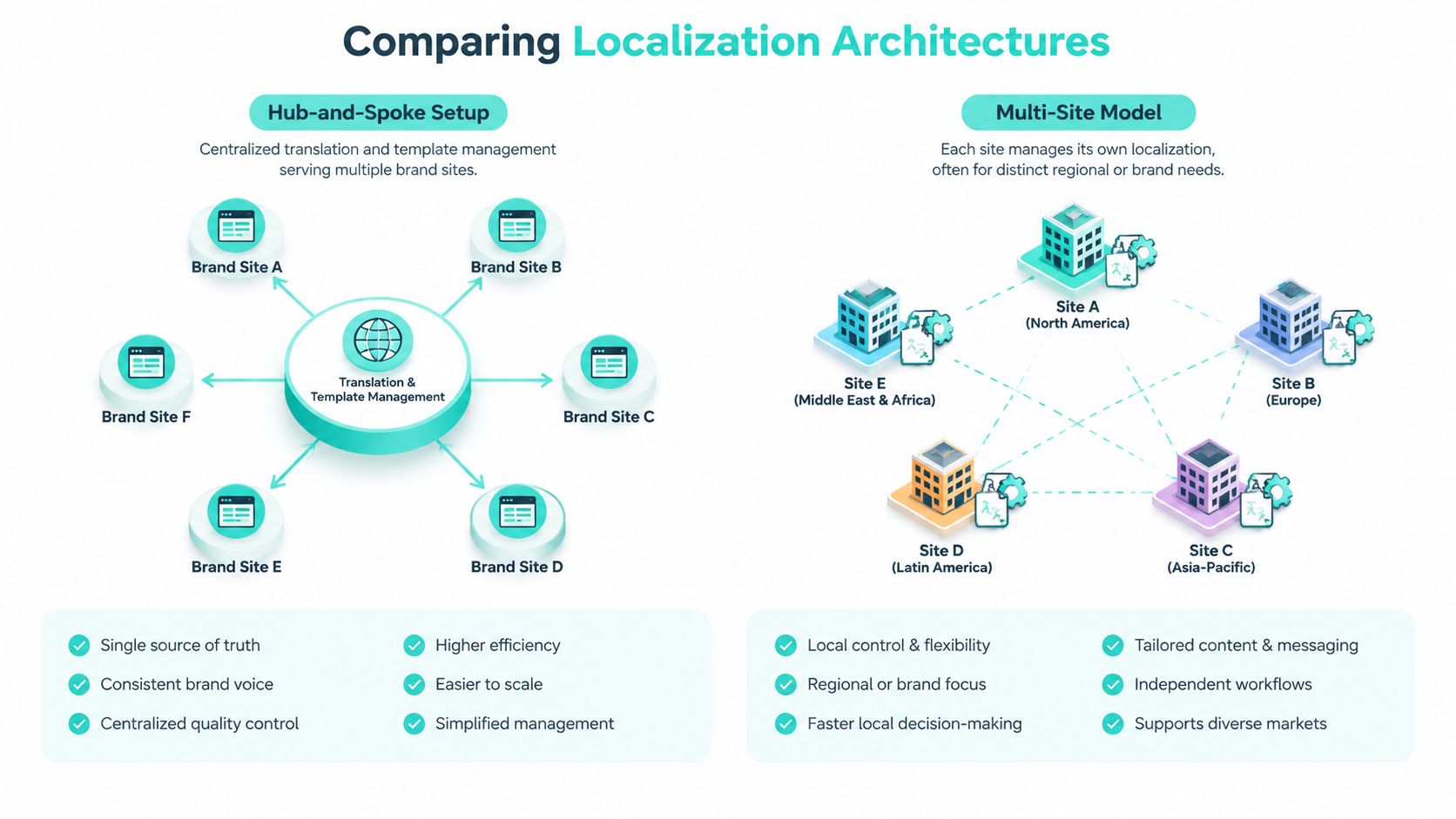
Enterprise teams commonly choose among three patterns. None is universally correct. The right decision depends on brand structure, regional autonomy, content reuse, release coordination, and the technical boundaries already present in the digital estate.
Hub and spoke
A hub-and-spoke architecture centralizes translation, component governance, design assets, and core content in a shared hub. Regional or brand sites consume centrally managed capabilities while retaining controlled space for local content.
This pattern suits organizations with a strong global brand, shared component libraries, and common compliance requirements. A central team can manage terminology, templates, SEO rules, and translation connectors, while market teams contribute local campaigns or market-specific information.
The main advantage is consistency. A change to a shared component can move through a controlled release path instead of being rebuilt independently in every market. The trade-off is organizational: the hub must define clear service levels, approval rights, and exception processes so regional teams don't feel blocked by central governance.
Multi-site localization
A multi-site model gives each locale, brand, or region its own site instance or substantial site boundary. Teams can choose local publishing schedules, content structures, integrations, and approval processes while sharing selected design assets.
This approach works when markets have distinct legal requirements, products, customer journeys, or operational teams. It can also protect one market from a release problem in another. However, duplication grows quickly if teams copy components, templates, content types, and SEO logic without a shared architectural standard.
A multi-site estate needs a central governance layer even when publishing remains decentralized. Shared definitions should cover component behavior, accessibility, URL conventions, analytics, release management, and security. Otherwise, local independence becomes platform fragmentation.
Headless with a localization layer
A headless architecture separates structured content from presentation and delivers localized entries through APIs. Translation management systems, webhooks, serverless functions, and front-end applications connect around the CMS rather than relying on one monolithic publishing path.
This pattern supports omnichannel delivery because the same localized content can serve websites, applications, portals, and other experiences. It also makes field-level workflows practical, provided the content model distinguishes translatable fields from shared identifiers and system values.
The cost is implementation complexity. The enterprise must design synchronization, preview, publishing states, cache invalidation, error handling, and observability across several services. A headless approach won't solve governance problems automatically. It makes them more visible.
| Architecture | Strong fit | Governance profile | Main risk |
|---|---|---|---|
| Hub and spoke | Shared brands, centralized standards, reusable components | Central control with regional contribution | Central bottlenecks |
| Multi-site | Distinct markets, brands, or legal operating models | Local control with shared guardrails | Duplication and drift |
| Headless localization layer | Omnichannel delivery and composable platforms | Policy-driven orchestration across systems | Integration complexity |
Choose by content behavior, not by fashion. If most content is shared and releases must remain coordinated, a hub-and-spoke model may be appropriate. If markets operate independently, multi-site boundaries may be safer. If content must reach several channels and teams have strong engineering capability, headless localization can provide the necessary flexibility.
Designing Translation Workflows and Automation
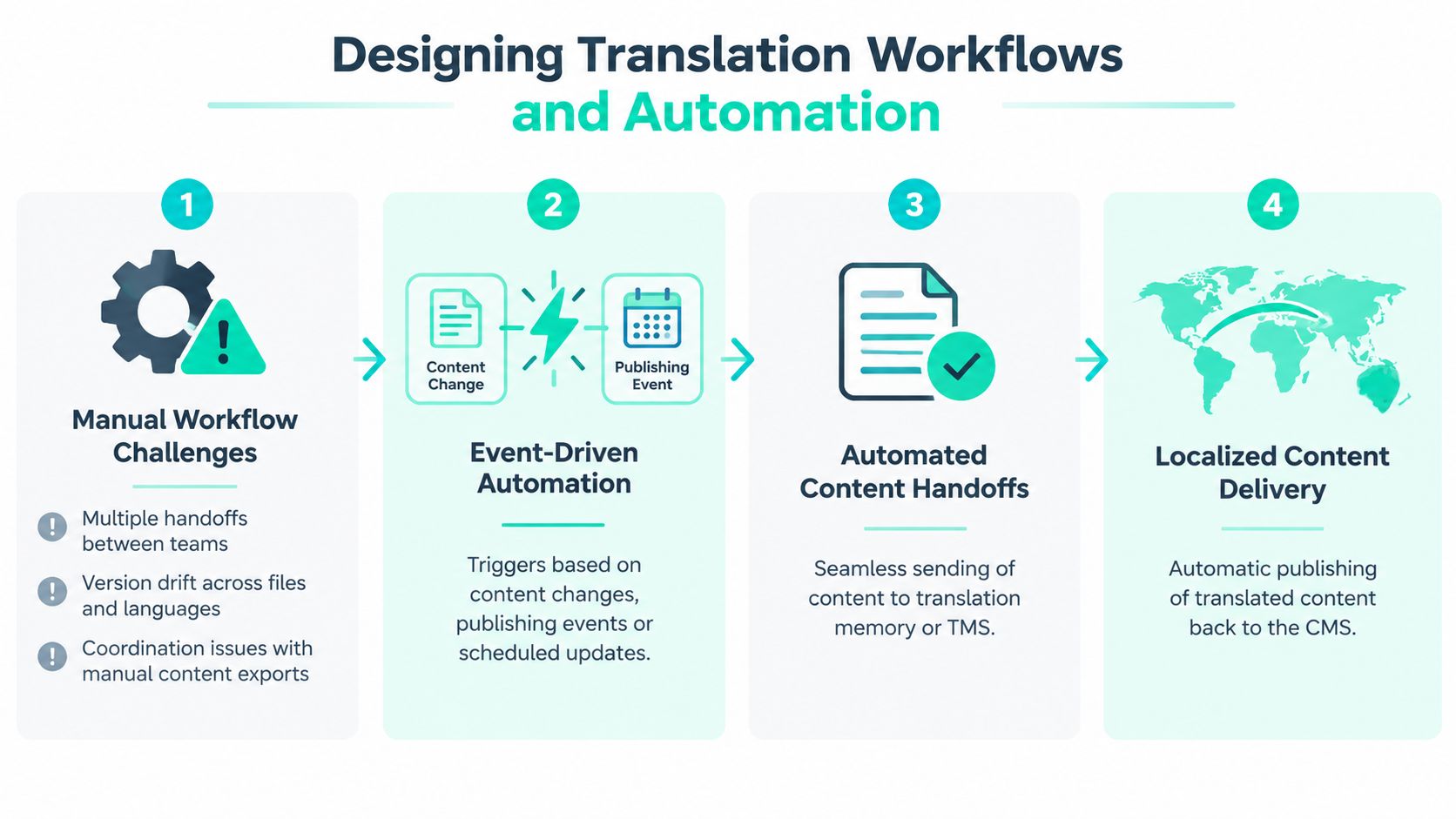
Manual export and import workflows fail for predictable reasons. Editors export content at different times, translators receive incomplete context, engineers copy results into the wrong locale, and nobody has a reliable answer to which version is approved. The problem isn't merely translation quality. It's the absence of an orchestration process.
Start with the source event
An effective pipeline begins when a source-language entry changes. The CMS emits an event, and a webhook or serverless function evaluates the change. It should determine whether the update affects translatable content, metadata, a shared component, or a non-translatable field.
The pipeline should then:
- Identify the delta. Send changed fields rather than resubmitting an entire content tree.
- Preserve shared values. Keep pricing IDs, taxonomy references, analytics identifiers, and other non-translatable fields synchronized automatically.
- Create a translation task. Route the content to a translation management system with locale, priority, context, and due-date information.
- Apply terminology controls. Use translation memory and glossaries where available, then expose the rendered context to reviewers.
- Return approved content. Write the reviewed values into the correct locale entry and record the source revision.
- Validate before publishing. Check required fields, links, metadata, accessibility content, and locale-specific routing.
- Publish and monitor. Trigger the appropriate release path and record the result for audit and rollback.
Sitecore AI can sit above this flow as the decision and experience layer. Its audience capabilities can help teams determine which localized component variants should appear for defined audiences, while the CMS and translation systems manage the content lifecycle. Keep these responsibilities distinct. AI may assist with drafts, classification, recommendations, or audience rules, but human reviewers should retain control over sensitive brand, legal, and market-specific content.
Organizations building AI-enabled content operations may also need a clear approach to managing AI agent languages, especially when agents participate in multilingual workflows and their outputs require consistent language policies.
Practical rule: An automated translation job should be reversible. Store the source revision, target revision, approval state, and publishing result so a team can restore a known-good locale version.
Workflow practitioners cite targets of a 50–70% reduction in translation turnaround, a 60% cut in duplicate content, and an over 90% reduction in post-launch errors for automated, event-driven localization workflows (content localization workflow guidance). Treat these as workflow benchmarks, not promises. Your results will depend on content structure, integration quality, reviewer capacity, and the number of exceptions in the process.
Teams assessing a translation management system can use this guide to understand how a translation management system fits between the CMS, translators, automation services, and publishing controls.
Optimizing SEO Accessibility Governance and Performance
A localized page can be linguistically correct and still fail users. Search engines may discover the wrong regional URL, screen readers may receive untranslated alt text, editors may publish content without approval, and a global release may load slowly because caching rules ignore locale boundaries.
The solution is a single operating model that treats SEO, accessibility, governance, and performance as connected quality dimensions.
Make locale signals explicit
Each localized URL should have a clear language and, where needed, regional relationship. Proper hreflang implementation uses ISO 639-1 language codes, optionally paired with ISO 3166-1 region codes, and requires self-referencing and reciprocal alternate links aligned with canonicals (enterprise international SEO guidance).
Generate these relationships from the CMS or localization platform rather than maintaining them by hand. Validate them in CI/CD, check that every alternate returns the expected response, and audit routinely because redirects, URL changes, and removed pages can break return tags.
| Method | Use case | Scalability |
|---|---|---|
| HTML head | Smaller sites or tightly controlled page templates | Moderate, provided templates generate relationships consistently |
| HTTP headers | Non-HTML assets or delivery patterns where headers are already managed | Useful for specialized routes |
| XML sitemaps | Large estates with many localized URLs | Strong, because relationships can be generated centrally |
Localize more than the visible page. Meta titles, descriptions, slugs, image alt text, Open Graph fields, structured data, and navigation labels should enter the same workflow as body copy. A market-specific page may also require different internal links, regional product availability, or compliance language.
Teams without mature international search operations can use a specialist resource such as international SEO services to assess technical relationships, localized keyword intent, and market-level discoverability.
Build accessibility into the pipeline
Accessibility reviewers should examine localized pages, not just the source locale. Translated headings can change hierarchy, labels can become longer, and alternative text can lose meaning if translators lack visual context. The CMS should require alt text where appropriate, preserve semantic structure, and prevent decorative content from receiving misleading descriptions.
Automated checks can catch missing fields, broken links, invalid heading sequences, and language declarations. Human review remains important for reading order, meaning, and culturally appropriate instructions. Locale-specific accessibility testing should happen before release, not after users report problems.
Govern the publishing chain
Assign ownership at each stage:
- Global content owners approve source messaging and brand terminology.
- Regional editors adapt market content and identify local exceptions.
- Translators and reviewers approve linguistic accuracy and context.
- SEO specialists validate URLs, metadata, canonicals, and hreflang.
- Accessibility specialists test localized interaction and assistive content.
- Platform teams maintain integrations, release controls, monitoring, and rollback.
Use role-based permissions, audit trails, approval states, and explicit service-level expectations. A locale should show whether it is in draft, in translation, under review, approved, published, or blocked. That state model gives Sitecore AI and connected services reliable information about which content can participate in an audience experience.
Performance needs the same discipline. Cache localized responses with locale-aware keys, configure CDN behavior so one language doesn't overwrite another, and invalidate dependent pages when shared content changes. Edge routing should resolve language and region consistently before the application requests content. Monitor cache behavior, publishing latency, failed translation callbacks, and locale-specific errors separately.
For practical guidance on combining language variants with URL, accessibility, and governance decisions, see these website localization best practices.
CMS Localization on Sitecore AEM and SharePoint
Platform capabilities shape the operating model. Sitecore XM Cloud, Adobe Experience Manager, and SharePoint can all support multilingual experiences, but they organize language, content, workflow, and navigation differently.
Sitecore XM Cloud and Sitecore AI
Sitecore XM Cloud allows teams to add any number of languages to an instance, including predefined and custom languages. It supports language fallback, so partially translated sites can display content from another language instead of leaving gaps (Sitecore XM Cloud language documentation).
A practical Sitecore setup creates language versions for pages, exposes a language switcher, and defines what happens when a translation is missing. The fallback language should be an intentional policy, not an accidental default. Teams should also decide which content types can publish with fallback and which require complete translation.
Sitecore supports localized URLs with language-code slugs, localized page names, and multi-domain routing (Sitecore localization implementation guidance). That makes it possible to support market-specific URL conventions without duplicating the entire site architecture.
Sitecore AI adds an orchestration dimension. The Audience builder can use CDP profiles, sessions, events, and traits, then apply rule groups with And, Or, and Not operators. Authors can manage component variants in Page builder for defined audiences, connecting localized content delivery with broader experience personalization.
Adobe Experience Manager
AEM commonly uses translation projects and language copies to coordinate source and target content. Live Copy mechanics can help teams maintain relationships between a blueprint and regional copies, while local teams modify approved areas through inheritance controls.
The architectural question is where local variation belongs. If every market overrides the same components, the team may have created a maintenance problem rather than a localization strategy. Define which content remains inherited, which fields can be overridden, and how translation updates interact with local edits.
AEM teams should connect translation projects to permissions, review stages, metadata, and launch governance. They'll also need to test how localized assets, tags, experiences, and content fragments move through the delivery stack.
SharePoint multilingual intranets
Microsoft SharePoint supports multilingual intranets through its Multiple Language Interface. Microsoft documents that sites can be created in languages other than the default language, and modern SharePoint pages and news can appear in a user's preferred language. Navigation, titles, and descriptions can also be shown in that language (Microsoft's multilingual SharePoint overview).
For an internal portal, this distinction matters. Employees don't just need translated articles. They need localized navigation, labels, news, and a predictable language experience across departments. SharePoint Server multilingual planning also emphasizes that users should be able to create, manage, read, and access content in different languages.
SharePoint's governance model should account for site owners, authors, translators, approvers, and Microsoft 365 permissions. Power Platform automations can support notifications and approvals, while SPFx components should avoid hardcoded user-facing strings.
Enterprise Implementation Checklist
A localization program becomes manageable when each stage has a clear owner and an observable outcome.
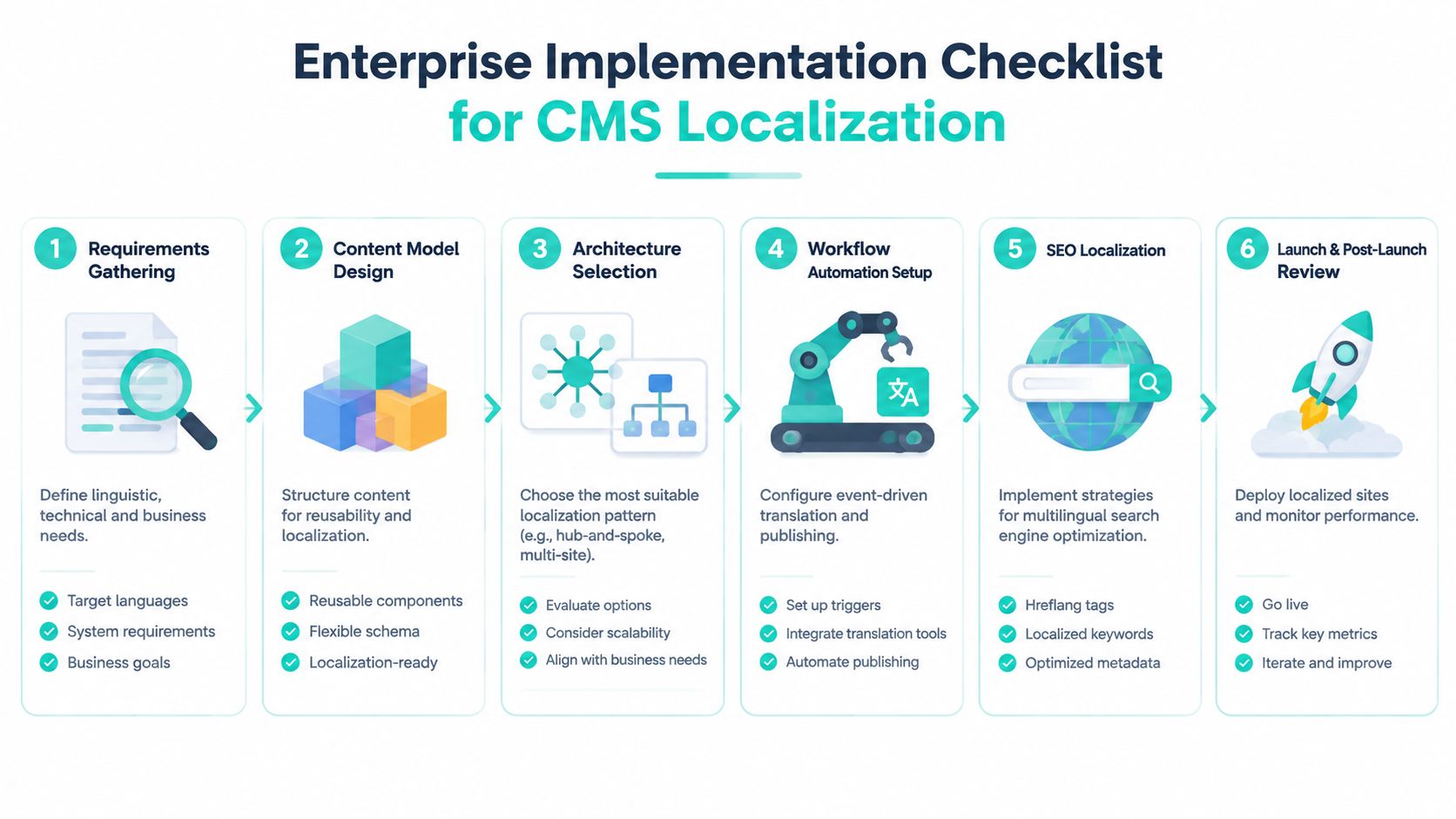
- Gather requirements. Marketing, legal, regional operations, SEO, accessibility, and IT should document target locales, content types, regional exceptions, fallback rules, and release expectations.
- Design the content model. Architects should identify field-level and entry-level localization, separate translatable values from shared identifiers, and define reusable components.
- Select the architecture. Compare hub-and-spoke, multi-site, and headless patterns against autonomy, reuse, governance, integrations, and delivery channels.
- Automate the workflow. Platform teams should connect CMS events to webhooks, serverless functions, translation management systems, review queues, and rollback controls.
- Validate the experience. SEO and accessibility owners should test localized URLs, metadata, canonicals, hreflang, language declarations, alt text, navigation, and rendered layouts.
- Launch in controlled stages. Release a pilot locale or content type, monitor publishing and delivery behavior, collect reviewer feedback, then expand through a documented rollout plan.
Success means more than a translated page. The team should be able to identify the source revision, locate the target status, explain who approved it, verify its search signals, and restore the previous version when necessary.
Conclusion and Next Steps
CMS localization works when enterprises treat it as content orchestration, not as a translation afterthought. Architecture determines where locale variants live. Content modeling determines what gets translated. Automation determines how changes move. Governance determines who can approve them. SEO, accessibility, and performance controls determine whether the published result works for real users.
Sitecore XM Cloud provides the language, fallback, URL, and routing mechanics needed for multilingual delivery. Sitecore AI extends the operating model by connecting audience definitions and component-level personalization with CMS workflows. AEM offers structured translation projects and inheritance-based regional content management. SharePoint supports language-aware intranet pages, news, navigation, titles, and descriptions for employee experiences.
Start with an audit of your current CMS estate. Map source and locale dependencies, identify manual handoffs, classify content fields, and choose one workflow for an automated pilot. Then establish governance metrics around approval status, failed synchronization, accessibility defects, SEO validation, publishing latency, and rollback readiness.
The strongest enterprise programs don't attempt to automate every exception immediately. They automate repeatable work, preserve human review for high-risk content, and use Sitecore AI as part of a broader orchestration layer that connects content, audiences, markets, and channels.
Kogifi designs and maintains enterprise localization solutions across Sitecore, Adobe Experience Manager, and Microsoft SharePoint, including headless architectures, multilingual governance, workflow automation, accessibility, and performance optimization. Visit Kogifi to discuss an architecture assessment or a practical pilot for your global CMS estate.