


A Content Management System (CMS) is the central nervous system of your digital presence. Yet, many organizations only scratch the surface of its potential, leading to content chaos, security vulnerabilities, and a disjointed customer experience. Moving beyond a simple 'publish' button to strategic implementation is what separates digital leaders from the rest. This guide details 10 mission-critical content management system best practices, drawing on deep expertise from enterprise platforms like Sitecore and SharePoint, to help you build a more robust and scalable digital foundation.
We will move beyond generic advice to provide specific, actionable insights into crucial areas often overlooked. You will learn not just what to do, but how to implement these strategies within complex ecosystems. From establishing rigorous version control and user permissions to designing sophisticated content models and workflows, each point is designed to enhance operational efficiency and maximize your technology investment.
Whether you're managing a sprawling Digital Experience Platform (DXP) like Sitecore or a collaborative SharePoint intranet, these practices are universal in their importance. Mastering them transforms your CMS from a mere content repository into a dynamic engine for growth and engagement. To gain a deeper understanding of the core principles in this guide, consider these essential content management best practices as a foundational starting point. This article will build upon those concepts with advanced, platform-specific examples to help you achieve a higher level of CMS maturity.
1. Version Control and Content History
Robust version control is a foundational pillar of effective content management system best practices. It involves systematically tracking every change made to your content, from minor text edits to major component reconfigurations. This creates a detailed revision history, allowing administrators to see who changed what, when, and why. More critically, it provides a safety net, enabling a swift rollback to a previous state if an error occurs or a change proves undesirable.

This practice is essential for maintaining content integrity and governance, especially in large, multi-author environments. It ensures that accidental deletions, incorrect updates, or even malicious changes do not result in permanent data loss. The audit trail it creates is also invaluable for compliance, accountability, and debugging content-related issues.
Implementation in Practice
Enterprise CMS platforms handle versioning with varying levels of sophistication. For instance, Sitecore offers exceptionally granular versioning capabilities, allowing for language-specific and numbered versions of every content item and its presentation details. This is crucial for global enterprises managing multilingual sites, as a change to the English version doesn't have to affect the German one. This feature is a core part of the Sitecore content engine, available across its products from XM to XM Cloud. Similarly, SharePoint automatically creates major (published) and minor (draft) versions for documents and list items, providing a clear history and restore options within its document libraries, a key feature for document lifecycle management.
Actionable Tips for Version Control
To maximize the benefits of version control, move beyond default settings and implement a clear strategy.
- Establish Versioning Policies: Define when to create new versions. For instance, in Sitecore, you might configure workflows to automatically create a new version when an item moves to an "In Review" state, preserving the previously approved version.
- Use Meaningful Comments: Mandate that editors add comments when saving significant changes. A comment like "Updated Q3 promotion details per marketing brief" is far more useful than a generic system note.
- Document Major Milestones: For key content pieces like a homepage or a major campaign landing page, use version tagging or specific comments to mark significant states, such as "Pre-launch version" or "Post-A/B test winner."
- Schedule Version Cleanup: To prevent database bloat, especially in high-volume systems like Sitecore or SharePoint, schedule regular automated cleanups of old, unnecessary versions. For example, you might decide to keep only the last 10 versions of any given item. Integrating version control with development is also a key strategy; you can explore advanced techniques for version control in CI/CD pipelines to align content changes with code releases.
2. User Role and Permission Management
Effective content management system best practices are incomplete without a rigorous approach to user roles and permissions. This involves establishing a granular role-based access control (RBAC) system that defines precisely what different users can do within the CMS. It’s a foundational security measure that prevents unauthorized changes, protects sensitive data, and streamlines workflows by presenting users with only the tools and content relevant to their specific responsibilities.

Implementing the principle of least privilege ensures that a junior content editor cannot accidentally publish changes to the homepage or access administrative settings. This controlled environment minimizes human error, strengthens security, and is crucial for maintaining compliance with data protection regulations. A well-defined permission structure is the backbone of an organized, secure, and efficient content operation.
Implementation in Practice
Enterprise-grade platforms are built with sophisticated RBAC capabilities. Sitecore, for instance, uses a powerful security model based on accounts, roles, and domains. Administrators can deny or grant specific rights, such as read, write, create, delete, and administer, to any item in the content tree. This allows for incredibly detailed permission sets, like allowing a regional marketing team to edit content only within their specific country's section of the website. Similarly, SharePoint utilizes a hierarchical permission system with levels like Full Control, Edit, and Read, which can be applied to sites, libraries, folders, and individual items, ensuring secure collaboration.
Actionable Tips for User Roles
To build a robust and manageable permission model, a strategic approach is necessary.
- Document Roles and Permissions: Create and maintain a clear document that outlines every user role, its associated permissions, and the business justification. This becomes an essential part of your overall content governance.
- Review Permissions Quarterly: User responsibilities change. Schedule regular audits of all user accounts and their assigned roles to ensure permissions are still appropriate and remove access for former employees.
- Use Template Roles: Create standardized roles for common positions like "Content Author," "Content Approver," or "SEO Specialist." This speeds up onboarding and ensures consistency across teams.
- Implement Separation of Duties: A core security principle, ensure that no single user has the ability to create, approve, and publish content without oversight. This is a key part of an effective content governance framework.
3. Content Metadata and Tagging Strategy
A disciplined content metadata and tagging strategy is a cornerstone of intelligent content management. This practice involves creating a consistent system for describing, categorizing, and tagging every piece of content with structured data. This metadata makes content machine-readable, dramatically improving its discoverability, searchability, and reusability. It is the foundation for personalization, advanced search, and effective SEO.
This approach transforms your CMS from a simple content repository into an intelligent content hub. By tagging content with attributes like audience, topic, or product line, you empower the system to automatically surface relevant information to the right user at the right time. This is a critical component of modern content management system best practices, enabling everything from dynamic content filtering to sophisticated recommendation engines.
Implementation in Practice
Leading CMS platforms provide robust tools for building and enforcing metadata strategies. In Sitecore, for instance, templates are built with specific metadata fields (e.g., Topic, Region, Intended Audience), forcing content authors to provide this crucial context upon creation. This structured data directly fuels the Sitecore personalization engine, allowing rules to be created based on a user's interaction with tagged content. Similarly, SharePoint uses "Managed Metadata" and "Term Sets" to create a centralized, controlled vocabulary that can be applied consistently across document libraries and sites, ensuring uniform tagging and enhancing enterprise search.
Actionable Tips for Metadata and Tagging
An effective metadata strategy requires more than just adding a few tags; it demands a structured, governed approach.
- Establish a Controlled Vocabulary: Create a predefined list of terms within a Term Store (like in SharePoint) or as a taxonomy source in Sitecore. This prevents ambiguity and ensures authors use "Automotive Industry" instead of variations like "Automotive" or "Auto."
- Start Simple, Then Expand: Begin with a core set of essential metadata fields (e.g., topic, content type, audience). As your needs evolve, you can add more granular tags and attributes without overwhelming your authors initially.
- Train Content Creators: Ensure all users understand the importance of metadata. Document the tagging strategy and provide clear guidelines on which tags to use for different types of content and scenarios.
- Leverage Schema.org: For public-facing content, map your internal metadata to Schema.org standards. This provides search engines like Google with explicit context about your content, significantly improving its visibility and potential for rich results.
- Automate Where Possible: Use CMS features or third-party integrations to automate tagging based on content analysis or other attributes, reducing the manual burden on authors and improving consistency.
4. Content Workflow and Approval Processes
Structured workflows are the procedural backbone of a well-governed content management system, guiding content from creation and review to final approval and publication. These automated processes enforce quality control, ensure editorial standards are met, and prevent unapproved or premature content from going live. By defining a clear path with designated stakeholders at each stage, workflows introduce accountability and predictability into the content lifecycle.
This practice is crucial for maintaining brand consistency and regulatory compliance, particularly in complex organizations with multiple contributors and legal or brand oversight requirements. It transforms content creation from an ad-hoc, chaotic process into a streamlined, repeatable operation. The audit trail generated by a workflow also provides clear visibility into bottlenecks and reviewer performance, enabling continuous process improvement.
Implementation in Practice
Enterprise-level CMS platforms excel at creating sophisticated, multi-step approval chains. For example, Sitecore offers a highly flexible workflow engine that can be customized to match any business process. A common setup involves a "Draft" state for content creation, which then moves to a "Marketing Review" state upon submission. After marketing approval, it might proceed to a "Legal Review" state before finally reaching a "Ready to Publish" state, where a final publisher can schedule it to go live. Each transition can trigger notifications and enforce specific permissions, ensuring only authorized users can act on the content. Similarly, SharePoint provides robust, out-of-the-box approval workflows for documents and pages, allowing teams to formalize their review processes directly within their collaborative environment.
Actionable Tips for Workflows
To build effective and efficient approval processes, tailor them to your operational needs rather than relying on default configurations.
- Keep Workflows Simple: Start with the simplest possible workflow that meets your governance needs. A complex, 10-step process for a simple blog post will cause delays and frustration.
- Set Clear SLAs: Define Service Level Agreements for each stage. For example, reviewers in the "Marketing Review" state must provide feedback or approval within 48 hours.
- Implement Escalations: Configure your workflow to automatically escalate or re-assign a task if an approver fails to act within the defined SLA, preventing content from getting stuck.
- Use Parallel Approvals: Where appropriate, allow multiple teams (e.g., brand and legal) to review content simultaneously rather than sequentially to accelerate the timeline.
- Monitor Workflow Metrics: Regularly analyze workflow reports in your CMS to identify bottlenecks. If content consistently stalls at a particular stage, it may indicate a need for process refinement or additional reviewer training.
5. Content Modeling and Schema Design
Effective content modeling and schema design are the architectural blueprints for a successful CMS. This practice involves creating well-defined, structured content models that dictate how information is organized, what its components are, and how different content pieces relate to one another. A proper schema ensures consistency, enables powerful content reuse across channels, and is fundamental to managing content efficiently at scale.
By defining content in a structured, presentation-agnostic way, you decouple it from its final display format. This is a cornerstone of modern content management system best practices, empowering you to deliver the same core information seamlessly to a website, a mobile app, or a digital kiosk. It transforms content from static page-based blobs into a flexible, future-proof asset.
Implementation in Practice
Different platforms approach content modeling with unique strengths. Sitecore’s entire architecture is built on the concept of structured content templates. These templates define the fields for any content item, allowing for granular control, inheritance, and component-based design. This methodology is fundamental to Sitecore's headless solutions like XM Cloud, where structured content is delivered anywhere via APIs. Similarly, SharePoint uses Content Types to enforce consistent metadata and behavior for documents and list items, which is critical for building scalable and predictable solutions, especially when integrated with the Power Platform.
Actionable Tips for Content Modeling
A thoughtful approach to schema design pays long-term dividends. Implement a clear strategy to ensure your models are robust and scalable.
- Start with Core Content Types: Identify your most foundational content elements, such as "Article," "Product," or "Event." Build these out first with only the essential fields.
- Plan for Future Use: While starting simple, anticipate future needs. Consider how a "Team Member" model might one day need to be pulled into an "Office Location" page.
- Use Composition: Instead of creating monolithic models, build smaller, reusable components. For example, create a separate "SEO Metadata" model that can be added to any page type in your system.
- Document All Content Models: Maintain a living document or wiki that explains what each model and field is for, its validation rules, and where it's intended to be used. This is crucial for onboarding new team members.
6. SEO Optimization and Technical Implementation
Integrating Search Engine Optimization (SEO) directly within the CMS is a critical best practice that transforms content creation into a strategic, performance-driven activity. This involves embedding SEO tools, metadata fields, structured data support, and preview capabilities into the content authoring experience. By doing so, you empower content creators to optimize for search engines from the outset, reducing reliance on post-publication fixes and external tools.
This approach makes SEO a proactive, rather than reactive, part of the content lifecycle. When technical SEO features are built into content templates and workflows, it ensures consistency and compliance across thousands of pages. It helps maintain site health, improves search visibility, and directly contributes to organic traffic growth, making it an indispensable part of any modern content management strategy.
Implementation in Practice
High-end DXP platforms excel at integrating deep SEO capabilities. Sitecore, for instance, allows developers to build SEO considerations directly into content templates, requiring authors to populate fields for meta titles, descriptions, and Open Graph tags. Custom validation rules can prevent content from being published without essential SEO data. Similarly, SharePoint Modern sites can be customized to include specific columns for SEO metadata in page libraries, which can then be used to programmatically populate page head tags, ensuring a consistent approach to on-page optimization. Enterprise systems build these foundational elements into the core architecture, providing a stable base for SEO.
Actionable Tips for SEO Implementation
To effectively integrate SEO into your CMS, you need to go beyond just adding fields; you must build it into the process.
- Create SEO-Ready Templates: Design content templates (e.g., for articles, product pages) with mandatory fields for meta descriptions, title tags, and image alt text. Use placeholder text to guide authors on best practices, such as character limits.
- Automate Sitemap Generation: Configure your CMS to automatically generate and update XML sitemaps as content is published, unpublished, or moved. In Sitecore, this is often handled by a scheduled task or a dedicated module.
- Implement Structured Data: Use CMS components to generate JSON-LD structured data for content types like articles, events, or products. This allows authors to fill out simple fields that render as complex, machine-readable code, boosting eligibility for rich snippets.
- Enforce Heading Hierarchies: Use CSS and template logic to enforce a proper H1, H2, H3 structure, preventing authors from misusing headings for stylistic purposes. Provide clear guidance in the CMS on their semantic importance. For a deeper dive into technical execution, you can explore strategies for how to implement search engine optimization.
7. Backup and Disaster Recovery Planning
A comprehensive backup and disaster recovery (BDR) plan is a non-negotiable component of content management system best practices. It extends beyond simple data backups to encompass a full strategy for restoring operations swiftly after an unexpected event, such as a server failure, cyberattack, or data corruption. This plan ensures business continuity by safeguarding your valuable content assets and the functionality of the entire CMS platform.
Without a tested BDR strategy, an organization risks catastrophic data loss, prolonged downtime, and severe damage to its reputation and revenue. A solid plan defines not just how to back up data but also how to recover it within specific timeframes, known as Recovery Time Objectives (RTO) and Recovery Point Objectives (RPO). This proactive approach transforms a potential crisis into a manageable incident.
Implementation in Practice
Modern enterprise platforms offer sophisticated tools for backup and recovery. In a Sitecore environment, a BDR plan must account for multiple components, including the core, master, and web SQL databases, the file system (wwwroot), and any integrated services like Solr or Azure Search indexes. Many organizations leverage cloud-native services like Azure Backup and Azure Site Recovery to automate this process, creating geographically redundant copies of their entire Sitecore infrastructure. For SharePoint, both on-premises and online versions have robust BDR capabilities. SharePoint on-premises administrators can use SQL Server tools and Central Administration to schedule farm-level backups, while SharePoint Online benefits from Microsoft's built-in geo-redundancy and data protection protocols.
Actionable Tips for Backup and Recovery
A "set it and forget it" approach is insufficient; an effective BDR strategy requires active management and validation.
- Automate Everything: Schedule automated, regular backups of both your CMS databases and file systems. Manual backups are prone to human error and are easily forgotten.
- Test Your Recovery Plan: Regularly conduct drills to restore your system from a backup in a staging environment. This validates the integrity of your backups and ensures your team knows the recovery procedures.
- Define and Monitor RPO/RTO: Clearly define your Recovery Point Objective (how much data you can afford to lose) and Recovery Time Objective (how quickly you need to be back online). Monitor your BDR process to ensure it meets these targets.
- Use the 3-2-1 Rule: Maintain at least three copies of your data on two different media types, with one copy stored off-site. For a Sitecore on Azure setup, this could mean local snapshots, Azure Backup, and a geo-replicated copy.
- Document Procedures Clearly: Maintain a step-by-step recovery guide. In a high-stress disaster scenario, clear documentation is critical for a fast, error-free restoration. An effective plan is one of the key tenets of a strong CMS Governance Framework.
8. Performance Optimization and Caching Strategies
A high-performing website is non-negotiable for user experience, engagement, and search engine rankings. Performance optimization within a CMS involves a multi-layered approach, combining server-side caching, content delivery networks (CDNs), and frontend best practices to ensure content is delivered to the user as quickly as possible. This is a critical component of content management system best practices, directly impacting conversion rates and brand perception.
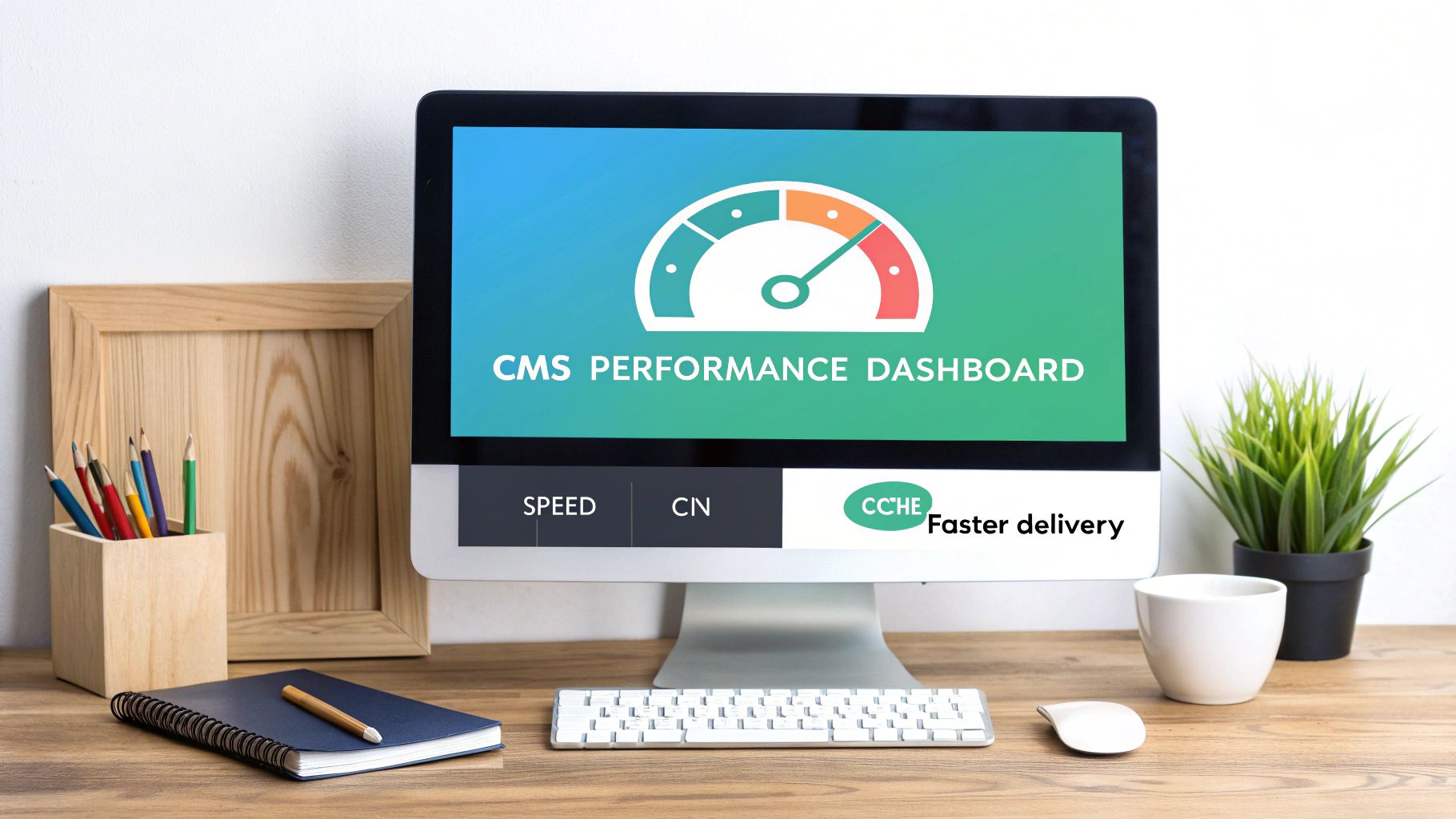
Effective caching stores pre-generated versions of pages and components, serving them directly from memory instead of rebuilding them for every request. This dramatically reduces server load and latency. When combined with a CDN that distributes static assets like images and scripts across a global network of servers, the result is a significantly faster and more reliable digital experience for a worldwide audience.
Implementation in Practice
Enterprise platforms are built with performance in mind, offering sophisticated caching mechanisms. For example, Sitecore provides multiple layers of caching, including HTML, data, and item caches, which can be finely tuned for specific components and templates. Integrating a CDN like Azure CDN or Akamai is a standard practice in Sitecore projects to offload asset delivery. In the SharePoint world, the platform uses BlobCache to store frequently used files on web front-end servers, and integrating it with a CDN like Azure CDN is crucial for optimizing SharePoint Online performance, especially for geographically dispersed users.
Actionable Tips for Performance Optimization
To build a truly high-performing site, you must actively manage and monitor your optimization strategies.
- Implement Layered Caching: Configure caching at multiple levels: in-memory application cache, output cache for rendered components, and a CDN cache for static assets. In Sitecore, ensure rendering-specific HTML caching is enabled for all non-dynamic components.
- Optimize Images: Before uploading to the CMS, compress and resize images to web-friendly dimensions. Utilize modern formats like WebP where supported and leverage the CMS’s built-in image resizing capabilities.
- Leverage a CDN: Distribute all static assets (images, CSS, JavaScript) through a Content Delivery Network. This reduces latency by serving content from a location geographically closer to the user.
- Monitor Cache Hit Ratios: Regularly check your analytics and server logs to ensure your caching strategies are effective. A low hit ratio indicates that your cache is being bypassed too often, negating its benefits. You can learn more about how to optimize your website performance with a comprehensive approach.
- Use Lazy Loading: Implement lazy loading for images and videos that are not immediately visible ("below the fold"). This defers the loading of these assets until the user scrolls to them, speeding up the initial page load.
9. Security Hardening and Vulnerability Management
Security hardening is a non-negotiable component of content management system best practices, involving a multi-layered approach to protect your platform, content, and user data from threats. This practice goes beyond default settings, requiring proactive measures to reduce the system's attack surface. It encompasses everything from keeping software up-to-date and managing user access to actively scanning for and patching vulnerabilities before they can be exploited.
In an era of constant cyber threats, a "set it and forget it" attitude towards CMS security is a recipe for disaster. A single vulnerability can lead to data breaches, reputational damage, and significant financial loss. A robust security and vulnerability management program ensures system integrity, builds user trust, and maintains compliance with data protection regulations like GDPR and CCPA.
Implementation in Practice
Different platforms offer distinct security frameworks. For example, Sitecore provides a comprehensive security model based on roles and permissions, which can be tightly integrated with Active Directory for enterprise-level user management. It also publishes security bulletins and patches that administrators must apply diligently. In the SharePoint ecosystem, security is managed through permission levels (e.g., Full Control, Contribute, Read) applied to sites, lists, and items, with governance often managed via Microsoft 365 security and compliance centers. This enterprise-grade approach is a key differentiator from plugin-reliant systems.
Actionable Tips for Security Hardening
To effectively secure your CMS, you need a proactive and continuous strategy that integrates multiple layers of defense.
- Enforce Strict Access Controls: Implement the principle of least privilege. In Sitecore, create granular roles that grant users access only to the content and features they absolutely need. Avoid assigning broad administrator rights.
- Mandate Strong Authentication: Require complex passwords and enable two-factor authentication (2FA) for all users, especially those with administrative or editing privileges.
- Maintain an Update Cadence: Regularly apply all security patches and updates for the CMS core, plugins, modules, and underlying server software. Outdated components are a primary vector for attacks.
- Conduct Regular Security Audits: Schedule periodic vulnerability scans and penetration tests to proactively identify and remediate weaknesses in your system's configuration and code.
- Actively Monitor and Log: Configure and actively monitor security logs to detect suspicious activity. Use tools to get real-time alerts for potential security incidents, such as repeated failed login attempts. Beyond technical configurations within your CMS, it's vital to implement broader security measures. A comprehensive overview can be found in these essential website security best practices.
10. Analytics and Content Performance Measurement
Integrating analytics directly into your CMS is a critical best practice for transforming content from a cost center into a strategic asset. This involves tracking user behavior, engagement metrics, and conversion funnels to understand which content resonates and drives business outcomes. A data-driven approach moves content strategy beyond guesswork, enabling teams to make informed decisions based on real-world performance data. This continuous feedback loop is essential for optimization and demonstrating ROI.
This practice is fundamental for any organization aiming to personalize experiences and refine its digital strategy. By measuring content effectiveness against key performance indicators (KPIs), you can identify underperforming assets, optimize user journeys, and allocate resources more effectively. The insights gained are invaluable for justifying content marketing budgets, refining audience segmentation, and proving the value of digital initiatives to stakeholders.
Implementation in Practice
Modern DXP and CMS platforms offer powerful, integrated analytics capabilities. For example, Sitecore Personalize provides real-time behavioral tracking and A/B testing, allowing marketers to measure the impact of personalized experiences directly within the platform. This tight integration means analytics aren't an afterthought; they're woven into the content creation and delivery workflow. Similarly, SharePoint can be integrated with Microsoft's Power BI to create sophisticated dashboards that visualize site usage, document engagement, and search queries, giving administrators a clear view of how internal content is being consumed.
Actionable Tips for Analytics and Measurement
To effectively leverage analytics, you must go beyond basic page-view tracking and build a comprehensive measurement framework.
- Define Goal-Aligned Metrics: Before tracking anything, define what success looks like. Map content KPIs (e.g., time on page, downloads, form submissions) directly to broader business objectives like lead generation or customer retention.
- Create Role-Specific Dashboards: Build customized dashboards for different teams. A content editor may need to see page performance and engagement, while a marketing executive needs a high-level view of content's impact on the sales funnel.
- Implement Comprehensive Tracking: Use consistent UTM parameters for campaign tracking and set up event tracking for key user actions like video plays, CTA clicks, and document downloads to understand the full user journey.
- Establish a Review Cadence: Schedule regular (e.g., weekly or monthly) analytics reviews to discuss insights and agree on optimization actions. Data is only useful if it's used to inform strategy adjustments.
Top 10 CMS Best Practices Comparison
From Plan to Platform: Activating Your CMS Strategy
Navigating the landscape of an enterprise Content Management System is less like a single project and more like a continuous journey of refinement and optimization. The ten core pillars we've explored, from meticulous version control and robust security hardening to sophisticated content modeling and performance analytics, are not isolated tasks to be checked off a list. Instead, they represent the interconnected gears of a well-oiled digital experience machine. Implementing these content management system best practices is the critical first step in transforming your CMS from a simple content repository into a strategic business asset that drives growth, engagement, and operational efficiency.
The journey begins with establishing a foundation of control and clarity. Practices like User Role and Permission Management are not merely administrative hurdles; they are the bedrock of secure and scalable content operations, ensuring that the right people have the right access at the right time. Similarly, a well-defined Content Workflow and Approval Process prevents bottlenecks and maintains brand consistency, creating a predictable and efficient content lifecycle. These foundational elements are what allow more advanced strategies to flourish.
Bridging Strategy and Execution
Once the foundation is set, the focus shifts to maximizing the value and impact of your content. This is where strategic implementation of Content Metadata and Tagging and a forward-thinking Content Modeling and Schema Design become paramount. In a platform like Sitecore, a robust content model is the key that unlocks the full potential of personalization and omnichannel delivery. It's the architectural blueprint that ensures content is structured, reusable, and ready to be deployed across any channel, from a traditional website to a headless application or a personalized email campaign powered by Sitecore Send.
Think of it this way: without a strong schema, your content is locked in a rigid format. With a strategic model, that same content becomes a fluid asset, capable of adapting to any context. This is the essence of modern digital experience delivery and a core tenet of effective CMS management.
The Continuous Cycle of Improvement
Ultimately, the most successful digital teams recognize that a CMS is a living ecosystem. The best practices surrounding Performance Optimization, SEO Implementation, and Analytics Measurement are not one-time fixes but ongoing disciplines. Caching strategies must be revisited, security protocols must be updated to counter new threats, and content performance data must be used to inform future content strategy.
For organizations leveraging powerful platforms like Sitecore XM Cloud, this cycle is accelerated. The headless, composable architecture demands a disciplined approach to content modeling and API-first design, but it rewards this discipline with unparalleled speed, scalability, and agility. Likewise, SharePoint users find that consistent application of governance, metadata standards, and security policies transforms their environment from a sprawling file share into a structured, collaborative, and highly secure knowledge hub.
Embracing these content management system best practices is an investment in your organization's digital future. It's about building a framework that not only supports your current needs but is also flexible enough to adapt to the challenges and opportunities of tomorrow. It's the commitment to excellence that separates a functional website from an unforgettable digital experience.
Ready to transform your CMS from a cost center into a strategic growth engine? The experts at Kogifi specialize in implementing these best practices for enterprise platforms like Sitecore and SharePoint, ensuring your technology delivers measurable business value. Partner with us to unlock the full potential of your digital ecosystem. Learn more at Kogifi.