


When you get down to it, the Docker Compose vs Kubernetes debate isn't about which tool is better, but which tool is right for the job at hand. Docker Compose is a development tool, built for defining and running multi-container applications on a single machine. Kubernetes is a production-grade orchestration platform, designed to deploy, scale, and manage those applications across a whole cluster of servers.
Your choice boils down to a simple trade-off: do you need the speed and simplicity of a local setup, or the power and resilience of a large-scale deployment?
The Strategic Choice for DXP Architectures
For enterprise leaders building a Digital Experience Platform (DXP), this isn't just a technical detail—it's a critical strategic decision. The choice you make here will define the scalability, resilience, and operational cost of business-critical platforms like Sitecore AI and SharePoint.

Defining the Core Use Case
Docker Compose truly shines as a rapid development tool, making it a perfect fit for local environments. A Sitecore developer, for example, can use a single docker-compose.yml file to spin up a complete, multi-container Sitecore instance with all its dependencies. This simplicity is a game-changer for accelerating the "inner loop" of day-to-day development and testing.
Kubernetes, on the other hand, is the undisputed champion for enterprise-grade production orchestration. It's built from the ground up to manage complex, distributed systems across entire fleets of servers or cloud environments. This architecture delivers the automation, self-healing, and dynamic scaling essential for a high-traffic DXP that needs to be available 24/7.
This table breaks down the key strategic differences when you're planning a DXP deployment.
| Feature | Docker Compose | Kubernetes |
|---|---|---|
| Primary Use Case | Local Development & Testing | Production Deployment & Scaling |
| Scope | Single Host | Cluster of Multiple Hosts (Nodes) |
| Scalability | Manual, limited to one host | Automated, horizontal & vertical scaling |
| Resilience | None (single point of failure) | High Availability, Self-Healing |
| Operational Effort | Low, simple YAML file | High, requires specialized expertise |
For platforms like Sitecore AI or SharePoint, the discussion isn't about replacing one tool with the other. It's about using the right tool for the right job: Compose for building and Kubernetes for running.
This distinction is fundamental. While Compose gives your developers unmatched speed, Kubernetes provides the robust, industrial-strength infrastructure that business-critical applications demand. As we dig deeper, it becomes clear how these tools fit into a modern, containerized DXP strategy and why understanding their roles within different service models is so important. You can learn more about these cloud models in our guide to IaaS, PaaS, and SaaS.
Architectural Differences in DXP Environments
To really get to the heart of the Docker Compose vs. Kubernetes debate, you have to see them for what they are: two tools built on completely different philosophies. One is all about contained simplicity, while the other is engineered for distributed resilience. For CTOs managing complex Digital Experience Platform (DXP) ecosystems, this difference is everything.
Docker Compose is built on a single-host architecture. It simply reads a docker-compose.yml file and spins up a set of containers on one machine, all managed by a single Docker Engine. This isn't a limitation; it's by design.
For a developer working on a Sitecore AI or SharePoint project, this is perfect. They can run a single command—docker compose up—and have a complete, self-contained DXP environment running locally in minutes. This includes every service they need, from databases and caching layers to identity servers, all without the headache of managing a real cluster.
The Kubernetes Control Plane Model
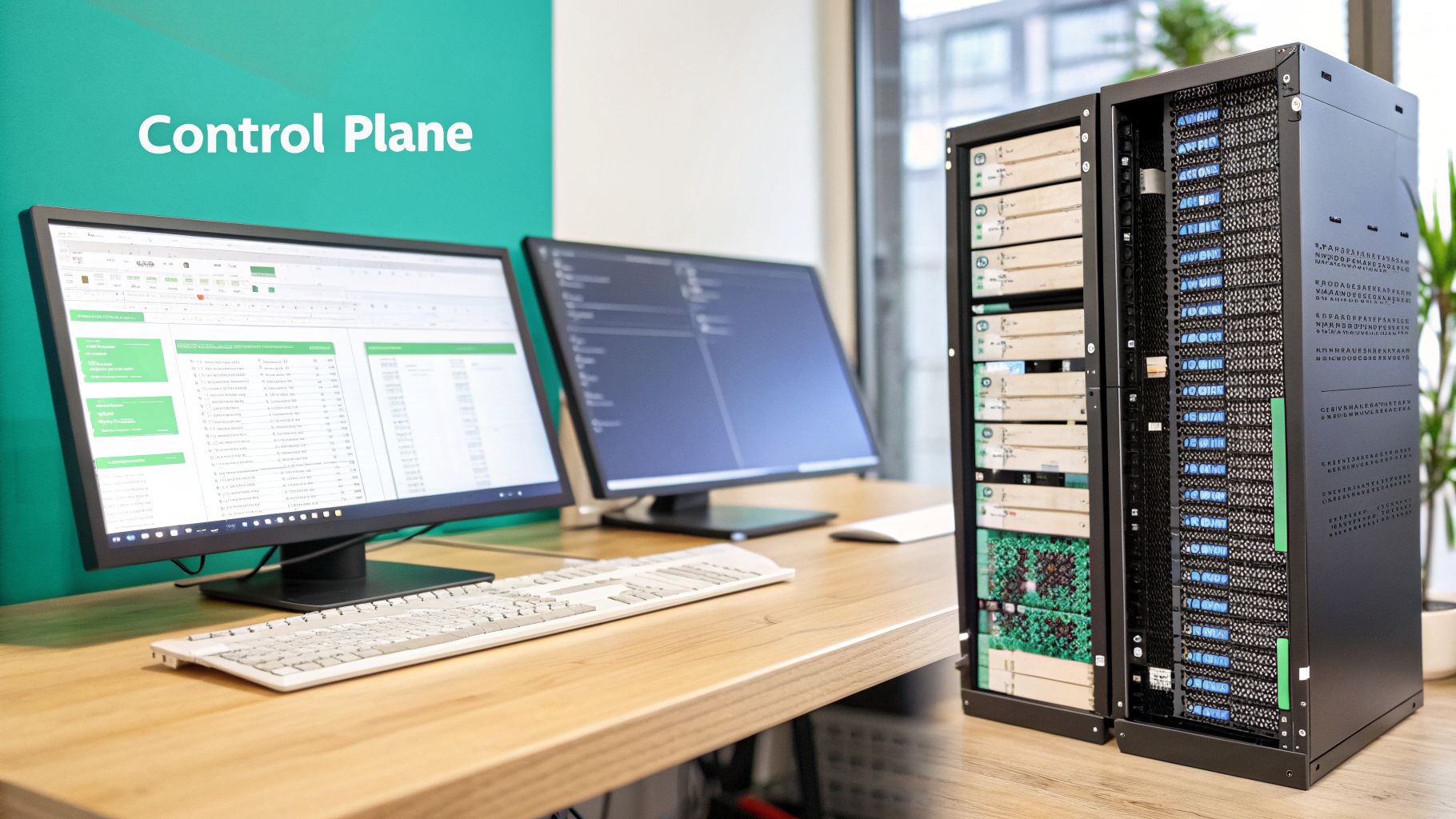
Kubernetes is a different beast entirely. It uses a sophisticated, distributed master-node architecture that's built from the ground up for production environments. This is what separates it from a tool like Docker Compose.
At the center of it all is the Kubernetes Control Plane, which acts as the brain of the operation. It's responsible for keeping the entire cluster in its desired state, handling everything from scheduling applications and managing updates to monitoring the health of all its moving parts.
The actual applications run on worker nodes, which are the physical or virtual machines in the cluster. The Control Plane intelligently places containerized applications—packaged into units called Pods—onto these nodes based on resource availability and rules you define.
The architectural gap is clear: Docker Compose manages containers on one machine, while the Kubernetes Control Plane manages applications across an entire fleet of machines. This distinction is the primary driver in the Docker Compose vs Kubernetes decision for enterprise DXPs.
Architectural Implications for Sitecore and SharePoint
For a platform like Sitecore AI, this architectural split has massive real-world consequences. A Docker Compose setup is fantastic for a single developer, but it’s also a single point of failure. If that one machine goes down, the entire Sitecore instance is gone.
Kubernetes, on the other hand, distributes Sitecore's application roles (like Content Delivery, Content Management, and xConnect) across many different worker nodes. If one of those nodes fails, the Control Plane simply detects the failure and automatically reschedules the affected Pods onto healthy nodes. The DXP stays online.
This distributed, self-healing design is the bedrock of high availability and massive scalability. It’s what enables a global brand to run a complex SharePoint intranet or a multi-region Sitecore e-commerce site that can survive hardware failures and absorb huge traffic spikes without blinking. Of course, the underlying infrastructure matters too; the choice between cloud computing vs. on-premise hosting can heavily influence which orchestration tool is a better fit.
Ultimately, architecture dictates capability. Docker Compose is optimized for development speed with its simple, single-host model. Kubernetes is engineered for the resilience and scale that business-critical digital experiences demand. Building such robust systems is a topic in itself, and you can learn more about how to approach it by reading up on future-proofing with composable DXP architecture.
Ensuring Scalability and Resilience for Global Brands
For any global brand running a Digital Experience Platform (DXP), scalability and resilience aren't just nice-to-haves—they're the foundation of your digital presence. The ability to absorb a sudden traffic spike or recover instantly from a server failure is what separates a world-class experience from a costly outage. This is where the docker compose vs kubernetes debate gets really interesting.
Docker Compose offers a very basic, manual approach to scaling that’s tied to a single machine. You can use the docker-compose up --scale command to spin up more instances of a service, but it’s all happening on one host. There’s no automatic failover. If that server goes down, your whole application—whether it’s a SharePoint portal or a Sitecore deployment—goes down with it. That single point of failure is an unacceptable risk for any serious production DXP.
Kubernetes, on the other hand, was built from the ground up for automatic scaling and high availability across a whole fleet of servers.
Automated Scaling with Kubernetes
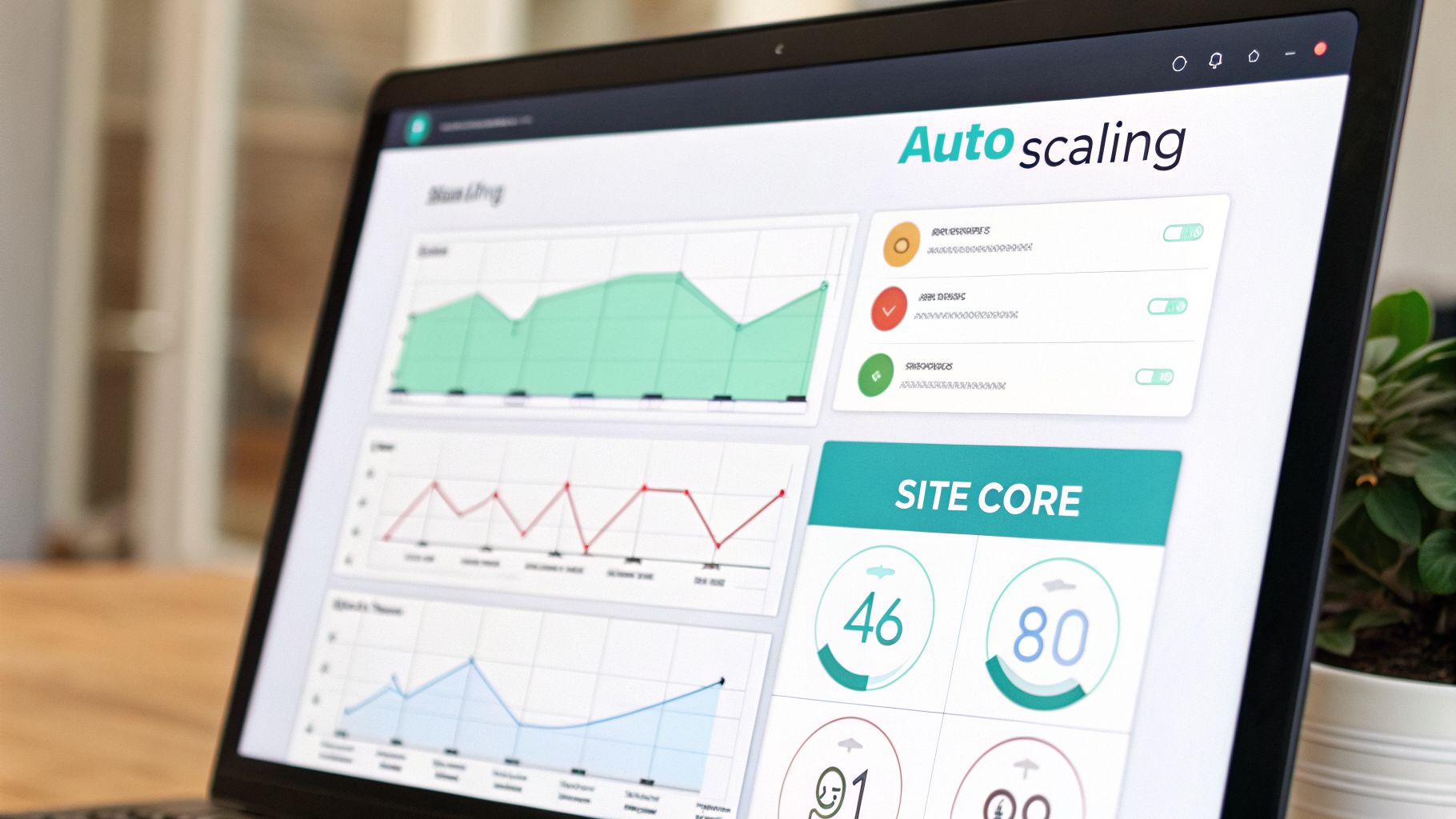
Kubernetes handles scalability in a much more dynamic and automated way, designed to react to real-time demand without a developer needing to lift a finger. This is a must-have for platforms like Sitecore AI, which can see wild traffic swings during a big marketing push or a flash sale.
Here are the key tools Kubernetes uses for this:
- Horizontal Pod Autoscaler (HPA): This is the workhorse of Kubernetes scaling. The HPA automatically adds or removes application pods (your container instances) based on metrics like CPU or memory usage. If your Sitecore Content Delivery instances get slammed with traffic, the HPA spins up more pods to share the load, keeping the user experience smooth.
- Vertical Pod Autoscaler (VPA): The VPA focuses on efficiency. It automatically adjusts the CPU and memory allocated to your pods, "right-sizing" them to match what they actually need. This prevents you from wasting resources.
- Cluster Autoscaler: When you run out of room on your existing servers, the Cluster Autoscaler steps in. It automatically provisions new nodes (servers) from your cloud provider, adding more capacity to the entire cluster.
These mechanisms highlight why Kubernetes is the clear winner for enterprise workloads, especially as more teams adopt composable DXP architectures. While Docker Compose is stuck with manual, single-host scaling, Kubernetes’s trio of autoscalers provides the elasticity to handle peak e-commerce traffic and scale down to save money during quiet periods. The resource footprint tells a similar story: Compose's tiny ~50MB footprint is great for a developer's laptop, but a minimal Kubernetes cluster needs about 2GB, reflecting its production-grade power. For a deeper dive into the technical details from the source, the official Kubernetes documentation is invaluable.
The Power of Self-Healing and Resilience
Beyond just scaling up and down, Kubernetes offers a degree of resilience that’s simply out of reach for Docker Compose. This idea of self-healing is baked into its DNA.
Kubernetes constantly watches the state of the cluster and the applications running on it. If a container crashes, a pod stops responding, or an entire server goes offline, Kubernetes automatically takes action to bring the system back to the desired state.
Imagine a server hosting several critical Sitecore roles suddenly fails. Kubernetes detects this immediately and reschedules those workloads onto healthy nodes elsewhere in the cluster. For the end-user, there’s no interruption—the application stays online, and the failover is completely transparent. This automated recovery is precisely the kind of high availability that global brands and public sector organizations using SharePoint for critical operations demand.
For any serious Sitecore AI or SharePoint deployment that needs to handle unpredictable traffic and guarantee uptime, Kubernetes isn't just an option; it's a necessity. Its architecture provides the solid foundation required to build and run a world-class DXP. Since this can be a complex undertaking, many organizations find success by partnering with experts. Exploring the benefits of expert managed cloud services can give you a clear path forward.
Comparing Operational Complexity and Total Cost of Ownership
When you're looking at Docker Compose versus Kubernetes, the conversation has to go beyond just features. You need to talk about operational complexity and the total cost of ownership (TCO). These factors hit your budget, your team structure, and the long-term health of your DXP, whether it’s a sophisticated Sitecore AI setup or a business-critical SharePoint solution. The choice boils down to a fundamental trade-off: do you want immediate simplicity or long-term operational power?
Docker Compose is known and loved for its simplicity. Getting started is easy, and the learning curve is gentle. For most development teams, managing a single docker-compose.yml file doesn't require any special expertise, which makes it incredibly accessible. This simplicity keeps operational costs very low on a single server because you aren't managing, securing, or monitoring a complex cluster.
The Kubernetes Investment
Kubernetes is a different beast entirely. It comes with a steep learning curve and a ton of operational complexity right out of the gate. Setting up and maintaining a production-ready cluster isn't something you do on a Friday afternoon. It requires a deep understanding of its core components, from the control plane to worker nodes, plus real expertise in networking (CNI), storage (CSI), and security.
This is why most companies either build a dedicated DevOps team with specialized skills or pay for a managed Kubernetes service like Azure Kubernetes Service (AKS), Amazon EKS, or Google GKE. These services handle a lot of the heavy lifting, but they come with their own costs and still demand expertise to configure and run correctly. For a more detailed breakdown of the components involved, you might find our guide on the differences between Docker Compose and Dockerfile helpful.
For a large enterprise, this higher operational cost is a strategic investment. You’re paying for automation, resilience, and the ability to scale without breaking a sweat. It’s a calculated expense that pays for itself over the platform's lifecycle.
The upfront complexity and cost of Kubernetes are not a flaw; they are the price of admission for enterprise-grade automation and self-healing. This investment directly mitigates the far greater costs associated with downtime, manual intervention, and an inability to scale.
Calculating the Real TCO for Sitecore and SharePoint
When a global brand deploys a platform like Sitecore AI, the TCO calculation must include the business impact of a potential outage. The cost of a single hour of downtime during a Black Friday sale can easily eclipse the entire yearly cost of a managed Kubernetes service and the DevOps team that runs it. In this context, the self-healing features of Kubernetes are a direct form of risk mitigation.
The same logic applies to a public sector organization that depends on SharePoint for critical public services. The operational overhead of Kubernetes is what guarantees the platform stability and availability that a single-host Docker Compose setup simply can't promise. That investment prevents costly service disruptions and frees the IT team from constant, manual fire-fighting.
Here’s a practical breakdown when you’re evaluating TCO:
| Cost Factor | Docker Compose (Single Host) | Kubernetes (Managed Cluster) |
|---|---|---|
| Initial Setup Cost | Very Low. Just needs a Docker Engine installation. | High. Involves cluster provisioning, network configuration, and security setup. |
| Specialized Staff | Minimal. Basic Docker knowledge is enough. | Required. Demands experienced DevOps or SRE professionals. |
| Managed Service Fees | None. Runs on a single host that you manage. | Moderate to High. Monthly fees for AKS, EKS, GKE, etc. |
| Downtime Risk Cost | High. Single point of failure with no automatic recovery. | Very Low. Built-in high availability and self-healing mechanisms. |
| Scaling Cost | Manual Effort. Requires manual commands and provisioning. | Automated & Efficient. Autoscaling optimizes resource use, cutting down waste. |
Ultimately, CTOs have to look at their team's skills and the business demands of their DXP to decide if the Kubernetes investment makes sense. For a simple internal application, Docker Compose is the clear financial winner. But for a mission-critical, customer-facing platform like Sitecore AI, the "expense" of Kubernetes is actually an investment in the operational excellence that protects revenue and reputation.
Moving from theory to the real world, the Docker Compose vs. Kubernetes debate really comes down to how each tool performs in the day-to-day grind of a Digital Experience Platform (DXP) project. For complex systems like Sitecore and SharePoint, certain use cases make the choice crystal clear, helping you balance developer speed with production-grade stability.
Docker Compose for Development and Prototyping
Docker Compose is, without a doubt, the developer's best friend. It’s the engine of the "inner loop," where speed and simplicity are everything. A Sitecore developer can spin up a complete local environment—including XM, xConnect, identity services, and databases—with a single docker compose up command.
This kind of rapid, consistent setup is a massive productivity win. It lets developers build and test new features without getting bogged down by the complexity of a full-blown cluster.
Its sweet spot is any pre-production task on a single machine where consistency is key. Think of it for:
- Local DXP Development: Developers can reliably mirror the core services of a production Sitecore or SharePoint stack right on their laptop. This ensures code behaves just as you'd expect when it's time to promote it.
- Rapid Prototyping: Need to build a quick proof-of-concept for a SharePoint add-in or a new Sitecore feature? Docker Compose lets you assemble the necessary services fast, without the overhead of managing a cluster.
- Isolated CI/CD Tests: Within a CI pipeline, Docker Compose can fire up a temporary environment on a single build agent to run automated unit and integration tests, giving you a clean, consistent stack for every run.
Kubernetes for Production DXP Deployments
When an environment faces real users, Kubernetes is the only game in town. It's built for the high-stakes world of staging, UAT, and, most importantly, live production deployments. Its entire architecture is designed to handle the pressures of enterprise-grade DXPs.
Kubernetes isn't just another deployment tool; it's the operational backbone for your most critical DXP solutions. For Sitecore and SharePoint, it’s what guarantees the scalability and resilience needed to protect revenue and brand reputation.
The power of Kubernetes shines in real-world scenarios. A global retail brand running Sitecore can use it to deploy a multi-region architecture. By spreading Content Delivery nodes across clusters in North America, Europe, and Asia, they deliver fast, personalized experiences to shoppers everywhere, all managed from one place.
Likewise, a public sector organization can count on Kubernetes to keep a critical SharePoint portal for citizen services online 24/7. If a server node goes down, Kubernetes simply reschedules the SharePoint containers to healthy nodes. For users trying to access vital information, it’s like nothing ever happened.
Docker Compose vs Kubernetes Decision Matrix for DXP Teams
To make the decision as straightforward as possible, this matrix maps common DXP scenarios to the right tool. It’s a quick reference to guide you at each stage of your project lifecycle.
| Scenario / Use Case | Recommended Tool | Justification |
|---|---|---|
| Local Developer Environment | Docker Compose | Unmatched speed and simplicity for creating a consistent, isolated setup for Sitecore or SharePoint on a single machine. |
| Rapid Proof-of-Concept (PoC) | Docker Compose | Perfect for quickly assembling services to demo functionality without the overhead of cluster management. |
| Staging, UAT, & Production | Kubernetes | Absolutely essential for high availability, auto-scaling, and self-healing. Non-negotiable for any user-facing environment. |
| Global Multi-Region Deployment | Kubernetes | The only way to effectively manage and orchestrate DXP workloads across different geographical regions for low latency and DR. |
This clear separation of duties isn't just theory—it's how the industry works.
Sitecore itself endorses this dual-tool strategy. Developers are guided to use Docker for local setups, while the official path for production is a fully containerized deployment on Kubernetes, complete with official Helm charts. For anyone looking to scale a DXP like Sitecore, the path is clear: Kubernetes is the standard for protecting uptime and maximizing business impact.
When you're ready to make the jump, a solid guide on how to deploy to Kubernetes can be an invaluable next step.
Making the Right Choice for Your Enterprise DXP
When it comes to the Docker Compose vs. Kubernetes debate, the real question isn't which tool is better overall. It's about which tool is right for the job at hand. For leaders managing complex DXP solutions like Sitecore AI or SharePoint, the best strategy isn't choosing one over the other. It’s about knowing when to use each.
This means embracing a "both, not either" approach. Let your development teams use Docker Compose to make local development faster and smoother. Its simplicity is a massive boost for developer productivity, perfect for rapid prototyping and the inner loop of your CI/CD process.
But when it comes to production, it’s a different story. For any DXP that runs business-critical operations, you need the power, resilience, and automated management of Kubernetes. Its advanced orchestration isn't a luxury—it's a necessity for scale.
Your Final Decision Checklist
To help you land on the right strategy, here are the questions every CTO and IT leader should be asking. Your answers will point your organization toward the right architecture for building and supporting a future-proof digital platform.
What is our team's current DevOps maturity? If your team is just getting started with containers, Docker Compose is far more approachable. A seasoned DevOps team, or one with a managed service partner, can confidently handle the operational side of Kubernetes.
Do we need multi-cloud or hybrid-cloud capabilities? If your strategy involves deploying your Sitecore solution across different cloud providers—or between on-prem and the cloud—Kubernetes is your only real choice. It gives you a consistent operational layer, no matter the underlying infrastructure.
What is our expected traffic and growth trajectory? For platforms expecting major growth or unpredictable traffic spikes (think a Sitecore-powered e-commerce site during a holiday sale), the auto-scaling in Kubernetes is essential. If traffic is low and predictable, the simplicity of a single-host deployment might be enough for less critical applications.
This decision tree helps visualize the core choice based on where you are in the project lifecycle.
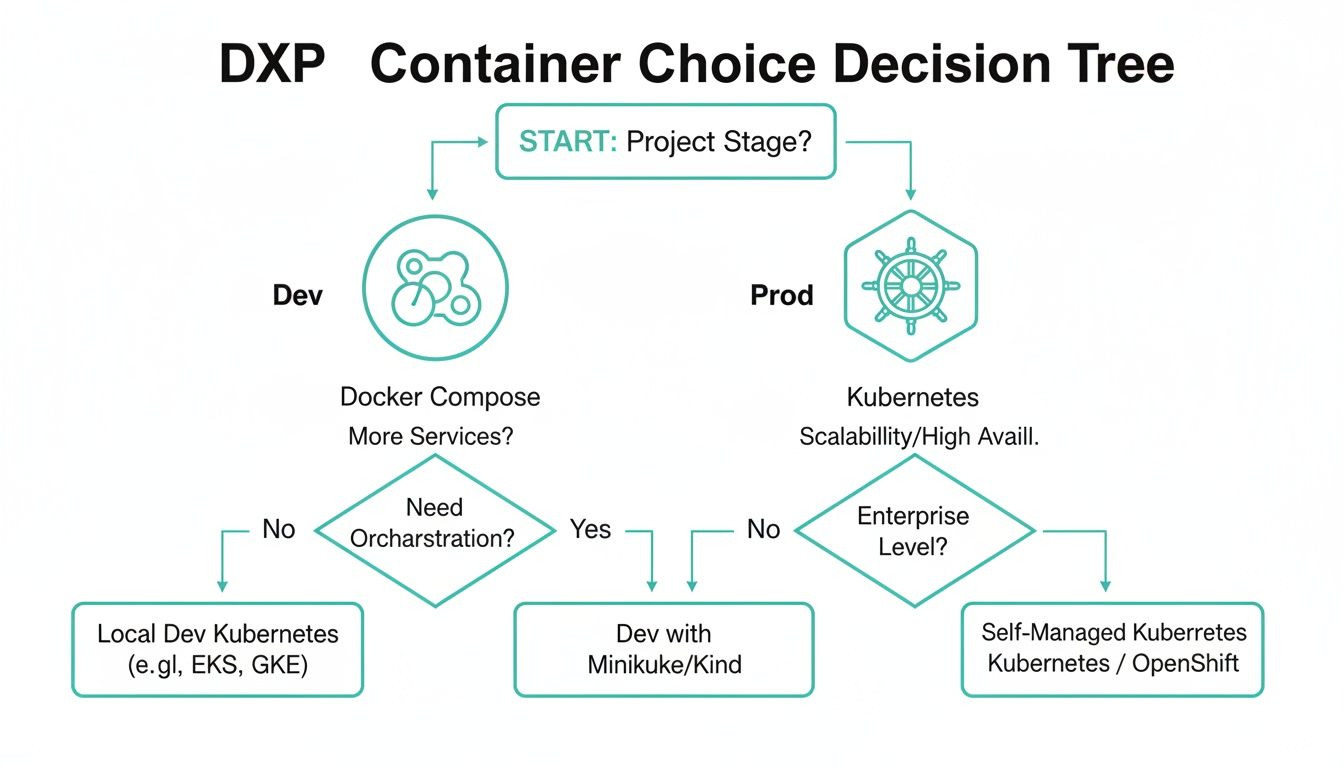
The visual reinforces a simple but powerful principle: the journey from dev to production should guide your technology choices. Docker Compose is the hands-down winner for local, single-host development. For production, Kubernetes is the undisputed standard for high availability and scale.
Ultimately, the "Docker Compose vs Kubernetes" decision is a strategic one that balances developer velocity against production-grade reliability. By leveraging Docker Compose for development and Kubernetes for production, you create a powerful, end-to-end workflow that supports both speed and stability for your enterprise DXP.
Frequently Asked Questions
When teams start discussing Docker Compose versus Kubernetes, especially for big platforms like Sitecore or SharePoint, a few key questions always come up. Here are the straight answers from our experience working with enterprise CTOs and development teams.
Can Docker Compose Be Used for Production?
Let's be blunt: while you can technically run a small, non-critical app on Docker Compose, using it for a production DXP like Sitecore or SharePoint is asking for trouble. It's a single-host tool, which immediately creates a single point of failure.
More importantly, it’s missing the non-negotiable features you need for any serious enterprise platform. Think about:
- Automated Scaling: Compose has no answer for traffic spikes. It can't scale out on its own.
- Self-Healing: If a container—or worse, the entire host—goes down, your application is offline. There’s no automatic recovery.
- Multi-Host Networking: It simply wasn't built to manage applications distributed across multiple servers for genuine high availability.
For these reasons, Kubernetes isn't just a preference; it’s the standard for any DXP that needs to be reliable and perform under pressure.
Does Sitecore Officially Support Kubernetes?
Yes, absolutely. Sitecore fully supports deploying its platform on Kubernetes, and they provide official container images, Helm charts, and guidance to make it happen. You can find everything on the Sitecore Downloads page.
This isn't just a token gesture; it's official validation that Kubernetes is the standard for building a scalable, enterprise-grade Sitecore architecture. It gives your team a clear, supported path to follow.
What Is the Role of Docker Compose in a Kubernetes Workflow?
Even when Kubernetes is your production target, Docker Compose remains an indispensable part of the workflow. Its real power is in local development, where it dramatically simplifies the developer's "inner loop" of coding, building, and testing.
Developers use Docker Compose to spin up a consistent, multi-container setup on their own machines in seconds. This local environment can mimic the services used in production—like databases, caching layers, and the application itself—without the overhead of a full Kubernetes cluster. It lets developers work quickly and efficiently before their code ever touches a shared staging or production cluster.
At Kogifi, we specialize in architecting and supporting high-performance DXP solutions on platforms like Sitecore and SharePoint. If you're planning your move to a containerized architecture, explore how our expertise can ensure your project's success.