


A major release goes live on Friday. The templates render, editors publish without errors, and analytics show traffic holding steady. Six weeks later, someone opens Search Console and finds thousands of new URLs sitting in Discovered, currently not indexed, while older commercial pages have stopped being recrawled. That delay between shipping and discovery is where an enterprise SEO audit earns its value, not in a longer checklist, but in connecting crawl behavior to templates, locales, and release decisions before the next deployment repeats the damage.
Table of Contents
- Assemble the Inventory From Four Sources
- Segment Before You Count Anything
- Decide the Boundaries Explicitly
- Reconcile Intent Against Crawler Behavior
- Fix Canonical Signals as a System
- Measure Crawl Waste, Don't Guess at Crawl Budget
- Test Rendered Output, Then Rank Everything
What Makes an Enterprise SEO Audit Different
That Friday release usually isn't one site changing. It's a shared component rolling through a dozen country sites, two brands, and a preview environment that someone forgot to exclude. Everything looks correct in the editor. Six weeks later, the index tells a different story.
Auditing a small brochure site means inspecting pages. Auditing a multi-brand, multilingual DXP estate means inspecting systems that produce pages. An enterprise SEO audit is an audit of discoverability, crawlability, rendering, indexing, and search appearance across large, interconnected web estates, and those systems rarely fail one URL at a time.
Three Forces Change the Job
Scale changes the unit of work. When an estate holds hundreds of thousands of URLs, you can't review pages individually. You audit templates, publishing rules, and URL generation logic, then measure how many URLs each defect touches.
Platform complexity changes the failure modes. Sitecore, AEM, and SharePoint estates often sit alongside headless front ends, faceted navigation, and cloud publishing workflows. A single misconfigured canonical rule or blocked script can replicate across every market before anyone notices.
Organizational complexity changes the output. A finding without an owner is trivia. Template defects go to developers, thin localized content goes to content owners, redirect maps go to infrastructure, and release gating goes to release managers.
A crawl export tells you what's broken. An audit tells you who fixes it, in what order, and how you'll know it worked.
Google's crawler primarily discovers pages through links from pages it has already crawled, and it also processes XML sitemaps and redirects as it moves from URL to URL, which is why technical architecture is a measurable foundation rather than a secondary concern in Google's SEO starter guidance on how search discovery works. If your internal linking, sitemaps, and redirect logic don't agree, Google receives three different descriptions of your estate.
The practical promise is simple. You should finish with a prioritized, owned backlog tied to templates and releases, not a PDF of red flags that nobody can action. Most enterprise findings don't fail at detection. They fail at governance, because nobody routed them into a sprint, a publishing checklist, or a release gate.
Scoping the Audit and Building a Complete URL Inventory
Every later pass depends on one unglamorous asset: a defensible list of what exists. Build it from four independent sources, because each one reveals URLs the others miss.
Assemble the Inventory From Four Sources
- XML sitemaps show intent. They list what the platform believes should be indexed. Compare them against reality and you'll find stale locales, retired campaigns, and non-canonical variants that were never cleaned up.
- Server or CDN logs show crawler reality. Logs reveal which URLs bots request, including parameterized facets and legacy redirects that no sitemap mentions and no editor remembers creating.
- Analytics landing pages show user reality. Pages receiving sessions but absent from sitemaps are often orphan pages, reachable through external links or old campaigns but disconnected from internal navigation.
- Search Console exports show Google's view. They surface discovered but unindexed URLs, crawl anomalies, and pages Google chose to index under a different canonical than the one you declared.
Merge these into one master table with one row per URL. Deduplicate carefully, preserving parameters long enough to see whether they're meaningful facets or tracking noise. Only then start crawling, because a crawler that starts from the homepage will never find orphans or published-but-unlinked pages.
Segment Before You Count Anything
Raw issue counts mislead at scale. Tag every URL by market, language, brand, template, status code, and business value so errors can be quantified by revenue impact rather than volume. A missing meta description on a legal archive and the same defect on a top converting product template are not the same finding.
- Template is the primary segment. Pages built from one Sitecore rendering or AEM component share the same defects, so fix rates should be reported per template, not per URL.
- Locale is the second cut. The same template can behave differently across markets when publishing workflows, translation states, or regional components diverge.
- Business value sets priority. Weight segments by organic traffic and conversion value so crawl waste on low value facets doesn't outrank indexation failures on commercial pages.
Practical rule: if you can't say which template produced a URL and which team owns it, you're not ready to audit it.
Decide the Boundaries Explicitly
Scoping is a decision, not a default. Agree in writing which subdomains, preview and staging environments, parameterized facet spaces, legacy platforms awaiting migration, and SharePoint driven sections are in scope. Preview environments deserve special attention, because a single crawlable staging host can pollute the index for months.
Finally, name the commercial pages that define success. Product detail templates, key landing pages, and high intent editorial hubs become your protected set. Every later measurement, from crawl waste ratios to post release indexation latency, gets reported against whether those pages are being crawled, rendered, and revisited as intended.
Running the Five Technical Audit Passes
With a segmented inventory in place, run the audit in five passes. The order matters, because each pass narrows the question from what exists, to what Google sees, to what deserves fixing first.
| Audit pass | Primary data sources | Defects it surfaces | Output |
|---|---|---|---|
| 1. Inventory reconciliation | Sitemaps, logs, Search Console, analytics | Orphans, uncrawled published pages, phantom URLs | Master URL table with segments |
| 2. Indexation and canonicalization | Crawl data, Search Console coverage | Canonical conflicts, duplicate clusters, wrong indexation | Preferred URL per cluster |
| 3. Crawl waste measurement | Server logs, crawl stats | Bot hits on facets, redirects, soft 404s, errors | Waste ratio by template and locale |
| 4. Rendering validation | Rendered HTML, URL inspection | Missing content, links absent without JavaScript | Per template rendering verdict |
| 5. Prioritization | Traffic, conversion, effort estimates | Low impact noise versus revenue defects | Ranked, owned backlog |
Reconcile Intent Against Crawler Behavior
Compare intended canonical URLs with observed bot requests. Pages published without crawl exposure point to weak internal linking or sitemap gaps. URLs crawled heavily but absent from your inventory usually come from faceted navigation, calendar style archives, or automated publishing creating technically valid but commercially irrelevant variants.
Fix Canonical Signals as a System
Each duplicate cluster needs one preferred canonical URL, reinforced three ways. Only preferred URLs belong in XML sitemaps, internal links should point directly to preferred URLs, and redirects plus rel="canonical" should agree with both. Sitemap inclusion is only a hint, as Google's crawling and indexing documentation for large sites makes clear, so treating it as the primary signal is a common enterprise mistake.
Structured data belongs in this pass too, because markup that points to non-canonical variants undermines the same signals. Reviewing schema markup practices that support search visibility alongside canonical checks prevents rich result eligibility from attaching to URLs you're trying to consolidate.
Measure Crawl Waste, Don't Guess at Crawl Budget
Count bot requests spent on parameterized, duplicate, redirected, soft-404, and error URLs, then compare that total with crawl activity on indexable commercial and editorial pages. Report the ratio by template and locale. Crawl budget analysis becomes relevant around 1 million unique pages, 10,000 pages updated daily, or a high proportion of URLs marked Discovered, currently not indexed, thresholds summarized in Elsner's enterprise SEO strategy guidance on crawl budget triggers.
Two traps catch auditors repeatedly. First, noindex is not a crawl budget tool, because Google must crawl a page to see the directive. Second, blocking a URL in robots.txt prevents Google from seeing canonical or noindex signals on it, so blocked duplicates can linger in the index as bare URLs.
Test Rendered Output, Then Rank Everything
Fetch representative URLs per template and compare raw HTML with rendered HTML. Confirm that primary content, internal links, and structured data exist in crawlable output, not only after fragile client-side interaction. CSS and JavaScript resources needed to understand a page must stay crawlable, or important content may never appear.
Close by scoring every defect against organic traffic, conversion value, crawl waste, and implementation effort. Discovery defects, where Google can't find pages, need different fixes than indexation decisions, where Google found pages and declined them. Conflating the two produces backlogs full of sitemap submissions for pages Google has already judged.
Auditing Multilingual Architecture and Hreflang at Scale
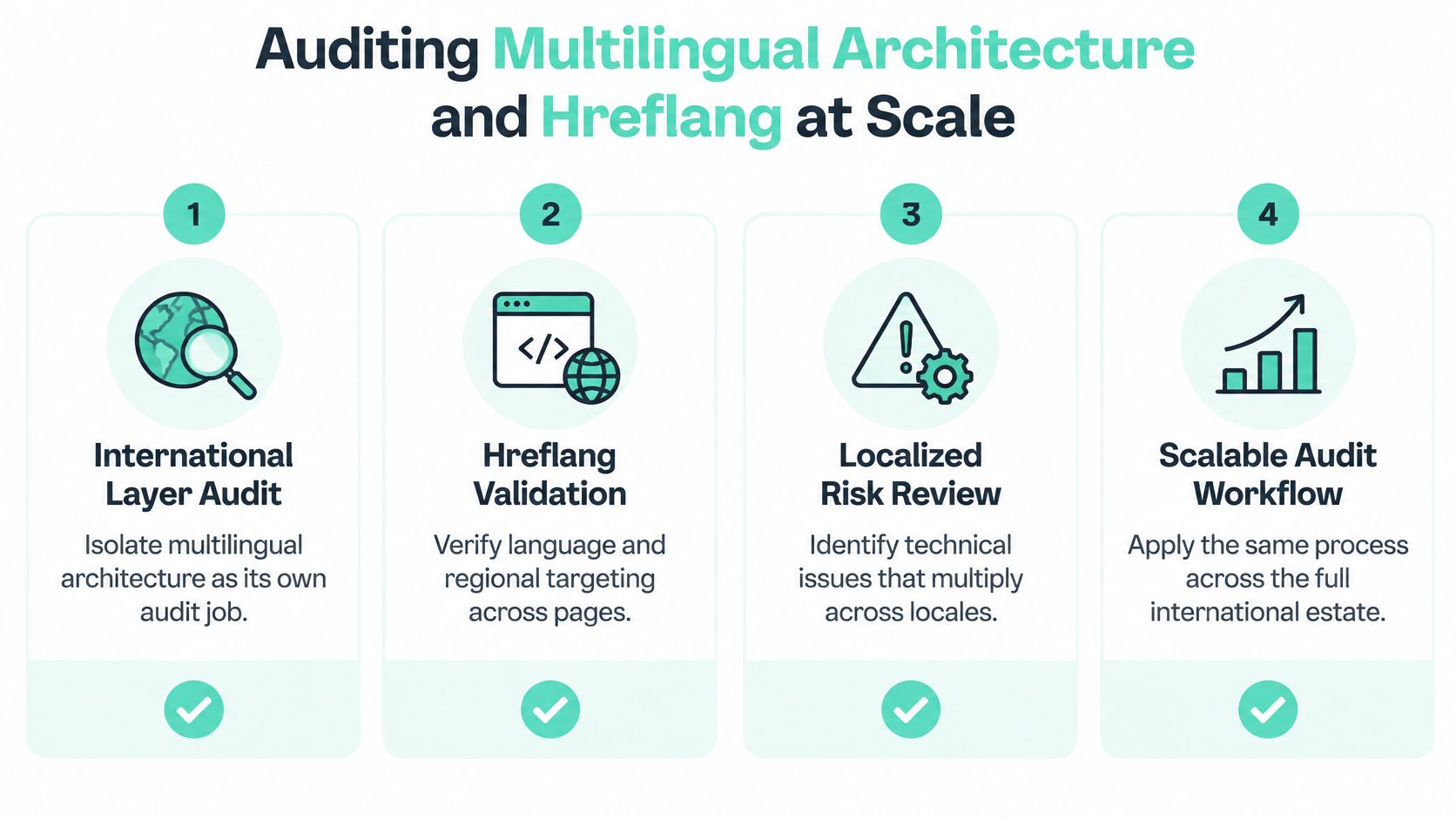
Localization doesn't add risk linearly. It multiplies it. Every template defect, canonical conflict, and sitemap error from the technical passes reappears once per locale, so the international layer needs its own audit job rather than a footnote in the crawl report.
The workflow below sequences that job, from isolating the international layer through to a repeatable per locale process.
Validate Hreflang Clusters End to End
Hreflang fails without obvious signs. Pages still index, traffic still arrives, and the wrong country's pricing page ranks in three markets for a year. Validate clusters as complete systems, not individual tags.
- Reciprocal return links exist. If page A declares page B as its German alternate, B must declare A back, or the annotation is ignored.
- Self-referencing tags are present. Every page in a cluster must list itself, which publishing workflows often drop when a locale is cloned from a partial template.
- X-default points somewhere deliberate. It should resolve to a genuine fallback, usually a language selector or global English page, not the homepage of whichever market launched first.
- Hreflang targets match canonicals. An alternate that canonicalizes elsewhere creates contradictory signals, and Google typically discards the cluster rather than guessing.
Run these checks per locale template, not per page. If the product template's cluster logic is correct in French and broken in Polish, that's a publishing workflow defect in one market, not thousands of page level errors.
Audit Structure Against Governance Reality
Subdirectories, subdomains, and ccTLDs each work when governance matches the choice. Subdirectories consolidate signals but demand disciplined internal linking across locales. Subdomains suit semi-autonomous regional teams but fragment measurement. ccTLDs send the strongest geographic signal and carry the heaviest maintenance burden. Audit the structure you have against the team that's staffed to run it, a consideration central to practical CMS localization planning for multilingual estates.
In multi-brand hub-and-spoke Sitecore setups, shared components and cloned site definitions generate URL variants through publishing workflows. Check for regional duplicate content where markets share language but differ in pricing or regulation, wrong-language indexing where fallback content renders under a localized URL, and localized sitemap hygiene, since one sitemap index mixing stale and current locales hides indexation problems per market.
Sample one URL per template per locale and verify the full cluster by hand. Automated checks count tags. Only a human notices the German page declaring itself the French alternate.
Measuring Performance and Core Web Vitals by Template
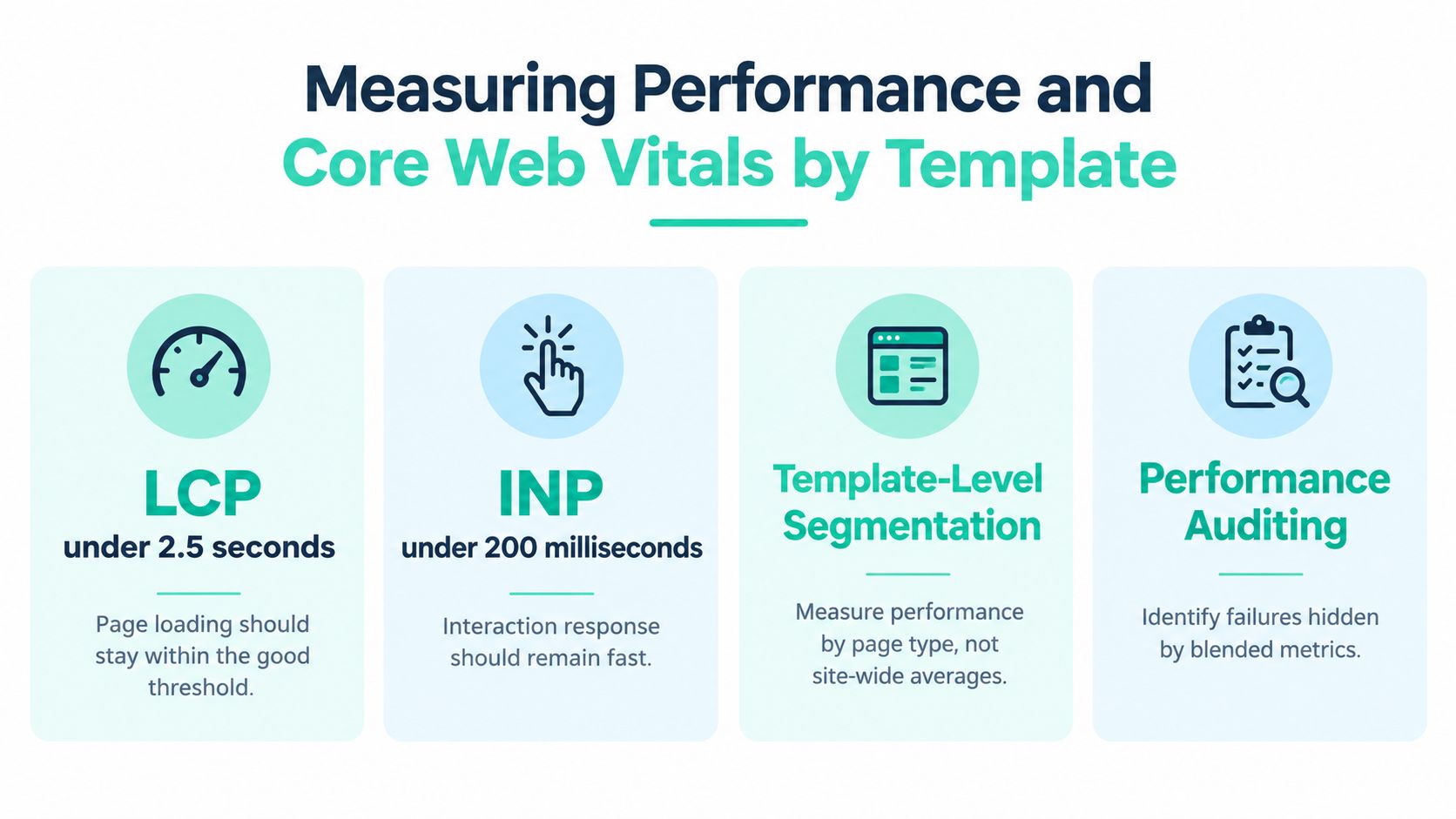
A site-wide average is where performance problems hide. Blend a fast editorial template with a heavy product configurator and the mean looks acceptable while your highest value pages fail. Segmented measurement is the entire discipline here.
The thresholds and segmentation model below frame how to read field data before touching any code.
Know What Passing Actually Means
Good thresholds are Largest Contentful Paint within 2.5 seconds, Interaction to Next Paint below 200 milliseconds, and Cumulative Layout Shift below 0.1, and a page must meet all three at the 75th percentile of page loads, evaluated separately for mobile and desktop, to pass, per Google's Core Web Vitals thresholds and assessment rules.
The all-or-nothing rule matters. In June 2025 measurement summarized from HTTP Archive and Chrome User Experience data, only 48% of mobile websites and 56% of desktop websites achieved good results across all three metrics, according to HTTP Archive technology reporting on Core Web Vitals pass rates. Individual metrics pass far more often. One weak experience blocks the whole assessment, which is why reporting LCP alone flatters most estates.
Run the Audit in Sequence
- Export field data first. Pull Search Console or CrUX data, because field data reflects real users across real devices and networks, while lab tests only diagnose causes.
- Group failures by template and release version. A regression that starts with a deployment is a release governance problem, and grouping by reusable template shows whether one fix repairs ten pages or ten thousand.
- Validate with lab traces. Test representative pages under throttled mobile conditions to isolate causes field data can't name.
- Isolate the usual suspects. Work through server response time, render-blocking resources, JavaScript execution, image weight, third-party tags, and missing layout reservations in that order.
- Remediate high-traffic templates first. Then wait for sufficient real-user volume before declaring victory, because field data moves slowly.
These diagnostic steps pair naturally with broader website performance optimization work on caching, delivery, and asset weight, but sequencing matters. Fixing image delivery on a template whose real problem is server response time wastes a release cycle.
The traps are predictable. Teams optimize the homepage because executives visit it, or chase a desktop lab score because it's easiest to improve. Meanwhile personalization scripts, consent tooling, and SPA hydration degrade mobile field results in ways no lab run reproduces. On Sitecore, AEM, SharePoint, or composable front ends, map every finding back to image delivery, JavaScript bundles, CDN configuration, and release governance, then track it as a trend line per template rather than a one-off score.
Extending the Audit to AI Search and Content Governance
A release can pass every crawl, indexation, and Core Web Vitals check and still leave the brand misquoted in AI answers. Traditional audits answer whether Google can crawl, index, and rank your pages. The added layer answers a harder question: when an answer engine speaks for you, which source did it use, was the claim current, and who is authorized to correct it across brands and locales.
The collaboration this layer demands spans SEO, content, platform, and compliance teams, as the working session below suggests.

Build a Citation and Representation Test
Expectations are moving fast. In a study of 300 US enterprise leaders, respondents expected AI-search traffic to rise from 35% of website traffic in 2025 to 50% in 2026, and 65% planned to allocate at least 25% of their 2026 marketing budget to AI-search optimization, according to Branch's 2026 AI search findings from enterprise leaders. Treat those figures as stated expectations, not outcomes, but they explain why audit scope is expanding.
Build a fixed prompt set covering branded and unbranded queries per market, per brand, and per language. Record which URLs and entities answer engines cite, whether cited claims are current, and where third-party sources outrank your own pages as the attributed authority. Flag incorrect regional, product, accessibility, or compliance information as business risk, not as a ranking fluctuation.
Ranking first and being cited wrong are compatible outcomes. Your audit should be able to detect both at once.
Separate visibility from clicks in reporting. An answer can represent your brand to users who never visit, which makes accuracy a governance issue. Define audited content standards before scaling across locales: each claim needs a source, a last-verified date, a locale owner, an accessibility check, and a rollback path. Humantext.pro's guide to SEO quality works as a starting checklist for that bar; the audit requirement is naming the person who corrects source content when an answer engine repeats an outdated claim.
The embedded walkthrough below is an operations reference, not the test itself: it shows why variant generation, approvals, and brand kits belong in the same governance review as citation accuracy.
Connect Monitoring to Platform Workflows
Citation monitoring only helps if corrections flow through structured content, authorship signals, and entity data that release workflows maintain, which is why a documented content governance framework for enterprise publishing matters more than another dashboard. Someone must own correcting the source content when an answer engine repeats an outdated claim, and that owner needs a route into the next release, not a note in a spreadsheet. Most findings fail at governance, not detection.
Sitecore's AI portfolio becomes operationally relevant through Sitecore Stream, an AI layer built on Microsoft Azure OpenAI Service and integrated into Sitecore products, covering content creation, campaign briefs, personalization, and brand kits inside existing marketer workflows, as described in Sitecore Stream product documentation. Its portfolio separates copilots, which guide decisions, from agents, which automate actions, including Brand Copilot for brand-aware briefs, Content Copilot for refinement, translation, and image tagging, and Experience Copilot for visual search and question generation, per Sitecore's documentation of Stream copilots and agents.
Sitecore announced in February 2025 that Stream had expanded across CMS, digital asset management, and customer data platform products, adding XM Cloud variant generation, A/B/n testing, and visual asset search, as detailed in Sitecore's February 2025 Stream expansion announcement. XM Cloud also builds real-time personalization and A/B testing into every page using shared customer data, according to Sitecore XM Cloud product information on built-in personalization. For audit purposes, the point is the control surface: brand-consistent generation and governed variants reduce the drift that AI citation audits keep detecting.
Prioritizing Fixes and Keeping the Audit Alive
An audit that produces a spreadsheet nobody acts on has failed, regardless of how accurate it is. The final job is converting findings into a program with scores, owners, and a cadence tied to releases.
Score Fixes Before Scheduling Them
Weigh every defect by organic traffic, conversion value, crawl waste, and implementation effort. That scoring separates quick wins from program work, and it gives product managers a language they already use.
- Quick wins ship first. Redirect chains, sitemap hygiene, canonical conflicts, and blocked rendering resources usually need configuration changes, not rebuilds.
- Program work needs a roadmap slot. Template performance rebuilds, hreflang architecture corrections, and governance changes compete with feature work, so they need revenue framing and acceptance criteria.
- Noise gets parked explicitly. Low traffic 404s and cosmetic metadata gaps should be recorded as deferred, not left to inflate the backlog and erode confidence in the audit.
Reporting discipline keeps this alive. A lightweight SEO reporting tool approach, focused on a few template level trend lines rather than hundreds of metrics, makes it easier for non-SEO stakeholders to see whether fixes moved indexation and field performance after each release.
Assign Owners and Audit on Release Cadence
Route each defect to a named content owner, developer, or release manager with a measurable acceptance test, such as rendered output verified on staging or crawl waste ratio checked two weeks post deployment. Schedule re-audit checkpoints after every major release, not annually. Annual audits on quarterly release trains guarantee that findings describe a platform that no longer exists.
Enterprises running Sitecore, AEM, or SharePoint estates can shorten the learning curve by working with a partner that audits these platforms daily. Kogifi's teams have delivered 70+ DXP projects over 12+ years and run this kind of audit, performance tuning, and stabilization engagement for global brands. Whether you staff it internally or externally, the standard is the same. Detection is the easy half. Governance is what makes an enterprise SEO audit compound.
If your Sitecore, AEM, or SharePoint estate is shipping releases faster than search engines can make sense of them, Kogifi can run a release-aware enterprise SEO audit across your brands and locales, from URL inventory and crawl waste analysis to Core Web Vitals remediation and AI citation monitoring. Our DXP specialists turn findings into owned, prioritized backlogs your platform teams can ship. Visit Kogifi to start a conversation about auditing your estate before the next release.