


Let’s be honest: "marketing digital transformation" isn't a single project you can just check off a list. It's a fundamental rewiring of how your business connects with customers. Think of it as a continuous evolution of your people, processes, and technology, all working together to deliver seamless, personal experiences wherever—and whenever—your customers show up.
Platforms like Sitecore's Digital Experience Platform (DXP) are the bedrock for this modern marketing engine. They give you the power to move beyond siloed, one-off campaigns and start building a truly unified customer journey.
What Is Marketing Digital Transformation
Imagine your current marketing efforts are a town full of local roads. Each campaign might get someone from point A to point B, but there's no high-speed, interconnected system to tie everything together. A marketing digital transformation is like upgrading those disjointed streets into a national highway system. Suddenly, you have incredible reach, speed, and the infrastructure to handle massive amounts of traffic with total efficiency.

This shift is about more than just buying new software. It’s about reorienting your entire marketing function around the customer, using data as the fuel and platforms like Sitecore as the engine. The real goal is to create a fluid, intelligent system that can anticipate what customers need and respond instantly, no matter which channel they're using.
This isn't just a nice-to-have concept; it's a financial necessity. The digital transformation market is exploding, with global spending projected to hit $3.9 trillion by 2027. This massive investment is a clear signal that companies now see this evolution as critical for survival and growth. You can learn more from these digital transformation statistics.
The Core Pillars of Transformation
True transformation isn't just one big change; it’s built on three foundational pillars. Each one represents a major departure from the old way of doing things, demanding a new mindset about technology, data, and how you engage with your audience.
This table breaks down the shift from traditional thinking to a modern, transformed approach, highlighting how a platform like Sitecore can bring these pillars to life.
| Key Pillars of Marketing Digital Transformation |
|---|---|---|
| Pillar | Traditional Approach | Transformed Approach (Sitecore Enabled) |
| Data-Driven Personalization | Generic, one-size-fits-all campaigns sent to broad segments. | One-to-one conversations at scale, delivering unique content based on real-time behavior and historical data. |
| Omnichannel Consistency | Disconnected experiences where the website, app, and social channels feel like separate worlds. | A seamless, consistent brand experience across all touchpoints, from a web browser to a chatbot or mobile app. |
| Agile Operations | Marketing and IT teams work in silos, leading to slow execution and disjointed strategies. | Integrated, collaborative teams that use shared platforms for planning, approvals, and quick adaptation to market changes. |
Let's dig a little deeper into what each of these means in practice.
Data-Driven Personalization: This is where you move beyond broad-stroke campaigns and start creating one-to-one conversations at scale. It’s the ability to serve up unique experiences based on an individual's behavior, preferences, and history, powered by a robust solution like Sitecore CDP.
Omnichannel Consistency: Customers don't think in channels; they just see your brand. This pillar is all about making sure their experience is consistent and seamless, whether they’re on your website, using your mobile app, or talking to a chatbot. A composable DXP makes this happen by centralizing content and data.
Agile Operations: Your internal processes need to be just as dynamic as your customer experiences. This means breaking down the classic silos—especially between marketing and IT—and fostering genuine collaboration. A tool like SharePoint can be a game-changer here, creating a unified workspace for content planning, approvals, and knowledge sharing.
True marketing digital transformation is achieved when technology, data, and organizational culture align to serve a single purpose: delivering an exceptional and cohesive customer experience at every single touchpoint.
When you integrate powerful external platforms like Sitecore with internal collaboration hubs like SharePoint, you create a powerful feedback loop. Marketers get the tools they need to execute sophisticated campaigns, while the business gains the internal agility to adapt and optimize strategies on the fly. It’s this complete ecosystem that defines a modern marketing powerhouse.
Why Marketing Transformation Is No Longer Optional
In today's market, standing still is the fastest way to fall behind. The push for marketing digital transformation isn’t just about keeping up with trends; it’s a direct response to a massive shift in what customers expect. They want personalized, seamless interactions on every channel, from your website to their phone. You're no longer just up against your direct competitors—you're competing with every slick, easy digital experience they’ve ever had.
Legacy systems, with their walled-off data and clunky, patched-together technologies, just can’t keep up. They lead to broken customer journeys where the marketing team has no idea what the sales team is doing. This friction isn't just a technical problem; it creates real frustration that drives customers away.
The Strategic Risks of Inaction
Putting off transformation isn’t a safe bet; it’s a strategic gamble where the stakes get higher every day. The most immediate danger is losing ground to the competition. As your rivals adopt more agile platforms, like Sitecore’s composable DXP, they gain the power to personalize experiences on the fly, launch campaigns in days instead of weeks, and pivot the moment the market shifts. If you're stuck with outdated tech, you're left trying to catch up.
There’s also the crippling cost of operational drag. When marketing, sales, and service teams are all working from different sets of data, collaboration becomes a nightmare. Without a unified customer view, which tools like a Sitecore CDP are built to provide, you end up with duplicated work, mixed messaging, and a ton of missed opportunities. An internal platform like SharePoint might help teams talk to each other, but it doesn't solve the core issue of a fragmented customer experience.
The risks of sticking with the status quo are clear:
- Customer Churn: If you can’t deliver the personalized experiences customers expect, they’ll find someone who can.
- Decreased Relevance: Generic, one-size-fits-all marketing is just noise in a world of curated content.
- Operational Drag: Clunky workflows and siloed data cripple your ability to react to new opportunities.
A Proactive Strategy for Survival and Growth
Thinking of marketing transformation as just a tech upgrade completely misses the point. It’s a proactive strategy for survival and, more importantly, for growth. By embracing a modern tech stack, you're essentially future-proofing your business against the market shifts and customer demands you know are coming.
The real goal is to shift from a reactive, campaign-focused mindset to a proactive, customer-obsessed one, where every single interaction is driven by data and fine-tuned for relevance.
But let's be honest—this path is full of challenges. While companies are pouring money into these initiatives, success is far from guaranteed. In fact, a sobering analysis of over 850 companies found that only 35% of digital transformation projects ever hit their stated goals. This statistic isn't meant to be discouraging; it’s a wake-up call about the need for a rock-solid strategy and the right partners. You can find more on this data transformation challenge online.
Ultimately, this is about rebuilding your marketing function from the ground up to not just survive, but thrive in a digital-first world. Platforms from the Sitecore ecosystem give you the tools to build real, personal relationships with customers at scale. It’s how marketing stops being a cost center and becomes a predictable engine for revenue growth. The question is no longer if you should transform, but how you'll get it done to secure your place in the market.
Building Your Technology Foundation with Sitecore and SharePoint
At the heart of any marketing digital transformation is a solid technology core, the central nervous system connecting every customer touchpoint. Without it, you're just juggling a mess of disconnected tools.
Sitecore’s Digital Experience Platform (DXP) is designed to be that core. It’s built to orchestrate everything from content and commerce to deep personalization, making sure the right message hits the right person at the right time.
Think of it as a composable suite of powerful, specialized products that all talk to each other.
- XM Cloud for pushing content out to any channel with seriously high performance.
- Content Hub for getting a handle on all your assets and editorial workflows.
- OrderCloud for building out flexible, often complex, B2B commerce experiences.
- Sitecore CDP for creating a single, unified view of your customer and segmenting them in real-time.
XM Cloud is particularly interesting because it uses a headless architecture, which essentially separates your content from how it's displayed. This gives you incredible flexibility and allows the platform to scale on-demand, using global CDNs to slash latency for users anywhere in the world.
Content Hub acts as your single source of truth for digital assets. It cuts down the chaos of the content lifecycle, from the first spark of an idea to final publication, with handy tools like automated metadata tagging and AI-powered search to find what you need fast.
For the commerce side, OrderCloud provides a headless engine that can handle even the most complicated ordering scenarios. Its API-first design means it plays nicely with your existing ERPs and other services, keeping inventory and pricing perfectly in sync.
And tying it all together is Sitecore CDP. It pulls in data from everywhere—website behavior, past purchases, CRM notes—and builds a comprehensive profile for each customer. With real-time segmentation, marketers can trigger personalized campaigns on the fly.
Understanding the DXP Concept
If all this sounds a bit abstract, imagine your DXP as a central train station. Every piece of content and data is a passenger, and the DXP routes them to the correct track, or channel, ensuring no message gets lost.
- Your CRM feeds in transaction histories.
- Web analytics provides real-time behavior.
- Social platforms deliver public sentiment.
- E-commerce engines send order data.
This "central hub" model breaks down the silos that slow marketers down, making campaign execution much faster and more cohesive. At Kogifi, we've implemented dozens of Sitecore DXPs, always focusing on rock-solid security and scalability from day one.
Integrating Sitecore Modules Seamlessly
The real magic happens when you start combining these modules. For instance, pairing XM Cloud with Content Hub unifies your editorial workflows with omnichannel delivery. No more manual exports or worrying about brand consistency across channels.
Or, connect OrderCloud with the CDP, and suddenly your commerce insights can directly trigger personalization campaigns. This is all made possible by APIs and webhooks that let data flow freely between systems, allowing for rapid development without the constraints of old-school, monolithic platforms.
Webhooks and events enable near real-time updates, so a change to content or an order status propagates instantly. A few best practices we always follow include using version control for APIs and setting up monitoring dashboards to catch errors early.
Key Insight: Sitecore’s composable architecture turns complex multi-system setups into a unified marketing engine.
Here’s a look at how Sitecore visualizes this unified approach, giving you a single dashboard to see what’s happening.

This dashboard view pulls together real-time analytics, content statuses, and commerce metrics all in one place. By keeping an eye on key metrics, you can constantly refine your DXP setup.
- Time to first byte (TTFB)
- Asset retrieval times
- API call success rates
- Personalization ROI impact
Real-World Integration Example
We worked with a manufacturing firm that used XM Cloud and OrderCloud to launch a personalized B2B portal in just 90 days. By syncing their product catalogs with customer segments in the CDP, they were able to increase average order sizes by 15%.
- They launched a new storefront quickly using APIs.
- The CDP triggered automated email workflows.
- They used a shared asset library on SharePoint for all their marketing updates.
Data Governance and Security in the DXP
Sitecore has robust, built-in role-based access controls to keep content and customer data secure. When you combine this with the compliance features in SharePoint, you're well-equipped to meet regulations like GDPR and CCPA.
- Encryption at rest and in transit.
- Audit logs for all content changes.
- Permission hierarchies for sensitive data.
- Regular security reviews and updates.
While Sitecore runs your external-facing DXP, Microsoft SharePoint is the perfect complement for your internal teams. It becomes the collaboration hub where marketing teams can manage document libraries, co-author content, and automate workflows.
SharePoint’s flexible site collections make it easy to organize projects, creative briefs, and asset approvals.
Empowering Internal Teams with SharePoint
SharePoint really shines by boosting internal productivity through its tight integration with Microsoft 365 apps and by serving as a central knowledge base.
- Document versioning tracks changes and prevents outdated content from slipping through.
- Approval flows with Power Automate speed up campaign launches.
- Team sites provide a single place for project updates and calendars.
- Permissions management keeps sensitive marketing materials locked down.
When you integrate SharePoint and Sitecore, you can create a feedback loop between internal operations and external customer experiences. For example, asset usage metrics in Sitecore can flag which documents in SharePoint need an update. This closed-loop process ensures your internal engine and external presence evolve together.
Best Practices for Sitecore and SharePoint
Our advice is to adopt an iterative approach. Start with the modules that will deliver the most value first, then build from there. It's also critical to ensure your governance policies are aligned between Sitecore and SharePoint to avoid data inconsistencies.
- Define clear content ownership roles.
- Standardize your metadata taxonomies across both platforms.
- Regularly audit integration logs.
- Train your teams on API management best practices.
For a deeper dive into integrating these kinds of systems, check out our guide on enterprise content management solutions.
Key Takeaways
Building this technology foundation gives you a scalable, data-driven engine to power your marketing digital transformation. It’s a powerful combination.
Sitecore delivers the external engagement muscle, while SharePoint fosters the internal agility needed for rapid campaign execution. With this architecture, your teams have the freedom to innovate, personalize at scale, and confidently outpace the competition.
Unlocking Growth with AI and Automation
Artificial intelligence and automation aren't just buzzwords anymore; they’re practical, powerful tools baked right into the Sitecore DXP. Think of them as the engine driving a smarter, more effective marketing transformation. We're moving past guesswork and into a world where every marketing action is backed by real data.
The whole idea is to switch from manual, often inefficient marketing tasks to an automated, data-driven operation. Sitecore's AI-powered personalization engine is the star of the show here. It watches everything a user does in real-time—clicks, page views, downloads, you name it—to build a unique profile for each visitor. This lets you serve up the right content to the right person, at exactly the right time.
Real-Time Personalization with Sitecore AI
Imagine someone lands on your website for the very first time. Sitecore’s AI gets to work instantly, analyzing their journey and comparing their behavior to millions of other interactions it has seen before. It can then predict what they’re looking for and automatically serve content or product recommendations that will actually resonate, all without a single person lifting a finger.
This isn’t just about basic segmentation. It's about creating a true one-to-one conversation that changes with every click. This capability is absolutely essential for creating the kind of customer experiences that build loyalty and drive conversions. For a deeper dive, you might want to check out our AI personalization in DXP implementation guide.
The entire digital world is moving in this direction. Over 80% of brands are planning to use generative AI tools in their day-to-day operations, and 56% of marketing leaders are already putting their money into these technologies. This isn't a trend; it's a fundamental shift in how businesses think about engaging with customers.
Intelligent Automation and Predictive Analytics
Automation in Sitecore goes way beyond just delivering content. You can set up smart marketing automation workflows that trigger personalized email sequences, SMS alerts, or even notifications to your sales team based on what a user does on your site. This makes sure every follow-up is timely and relevant, gently guiding prospects through the sales funnel.
Sitecore also lets marketers run A/B and multivariate tests on autopilot. The platform can test different headlines, images, or calls-to-action, automatically figure out which versions work best, and then deploy the winners to maximize conversions. It’s a continuous cycle of improvement, all fueled by real user data.
Predictive analytics takes this even further by digging through your historical data to find high-value customer segments you might have otherwise missed.
- Predictive Segmentation: The system can automatically group users based on how likely they are to convert, churn, or make a big purchase.
- Lead Scoring: It assigns scores to leads based on their engagement, helping your sales team focus their energy on the hottest prospects.
- Forecasting: By analyzing trends, it can predict how future campaigns might perform, helping you allocate your marketing budget more effectively.
To see how this works in practice, check out our guide on how AI can transform your marketing efforts.
Accelerating Content Creation at Scale
One of the biggest headaches for any marketing team is creating enough content to keep personalization efforts running smoothly. This is where generative AI tools, like those in Sitecore Content Hub, give you a serious competitive advantage. It can help your team churn out on-brand material by:
- Generating drafts for blog posts or product descriptions.
- Suggesting different headlines and social media copy.
- Automating tedious tasks like creating metadata and image alt text.
Key Takeaway: Bringing AI and automation into your marketing isn't about replacing people. It's about giving them superpowers. It frees up your team from repetitive tasks so they can focus on what really matters: strategy, creativity, and building genuine customer relationships.
By making these technologies a core part of your digital marketing transformation, you'll drive real-world efficiency, create experiences that your customers will love, and build a clear, measurable advantage over the competition.
Your Phased Roadmap to a Successful Transformation
A true marketing digital transformation isn't a chaotic sprint to the finish line; it’s a structured journey. Thinking about it as a clear, phased roadmap makes the entire process manageable and ensures you’re delivering real value every step of the way. This approach helps you sidestep common pitfalls, get everyone on the same page, and build momentum that lasts.
We can break the whole initiative down into three distinct stages. Each one has its own objectives, activities, and ways to measure success, turning what feels like a massive undertaking into a series of achievable milestones.
The goal is to create a flow where data fuels technology, like AI, to drive measurable growth.
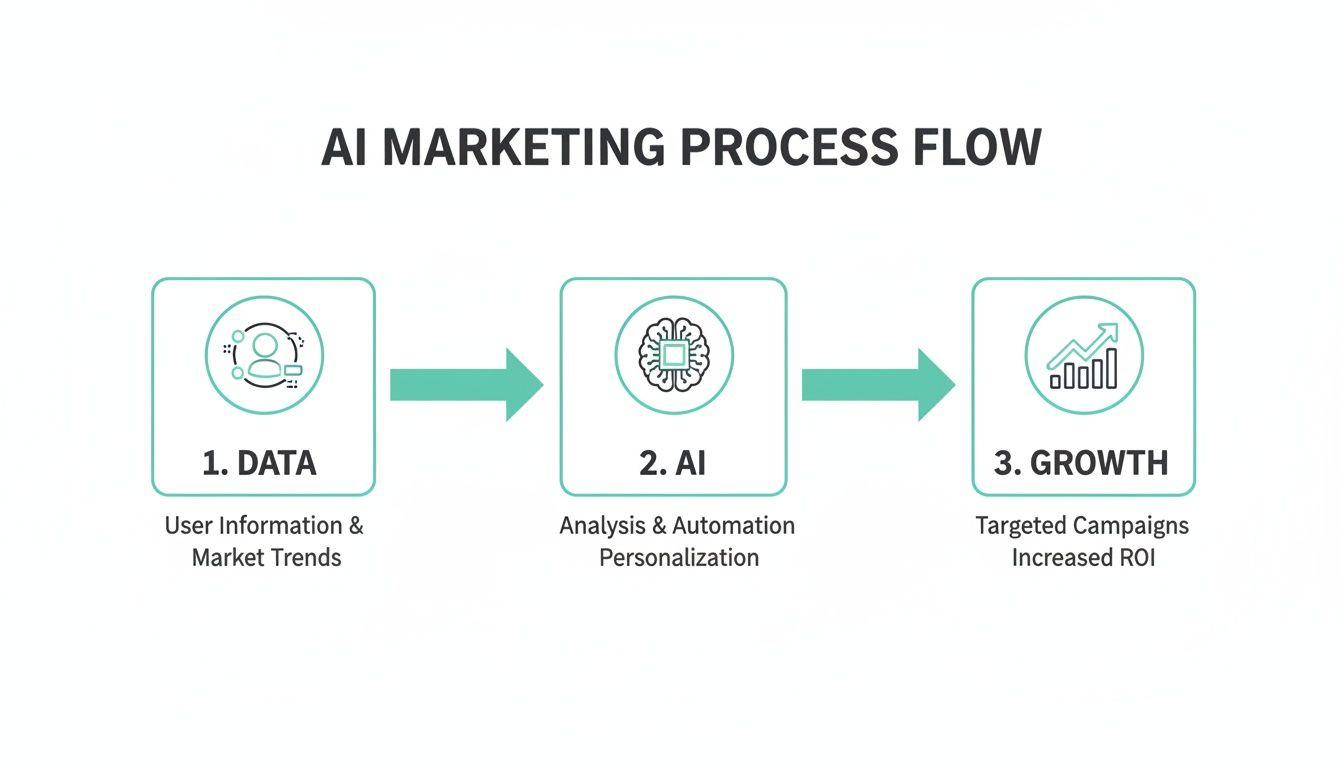
This illustrates a core principle of modern marketing: raw user data gets refined by AI to produce strategic, tangible business growth.
Three-Phase Transformation Roadmap
To bring this journey to life, we've outlined a high-level roadmap. This table breaks down the transformation into manageable phases, each with a clear focus, set of activities, and a metric to prove you're on the right track. It’s designed to provide a bird's-eye view of the path from initial planning to long-term success.
This structured approach ensures that each step builds on the last, creating a solid foundation for a transformation that not only launches successfully but also thrives and adapts over time.
Phase 1: Discovery and Strategy
This first phase is all about laying the groundwork. Before you even think about technology, you have to get a crystal-clear picture of where you are now and exactly what "success" will look like when you're done. It all kicks off with a thorough audit of your current marketing tech, internal processes, and team skills.
Key activities here include:
- Technology Audit: Map out every single tool in your martech stack. This is where you find the redundancies, data silos, and critical gaps holding you back.
- Goal Definition: Get specific and define measurable business goals. Are you trying to boost lead quality by 30%, slash customer churn by 15%, or just get content out the door faster?
- Stakeholder Workshops: Get leaders from marketing, sales, IT, and customer service in a room. The goal is to agree on a single, unified vision for the customer experience.
- Platform Evaluation: Dive deep into potential platforms. For example, you’d analyze a solution like Sitecore and map its composable tools (XM Cloud, CDP, etc.) directly to the business goals you just defined.
The main deliverable from this phase is a detailed strategy document and a high-level project plan. This becomes your North Star, guiding every decision that follows. For a solid framework, check out our detailed guide on creating a software implementation project plan.
Phase 2: Implementation and Integration
With a solid strategy in hand, it's time to get technical. This phase is all about building out the technological foundation and hooking it into your existing business systems. The core of this phase is setting up your Sitecore environment, particularly a cloud-native solution like XM Cloud. But the most critical part is integration. Your new DXP can’t live on an island; it needs to talk fluently with your CRM, ERP, and other key data sources.
A successful implementation isn't just about deploying software. It's about creating a connected ecosystem where data flows freely, empowering marketers to act on real-time insights from every corner of the business.
This is also where you’d configure internal collaboration tools, like SharePoint, to support your new marketing workflows. For example, you could build automated approval flows in SharePoint for content that’s destined for Sitecore, locking in brand consistency and compliance.
Phase 3: Optimization and Scale
Launching your new platform isn't the finish line—it's the starting line. This final phase is all about empowering your teams, crunching the data, and scaling up what works. It kicks off with comprehensive training to make sure your marketing team feels confident and ready to use the new toolset.
Once everyone is trained, the focus shifts to pilot campaigns. Start small. Pick a specific customer segment or product line to test out your new personalization and automation features. Use the platform’s built-in analytics to meticulously track performance from day one.
Key activities in this phase include:
- Team Training: Run hands-on workshops for your content creators, campaign managers, and data analysts.
- Pilot Campaigns: Launch a few targeted campaigns to validate your strategy and grab that initial performance data.
- Performance Analysis: Use your platform's analytics to watch KPIs, spot opportunities for improvement, and fine-tune your personalization rules.
- Iterative Rollout: Based on what you learn from the pilots, you can systematically expand the new way of working across other business units and markets.
This iterative loop helps build a culture of data-driven decision-making. It turns your marketing digital transformation from a one-off project into a sustainable engine for growth.
How to Measure Success and Prove ROI
So you've invested in a major digital transformation. Now comes the hard part: proving it was worth it. To get buy-in from stakeholders, you need to connect the dots between your technology spend and actual business results. Forget about vanity metrics like page views or social media likes—those don't pay the bills.
The conversation has to shift toward KPIs that tell a story of growth and efficiency. This is exactly where a powerful DXP like Sitecore shines, because it gives you the tools to track the numbers that truly matter.
Key Performance Indicators That Matter
A successful transformation isn’t just about a new website; it’s about improving the entire customer lifecycle and making your internal teams more efficient. The analytics baked into a platform like Sitecore are built to give you deep visibility into these critical areas.
Here are a few of the metrics you can—and should—be tracking:
- Customer Lifetime Value (CLV): Are your personalization strategies actually creating more loyal, valuable customers? By tracking CLV within Sitecore CDP, you can see how targeted experiences are impacting long-term revenue from different customer segments. A rising CLV is a clear win.
- Conversion Rates by Segment: Use Sitecore Personalize to see how specific audiences respond to tailored content and offers. This data proves that your one-to-one marketing efforts aren't just clever ideas—they're driving real action.
- Marketing-Attributed Revenue: Connect the dots between your campaigns and the bottom line. Sitecore's analytics can pinpoint which digital touchpoints influenced a sale, giving marketing clear credit for its contribution to revenue.
- Reduced Time-to-Market: How fast can your team get new campaigns or content out the door with Sitecore XM Cloud? A shorter launch cycle is a concrete operational improvement that saves time and money.
True ROI is found by connecting every marketing action to a specific business outcome. The goal is to build a dashboard that tells a compelling story of growth, efficiency, and customer satisfaction, directly tying technology spend to revenue generation.
Leveraging Sitecore for Clear Reporting
One of Sitecore’s biggest strengths is its ability to pull data from countless touchpoints into one unified view. This lets you build custom dashboards that speak directly to different stakeholders, whether it's a high-level summary for the C-suite or a deep-dive on campaign performance for your marketing team.
For instance, you can create a dashboard showing the conversion lift from A/B tests managed in Sitecore Personalize, or map out the entire customer journey to spot friction points. This turns subjective "I think this is working" conversations into objective, data-driven strategy sessions. For a more detailed look, our guide on how to measure ROI provides a structured framework for this process.
Measuring Operational Gains with SharePoint
The benefits of your transformation don't stop with customer-facing metrics. When you integrate a tool like SharePoint for internal collaboration, you can unlock serious operational efficiencies that add to your overall ROI.
Look for internal improvements like these:
- Faster Content Approval Cycles: Use SharePoint's automated workflows to measure how long it takes for content to go from a first draft to published. Shaving days or even hours off that timeline is a huge efficiency gain.
- Reduced Asset Creation Time: A centralized digital asset management system in SharePoint means your creative teams aren't wasting time searching for files or recreating assets that already exist. Track this reduction in redundant work.
To really paint the full picture of your transformation's impact, you need to know how to calculate marketing ROI effectively. By combining the customer-facing metrics from Sitecore with the internal operational wins measured through SharePoint, you can build a rock-solid business case. You're not just proving that you've improved marketing; you're showing how the investment has made the entire organization more agile and profitable.
Got Questions? We've Got Answers
Stepping into a major marketing transformation is a big move, and it's natural to have questions. We hear a lot of the same ones from leaders getting ready to implement powerful platforms like Sitecore or integrate essential tools like SharePoint. Here are a few of the most common ones we tackle.
How Long Does a Sitecore Transformation Typically Take?
There's no magic number here—it really depends on how complex your organization is and the project's scope. That said, the best way to approach it is in phases. You want wins along the way, not a risky "big bang" launch that leaves everyone holding their breath.
A foundational rollout, like getting Sitecore XM Cloud up and running, can often be done in 3-6 months. If you're going for the full Digital Experience Platform (DXP) with deeper personalization through Sitecore CDP and e-commerce with OrderCloud, you’re likely looking at a 9-18 month journey. The goal is always to deliver value incrementally.
Is Sitecore a Good Fit for Mid-Sized Businesses?
Absolutely. Sitecore has a reputation as a heavy-hitter for large enterprises, but its move to a composable, cloud-native architecture has been a game-changer for mid-sized companies.
Products like XM Cloud let you pick and choose the capabilities you need now and add more as you grow. This "pay for what you use" model gives you much more flexibility with your budget and implementation timeline, leveling the playing field.
A composable DXP means mid-sized businesses can start with a rock-solid content foundation and scale into sophisticated personalization and commerce without a massive upfront investment. The platform grows with you.
What Role Does SharePoint Play in a Sitecore-Powered Transformation?
Think of it this way: Sitecore is the star of the show, delivering amazing experiences to your customers. SharePoint is the behind-the-scenes crew that makes sure the star has everything they need to shine. It perfects the internal operations that make your external marketing hum.
Here’s where SharePoint really makes a difference:
- Team Collaboration: It’s the central hub where your marketing team can draft content together, share creative briefs, and keep project timelines on track.
- Asset and Document Management: It acts as the single source of truth for all your internal brand guidelines, campaign documents, and creative assets before they ever see the light of day on Sitecore.
- Streamlined Workflows: It automates the boring-but-critical stuff, like getting content approved, which keeps everything consistent and helps you launch campaigns faster.
By building an efficient internal engine on SharePoint, you give your marketing team the agility they need to truly unlock the power of their customer-facing Sitecore DXP.
Ready to start your own transformation? The experts at Kogifi specialize in implementing Sitecore and SharePoint solutions that drive real, measurable growth. Discover how we can build your technology foundation.