


At its core, Marketing Resource Management (MRM) is a way to bring order to chaos. It’s a combination of strategy and technology designed to get your people, processes, and assets all working together, turning messy operations into a well-oiled marketing machine. Think of it as the central command center for your entire marketing department, making sure every campaign runs smoothly, stays on-brand, and doesn't blow the budget.
Why Your Marketing Team Feels So Chaotic
Does your marketing department ever feel like a kitchen during the dinner rush? You’ve got multiple campaigns cooking at once, deadlines are constantly changing, and your brand assets are scattered across so many different folders and platforms that nobody can find the right one. This isn't just frustrating—it's a massive drag on growth and a huge waste of time and money.

If that sounds familiar, it’s a sure sign your team has outgrown its current way of working. Without a single, unified system to keep everything on track, you’re left wrestling with the same old problems day after day. Let's break down some of the most common pain points an MRM is built to solve.
Common Marketing Problems an MRM System Solves
Marketing teams today face a barrage of operational hurdles. An MRM system isn't just another tool; it's a direct answer to these persistent challenges, providing a structured solution where there was once only chaos.
By centralizing these core functions, an MRM system gives teams the structure they need to not just keep up, but to get ahead.
The Central Nervous System for Marketing
An MRM system acts as the central nervous system for your entire marketing operation. It connects every critical function—from budget planning and creative production to asset distribution and performance analysis—into one cohesive unit. Instead of siloed teams working from different spreadsheets and disconnected tools, everyone operates from a single source of truth.
By putting an MRM in place, teams can finally implement meaningful process improvement strategies, moving away from frantic, ad-hoc work and toward predictable, streamlined operations. This shift is what separates teams that scale from those that stagnate. It’s no surprise that the global MRM market, valued at USD 4.91 billion, is expected to more than double to USD 9.83 billion by 2030. You can dig into the full MRM market growth analysis on Grand View Research.
An MRM system doesn't just manage resources; it creates a predictable, scalable framework for marketing execution. This foundation is crucial for platforms like Sitecore, which rely on organized content and efficient workflows to deliver personalized digital experiences.
Ultimately, a well-implemented MRM turns operational chaos into a real strategic advantage. It lays the groundwork for more sophisticated marketing, especially when integrated with powerful platforms like Sitecore Content Hub or collaborative tools such as SharePoint.
The Four Pillars of a Modern MRM System

A top-tier Marketing Resource Management system isn’t just one tool; it’s a strategic framework built on four interconnected pillars. When these components click into place, they create an operational backbone that completely changes how marketing gets done.
Each pillar tackles a critical area of marketing operations, turning chaos into clarity and inefficiency into real-world impact. Let's dig into what they are and how they actually work, especially within an ecosystem like Sitecore.
Pillar 1: Financial and Budget Management
This is all about getting total control over your marketing spend and finally being able to prove ROI. It's the move from confusing spreadsheets and siloed financial data to a single, live view of your entire marketing budget. This pillar links financial planning directly to campaign execution, making sure every dollar is accounted for and tied to a strategic goal.
Inside a tool like Sitecore Content Hub, teams can assign budgets to specific campaigns, projects, or even individual pieces of content. This lets managers track actual spend against planned costs in real-time, catching overruns before they ever become a problem. That level of financial visibility is crucial for proving marketing’s value to the bottom line.
Pillar 2: Creative Production and Workflow Automation
Think of this pillar as the engine room of your content factory. It’s focused on automating the repetitive, manual tasks that bog down the entire creative process, from the initial brief to the final sign-off. It’s designed to kill the bottlenecks—those endless email chains, version control nightmares, and confusing feedback loops that delay launches.
It’s like a digital assembly line for your content. In Sitecore Content Hub, you can set up workflows that automatically push tasks to the right person at the right time. A designer finishes a graphic, and the system instantly notifies the copywriter and then the brand manager for approval. This structured process doesn't just make things faster; it also enforces compliance and keeps quality high.
A well-designed MRM workflow doesn't just make teams faster; it makes them smarter. By automating the mundane, it frees up creative talent to focus on high-value strategic work rather than administrative tasks.
Pillar 3: Digital Asset Management
At the heart of any modern marketing resource management platform is a powerful Digital Asset Management (DAM) system. This pillar is your single source of truth for every piece of brand and product content—logos, images, videos, product sheets, you name it. It guarantees brand consistency across every channel and maximizes the value of your creative investments by making assets easy to find and reuse.
A great DAM, like the one built into Sitecore Content Hub, does more than just store files. It adds smart metadata and rights management, making assets instantly searchable while ensuring they’re used correctly. Teams can find the exact approved image they need in seconds instead of digging through disorganized shared drives for hours. To really grasp this component, you can learn more about how media asset management systems work and why they are so fundamental.
Even tools like SharePoint can play a supporting role, acting as a repository for collaborative documents that feed into the creative process before final assets land in the DAM.
Pillar 4: Performance Analytics
The final pillar closes the loop, giving you a single, trustworthy view of campaign and content performance. It connects the dots between operational data (like production time and cost) and performance data (like engagement and conversions). This is what allows marketers to answer the ultimate question: "What's actually working?"
An MRM with strong analytics tracks key metrics and visualizes performance on intuitive dashboards. By seeing which assets get used most often or which campaigns deliver the highest ROI, you can make data-driven decisions to optimize future efforts. This pillar elevates an MRM from a simple organizational tool into a strategic engine for continuous improvement, ensuring your resources are always put to the best possible use.
Connecting MRM to Your Digital Experience Platform
Having a bunch of standalone tools is a recipe for disconnected marketing. But when you hook up your Marketing Resource Management (MRM) system to your core platform, you create a genuine powerhouse. This is where we bridge the gap between your MRM and your Digital Experience Platform (DXP), showing why this connection isn't just a nice-to-have—it's essential for modern, personalized marketing.
This integration transforms your MRM from a simple backend organizer into the central engine that fuels every single customer interaction. When your content creation hub talks directly to your customer experience delivery layer, you get a seamless flow from the initial idea all the way to the final, personalized delivery.
The Sitecore Ecosystem: A Unified MRM and DXP
The Sitecore ecosystem gives us a perfect picture of how MRM and DXP integration drives real value. This isn’t about duct-taping separate tools together; it’s about a unified platform built from the ground up for the entire content lifecycle.
At the heart of it all is Sitecore Content Hub. It’s the ultimate MRM, pulling several critical functions into one place:
- Digital Asset Management (DAM): A single source of truth for every brand and product asset, locking down consistency.
- Content Marketing Platform (CMP): The command center for planning, creating, and managing your entire content strategy.
- Product Content Management (PCM): A central system for keeping all product-related information and specs in order.
This combination inside Content Hub manages the entire "upstream" part of marketing—all the planning, collaboration, creation, and approval.
Once content gets the green light in Content Hub, it flows seamlessly "downstream" to Sitecore Experience Platform (XP) or Experience Manager (XM) Cloud. This is the delivery layer that uses customer data and AI to personalize and serve up that content across websites, mobile apps, and other channels. This direct link guarantees that the right content, fully approved and on-brand, reaches the right customer at exactly the right moment.
How SharePoint Enhances the Marketing Stack
While Sitecore offers a complete, all-in-one solution, many large companies have already invested heavily in other platforms, especially SharePoint. Instead of ripping it out, smart teams integrate SharePoint as a powerful foundational layer for collaboration within their marketing stack.
Think of it as the brainstorming room and document hub. Teams can stick with SharePoint's familiar document management and co-authoring features for early-stage project planning, drafting briefs, and getting initial feedback. Once those foundational documents are polished, they can kick off workflows that push the official project into a system like Sitecore Content Hub for formal production and asset creation.
Integrating SharePoint as a collaboration hub lets marketing teams use tools they already know and love while feeding a more structured and powerful MRM system like Sitecore Content Hub. This creates a hybrid solution that is both user-friendly and enterprise-grade.
This approach respects the workflows and investments you already have in place while giving you the specialized power of a true enterprise MRM. We have deep expertise in building these powerful hybrid solutions that modernize your entire marketing operation without causing a massive disruption.
Why This Integration Is No Longer Optional
The market trends tell the whole story. The U.S. Marketing Resource Management market, which recently hit USD 1.0 billion, is projected to climb to USD 2.5 billion by 2033. This explosive growth is fueled by sophisticated enterprise marketing teams who know that disconnected systems are the biggest roadblock to success. You can see more on the rising demand for integrated marketing platforms from IMARC Group.
Plugging your MRM directly into your DXP creates a closed-loop system with benefits you can actually measure. To get a better handle on the platform at the center of this strategy, check out our detailed guide on what a Digital Experience Platform is and why it's so critical.
The benefits of going with a unified approach are clear and impactful:
- Faster Time-to-Market: Content gets from creation to publication without painful manual handoffs or bottlenecks.
- Guaranteed Brand Consistency: Only approved, final assets from the central MRM can ever make it into live campaigns.
- Enhanced Personalization: Delivery platforms like Sitecore XP get direct access to a rich, organized library of content variants, perfect for AI-driven personalization.
- Actionable Insights: Performance data from the DXP can flow back to the MRM, giving you real-world data to inform your next content strategy.
At the end of the day, integrating your MRM and DXP is about building a single, intelligent system that powers the entire marketing lifecycle—from planning and budgeting all the way to personalized delivery and performance analysis.
Your Roadmap for a Successful MRM Rollout
Shifting from scattered processes to a unified marketing operation takes more than just new software—it demands a smart, deliberate plan. A successful marketing resource management (MRM) rollout is a strategic journey, not a sprint. This roadmap lays out the essential phases to ensure your implementation delivers real value and gets your team on board from day one.
The whole thing kicks off with a hard look at where you are right now. Before you can build a better future, you have to be honest about the present.
Define Goals and Audit Your Pain Points
The first step has nothing to do with technology. It’s all about your people and processes. You need to nail down exactly what you’re trying to fix with an MRM. Are you trying to slash content production time? Get a grip on a runaway budget? Or maybe enforce brand consistency across global teams?
Get specific. Talk to the key players in marketing, finance, and IT to uncover the biggest operational headaches.
- Map Existing Workflows: Document how a campaign goes from a simple idea to a live initiative. Where do things get stuck? Who are the usual blockers?
- Identify Resource Drains: Pinpoint where your team is wasting time on low-value admin tasks instead of doing high-impact strategic work.
- Set Clear Objectives: Establish goals you can actually measure. For example, aim to "reduce campaign launch time by 25%" or "increase asset reuse by 40%."
These early findings become the business case you’ll use to get leadership buy-in and will steer the entire project.
Select the Right Technology Platform
Once you know your goals, you can find a technology partner that fits your enterprise needs. This is where platforms built for scale, like Sitecore Content Hub, really shine. An enterprise-grade MRM shouldn't be a siloed tool; it should be the heart of your content supply chain, built to plug right into your broader digital experience ecosystem.
Sitecore Content Hub offers a unified solution that covers Digital Asset Management (DAM), a Content Marketing Platform (CMP), and workflow automation. Its architecture is designed to connect directly with delivery platforms like Sitecore XP, creating a smooth path from content creation to personalized customer experiences. For companies deep in the Microsoft world, integrating SharePoint for document management can also be a powerful move, feeding structured content into the more robust Sitecore MRM engine.
Map and Optimize Your Processes
A classic mistake is to just automate your current broken workflows. An MRM implementation is the perfect chance to redesign your processes for peak efficiency. Don't just digitize the chaos—get rid of it.
Before you automate anything, you must optimize everything. Use the MRM rollout as a catalyst to challenge old habits, remove unnecessary approval steps, and clarify roles and responsibilities across the marketing organization.
Map out your ideal future-state workflows inside the new system. For example, define a clear, stage-gated approval process for a new product launch, specifying exactly who needs to review what and when. This upfront planning prevents confusion and makes sure the platform actually supports your team, instead of boxing them into a rigid, awkward structure. For a deeper dive into structuring these kinds of projects, our guide on creating a software implementation project plan offers some valuable frameworks.
Launch with a Phased Rollout and Training
A "big bang" launch across an entire enterprise is just asking for trouble. A phased rollout, starting with a pilot team or a single brand, is a much smarter approach. This lets you gather real-world feedback, iron out any kinks, and build a group of internal champions who can advocate for the new system.
This diagram shows the ideal flow of content and data in an integrated MRM and DXP ecosystem.
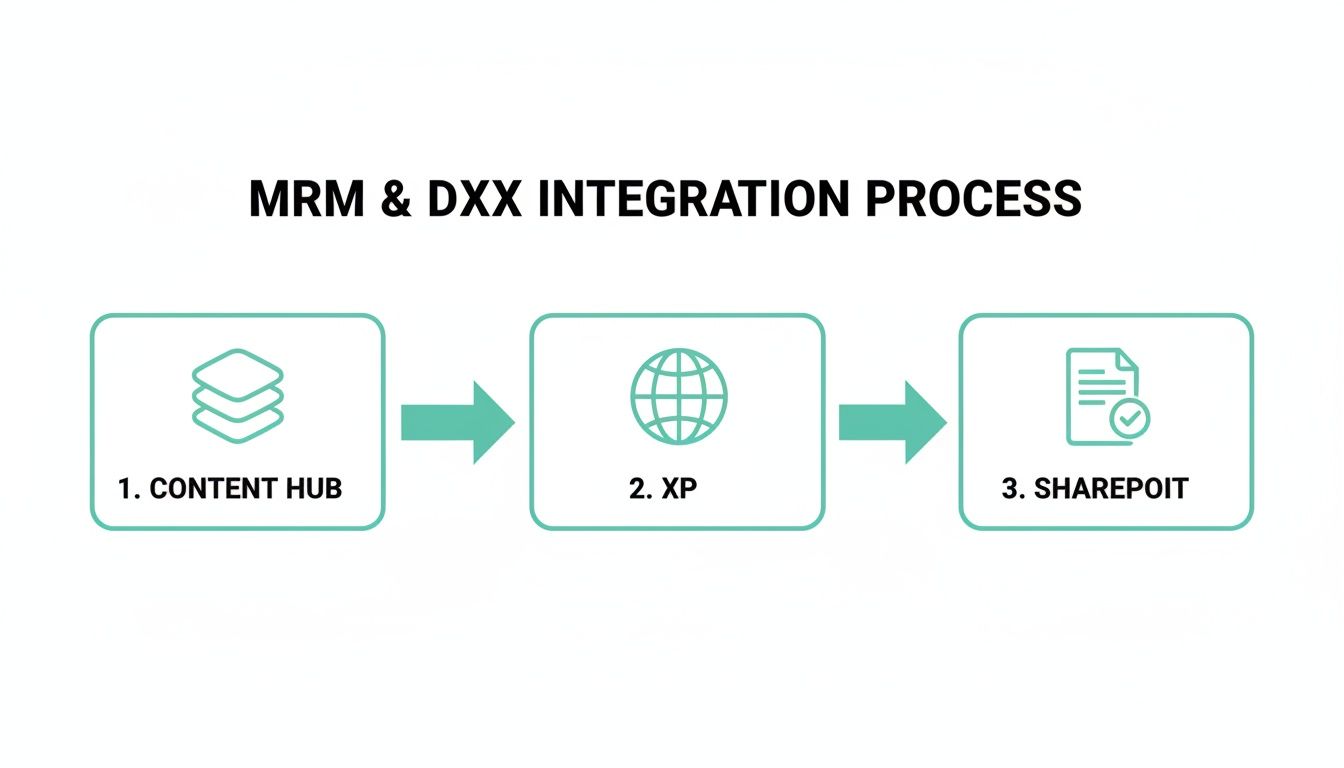
It visualizes how a central hub like Sitecore Content Hub feeds approved assets into a delivery platform like Sitecore XP, while using SharePoint for foundational collaboration.
Finally, effective, role-based training is non-negotiable. Don't just show users what buttons to click; explain why the new process is better for them and for the business. Customized training for content creators, brand managers, and finance stakeholders will drive much higher adoption rates and ensure the platform is used to its full potential right from the start.
Proving the Value of Your MRM Investment
Bringing a marketing resource management (MRM) system into your tech stack is a serious commitment. Its long-term survival in your budget rides on one simple thing: proving it was worth it. An MRM platform is only as good as the results it delivers, and that means you need to track the right metrics to show a clear and compelling return on investment (ROI) to leadership.
This is about more than just showing off adoption rates; it's about connecting the dots between your team using the platform and real, tangible business outcomes. The key is to break performance down into three critical areas: operational efficiency, financial performance, and overall brand impact. By zeroing in on these categories, you can build an undeniable business case for your MRM.
Measuring Operational Efficiency Gains
The first and most immediate place you’ll see ROI is in your team's day-to-day grind. These metrics are the proof that your MRM is cutting out the friction, automating the grunt work, and speeding up your entire content pipeline. Inside a platform like Sitecore Content Hub, you can often track these KPIs right out of the box.
- Content Production Cycle Time: How long does it actually take to get a project from a creative brief to final approval and out the door? A big drop in this number is hard evidence that the MRM is busting through bottlenecks.
- Asset Reuse Rate: This is a big one. Track how often your team repurposes existing photos, videos, and graphics across different campaigns. A higher reuse rate, which is easy to spot in Sitecore’s DAM, means you’re squeezing every drop of value from your creative investments and killing off duplicate work.
- Workflow Completion Rate: What percentage of tasks and projects are actually hitting their deadlines? This KPI is a direct reflection of better project predictability and accountability.
Even if you’re just using a tool like SharePoint for some initial collaboration, the data can feed into these metrics and show how a more connected ecosystem picks up the pace for everyone.
Tracking Financial Performance Wins
Next up, you need to translate those operational wins into dollars and cents. An MRM gives you a clear window into marketing spend, making it easier than ever to connect your budget to actual performance and justify every penny.
An MRM system transforms marketing from a perceived cost center into a measurable revenue driver. By linking financial data directly to campaign activities, you can definitively prove marketing’s contribution to the bottom line.
To paint this financial picture, concentrate on these metrics:
- Budget Adherence: How close are you staying to your planned budget on campaigns and projects? MRM systems like Sitecore Content Hub give you real-time dashboards that make this almost effortless to track, showing you have a tight grip on financial governance.
- Reduced Agency and Freelancer Costs: When your internal team is more efficient and reusing assets like pros, you naturally rely less on outside help for routine creative tasks. This is a direct, hard-dollar saving that always gets leadership's attention.
- Marketing ROI Lift: This is the ultimate metric. By pulling MRM data into your DXP’s analytics, you can draw a straight line from smoother operations to better campaign results, like higher conversion rates or a lower cost to acquire a customer.
Demonstrating Brand and Campaign Impact
Finally, don’t forget to measure how your MRM is making your brand stronger and faster. These metrics can sometimes feel a bit softer, but they're critical for showing the strategic value of having a truly unified marketing operation.
- Time-to-Market for New Initiatives: How fast can you launch a new product or a major campaign? Getting to market faster is a massive competitive advantage, and it’s a direct result of the streamlined workflows your MRM enables.
- Brand Consistency Score: Use internal audits or even customer surveys to get a read on brand consistency across every channel and touchpoint. A centralized DAM in your MRM ensures everyone is using the right logos, colors, and messaging, which directly shores up this score.
Tracking these KPIs is about more than just creating a report; it's about building a narrative that shows how your MRM investment is paying dividends across the entire organization.
The table below breaks down some of the most critical KPIs you should be tracking to measure the impact of your MRM platform and demonstrate its value to the business.
Key Performance Indicators for MRM Success
A breakdown of essential metrics to track the effectiveness and ROI of your Marketing Resource Management implementation.
By consistently monitoring these metrics, you can move the conversation from "How much does the MRM cost?" to "Look at the value the MRM is creating." This data-driven approach is the key to securing ongoing support and investment in your marketing operations.
Why Enterprises Build Their MRM with Sitecore and SharePoint
Choosing the right technology is the single most important decision when building an enterprise-grade marketing resource management (MRM) system. For global brands, the combination of Sitecore and SharePoint creates an intelligent, scalable, and incredibly efficient foundation that connects the entire content supply chain.
This isn't about forcing one tool to do everything. It's about playing to each platform's strengths. Sitecore provides the sophisticated, AI-driven engine for managing and personalizing content, while SharePoint offers a familiar, powerful hub for internal collaboration and document workflows. Together, they form a complete ecosystem that supports marketing from the initial brief all the way to final delivery.
Sitecore Content Hub The Intelligent Core
Sitecore Content Hub sits at the center of a modern MRM strategy. It was purpose-built to manage the entire content lifecycle, bringing together Digital Asset Management (DAM), a Content Marketing Platform (CMP), and workflow automation into one cohesive platform. Its composable architecture also makes it future-proof, allowing businesses to easily plug it into a wider digital experience stack.
But what really sets Sitecore apart is its embedded AI. This isn't just a buzzword; it's a practical tool that accelerates everything you do.
- AI-Powered Tagging: Automatically analyzes and tags images and videos, making assets instantly searchable and saving thousands of hours of manual work.
- Content Recommendations: Suggests relevant assets to content creators based on campaign goals or audience segments, which boosts asset reuse and strengthens brand consistency.
- Predictive Insights: Helps teams understand which content will perform best before it even goes live, optimizing how resources are allocated.
This intelligent layer turns your MRM from a simple storage locker into a strategic engine that drives smarter, faster marketing.
SharePoint The Collaboration Engine
While Sitecore handles the formal content lifecycle, SharePoint excels as the collaborative engine that fuels it. Most enterprises already have a significant investment in SharePoint, making it the perfect workspace for ideation, planning, and drafting.
SharePoint serves as the perfect collaborative starting point for marketing teams. It allows for fluid document creation and review before assets and projects are formalized within the more structured, governance-driven environment of Sitecore Content Hub.
Teams can stick with familiar tools for initial briefs, budget spreadsheets, and collaborative documents. Once these elements are ready, they can trigger automated workflows that push the approved project into Sitecore for formal production, asset creation, and global distribution.
By pairing these two powerhouses, global brands build intelligent and efficient marketing operations that are ready for any challenge. To better understand the foundational principles behind this approach, you can explore our detailed article on enterprise content management solutions. Let our experts show you how to transform your marketing ecosystem with a connected, future-ready MRM foundation.
Frequently Asked Questions About MRM
When you start digging into marketing technology, the same questions always seem to pop up. For leaders exploring marketing resource management, getting clear, straightforward answers is the first step toward making a smart investment.
Distinguishing MRM from DAM and CMP
So, what's the real difference between an MRM, a DAM, and a CMP? Let's use a film studio analogy.
A Digital Asset Management (DAM) system is your prop room and raw footage library—it’s where you store and organize all your creative assets. A Content Marketing Platform (CMP) is your production schedule and script, mapping out what content you’ll create and when.
The MRM is the studio director. It oversees the entire production—managing the assets (DAM), the calendar (CMP), the crew, the budget, and all the workflows that tie everything together into a finished film.
Understanding Implementation Timelines
How long does it actually take to get an MRM system up and running? While every company is different, a phased approach almost always works best. A pilot program focusing on a single team or brand can often go live in just three to six months.
This strategy lets you score some early wins, gather honest feedback from users, and build momentum internally before you go for a full-scale rollout. It’s a proven way to minimize disruption and get people on board—a process we specialize in managing for our clients.
Connecting MRM with Other Tools
Can an MRM system actually talk to our other tools? Absolutely. Modern platforms like Sitecore Content Hub are built from the ground up for integration. They use an API-first design, meaning they're meant to connect seamlessly with your other critical business systems.
This ensures your MRM becomes the single source of truth by linking up with:
- ERPs like SAP for financial alignment.
- Financial Software for tracking budgets in real-time.
- Project Management Tools like Jira so workflows stay connected.
This kind of connectivity turns your marketing resource management platform from just another tool into the operational heart of your entire marketing ecosystem.
Ready to build a smarter, more efficient marketing operation? Kogifi specializes in implementing powerful DXP and MRM solutions built on Sitecore and SharePoint. Let's connect and start your transformation.