


MVC is an architectural pattern that separates data, presentation, and request handling into three components, Model, View, and Controller, to reduce coupling and improve maintainability in enterprise applications. By 1979, this separation had already been formalized in Smalltalk at Xerox PARC, and its principles now guide both traditional CMS implementations and headless platforms.
A familiar enterprise failure starts with a harmless request. Marketing wants to change a navigation label, a product team modifies personalization logic, and an administrator updates permissions in a SharePoint web part. Instead of independent changes, each adjustment touches shared code, triggers regression testing, and waits for a release window. The platform may still work, but every team has learned to move cautiously.
That's where the MVC architecture design pattern earns its place. It doesn't eliminate complexity, and it isn't a magic folder structure. It creates boundaries that let content models, rendering logic, and request coordination evolve without forcing every change through the same code path. In Sitecore and Microsoft 365 projects, that distinction affects governance, testing, personalization, and the decision between server-rendered and headless delivery.
Table of Contents
- Can a monolithic Sitecore site migrate gradually?
- Should a new Sitecore project use MVC or headless?
- Does MVC still matter in JavaScript-heavy systems?
- How should teams test the layers?
Why MVC Matters in Enterprise CMS
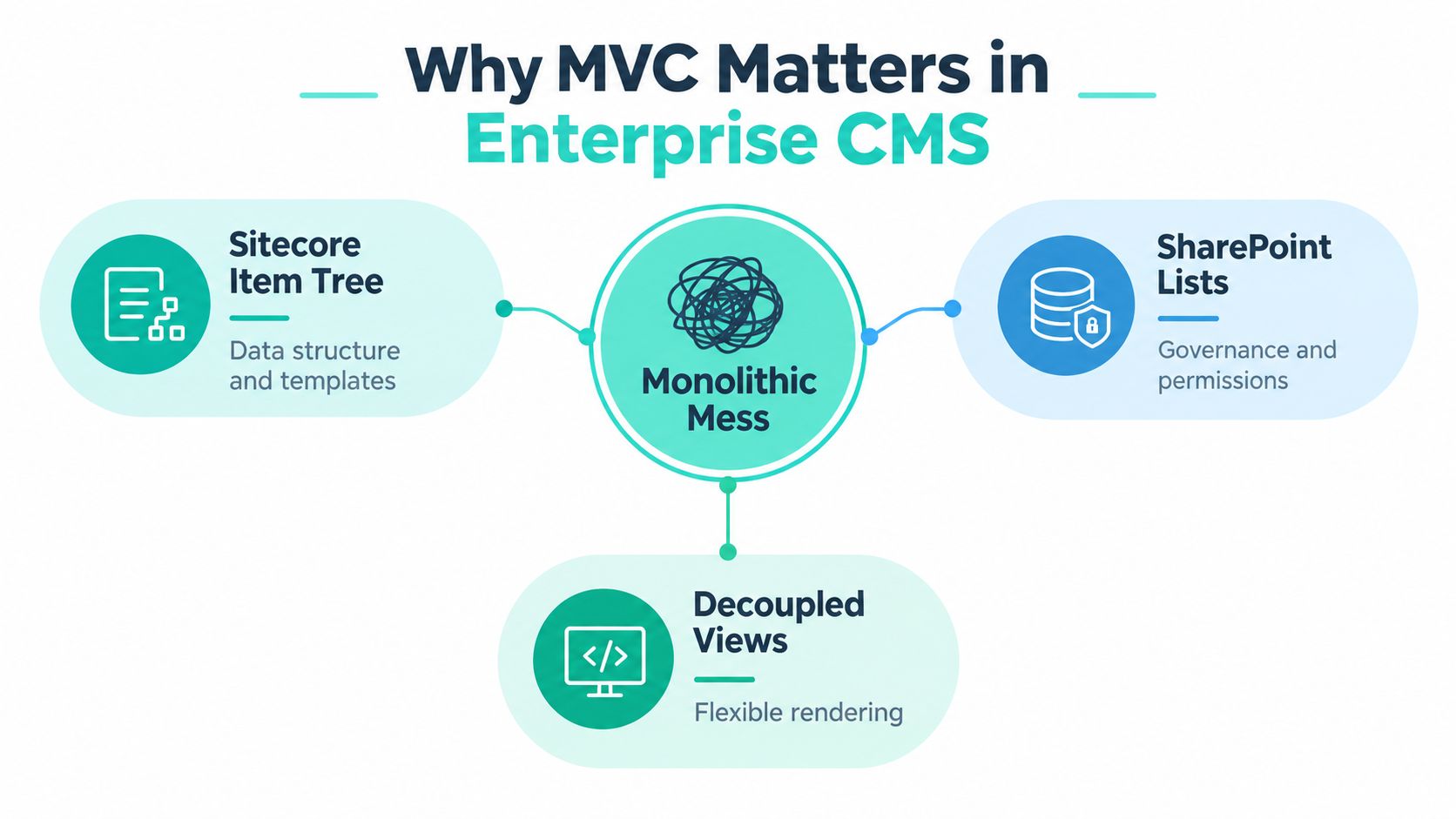
A monolithic CMS often begins with a reasonable shortcut. A developer puts a database call in a Razor view, adds a permissions check beside the markup, and ships the release. A SharePoint web part may start with one list query before accumulating authentication checks, filtering rules, layout decisions, and Teams-specific behavior. Each addition addresses an immediate need, yet each also makes the next change harder to isolate.
The pattern becomes costly across a large digital estate. A designer needs engineering support to change presentation. A content editor's update exposes an assumption buried in business logic. A front-end redesign triggers regression testing across integrations that should never have depended on the old markup. The platform has plenty of features; what it lacks are reliable boundaries between responsibilities.
Microsoft's ASP.NET Core MVC overview describes MVC as a separation between Models, Views, and Controllers. A request reaches a controller, the controller coordinates access to the model, and a view presents the resulting data. UNC's notes on MVC also describe the pattern as an application of separation of concerns. For enterprise CMS teams, that boundary has an operational purpose: presentation can change without rewriting domain rules, as long as the implementation respects the contract between layers.
The boundary is more valuable than the acronym
Consider a Sitecore product listing. The Model represents product content, pricing attributes, availability, and taxonomy. The Controller determines which data the request needs and coordinates request-specific work. The View renders cards, filters, or a detail page. If the brand team changes the card layout, the view should change. If the business introduces an eligibility rule, that rule belongs in a domain or service layer used by the model, not in the markup.
Sitecore teams apply the same boundary when moving from server-rendered components toward headless delivery. A rendering should consume a defined model rather than reach into content storage, presentation settings, or permission logic. That discipline makes a channel change manageable without turning every component into an integration point.
SharePoint follows a comparable pattern. A list or library provides governed data, while an SPFx component renders it for employees. Authentication and Microsoft Graph access belong in the data and service boundary. React markup belongs in the view layer. Marketing, intranet, and platform teams can then work in parallel instead of editing one increasingly fragile component.
MVC also gives architects a practical vocabulary for diagnosing coupling. If a view queries Sitecore directly, a controller formats HTML, or an SPFx React component decides whether a user may access a record, the boundary has leaked. Those leaks create hidden dependencies that make testing and deployment less predictable.
Practical rule: If a presentation change requires business-rule edits, or a data change requires rewritten markup, inspect the boundary before adding another patch.
The Three Components Explained with Sitecore and SharePoint
MVC works when each component has a narrow responsibility and a predictable contract with the others. The names are simple. The discipline is not.
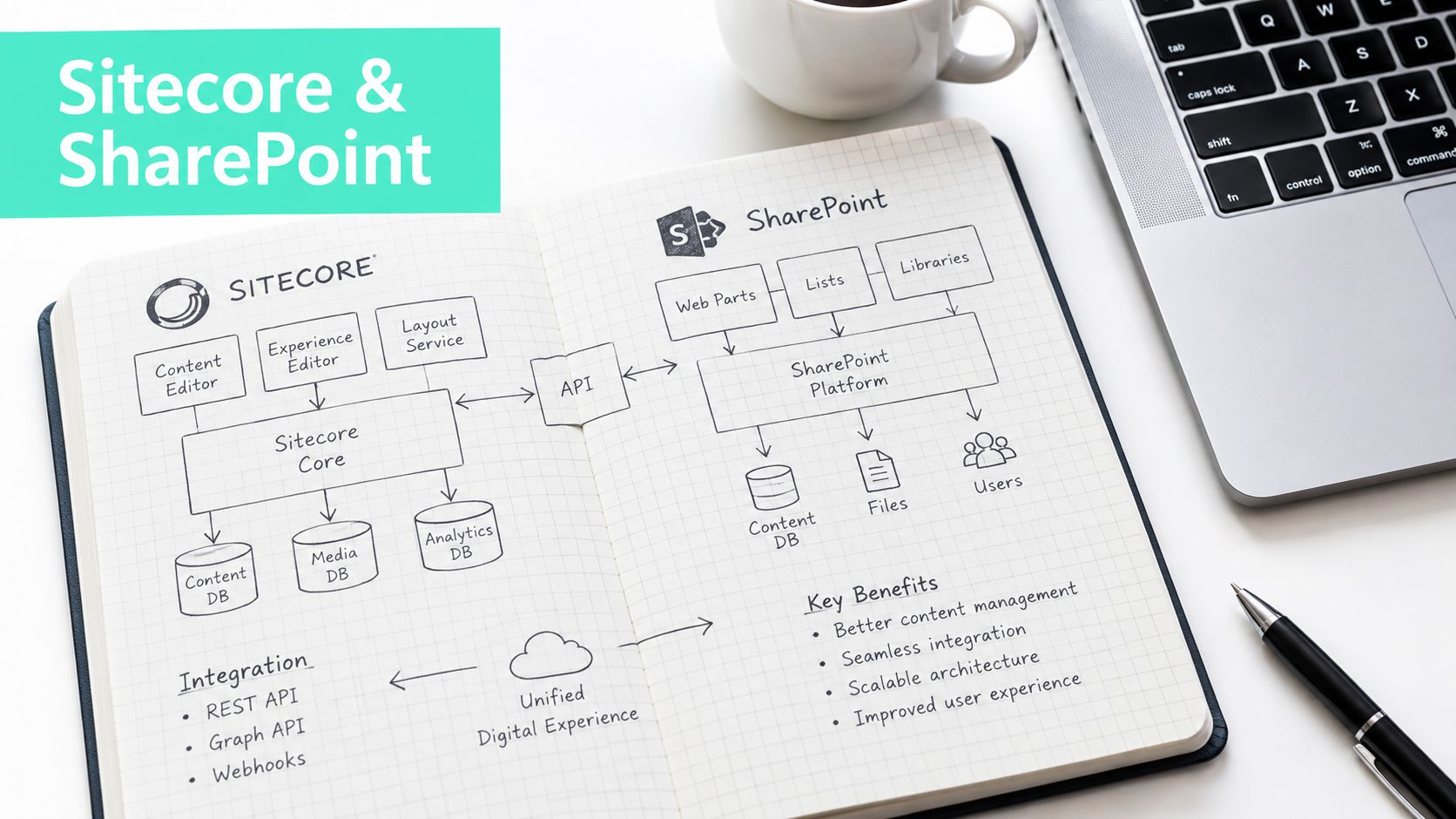
Model
The Model represents application data and the rules needed to work with it. In Sitecore, that may mean a page item, a product structure, an employee profile, or a serialized content definition. Templates and fields describe the content shape, while repositories or service classes provide a controlled way to retrieve it.
A Sitecore model shouldn't know whether the consumer is a Razor rendering, a Next.js component, or an API client. That independence matters when a team moves from traditional rendering to headless delivery. The model can expose a stable representation while different presentation channels consume it.
In SharePoint, lists, libraries, and Microsoft Graph data play a similar role. An SPFx web part can retrieve governed records through a service abstraction rather than embedding list queries throughout React components. The model boundary should also account for permissions, validation, and mapping, so the view receives data that it can safely display.
View
The View presents information and captures presentation-level interaction. In traditional Sitecore implementations, this commonly means a rendering and its Razor view, with Experience Editor compatibility considered from the start. The view should format values, apply semantic markup, and expose editing affordances, but it shouldn't decide whether a customer qualifies for an offer.
In SharePoint, the equivalent is often a React component inside an SPFx web part. Power Apps interfaces can also serve as a presentation surface for governed business data. Keep visual behavior in the component, but move retrieval, authorization, and business decisions into services that can be tested without rendering a browser.
Controller
The Controller coordinates the request. In a conventional Sitecore solution, routing and rendering handlers determine what the request needs, call repositories or services, and select the appropriate view model. Pipelines can participate in that flow, but they shouldn't become an unstructured dumping ground for unrelated business logic.
SPFx doesn't reproduce server-side MVC in a direct sense. Its web parts coordinate lifecycle events and connect client-side components to SharePoint, Teams, Viva, or Microsoft Graph integration points. The useful lesson is conceptual: the component that receives interaction shouldn't also own every data and policy decision.
A practical project structure might separate:
- Content models: Sitecore item mappings or SharePoint record types.
- Repositories and services: Data retrieval, transformation, validation, and policy coordination.
- Controllers or coordinators: Request and lifecycle orchestration.
- Views and components: Razor or React presentation.
For a complementary explanation of layers and responsibilities, see Kogifi's MVC pattern in Java.
The request flow should remain visible to the team: input arrives, a coordinator validates and delegates, the model or service returns data, and the view renders a deliberate representation. When a view starts making policy decisions, stop and move that decision to a service boundary.
From Smalltalk to Modern Headless Architectures
Enterprise teams still face the problem that shaped MVC: people need usable interfaces for complex information, while business rules and data access remain outside the presentation layer. Trygve Reenskaug formulated the approach at Xerox PARC while working on Smalltalk. The earliest written note used Thing-Model-View-Editor on May 12, 1979, and by December 10, 1979, the name had become Model-View-Controller, as documented in the historical MVC note.
That history explains why MVC remains useful beyond web folder conventions. It separates complex information, interaction, and presentation while keeping their relationships explicit. The pattern has changed shape across platforms, but the architectural question remains the same: which component owns each decision?
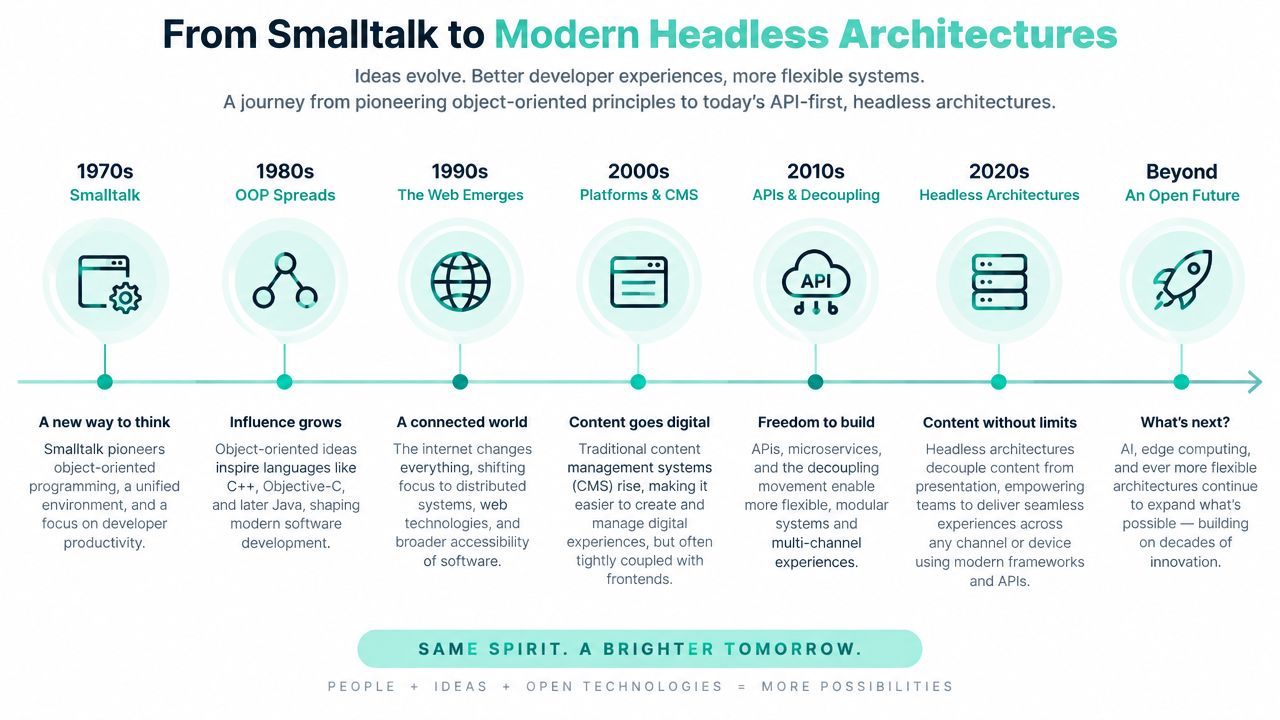
From server-side coordination to channel independence
As MVC moved beyond Smalltalk, web frameworks adapted it for server-rendered applications. Ruby on Rails, Django, ASP.NET MVC, Spring MVC, and Laravel established variations that teams could apply across larger codebases. The MVC framework overview from freeCodeCamp describes this progression. The practical shift was from one desktop interface to applications serving browsers, devices, and multiple teams.
Headless delivery pushes that separation across channels. A server-side controller may no longer return a rendered page. A Next.js application can request structured content, apply presentation logic, and compose an experience for a specific channel. Routing, data fetching, orchestration, and component composition now share responsibilities that a traditional controller handled more directly.
Sitecore XM Cloud illustrates the change. Its headless-only delivery model requires teams to design around APIs and front-end applications rather than MVC renderings. Sitecore recommends Next.js as the Jamstack framework for full XM Cloud functionality. Architects who declare MVC obsolete miss the implementation lesson: the boundaries still matter, but they may sit between services, APIs, and client applications.
SharePoint SPFx takes a different route. Microsoft describes SPFx as the page and web-part model for client-side SharePoint development, with support for SharePoint data and extensions across Microsoft Teams and Microsoft Viva in the SPFx overview. TypeScript and React handle presentation, while SharePoint services and Microsoft Graph supply governed data. The code is not classic MVC, yet the separation between data access, coordination, and rendering remains recognizable.
For teams comparing platforms, headless CMS architecture guidance is useful when translated into concrete delivery boundaries. Headless changes where architecture operates; it does not remove the need for architecture. In Sitecore and SharePoint projects, that means defining ownership for content retrieval, authorization, orchestration, and channel-specific rendering before implementation begins.
When MVC Helps and When It Hurts
MVC helps most when an application has enough complexity to justify explicit boundaries. Enterprise CMS platforms usually reach that point quickly because content, permissions, integrations, personalization, localization, and multiple delivery teams interact in the same estate.
A clear separation makes independent work safer. A front-end team can change a rendering without modifying data retrieval. A platform team can replace a repository implementation without asking designers to rewrite markup. Test authors can exercise business rules without booting a browser.
The cost is coordination. Every boundary introduces contracts, naming decisions, mapping, and ownership questions. A small content site with limited behavior may move faster with a simpler component model. Building controllers, view models, repositories, and service abstractions for every static block can create ceremony without reducing meaningful risk.
Where the pattern becomes expensive
Highly interactive interfaces expose MVC's weaker side. A dashboard with continuous client-side state, optimistic updates, filtering, and cross-component communication can generate expensive view-controller chatter. Teams may spend more time synchronizing state across layers than implementing the user experience.
MVC also depends on supporting patterns in real systems. Independent references note that MVC was not originally treated as a pure design pattern and often works alongside patterns such as Observer, Composite, and Strategy, as discussed in this architectural patterns reference. That's a warning against treating the three labels as a complete architecture.
Use MVC when:
- Business rules are substantial: Domain behavior needs independent testing and ownership.
- Multiple teams contribute: Teams require contracts that limit accidental dependencies.
- Several views consume the same data: Shared models or services justify the separation.
- The platform has a long life: Maintainability matters more than the fastest first release.
Choose a lighter approach when the interface is small, state is local, and the team can understand the entire code path without layers. The right question isn't whether MVC is fashionable. It's whether the boundary reduces more risk than the coordination it creates.
MVC Versus MVVM, MVP, and Headless Approaches
Pattern selection becomes clearer when the team evaluates how data moves, who owns state, and how independently teams can deliver. MVC, MVVM, MVP, and headless architectures can all produce maintainable systems, but they solve different coordination problems.
| Pattern | Best For | Coupling Level | Team Independence | Learning Curve |
|---|---|---|---|---|
| MVC | Enterprise CMS applications with request handling and complex business rules | Low when boundaries are enforced | Strong across data, presentation, and routing teams | Moderate |
| MVVM | Data-rich dashboards and interfaces with substantial client-side state | Low between view and model, with binding complexity | Strong for front-end teams that understand state flow | Moderate to high |
| MVP | Legacy migration scenarios and presentation logic that needs a testable presenter | Moderate, depending on contracts | Useful when presenter ownership is clear | Moderate |
| Headless | Omnichannel delivery across web, mobile, and other front ends | Low at the content delivery boundary, with orchestration responsibility moved elsewhere | Strong for channel teams, provided APIs are governed | High at enterprise scale |
Traditional Sitecore XP implementations commonly use MVC-style renderings, controllers, view models, and server-side request coordination. That approach remains useful where the platform owns page assembly and the delivery experience is closely tied to the CMS.
XM Cloud takes a different architectural position. Its headless-only model requires teams to design content APIs, rendering contracts, front-end composition, and preview workflows as separate concerns. Next.js becomes the recommended Jamstack framework for full XM Cloud functionality, so architects need to govern both the content model and the front-end component system.
SharePoint SPFx demonstrates how MVC principles adapt to a client-side environment. React components render the interface, TypeScript services retrieve data, and Microsoft 365 integration points provide access to SharePoint, Teams, and Viva. A view model or presenter may be more appropriate than a conventional controller when the interface owns rich client-side state.
Choose by constraint, not label
Select MVC when request coordination and business rules dominate. Choose MVVM when binding and client-side state are central to the experience. Use MVP when a legacy UI needs a testable presentation boundary during migration. Choose headless when several channels need governed content independently of page rendering.
The comparison matters because headless delivery doesn't remove coupling. It relocates coupling into schemas, APIs, preview contracts, caching, personalization, and deployment workflows. Teams considering the trade-off between headless and traditional CMS models should assess those operational boundaries instead of comparing labels in isolation.
Implementing MVC in Sitecore and SharePoint
A rendering can look correct and still fail in production if its model, data contract, ownership, or test boundary remains unclear. Define those contracts before building the component. This gives teams a stable way to handle content changes, platform upgrades, permissions, and front-end releases.
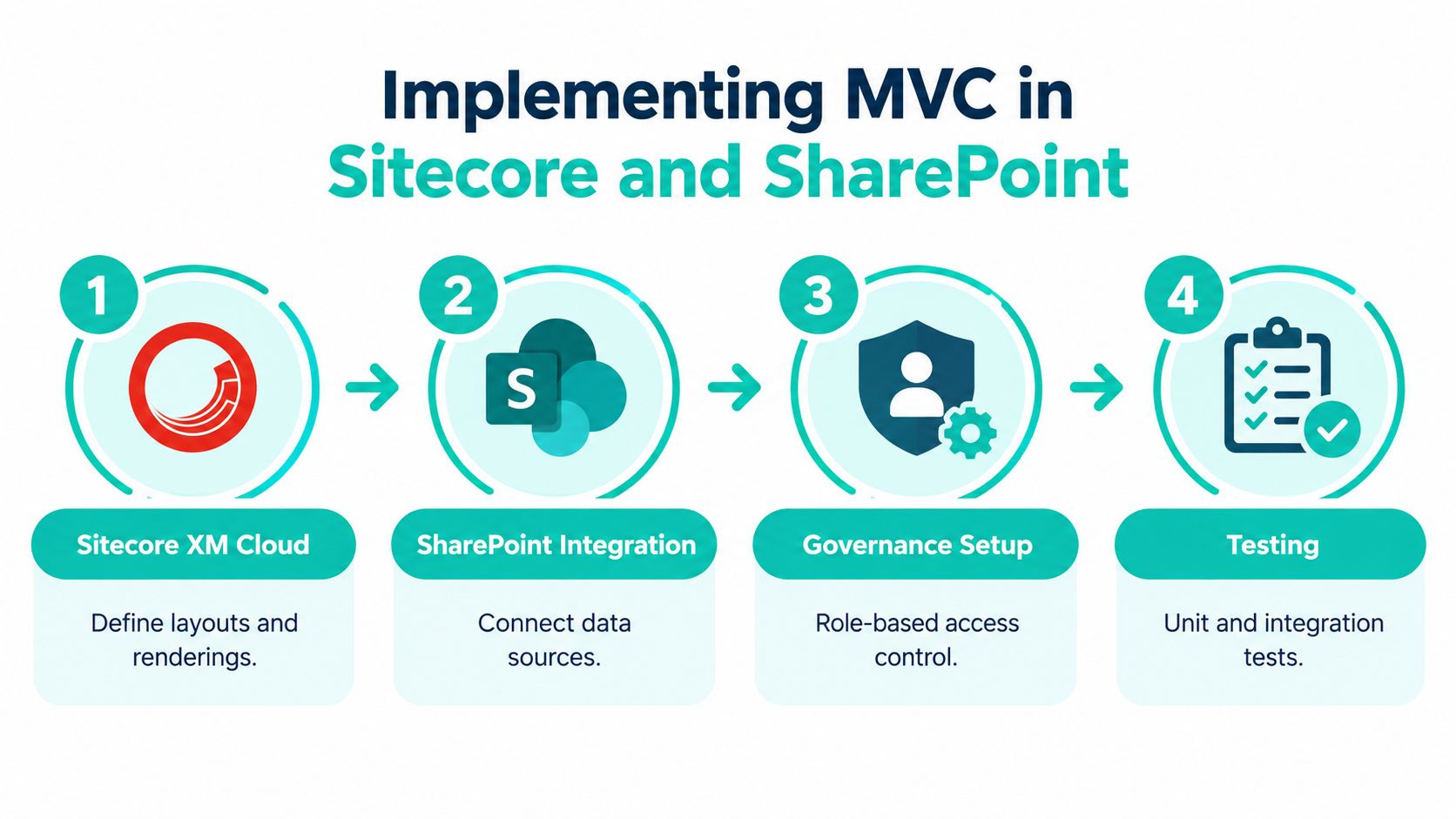
Sitecore XM Cloud
XM Cloud uses headless delivery, so new implementations should not assume server-side MVC renderings. Define Sitecore templates and content relationships for reuse, expose a predictable layout and data contract, then map that contract into Next.js components. Helix-style boundaries remain useful for feature ownership, foundation services, and shared libraries, even when the delivery front end is separate from Sitecore. Teams can refer to this Helix architecture guide when organizing solution ownership.
Sitecore Stream brings AI capabilities into XM Cloud, including Content Copilot, content generation and optimization, A/B testing support, audience-based personalization, and brand-aware controls. Treat these capabilities as governed services rather than placing AI decisions inside presentation components. Marketing workflows, approval rules, brand context, and audit records need explicit ownership.
For multi-brand estates, maintain a shared component library with documented extension rules. A hub-and-spoke model works when the hub owns accessibility, analytics hooks, design tokens, and release discipline. Individual brands can configure approved behavior without creating unmanaged forks.
SharePoint Online and SPFx
SPFx places MVC responsibilities inside a client-side solution. Build each web part with a focused presentation component, a service layer for SharePoint or Graph access, and explicit handling for loading, empty, error, and permission states. Keep data retrieval and transformation outside the render logic so those behaviors can be tested independently.
Microsoft's content security policy guidance describes enforcement planned for March 1, 2026, and provides the csp=enforce URL parameter for advance testing. Test every SPFx solution against that behavior before production deployment. Microsoft also identifies SPFx 1.23 as the leading extensibility model for Microsoft 365, supporting custom solutions across SharePoint, Teams, and Viva.
Apply the same delivery controls to both platforms:
- Define ownership: Record responsibility for models, services, components, and shared libraries.
- Automate validation: Run unit, integration, accessibility, and contract tests in CI.
- Control reuse: Publish versioned components instead of permitting untracked copies.
- Test platform behavior: Validate preview, personalization, permissions, CSP, and failure states.
Kogifi provides Sitecore, XM Cloud, and SharePoint implementation, modernization, support, and governance services, including Helix-based component libraries and SPFx solutions for Microsoft 365. Teams should still retain architectural ownership and document the boundaries that govern each release.
Common Questions About MVC in Enterprise Platforms
Can a monolithic Sitecore site migrate gradually?
Yes. Start with one bounded feature, extract its model and service contract, and leave unrelated renderings untouched. Run the old and new approaches together until the new boundary proves stable.
Should a new Sitecore project use MVC or headless?
For XM Cloud, use headless delivery because the platform is headless-only. For an existing XP estate, assess the current rendering model, team skills, preview needs, and migration cost before changing the delivery architecture.
Does MVC still matter in JavaScript-heavy systems?
Yes, as a separation principle. React, Next.js, and SPFx may distribute controller responsibilities across routing, data fetching, state management, and orchestration, but teams still need clear boundaries between data, coordination, and presentation.
How should teams test the layers?
Test business rules and mappings without a browser, test service contracts against platform behavior, and test rendered components for accessibility, content states, and integration failures. The test structure should reflect the ownership boundaries rather than mirror framework folders blindly.
If your Sitecore or SharePoint estate is accumulating release risk, Kogifi can assess the current boundaries, plan a practical migration path, and implement governed XM Cloud or SPFx components. Visit Kogifi to discuss an architecture review, modernization program, or delivery team for your enterprise platform.