


The campaign is approved, but the content still has to reach four different experiences. A React storefront needs the hero banner, the iOS app needs the product story, a dealer portal needs the technical summary, and a kiosk needs a simplified version of the same offer. The marketing team wants one publishing action. The development team wants stable APIs. Neither team wants another content copy-and-paste exercise.
That tension explains why AEM headless CMS projects rarely succeed through architecture alone. The decoupled model can improve reuse and give frontend teams more independence, but it also changes how editors preview, organize, approve, and troubleshoot content after launch. The central question isn't whether AEM can deliver structured content. It can. The question is whether your operating model can support the trade-offs.
Table of Contents
When Enterprise Teams Reach for AEM Headless
A marketing operations lead usually feels the problem before the architecture board does. A campaign has been approved, but the same headline and creative need to appear in a single-page application, a mobile experience, a partner portal, and an in-store screen. The page-based AEM team can build the campaign page quickly, yet every additional surface creates another presentation problem.
Traditional AEM authoring works well when content and layout belong together. Authors select a template, place components into a page structure, adjust responsive behavior, preview the result, and publish the page. That model becomes harder to manage as brands add regions, applications, partner integrations, and specialized devices. Each channel tends to introduce its own component tree, rendering rules, preview path, and training needs.
Architectural signal: If the same business content is being recreated for every channel, the problem is no longer only page production. It's a content modeling and delivery problem.
A retailer with several storefront experiences may need product narratives, campaign messages, and media references available to web and mobile teams without asking authors to maintain separate pages. A manufacturer may need the same structured specification delivered to a dealer portal and a field application. A financial institution may need governed product information exposed to a web frontend while a separate team maintains an authenticated application.
That's where headless CMS architecture becomes a practical AEM option. Teams that already operate AEM, Adobe Analytics, or Adobe Target often prefer extending that investment rather than creating a separate content authority. Content Fragments provide reusable, structured records, while APIs let each frontend decide how the content should look.
The market context supports treating this as an enterprise architecture decision, not an experiment. One forecast valued the headless CMS software market at US$328.5 million in 2019 and projected US$1,628.6 million by 2027, representing a 22.6% CAGR from 2020 through 2027 (Research and Markets forecast). A separate study estimated the market at US$1.56 billion in 2025 and US$4.42 billion by 2031, with large enterprises representing 72.39% of market share in 2025 (market study details). The exact forecasts differ, but both point to the same enterprise reality. Decoupled delivery has moved into mainstream platform planning.
How AEM Headless Actually Works
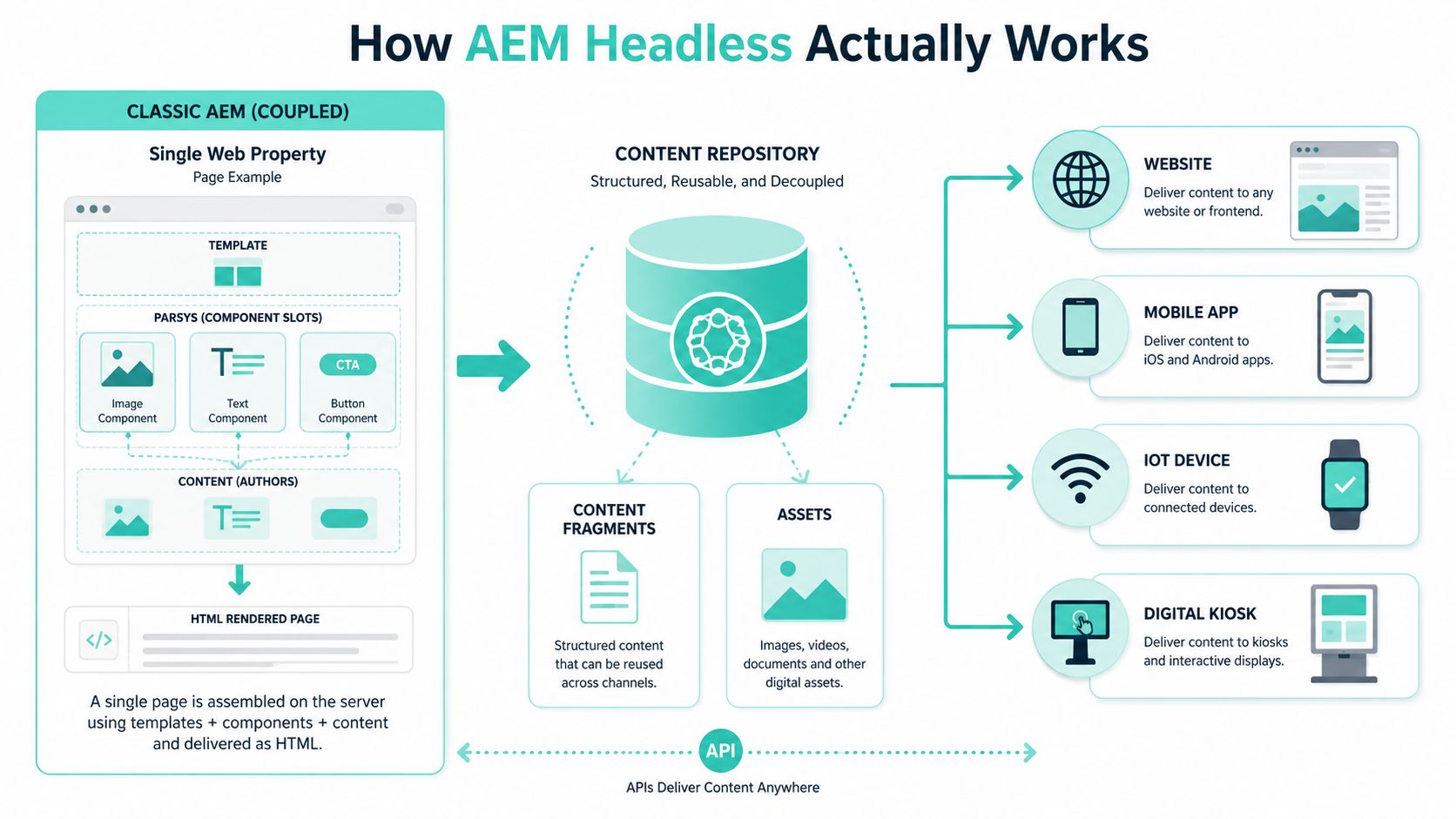
Think of classic AEM as a library where every book arrives already placed on a particular shelf. The shelf is the page template, the arrangement is the component tree, and the reader sees a finished HTML page assembled by AEM. That model is efficient for a website with a stable presentation system.
In a headless model, the library stores the material as structured records. A product story might contain a title, summary, hero asset, gallery, related items, and locale variants. The record exists independently of a page layout, so a storefront, mobile app, or kiosk can request the fields it needs and render them according to its own rules.
Adobe describes AEM headless as structured, channel-neutral content delivery through APIs in its official headless documentation. The content is still authored and governed in AEM, but the delivery responsibility shifts to consuming applications.
The content layer
Content Fragment Models define the fields, types, validations, and relationships available to authors. Content Fragments created from those models sit in AEM's repository and can be versioned, translated, referenced, and governed independently of page composition. Assets remain part of the broader content supply chain, but their use is no longer automatically determined by a specific page.
That independence creates reuse, but it also removes assumptions that page-based teams often take for granted. A fragment doesn't know how it should appear in every route, which rendition a particular device needs, or whether a downstream application has implemented the latest field.
The delivery layer
AEM supports several ways to deliver structured content:
- Content Services expose authored content and assets as JSON for applications that need a stable content representation.
- SPA Editor capabilities connect AEM authoring context with frontend applications such as React or Angular, allowing authors to work with mapped components.
- GraphQL and REST delivery provide API-based access to structured content, with GraphQL suited to querying related fragment data and REST suited to compatible integration patterns.
The AEM guidance on headless delivery matters here because server-side rendering, caching, routing, and hydration still belong to the application architecture. AEM doesn't automatically make a frontend fast or search-friendly. The consuming team must design the rendering and caching strategy.
AEM as a Cloud Service and on-premises AEM can support headless delivery. The managed service reduces infrastructure responsibility around scaling and CDN operations, but it doesn't remove the need for content contracts, frontend ownership, observability, or editorial governance.
The most useful mental model is simple: AEM owns structured content and governance, while the consuming application owns presentation. Hybrid implementations keep some page rendering in AEM, which can be the right answer when authors need traditional visual control.
The Three Integration Patterns Teams Choose Between
AEM headless projects usually fail when teams treat every API option as interchangeable. Content Services, SPA Editor, and GraphQL or REST delivery solve different problems. The right choice depends on how much authoring context the frontend needs, how independently the channel must evolve, and who owns page composition.
Content Services
Content Services fit a team that already has a frontend framework and wants JSON access to authored content and assets. A mobile team can request content without adopting AEM's page rendering model. A kiosk application can use the same governed source while applying its own display rules.
This approach is practical for simpler SPAs and native applications that don't require authors to place components directly inside a live page. The trade-off is that the frontend team must build its own preview and composition experience. Caching, image handling, reference resolution, and fallback behavior need explicit implementation.
SPA Editor
The SPA Editor is useful when React or Angular developers want a modern application but marketing still needs to work in context. AEM maps content and components into the application's structure, exposing properties that authors can edit through the AEM experience.
That convenience comes with constraints. The frontend must follow AEM's mapping and component expectations, and teams need discipline around shared component contracts. It isn't pure frontend independence, but it can preserve the editorial workflow that makes campaign production manageable.
GraphQL and REST delivery
GraphQL is closest to a pure headless approach. A frontend can query the fragment graph and request the content it needs, rather than receiving a broad page-shaped response. REST remains useful where consumers, integration standards, or operational requirements favor resource-oriented endpoints.
This model works well for storefronts, static-site frameworks, partner APIs, and applications that require presentation independence. It also creates the greatest responsibility for schema design, persisted queries, validation, caching, and release coordination. Teams should treat the API contract as a product, not as an implementation detail.
| Pattern | Best For | Authoring Experience | Typical Trade-off |
|---|---|---|---|
| Content Services | Native apps, kiosks, and straightforward frontend consumers | Structured AEM authoring, separate application preview | Frontend teams own composition, preview, and presentation rules |
| SPA Editor | React or Angular experiences that need in-context editing | Authors work with mapped components and live application context | Frontend architecture follows AEM integration conventions |
| GraphQL and REST | Storefronts, partner integrations, static sites, and custom applications | Fragment-level authoring with application-specific preview | Teams own query contracts, caching, rendering, and orchestration |
A multi-channel estate often combines these patterns. A storefront might use GraphQL, a mobile app might consume Content Services, and campaign landing pages might use the SPA Editor. The AEM integration perspective is more useful than a binary headless decision because it forces teams to match delivery mechanics to channel needs.
Benefits and the Trade-offs Most Articles Skip
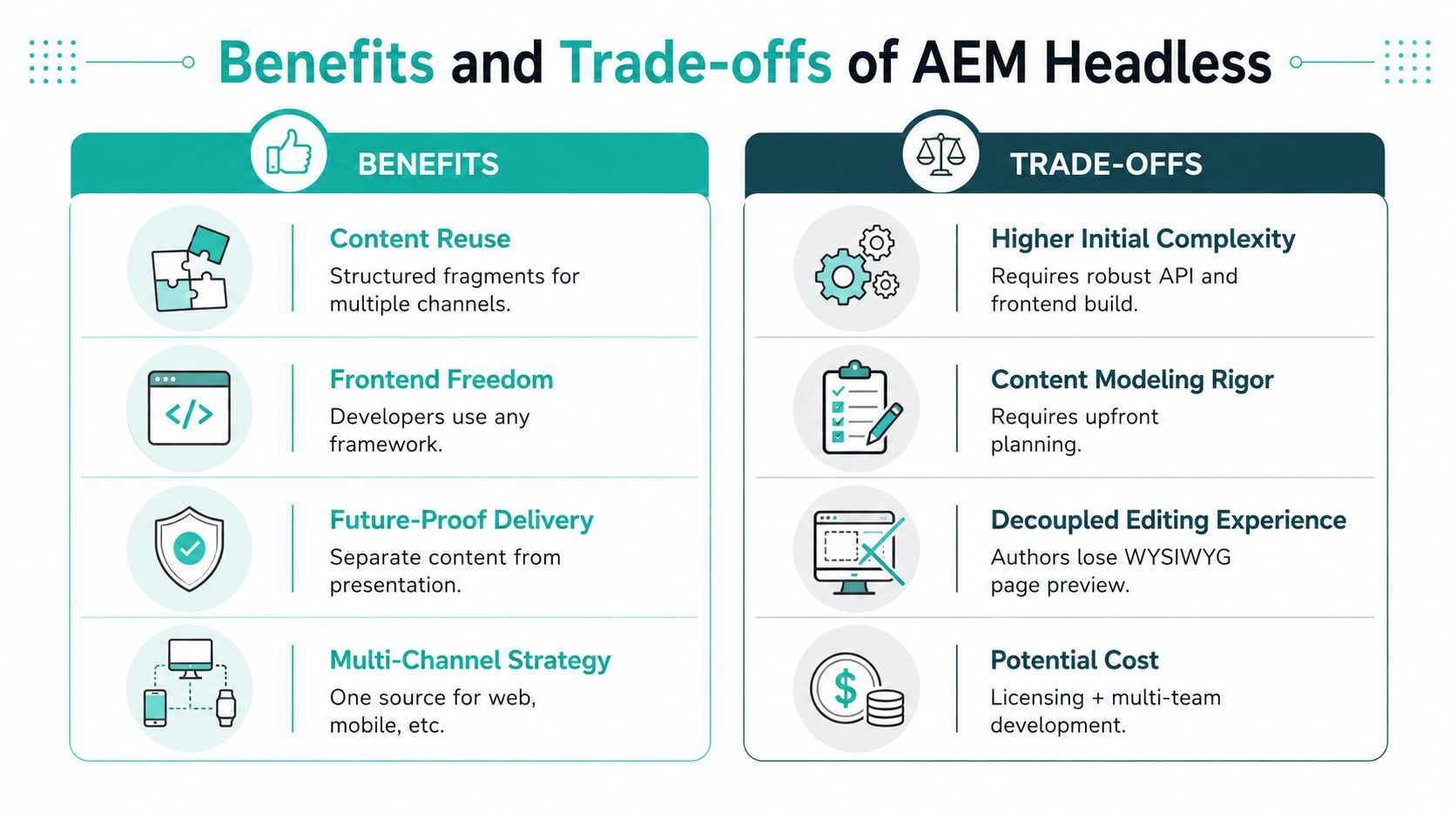
An enterprise launches a product site, mobile app, partner portal, and regional campaigns from the same content estate. Structured reuse lets authors manage governed content once while different applications consume it through their own interfaces. Frontend teams can use React, Angular, Next.js, or another suitable framework, while the organization keeps a central boundary for content and assets.
The separation supports parallel delivery. A frontend team can change presentation without rewriting every content record. A content team can update a reusable fragment without asking developers to duplicate it across page trees. Shared models and policies can also reduce uncontrolled variation across brands and regions.
The trade-off appears after launch. AEM headless removes page context from much of the authoring process, so marketing teams take on work that page-based delivery handled for them. Headless adoption continues to attract interest across enterprise content programs, but the business case depends on operating model, channel needs, and the quality of the delivery tooling, not on adoption forecasts.
The authoring-context gap
Editors lose immediate visibility when an application does not provide an equivalent visual workflow. A page author can see hierarchy, spacing, responsive behavior, and component relationships in traditional AEM. A fragment author often sees fields, references, folders, and metadata, but not the final composition.
That gap creates operational work:
- Preview ownership: Someone must expose draft content in a realistic application context.
- Composition responsibility: Developers or marketers need a shared method for assembling fragments into coherent routes.
- Asset decisions: Renditions and crops may require channel-specific rules because the page no longer defines the context.
- Governance tracking: Teams need processes for usage, dependencies, approvals, localization, and publishing.
Practical rule: Headless accelerates marketing only when the organization replaces lost context with usable preview, mapping, and governance experiences.
AEM's headless introduction describes structured, channel-neutral delivery. The practical questions concern fragment usage tracking, broken links, page moves, metadata, publishing workflows, and ownership across teams. The decision is whether the delivery flexibility justifies that authoring and orchestration cost for the specific estate.
The business case for headless CMS should include marketing effort, frontend operations, preview tooling, integration maintenance, and governance. Licensing covers only one part of the cost. A hybrid model may give marketers page-level context for campaigns while reserving headless delivery for channels that need presentation independence.
Implementation and Migration Patterns That Hold Up
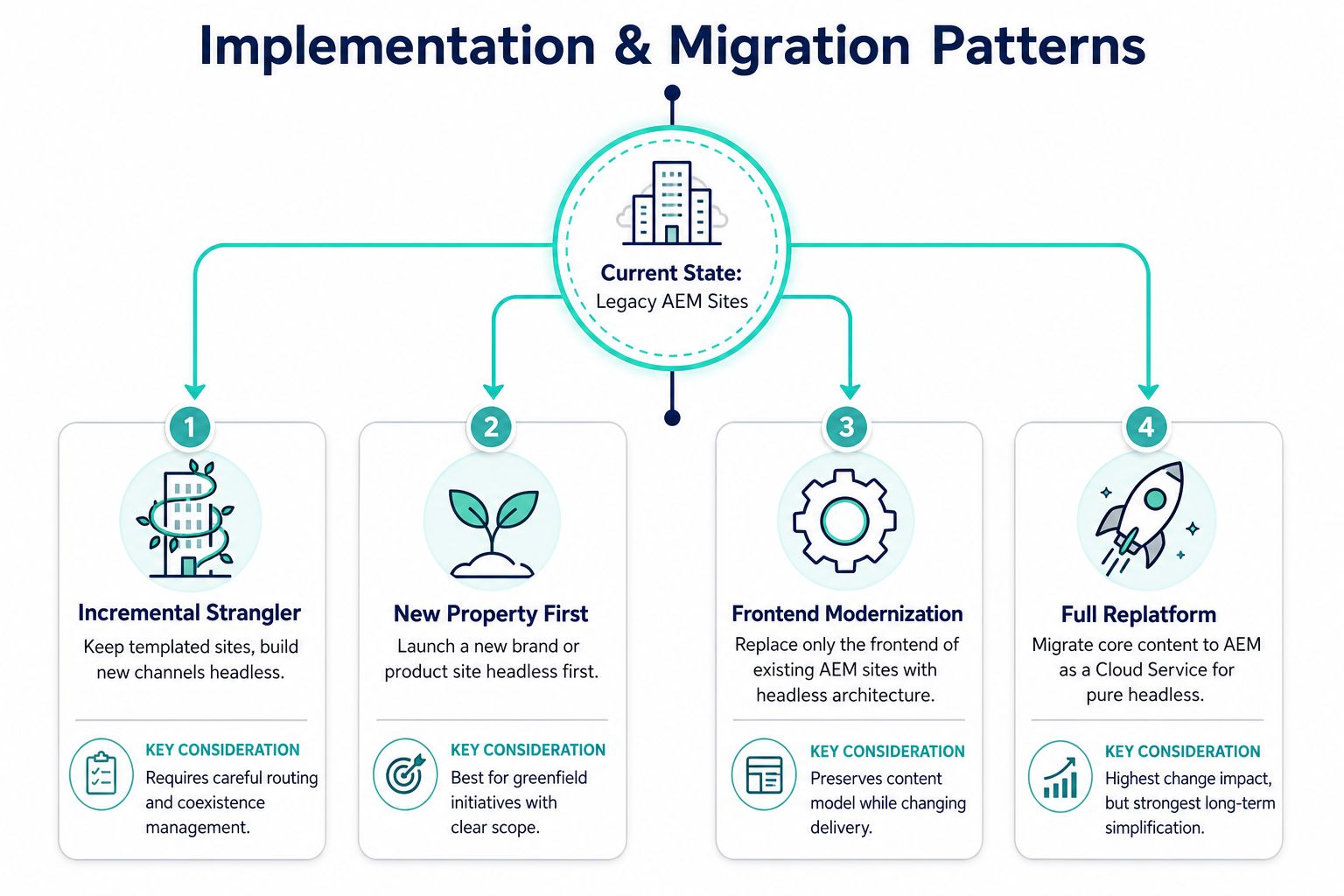
Large AEM estates rarely move cleanly from page-based delivery to pure headless delivery. The durable programs choose a migration boundary that allows authors and developers to learn without putting every brand and region at risk.
Incremental adoption
Keep the existing templated sites running and expose new Content Fragment Models through GraphQL to one new SPA. Select a bounded brand, region, or application with a clear content lifecycle. This creates a real test of modeling, permissions, localization, preview, caching, and publishing without forcing a complete page migration.
The first release should include authors, not only developers. Ask editors to create, revise, translate, approve, preview, and withdraw content. A successful API demonstration doesn't prove that the content operation works.
The strangler pattern
For a legacy site, replace one route at a time behind a reverse proxy or routing layer. Leave stable AEM-rendered pages in place while a new frontend handles selected routes. This approach reduces the blast radius and lets teams compare operational behavior across old and new delivery paths.
The risk is accidental duplication. Define which system owns each route, asset, redirect, metadata rule, and approval path before the first replacement. Otherwise, the migration creates two competing sources of truth.
Greenfield and Universal Editor
A new property can pair AEM as a content hub with a separate Next.js or Remix frontend deployed through a CDN. Greenfield teams avoid legacy component assumptions, but they still need a content model that reflects real editorial work rather than only developer convenience.
Adobe's Universal Editor direction addresses the visual gap by bringing in-context editing to headless projects. It doesn't eliminate the need for frontend instrumentation or governance, but it can make headless content more understandable to marketers accustomed to page-based authoring. Teams should validate the actual authoring flow with representative components before treating it as a complete replacement for traditional page editing.
Before cutover, establish:
- Locks and ownership: Prevent conflicting edits across brands and markets.
- Locales and inheritance: Define translation, fallback, and regional override behavior.
- Fragment templates: Restrict models to approved folders and use cases.
- Asset policies: Set rules for approved media, renditions, rights, and metadata.
- Release controls: Connect publishing to validation, approvals, cache invalidation, and rollback.
AEM Headless Inside the Composable DXP Picture
AEM headless is rarely the only platform in an enterprise experience stack. A typical architecture may place AEM at the structured-content and authoring-governance layer, while Coveo or Algolia handles search, Adobe Target handles personalization, an ecommerce engine manages transactions, and DAM workflows manage rich media.
That division is healthy when responsibilities are explicit. AEM can provide reusable editorial content and brand governance while another service handles a specialized capability. The architecture becomes fragile when teams assume that APIs automatically create a unified experience. Identity, analytics, search indexing, commerce data, preview, and publishing events still need contracts.
Sitecore XM Cloud occupies a similar composable position for organizations using Sitecore. Its developer documentation identifies Headless SXA, JSS, and Headless Services as core parts of the platform (Sitecore XM Cloud introduction). Sitecore Stream extends that ecosystem with AI-assisted visual search, content generation, translation, grounded image tagging, content optimization in the XM Cloud page builder, Q&A over Sitecore Search content, Gensights for CDP dashboard insights, brand kits, brand-aware chat, brief generation, and brainstorming (Sitecore Stream AI capabilities).
SharePoint still has a different authority in many organizations. Microsoft's official documentation positions SPFx as the primary framework for extending SharePoint and Microsoft Teams, while Power Platform components support workflow automation and business-system connections (Microsoft SharePoint framework documentation). That makes SharePoint Online a natural home for intranets, employee forms, approvals, and authoritative internal documentation. AEM may consume or reference that information through connectors rather than replace the intranet's ownership model.
| Capability | AEM Headless | Sitecore XM Cloud | Contentful |
|---|---|---|---|
| Structured content | Content Fragments with AEM governance and asset integration | Headless content delivery with Sitecore models and services | API-first structured content platform |
| Presentation | Separate frontend, hybrid AEM delivery, or SPA integration | Headless SXA, JSS, and rendering host patterns | Consumer-owned frontend |
| Enterprise context | Strong fit for Adobe Experience Cloud estates | Strong fit for Sitecore and Sitecore Stream estates | Fit for teams seeking a focused content hub |
| Editorial model | Can combine page-based, SPA, and headless workflows | Supports headless development with XM Cloud tooling | Primarily structured, decoupled authoring |
| Composable role | Content, assets, and governance layer | Content and experience layer with AI portfolio | Content hub alongside external experience services |
Architecture review boards increasingly evaluate these composition boundaries rather than comparing CMS checklists in isolation. The winning platform is the one that fits identity, search, commerce, analytics, employee knowledge, and operating ownership.
Common Misconceptions That Derail Headless Projects
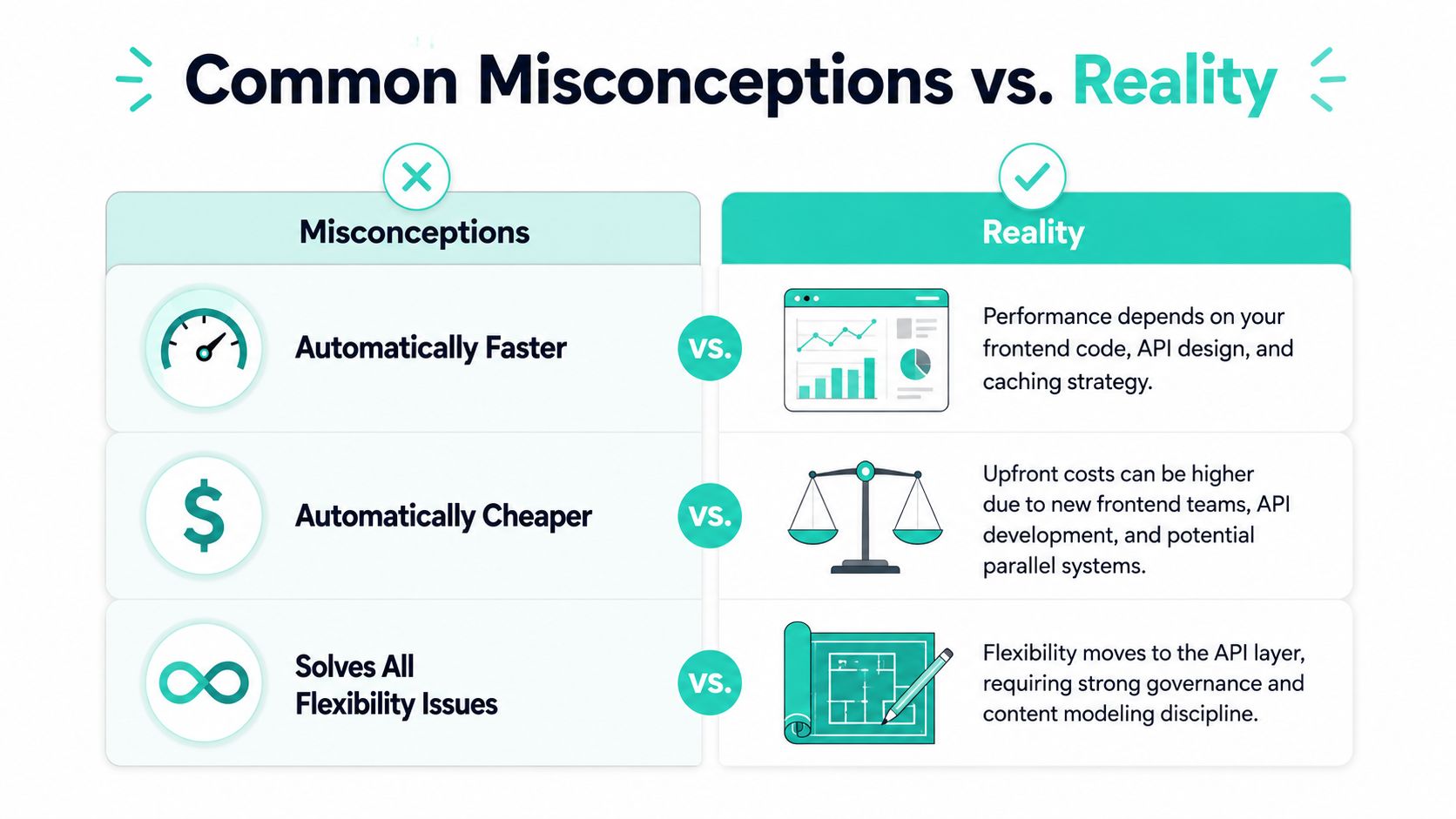
Headless isn't automatically faster. Performance depends on frontend code, API design, rendering strategy, cache behavior, asset delivery, and monitoring. A decoupled application can outperform a tightly coupled page stack, but it can also introduce extra network calls and slower releases if teams design the delivery path poorly.
It isn't automatically cheaper either. The CMS may remain the same while the organization adds frontend ownership, API development, preview tooling, release automation, observability, and another production stack. The cost moves unless the operating model deliberately removes duplicated work.
What editors notice
Editors notice when they lose visible page composition, responsive controls, and in-context approval workflows. Fragment-level authoring can work well for reusable content, but it doesn't automatically replace the confidence that a page preview provides.
Why hybrid often wins
Pure headless doesn't automatically beat hybrid AEM. Traditional rendering remains valuable for campaign pages, standardized templates, and teams that need integrated authoring. APIs are better suited to reusable content, custom applications, and channels that require presentation independence.
Decoupling presentation also doesn't eliminate coupling. Frontends still depend on content models, query contracts, validation rules, localization behavior, and publishing events. Governance still covers ownership, versioning, taxonomy, asset rights, and approvals.
A representative pilot should include authors, developers, security, operations, and channel owners. An API demo alone won't reveal whether the organization can run the new model.
Decision Checklist for Planning Your Headless Rollout
Start with the business problem, not the API. Decide whether the primary need is omnichannel reuse, application integration, independent frontend delivery, or a deliberate separation between content and presentation.
Then build an estate inventory:
- Content: Classify pages, fragments, assets, and models by reuse, lifecycle, localization, and governance requirements.
- Integrations: Record analytics, personalization, commerce, search, identity, translation, partner, and intranet dependencies.
- Authoring: Document who creates, reviews, translates, previews, publishes, and withdraws each content type.
- Delivery: Define frontend ownership, rendering, caching, observability, backup, disaster recovery, and API rate-limit expectations.
- Governance: Establish rules for components, taxonomies, metadata, fragment templates, asset rights, locales, locks, and approvals.
Choose the integration pattern deliberately. Use GraphQL for structured Content Fragment consumption where query control matters. Use REST or Content Services when the consumer needs a compatible JSON delivery contract. Use the SPA Editor when a React or Angular application still needs AEM's authoring context.
Before migration, agree on query contracts, validation rules, versioning, preview behavior, and rollback. Test the complete workflow with one bounded use case, then measure authoring effort, release lead time, delivery reliability, and content reuse qualitatively or through your own agreed operational measures. Reassess hybrid delivery if it provides the required channel independence with less disruption.
Kogifi designs, builds, migrates, and supports enterprise platforms across AEM, Sitecore, and Microsoft 365, including headless architectures, composable integrations, SharePoint intranets, and ongoing platform operations. Visit Kogifi to discuss an AEM headless rollout that accounts for content modeling, authoring workflows, frontend delivery, and governance before implementation begins.