


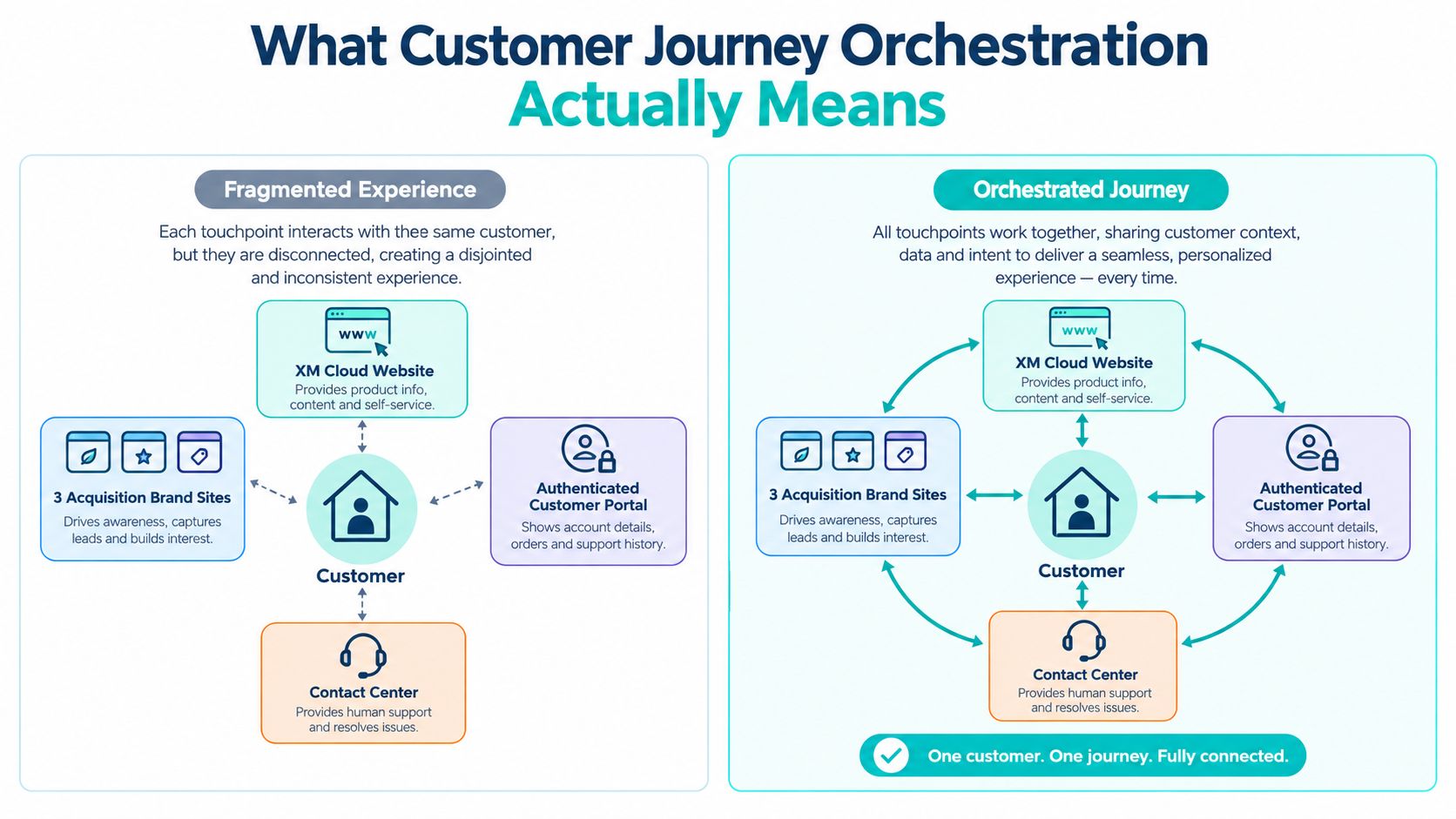
A global insurer can have XM Cloud, three acquisition brands, an authenticated customer portal, and a contact center, yet still treat one household as five unrelated customers. A prospect researches a policy on one brand site, logs into another portal to check documents, calls service about a claim, and receives an acquisition email that ignores the open case. Every team is active. The experience is still fragmented.
That gap is where customer journey orchestration earns its place. The discipline connects customer data, decisioning, content, channels, and outcomes so each interaction reflects the customer's current situation. For Sitecore estates, that means looking beyond a single personalization feature and designing an operating model around XM Cloud, Personalize, Content Hub, Stream, consent, measurement, and the systems outside the DXP.
Table of Contents
- Data resolves context
- Decisioning chooses the next action
- Orchestration coordinates timing
- Delivery executes the experience
What Customer Journey Orchestration Actually Means
Customer journey orchestration is the continuous coordination of data, decisions, and content across owned and paid channels, timed to a person's behavior and operational context rather than to a campaign calendar. A website visit matters, but so do service history, order status, inventory, authentication state, loyalty data, and consent.
That distinction matters in the insurer scenario. A customer who has just submitted a claim shouldn't receive a generic cross-sell message because they visited a product page. The orchestration layer should recognize the claim, apply the relevant suppression or service priority, and select an appropriate next action.
Mapping, automation, and orchestration are different
A journey map is a design artifact. It shows stages, touchpoints, customer needs, emotions, and friction. It helps teams agree on the intended experience, but it doesn't execute a decision.
Campaign automation usually applies rules within a channel or campaign. For example, an email workflow might send a reminder after a form abandonment. That can be useful, but it may not know whether the customer completed the form through a portal, called an agent, or changed their consent preference.
Orchestration sits above the DXP as both a system of record for journey state and a system of action. It coordinates decisions across channels and keeps the experience aligned as new signals arrive. Sitecore's documentation describes Personalize as activating data across customer touchpoints and orchestrating consistent experiences, with analytical and decision models supporting automated personalization (Sitecore Personalize feature documentation).
The four jobs every journey must perform
A production-grade journey needs to:
- Sense signals: Capture behavioral, transactional, service, and consent events.
- Decide next moves: Select the next-best action, variant, channel, timing, or suppression.
- Activate consistently: Deliver the decision through web, app, email, sales, or service experiences.
- Learn from outcomes: Feed completion, abandonment, conversion, and resolution data back into the model.
If one job is missing, the implementation becomes campaign automation rather than orchestration.
Why Orchestration Has Become a Board-Level Topic
Boards aren't interested in another journey canvas. They want to know whether fragmented customer experiences are increasing acquisition cost, weakening retention, or preventing marketing from proving revenue contribution.
The category itself has become substantial. One 2026 market estimate places global customer journey orchestration at USD 13.09 billion in 2026, with a projection of USD 24.41 billion by 2031 and a 13.27% CAGR (Mordor Intelligence market estimate). The same estimate says cloud deployment accounted for 61.63% of the market in 2025, large enterprises represented 68.26% of demand, and North America held 39.18% of market share in 2025. Those patterns fit what architects see in the field. Complex, multi-brand organizations with mature digital operations tend to adopt orchestration first because disconnected journeys create visible operational and commercial waste.
A second market view estimates a smaller base, USD 5.2 billion in 2025, growing to USD 18.7 billion by 2034 at a 15.4% CAGR, with software representing 62.3% of revenue and cloud deployment 73.5% (DataIntelo market view). The estimates use different scopes, but they point in the same direction: buyers are moving from isolated journey builders toward platforms that combine audience management, analytics, campaign automation, and AI-supported personalization.
| Pressure | Signal | Implication for Orchestration |
|---|---|---|
| Tool sprawl | Enterprise stacks contain many specialized systems | Teams need shared decisioning and governance, not another isolated workflow |
| First-party data pressure | Cookie loss and stricter privacy expectations reduce casual signal availability | Consent-aware identity and owned behavioral data become foundational |
| Revenue accountability | Executives expect marketing activity to connect to business outcomes | Journey completion, retention, resolution, and lifetime value must outrank isolated engagement metrics |
Sitecore's direction reflects this consolidation. Its current portfolio positions the platform as a composable, cloud-native DXP with AI workflows, generative copilots, and brand-aware AI, while Sitecore Stream is described as embedding AI capabilities across the DXP (Sitecore). XM Cloud sits at the center of that model, but orchestration still isn't created by product packaging alone.
The strategic shift is from improving one message to coordinating a customer's full path. Without shared data and KPIs, personalization produces channel-level wins that never compound into a board-visible improvement in customer value.
The Four Layers of an Orchestrated Journey
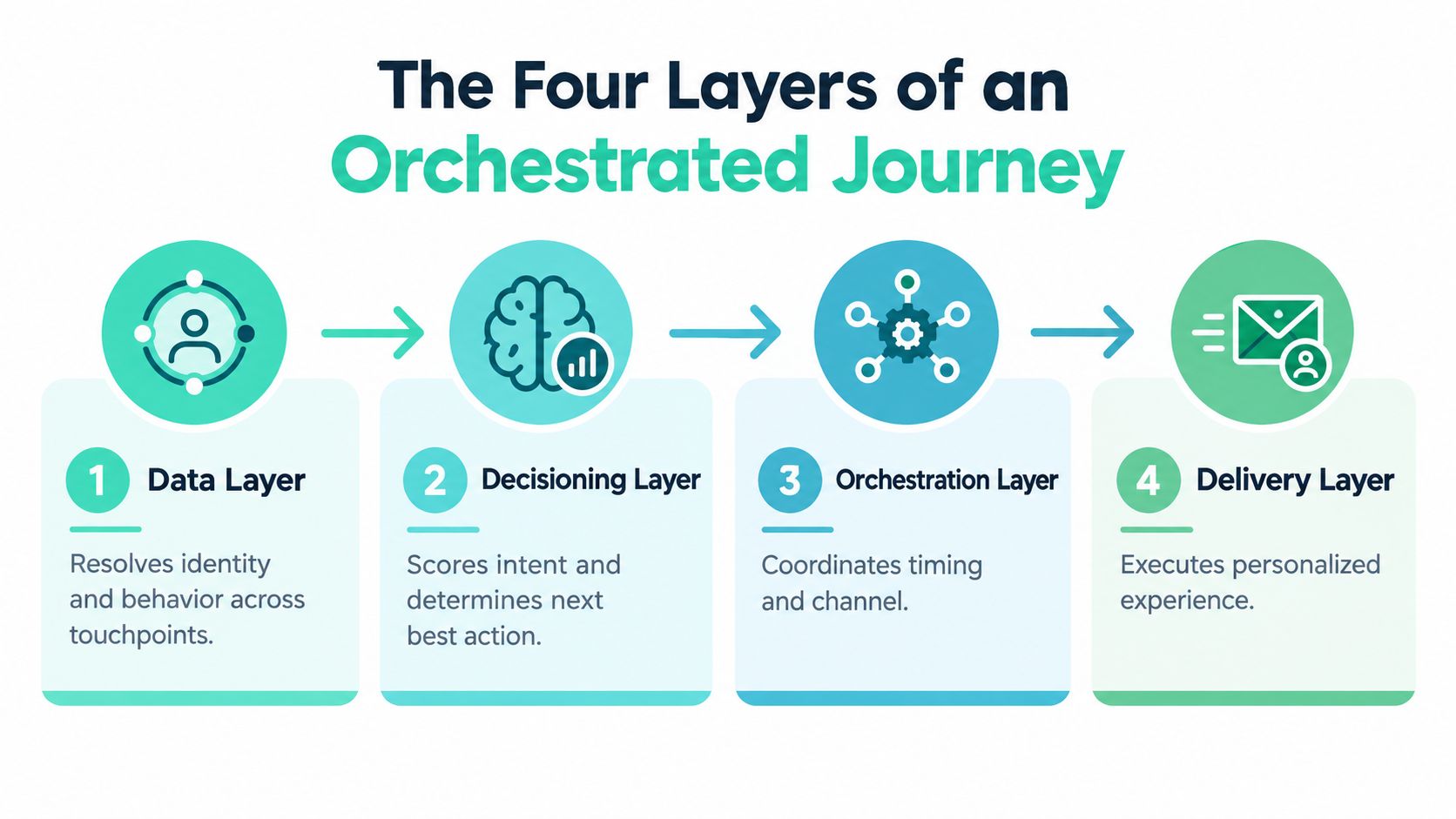
Every vendor implementation can be reduced to four connected layers. Sitecore teams already own parts of each layer, but the seams between them determine whether the journey works.
Data resolves context
The data layer joins identity, behavior, transactions, service interactions, consent, and operational status. Its owner is usually a data or architecture team working with marketing and service. Its failure mode is familiar, a customer appears as several profiles or an event arrives without enough context to support a safe decision.
For a Sitecore-led estate, XM Cloud interaction data, Personalize audiences, CRM records, portal events, and external operational systems need explicit contracts. A CDP or integration layer can help, but it won't resolve ambiguous ownership by itself.
Decisioning chooses the next action
The decisioning layer interprets intent and selects an outcome. It may use rules, propensity models, forecast models, outlier detection, or a controlled experiment. Personalize provides the relevant mechanics, including interactive experiments and decision models, but business owners still need to define acceptable actions and exclusions.
Personalization also requires judgment. The practical distinction between adapting an experience and changing it for a specific individual is explained well in this guide on when to personalize instead of customize. The right choice depends on context, consent, content risk, and the value of the decision.
Orchestration coordinates timing
The orchestration layer manages sequence, priority, channel, wait conditions, suppression, and exits. A service event can pause a promotion, or an authenticated portal action can remove a prospect from an acquisition path. Teams designing connected journeys may also benefit from this practical reference on defining omnichannel marketing.
Delivery executes the experience
The delivery layer renders the chosen outcome. XM Cloud delivers components and pages, Content Hub supplies governed assets, and connected systems handle email, apps, sales, and service. If the content variant doesn't exist, the asset isn't approved, or a channel can't accept the decision, orchestration fails at the final step.
The flow is circular, not linear. Outcomes return to the data layer, where they influence later decisions.
Practical rule: Treat every handoff as a product boundary. Define the event, owner, contract, fallback, and monitoring requirement before building the journey.
Anatomy of an Orchestrated Journey on Sitecore
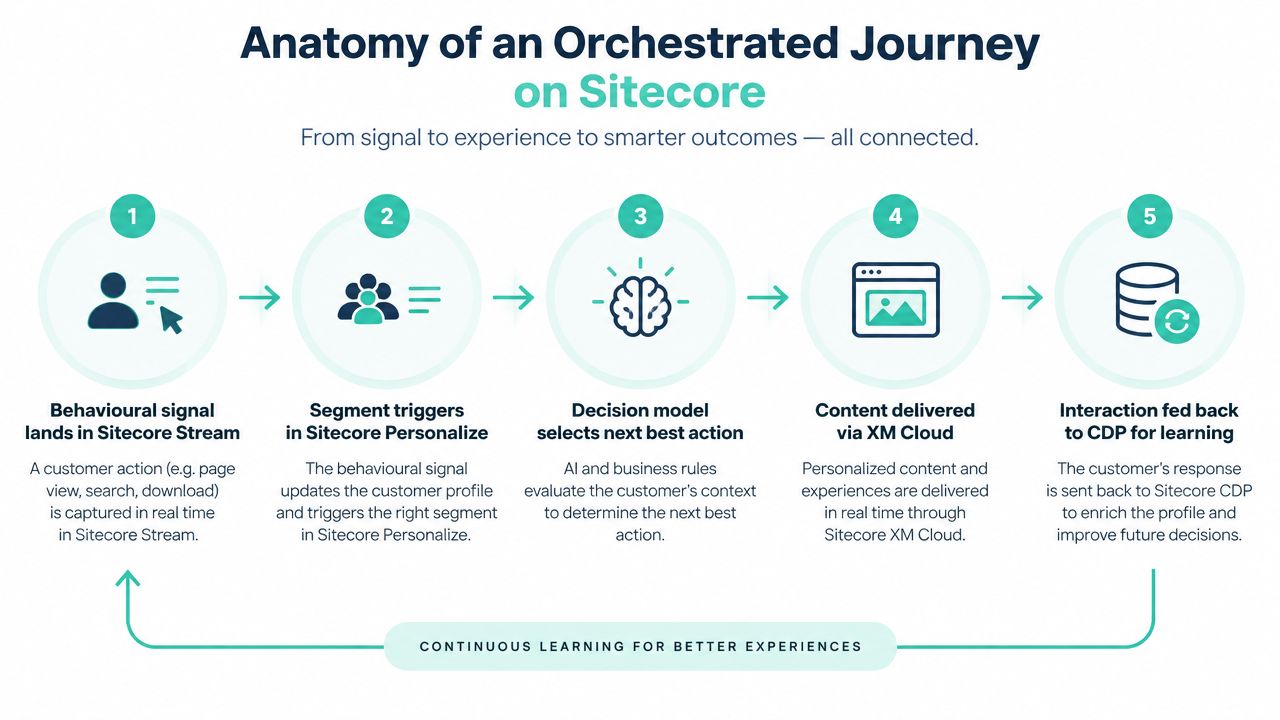
Consider a visitor researching commercial insurance across a multi-brand estate. The journey starts with behavior, but it becomes useful only when Sitecore can connect that behavior to identity, content, policy state, consent, and a measurable business outcome.
Signal and segmentation
A behavioral event lands in Sitecore Stream. The event might represent repeated product research, a return to a quote flow, or authenticated activity in a portal. Stream should capture the event with an identity key, timestamp, consent state, source, and enough metadata to distinguish meaningful behavior from noise.
Personalize then evaluates the audience. A segment could combine recent behavior with account status, region, product ownership, or service context. The key artifact is not just a segment definition. It is a documented audience contract that tells downstream teams what the audience means and when it must be suppressed.
Decision and delivery
A decision model selects the next-best action. The model might choose between a guide, a quote prompt, a service message, or no message at all. A rule-based decision is often the safest starting point because the team can explain its inputs, thresholds, exclusions, and fallback.
XM Cloud renders the selected experience through a component variant. Content Hub supplies the approved image, document, or campaign asset, with taxonomies and metadata supporting reuse across brands and markets. Sitecore's XM Cloud Plus positioning combines content management, AI-powered search, personalization, customer data management, and analytics, including omnichannel personalization and intelligent search recommendations (Sitecore XM Cloud Plus announcement).
The systems around Sitecore
The journey rarely lives entirely in Sitecore. A legacy AEM implementation may still hold content during a migration. SharePoint often remains the source for policy documents, legal collateral, internal guidance, and controlled enterprise files. CRM, customer data platforms, identity services, commerce, and consent platforms may own the facts Personalize needs.
A useful enterprise customer data platform pattern makes those ownership boundaries explicit. The integration must define which system publishes each event, which system resolves identity, and what happens when consent or operational data is unavailable.
The outcome event then returns for measurement. It should record the decision made, the variant shown, the channel used, the customer's response, and any suppression or fallback reason. Without that detail, the team can see an interaction but can't explain why the journey produced it.
Governance and Data Readiness the Stack Cannot Fix
Platform selection is rarely the true blocker. Governance is.
Recent industry coverage reports that only 41% of B2B organizations say they have a unified customer data foundation for AI at scale, while 72% cite skills gaps as a major barrier (InsiderOne trend coverage). Those figures describe an operating problem. A team can't run reliable orchestration when it hasn't agreed on identity, data ownership, consent, or who may change a decision.
Before Personalize goes live, the programme needs concrete delivery artifacts:
- Data contracts: Define event names, identity keys, timestamps, source systems, required fields, and service-level expectations.
- Consent mapping: Connect each consent state to permitted channels, regions, purposes, and personalization behavior.
- Decision rights: Name who can create, approve, publish, pause, and retire segments, experiments, and models.
- Experiment policy: Set rules for audience eligibility, control groups, variant review, and statistical interpretation without letting every team invent its own standard.
- Model-risk register: Record inputs, intended use, known limitations, explainability requirements, monitoring, rollback, and the owner responsible for intervention.
Governance is a delivery discipline
Legal approval at the end of a build won't create safe orchestration. Teams need a RACI, change control, release gates, vendor escalation routes, and an incident process that can pause activation without waiting for a quarterly steering meeting.
Sitecore Stream and Personalize can support an implementation, but neither product decides whether a policy document is current, whether an inferred attribute is appropriate, or whether a model should be allowed to act in a region. Those decisions belong to named people.
The most expensive missing feature is often an owner. If nobody owns a journey outcome, every team optimizes its own queue and calls the result progress.
A practical starting point is a governed customer 360 view that documents which facts are trusted and which remain provisional. Start small, but make the contracts production-grade from the first journey.
Measuring Journeys Instead of Campaigns
A campaign dashboard asks whether a message performed. A journey scorecard asks whether the customer reached the intended outcome with less friction and whether the business created value across the path.
That changes the optimization unit. Click-through rate, last-click revenue, and channel return remain useful diagnostics, but they become inputs rather than the headline. Journey-level guidance emphasizes completion, abandonment, cross-channel conversion, and resolution velocity because those measures capture the end-to-end experience (NICE on journey orchestration in contact centers).
A two-level scorecard
| KPI | Optimised under | Primary owner | Sitecore source |
|---|---|---|---|
| Journey completion | Journey-level | Journey owner | Stream events and Personalize outcomes |
| Drop-off by step | Journey-level | Product or experience owner | XM Cloud interactions and Stream |
| Assisted conversion credit | Journey-level | Marketing and analytics | Personalize decision and interaction records |
| Resolution velocity | Journey-level | Service owner | Service events integrated into the journey |
| Consent health | Journey-level | Privacy and data owner | Consent platform plus activation logs |
| CTR | Campaign-level | Channel manager | Channel interaction events |
| Last-click revenue | Campaign-level | Performance marketing | Commerce or CRM attribution |
| Channel ROI | Campaign-level | Finance and marketing operations | Cost and conversion data |
Instrumentation before interpretation
Sitecore teams need more than an event stream. They need event identity resolution, consistent journey and step identifiers, decision logs, variant identifiers, and suppression reasons. Bot traffic and internal traffic must be excluded, or the team will mistake operational noise for customer behavior.
The scorecard should also show counterfactual context. A control group, holdout, or pre-agreed comparison helps answer whether orchestration changed the outcome instead of merely claiming credit for a conversion that would have happened anyway. Attribution should be explicit about assisted touches, time windows, and channel transitions.
For a deeper implementation perspective, this guide to analytics for the customer journey is useful when aligning analytics design with journey ownership. The important decision is not which dashboard looks most polished. It's which metric a cross-functional team is willing to optimize together.
When AI Autonomy Becomes a Risk Surface
More autonomy isn't automatically better personalization. It can also mean faster propagation of a bad assumption.
The first risk is consent and jurisdiction. A Personalize experiment might expand an audience definition into European Economic Area cohorts because the behavioral pattern looks relevant, even though the consent state doesn't authorize that activation. A model may infer an attribute from behavior that a privacy regime treats as sensitive. The technical decision can be valid while the business action remains impermissible.
The second risk is intrusiveness decay. An always-on system can respond to every visit, hesitation, and repeat interaction until the customer sees the brand as invasive. Independent guidance describes the fine line between relevance and intrusion and links richer behavioral data with heightened trust and privacy risk (Talkdesk on customer journey orchestration).
The third is model drift and explainability. A decision model can perform acceptably during launch and then respond differently as audiences, products, content, and behavior change. If nobody can explain why a regulated financial product was recommended, a model-risk review has no usable evidence.
Autonomy needs a gradient
Use increasing autonomy only as the controls mature:
- Rule-based segmentation: Human-authored conditions, explicit exclusions, predictable fallback.
- Assisted decisioning: AI recommends a segment, variant, or action, while a named owner approves activation.
- Gated autonomous activation: The system acts within consent, threshold, jurisdiction, monitoring, and kill-switch boundaries.
Sitecore's AI-first portfolio can support more assisted workflows, but autonomy should remain a governance decision. Every model needs an owner, an audit trail, a review cadence, and a reversible path. The safest architecture isn't the one that eliminates human judgment. It's the one that makes human intervention fast and accountable.
A Practical Roadmap and a Final Checklist
A steering committee can approve orchestration without approving a broad transformation programme. Start with one valuable journey, make the contracts real, and expand only when the team can explain the result.
Phase 1, foundation
During weeks 0 to 6, inventory journeys across XM Cloud, document the relevant CDP and consent dependencies, and define the North Star KPIs. The decision owner is the enterprise journey sponsor. Exit when one journey has an agreed scope, data map, consent path, KPI hierarchy, and named owners. The common failure mode is choosing a technically impressive journey with no measurable business outcome.
Phase 2, decisioning
During weeks 6 to 14, move one high-value journey into Personalize. Use rule-based segments, human-owned variants, explicit suppression, and a documented fallback. The decision owner is the product or journey owner. Exit when the team can reproduce each decision from its inputs and publish a controlled experiment. Failure usually begins when marketing publishes variants before analytics and compliance can inspect them.
Phase 3, activation
During weeks 14 to 24, connect Content Hub assets, Stream behavioral triggers, XM Cloud components, and the required channel activations. Create authoring playbooks for the multi-brand estate, including taxonomy, localization, accessibility, approval, and retirement rules. The decision owner is the platform product owner. Exit when the journey runs across its intended channels with monitoring and rollback. A recurring failure is building content variants faster than teams can govern them.
Phase 4, autonomy
From week 24 onward, introduce assisted decisioning only after consent, governance, and model-review rituals are signed off. The decision owner is the AI risk owner, not an automation administrator. Exit when the model has a review record, threshold policy, monitoring, and kill switch. The failure mode is treating autonomy as a launch feature instead of a controlled operating capability.
Teams that need external creative support should separate brand production from decision governance. A curated overview of best creative agencies can help with that supplier discussion, but the agency producing an asset shouldn't automatically own the rule that decides who sees it.
Use this checklist in the steering committee deck:
- Data unified: Identity, behavioral, operational, and service signals have owners.
- Consent captured: Activation rules reflect purpose and jurisdiction.
- Decision rights assigned: People can approve, pause, and retire logic.
- KPI hierarchy approved: Journey outcomes headline the scorecard.
- Experiment cadence agreed: Variants, controls, and review windows are documented.
- AI autonomy gated: Thresholds, explanations, monitoring, and kill switches exist.
- Legacy metrics retired: Campaign measures remain diagnostic rather than defining success.
Kogifi designs, builds, and maintains enterprise platforms across Sitecore, Adobe Experience Manager, and Microsoft 365, including XM Cloud and Personalize architectures, SharePoint Online intranets, integrations, analytics enablement, and multi-brand governance. If your orchestration programme is stuck between a convincing slide deck and a production-ready journey, visit Kogifi to discuss the data contracts, Sitecore architecture, measurement model, and delivery roadmap needed to move it forward.