


Personalized product recommendations can account for up to 31% of total e-commerce site revenue, while reported lifts reach 288% for conversion rate and 369% for average order value compared with generic recommendations, according to Rivo's ecommerce personalization data. Those figures explain why personalization in e-commerce has moved beyond a marketing experiment. They also hide the harder question: when does relevance become intrusion?
A useful personalization program doesn't show more products or insert a customer's name into an email. It uses consented data, live context, and intelligent decisioning to present the next useful product, message, or action, while giving customers a clear reason to trust the experience. The Sitecore stack provides several ways to do that, from automated component optimization in XM Cloud to cross-channel experimentation in Sitecore Personalize. SharePoint solutions also matter when employee-facing commerce operations, product governance, and internal workflows need the same disciplined data foundation.
Table of Contents
Why Personalization in E-Commerce Is Now a Core Revenue Lever
The ecommerce personalization software market is projected to grow from USD 263 million in 2023 to USD 2.4 billion by 2033, with a 24.8% compound annual growth rate, according to Contentful's overview of ecommerce personalization statistics. The shift is operational, not cosmetic. Personalization now influences acquisition, conversion, retention, merchandising, and service across an enterprise commerce estate.
Personalization in e-commerce uses visitor data and context to choose a relevant product, offer, message, or experience instead of presenting the same storefront to every visitor. A first-time visitor may need category guidance. A returning buyer may need replenishment content, compatible accessories, or support linked to a known purchase. Someone arriving through a regional campaign may require different content from a visitor entering through organic search.
The expectation has changed
Customers compare digital storefronts with the most relevant experiences they have already received. They do not expect a brand to expose private knowledge about them. They do expect an obvious intent signal to receive a useful response. Showing a product someone already purchased, promoting unavailable stock, or ignoring a selected market makes the storefront look inattentive.
The perception gap remains significant. 67% of retailers believe they excel at personalizing online experiences, while only 46% of consumers agree, as reported in the same Contentful market summary. Platform adoption and campaign volume cannot prove that personalization is working. Teams need to measure whether a decision reduces customer effort, improves the experience, and creates incremental commercial value.
Practitioner rule: Personalization earns its place when it removes effort for the customer and produces an incremental business outcome.
Four questions should guide the program. Does the data represent genuine customer intent? Can AI recommendations improve revenue and basket quality rather than clicks alone? Does the Sitecore architecture put decisioning in the correct layer? Is the privacy exchange still understandable as the experience becomes more personalized?
Personalization should sit on the P&L for teams responsible for B2C ecommerce architecture and experience delivery, not in an isolated campaign workflow. Kogifi builds on Sitecore platforms, including Sitecore AI, Sitecore Personalize, and Sitecore XM Cloud, where responsible decisioning can connect content variation, experimentation, and delivery. For teams assessing the content side, boost SaaS revenue with content personalization provides a useful view of matching content variation to audience need.
The trade-off is clear. Relevance can increase the value of existing demand, but aggressive targeting can reduce trust when the inference feels unexplained or wrong. The effective program measures both outcomes.
The Data and Segmentation Foundation That Makes Personalization Work
A restaurant provides a practical model for personalization. On a previous visit, the staff may learn that you avoid a particular ingredient. When they ask what you'd like tonight, you can state a preference directly. Your table, time of day, and the current menu add context. A good server combines all three without pretending to know more than you've shared.
Commerce teams need the same distinction.
First-party data is observed on channels the business owns. Product views, searches, cart additions, dwell time, purchase cadence, and customer service interactions can reveal behavior. Zero-party data is information the customer intentionally declares through a preference center, quiz, account profile, survey, or other explicit interaction. Zero-party data often carries strong intent because the customer chose to provide it.
Both reduce dependence on third-party tracking, but neither is automatically useful. A product view can mean serious interest, comparison shopping, or accidental navigation. A declared preference can become outdated. The implementation must retain provenance, timestamp signals, and define how long each input remains eligible for decisioning.
Separate behavior from context
Behavioral signals describe what the visitor does. Contextual signals describe the circumstances around the visit:
- Behavioral signals: Product views, internal searches, cart additions, repeat purchases, dwell time, and browsing sequences.
- Contextual signals: Device type, channel, location, referrer, session timing, and market.
- Declared signals: Preferences, sizes, use cases, communication choices, and account information supplied by the customer.
The strongest profile combines these categories without allowing one noisy event to dominate. A customer who browses running shoes once shouldn't necessarily receive running content indefinitely. A declared preference should influence recommendations, but inventory, price, eligibility, and current session intent still matter.
Segmentation should evolve in the same way. Rule-based segments work well for stable traits such as account status, market, or known product ownership. Propensity segments identify likelihood, such as the likelihood of replenishment or cross-sell. Dynamic segments respond to current session context.
The practical test is simple: a segment is useful only when it triggers a different experience. If two segments receive the same content, offer, ranking, and exclusion rules, maintaining both creates governance overhead without customer value. Teams building this layer can use the segmentation in AI-driven personalization guide to connect segment design with decision logic rather than treating audiences as static lists.
How AI-Driven Recommendations Move the Numbers
An AI recommendation engine converts event data into ranked choices. It compares current activity with patterns from similar shoppers, scores eligible products or content, applies commercial rules, and selects the variant most likely to support a defined outcome. The ranking only works when the candidate set is disciplined. Inventory, product relationships, margin, eligibility, and recent customer history must shape which options the model can consider.
The commercial case depends on the outcome being measured. Personalized recommendations can contribute a substantial share of ecommerce site revenue, as noted earlier. Clicks alone are an incomplete test. A recommendation block that increases engagement while lowering margin, encouraging returns, or distracting from a high-intent purchase has not improved the decisioning system.
What the engine evaluates
A typical decision flow includes five stages:
- Collect events: The system receives browsing, search, cart, and purchase signals under consent and identity rules.
- Generate candidates: It identifies products related to the current item, prior behavior, declared preferences, or similar shoppers.
- Apply constraints: It excludes unavailable, already purchased, restricted, or commercially unsuitable options.
- Score outcomes: It ranks candidates against objectives such as conversion, revenue per visitor, basket value, or repeat purchase.
- Learn from feedback: Impressions, clicks, dismissals, purchases, and negative signals influence later decisions.
The reporting layer should extend beyond CTR. Track incremental revenue per visitor, clicks on the personalized slot, AOV differences between comparable cohorts, conversion by experience, and time-to-first-relevant-impression. Use holdouts or controlled comparisons where the implementation supports them. Otherwise, a recommendation may appear effective because it receives high-intent traffic.
A model that wins on popularity can still lose on profit.
Merchandising teams need explicit exclusions before ranking begins. Recently purchased products, incompatible accessories, out-of-stock items, and products outside the customer's market should not reach the final selection. Apparel adds a further decision risk because fit and size affect both confidence and returns. Specialist tools such as AI fit tools for apparel retailers show how recommendation logic can address that risk alongside product discovery.
A practical AI-powered personalization approach starts with one decision and one measurable business objective. Expand after the team has verified data quality, response latency, exclusion rules, and downstream economics. Trust improves when recommendations reflect real availability and intent, rather than forcing every visitor into a model-driven experience.
Sitecore AI and Sitecore Personalize Inside a Sitecore XM Cloud Stack
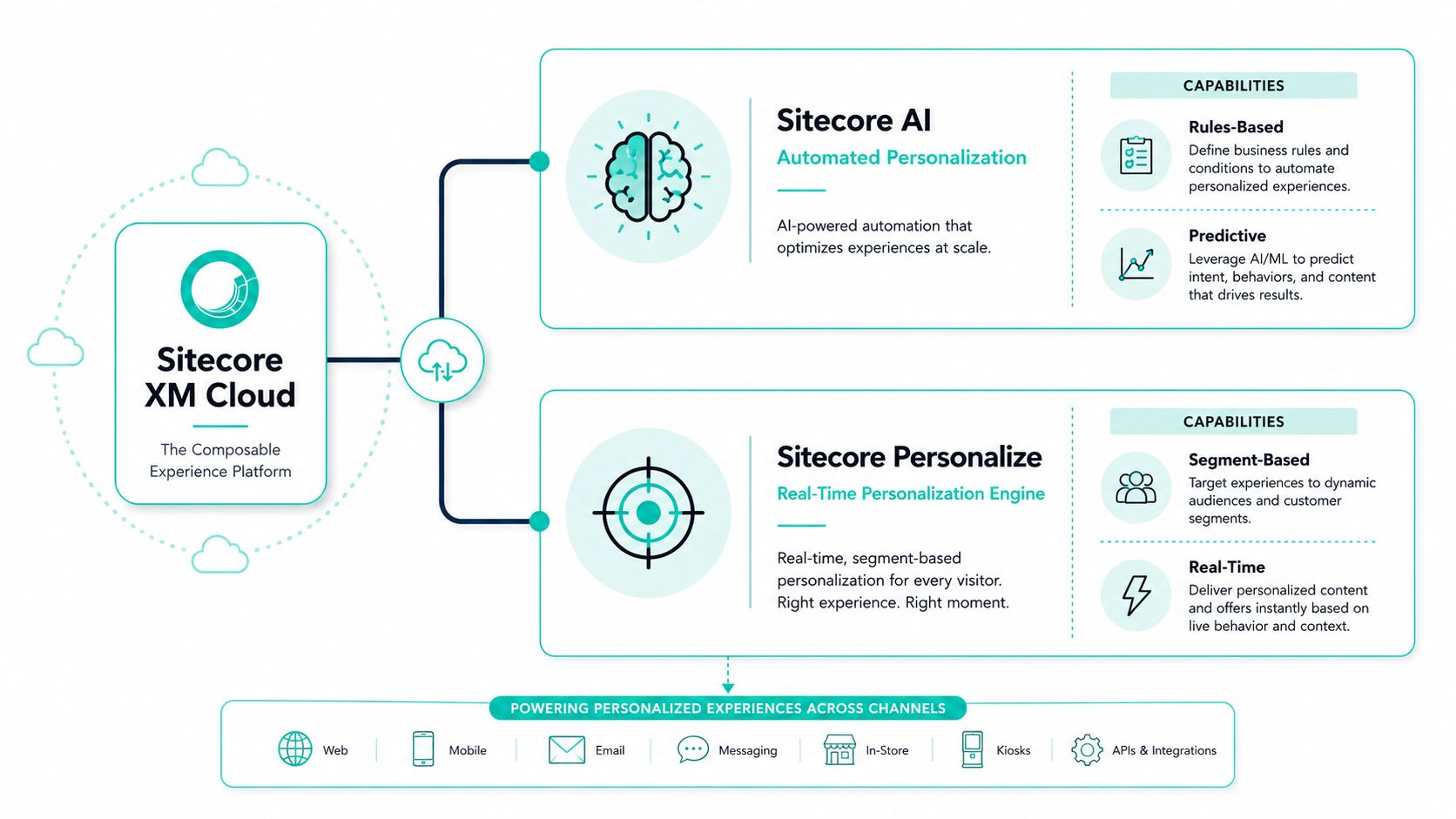
Sitecore offers two distinct routes to decisioning, and the architecture matters. Sitecore AI Automated Personalization is a SaaS capability hosted in Microsoft Azure. It uses machine learning to personalize experiences from prior visitor behavior and characteristics such as country and browser, and the documentation identifies compatibility with Sitecore XP 10.2.0 in the relevant product context, as described in Sitecore's Automated Personalization documentation.
Automated component optimization
The practical appeal of Sitecore AI Automated Personalization is that marketers can use machine learning without predefining every audience. With the Standard offering, the service can train up to 20 personalized components. If more auto-personalized components are added, Sitecore AI selects variants randomly, and the documentation says users don't need to define user segments before launching experiences, according to Sitecore's usage guidance.
That fits content swaps inside an XM or XM Cloud page template. A marketer can configure components in Pages, provide variants, and allow the service to learn which combinations perform better. It's useful for hero areas, promotional panels, category introductions, and other bounded content decisions. It isn't a substitute for a full product information model, inventory service, or cross-channel offer strategy.
Sitecore Personalize sits at a different level. Sitecore positions it as an experimentation and personalization platform powered by real-time data, intelligent decisioning, and A/B testing and optimization. Its decisioning engine uses a drag-and-drop canvas for building strategies, as shown in the Sitecore Personalize product documentation.
Personalize is better suited to decisions that span sessions, channels, and systems. It can support offer selection, audience traits, experimentation, and integrations beyond a single CMS component. In a composable architecture, XM Cloud provides the headless, cloud-native, API-first CMS foundation, while Experience Edge and the Next.js SDK support delivery. Sitecore's XM Cloud documentation describes bundled capabilities including Experience Edge, SXA, Pages, personalization, tracking, analytics, localization, and multisites, and recommends Next.js for full XM Cloud functionality, as documented in Sitecore XM Cloud.
CDP and behavioral data should flow into the decision layer with explicit ownership. XM Cloud supplies presentation and content context. Personalize can make the broader decision. Sitecore Connect and related data services move signals between the systems that need to act on them.
When Personalization Backfires and How to Prevent It
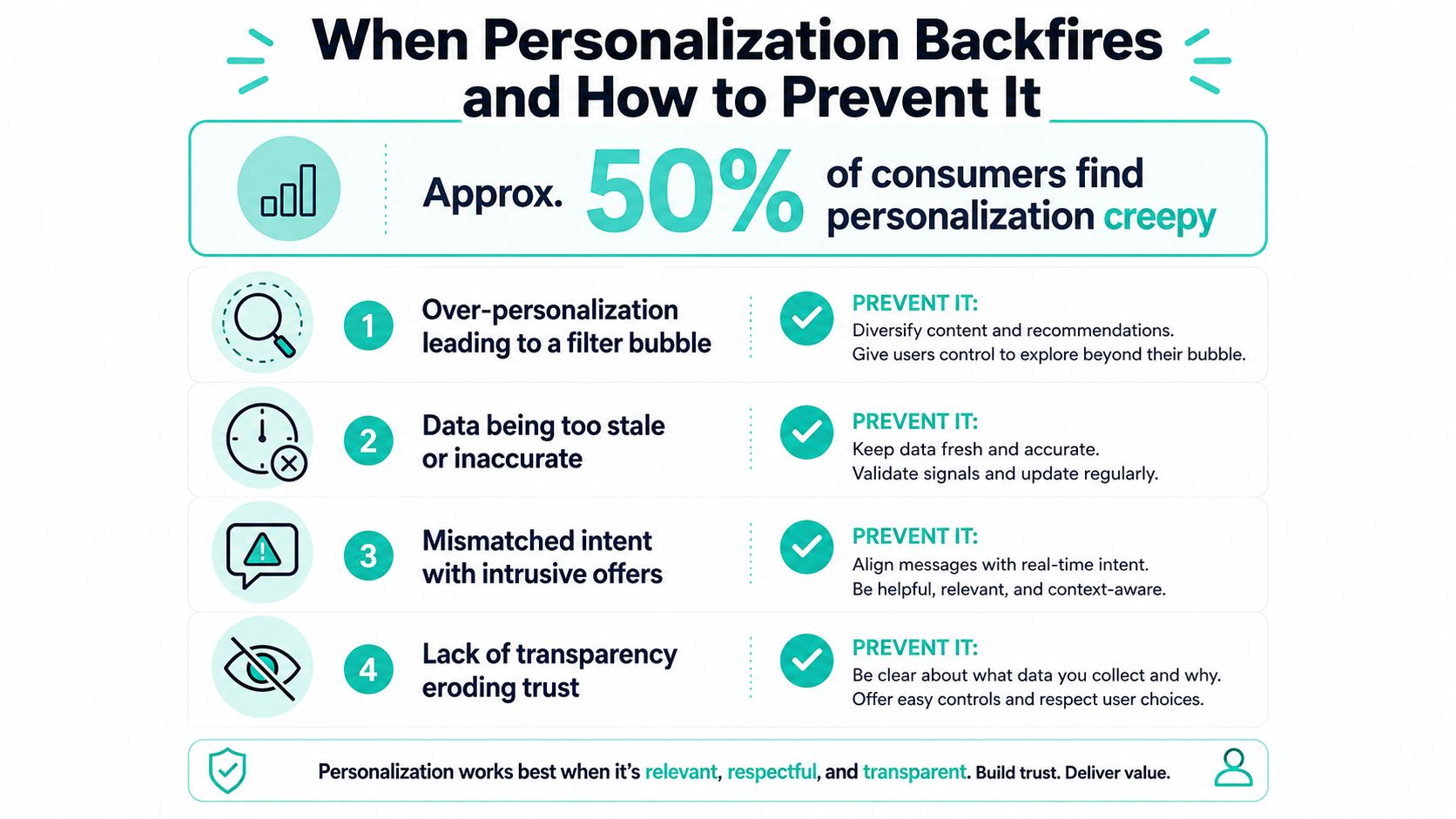
Personalization isn't automatically helpful. A 2025 Gartner finding reported in industry analysis says personalized marketing created a negative experience for 53% of customers, made customers 3.2 times more likely to regret a purchase, and left them 44% less likely to buy again, as summarized in the 2026 ecommerce personalization statistics coverage. The precise lesson isn't that personalization fails. It's that relevance, timing, transparency, and control determine whether customers experience it as assistance or surveillance.
Production failure modes
The most common failures are design failures, not missing features:
- Stale recommendations: The site promotes a product the customer just bought. Add purchase exclusions, replenishment logic, and freshness windows.
- Inventory mismatch: The engine recommends unavailable or unshippable products. Connect recommendation eligibility to current stock and market rules.
- Over-automation: Every component changes, making the experience unstable or difficult to understand. Start with a small number of meaningful decisions.
- Identity leakage: A supposedly VIP experience appears for an anonymous or misidentified visitor. Separate anonymous signals from verified profile attributes.
- Premature activation: AI decisions fire before consent is captured. Build consent state into eligibility, not as a later reporting concern.
- Poor mobile judgment: A geo-targeted overlay ignores the viewport or blocks the purchase path. Test the experience at the actual breakpoint and interaction state.
A useful diagnostic review asks who supplied the signal, how old it is, what happens when it conflicts with a newer signal, and which rule stops the experience from becoming harmful. The team should also identify a human owner who can pause a decision, inspect outcomes, and approve changes to sensitive use cases.
Trust test: If the customer would reasonably ask, “How did you know that?”, provide a clear explanation or choose a less intrusive signal.
A backfire review belongs in release management. Test consent-denied states, anonymous sessions, stale profiles, out-of-stock candidates, repeat purchasers, regional restrictions, accessibility behavior, and mobile layouts. Personalization should degrade gracefully to a coherent generic experience. A plain but accurate storefront is safer than an intelligent-looking experience that gets the customer's intent wrong.
Privacy-First Personalization With First-Party and Zero-Party Data
First-party and zero-party data give enterprise personalization a clearer basis than third-party tracking. First-party data comes from behavior on owned channels, including searches, product views, purchases, and account interactions. Zero-party data is stated directly through quizzes, preference centers, surveys, and profiles. Second-party data comes from partner sharing, so teams must set separate consent, retention, contractual, and accuracy controls.
The source of a signal should shape how the system uses it. A customer selecting a preferred category in a preference center has expressed intent directly. A product view indicates interest indirectly. Both can inform a decision, provided the profile records how each signal was collected and applies suitable confidence and expiry rules.
Consent is part of the experience
Consent works better as a visible UX choice than as a legal interruption. Ask for information when the customer can understand its value, use progressive profiling instead of a long form, and offer a preference center for correcting or withdrawing choices. If consent is denied, the storefront should continue with contextual, non-identifying experiences.
Consent rules belong in the decision architecture. Teams working on consent management platform design should define which data each experience may use, how that permission is recorded, and when the decision must stop. This keeps Sitecore Personalize and XM Cloud delivery aligned with the customer's stated choices.
Data also needs freshness controls. Profiles change over time. A declared preference may remain useful for an extended period, while a browsing signal can become irrelevant quickly. Define decay windows, re-eligibility rules, and conflict resolution before activating a segment. Current inventory, current intent, and the customer's latest stated choice should take precedence over a static audience membership.
Teams should document data lineage, purpose limitation, access controls, retention, and deletion handling. Guidance on secure handling of store data can support the platform work, while security and privacy decisions must still follow the organization's policies and regulatory obligations.
The operational problem is usually fragmented data, not a lack of personalization ideas. Real-time profile updates, identity resolution, and consent state must travel reliably between commerce systems, Sitecore Connect, Sitecore Personalize, and XM Cloud. Adding another tool does not resolve missing ownership or unclear data contracts.
A durable pattern starts with governed first-party and zero-party data, then activates only the decisions those signals support. Commerce, analytics, engineering, legal, and customer service should agree on permitted uses before launch. Consent is not a banner project. It defines the decisions the system is allowed to make.
Choosing Between Sitecore AI Automated Personalization and Sitecore Personalize
The choice is fit-for-purpose, not a simple upgrade path. Sitecore AI Automated Personalization belongs close to the CMS presentation layer and is appropriate when a team wants model-driven selection among component variants. Sitecore Personalize is a broader decisioning service for experimentation, custom traits, offers, and integrations across headless or non-Sitecore channels.
A practical comparison
| Criterion | Sitecore AI Automated Personalization | Sitecore Personalize |
|---|---|---|
| Primary job | Optimize content variants within Sitecore experiences | Orchestrate real-time decisions, offers, and experiments |
| Ownership | Marketers can configure component personalization in the CMS workflow | Marketing, product, data, and engineering teams often share ownership |
| Stack fit | Best aligned with Sitecore XM and XM Cloud page components | Works alongside XM Cloud and can serve broader channel integrations |
| Decision model | Machine learning selects among configured component variants | Visual decision strategies, testing, traits, and business logic |
| Scale boundary | Standard automated training supports up to 20 personalized components | Suited to broader decision portfolios, subject to architecture and operating cost |
| Time to value | Fast for bounded page-level content decisions | Longer setup, but stronger for reusable cross-channel decisioning |
| Best starting point | Hero, banner, category, or promotional component variants | Offers, eligibility, experiments, and decisions spanning systems |
Data volume matters, but there's no universal threshold that makes one product correct. A team with modest traffic may still use component optimization if the decision is low risk and the variants are meaningful. A team with complex identity, multiple brands, or an offer catalog may need Personalize even when the first use case is narrow, because the operating model must support more than page content.
The marketer versus engineer boundary is another branch point. Sitecore AI reduces the amount of modeling a marketer needs to design. Personalize gives teams more control, but that control brings governance, integration, testing, and monitoring responsibilities.
Headless delivery also changes the implementation. XM Cloud supports API-first delivery and Next.js, but teams must decide where the decision is made, how the selected experience reaches the frontend, and how performance behaves at the edge. Don't place a decision in the CMS merely because the CMS is familiar. Place it where the required data, latency, experimentation, and channel reach can be managed responsibly.
Putting It Together A Practical Personalization Operating Model
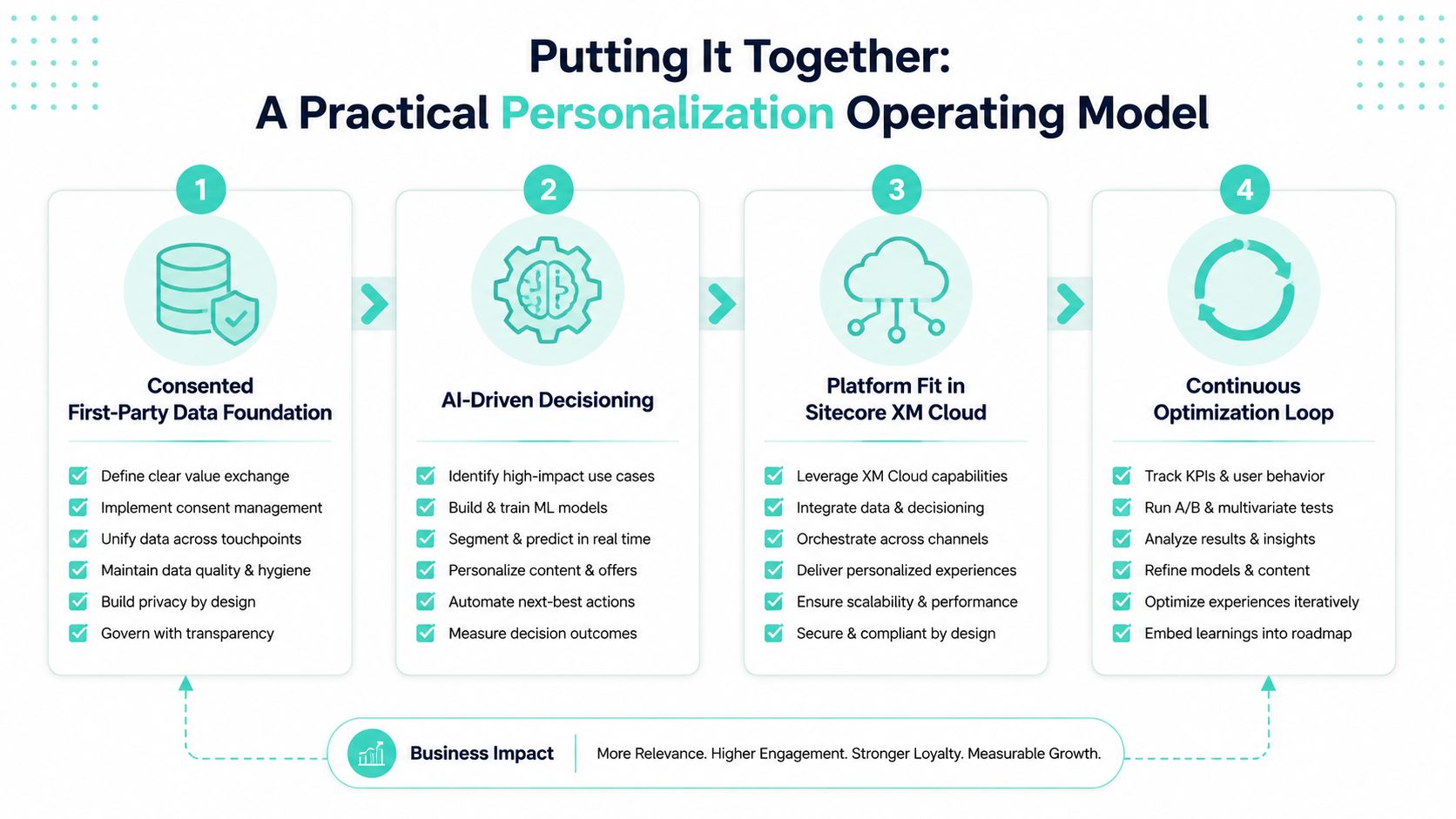
A sustainable personalization practice rests on four connected pillars: consented first-party data, AI-driven decisioning, platform fit inside Sitecore XM Cloud, and a privacy-first review loop. Each pillar needs an owner, an artifact, and a recurring quality check. Without those controls, personalization becomes a sequence of disconnected campaigns that no one can explain or maintain.
The operating cadence
Data foundation. A data engineer owns event definitions, identity rules, signal provenance, and freshness policies. The core artifact is a data contract that records what each signal means, when it expires, and whether consent is required. A quarterly audit should check missing events, duplicate identities, broken product joins, and consent-state propagation.
Decisioning. A personalization lead owns the use-case backlog, recommendation objectives, exclusions, and experiment design. The team should produce a decision brief for every launch, including the customer problem, eligible audience, fallback experience, business metric, guardrails, and stop condition. Quarterly review should retire decisions that no longer create meaningful differentiation.
Platform fit. A platform architect maps each decision to XM Cloud, Sitecore AI, Sitecore Personalize, Sitecore Connect, Experience Edge, frontend delivery, and downstream commerce services. The artifact is an architecture decision record that explains data flow, latency, ownership, deployment, and failure behavior. Review it when a new brand, market, channel, or integration enters the estate.
Privacy and consent. A compliance partner works with UX and engineering to review collection, disclosure, preference management, retention, and deletion behavior. The artifact is a consent test pack covering accepted, denied, withdrawn, anonymous, and changed-preference states. Run the checks before launch and during the quarterly review rather than treating consent as a one-time release gate.
A Head of eCommerce can paste this checklist into a planning document:
- Confirm the customer problem and the experience that will change.
- Identify the first-party and zero-party signals required.
- Define consent, retention, freshness, exclusion, and fallback rules.
- Choose Sitecore AI Automated Personalization for bounded component variation or Sitecore Personalize for broader decisioning and experimentation.
- Measure incremental revenue per visitor, conversion, AOV, relevance, and negative signals.
- Assign data, platform, personalization, and compliance ownership.
- Review the result quarterly and stop decisions that erode trust.
Kogifi designs and implements Sitecore XM Cloud, Sitecore Personalize, Sitecore CDP activation, headless Next.js estates, and Microsoft 365 and SharePoint solutions with SPFx and Power Platform integrations. If your commerce platform needs a governed personalization foundation rather than another isolated campaign, visit Kogifi to discuss the data model, decisioning architecture, and delivery roadmap with its enterprise digital experience team.