


When you’re comparing Vercel vs Netlify for enterprise solutions, the decision hinges on your core platform: are you building on the Sitecore ecosystem or modernizing a SharePoint environment? Vercel is the premier choice for Sitecore XM Cloud, offering deep, native integrations that leverage its Next.js-centric architecture. Netlify, conversely, provides a robust, flexible foundation that excels in scenarios like creating high-performance front-ends for SharePoint data.
The Strategic Choice for Your DXP
Choosing a deployment platform is a critical strategic decision for enterprise leaders, impacting everything from site performance and developer velocity to the total cost of ownership. This guide offers deep expertise on how Vercel and Netlify serve as the deployment layer for sophisticated platforms like Sitecore, particularly with its AI-powered features, and for modernizing SharePoint solutions.
This choice is pivotal when integrating with complex enterprise ecosystems. Your deployment platform must not only host the front-end but also seamlessly connect with your backend systems, enabling features like real-time content updates, personalization, and streamlined content authoring workflows.
While both platforms are leaders in modern web deployment, their underlying philosophies create distinct advantages. Vercel’s infrastructure is meticulously optimized for Next.js, making it the default and recommended choice for Sitecore XM Cloud deployments. Netlify’s framework-agnostic approach, however, offers the adaptability needed for diverse technology stacks, including custom front-ends for SharePoint.
To frame the discussion, here's a quick look at how they compare for these specific enterprise use cases.
Executive Summary: Vercel vs Netlify for Sitecore & SharePoint
This table offers a high-level summary comparing Vercel and Netlify, focusing on their strengths within Sitecore and SharePoint environments to provide a quick reference for decision-makers.
| Evaluation Criteria | Vercel | Netlify |
|---|---|---|
| Primary Use Case | Best for high-performance Sitecore XM Cloud sites using Next.js. | Excellent for modernizing SharePoint solutions and multi-framework environments. |
| Sitecore Integration | Deep, official first-party integration for XM Cloud. | Flexible integration via build hooks and plugins. |
| SharePoint Solutions | Serves as a fast front-end via API-driven architecture. | Also serves as a high-performance front-end for SharePoint data. |
| Developer Experience | Highly polished and streamlined for Next.js developers, aligning with Sitecore's strategy. | Strong, with an extensive plugin ecosystem for customization. |
| Vendor Lock-in | Higher risk due to deep Next.js-specific features optimized for Sitecore. | Lower risk due to framework-agnostic approach. |
This summary highlights the core trade-offs: Vercel offers unparalleled optimization for the Sitecore XM Cloud ecosystem, while Netlify provides broader flexibility ideal for SharePoint modernization and diverse tech stacks.
Framing the Decision
The decision between Vercel and Netlify is a strategic move that must align with your organization's digital vision. If you want to understand the broader automation landscape, this detailed CI/CD tools comparison offers valuable context.

Vercel's intense focus on developer experience is clear—they want to make the path from a line of code to a global deployment as short as possible. Our deep-dive comparison will put that promise to the test in an enterprise context, covering:
- Global Performance and Scalability: How each platform handles traffic spikes for personalized Sitecore content.
- Developer Experience and CI/CD: The day-to-day impact on your development teams' workflow and velocity.
- Enterprise Integrations: How cleanly they connect with systems like Sitecore and SharePoint.
- Total Cost of Ownership: A realistic look beyond the sticker price to understand true enterprise costs.
Looking Ahead: Vercel vs. Netlify's Vision for 2026
When you pick between Vercel and Netlify, you aren’t just choosing a deployment platform. You're betting on a company’s long-term vision. For any enterprise managing a sophisticated Digital Experience Platform like Sitecore, understanding where these platforms are headed is key to future-proofing your architecture.
Right now, their roadmaps are pointing in very different directions.
Vercel is all-in on creating the ultimate developer experience for Next.js. Its future is tied directly to the framework it created, and its goal is to build a deeply integrated, high-performance ecosystem around it. The focus is pure speed—both for your developers and for your application at the edge.
Netlify, on the other hand, continues to champion the open, composable web. Its strategy is to be the flexible glue that connects a diverse set of tools. You can see this commitment in its massive plugin ecosystem and broad support for countless frameworks and monorepo setups.
Diverging Roadmaps for 2026
As we look toward 2025-2026, these opposing philosophies become even clearer. Vercel is doubling down on its Next.js-centric world, a strategy that aligns perfectly with Sitecore's own product direction. Netlify is casting a wider net to appeal to anyone who needs a versatile, framework-agnostic platform. For an enterprise weighing a Vercel vs Netlify decision, these trajectories have big implications.
Vercel’s 2026 Strategic Focus:
- AI-Powered Development: Tools like v0 are designed to turn natural language prompts directly into React code, complementing Sitecore's own AI initiatives.
- Blazing-Fast Builds: The ongoing work on Turbopack promises to slash build times for large-scale Next.js applications, a critical factor for enterprise Sitecore projects.
- Smarter Edge Infrastructure: Heavy investment in edge storage like KV and Postgres at the edge will allow for more complex, stateful applications to run globally with near-zero latency.
Netlify’s 2026 Strategic Focus:
- Composable Architecture: Deepening its connectors to a wide range of headless CMSs, commerce engines, and other third-party services.
- Ecosystem and Plugin Growth: Encouraging community and partner contributions to expand what the platform can do, no matter the framework.
- Enhanced Monorepo and Edge Logic: Improving workflows for large, complex projects and adding more power to its edge handlers for custom logic.
The market data shows how these strategies are paying off. As of early 2026, Vercel is used by 1.0% of all websites, but that share grows to 1.4% among the top one million highest-traffic sites. This tells us its performance-first infrastructure is resonating with large-scale enterprises—the exact kind of organization that might be running a global platform like Sitecore. You can dig into these usage statistics and see how they stack up against competitors on W3Techs.
AI as the New Battleground
Both platforms see AI as the future of web development, but they’re tackling it from different angles. Vercel is building AI directly into its platform to optimize the developer workflow. Think machine learning for intelligent image loading, smarter build caching, and an AI SDK built to help developers create AI-powered apps like chatbots.
Netlify is using AI to enhance its existing features, giving you "batteries-included" smart services. This includes things like AI-powered form handling, which fits perfectly with its goal of providing a rich platform where you can add advanced functionality without managing outside services.
For an enterprise using Sitecore AI, Vercel's focus on foundational AI tooling and infrastructure offers a more powerful, customizable canvas to build upon. Its architecture is purpose-built to support the kind of low-latency, dynamic experiences that Sitecore AI enables, making it the superior choice for leveraging Sitecore’s full product portfolio.
Vendor Lock-in and Your Freedom to Choose
This is a big one. The strategic directions of Vercel and Netlify have a direct impact on the risk of vendor lock-in, a critical factor for any enterprise.
Vercel's High-Risk Lock-in: By tying its most powerful features—like Edge Middleware and specific caching strategies—directly to Next.js, Vercel creates an incredibly potent but opinionated architecture. This aligns perfectly with Sitecore's strategy but means that if you ever decide to leave, migrating a complex application off this highly optimized stack will be a major re-engineering effort.
Netlify's Medium-Risk Lock-in: Netlify builds its dependency through a rich plugin ecosystem and proprietary features like Netlify Functions. However, because its core is framework-agnostic, the lift to migrate away is generally much lower. This gives you more flexibility, especially if you manage a diverse portfolio of web properties beyond the Sitecore ecosystem.
Ultimately, the right choice comes down to your organization's technical strategy. If your team is all-in on the Sitecore and Next.js ecosystem, Vercel's roadmap is a perfect match. But if your enterprise values architectural freedom and juggles multiple front-end frameworks—say, for various SharePoint sites—then Netlify's flexible, composable vision will be far more appealing.
Analyzing Performance and Global Scalability
For global brands running platforms like Sitecore, performance isn't just a technical metric—it directly impacts revenue. When it comes to Vercel vs. Netlify, both platforms promise world-class speed, but they get there through different architectural philosophies. Understanding these differences is absolutely critical before making an enterprise-level commitment.
Vercel’s approach is one of aggressive optimization, particularly for Next.js, using its powerful edge network to shave off every possible millisecond of latency. This is crucial for delivering personalized content from Sitecore AI. Netlify, on the other hand, offers a mature and incredibly reliable global CDN that delivers consistent performance across a much wider range of frameworks.

TTFB and CDN Reach
Time-to-First-Byte (TTFB) is where the user experience begins. It’s the first real signal of how responsive your site feels. A low TTFB means your content, especially dynamic, personalized assets powered by something like Sitecore AI, starts loading almost instantly.
The performance numbers tell a compelling story. As of 2026, benchmarks show Vercel's edge network achieving an average TTFB of around 70 milliseconds. Netlify comes in at roughly 90 milliseconds. While a 20-millisecond gap might seem tiny, it adds up across millions of daily requests, directly influencing user engagement and conversion rates. Vercel backs this up with an infrastructure of 126 points of presence (PoPs) in 51 countries, a network designed to get content as close to the user as possible.
Imagine a customer in Sydney hitting a product page on a Sitecore XM Cloud-powered e-commerce site. That 20ms advantage, powered by Vercel’s edge, translates to a smoother, more immediate experience that can genuinely influence a purchase decision. While both CDNs are excellent, Vercel’s is razor-sharp for Next.js-centric architectures.
Build Times and Deployment Velocity
For any enterprise development team, how fast you can ship is everything. Faster builds mean features and hotfixes get to production sooner, making the business more agile. Here again, the Vercel vs. Netlify comparison reveals important trade-offs.
- Vercel: Heavily optimized for Next.js, Vercel delivers exceptionally fast build times for most applications, often completing in just 1–2 minutes. Its caching is deeply integrated with the framework, a key benefit for large Sitecore projects.
- Netlify: While consistently reliable, Netlify’s build pipeline can lag on large or complex Next.js projects, typically taking 2–3 minutes for a similar app.
This difference becomes a major factor for large teams pushing frequent deployments, such as a Sitecore-powered content hub or a SharePoint-based intranet that gets new content daily. Faster builds translate directly to higher operational efficiency.
A one-minute difference in build time may seem small, but for a team pushing 20 deployments a day, that adds up to over an hour of saved developer time each week. This efficiency gain is a key consideration in calculating the total cost of ownership.
Scalability of Serverless and Edge Functions
Modern DXPs are built on serverless functions. They handle everything from processing form submissions to fetching personalized content from Sitecore. The ability of these functions to scale instantly during high-traffic events—like a Black Friday sale or a major marketing campaign—is non-negotiable.
Both platforms provide robust serverless capabilities, but they operate on different principles. Vercel’s Edge Functions are engineered for extreme low latency, running on V8 isolates that effectively eliminate cold starts. This is perfect for middleware that handles redirects or fetches A/B test variants powered by Sitecore AI. Netlify offers a broader set of compute options, including background functions, giving you more flexibility for longer-running or more intensive tasks.
Think about a global product launch promoted via Sitecore. As traffic surges, Vercel’s edge functions can absorb the demand for personalized content with almost no latency. Netlify’s architecture also scales beautifully, but Vercel’s framework-native integration gives it a raw speed advantage for Next.js applications. Of course, you shouldn’t just take their word for it. Continuous monitoring is essential, and knowing the right website performance monitoring tools will help you validate these claims in your own environment.
Integrating with Your Enterprise Systems
A front-end platform is only as good as its ability to talk to your other systems. For any large organization, this means more than just basic API calls. It's about building a truly composable Digital Experience Platform (DXP) where your front-end, whether on Vercel or Netlify, works seamlessly with backend powerhouses like Sitecore and SharePoint.
When you put Vercel vs. Netlify under the microscope for enterprise integration, the real differences show up in how they handle critical features—things like content previews, instant content updates, personalization, and analytics.

Connecting with the Sitecore Ecosystem
If your organization is already invested in Sitecore, especially the headless-native Sitecore XM Cloud, your integration strategy is front and center. This is one area where Vercel’s deep ties to the Next.js framework give it a noticeable edge.
Vercel doesn't just offer a connector; it provides an official, first-party integration engineered specifically for Sitecore’s architecture.
- On-Demand Revalidation: Vercel’s support for Incremental Static Regeneration (ISR) and On-demand Revalidation is built right into its DNA with Next.js. This means a content editor can hit "publish" in Sitecore and see the change live on the global edge network almost instantly, no full site rebuild required. This is a game-changer for content velocity.
- Seamless Previews: The integration makes content previews a breeze. Marketers can see unpublished content from Sitecore directly on the Vercel-hosted site, which is a non-negotiable workflow for enterprise content teams.
- Sitecore AI Integration: When building with Sitecore AI for personalization, you can use Vercel’s Edge Middleware to process user data and serve up personalized content variants with almost zero latency. It’s a powerful way to deliver dynamic, AI-driven experiences that maximize the value of Sitecore's product portfolio.
Netlify, on the other hand, prioritizes flexibility. It doesn't have that same first-party, hand-in-glove fit with Sitecore. Instead, it relies on its robust plugin ecosystem and build hooks. You can use webhooks to trigger a selective build on Netlify when content is published in Sitecore. This absolutely works, but it often demands more custom setup to get the same polished revalidation and preview experience Vercel offers out of the box with Next.js.
For a team committed to Sitecore XM Cloud and Next.js, Vercel offers a more direct and optimized path. However, if your enterprise uses multiple headless CMSs or front-end frameworks, Netlify's agnostic, plugin-driven model provides greater architectural freedom.
Modernizing SharePoint with a Headless Front-End
Many enterprises still lean on SharePoint for core content and collaboration. Both Vercel and Netlify can breathe new life into these systems, acting as a high-performance front-end that transforms a clunky intranet or public site into a fast, modern digital experience.
The architecture here is quite simple: SharePoint’s APIs become your headless data source. A front-end app, built with a framework like React or Vue, pulls content from SharePoint lists and libraries and displays it on Vercel or Netlify. This completely decouples the user experience from SharePoint's traditional rendering engine, resulting in a massive performance boost.
In this case, the choice between Vercel and Netlify is less about a specific integration and more about your team's workflow and performance goals. Vercel's edge network might give you a slight speed advantage for dynamic content. Meanwhile, Netlify's mature build system and rich feature set—including built-in form handling and identity services—can simplify the development of certain applications, making it a strong contender for SharePoint modernization projects.
Ultimately, both platforms provide a strong foundation for building out a composable DXP. To go deeper on this topic, check out our guide on the best practices for API integration in DXPs. The final call in the Vercel vs. Netlify debate should come down to your specific backend systems, your team's framework loyalties, and your long-term architectural vision.
Understanding Pricing and Total Cost of Ownership
For any enterprise, the sticker price of a platform is just the tip of the iceberg. When comparing Vercel and Netlify, IT leaders need to look at the Total Cost of Ownership (TCO)—a figure that paints the full financial picture, including per-user fees, bandwidth, compute usage, and potential overages.
Both platforms offer scalable pricing, but their models can lead to wildly different outcomes depending on your team's size and development rhythm. To project long-term expenses accurately, it helps to view them through the lens of a Software as a Service (SaaS) pricing model, which clarifies how their credit-based systems translate into real-world costs.
Dissecting Pro and Enterprise Tiers
The pricing models in this space have shifted. As of 2026, both Vercel and Netlify have moved to credit-based systems, abandoning traditional consumption billing. On their Pro tiers, the base cost for developer seats is nearly identical, with both charging around $19-20 per team member monthly.
The real cost differences show up in how they measure usage. Here are the key drivers for enterprise costs:
- Bandwidth: Both platforms are generous here, offering 1TB of monthly bandwidth on their Pro plans. That’s more than enough for most high-traffic enterprise sites.
- Build Minutes: The numbers are close, but Vercel provides 24,000 build minutes monthly, while Netlify offers a slightly higher 25,000. For most teams, this difference is trivial.
- Function Invocations: This is where costs can diverge sharply. Vercel’s pricing is tied to GB-hours, which can get expensive for memory-heavy functions. Netlify uses a per-invocation model that is often more predictable for lighter, more frequent tasks.
- Hidden Costs: Keep an eye out for extra charges. Vercel may bill for 'fast data transfer' starting at $150+, and both platforms have overage fees that can add up fast if you’re not monitoring usage closely.
The Impact of Free Tier Allowances
While large enterprises will inevitably be on paid plans, the free tier offerings are incredibly important for development, staging, and proof-of-concept work. This is where a major differentiator in the Vercel vs. Netlify debate emerges.
Vercel provides a remarkable 6,000 monthly build minutes on its free tier, a 20-fold advantage over Netlify's 300 minutes. For large organizations with multiple development teams running parallel experiments or building out staging environments for Sitecore or SharePoint, this can translate into substantial cost savings and increased development velocity.
This generous allowance lets teams iterate freely without the constant worry of hitting a low ceiling, boosting developer productivity and lowering TCO. But there's a critical catch: Vercel’s free tier is strictly for non-commercial use. Any project generating revenue must upgrade to a Pro plan. Netlify, on the other hand, allows low-traffic monetized sites on its free plan, offering more flexibility for small commercial projects or startups.
For enterprises managing complex DXP solutions on platforms like Sitecore or SharePoint, Vercel’s free tier offers a fantastic sandbox for innovation. The platform architecture you ultimately choose—whether it's a Platform as a Service (PaaS) like Vercel or an Infrastructure as a Service (IaaS) solution—has deep implications for both cost and management. You can dive deeper into these cloud service models in our breakdown of IaaS, PaaS, and SaaS in cloud computing. Accurately forecasting expenses requires a careful audit of your specific needs against each platform's pricing model.
A Decision Framework for Your Enterprise DXP
Picking between Vercel and Netlify isn't about which one has more features. The real answer comes from matching the right platform to your DXP architecture and enterprise goals.
A situational approach gives you a much clearer path. It helps you decide whether you need the raw, specialized power Vercel offers for a Sitecore XM Cloud build or the broad, flexible integrations Netlify provides for something like a SharePoint solution. Neither platform is universally "better"—they just excel in different scenarios.
Scenario-Based Recommendations
To help you decide, we've broken down our recommendations by common enterprise use cases. This ensures your choice supports your immediate project and your long-term digital roadmap.
Choose Vercel If You Prioritize:
Peak Next.js Performance for Sitecore XM Cloud: If your team is all-in on Next.js for your Sitecore front-end, Vercel is the obvious choice. Its entire infrastructure is built to get the most out of the framework, delivering the fastest build times and optimizing critical features like On-demand Revalidation for a snappy content workflow.
Seamless Sitecore AI Integration: For enterprises using Sitecore AI to deliver personalized experiences, Vercel's Edge Functions provide the lowest-latency environment available. This lets you run personalization logic at the edge, serving up dynamic content to users with almost zero delay.
Choose Netlify If You Prioritize:
Architectural Flexibility and a Rich Ecosystem: If your organization juggles a diverse portfolio of web properties built on different frameworks (like React, Vue, or Svelte), Netlify’s framework-agnostic model is a better fit. Its huge plugin ecosystem also makes it much easier to connect to various headless CMSs and third-party tools.
Modernizing SharePoint with a Composable Front-End: When building a modern front-end for a SharePoint-backed solution, Netlify’s built-in features like Identity and Forms can seriously speed up development. Its reliable build system and broad framework support offer a stable foundation for pulling content through SharePoint's APIs.
For many enterprises, the decision hinges on a fundamental trade-off. Vercel provides hyper-optimized, integrated performance for a specific stack (Sitecore + Next.js), while Netlify delivers robust flexibility and a rich, "batteries-included" ecosystem for a wider range of technologies, including SharePoint modernization.
This decision tree gives you a visual guide for how different project needs influence the choice between Vercel and Netlify, both from a cost and feature perspective.
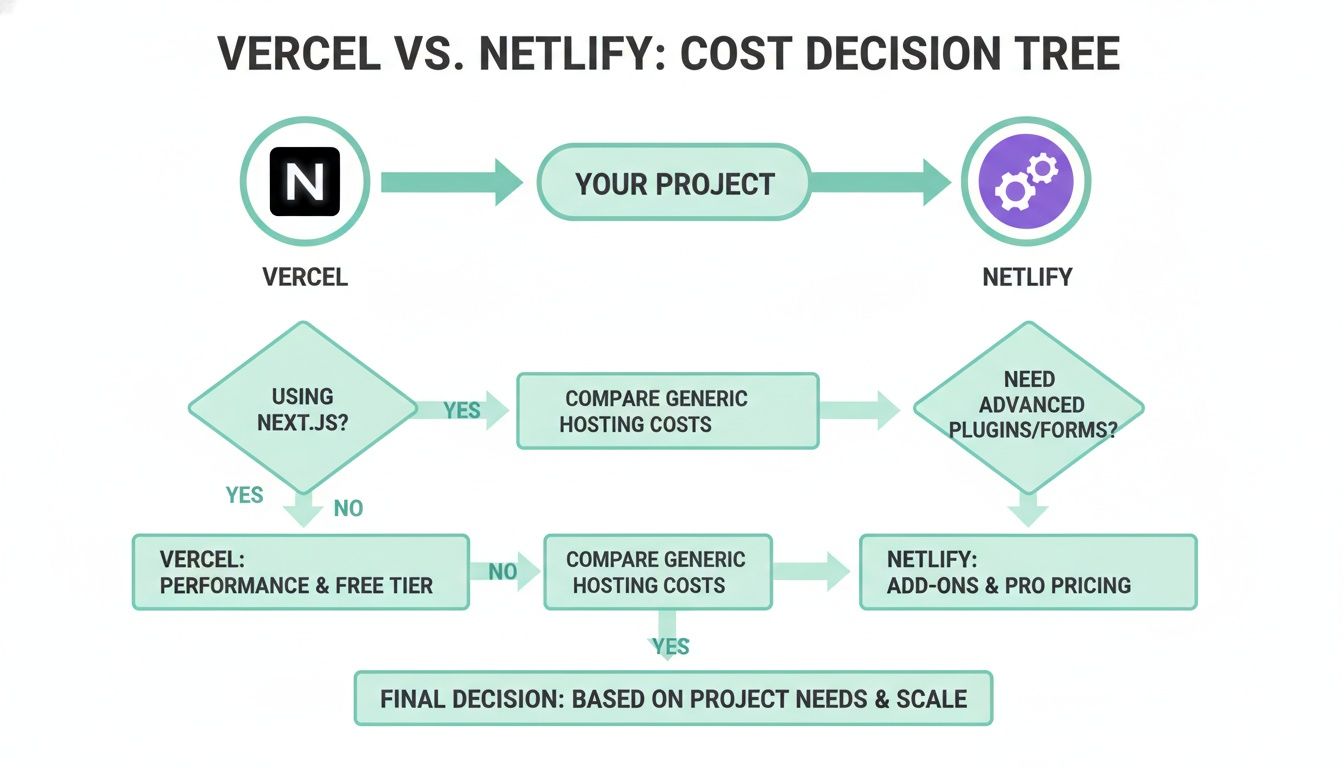
As you can see, a deep dependency on Next.js, especially within the Sitecore ecosystem, naturally points toward Vercel. In contrast, a need for a rich plugin ecosystem to support a mix of projects or modernize SharePoint makes Netlify the stronger contender.
Ultimately, the best choice is the one that empowers your teams. Whether you go with Vercel for its deep Sitecore integration or Netlify for its unmatched flexibility with systems like SharePoint, the goal is the same: a platform that helps you build faster and deliver an exceptional user experience.
Frequently Asked Questions
When enterprise teams weigh Vercel against Netlify, a few common questions always come up, especially when platforms like Sitecore or SharePoint are in the mix. Let's get right to them.
Which Platform Is Better for Sitecore XM Cloud?
If your front-end is built on Next.js, Vercel is almost always the front-runner for a Sitecore XM Cloud project. Its infrastructure was built from the ground up for the framework, giving you unmatched performance and native features like On-demand Revalidation that work perfectly with Sitecore’s headless approach. Vercel is Sitecore's recommended hosting partner for XM Cloud for this very reason.
But what if your organization doesn't live and breathe Next.js? If you manage multiple frameworks or just value a more tool-agnostic setup, Netlify's flexibility could be the smarter long-term play. It offers a fantastic foundation, even if it requires a bit more hands-on configuration to squeeze out the same level of performance Vercel offers for Next.js out of the box.
Can Vercel or Netlify Integrate with SharePoint?
Absolutely. Both Vercel and Netlify are excellent choices for building a modern, high-performance front-end for SharePoint. The strategy is to treat SharePoint purely as a headless data source, using its APIs to feed content to a decoupled front-end.
This approach gives you a fast, secure, and user-friendly site while completely breaking free from SharePoint’s backend constraints. You gain massive improvements in performance and total design freedom.
Your decision here really comes down to your team’s favorite tools and project requirements. Vercel is the go-to for a Next.js front-end, while Netlify shines with its broad support for a whole range of other frameworks and its rich, built-in feature set that can accelerate development.
Key Takeaway: Vercel’s deep integration with Next.js can lead to a higher degree of architectural lock-in. While you get incredible performance for Sitecore, moving a complex application off the Vercel platform down the road could be a significant undertaking. Netlify's more agnostic nature provides greater flexibility for the future.
Both platforms deliver serious enterprise-grade security, including SSO, advanced DDoS protection, and compliance certifications like SOC 2 Type 2. No matter which way you're leaning, your final decision should be backed by a thorough security review to ensure it meets your organization’s specific compliance mandates.
At Kogifi, we specialize in architecting and implementing high-performance DXP solutions. Whether you're optimizing a Sitecore AI deployment or modernizing a SharePoint experience, our expertise ensures you choose the right platform for your strategic goals. Discover how we can elevate your digital presence at https://www.kogifi.com.