



You launch a redesigned enterprise site. Content models are cleaner, components are reusable, personalization rules are smarter, and the executive team signs off. Then organic traffic slips.
This pattern appears more often than acknowledged. The redesign itself usually isn’t the only problem. The primary issue is that major SEO decisions were shipped as assumptions, not tested as hypotheses.
On a modern DXP, especially one built around Sitecore AI, composable services, and shared enterprise governance, small template changes can affect thousands of URLs. A modified heading pattern, a new module order, a different internal linking component, or a rewritten title strategy can either help search visibility or suppress it. ab testing seo is how you separate belief from evidence before the whole estate absorbs the change.
Why AB Testing SEO is Critical for Enterprise DXPs

Enterprise teams rarely break SEO with one dramatic mistake. They break it through well-intentioned platform changes rolled out too broadly and too quickly.
A new Sitecore component library might reorder content blocks. A search-driven content authoring workflow might shorten titles too aggressively. A SharePoint publishing update might alter heading hierarchy or inject duplicate metadata. None of those decisions look dangerous in a sprint review. In aggregate, they can become very expensive.
SEO A/B testing gives enterprise teams a controlled way to validate changes on a subset of comparable pages before they roll anything out across the full platform. Instead of asking whether a new pattern feels better, you test whether it improves organic traffic, CTR, or downstream engagement relative to a control group.
Why enterprise teams need a testing culture
Google pioneered A/B testing in 2000 to optimize the number of search results per page. Today, major players like Amazon, Facebook, and Booking.com run over 10,000 controlled experiments annually, which shows how thoroughly experimentation is embedded in mature digital operations, as noted by ConvertMate’s overview of SEO A/B testing.
That matters because the enterprise DXP problem isn’t lack of ideas. It’s lack of safe validation.
Sitecore gives teams enormous flexibility. That’s a strength, but it also means SEO outcomes are affected by template logic, rendering strategy, personalization, content reuse, and deployment governance. When teams skip testing, they turn that flexibility into risk.
A disciplined experimentation model also helps settle internal debates. SEO, UX, content, and product teams often want different things from the same page. Testing creates a neutral decision framework. If the variant wins, scale it. If it loses, retire it.
Practical rule: On enterprise websites, every reusable SEO change should be treated like product code, not editorial preference.
What ab testing seo changes operationally
At its best, ab testing seo changes how teams work, not just what they optimize.
Instead of broad releases, teams make bounded changes. Instead of arguing from best practice, they evaluate page groups with similar intent and structure. Instead of shipping a new template everywhere, they trial it on a limited cohort and watch the effect before the release train moves further.
A good overview of experimentation maturity in digital teams is Kogifi’s write-up on A/B/n testing approaches.
That shift is what turns SEO from reactive troubleshooting into a managed growth channel. On Sitecore estates, that’s often the difference between a platform that merely publishes content and one that learns from every release.
Designing Your SEO Experiment in Sitecore and SharePoint
Most failed SEO tests were poorly designed before they were poorly implemented.
The common mistake is starting with a change request. “Update titles.” “Shorten intros.” “Add FAQs.” None of those is a test yet. They’re edits. A proper experiment needs a clear hypothesis, a defined page set, and metrics that tie back to business value.
Start with a narrow hypothesis
Strong hypotheses are specific enough to disprove.
In Sitecore, that usually means picking one reusable element from a shared template or component model. That could be the title field mapping, an H1 rendering rule, body copy structure, related links block, or a content module that appears across a product family or content hub.
Use language like this:
- Template-based hypothesis: Changing the title pattern on a set of product detail pages may improve organic CTR because the current pattern hides the key differentiator too late.
- Information architecture hypothesis: Moving supporting copy higher in the rendered page may improve search relevance for pages that currently depend too heavily on tabs or accordions.
- Entity clarity hypothesis: Standardizing H1 structure across solution pages may help search engines interpret page intent more consistently.
That’s much stronger than “improve metadata.”
Choose page groups that behave similarly
Sitecore makes page grouping easier if the implementation was modeled properly. SXA tenants, reusable page types, taxonomy fields, and structured templates all help.
Your test and control groups should share the same page purpose. Don’t mix campaign pages with evergreen solution pages. Don’t test a handful of top performers against a broad pool of lower-authority pages. And don’t use pages with active merchandising or sales-team edits if you can avoid it.
For SharePoint, the same principle applies, but you often need stricter governance. Many SharePoint environments contain mixed content quality, looser publishing discipline, and inconsistent metadata. That means the page set matters even more. If the content estate is noisy, the experiment will be noisy too.
A useful adjacent framework is Kogifi’s article on multi-armed bandit testing, especially for teams deciding when they need simple control-versus-variant structure and when they need more adaptive experimentation logic.
Define one primary KPI and a few supporting metrics
If every metric is “primary,” none of them is.
For SEO tests, I usually recommend one lead metric and a small number of secondary checks:
| Measurement type | What to watch |
|---|---|
| Primary KPI | Organic traffic change or CTR, depending on the change |
| Search visibility check | Query mix and impression trend |
| Engagement check | Bounce behavior or time on page |
| Business check | Lead submissions, assisted conversions, or qualified visits |
The key is alignment. If you test title logic, CTR is usually the best lead signal. If you test body structure or internal linking components, organic traffic and on-page engagement may be more useful.
Don’t ask one experiment to prove everything. Ask it to answer one clear question and support that answer with a few surrounding signals.
Use Sitecore data where it helps
Sitecore AI and related products can add value here, but only if teams use them carefully.
Sitecore Search can surface behavior patterns and content discoverability issues. Sitecore CDP and Personalize can help segment downstream outcomes once visitors arrive. Sitecore analytics data can expose page clusters with strong opportunity, especially when the page model is clean and the tagging strategy is disciplined.
But keep the experiment itself simple. If Sitecore Personalize is already changing content by audience, don’t run an SEO structural test on the same page group without isolating that interaction. Otherwise, you won’t know which system moved the result.
What works and what doesn’t
What works:
- Reusable page types
- Stable content groups
- One change per test
- Clear success criteria agreed before launch
What doesn’t work:
- Testing pages under active redesign
- Mixing SEO changes with unrelated personalization shifts
- Using broad, fuzzy page sets
- Declaring a win because one page spiked
The planning phase feels slower. It saves time later because it gives the result a chance to mean something.
Choosing Your Implementation Server-Side vs Client-Side
The implementation choice determines whether your test is SEO-safe or SEO-fragile.
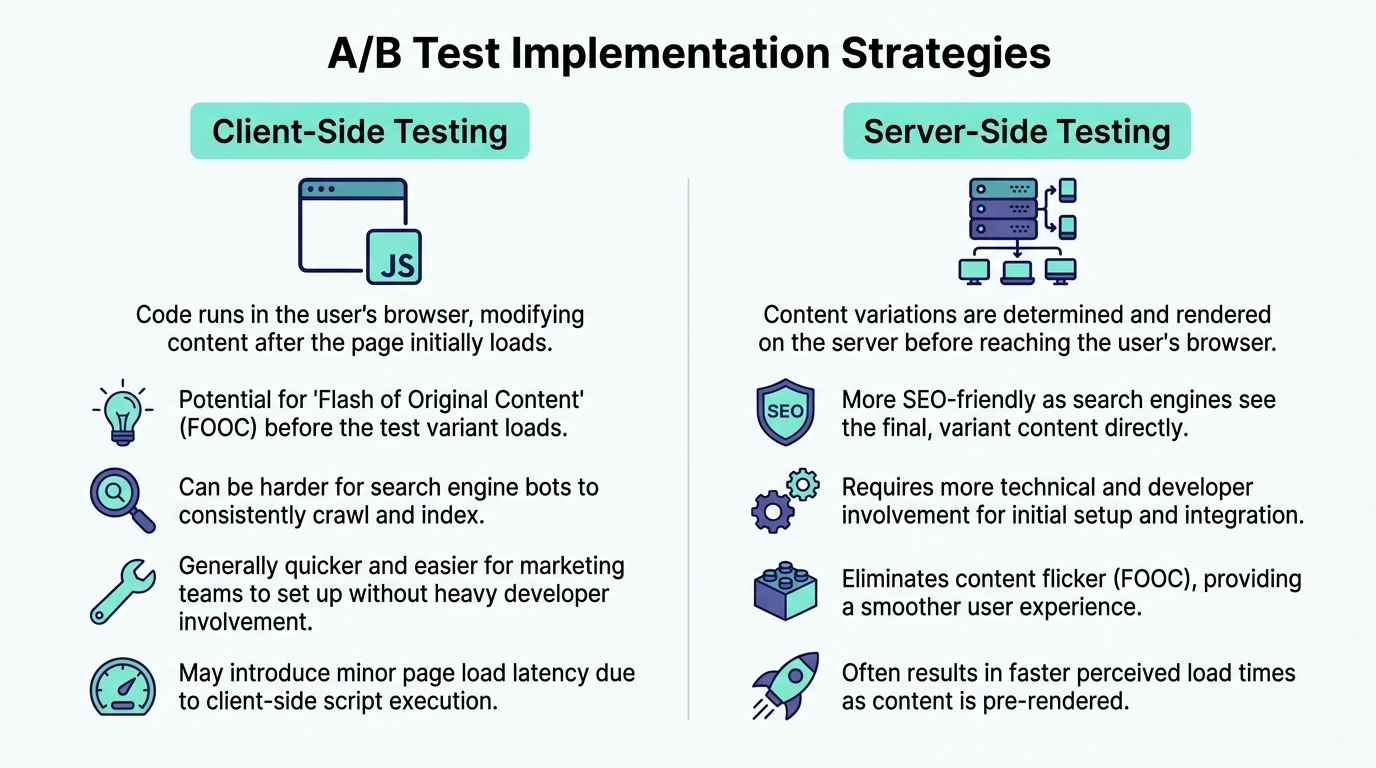
Marketing teams often prefer the path with the least engineering effort. That usually points to client-side testing, where JavaScript changes the page after it loads in the browser. It’s fast to launch and easy to tweak. For enterprise SEO, it’s also where many avoidable problems start.
Why client-side testing creates SEO friction
Client-side tools are common in CRO programs because they can swap headlines, buttons, or layouts without touching the server response.
That convenience comes with trade-offs:
- Content flicker: Users may briefly see the original version before the script applies the variant.
- Rendering inconsistency: Search engines and users may not always receive the same effective version at the same moment.
- Performance overhead: Additional scripts can slow rendering and complicate debugging.
- Governance drift: Teams can launch tests outside the normal release process, which creates hidden dependencies.
On a Sitecore estate, those issues get worse when multiple scripts interact with personalization, consent tooling, analytics, and component hydration.
Why server-side testing is the better fit for SEO
Server-side testing renders the chosen variant before the page reaches the browser. That gives both users and crawlers a stable output.
For SEO work, that’s the standard I trust most. It reduces flicker, keeps markup cleaner, and gives the technical team a better shot at preserving crawlable, indexable content states.
Sitecore is well suited to this model because the platform already controls rendering decisions through templates, components, rules, and delivery architecture. In XM Cloud and composable setups, teams can implement variant logic at the rendering or edge layer instead of bolting it on after the fact.
For SharePoint, this is less elegant, but still workable. If native testing controls are limited, teams can use a controlled middleware or edge layer to decide variants before delivery. The principle stays the same. Don’t ask the browser to clean up what the server should have decided.
If your organization is also modernizing analytics architecture, this guide to server-side tracking is useful background because it explains why moving logic closer to the server improves reliability and data quality. The same architectural instinct helps with SEO testing.
Kogifi also has a relevant perspective on server-side tracking in enterprise digital environments, especially where data governance and composable architecture intersect.
Server-side vs client-side SEO A/B testing
| Attribute | Server-Side Testing | Client-Side Testing |
|---|---|---|
| Variant delivery | Rendered before response reaches browser | Changed after initial page load |
| SEO stability | Stronger, because crawlers see final rendered variant directly | Weaker, because rendering can vary by execution timing |
| User experience | No visible flicker in normal operation | Higher risk of flash of original content |
| Implementation effort | Higher initial engineering involvement | Faster for marketing-led setup |
| Governance | Easier to align with release controls | Easier to bypass platform discipline |
| Sitecore suitability | Strong fit for component-driven delivery | Usually best kept to non-SEO UX tests |
When client-side can still be acceptable
There are limited cases where client-side is fine.
If the test changes a non-indexed interaction that won’t affect crawlable content, metadata, or core page meaning, the risk is lower. For example, testing CTA phrasing for signed-in users isn’t the same as testing H1s, internal links, or body copy exposed to search engines.
That distinction matters. Many teams say they are running “SEO tests” when they’re running user interface experiments on organic landing pages. Those are not the same thing.
Server-side is the safer default for any test that changes content search engines use to understand, rank, or present the page.
The architectural trade-off that matters
Client-side gets you speed at launch. Server-side gets you trust in the outcome.
On enterprise platforms, trust matters more. If your result is contaminated by rendering inconsistency, script timing, or hidden interactions with personalization, you may still get a number at the end, but you won’t get a decision you can scale confidently.
That’s why serious ab testing seo on Sitecore should start with delivery architecture, not just experimentation software.
Executing a Test in Sitecore without Harming SEO
Once the test is live, the job shifts from design to containment.
Most SEO damage during experimentation doesn’t come from the hypothesis. It comes from poor execution discipline. Teams launch overlapping variants, expose duplicate versions, let personalization interfere, and forget that crawlers are also part of the audience.

Control the canonical signal
Running multiple overlapping A/B tests without proper canonicalization can lead to duplicate content issues and crawl budget wastage, as search engines index different versions of the same page. This is especially critical on enterprise platforms like Sitecore, where the scale of content delivery can multiply the negative impact exponentially, as described in Search Engine Land’s guidance on SEO A/B testing pitfalls.
That warning isn’t theoretical. On large Sitecore estates, even a small canonical mistake can spread through a shared rendering or layout and affect a huge URL footprint.
The first rule is simple. Every test variant must preserve the intended canonical version unless the test explicitly requires a different indexation strategy.
In practice, that means:
- Variant pages shouldn’t self-canonicalize by accident
- Rendered alternates shouldn’t create crawlable duplicate URLs unless intentionally designed
- Template and component logic must be checked in the final HTML, not assumed from configuration
Stagger tests instead of stacking them
Sitecore can support many parallel initiatives. That doesn’t mean one page group should carry them all.
If SEO is testing title logic while another team is adjusting personalization rules and a third team is changing component order, the result won’t isolate anything useful. Worse, crawlers may process mixed states over time.
Use a release discipline like this:
- Freeze unrelated edits on the selected page set during the live test window.
- Limit the test to one major SEO variable per page group.
- Sequence adjacent experiments rather than running them concurrently on the same templates.
- Document exposure rules so SEO, product, analytics, and content teams know exactly what changed and where.
The cleanest SEO experiment often feels operationally inconvenient. That inconvenience is the price of getting a result you can trust.
Keep Googlebot’s view boring
This is one area where “boring” is good.
Googlebot should encounter stable, crawlable pages with consistent canonical, metadata, and internal linking signals. If your testing setup creates temporary states that humans barely notice but crawlers can access, you’re teaching search engines to waste time on versions that don’t deserve indexation.
For Sitecore implementations, I recommend checking these items before launch:
| Execution checkpoint | Why it matters |
|---|---|
| Canonical output in final HTML | Prevents authority from splitting across variants |
| Metadata rendering logic | Avoids accidental title and description inconsistencies |
| XML sitemap treatment | Keeps temporary experiment URLs out of discovery paths when needed |
| Internal links between variants | Prevents crawl paths you didn’t intend |
| Personalization overlap | Reduces mixed signals for both users and crawlers |
A broader operational checklist for technical implementation lives in Kogifi’s article on how to implement search engine optimization.
Sitecore-specific safeguards that work
The best Sitecore setups treat SEO experiments as governed renderings, not ad hoc content edits.
That usually means:
- Use component-level flags instead of cloning full pages where possible.
- Separate authoring visibility from delivery logic so editors don’t accidentally modify only one branch of a test.
- Log variant assignment rules in deployment notes and analytics annotations.
- Test final output at the edge if CDN or middleware logic influences what’s served.
For teams using Sitecore Personalize or Sitecore Search, be careful with hidden interactions. If personalized content blocks appear within the experiment area, the “SEO test” can become a moving target. The safer pattern is to keep search-facing structural tests outside audience-specific runtime variation.
What not to do
Don’t do these:
- Don’t launch multiple SEO experiments on the same URL set at once
- Don’t rely on authors to manually preserve canonical consistency
- Don’t create test URLs that linger after the experiment ends
- Don’t assume a JavaScript-rendered change is harmless just because users can see it
The execution phase is where enterprise discipline matters most. A good hypothesis can survive a mediocre result. A bad technical rollout can damage the site long after the test itself is forgotten.
Measuring Impact and Validating SEO Test Results
An SEO test isn’t finished when the variant goes live. It’s finished when the team can explain what changed, what probably caused it, and whether the outcome deserves rollout.
That sounds straightforward until practicalities interfere. Other channels contribute traffic. Sales campaigns start. content teams publish updates. personalization engines alter downstream journeys. On enterprise DXPs, proving business impact is harder than spotting a directional movement in search data.

Start with the test outcome, not the story you want
Many enterprise teams struggle to calculate the true ROI of SEO A/B testing, as they can’t easily isolate test results from other marketing channels, especially on personalized DXP implementations like Sitecore AI. That creates a blind spot when teams try to justify testing investment and resource allocation, as outlined by Advanced Web Ranking’s discussion of SEO A/B testing ideas.
The practical response is to evaluate in layers.
First, determine whether the test changed the search-facing metric it was meant to affect. If the experiment targeted title patterns, look at CTR and related query behavior. If it changed on-page structure, review organic traffic and engagement on the tested page group relative to the control.
Only after that should you expand into commercial impact.
Validate before you celebrate
A result that looks positive at a glance may still be noise.
That’s why teams should have a defined method for reviewing significance, confidence, and possible contamination. If your analysts need a plain-English refresher on the mechanics, this resource on testing statistical significance is a useful reference.
What matters operationally is consistency:
- Use the same decision rule each time
- Record external events during the test window
- Check whether control and variant diverged in a way that fits the hypothesis
- Avoid cherry-picking a short date range that flatters the result
A trustworthy negative result is more valuable than a flattering positive result nobody can reproduce.
Connect SEO outcomes to business outcomes in Sitecore
Here, Sitecore’s broader product portfolio can help, if the architecture is clean.
Sitecore CDP can help map post-click behavior from tested pages into customer journeys. Sitecore Personalize can show whether visitors from the winning page set behaved differently downstream, though teams need to make sure personalization itself didn’t distort the experiment. Sitecore analytics layers can support segmentation by page type, audience cohort, and content path. In this context, Sitecore’s broader product portfolio can help, if the architecture is clean.
A practical enterprise measurement model looks like this:
| Layer | Question |
|---|---|
| Search layer | Did the tested page group outperform the control on the target SEO metric? |
| Engagement layer | Did visitors behave differently after arriving? |
| Pipeline layer | Did the quality of visits change, not just the quantity? |
| Operational layer | Was the gain worth the engineering, content, and governance effort? |
That last row is often ignored. It shouldn’t be.
If a test requires heavy template rework, author retraining, QA time, and release coordination, the business case needs to account for that effort. Some wins are real but too expensive to scale. Others are modest in search terms but easy to deploy broadly, which makes them more valuable over time.
Separate attribution from over-attribution
One of the biggest measurement mistakes is forcing every positive downstream change to belong to SEO.
Don’t do that. Organic search can introduce the visit without owning the conversion outright. On enterprise B2B sites, especially those using Sitecore AI for customized journeys, multiple touches often shape the outcome. The goal isn’t to claim everything. It’s to show whether the tested SEO change contributed meaningfully enough to justify rollout.
Use clear language with stakeholders:
- Direct effect: The tested pages improved on the primary SEO metric.
- Observed downstream effect: Post-click behavior also improved or held steady.
- Business interpretation: The change appears worth scaling, or it doesn’t.
That level of honesty builds credibility. It also makes future tests easier to approve because the organization trusts the reporting.
Rollback Strategies and Scaling Your Wins
Every SEO test needs two pre-approved endings. One for losers. One for winners.
Teams usually plan for success and improvise failure. That’s backwards. On a large Sitecore implementation, rollback should be defined before launch, because the cost of confusion grows fast when templates, renderings, and shared components are involved.
How to roll back cleanly
If the variant underperforms, remove it quickly and remove it completely.
A clean rollback usually follows this sequence:
- Revert the rendering or rule, not just the visible content. If the test changed logic in a shared component, roll back the code or configuration path that introduced it.
- Confirm canonical and metadata output after rollback. Some issues linger in partials, caches, or delivery layers.
- Close the experiment in analytics tooling so reporting windows don’t blur the before and after state.
- Document what failed and why the team believes it failed. That record matters later.
Rollback isn’t an admission of failure. It’s a core feature of disciplined experimentation.
How to scale a winning variant across Sitecore
Winning changes should be industrialized, not copied manually. Sitecore’s component model demonstrates its value here. If the successful test lives in a reusable rendering, title generation rule, page design, or SXA-compatible structure, rollout can be coordinated through the shared architecture rather than page-by-page editing.
Good scaling patterns include:
| Scaling approach | Best use |
|---|---|
| Shared rendering update | When the winning change is component-based |
| Template standardization | When the win depends on structured fields or content rules |
| SXA partial design rollout | When layout consistency drives the gain |
| Authoring governance update | When editors need new rules to preserve the pattern |
For SharePoint, scaling is often more governance-heavy. You may need publishing controls, approved page layouts, content owner training, and stronger review workflows to keep the winning pattern intact. The platform can support repeatability, but usually with more process than Sitecore.
Build a testing memory, not just a testing calendar
The most effective enterprise teams don’t just run tests. They build a library of operational knowledge.
That means each experiment should leave behind:
- The hypothesis
- The page set
- The implementation method
- The observed outcome
- The decision taken
- The follow-up recommendation
Teams get better at ab testing seo when they can reuse what they’ve learned, not when they merely increase test volume.
Over time, that record becomes a practical asset for platform governance. It helps content teams avoid repeating weak ideas. It helps architects spot patterns in what scales. It helps leadership fund experimentation because the program stops looking like a sequence of isolated bets and starts looking like a managed capability.
A mature Sitecore organization eventually reaches a useful state. SEO tests no longer feel like exceptions. They become part of release planning, template design, AI-driven optimization, and post-launch governance.
If your team is running Sitecore AI, SharePoint, or a composable DXP and wants a more reliable way to test SEO changes without risking crawl issues, broken attribution, or weak rollout governance, Kogifi can help design the architecture, delivery model, and measurement framework needed to make experimentation work at enterprise scale.