


A campaign is ready to launch, traffic is building, and the marketing team needs one more landing page. Instead of publishing it independently, they're waiting for a release train because the change touches a shared SharePoint farm or Sitecore XP instance. At the same time, a personalization API is competing for resources with content delivery, and one failing integration threatens the entire digital experience.
That's the point where Azure microservices architecture becomes more than a cloud-native slogan. The practical objective isn't to rewrite every legacy system. It's to create a delivery substrate where high-change capabilities can be deployed, scaled, observed, and secured independently, while established platforms continue doing the work they already do well.
Microservices had already become an established enterprise pattern by 2020. O'Reilly reported that 77% of respondents had adopted microservices, 92% of adopters considered the approach successful, and 29% were migrating or implementing a majority of their systems with microservices. The report also found that 61% had used microservices for at least a year, while 28% had used them for at least three years. (O'Reilly's microservices adoption report)
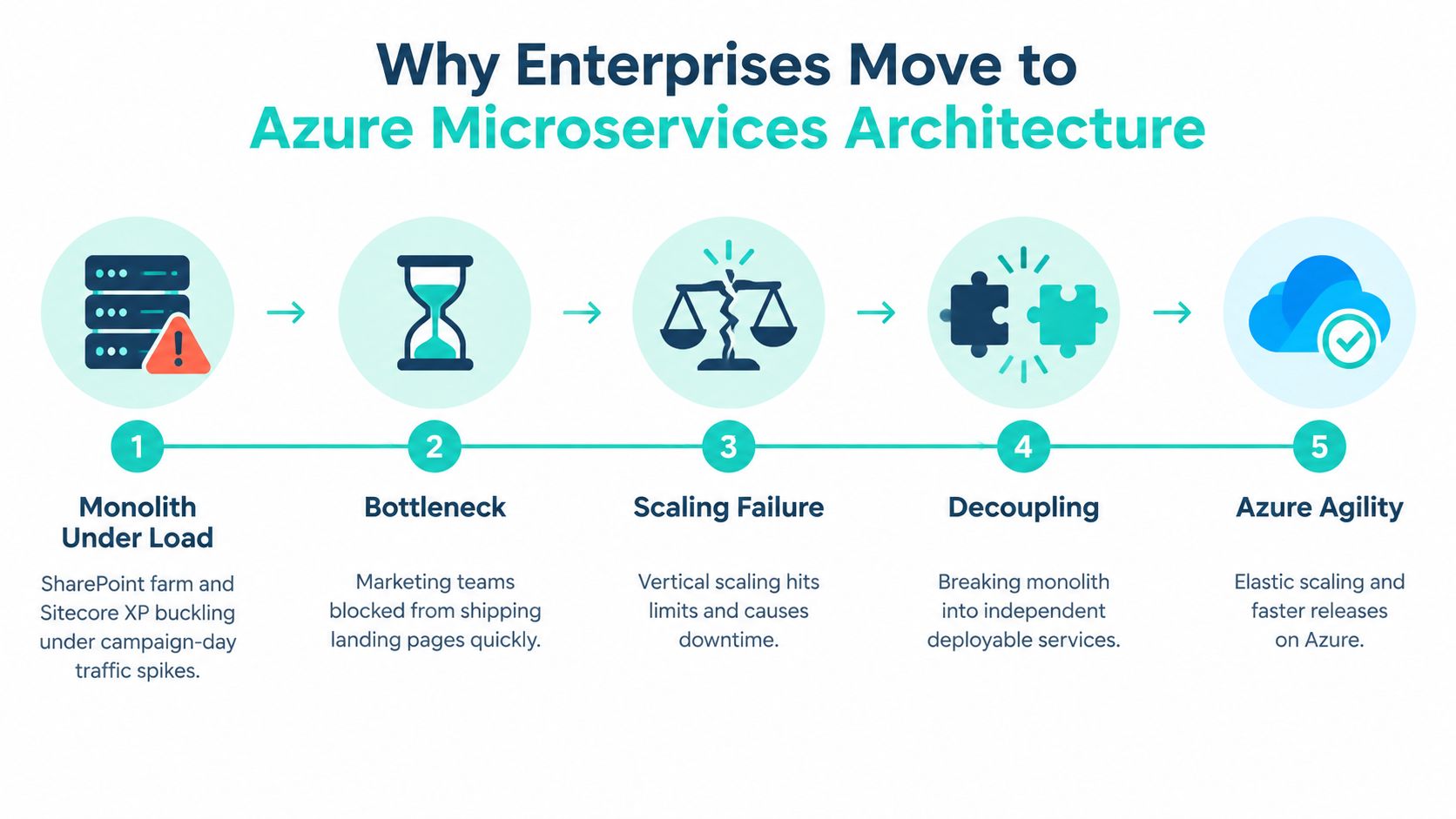
Table of Contents
Why Enterprises Move to Azure Microservices Architecture
The breaking point usually arrives through ordinary operational pressure. A Sitecore XP instance or SharePoint farm may still serve content reliably, but campaign-day demand exposes scaling limits. Marketing wants to release a new experience without waiting for infrastructure work, while IT has to coordinate a deployment that also contains unrelated search, personalization, and integration changes.
The architecture becomes a candidate for decomposition when three pressures appear together:
- Release pressure: Teams need to publish and change selected capabilities without rebuilding the entire experience.
- Uneven scaling: Content delivery, personalization, search indexing, and asset processing rarely consume resources in the same way.
- Failure isolation: A broken webhook, search worker, or downstream partner API shouldn't make the whole portal unavailable.
The useful question isn't, “Can we turn this CMS into microservices?” It's, “Which capabilities need independent ownership, deployment, and scaling?” A content API may need predictable low-latency capacity, while image transformation can wait for an event and process asynchronously. A personalization service may require long-running containers, but a form submission handler may fit a serverless execution model.
Practical rule: Decompose around business capabilities and operational behavior, not around every technical layer in the existing monolith.
This is also why a platform engineering approach works better than a wholesale rewrite. Keep the system of record where it makes sense, then place independently evolving services around it. A headless Sitecore delivery layer, a SharePoint extension service, a search indexer, and a campaign automation worker can share identity, networking, observability, and deployment controls without becoming one tightly coupled application.
Teams planning this transition should also understand how composable delivery principles affect ownership and integration boundaries. The MACH architecture principles provide useful context for separating capabilities while preserving an intentional platform model.
This guide focuses on the decisions that determine whether the result remains operable: AKS versus Service Fabric versus Functions, Dapr for shared service plumbing, CI/CD, observability, readiness assessments, and the way Sitecore XM Cloud and SharePoint Online intranets use the same Azure foundations.
Core Building Blocks of an Azure Microservices Architecture
Start with vocabulary before selecting compute. A microservice is an independently deployable unit organized around a focused business capability. It should expose a clear API or event contract, own the data needed for its responsibility, and avoid reaching directly into another service's private storage.
For a digital experience platform, that might mean separate services for personalization decisions, search indexing, media transformation, identity-aware profile enrichment, or campaign orchestration. It doesn't mean every controller or database table deserves its own container.
Think like a publishing newsroom
A useful analogy is a publishing newsroom. The search desk owns indexing decisions, the media desk owns asset processing, and the personalization desk owns audience rules. Each desk can work independently, but all of them follow shared editorial standards for identity, access, publishing events, logging, and incident response.
Azure supplies the equivalent platform layer:
- API Management provides a governed front door for APIs, policies, authentication, throttling, and versioning.
- AKS or Azure Container Apps hosts containerized services, with the choice depending on how much orchestration control the platform team needs.
- Azure Service Bus and Event Grid support asynchronous communication for content updates, webhooks, indexing, and downstream workflows.
- Azure Cosmos DB or Azure SQL can provide service-owned persistence, selected according to consistency, query, relational, and operational requirements.
- Azure Key Vault stores secrets and certificates, while managed identity reduces the need for applications to carry credentials.
- Azure Front Door and a CDN provide global routing and content delivery for public experiences.
The gateway shouldn't absorb business logic. It should authenticate requests, apply policy, route traffic, and expose a stable contract while services evolve behind it. Similarly, an event bus should communicate meaningful domain events, not become a dumping ground for arbitrary internal messages.
Service boundaries deserve more attention than container definitions. Poor boundaries create excessive synchronous calls, shared database dependencies, and coordinated releases. That produces a distributed monolith, with the network adding latency and failure modes without giving teams meaningful independence.
Teams building or operating this model can use this practical resource on managing microservices in production to pressure-test ownership, deployment, and runtime practices. For the wider platform context, cloud-native architecture helps connect independently deployable services with managed infrastructure and automation.
Choosing AKS, Service Fabric, or Azure Functions
There isn't one correct Azure compute service for every part of a DX platform. The right choice depends on runtime control, state requirements, execution shape, team capability, and the latency contract promised to users.
AKS is the strongest fit when the organization wants Kubernetes control, consistent deployment patterns across regions, sidecar-based infrastructure, and long-running container workloads. Personalization APIs feeding a Sitecore XM Cloud experience often need stable process behavior and controlled scaling. AKS also supports mature GitOps, ingress, policy, and service mesh patterns, but the platform team owns more operational complexity.
Service Fabric makes sense in narrower situations. It remains relevant for stateful services that use reliable collections or the actor model, and for organizations already operating a Service Fabric estate that can move into Azure without replacing its orchestration model. It's a poor default for a new DX platform if the team lacks existing Service Fabric skills or if managed container platforms already satisfy the workload.
Azure Functions paired with Container Apps works well for bursty, event-driven jobs. Blob-triggered image resizing, webhook receivers, scheduled rule evaluation, and lightweight integration handlers don't need a permanently running Kubernetes deployment. Functions reduce infrastructure management, but consumption-oriented execution introduces cold-start considerations that can conflict with strict digital experience latency budgets.
| Dimension | AKS | Service Fabric | Azure Functions / Container Apps |
|---|---|---|---|
| Best fit | Long-running APIs, complex container estates, controlled orchestration | Stateful services and existing Service Fabric investments | Event-driven jobs, integrations, bursty workloads |
| Operational control | Highest control and highest platform responsibility | Strong control within the Service Fabric model | More managed, with less infrastructure ownership |
| Scaling model | Cluster capacity and workload scaling | Cluster capacity and service scaling | Execution or application scaling, depending on service |
| DX example | Personalization API or custom BFF | Existing stateful orchestration service | Blob processing or webhook receiver |
| Main trade-off | Reserved node capacity and Kubernetes operations | Narrower fit and specialized skills | Cold starts, runtime constraints, and distributed diagnostics |
The cost shape matters as much as the technical shape. AKS commonly carries reserved node capacity even when individual services aren't busy, while Functions can align spend more closely with execution but may need warm instances or a different hosting plan for latency-sensitive paths. Container Apps sits between those models, providing managed container hosting without requiring the full Kubernetes operating surface.
A useful modern system architecture guide can help frame the decision against broader architectural concerns rather than treating compute selection as an isolated product comparison. For teams deciding how much orchestration they need, Docker Compose versus Kubernetes offers a practical contrast in local simplicity and production control.
My default recommendation is a primary container substrate plus Functions for glue. Use AKS where platform consistency and runtime control justify the operating cost. Use Functions or Container Apps where the work is naturally asynchronous, short-lived, or integration-focused. Don't deploy every endpoint to Kubernetes because Kubernetes is available.
Service Mesh, Dapr, and Cross-Service Plumbing
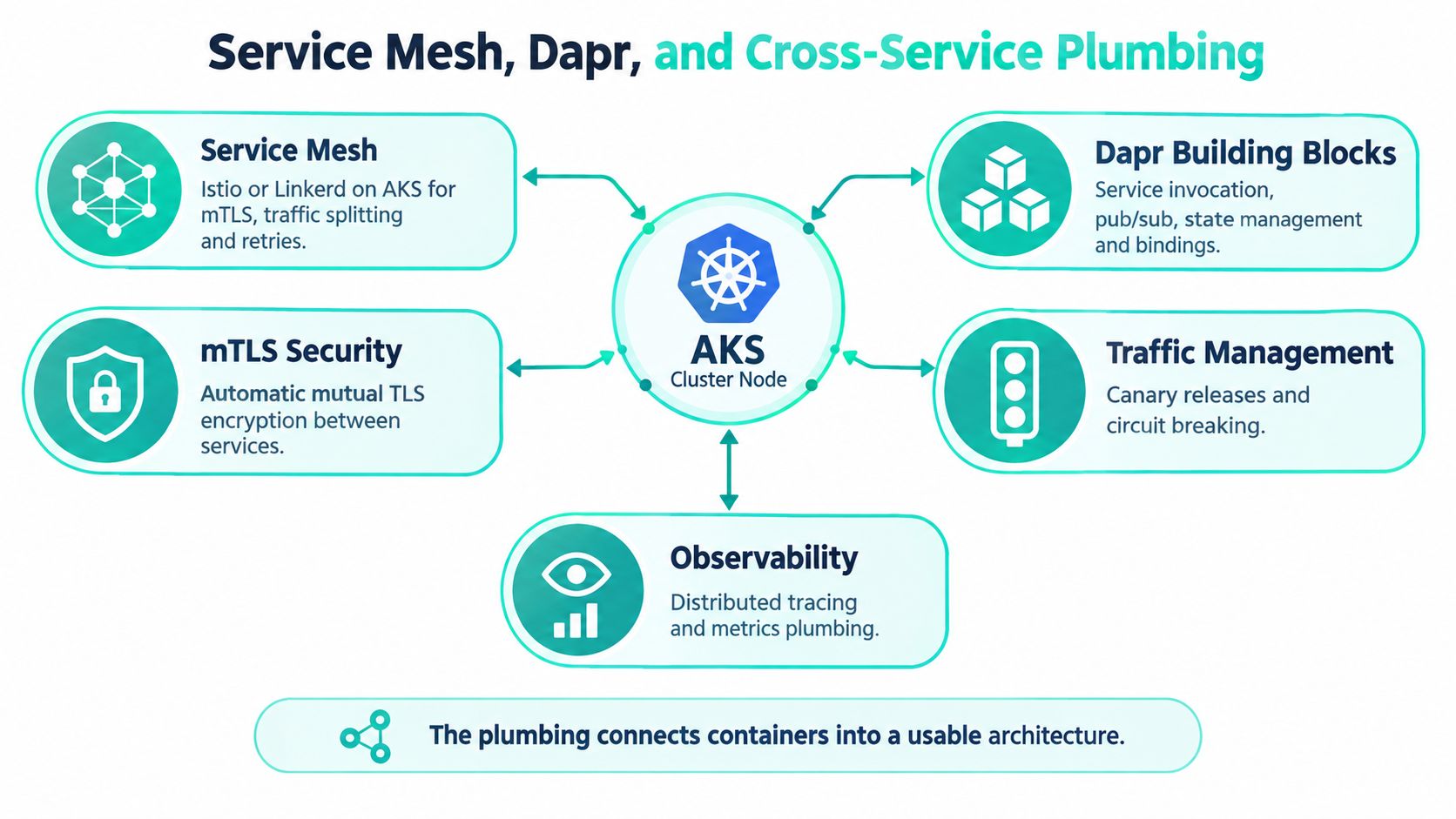
Containers become a usable platform only when teams solve the communication problems around them. Service discovery, retries, encryption, traffic policy, secrets, state, events, and tracing all need consistent behavior. If every development team implements those concerns independently, the estate becomes difficult to secure and diagnose.
On AKS, Istio or Linkerd can provide service mesh capabilities such as mutual TLS, traffic splitting, retries, and policy enforcement. A mesh becomes more valuable as service interactions multiply, particularly when teams need canary releases, circuit-breaking behavior, or consistent east-west security. It also adds sidecars, configuration, upgrades, and debugging overhead, so it shouldn't be installed by reflex.
Use Dapr to standardize application plumbing
Dapr provides a different abstraction. Its sidecar exposes building blocks for service invocation, state management, pub/sub, bindings, and secrets. Microsoft documents Dapr state management as generally available, with pub/sub components backed by services including Azure Cosmos DB, Azure Blob Storage, Azure Table Storage, Microsoft SQL Server, Azure Service Bus, and Azure Event Hubs. (Microsoft's Dapr overview for Azure Container Apps)
That separation keeps a service from hard-coding every storage and messaging SDK. A content event publisher can use Dapr pub/sub while the platform team selects an appropriate Azure component. The application remains focused on publishing a business event, while delivery, component configuration, and credentials stay in the platform layer.
Ingress normally combines Azure Application Gateway or API Management with identity policy. API Management can validate Microsoft Entra ID tokens and OIDC scopes before forwarding requests. Mesh policy then governs service-to-service traffic inside the cluster. Those layers should complement each other, not duplicate opaque authorization logic in every service.
Use less machinery for simple workloads. A small Functions endpoint may only need managed identity, Key Vault integration, and Application Insights. Adding a mesh and multiple sidecars to a trivial webhook creates an operational burden without improving the user experience.
The following video provides a visual treatment of how service mesh and Dapr concepts fit together:
CI/CD, Observability, and Readiness Assessments
A microservices platform fails when delivery and operations remain centralized in theory but fragmented in practice. Each service needs a repeatable path from source control to production, with policy checks that prevent an unsafe image, configuration, or dependency from reaching users.
A practical pipeline can use GitHub Actions or Azure DevOps to build and sign container images, run unit and integration tests, scan dependencies, and publish artifacts to Azure Container Registry. Helm-based releases can move through blue-green or canary environments on AKS, while Flux or ArgoCD reconciles the desired state. Promotion should depend on policy and security checks, not on someone manually confirming that a deployment “looks fine.”
Make failure visible
Microsoft's Azure guidance recommends testing partial-failure behavior through chaos engineering and using centralized logging, distributed tracing, and metrics, including OpenTelemetry, to identify dependency problems and improve mean time to resolution. (Azure's microservices architecture guidance)
A workable observability layer combines Container Insights with Prometheus and Grafana for platform metrics, OpenTelemetry for distributed traces, and Application Insights for application telemetry. Structured logs should flow into a centralized Log Analytics workspace with correlation identifiers preserved across API calls, message handlers, and background jobs.
Azure Chaos Studio can validate whether retries, timeouts, circuit breakers, and fallback paths behave as designed. The test isn't successful because a pod restarts. It's successful when the business journey remains understandable, the incident is detected, and operators know what action to take.
The scorecard below should be adapted to the service's business context. The targets are operating decisions, not universal industry benchmarks.
| Metric | Target | Source |
|---|---|---|
| Deployment frequency | Defined by service criticality and release policy | CI/CD history |
| Mean time to resolution | Agreed service-level objective with escalation path | Application Insights and incident records |
| Error budget | Approved budget tied to user journeys | SLO platform and telemetry |
| Failed releases | Tracked after deployment and reviewed by owners | Deployment platform |
| Dependency risk | Known owners, health checks, and tested fallback behavior | Architecture register and chaos tests |
| Observability coverage | Logs, metrics, traces, and alerts for critical paths | OpenTelemetry, Log Analytics, and dashboards |
Microsoft's readiness assessment guidance recommends periodic review for architectural drift, monitoring gaps, self-healing capability, failed releases, and environment promotion issues. It also emphasizes documenting deployment options, monitoring deployment infrastructure, and tracking releases that fail after deployment. (Microsoft's microservices readiness assessment)
A quarterly review should produce remediation owners and dates. A dashboard without an owner is decoration.
Applying the Patterns to Sitecore XM Cloud and SharePoint
A modern DX estate rarely has one platform doing everything. Sitecore XM Cloud may own structured content and omnichannel publishing, while SharePoint Online provides the intranet, collaboration content, and Microsoft 365 integration. Both can use the same Azure platform services for custom delivery, identity, event processing, and operational control.
Sitecore Stream was launched by Sitecore on 16 October 2024 and is built on Microsoft Azure OpenAI Service. Sitecore describes it as orchestrating marketer workflows across XM Cloud, Content Hub, and Experience Platform, with brand-aware AI, AI-enhanced workflows, and generative copilots for brand, brief, content, and experience creation. (Sitecore Stream AI capabilities)

Sitecore delivery and AI workflows
In an XM Cloud implementation, decoupled rendering hosts can serve Next.js experiences while Azure services handle custom BFF logic, search indexing, media workflows, and integration events. Dapr can publish content changes to Service Bus and coordinate state or service invocation without forcing every service to embed the same Azure SDK patterns.
Sitecore's XM Cloud Content Copilot can generate and optimize text-based components inside XM Cloud. Stream Premium users can also access brand intelligence capabilities, and Sitecore states that assigning a brand kit to a site allows brand-aware AI to retrieve relevant brand insights for the intended output. (Sitecore Stream in XM Cloud)
That matters architecturally because AI assistance still needs governance. Brand context, identity, content permissions, review workflows, and telemetry belong in the operating model. The platform shouldn't treat generated content as a bypass around editorial controls.
SharePoint extension services
For SharePoint Online intranets, SPFx components, Azure Functions, and Logic Apps form an extension tier around SharePoint rather than replacing it. Microsoft Graph provides the integration surface, while AKS-hosted BFF services can aggregate data for custom portals, partner views, or experiences that need more control than a standard web part provides.
Microsoft Entra ID supplies the common identity layer. Audience claims and app roles can map to API scopes, service authorization rules, and workload identities used by AKS services. The mapping must be explicit, because a user's access to an intranet page isn't automatically equivalent to permission to invoke every downstream service.
Sitecore XM Cloud is described by Sitecore as a fully managed, self-service deployment platform for developers and marketers, built around a headless CMS for omnichannel experiences. (Sitecore XM Cloud overview) A tenant onboarding runbook should therefore provision a brand environment through shared platform services: create the content and rendering configuration, assign identity roles, register API policies, attach search and messaging components, configure observability, and validate promotion through nonproduction environments.
Architects choosing between legacy XP and XM Cloud should also use a structured evaluation of Sitecore XP or Sitecore XM Cloud, especially where existing personalization and integration investments affect the migration path.
Governance, Security, and Multi-Region Operating Model
Long-lived Azure microservices estates need guardrails that survive team changes, platform upgrades, and new brands. Start with Azure landing zones and Azure Policy. Enforce naming, tagging, allowed SKUs, network expectations, and subscription boundaries before individual teams deploy services.
Identity should be short-lived and workload-oriented. Microsoft Entra ID, managed identities, and workload identity federation let pods and Functions access Azure resources without carrying long-lived credentials. Key Vault should remain the controlled secret store, while Private Link and network segmentation limit exposure between AKS node pools and downstream platform services.
Design for regional and tenant boundaries
For multi-region digital experiences, paired-region deployments, Azure Front Door or Traffic Manager, region-aware health probes, and geo-replicated Cosmos DB or Blob storage can support continuity. The topology must reflect data ownership and write behavior. Active-active delivery isn't a substitute for resolving replication conflicts, content publishing order, or regional dependency failures.
Multi-tenant platforms need an explicit isolation model. A namespace per tenant can provide operational separation, while tenant-ID claims propagated through API gateways and Dapr can support shared services. Quotas, rate limits, logging dimensions, and deployment permissions should all carry tenant context.
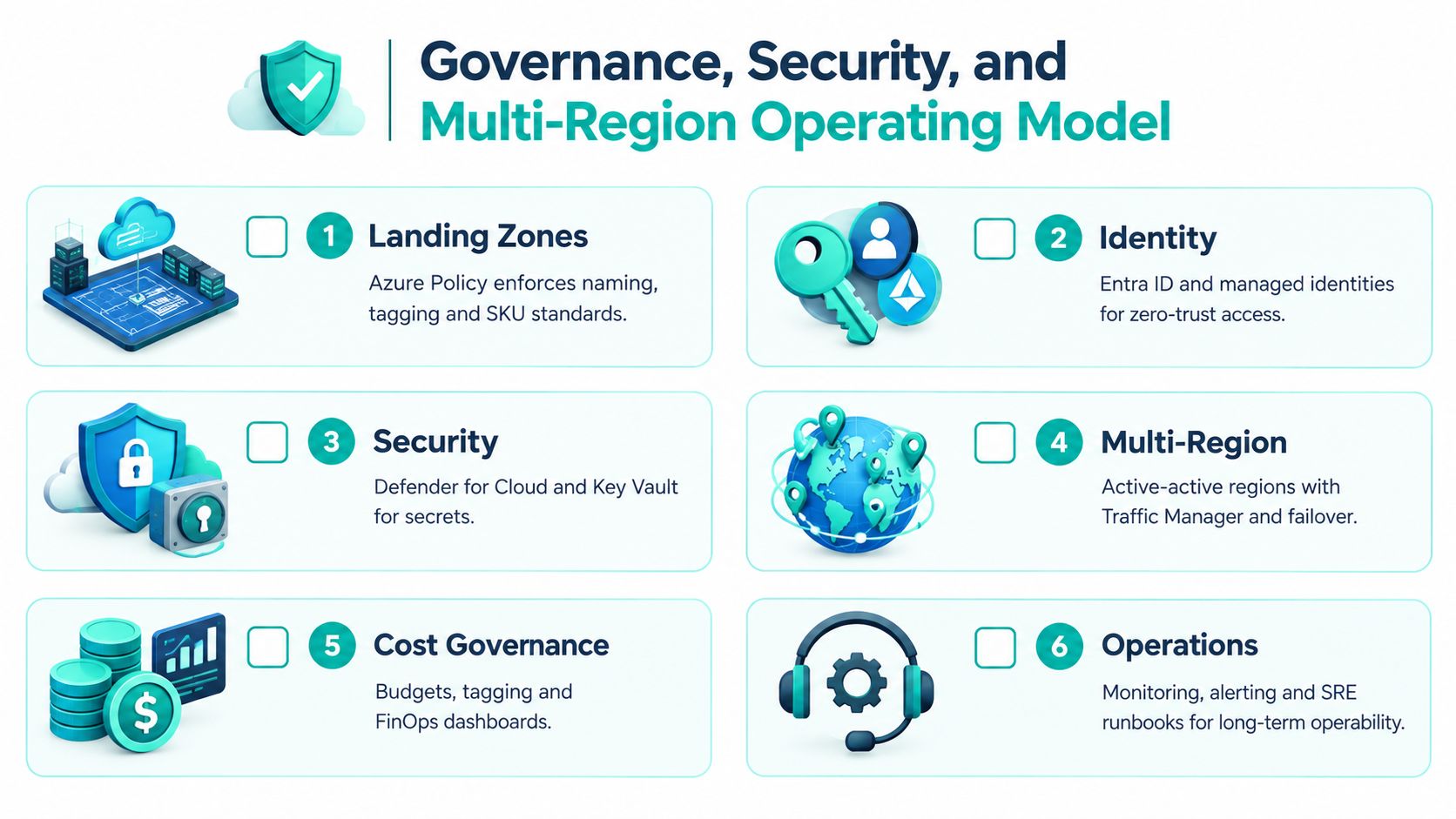
Use this checklist as an operating baseline:
- Policy guardrails: Enforce naming, tagging, SKU, region, and network rules through landing zones and Azure Policy.
- Identity controls: Prefer Entra ID, managed identities, and workload federation over embedded credentials.
- Secret protection: Centralize secrets and certificates in Key Vault, with access reviewed through identity policy.
- Network boundaries: Use Private Link, ingress controls, and segmentation between workloads and managed services.
- Regional resilience: Test routing, health probes, replication, and recovery procedures rather than assuming failover works.
- Tenant isolation: Propagate tenant context, enforce quotas, and separate deployment permissions.
- FinOps ownership: Tag resources, allocate shared platform costs, and review capacity against actual workload behavior.
- Operational readiness: Assign service owners, maintain runbooks, and repeat the readiness assessment as the estate changes.
Kogifi delivers Sitecore XM Cloud and XP implementations, SharePoint Online intranets, Azure-based integrations, platform migrations, monitoring, and operational support for enterprise digital experience estates. If your team is deciding how to modernize a CMS or intranet without creating another distributed monolith, visit Kogifi to discuss the platform architecture, delivery model, and operating controls that fit your environment.