


The popular advice is simple: put the DXP in containers, deploy it to Kubernetes, and call the transformation cloud native. That advice confuses infrastructure adoption with operational maturity. A Sitecore or SharePoint platform becomes cloud native when teams can release, observe, secure, recover, and govern it consistently, not merely when the underlying services run on a modern hosting substrate.
For enterprise digital experience platforms, the distinction matters. Sitecore XM Cloud and SharePoint Online already provide managed, API-driven capabilities, but the surrounding architecture still determines whether marketing teams gain speed or inherit another layer of operational complexity. The right question is less “Should we go cloud native?” and more “Which cloud native capabilities improve this workload enough to justify their operational cost?”
Table of Contents
Where Cloud Native Adoption Fails: Measuring Operational Depth Beyond Kubernetes
Kubernetes can run containers while an organization remains operationally immature. Teams may still deploy manually, lack useful telemetry, restore applications in the wrong order, and let each product group create separate security and integration patterns. The platform looks modern, but delivery and recovery remain fragile.
The gap appears in the difference between cloud native tool adoption and day-to-day operating discipline. CNCF and SlashData reported that 71% of backend developers use at least one cloud-native technology, while only 52% meet the threshold for cloud-native classification, leaving a 19-point gap between adoption and maturity (CNCF and SlashData State of Cloud Native Development Q1 2026). Enterprise teams frequently adopt containers or Kubernetes first, then postpone observability, immutable delivery, event-driven design, resilience testing, and platform governance.
Tools are evidence, not proof
Cloud native architecture requires an operating model that defines desired state, reproduces it through automation, detects abnormal behavior, and restores user-facing capabilities under pressure.
For a DXP, assess the operating practices around the hosted application:
- Delivery maturity: Can teams promote content, configuration, and code through controlled environments without manual drift?
- Operational maturity: Can engineers connect a slow page, failed personalization rule, or broken integration to useful logs, metrics, and traces?
- Resilience maturity: Can the organization restore dependent services and application data in a valid sequence?
- Governance maturity: Can product teams move independently while shared components, identities, and policies remain controlled?
These questions expose weaknesses that infrastructure tooling can hide. A Sitecore XM Cloud implementation may use managed services while release controls, content promotion, and integration ownership remain unclear. A SharePoint Online estate may gain Microsoft-managed availability while identity boundaries, information architecture, and recovery responsibilities still require deliberate design.
CNCF and SlashData also found that 88% of backend developers work in standardized DevOps or platform environments. Standardization reduces repeated work, but a platform team that centralizes every decision can slow delivery and obscure workload-specific risks. Reusable platform capabilities should handle common controls while leaving product teams room to choose appropriate content, experience, and intranet patterns.
Practical rule: Treat Kubernetes as one capability in your maturity model, not as the maturity model itself.
Teams assessing composable DXP choices can use MACH architecture principles as an architectural lens. The useful test is whether modularity, APIs, cloud delivery, and business ownership appear in operating practices. For Sitecore and SharePoint estates, assign each capability clearly to the platform team or to content, experience, and intranet product owners.
Core Principles of Cloud Native Architecture
Cloud native architecture is an operating model before it is a technology selection. A composable content hub shows the distinction clearly. Search, personalization, media, content delivery, and analytics can evolve as separate capabilities, while shared interfaces, release controls, ownership, and telemetry keep the DXP coherent.
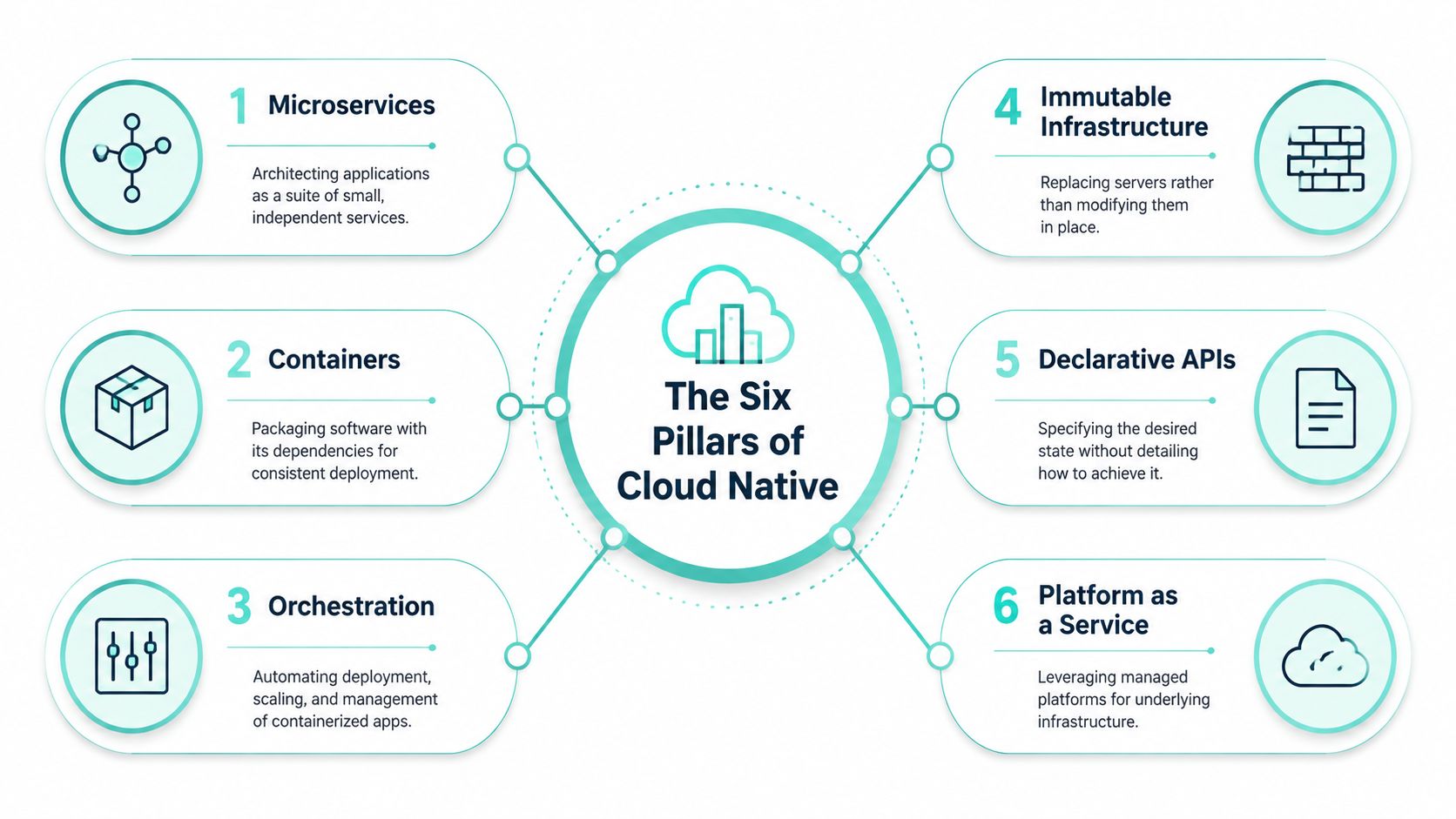
Six principles that have practical consequences
Microservices isolate capabilities so a team can change search or personalization without rebuilding the entire DXP. The cost is distributed failure. Every service needs contracts, versioning, ownership, dependency management, and a workable troubleshooting path.
Containers package applications with their dependencies, improving consistency between development and deployment environments. They leave state management, licensing, patching, and application security under team or provider responsibility.
Orchestration handles placement, scaling, rollout, and recovery for containerized workloads. Kubernetes suits organizations that need direct control over these mechanisms. A managed SaaS platform may fit better when the provider already operates the runtime and the product team needs to focus on delivery.
Immutable infrastructure replaces images or instances instead of changing servers in place. This limits configuration drift and makes rollback more predictable. Teams still need externalized configuration, durable data design, and release pipelines that can reproduce an environment.
Declarative APIs let teams define the desired state while automation determines the steps required to reach it. Infrastructure as code, GitOps, and platform APIs rely on that model. Portal-click processes lack the same repeatable control model, even if containers run underneath the application.
Platform as a service transfers undifferentiated infrastructure work to a managed provider. The architectural decision is where to buy operational capability and where to retain ownership. Sitecore XM Cloud and SharePoint Online can remove server management while leaving release governance, integrations, identity, observability, and recovery design with the enterprise.
Apply the principles to the workload
A media-heavy marketing platform may suit managed storage, edge delivery, and API-based content access. A steady customer portal may prioritize predictable latency and controlled releases over function-level elasticity. A small intranet team may gain more from SharePoint Online and Power Platform guardrails than from operating an internal Kubernetes platform.
Architects aligning these choices with organizational ownership can use a Cloud Architect Principal hiring resource when building or expanding platform leadership. The objective is clear accountability for interfaces and operating practices, rather than a collection of fashionable technologies.
A practical classification of service responsibility starts with IaaS, PaaS, and SaaS in cloud computing. For Sitecore XM Cloud and SharePoint Online, the provider absorbs infrastructure concerns that an internally operated DXP would need to manage. Cloud native maturity therefore belongs in delivery controls, integration quality, observability, identity boundaries, recovery procedures, and team ownership as much as in the runtime itself.
Architecture Patterns and Workload Trade-Offs
Architecture decisions should follow workload shape, not fashion. A controlled comparison of microservices and serverless deployment strategies found that microservices were more cost-effective for long-lived services with regular traffic, while serverless delivered immediate elasticity for spikes but introduced cold-start latency and higher minimum response time (controlled cloud-native deployment comparison).
That distinction maps cleanly to enterprise DXPs. A persistent search, content delivery, or personalization integration often has a steady operating profile. An event-triggered transformation, webhook handler, or short-lived content-processing task may be a stronger serverless candidate.
Deployment Strategy Comparison
| Characteristic | Microservices | Serverless |
|---|---|---|
| Best fit | Long-lived services and regular traffic | Bursty, event-driven workloads |
| Scaling model | Service instances scale through orchestration | Provider-managed function elasticity |
| Latency profile | More predictable steady-state response | Cold starts can increase minimum response time |
| Cost behavior | Often more efficient for continuously active services | Attractive when execution is intermittent |
| Operational burden | Requires deployment, runtime, and service ownership | Reduces infrastructure management, but adds platform constraints |
| DXP example | Search integration or persistent commerce service | Webhook transformation or asynchronous notification |
Kubernetes has become the dominant orchestration choice for containerized enterprise platforms. CNCF reported that 82% of container users were running Kubernetes in production, compared with 66% in 2023, and that 98% of surveyed organizations had adopted cloud native techniques (CNCF Kubernetes and Cloud Native Survey announcement). Those figures establish adoption, not suitability for every DXP component.
Design the platform around failure boundaries
CI/CD pipelines should package, test, scan, and promote independently deployable units. Autoscaling should respond to meaningful signals, not just add capacity whenever a generic infrastructure metric rises. For a customer-facing DXP, request volume may matter, but queue depth, downstream latency, cache behavior, and failed dependency calls often reveal pressure earlier.
Kubernetes also introduces a platform engineering commitment. Teams need standardized deployment templates, secret handling, policy enforcement, upgrade ownership, and usable diagnostics. Without those services, product teams receive an abstraction layer they must operate themselves.
Before selecting a runtime, compare Docker Compose and Kubernetes against the actual environment. Compose can be appropriate for local development and bounded workloads. Kubernetes earns its complexity when the organization needs multi-service orchestration, automated reconciliation, and a platform team capable of supporting those features.
Cloud Native Patterns in Sitecore and SharePoint Platforms
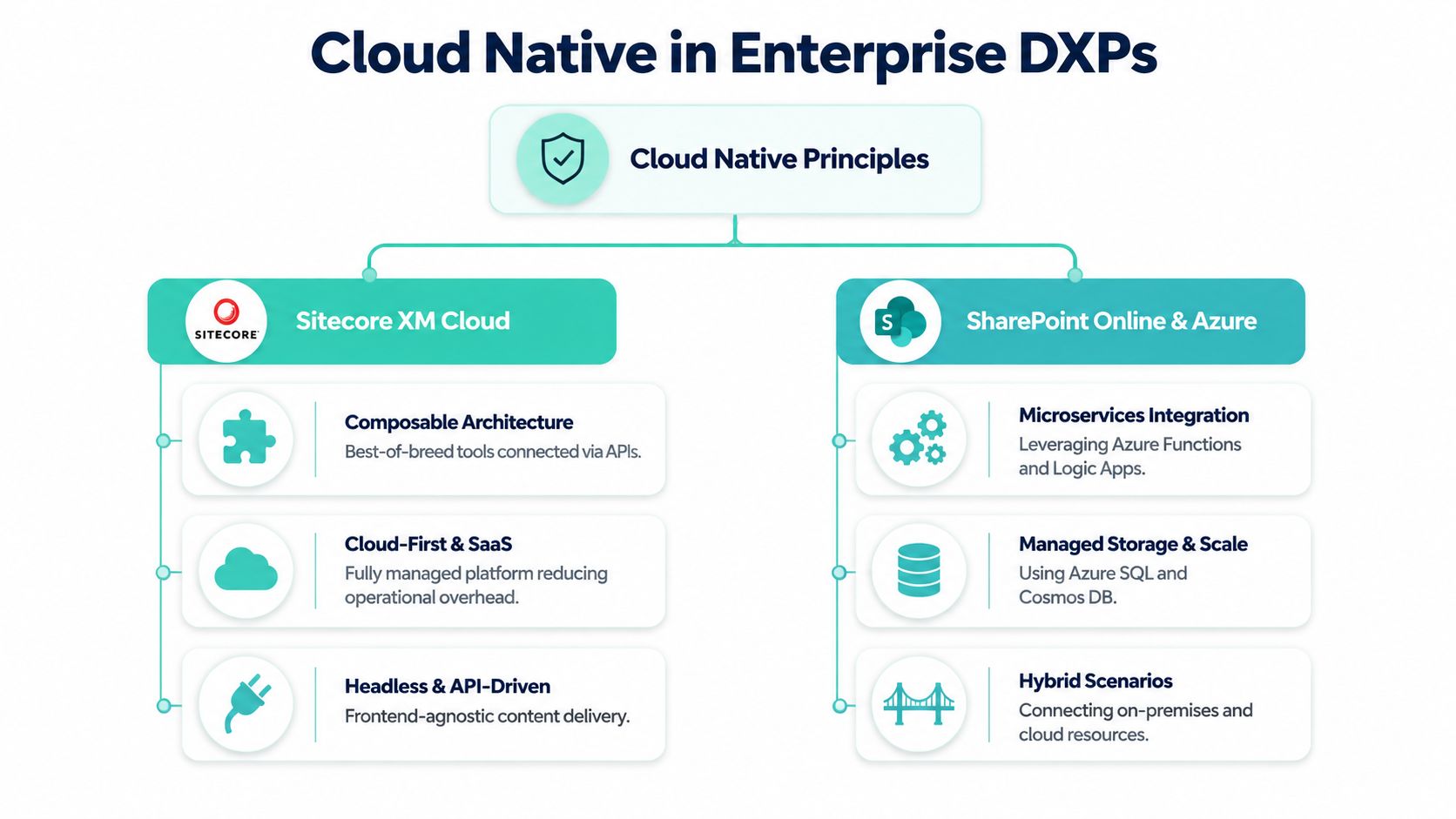
Sitecore XM Cloud shows why cloud native adoption cannot be measured by whether the customer runs Kubernetes. Sitecore describes XM Cloud as a fully managed, self-service, cloud-native, hybrid headless CMS for omnichannel experiences (Sitecore XM Cloud introduction). The operational model shifts platform maintenance to the service provider, while delivery teams still own content structure, front-end behavior, integrations, and release quality.
Its headless model separates content from presentation, so teams can deliver the same governed content through different front ends. Sitecore's documentation identifies headless SXA, JSS, Headless Services, Layout Service, GraphQL, Azure Blob Storage for media, and Edge delivery within the XM Cloud model. That separation supports independent front-end changes, while increasing the importance of API contracts, content modeling, caching, preview behavior, and editorial workflows.
Sitecore AI adds an operating-model question
Sitecore Stream embeds AI capabilities across Sitecore products, including brand-aware AI, copilots, and agentic workflows. Documented functions include AI-assisted content generation, translation for multiple markets, grounded image tagging, content optimization in XM Cloud Page Builder, natural-language questions over Sitecore Search content, and Gensights for insights from CDP dashboards (Sitecore Stream AI capabilities).
These capabilities require governance as platform workflows, with defined ownership for prompts, content quality, approval boundaries, brand rules, data access, and auditability. Sitecore AI Automated Personalization is a SaaS feature hosted in Microsoft Azure. Sitecore says it uses machine learning to infer insights from prior visitor experiences and characteristics such as country or browser (Sitecore AI Automated Personalization). Identity, consent, segmentation, and measurement therefore belong in the architecture design.
SharePoint uses managed composition
SharePoint Online follows a different route to cloud native delivery. Microsoft positions SharePoint Framework as the recommended client-side development model for SharePoint Online and Microsoft 365, supporting SharePoint and Microsoft Viva. Power Platform supplies low-code business solutions and workflow automation across Microsoft 365.
A mature intranet combines SPFx web parts with Power Automate, Microsoft Graph, permissions, search, and governed content structures. The platform team can standardize design systems, security patterns, provisioning, and telemetry, while departments own bounded employee experiences. The architecture depends less on operating microservices and more on composing managed capabilities through supported interfaces. That distinction exposes the maturity gap clearly: adopting managed cloud tools is only the starting point for cloud native operations.
Security and Governance as Design Constraints
Security shapes a cloud native DXP from its first boundary decision. Identity controls determine access to content, personalization signals, deployment systems, media assets, and operational telemetry. Supply-chain controls cover packages, container images, integrations, and build actions that can reach production.
A 2026 cloud security survey identified 77% of respondents citing identity and access security as the top cloud-native risk, followed by 70% citing misconfigured cloud services and 66% citing data exposure risks. Only 39% of organizations had a mature, well-defined cloud-native security strategy, while about 22% had no defined strategy (2026 cloud security survey coverage). The gap between adopting cloud services and operating them under defined controls is clear.
Build controls into the platform
For Sitecore and SharePoint, practical controls include least-privilege identities, protected deployment credentials, dependency scanning, signed artifacts where supported, environment separation, and runtime signals routed to the teams responsible for remediation. These controls should influence component boundaries and ownership before migration work begins.
Observability supports the same operating model. Logs, metrics, traces, publishing events, integration failures, and personalization outcomes need to support decisions. A dashboard that merely displays activity lacks observability. Engineers need it to explain behavior and choose actions.
Governance principle: Centralize guardrails and reusable mechanisms. Keep business decisions and bounded experience ownership with the teams closest to the users.
Disaster recovery exposes the limits of infrastructure-only planning. In a study of 10 popular Kubernetes applications, naïve restoration of replicated application data and resources failed for 60% of the applications. A recipe-based approach that grouped, ordered, and filtered resources raised recovery success to 100% while adding only seconds of overhead (Kubernetes disaster recovery study).
Managed DXP services still require application-aware recovery plans covering identity, search, commerce, integration endpoints, content synchronization, and front-end delivery. Guidance on cloud security for Sitecore DXP is most useful when applied during architecture and delivery, rather than appended as compliance documentation after implementation.
Modernizing a Monolithic DXP to Cloud Native
A realistic Sitecore modernization starts with restraint. The team first inventories the existing XP estate, including rendering dependencies, custom pipelines, integrations, scheduled jobs, content ownership, analytics usage, indexing, deployment processes, and undocumented operational assumptions.
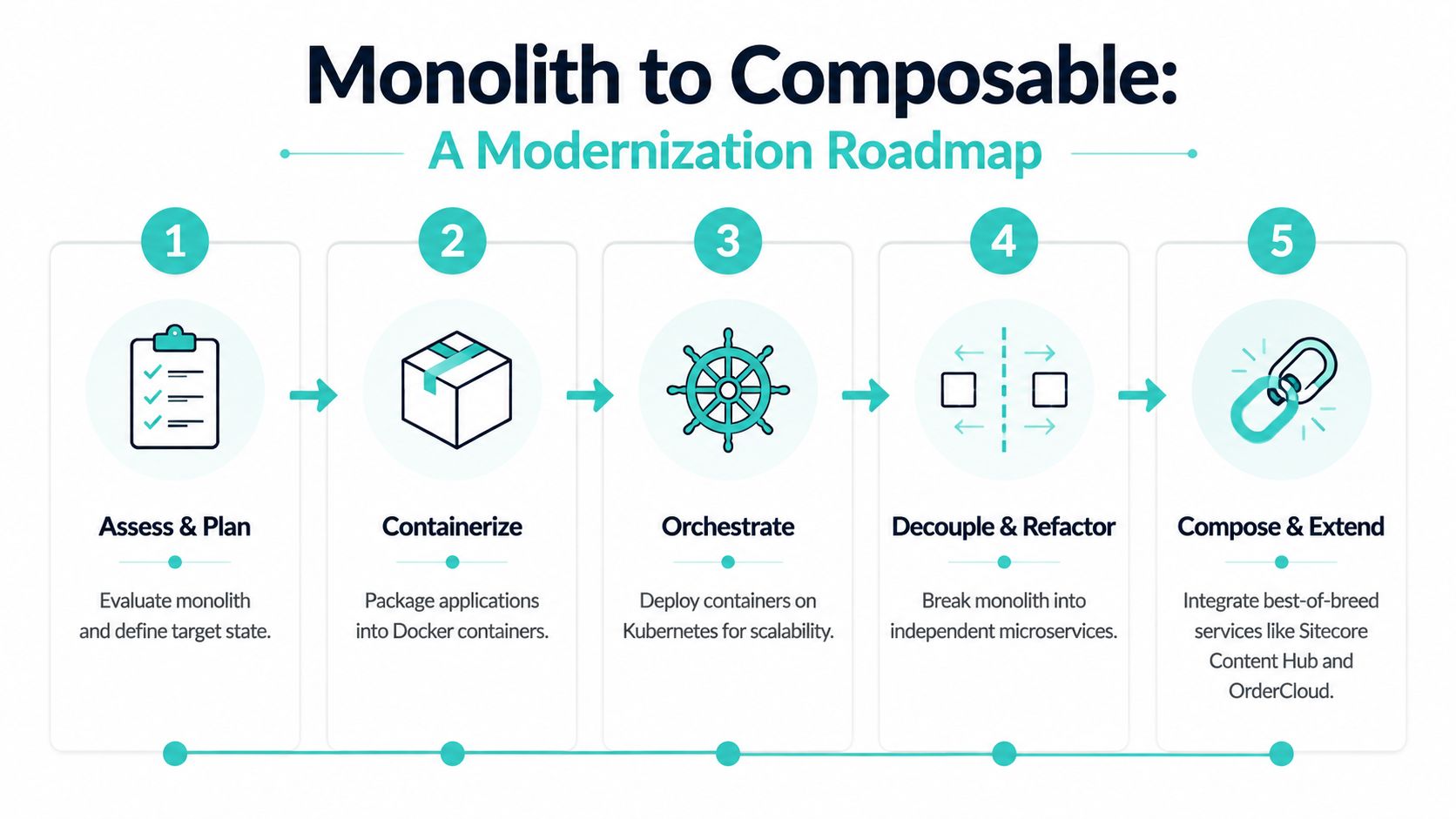
A migration sequence that limits surprise
The target state should define which capabilities move to XM Cloud, which integrations remain external, and which responsibilities belong to a central platform group. A Helix-based component library can provide reusable structure across brands, but teams still need clear rules for variants, accessibility, localization, analytics, and editorial ownership.
A practical sequence looks like this:
- Assess and plan: Map the monolith, identify unsupported customizations, and define the content, presentation, integration, and governance target state.
- Prepare delivery automation: Establish source control, environment promotion, automated testing, deployment approvals, and rollback procedures before moving business-critical experiences.
- Move toward headless delivery: Refactor renderings and content models so front ends consume supported APIs. Preserve SEO through redirect planning, metadata validation, structured content, and crawl testing.
- Migrate by bounded capability: Move a brand, site area, or journey with a clear owner rather than attempting an undifferentiated platform cutover.
- Instrument and govern: Add release health checks, integration monitoring, content validation, and operational runbooks before declaring the capability complete.
Teams often underestimate the people side of this work. Editors need new publishing and preview habits, developers need to understand API contracts and component reuse, and brand owners need governance that prevents local customization from recreating the old monolith.
The following video provides additional context for teams considering the transition.
SEO and multilingual governance deserve explicit acceptance criteria. A technically successful migration can still damage organic visibility or editorial confidence if canonical behavior, redirects, language variants, structured data, preview, and publishing permissions aren't tested as product capabilities.
Deciding Which Maturity Layers to Invest In
A sensible maturity roadmap begins with the business constraint, not the most advanced platform pattern. A global Sitecore estate with frequent releases, many brands, and complex integrations may justify stronger platform engineering. A contained SharePoint intranet may gain more from information architecture, permissions, search quality, and workflow governance than from introducing Kubernetes.
Match investment to the operating reality
Use three questions to prioritize:
- What fails today? If releases are risky, invest in automated testing, deployment controls, and rollback. If teams can't diagnose incidents, improve logs, metrics, traces, and ownership before adding another runtime.
- Where does demand vary? Regular, long-lived workloads often favor persistent services. Bursty event processing may justify serverless elasticity despite cold-start behavior, as the deployment comparison covered earlier.
- Who will operate it? A service mesh, chaos engineering program, or internally managed Kubernetes platform requires durable expertise. If that ownership doesn't exist, a managed Sitecore or Microsoft 365 capability may deliver more value.
Centralization and autonomy should be balanced deliberately. Centralize identity patterns, component foundations, deployment templates, policy controls, and recovery standards. Let product teams own content models, experience decisions, bounded integrations, and release priorities within those boundaries.
Use a staged decision framework
Teams beginning with containers should first establish reproducible builds, vulnerability controls, configuration discipline, and basic service health signals. Teams with reliable delivery can add contract testing, progressive release practices, dependency mapping, and recovery exercises. Advanced patterns such as service meshes and chaos engineering should follow a demonstrated problem, not precede one.
For Sitecore XM Cloud, maturity may mean better content modeling, component reuse, API contracts, personalization governance, and edge-aware performance practices. For SharePoint Online, it may mean governed SPFx development, Power Platform lifecycle controls, permission design, search management, and consistent intranet ownership.
The strongest architecture is the one the organization can operate repeatedly. Choose the layer that removes a current constraint, measure whether it changes delivery or reliability, then fund the next layer only when the preceding one is understood and maintained.
Kogifi helps enterprise teams assess, migrate, and operate Sitecore XM Cloud and SharePoint Online platforms with headless delivery, reusable component libraries, Power Platform integrations, CI/CD, observability, governance, and ongoing support. Visit Kogifi to discuss a cloud native DXP roadmap grounded in your workloads, team capabilities, and recovery requirements.